
Capsule Wardrobe Explained for Modern Everyday Dressing
A capsule wardrobe is a deliberately edited collection of clothing designed so that the pieces work well together, suit the wearer’s actual lifestyle, and can be worn repeatedly across multiple situations. Its value comes less from reaching a particular number of garments and more from improving compatibility, usefulness, fit, and frequency of wear.
The concept is often associated with minimalist dressing, but minimalism is not a requirement. A colorful wardrobe, a modest wardrobe, a professional wardrobe, or one adapted to tropical weather can all function as capsule wardrobes if the pieces have clear roles and enough compatibility to support everyday dressing.
For consumers, this approach can make getting dressed more manageable and expose gaps that are otherwise hidden inside a crowded closet. For fashion businesses, it also highlights something commercially important: a useful garment is not defined only by how attractive it looks individually. Fit, durability, styling compatibility, care requirements, climate suitability, and the customer’s existing wardrobe all influence whether that garment becomes part of regular life.
Quick Answer: What Is a Capsule Wardrobe?
A capsule wardrobe is a curated group of garments selected to work together across a person’s recurring activities, climate, style preferences, and practical needs. Instead of building a wardrobe through disconnected purchases, the wearer chooses pieces that can be combined easily and that have clear reasons for being included.
There is no universally correct capsule size. A compact work wardrobe for someone with a consistent dress code may need relatively few pieces, while someone who moves between office work, outdoor activity, formal events, travel, and different seasons may reasonably need more.
The core principle is therefore not simply “own fewer clothes.” It is build a wardrobe in which a higher proportion of clothes are useful, compatible, and actually worn.
That distinction matters. Reducing quantity without considering fit, weather, laundry frequency, footwear, layering, or lifestyle can create an impractical wardrobe. A successful capsule should simplify dressing without making everyday life artificially restrictive.

The Capsule Wardrobe Is a System, Not a Clothing Count
Many popular capsule wardrobe guides begin by specifying a maximum number of pieces. That can be useful as an exercise, but the number itself does not determine whether the wardrobe works.
Thirty carefully selected garments that rarely coordinate with one another are not necessarily more functional than a larger collection built around clear outfit relationships. Conversely, reducing a wardrobe to an arbitrary target may remove pieces that perform legitimate roles, particularly for people with varied professional duties, cultural clothing requirements, changing climates, sports activities, or frequent formal occasions.
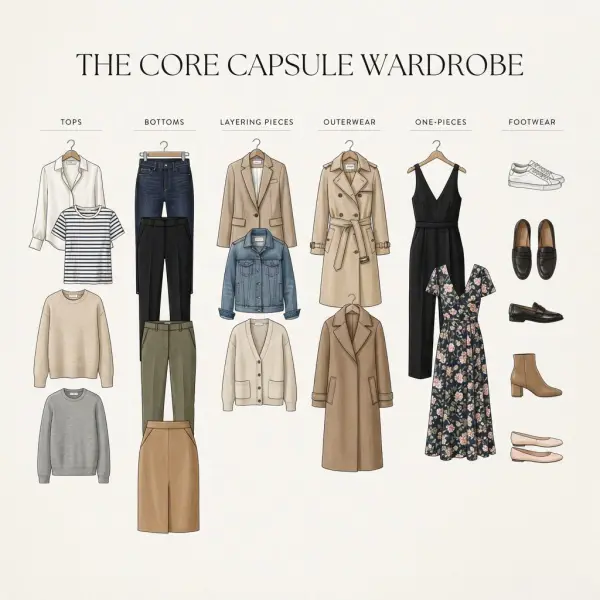
A more useful way to understand a capsule wardrobe is as a wardrobe architecture. Each garment occupies a role within a larger system. Some pieces serve as foundations, some provide layering, some handle weather or formality, and others introduce visual character. The wardrobe becomes easier to use when these roles overlap enough to produce flexibility without creating unnecessary duplication.
This idea has a well-known precedent in modern fashion. Donna Karan’s 1985 Seven Easy Pieces presented a compact set of interchangeable garments intended to move between different parts of a woman’s day. Vogue’s retrospective describes pieces including a bodysuit, skirt, tailored jacket, dress, leather item, white shirt, and cashmere sweater, illustrating how modular dressing can be built around coordinated essentials rather than isolated looks.
Modern capsule dressing is considerably broader than that example. It can involve streetwear, modest fashion, uniforms, casualwear, workwear, resort dressing, or a combination of categories. What remains relevant is the modular logic: pieces gain usefulness partly through their relationship with other pieces.
What Actually Makes a Wardrobe a Capsule?
A practical capsule wardrobe usually combines four characteristics: relevance, compatibility, repeatability, and enough variety to remain useful.
Relevance means the clothes correspond to real life. A wardrobe filled with formal tailoring may look coherent but will not work for someone who spends most days in a casual studio. Likewise, ten lightweight tops cannot solve the wardrobe needs of a wearer who regularly encounters cold weather.
Compatibility means garments can participate in more than one sensible outfit. Compatibility may come from color, silhouette, proportion, fabric weight, formality, or all of these together. Two pieces do not need to match perfectly, but they should not constantly compete with everything else in the wardrobe.
Repeatability means the garments can realistically be worn again and again. Comfort, fit, care requirements, physical durability, and resistance to premature appearance deterioration matter here. WRAP’s work on clothing longevity emphasizes product performance, including issues such as fading, pilling, trims, and other failure modes that can shorten useful garment life.
Finally, a capsule needs enough variety. The objective is not to make every outfit look identical. Texture, proportion, accessories, accent colors, footwear, layering, and occasional statement pieces can provide visual variation while the underlying wardrobe remains coherent.
Start With Everyday Life, Not With a Shopping List
One of the most reliable ways to build a capsule wardrobe is to begin with activities rather than garments. Before deciding that a wardrobe needs three shirts, two trousers, a blazer, or a particular neutral coat, the wearer should identify where clothing is actually being used.
Consider two people with similar aesthetic preferences. One works remotely, walks frequently, and meets clients only once or twice per month. The other works in a corporate environment five days a week. Giving both people the same “essential capsule wardrobe” would ignore the largest determinant of clothing usefulness: their routines.
A simple lifestyle review might divide clothing needs into areas such as work, commuting, home, social occasions, exercise, religious or cultural activities, travel, and formal events. The proportions do not need to be mathematically precise. They simply reveal whether wardrobe space and purchasing decisions reflect how time is really spent.
This exercise can uncover familiar mismatches. Someone may own many special-occasion dresses but struggle to assemble comfortable weekday outfits. Another person may repeatedly buy casual tops even though work trousers are the actual wardrobe bottleneck.
A capsule therefore starts with a question that sounds almost too simple: What do I regularly need to get dressed for?
The answer is more useful than a generic essentials checklist.
Climate changes what “essential” means
Climate deserves particular attention because capsule wardrobe advice is often presented as though the same categories work everywhere.
A heavy wool coat may be foundational in a cold climate and virtually irrelevant in a tropical city. Someone facing strong seasonal changes may benefit from a permanent core wardrobe supplemented by seasonal capsules. In hot and humid conditions, breathable construction, comfortable fabrics, washability, drying time, and the ability to rotate garments frequently may matter more than sophisticated layering.
Rain, air-conditioned interiors, sun exposure, commuting conditions, and local norms can also affect what gets worn. A capsule wardrobe designed without these realities may be visually appealing but operationally weak.
Build Around Outfit Relationships, Not Individual “Perfect Pieces”
A common shopping habit is to evaluate garments one at a time: Do I like this shirt? Is this skirt attractive? Would this jacket look good on me?
Capsule planning adds another question: What will this work with?
This does not mean every garment must coordinate with every other garment. That standard would be unnecessarily restrictive. Instead, useful pieces should have enough wardrobe relationships to justify the space, money, and maintenance they require.
A blouse that works with three existing bottoms, under a jacket, and with both casual and more polished footwear has several potential contexts. A visually striking blouse that requires purchasing a new skirt, different underwear, special shoes, and a specific jacket before it can be worn has a very different wardrobe cost.
This relationship-based thinking becomes especially powerful when evaluating future purchases. Instead of asking whether an item is inexpensive enough or fashionable enough, the wearer can examine whether it solves a genuine wardrobe requirement.
The mathematics of creating many combinations from compatible pieces deserves deeper treatment of its own. That is explored in how fewer clothing pieces can create more outfit options. The important point here is that capsule dressing treats outfit compatibility as part of product usefulness.
Color Helps, but a Capsule Does Not Have to Be Neutral
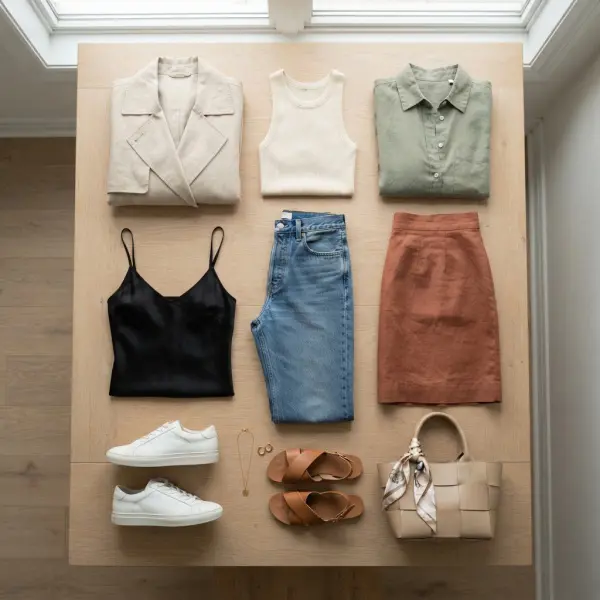
Neutral beige, black, white, navy, gray, and camel frequently appear in capsule wardrobe imagery because they are relatively easy to combine. This has sometimes created the impression that capsule dressing requires a restrained neutral palette.
It does not.
Color planning is valuable because repeated colors can make coordination easier, but the palette can be vivid, muted, warm, cool, monochromatic, printed, or highly personal. Someone who regularly wears cobalt blue, red, or botanical prints has little reason to remove those preferences simply to conform to a minimalist aesthetic.
The practical issue is relationship, not neutrality. If a wardrobe contains many colors but each works with at least several other garments, the system can remain highly functional.
Prints require similar judgment. A patterned skirt may be easy to use if several existing tops pick up colors from the print. A highly distinctive patterned garment can also work as a deliberate statement piece even when it has fewer combinations. Capsules need not maximize interchangeability at the expense of personality.
For fashion businesses, this is an important distinction. “Versatile” should not automatically translate into producing endless neutral basics. Customers may value products because they coordinate with their wardrobes and give those wardrobes identity.
Fit and Silhouette Matter as Much as Color
Two garments may coordinate perfectly in color and still look awkward together because of proportion.
A long oversized shirt interacts differently with wide trousers than with a narrow cropped bottom. A cropped jacket changes the visual balance of a high-waisted skirt. Footwear can alter trouser length requirements. A bulky knit may not fit comfortably beneath a fitted coat.
This is why effective capsule planning goes beyond matching color swatches. The wearer should consider silhouette relationships across the wardrobe: where waistlines sit, how long tops are, what can be tucked, what can be layered, and whether outerwear has enough ease for the clothing underneath.
Fit is even more fundamental. A technically versatile garment has little wardrobe value if the wearer avoids it because it pulls across the shoulders, slips at the waist, feels restrictive when sitting, or requires constant adjustment.
For product teams, this is a reminder that versatility is partly engineered through pattern cutting and product development. Styling campaigns may demonstrate ten ways to wear a garment, but the customer will only repeat-wear it if the fit and physical experience support those scenarios.
Quality Matters, but Price Is Not a Reliable Shortcut
Because capsule wardrobes emphasize repeated use, garment quality matters. Seams, fabric stability, colorfastness, pilling resistance, closures, shape retention, and appropriate care all affect whether a frequently worn piece continues to perform.
That does not mean a capsule must consist exclusively of expensive clothing.
Higher price can reflect materials, manufacturing location, brand positioning, design, distribution, marketing, retail margin, or exclusivity. It is not in itself proof that a garment will withstand more wear. WRAP’s current durability work similarly cautions against assuming that price, fiber composition, or fabric weight alone tells consumers how durable a garment will be.
A more useful evaluation combines construction quality with the garment’s intended use. A delicate blouse may be perfectly appropriate if it fills an occasional role. A frequently worn T-shirt, commuter trouser, or everyday knit deserves closer scrutiny because it will experience substantially more washing, abrasion, stretching, and handling.
Care habits also influence active life. Even a well-made product can deteriorate prematurely when laundering, drying, storage, or stain treatment conflicts with its material and construction. Readers planning high-use wardrobes may therefore find it useful to connect capsule planning with clothing care habits that help garments last longer.
A Useful Capsule Usually Contains More Than Basics
Basics are useful because they often have broad compatibility, but a wardrobe consisting entirely of generic basics can become functionally adequate and emotionally unsatisfying.
That matters because clothing is not merely equipment. People use dress to signal taste, identity, professionalism, cultural belonging, creativity, mood, and occasion. If capsule planning removes too much of that expressive function, the wearer may eventually compensate through renewed impulse buying.
A more resilient capsule often includes several types of pieces:
- Foundation pieces that appear frequently and coordinate broadly.
- Functional pieces required for climate, work, modesty, activity, or specific occasions.
- Layering pieces that adjust warmth, formality, or visual interest.
- Character pieces that make outfits feel personal rather than generic.
- Occasional pieces that may have low frequency of use but satisfy legitimate events or responsibilities.
Not every item has to perform equally often. A winter coat, formal dress, funeral outfit, protective garment, or ceremonial piece can have low annual wear and still be entirely justified.
This is one reason a wardrobe audit should distinguish between unused and infrequently needed. They are not the same thing.

How to Plan a Capsule Wardrobe in Practice
A useful capsule can be developed gradually. There is rarely a practical reason to empty the wardrobe and replace it with a newly purchased “capsule collection.” Doing so may simply turn minimalism into another shopping event.
Start with what is already owned.
First, identify the garments receiving regular wear. These pieces provide evidence about preferred silhouettes, colors, fabrics, and levels of formality. They are often more informative than aspirational mood boards because they show what survives contact with daily life.
Next, examine the garments that are rarely worn. The objective is not automatically to discard them. Determine why they remain inactive. Common explanations include poor fit, uncomfortable fabric, difficult care, limited compatibility, duplication, climate mismatch, or lack of an appropriate occasion.
Then identify wardrobe gaps. A gap is not simply “something you do not own.” It is a missing piece that prevents existing garments from functioning effectively or leaves a recurring dressing requirement unresolved.
A practical process might look like this:
- Map recurring activities. Note the settings for which clothing is needed most frequently.
- Identify current high-use garments. Look for patterns in fit, color, construction, and comfort.
- Separate genuine needs from aspirational clothing. Consider whether garments reflect actual routines.
- Check outfit compatibility. Identify pieces that repeatedly support several useful combinations.
- Locate bottlenecks. Find missing layers, bottoms, footwear, or other categories that make existing clothes difficult to use.
- Test before buying. Build potential outfits around a proposed purchase using garments already owned.
- Review after real wear. Adjust the wardrobe based on what is actually used rather than protecting the original plan.
The last step matters because a capsule wardrobe should be treated as a working system rather than a fixed project. Jobs change. Bodies change. climates change. Personal preferences change. Wardrobes should be able to adapt accordingly.
Seasonal Capsules Can Be More Practical Than One Permanent Wardrobe
In regions with substantial temperature variation, trying to make one small collection operate identically throughout the year may create unnecessary compromises.
A permanent core can instead be combined with rotating seasonal garments. A transitional jacket might operate across spring and autumn, while heavy winter outerwear and lightweight summer pieces enter active use only when appropriate.
Storage then becomes part of wardrobe management. Seasonal rotation can make the active wardrobe easier to navigate while protecting garments that are temporarily unnecessary. Items should still be stored according to their material requirements rather than simply packed away indefinitely.
In climates with less seasonal temperature variation, a different rotation may make sense. Wet and dry seasons, religious calendars, work cycles, travel periods, or changes in professional activity can create their own wardrobe phases.
The capsule concept is therefore flexible enough to accommodate local conditions. Its usefulness comes from reducing friction around dressing, not from enforcing the wardrobe conventions of a particular climate or fashion culture.
What Does Capsule Dressing Mean for Fashion Businesses?
Capsule wardrobe planning may appear to be purely a consumer behavior topic, yet it contains several useful signals for product developers, retailers, and apparel brands.
The first is that compatibility has commercial value. Products that connect naturally with previous and future collections can help customers build continuity instead of restarting their wardrobes each season. Consistent core colors, dependable fits, recognizable silhouettes, and repeatable product families can all support this approach.
The second is that styling content can become more useful. Instead of showing a garment in one campaign look, retailers can demonstrate how it works across workdays, weekends, layering situations, or different footwear. This turns product imagery into decision support.
Third, capsule thinking raises the importance of durability and care. A product promoted as an everyday wardrobe foundation faces a higher expectation of repeated wear. Product development, quality assurance, and care communication need to support that positioning. WRAP’s durability guidance specifically connects longer product life with design, testing, quality assurance, repairability, and customer guidance.

Product architecture can support repeat customers
For a brand, a coherent product architecture does not require every season to repeat the same merchandise. It can mean maintaining dependable anchors while introducing enough novelty to refresh the assortment.
A customer who owns a well-fitting trouser may be more willing to purchase a later blouse or jacket if the brand demonstrates that the pieces work together. Reliable sizing and recognizable fit blocks can make this relationship stronger, although fit consistency still requires careful quality control across fabrics and constructions.
This type of continuity can also make merchandising more intelligible. Instead of forcing every product to compete as an isolated “new arrival,” the assortment can show customers how new items extend what they already own.
Capsule positioning should not become a reason for bland products
There is a commercial risk in interpreting versatility too narrowly. If every brand arrives at the same palette of black trousers, white shirts, beige coats, and plain knitwear, differentiation becomes difficult.
Versatility and distinctiveness are not opposites. A recognizable collar shape, textile texture, print language, proportion, construction detail, or color system can make a product unmistakably associated with a brand while retaining broad styling potential.
That balance is particularly useful for smaller brands. Competing only through the breadth and frequency of new product drops can be difficult. A more coherent assortment may allow product storytelling, repeat styling content, and customer education to carry more weight.
Common Capsule Wardrobe Mistakes
Mistake 1: Choosing an arbitrary number before understanding the wardrobe
Setting a target such as 20, 30, or 40 pieces may make the project feel measurable, but it can reverse the planning process. The number should follow the wearer’s needs rather than determine them. A person managing several climates or dress codes may need more categories, while someone with a highly consistent routine may need fewer. A better approach is to remove unnecessary duplication only after identifying what each part of the wardrobe actually does.
Mistake 2: Buying an entirely new “capsule”
A capsule wardrobe is often marketed visually as a fresh collection of coordinated products, which can encourage people to replace perfectly usable clothes. This misses one of the most practical benefits of wardrobe planning: discovering more value in what is already owned. New purchases make more sense when they close a verified gap. The environmental implications of this distinction are explored more fully in why wardrobe planning supports smarter fashion consumption.
Mistake 3: Prioritizing visual coordination over comfort
A beautiful palette can disguise a poorly functioning wardrobe. Shoes that hurt, trousers that restrict movement, fabrics that feel unpleasant in local weather, and jackets that cannot accommodate normal layers will gradually fall out of rotation regardless of how well their colors coordinate. Real capsule performance is visible through wear behavior. If a garment repeatedly loses to more comfortable alternatives, the wardrobe plan should acknowledge that evidence.
Mistake 4: Removing every low-frequency item
Usage frequency is important, but not every low-frequency garment is unnecessary. Formal clothing, specialized sportswear, protective garments, mourning attire, culturally specific dress, or extreme-weather clothing may exist precisely because certain situations are uncommon. Eliminating them simply to make the wardrobe smaller can create avoidable emergency purchases later. Capsule editing should distinguish redundancy from preparedness.
Mistake 5: Treating the first version as permanent
A capsule wardrobe should evolve when lifestyle conditions change. Pregnancy, body changes, a new workplace, relocation, remote work, caregiving, climate differences, or a shift in personal style can all alter clothing requirements. Maintaining an outdated capsule simply because it once worked replaces one form of wardrobe clutter with another form of rigidity.
What a Capsule Wardrobe Does Not Mean
Capsule dressing is often connected with sustainability, intentional consumption, and minimalist lifestyles, but those ideas should not be treated as interchangeable.
A capsule wardrobe does not automatically make a person’s clothing consumption sustainable. Someone could repeatedly replace a small wardrobe every season, while another person with a large wardrobe might keep and use garments for many years. Quantity alone does not reveal purchasing frequency, garment lifespan, production impact, laundering behavior, repair, resale, donation, or end-of-life outcomes.
This distinction is worth preserving because textile consumption carries material and environmental consequences. The European Environment Agency reports that EU consumers purchased an estimated average of 19 kg of clothing, footwear, and household textiles per person in 2022 and identifies textiles as one of the household consumption categories associated with substantial raw-material, climate, water, and land pressures.
Capsule planning can support longer use when it helps people choose garments they repeatedly wear and maintain, but that outcome depends on behavior and product quality. It should therefore be seen as a wardrobe-management method with the potential to support more deliberate consumption, not as a sustainability certification.
What Should You Verify Before Adding Something to a Capsule Wardrobe?
A useful purchase should solve a real problem rather than merely fit the visual aesthetic of the capsule.
Before adding a garment, consider whether its role is already covered, how many realistic outfits it supports, and whether its physical properties fit the intended use. A linen shirt and polyester blouse may occupy the same visual category but behave very differently in heat, laundering, travel, and layering. Material, construction, and care requirements matter alongside styling.
Useful questions include:
- Does this garment serve an activity that occurs regularly?
- Can it be worn with several pieces already owned?
- Does the silhouette work with existing bottoms, layers, and footwear?
- Is the fit comfortable during the movements required in real use?
- Are the fabric and construction appropriate for the local climate?
- Can the care routine realistically be maintained?
- Does it add a new function, or mainly duplicate something already working?
- Would the garment still be desirable without a temporary trend or promotional discount?
These questions are more demanding than “Do I like it?”, but they do not remove emotion from fashion. They simply place desire inside a more complete decision.

Why Capsule Wardrobes Remain Relevant to Modern Dressing
Modern wardrobes face a peculiar problem: having access to more clothing choices does not necessarily make dressing easier.
Online retail, rapid product turnover, trend cycles, promotions, resale marketplaces, social media, and globalized fashion give consumers enormous variety. The resulting wardrobe can contain many individually appealing garments without forming a coherent system.
Capsule planning provides a counterweight by moving attention from acquisition to use. It asks whether clothing works together, whether it fits current life, and whether the wearer can identify what is genuinely missing.
This does not require rejecting fashion trends, experimentation, or new purchases. Trends can enter a capsule when they connect with the wearer’s style and existing wardrobe. Experimental pieces can coexist with dependable foundations. Fashion remains fashion.
The difference is that acquisition becomes part of wardrobe planning rather than the default response to wardrobe dissatisfaction.
That shift may ultimately be the most useful principle behind capsule dressing: a wardrobe is successful when it supports getting dressed well, not when it contains the greatest number of individually attractive products—or the smallest possible number of garments.
Frequently Asked Questions
How many clothes should be in a capsule wardrobe?
There is no universally accepted number of garments that defines a capsule wardrobe. The appropriate size depends on climate, laundry frequency, work requirements, social activities, cultural dress, exercise, seasonal variation, and whether shoes or accessories are counted. A numerical limit can be useful as a personal editing exercise, but it should not override practical needs. A more meaningful test is whether most garments have clear roles, coordinate with enough of the wardrobe, and receive appropriate use rather than remaining inactive because they do not fit the wearer’s real life.
Does a capsule wardrobe have to use neutral colors?
No. Neutral colors can simplify coordination, but they are a styling strategy rather than a capsule wardrobe requirement. A person who regularly wears red, green, cobalt, prints, or other strong colors can build a highly functional capsule around those preferences. What matters is whether the palette has enough internal relationships to make outfits easy to assemble. A colorful garment that coordinates naturally with several existing pieces may be more useful than a neutral item that does not suit the wearer’s complexion, style, climate, or preferred silhouettes.
Can capsule wardrobes work in tropical climates?
Yes, but the garment mix should reflect tropical conditions rather than copying capsule lists developed for temperate climates. Lightweight garments, comfortable fabrics, airflow, sun protection, frequent laundering, and fast or manageable drying may become more important, while heavy coats and extensive cold-weather layering may be unnecessary. Air-conditioned workplaces and rainy periods can still create a need for lightweight layers or outerwear. Climate-appropriate capsule planning should therefore start from actual temperature, humidity, commuting patterns, indoor conditions, and local dress expectations.
Is a capsule wardrobe the same as a minimalist wardrobe?
Not necessarily. A minimalist wardrobe generally emphasizes reducing possessions, whereas a capsule wardrobe emphasizes intentional selection and garment compatibility. The ideas often overlap because a well-edited capsule can contain fewer pieces than an unplanned wardrobe, but a capsule does not have to pursue the smallest possible quantity. Someone can maintain occasion wear, sportswear, cultural clothing, expressive pieces, and seasonal garments while still applying capsule principles to the parts of the wardrobe used most frequently.
Should all capsule wardrobe items be high quality or expensive?
They should be suitable for their expected use, but expensive does not automatically mean durable or appropriate. High-frequency pieces benefit from reliable fabrics, stable construction, functional trims, good fit, and care requirements the wearer can realistically maintain. Price can reflect many factors unrelated to physical durability, including brand positioning and distribution. WRAP’s durability research specifically warns against treating price, fabric weight, or fiber composition alone as reliable indicators of how long clothing will perform.
Can trends be included in a capsule wardrobe?
Yes. Capsule dressing does not require avoiding trends. A trend-led garment can be a sensible addition when the wearer genuinely likes it, can combine it with existing clothing, and expects to keep wearing it beyond a single social-media moment. The useful distinction is between trend participation and trend dependency. If every seasonal trend requires replacing multiple related garments, the wardrobe becomes difficult to stabilize. Incorporating selected trends into a consistent personal style generally creates more continuity while still allowing fashion experimentation.
Should clothes that are rarely worn be removed from a capsule wardrobe?
Not automatically. Low wear can indicate poor fit, redundancy, or a purchasing mistake, but it can also reflect a legitimate low-frequency function. Formalwear, specialized outdoor clothing, ceremonial garments, protective items, or extreme-weather pieces may be used only occasionally while remaining useful. Before removing something, identify why it receives little wear and whether the situation it serves is likely to recur. Wardrobe planning works better when it distinguishes genuine inactivity from justified preparedness.
Conclusion
A capsule wardrobe works best when it is treated as a practical system rather than a minimalist challenge. The objective is not to reach an impressive low garment count, follow a prescribed neutral palette, or recreate somebody else’s list of essentials. It is to understand what clothing needs to accomplish and build enough coherence around those requirements.
That process starts with lifestyle and climate, then moves through fit, silhouette, color, garment compatibility, quality, care, and personal expression. Some wardrobes will become significantly smaller as a result. Others may remain relatively broad but become easier to use because unnecessary duplication and disconnected purchasing decline.
For consumers, the strongest capsule is therefore not necessarily the smallest one. It is the one in which a high proportion of garments make sense.
For fashion businesses, the same principle offers a useful product lesson. Customers do not experience clothing only at the moment of purchase. They experience it when deciding what to wear, combining it with existing garments, laundering it, repeating it, repairing it, storing it, and deciding whether it deserves continued wardrobe space. Designing for that longer relationship can make versatility a meaningful product attribute rather than simply a styling claim.





Comments 0
Leave a CommentSend Comment
Anda harus Login terlebih dahulu untuk dapat memberikan komentar.