

Placket Construction Explained for Shirts, Dresses, and Tops
A neatly finished shirt often draws attention to its collar, fabric, or overall silhouette. Yet one of its most functional details runs along the opening: the placket. This relatively narrow section of fabric determines how the garment opens, how its buttons or other fasteners are supported, and how the front maintains its shape during wear.
Placket construction is not limited to classic button-down shirts. It appears in shirt dresses, casual blouses, tunics, polo-style tops, and sleeve openings. Depending on the garment, the placket may be prominently topstitched, subtly integrated into the fabric, or almost invisible from the outside.
For fashion designers and apparel manufacturers, understanding placket construction means looking beyond the finished appearance. Pattern dimensions, fabric behavior, reinforcement, stitching accuracy, and closure placement all influence whether the opening functions properly and looks consistent across production.
A well-designed placket should feel like a natural part of the garment rather than an added component that interrupts its fit or movement.
Quick Answer: What Is Placket Construction?
Placket construction is the process of creating and finishing an opening in a garment so it can be opened, closed, and worn comfortably. The construction typically uses folded fabric extensions, separate fabric bands, facings, or bindings to reinforce the opening and provide a suitable area for buttons, snaps, or other fasteners.
In shirts, plackets commonly run along the center front and support the button closure. In dresses, they may extend through the entire garment or form a shorter opening near the neckline. Tops and blouses often use shorter plackets that allow the head to pass through while preserving the intended neckline shape.
The construction method affects appearance, durability, fabric consumption, sewing operations, and production consistency. A folded placket integrated into the garment pattern may require fewer components, while an applied placket can provide a distinct design detail or accommodate specific construction requirements.
For apparel businesses, the most suitable placket is not necessarily the most elaborate. It is the construction that supports the garment's intended fit, fabric properties, visual identity, and manufacturing capabilities.
Understanding the Role of Plackets in Garment Construction
A placket is a finished garment opening designed to provide access, accommodate fastening, and control the edges of the opening. It may be formed from an extension of the main fabric, additional fabric pieces, or a finished slit.
This definition is consistent with garment-construction training materials published through India's Directorate General of Training, which describe plackets as finished openings used at necklines, sleeves, waistlines, and other garment areas where additional opening space is needed. The training material is available in the Dress Making trade theory resource.
Although plackets are frequently associated with buttons, they should not be understood simply as button holders. Their construction also influences how the garment behaves when opened, how stress is distributed around the fastening area, and how cleanly the opening lies against the body.
Allowing the Garment to Open Without Distorting Its Shape
Many garments require an opening because their intended fit does not provide enough space for the body to pass through easily.
A fitted woven blouse, for example, may have a neckline that is too narrow to pull over the head without an opening. Adding a short placket provides extra access while allowing the designer to retain the original neckline proportions. Similarly, a long-sleeved shirt with a fitted cuff generally needs a sleeve opening that can expand when the cuff is unbuttoned.
The placket creates that access without leaving exposed fabric edges. Its finished construction also helps the opening return to its intended position after fastening.
Supporting Fasteners and Reinforcing the Opening
Buttons and buttonholes place localized stress on the fabric. When a garment is repeatedly opened, closed, or pulled across the body, those forces are transferred through the fastening area.
Plackets help manage this stress by providing additional fabric layers and, when needed, interfacing. Interfacing is a supporting material used to improve stability, maintain shape, or reduce distortion in selected garment areas.
The amount of reinforcement must suit the fabric. A crisp woven shirting material may need relatively light support, while a fluid blouse fabric may require carefully selected interfacing to prevent the closure from becoming stiff or visibly bulky.
Creating a Visible or Subtle Design Detail
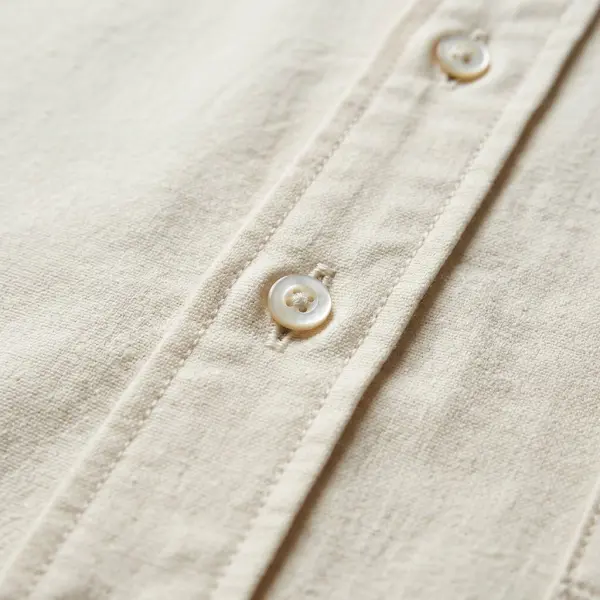
Not every placket is intended to disappear into the garment. In some designs, visible stitching, contrasting fabric, or decorative buttons make the placket an important part of the product's identity.
A casual utility shirt might use a clearly defined placket with prominent stitching to reinforce its structured appearance. A minimalist blouse, on the other hand, may use a concealed closure so the fabric surface remains visually uninterrupted.
These decisions affect how the garment is perceived, but also introduce different sewing requirements. Decorative stitching needs consistent spacing and alignment, while concealed constructions may involve additional folds or layers that must be controlled carefully.
The Basic Anatomy of a Garment Placket
A placket is not a single universal pattern piece. Its components vary according to the opening location, fastening system, and chosen construction method.
Nevertheless, several technical elements appear repeatedly in placket development.
|
Component |
Function in Construction |
Why It Matters |
|
Garment opening |
Creates access through the garment |
Must be long enough for dressing and movement |
|
Overlap |
The section positioned over the opposite side when closed |
Controls coverage and the visible closure appearance |
|
Underlap |
The section positioned beneath the overlap |
Supports fastening and prevents exposure beneath the opening |
|
Placket extension or band |
Provides the fabric needed to finish the opening |
Influences thickness, width, and construction operations |
|
Interfacing |
Adds stability where required |
Helps control stretching, distortion, and fastening stress |
|
Stitching and edge finishing |
Secures fabric layers and finishes exposed edges |
Affects appearance, strength, and manufacturing consistency |
|
Fastener placement |
Positions buttons, buttonholes, snaps, or other closures |
Determines how the opening aligns and functions |
The relationship between these components matters more than their individual appearance.
For instance, a perfectly stitched placket can still function poorly if the overlap allowance is insufficient or the buttonholes do not align with the garment's center-front reference. Likewise, appropriate reinforcement will not compensate for an opening that is too short to provide adequate dressing ease.
Center Front, Finished Width, and Overlap Allowance
In a button-front shirt, the center front is the reference line used to establish where the two shirt fronts meet when the garment is fastened. Button and buttonhole positioning is normally coordinated around this line.
The finished placket width is a different measurement. It describes the visible or constructed width of the finished band, rather than the amount of fabric originally added to the pattern.
These measurements should not be confused during pattern development. Fabric may be consumed by folds, turn-under allowances, or joining seams before the finished placket reaches its intended width.
The American Sewing Guild's cut-on shirt placket construction guide illustrates how center-front references and fabric extensions are coordinated when constructing a folded shirt placket.

How Placket Construction Works
Placket construction generally follows a controlled sequence of pattern preparation, fabric stabilization, folding or attachment, stitching, and fastening installation.
The exact sequence depends on whether the opening is integrated into the pattern or constructed using separate components. A shirt front with a folded extension, for example, does not require the same operations as a slit opening finished with binding.
Cut-On or Folded Placket Construction
A cut-on placket is formed from an extension included in the main garment pattern. Rather than attaching a separate band, the extended fabric is folded to create the finished opening.
This approach is commonly suitable for conventional woven shirt fronts where the pattern can accommodate the necessary extension. Depending on the pattern design, the folded layers may be secured by topstitching or another suitable finishing technique.
One practical advantage is the reduced number of separate components. Eliminating a joining seam may also create a relatively smooth finish, although the final thickness depends on the number of folds, fabric weight, and interfacing.
For manufacturers, the main requirement is consistent folding accuracy. When the extension is marked or pressed incorrectly, the resulting placket may become uneven along the front of the shirt.
Applied Placket Construction
An applied placket uses one or more separate pieces of fabric attached to the garment opening.
This method provides flexibility in controlling the appearance of the placket. The applied band can be made from the main garment fabric or, when appropriate, from a contrasting material that contributes to the design.
An applied placket may be selected for a structured casual shirt, a decorative blouse opening, or another garment where a separate band provides the desired appearance or construction flexibility.
The additional component introduces operations such as joining, turning, pressing, and securing the band. These operations need appropriate seam allowances and alignment references so the finished placket remains straight.
Slit, Faced, and Bound Placket Construction
Some garments require a short opening in an otherwise continuous piece of fabric. In these cases, the placket may be created by cutting a slit and finishing its edges using a facing or binding.
A short neckline placket on a blouse illustrates this approach. Instead of dividing the entire garment front into two separate panels, the opening can be positioned within the front bodice.
The opening must be finished carefully, especially at its lower endpoint. Sharp corners, clipped areas, and narrow seam allowances may need reinforcement or precise stitching to prevent distortion.
A bound sleeve placket uses a related principle, although its geometry and assembly sequence differ from a faced neckline opening.
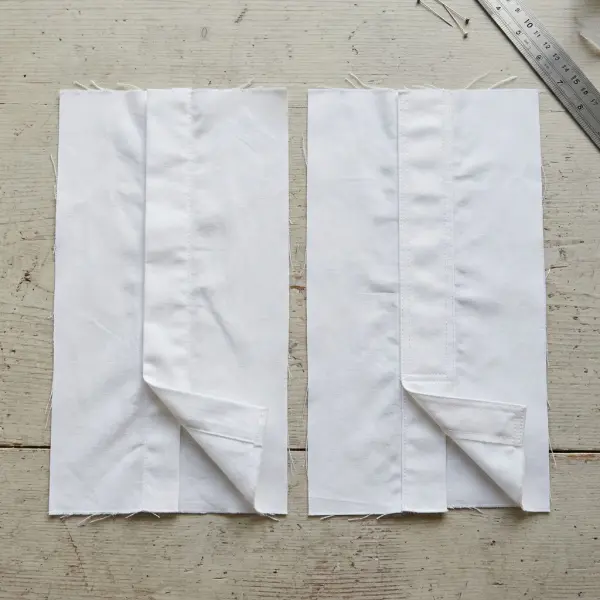
These construction approaches serve different pattern and manufacturing requirements. Their selection should begin with the desired garment opening and finished appearance rather than with a general assumption that one technique is universally superior.
For a more focused comparison of functional arrangements and visual finishes, see button plackets, sleeve plackets, and hidden plackets.
Placket Construction in Shirts, Dresses, and Tops
The same basic construction principle can produce quite different results depending on the garment category.
A shirt, dress, and casual top may all feature a front opening, but their requirements for length, reinforcement, movement, and visible detailing are not necessarily the same.
Shirt Plackets: Supporting a Consistent Front Closure
In woven shirts, the front placket commonly extends from the neckline toward the hem. Its position and construction help maintain a controlled front closure while accommodating a series of buttons.
Because the opening is long and visually prominent, small alignment differences become noticeable. Uneven placket width, inconsistent topstitching, or misplaced buttons can make an otherwise well-constructed shirt appear unbalanced.
The placket must also work with the collar and hem. A well-aligned front opening should meet the collar construction cleanly at the top and retain the intended hem appearance at the bottom.
In tailored shirts, button placement may require particular attention around the chest. A button positioned near a likely area of opening tension can help reduce gaping, although the underlying garment fit and available ease remain essential.
The shirtmaking guide from EmmaOneSock's sewing tutorials discusses folded and separate placket methods as well as practical considerations for interfacing, buttonholes, and button positioning.
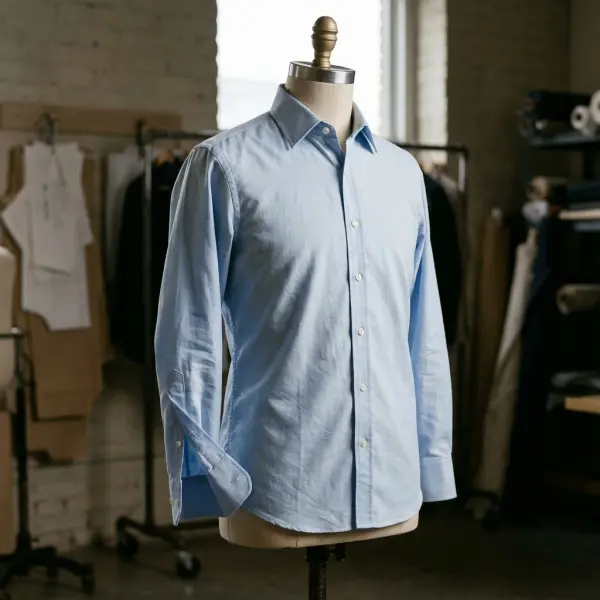
Sleeve openings introduce another construction consideration. A narrow cuff usually needs a placket that allows the wrist area to open sufficiently for the hand to pass through.
The sleeve placket must therefore coordinate with the cuff dimensions, sleeve shape, and assembly sequence rather than being treated as a purely decorative detail.
Dress Plackets: Balancing Access and Silhouette
In dresses, placket construction is influenced by garment length, neckline shape, waist shaping, and the intended dressing method.
A shirt dress may use a full-length button placket that becomes a major visual feature. A relaxed tunic dress may need only a short opening near the neckline, while a more fitted woven dress may require a longer opening or an alternative fastening system to provide adequate access.
The length and position of the placket can also affect the finished silhouette. A full-front closure interrupts the continuous fabric surface, while a partial placket preserves more of the front panel below its endpoint.
That distinction becomes important when the dress includes waist seams, gathered sections, or pattern-matched fabric.
Consider a printed shirt dress with a center-front closure. The designer may want the pattern motif to appear continuous when the dress is fastened. Achieving that result requires attention to cutting placement, overlap dimensions, and pattern matching, not simply accurate sewing.

Tops and Blouses: Managing Short Openings and Soft Fabrics
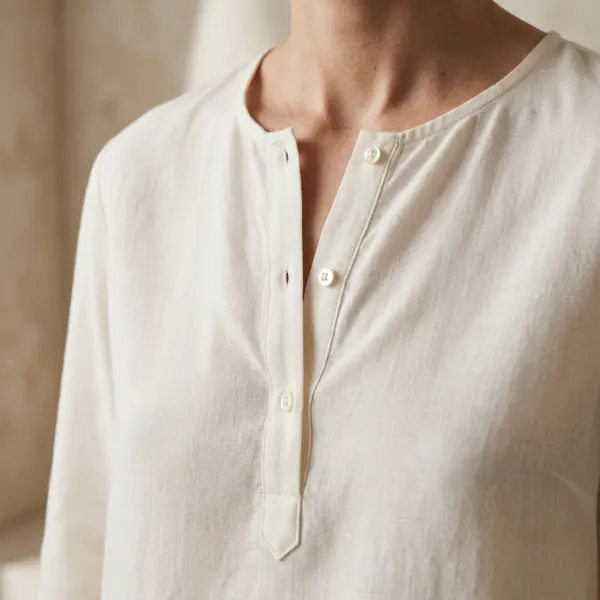
Tops and blouses often use plackets in a more localized way. A short opening near the neckline can provide dressing ease without changing the entire garment front.
This is particularly relevant for woven tops with limited stretch. A garment may appear loose across the body yet still need an opening because its neckline does not accommodate the head comfortably.
Fabric behavior becomes especially important with soft, lightweight materials. A fluid blouse fabric may not hold a sharply defined placket edge without suitable stabilization, but excessive interfacing can create an unnatural stiff area.
The placket must therefore be developed in relation to the fabric's drape, thickness, and surface appearance.
A soft blouse intended to fall naturally from the neckline may need a construction that preserves that movement. Conversely, a structured polo-inspired top may intentionally use a firmer placket to create a more defined front detail.
Why Fabric Choice Changes the Placket Construction
The same placket design can behave differently when sewn in two fabrics with different mechanical properties.
A stable cotton poplin generally supports crisp folds and controlled pressing, while a soft viscose fabric may require more careful handling to avoid stretching or distortion. A relatively thick linen blend may produce bulky overlapping layers, and a slippery fabric can introduce handling difficulties during alignment and stitching.
This does not mean that particular materials are inherently unsuitable for plackets. It means that the construction must be adjusted to the material rather than transferred without evaluation.
Fabric Weight and Layer Thickness
Fabric weight and thickness affect the finished placket's profile. A construction with several folded layers may remain relatively flat in a lightweight shirting fabric but become noticeably bulky in heavier cloth.
The designer may need to reconsider fold geometry, seam allowance treatment, interfacing coverage, or the method of attaching a separate band.
Reducing thickness is not simply a matter of removing reinforcement. The opening still needs sufficient stability for its intended fasteners and use.
Drape and Flexibility
Placket stiffness affects how a garment falls around the opening.
A stiff band attached to a flowing blouse can create an abrupt transition between the reinforced area and the surrounding fabric. It may also influence how the neckline hangs when the upper buttons are left open.
For softer garments, sample evaluation should include the placket both fastened and unfastened. A construction that looks appropriate on a flat table may behave differently when worn.
Interfacing Compatibility
Interfacing selection requires attention to weight, flexibility, adhesive compatibility, and care requirements.
Fusible interfacing may be convenient for some constructions, but its performance depends on appropriate application conditions and compatibility with the outer fabric. Sew-in interfacing may be preferable for certain sensitive materials or tailored applications.
The goal is to achieve the necessary stability without introducing visible bubbling, excessive stiffness, or changes to the fabric surface.
Before production, suppliers should test the complete placket construction using the intended fabric, interfacing, and pressing conditions.
The Placket Construction Process: From Pattern to Finished Garment
Although the sewing sequence varies by placket type, the production workflow typically follows several interconnected stages.
Understanding this sequence helps fashion businesses identify where design information must be translated into technical instructions.
1. Establish the Opening in the Pattern
The pattern maker first determines the position, length, and required access provided by the opening.
For a full-front shirt, this includes establishing the center-front reference, the finished placket width, and the necessary fabric extensions or separate component dimensions.
For a short neckline opening, the pattern must define the endpoint and how the slit will be finished.
The opening should also be evaluated for functional dressing ease, not just visual proportions.
2. Prepare the Fabric and Supporting Components
After cutting, the necessary placket areas are prepared according to the approved construction method.
Preparation may involve applying interfacing, pressing fold lines, marking stitching guides, or preparing separate fabric bands.
Careful preparation matters because errors introduced at this stage can become difficult to correct after the opening has been cut or the placket permanently stitched.
3. Form or Attach the Placket
A folded placket is created by turning the fabric extension according to its marked dimensions.
An applied placket requires joining the separate component to the garment opening before completing its folds and edge finishing.
For a slit opening, the operation may involve reinforcement stitching, accurate cutting, and turning or binding the raw edges.
The method should follow the approved pattern and sewing specification. A construction sequence that works for one type of placket should not automatically be transferred to another.
4. Control the Opening Endpoint
The endpoint is especially important in partial plackets and sleeve openings.
This area often experiences concentrated stress when the opening is pulled apart. Depending on the construction, reinforcement stitching, controlled seam allowances, secure corners, or other appropriate finishing methods may be required.
The Sewing & Craft Alliance's continuous lap sleeve placket guide illustrates the importance of accurate marking, reinforcement stitching, and avoiding fabric tucks near the point of a sleeve opening.
5. Complete Stitching and Pressing
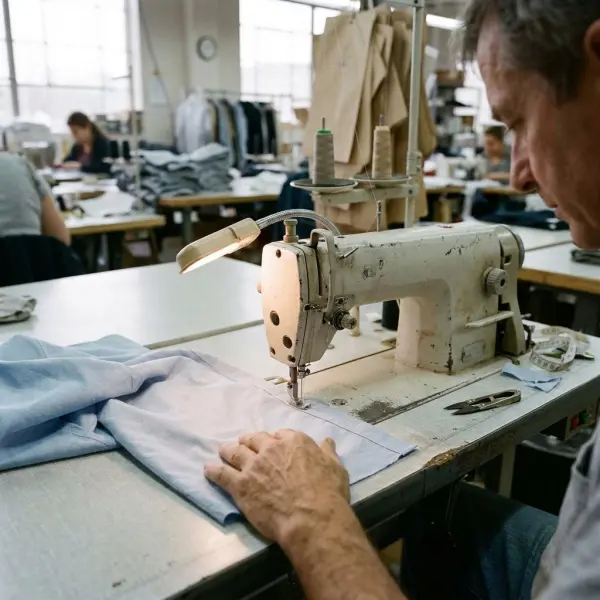
Once the opening has been formed, the placket is secured through the required stitching operations.
Topstitching may be functional, decorative, or both. Where it remains visible, stitch alignment and consistency contribute directly to the perceived quality of the garment.
Pressing is equally important. It establishes folds, controls seam allowances, and helps the finished placket maintain the intended shape.
However, pressing conditions must remain compatible with the fabric and interfacing. Excessive heat or pressure can damage some materials or produce unwanted marks.
6. Install Fasteners and Check Alignment
Buttons, snaps, or other fasteners are installed according to the approved placement specifications.
For button closures, buttonhole position must coordinate with the overlap and underlap so the garment aligns correctly when fastened.
A front placket should be checked in its closed position, particularly at the neckline, bust or chest, waist, and hem where relevant.
Fastener spacing alone does not guarantee a satisfactory result. The underlying fit, opening length, and fabric behavior also influence how the closure performs.
How Placket Construction Affects Garment Quality
The quality of a placket cannot be judged solely by whether its buttons close. A well-executed construction should also support the garment's intended appearance, comfort, and repeated use.
Several characteristics deserve attention during sample approval and production inspection.
Straightness and Symmetry
A front placket forms a strong visual line through the garment. When the line twists, curves unintentionally, or varies in width, the defect may be immediately noticeable.
The problem can originate from inaccurate cutting, inconsistent folding, fabric movement during stitching, or pressing distortion.
Symmetry also depends on correct placement of the opening in relation to the garment pattern. An accurately sewn placket will not correct a front bodice that has been cut or assembled out of balance.
Fastening Performance
Buttons and buttonholes should operate without unnecessary force, while the closed opening should provide the intended coverage.
A buttonhole that is too short for its button may be difficult to use. One that is excessively large may allow the closure to loosen more easily.
The fastening system should be tested with the actual button size, fabric layers, and finished construction.
Comfort and Movement
A placket can affect comfort when its internal layers become bulky, its edges are rough, or the opening restricts movement.
This is particularly relevant near necklines, fitted cuffs, and body areas subject to tension during wear.
Comfort should be evaluated on the wearer or an appropriate fit model, since a flat garment inspection cannot fully reveal movement-related issues.
Consistency After Care
A placket that looks straight immediately after sewing may behave differently after washing or other intended care.
Fabric shrinkage, interfacing behavior, and differential movement between layers can change its appearance. These outcomes depend on the materials and finishing methods used.
Care testing should therefore reflect the garment's intended cleaning instructions and the brand's established quality requirements.
Practical Placket Decisions for Fashion Brands and Manufacturers
Placket construction becomes commercially relevant when designers translate a product concept into a repeatable manufacturing specification.
A fashion startup developing its first shirt collection may have a clear visual reference but insufficient information about how the placket should actually be constructed. Without agreed specifications, different suppliers may interpret the same design differently.
A sample that looks acceptable does not necessarily establish a repeatable production standard. The approved method needs to be documented.
Define the Construction in the Tech Pack
A garment tech pack should identify the chosen placket method and the characteristics that need to remain consistent during production.
The following specification framework can help organize those requirements.
|
Specification Area |
Information to Define |
|
Placket location |
Center front, neckline, back opening, sleeve, or another designated area |
|
Construction method |
Cut-on, applied, faced, bound, or specified variant |
|
Finished dimensions |
Width, length, overlap, and relevant tolerances |
|
Fabric components |
Main fabric, separate bands, facings, or binding material |
|
Reinforcement |
Interfacing type, placement, or another approved stabilization method |
|
Sewing details |
Stitching position, edge finishing, reinforcement, and construction sequence |
|
Closure details |
Fastener type, size, quantity, spacing, and orientation |
|
Quality requirements |
Alignment, appearance, functionality, and agreed acceptance criteria |
Dimensions and tolerances should be established from approved samples and the manufacturer's actual process capability. There is no single universal placket width or stitching tolerance appropriate for every garment.
Clear documentation also reduces reliance on verbal interpretation during sampling and bulk production.
Evaluate Manufacturing Complexity Before Approval
A visually simple placket can require a demanding production sequence.
Concealed closures, narrow fabric turns, delicate materials, or intricate finishing may involve additional handling and quality-control requirements. Depending on the design and factory setup, these operations can affect production time and rework risk.
On the other hand, choosing a simpler construction solely to reduce sewing operations may compromise the intended appearance or functionality.
The appropriate decision balances design requirements, material performance, available equipment, operator skill, and target product cost.
Work With the Supplier on Sample Development
A useful sample review should address both appearance and manufacturability.
Instead of approving a placket merely because it looks straight in a photograph, product-development teams should inspect the garment physically and assess its closure under realistic conditions.
Questions worth reviewing include:
- Does the opening provide enough room for dressing and movement?
- Does the placket remain aligned when the garment is fastened?
- Are the interfacing and folded layers appropriate for the selected fabric?
- Does the construction maintain the intended silhouette?
- Can the supplier reproduce the approved appearance consistently?
These questions help connect design approval with operational feasibility.
Common Placket Construction Mistakes and Misconceptions
Many placket problems begin before the garment reaches the sewing machine. They arise from assumptions about pattern dimensions, fabric behavior, or how the opening should function.
A separate discussion of common placket sewing problems and how to prevent them can explore defect diagnosis in greater depth. Several underlying issues are especially relevant during product development.
Assuming the Same Construction Works for Every Fabric
A placket approved in crisp cotton cannot automatically be transferred to a lightweight fluid fabric without evaluation. The second fabric may need different stabilization, fold treatment, or sewing adjustments.
When this compatibility is ignored, the finished garment may show puckering, excess stiffness, or distorted edges. The more reliable approach is to approve the complete construction in each intended fabric or in a tested material group with sufficiently similar performance.
Confusing Pattern Extension With Finished Placket Width
The pattern extension includes fabric that may disappear inside folds or seam allowances. Treating this measurement as though it were the finished width can produce incorrect proportions and closure alignment.
This problem is particularly likely when a design reference is converted into a new pattern without a detailed construction drawing. Pattern dimensions should identify the finished measurement separately from the required cutting and folding allowances.
Treating Button Spacing as a Purely Decorative Decision
Evenly spaced buttons may produce a visually orderly closure, but their positions also need to accommodate the garment's fit and areas of tension.
On a fitted blouse, a long gap between buttons across the bust can contribute to unwanted opening. On a shirt dress, placement around the waist may affect how the closure behaves when the wearer sits or moves.
Button positioning should therefore be evaluated during fitting rather than determined only by dividing the placket length into equal intervals.
Overlooking the Relationship Between the Placket and Adjacent Finishes
A placket does not exist independently from the collar, neckline, cuff, or hem.
A shirt-front placket that is accurately sewn through its central length may still appear unfinished where it meets a collar band. Similarly, a dress placket can become bulky where its folds intersect with the bottom hem.
Product development should consider these intersections as part of the overall garment construction. For related finishing considerations, hemming techniques for clean garment finishing provides additional context.
What Should Apparel Brands Verify Before Bulk Production?
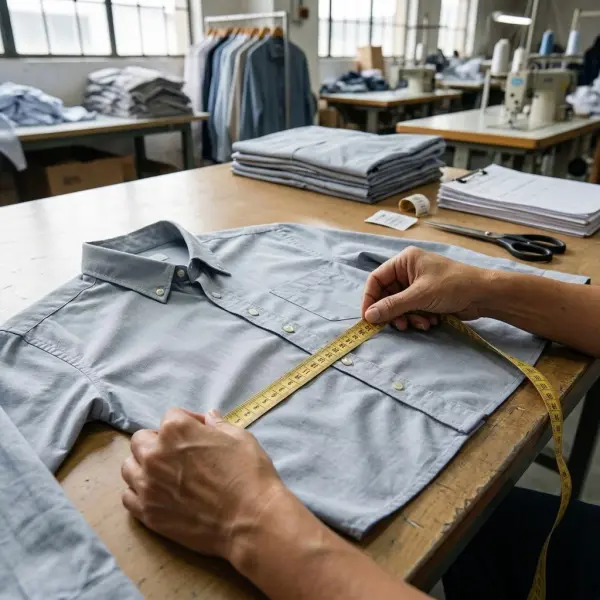
Before approving a placket for bulk manufacturing, brands should confirm that the chosen construction performs as intended in the actual garment rather than relying only on a technical sketch.
The most useful verification combines physical sample evaluation, construction documentation, and supplier capability assessment.
A practical inspection should address:
- Dimensional accuracy: Finished width, opening length, overlap, and closure placement match the approved specification.
- Construction integrity: The fabric layers, stitching, and reinforcement are properly secured.
- Visual consistency: The placket remains straight and appropriately aligned when the garment is closed.
- Functional access: The opening provides sufficient dressing ease and allows fasteners to operate correctly.
- Material compatibility: Interfacing and pressing do not cause unacceptable stiffness, distortion, or surface changes.
- Care performance: The placket retains acceptable appearance and functionality after appropriate product testing.
These checks should be interpreted against the garment category and quality expectations.
A relaxed casual top may allow a softer, less structured placket appearance than a formal dress shirt. The acceptance criteria should reflect the intended product rather than impose the same finishing characteristics on every garment.
Frequently Asked Questions About Placket Construction
What Is the Main Purpose of a Placket in Clothing?
The main purpose of a placket is to provide a finished opening that allows a garment to be worn, opened, and fastened comfortably. It is particularly useful where a garment's neckline, wrist opening, or fitted shape would otherwise restrict dressing.
Plackets also provide a suitable structure for buttons, snaps, and other closures. Their folded or reinforced fabric layers help control the opening during repeated use.
Depending on the design, a placket may be visually prominent or relatively discreet. Its functional requirements remain important in either case. A decorative appearance should not interfere with opening length, closure operation, or the garment's intended fit.
Is a Placket the Same as a Button Band?
A button band is closely related to a placket, but the terms are not perfectly interchangeable in every garment-construction context. A button band generally refers to the fabric section carrying buttons or buttonholes, while a placket is a broader term for a finished opening and its associated construction.
In a conventional button-front shirt, the button band forms part of the front placket assembly. In other garments, a placket may use snaps, concealed fasteners, or a finished slit without a conventional button band.
Terminology can vary among sewing patterns and manufacturers. For production documents, the safest practice is to specify the actual construction method, components, and finished dimensions rather than rely on the name alone.
Can a Garment Have a Placket Without Buttons?
Yes. A placket can be constructed without buttons because its essential function is to provide a finished opening, not necessarily to carry a specific fastening system.
Some designs use snaps, hooks, or another appropriate closure. Others feature a short open neckline placket that remains unfastened as part of the style.
The construction still needs to manage the opening edges and any stress created during dressing or movement. A permanently open placket may require a different overlap arrangement or reinforcement strategy from a buttoned version.
For fashion designers, the fastening choice should follow the desired appearance, dressing requirements, and fabric behavior.
Does Every Placket Need Interfacing?
No. Not every placket requires additional interfacing. The need depends on the fabric, construction method, fastening system, and desired stability.
Some cut-on constructions obtain sufficient support from their folded fabric layers. Others benefit from added interfacing, particularly where buttonholes need stabilization or the outer material is prone to distortion.
Interfacing should not be added automatically without considering its effect on thickness and drape. Excessive reinforcement can make a lightweight blouse placket feel stiff, while inadequate reinforcement may allow a buttoned opening to stretch.
The appropriate choice is established through sample testing using the actual material combination and intended care conditions.
What Is the Difference Between a Full-Length and Partial Placket?
A full-length placket extends along the intended opening through a substantial or entire garment section, such as the front of a button-down shirt or shirt dress. A partial placket creates a shorter opening, often beginning at the neckline and ending within the garment body.
Full-length constructions generally provide greater access through that section of the garment. Partial plackets can preserve a continuous fabric panel below the opening and create a different visual balance.
Neither arrangement guarantees sufficient dressing ease by itself. A partial placket must still be long enough for the garment's neckline and body proportions, while a full-length closure must be compatible with the intended fit.
How Does Placket Construction Affect Garment Production Cost?
Placket construction can influence production cost through its fabric requirements, component count, sewing operations, reinforcement materials, and inspection needs.
An integrated folded placket may eliminate some separate-component preparation, but it still requires accurate folding, stitching, and pressing. An applied or concealed placket can involve additional operations, depending on the design.
The actual cost difference cannot be established from construction type alone. Fabric handling, factory equipment, operator familiarity, production volume, and defect rates can all change the outcome.
Brands should request a construction-based costing comparison when evaluating alternatives, using approved samples so suppliers are estimating the same finished quality.
How Can Brands Prevent Placket Gaping in Shirts and Dresses?
Reducing unwanted placket gaping begins with checking garment fit, especially in areas where the fabric experiences tension. A placket may be properly sewn yet still open between buttons when the garment is too tight across the bust, chest, or waist.
Button placement, overlap dimensions, fabric stability, and reinforcement also influence how the closure behaves. Moving a button or adding an appropriate fastening point may help in some designs, but it cannot always compensate for insufficient garment ease.
For development teams, the most useful approach is to test the garment on an appropriate fit model while standing, sitting, and moving. The correction should address the actual cause rather than treating every opening gap as a sewing defect.
Should Placket Construction Be Standardized Across a Fashion Collection?
Standardization can be useful when several garments share similar fabric properties, opening requirements, and design intentions. Reusing an approved construction method can simplify technical documentation, operator training, and quality inspection.
However, applying one identical placket to every garment may create problems when materials or silhouettes differ. A structured woven shirt and a fluid blouse may need different reinforcement, dimensions, or finishing techniques.
A more practical strategy is to establish a small library of approved placket constructions. Each method can have its own sample, sewing specification, material compatibility guidance, and inspection criteria.
This approach supports production consistency while allowing appropriate design variation.
Conclusion: A Small Construction Detail With Lasting Product Impact
Placket construction demonstrates how a relatively narrow garment component can influence several aspects of apparel development. It determines how an opening functions, affects the finished appearance, and connects pattern design with material selection and sewing execution.
For shirts, the placket helps establish a consistent front closure and coordinates with collars, cuffs, and hems. In dresses, it contributes to dressing access and silhouette control. In tops and blouses, it may provide a compact opening that supports comfort without interrupting the overall garment design.
The most effective construction is not defined by complexity. It is defined by whether the method suits the garment, works with the fabric, and can be reproduced consistently at the required quality level.





Comments 0
Leave a CommentSend Comment
Anda harus Login terlebih dahulu untuk dapat memberikan komentar.