

Seam Finishing Techniques Explained for Better Garment Quality
Quick Answer
Seam finishing techniques are methods used to secure, cover, fold, or enclose the raw fabric edges inside a sewn garment. Their main purpose is to control fraying or edge distortion while creating an interior that is durable, comfortable, and appropriate for the product’s quality level.
Common finishes include overlocking, zigzag stitching, French seams, flat-felled seams, turned-and-stitched edges, bias binding, Hong Kong binding, and pinking. No single method is suitable for every garment. The right choice depends on fabric structure, weight, stretch, transparency, laundering conditions, seam location, available machinery, production volume, and the intended price point.
An overlocked edge may be efficient for a mass-produced cotton shirt, while a French seam can provide a cleaner result in a sheer blouse. Bias-bound seam allowances may justify their additional labor in an unlined premium jacket, but they would usually be unnecessary inside a basic lined garment.
Good seam finishing is therefore not merely decorative. It is a construction decision that connects design intent, material behavior, manufacturing capability, cost, wearer comfort, and long-term product performance.
What Is Seam Finishing?
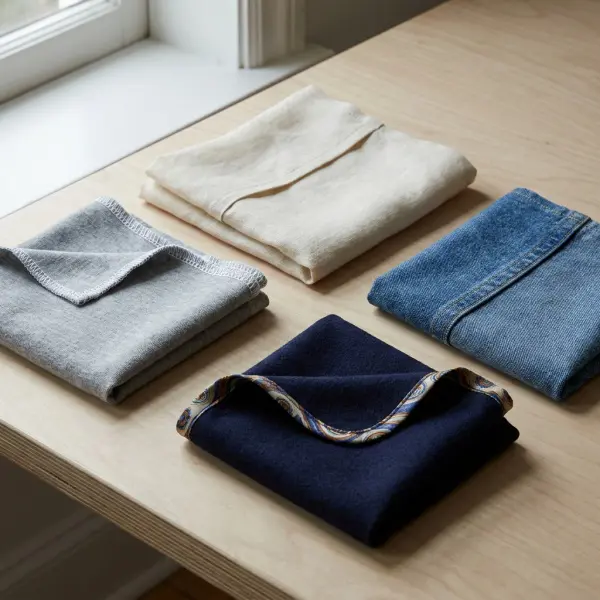
Seam finishing is the treatment applied to the raw edges of a seam allowance to control fraying, improve neatness, protect the fabric edge, or create a more comfortable and durable garment interior.
It is useful to distinguish three related terms:
- A seam joins two or more fabric components.
- A seam allowance is the fabric between the stitching line and the cut edge.
- A seam finish treats or encloses that raw edge after, before, or during seam construction.
These terms are sometimes used interchangeably, but they describe different parts of the construction system. An overlocked plain seam, for example, combines a conventional joining seam with an overedge finish. A French seam works differently because the seam allowance is enclosed within the seam construction itself.
The international classification described in ISO 4916 for textile seam types treats seam configuration and stitch type as connected but separate specifications. This distinction matters in industrial production because writing “finish the seam neatly” in a technical pack is too vague. A supplier needs to know the seam construction, stitch class, seam allowance, thread requirement, and expected appearance.
Why Seam Finishing Matters to Garment Quality
A seam finish is hidden inside many garments, but its effects are not hidden. Poorly controlled raw edges can release yarns, create lint, catch during wear, become uncomfortable against the skin, or make an otherwise well-designed product appear unfinished.
The finish also affects how the seam behaves as a complete system. Garment quality is not determined by one element alone. Fabric structure, thread size, stitch type, stitch density, needle selection, machine tension, seam configuration, and operator control all influence the result. ASTM D1683/D1683M describes seam engineering as the selection of thread, stitch type, seam type, and stitch density to achieve suitable strength and structural integrity in woven fabrics. The standard also warns that a laboratory seam-strength result does not by itself predict actual wear performance.
Controlling Fraying and Yarn Loss
Woven fabrics contain interlaced warp and weft yarns. Once cut, yarns near the edge can loosen or pull away, particularly in open weaves, loosely constructed fabrics, textured fabrics, or materials subjected to repeated laundering.
A suitable finish limits that deterioration. However, “anti-fray” should not be treated as an absolute claim. Pinking, for instance, changes the shape of the cut edge and may slow raveling, but it does not fully secure fabrics that fray heavily or undergo frequent washing. The Sewing and Craft Alliance similarly notes that pinking generally minimizes rather than eliminates raveling.
Supporting a Clean Garment Interior
Consumers may not know the technical name of a seam finish, but they often recognize whether the garment interior appears controlled and intentional. This is especially relevant for:
- unlined jackets and coats;
- sheer shirts and dresses;
- reversible garments;
- rolled sleeves or turn-back cuffs;
- open-front styles where internal construction may become visible;
- premium products marketed around craftsmanship.
A clean interior can support the product’s perceived quality, but complexity should still match the commercial proposition. An elaborate bound finish adds little value when it is completely hidden by lining and does not improve performance.
Managing Comfort and Bulk
Seams can rub, press into the skin, or create visible ridges under fitted garments. This makes the finish particularly important in underwear, activewear, childrenswear, sleepwear, base layers, and adaptive apparel.
A soft, low-bulk finish may be more appropriate than a visually elaborate one. In stretch apparel, the seam must also extend with the fabric. A neat finish that restricts movement or breaks under extension is not a successful finish.
The topic is examined more deeply in how seam finishing affects durability, comfort, and appearance.
Protecting the Brand’s Quality Positioning
Internal construction helps determine whether the garment fulfills its intended market position. A value-priced basic does not require couture finishing, but it still needs controlled, repeatable workmanship. A premium unlined jacket may require a more refined interior because the customer is likely to inspect areas that would remain unnoticed in a fully lined product.
The objective is not to use the most expensive technique. It is to use a finish that is credible for the material, garment category, retail price, care method, and customer expectation.
The Main Seam Finishing Techniques
Seam finishes can be grouped into three broad approaches:
- Edge-control finishes, which stitch or cut the raw edge without fully enclosing it.
- Folded or enclosed finishes, which hide the raw edge inside the construction.
- Bound finishes, which cover the edge with a separate strip of material.
The following overview explains their practical roles. A more detailed choice between three widely used options is covered in Overlock, French Seam, and Bias Binding: When to Use Each Finish.
|
Seam finish |
Generally suitable for |
Main advantage |
Main trade-off |
|
Overlock or serged finish |
Many woven and knitted garments |
Fast edge trimming and thread wrapping in one operation |
Appearance and performance depend heavily on setup |
|
Zigzag finish |
Small-scale production and conventional machines |
Accessible without an overlocker |
Can look less refined and may distort some fabrics |
|
French seam |
Lightweight, sheer, and fine woven fabrics |
Fully encloses raw edges |
Adds operations and can become bulky |
|
Turned-and-stitched finish |
Light- to medium-weight woven fabrics |
Clean finish using a lockstitch machine |
Folded edge can add thickness |
|
Bias or Hong Kong binding |
Unlined tailoring and visible seam allowances |
Refined appearance and strong edge coverage |
Higher material and labor cost |
|
Flat-felled seam |
Shirts, denim, workwear, and durable casualwear |
Enclosed raw edges with a strong visual structure |
Difficult on tight curves and bulky fabrics |
|
Pinked finish |
Stable fabrics with limited raveling |
Fast and inexpensive |
Usually insufficient for heavily laundered or fray-prone fabrics |

Overlock or Serged Finish
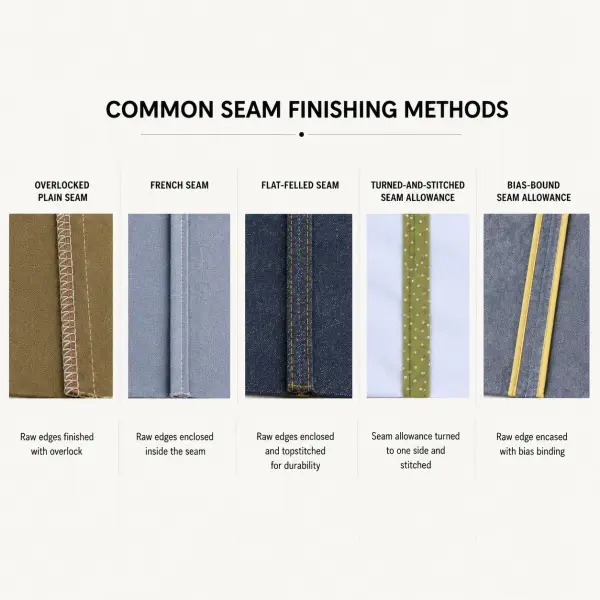
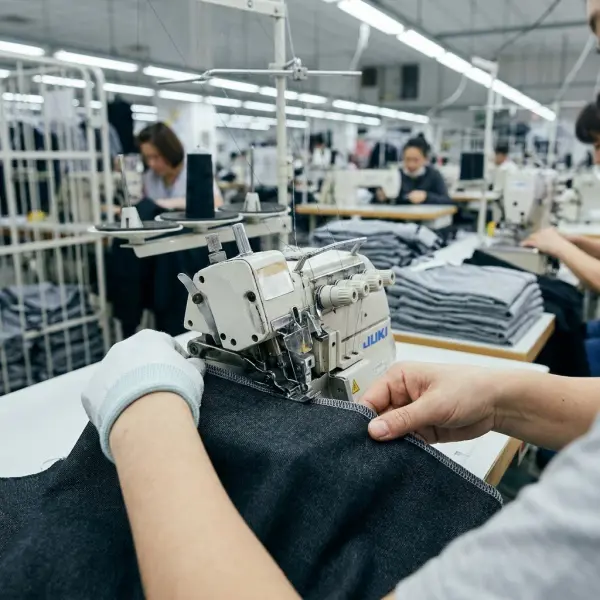
An overlock finish wraps thread around the fabric edge while the machine’s knife can trim excess material. Depending on machine configuration, overlocking may be used only to neaten a seam allowance or to join and finish fabric layers in one operation.
It is common in commercial apparel because it is fast, repeatable, and compatible with many garment categories. It is especially familiar in knitwear, T-shirts, casual tops, dresses, and mass-produced woven garments.
Yet overlock should not be described as universally suitable without qualification. The operator must match the stitch formation, differential feed, cutting width, thread tension, needle, and thread to the material. Excessive tension may curl or compress the edge, while poorly balanced loops can hang beyond the fabric or fail to cover it properly. Guidance from the Sewing and Craft Alliance similarly emphasizes that the fabric edge must be positioned so the overlock threads wrap it securely.
Zigzag and Machine Overcast Finishes
A zigzag finish uses a conventional sewing machine to place stitches across or near the raw edge. It is practical for sample rooms, small labels, alterations, home-based production, or workshops without a dedicated overlocker.
Machine overcast stitches are variations designed to imitate edge-wrapping behavior. They may alternate straight stitches with a wider edge stitch, depending on the machine.
These options can be effective, but they generally require more careful trimming and handling than an industrial overlock process. A wide or dense zigzag can cause lightweight fabric to tunnel, curl, or pucker. Stabilization, adjusted tension, lighter thread, or a three-step zigzag may improve the result depending on the fabric.
French Seam
A French seam is a self-enclosed construction made through two stitching stages. The first seam is sewn with the wrong sides together; the allowance is trimmed, folded inward, and sewn again with the right sides together. The raw edges are therefore trapped inside a narrow channel.
This finish is particularly useful where the inside remains visible, such as in sheer blouses, lightweight dresses, fine shirts, and unlined garments. It creates a controlled interior without an overlocker.
Accuracy matters. If the first allowance is not trimmed sufficiently, loose yarns may protrude through the final seam. If the finished channel is too wide, the seam can become stiff or visible from the outside. It is also less convenient at tight curves, intersecting seams, or areas with several layers. The Sewing and Craft Alliance recommends French seams primarily for lightweight materials and emphasizes accurate trimming and pressing.
Turned-and-Stitched or Clean-Finished Seam Allowances
In this method, each raw seam allowance is turned under and stitched close to the fold. It produces a neat edge using an ordinary lockstitch machine and can work well in light- to medium-weight woven fabrics.
This finish is useful in unlined garments when the brand wants a cleaner result than basic zigzagging but does not want the added material of binding. It can also work in sample development when industrial edge-finishing machinery is unavailable.
The main limitation is bulk. Each seam allowance contains an additional fold, so the method becomes less suitable for thick fabrics, dense seam intersections, or narrow seam allowances.
Bias Binding and Hong Kong Finishing
Bias binding covers the raw seam allowance with a separate strip of fabric, often cut on the bias so it can follow curved edges. Depending on the construction, the strip may wrap fully around the edge or create a Hong Kong-style finish in which the binding is folded over the visible side and secured along the underside.
This technique is frequently associated with unlined tailoring because it creates an intentional and visually polished interior. It can also introduce contrast color or subtle branding.
Its value comes with operational consequences:
- additional binding material must be cut or purchased;
- width and stretch must remain consistent;
- operators need control around curves and seam intersections;
- the extra layer can add bulk;
- production time is longer than basic overlocking.
For premium garments, those costs may be justified. For high-volume basics, they often are not.
Flat-Felled Seam
A flat-felled seam folds and encloses the raw edges before securing them with one or more visible rows of stitching. It is widely recognized on denim, workwear, casual shirts, and garments where durability and a clean internal finish are both desirable.
It has a different visual and structural role from simply overlocking a plain seam. The finished seam lies relatively flat and contains no exposed raw edge, but it requires accurate folding and consistent topstitching. Coats identifies lap-felled constructions as strong seams used in products such as jeans.
The finish is less efficient on complex curves, small enclosed areas, or thick multi-layer intersections. Factories may require specialist folders or lap-seam machinery to achieve stable high-volume production.
Pinking
Pinking shears cut the fabric into a zigzag edge. By interrupting the length of the yarns at the cut line, the method can reduce visible unraveling in relatively stable fabrics.
It remains useful for prototypes, tailoring details, dry-cleaned garments, craft production, or fabrics that fray only slightly. It should not be selected solely because it is quick. Where a garment will be washed repeatedly or receives high friction, a stitched or enclosed finish is usually more reliable.
How Should a Seam Finish Be Selected?
The most appropriate seam finish is the one that performs correctly in the finished product while remaining feasible within the production system. Selection should begin with the fabric and garment—not with a factory’s default machine.
Start with Fabric Structure
A tightly woven poplin, loosely woven bouclé, lightweight chiffon, brushed knit, denim twill, and coated fabric will not respond identically to the same finish.
Product developers should examine:
- how easily the cut edge ravels;
- whether the material stretches;
- fabric thickness and compressibility;
- transparency;
- surface texture;
- susceptibility to needle damage;
- tendency to curl or distort;
- response to steam, washing, or garment finishing.
A light French seam may disappear inside a chiffon blouse but become a rigid ridge in a heavier fabric. An overlocked edge that looks balanced on jersey may wave when used on an unstable knit unless differential feed is adjusted.
Consider Seam Position and Stress
The finish used at a loose skirt side seam may not suit a trouser crotch, armhole, pocket opening, or fitted activewear panel. Some locations receive greater tensile stress, abrasion, movement, or contact with the skin.
A finish cannot compensate for a fundamentally weak seam construction. Where load is high, the development team must evaluate the full assembly: fabric, seam allowance, stitch type, stitch density, thread, reinforcement, and finish.
Match the Finish to the Care Method
Repeated laundering can expose weaknesses that are not visible in a newly sewn sample. Raw yarns may loosen, overlock edges may curl, thread and fabric may shrink differently, or puckering may develop along the stitch line.
AATCC TM88B evaluates seam smoothness after standardized home-laundering procedures for washable woven, knitted, and nonwoven fabrics. This reinforces an important production principle: seam appearance should be assessed after the intended care process, not only immediately after sewing.
Account for Lining and Visibility
A lined garment may conceal the seam allowances, but lining should not automatically be treated as permission to leave unstable edges uncontrolled. During production, fitting, dry cleaning, repair, and long-term wear, unfinished edges may still deteriorate.
At the same time, applying premium binding beneath a full lining may add cost without providing meaningful customer or performance value. The specification should reflect what the construction genuinely requires.
Check Machinery and Operator Capability
A theoretically suitable finish can become impractical when the factory lacks the machine, folder, attachment, operator skill, or production capacity to execute it consistently.
During sourcing, brands should verify:
- available machine classes;
- folders and binding attachments;
- ability to handle the chosen fabric;
- acceptable seam tolerance;
- operator experience;
- realistic output per hour;
- quality-control checkpoints;
- backup process if specialist equipment fails.
This is where design intent meets manufacturing reality.
Seam Finish, Seam Type, and Stitch Type Are Not the Same Decision
One of the most common technical misunderstandings is treating the finish as an isolated instruction.
Consider the phrase “use overlock.” It could mean:
- overlock the two seam allowances together after lockstitching;
- overlock each allowance separately before joining;
- join and finish the fabric simultaneously with an overlock stitch;
- use a safety-stitch machine combining chainstitch and overedge formations;
- overlock only selected areas that are not covered by facing or lining.
These constructions do not have identical appearance, stretch, bulk, repairability, or production time.
The stitch specification also matters. A lockstitch, chainstitch, overedge stitch, and coverstitch form different thread structures and behave differently under extension. Readers who need a foundation in stitch formation can refer to basic sewing machine stitches and their functions.
A clear technical specification should therefore identify:
- seam location;
- seam or construction type;
- stitch type;
- seam allowance width;
- edge-finishing method;
- thread type and ticket or tex size where required;
- stitch density or approved range;
- topstitching details;
- pressing direction;
- acceptable visual standard.
The exact level of detail depends on the product and supplier relationship, but ambiguity should not be treated as flexibility. It usually becomes inconsistency.
A Practical Seam-Finishing Workflow for Fashion Businesses
Seam finishing should be decided during product development, not left until final production.
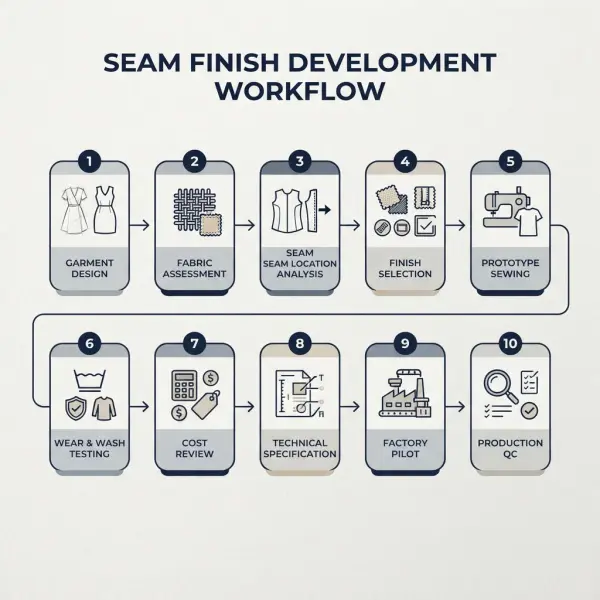
1. Assess the Material Before Finalizing Construction
The team should review actual bulk fabric or a representative development quality. Small swatches may not reveal how a full seam behaves along bias areas, curves, or long vertical lines.
Test more than one option when the material is unfamiliar. A finish that works on one supplier’s viscose fabric may perform differently on another fabric with a different yarn, weave density, finish, or weight.
2. Map the Garment’s Seam Locations
Not every seam needs the same treatment. A brand may use:
- French seams at visible side seams;
- narrow binding around an unlined facing;
- overlocking inside sleeves;
- flat-felled seams at selected structural locations;
- taped or specialized finishes for performance products.
This selective approach can control cost while preserving quality where it matters most.
3. Produce Construction Samples
A paper specification cannot replace a sewn trial. Samples reveal whether the finish creates bulk, show-through, stiffness, distortion, needle marking, or operator difficulty.
For commercial development, the trial should be made on production-relevant machinery rather than solely on a studio machine.
4. Test the Finished Assembly
Testing should reflect intended use. Depending on the product, this may include:
- home laundering or dry-clean simulation;
- dimensional stability checks;
- seam-strength or seam-slippage evaluation;
- stretch and recovery checks;
- abrasion or wear trials;
- visual inspection after pressing or garment finishing;
- wearer assessment for rubbing or bulk.
ASTM D1683/D1683M can support sewn-seam strength and seam-efficiency evaluation in woven fabrics, while ISO 13936 methods address yarn slippage resistance at seams. These tests answer specific questions and should be selected according to the product specification rather than used as generic proof of garment durability.
5. Confirm Cost and Capacity
The costing team should calculate more than thread consumption. Some finishes require extra handling, trimming, pressing, folders, material strips, slower sewing speeds, or multiple operations.
A finish that adds only several seconds per seam can still create a meaningful cost difference across a large order. Conversely, eliminating a necessary operation may increase returns, repairs, quality claims, or inspection failure.
6. Document the Approved Standard
The approved finish should appear consistently in the technical pack, construction sheet, bill of materials when binding is involved, sample comments, and quality-control reference.
Clear images or seam diagrams are usually more reliable than text alone.
How Seam Finishing Affects Production Cost and Scalability
Seam finishing contributes to both direct and indirect manufacturing cost.
Direct costs may include:
- operator time;
- thread consumption;
- binding or tape;
- machine depreciation;
- pressing;
- trimming;
- attachments and folders;
- additional quality inspection.
Indirect costs arise when the process interrupts line balance, requires specialist operators, generates rework, or produces variable appearance across factories.
Overlocking is often commercially efficient because trimming and edge covering can occur in one operation. French seams require at least two sewing stages plus trimming and pressing. Bound finishes add a separate material and demand accurate feeding. Flat-felled seams may be efficient in a factory equipped with the correct folder but much slower in a workshop performing each fold manually.
The lowest operation cost is not automatically the lowest product cost. A weak finish may create loose threads, edge breakdown, discomfort, or poor visual quality that later appears as returns, repairs, chargebacks, or reputational damage.
For small brands, standardization is usually more valuable than unnecessary variety. Developing a controlled library of approved seam constructions for lightweight wovens, stable wovens, knits, tailoring, and heavy casualwear can reduce repeated sampling and factory confusion.
Common Seam-Finishing Mistakes
Choosing the Finish Only by Appearance
A bound seam may look refined in a sample, but it can add excessive bulk to a lightweight or fitted garment. A French seam may appear clean on a straight test piece yet become difficult around an armhole.
The better approach is to evaluate appearance together with movement, weight, curve handling, care method, and production feasibility.
Using One Finish Throughout the Entire Garment
Uniformity sounds efficient, but seam locations perform different jobs. The finish inside a relaxed hem area does not necessarily need the same structure as a high-stress crotch or shoulder seam.
A controlled mix of finishes can produce a better garment without creating unnecessary complexity.
Treating Overlocking as Automatic Proof of Quality
An overlocked edge can still be defective. Common problems include loose loops, excessive trimming, skipped stitches, wavy edges, unbalanced tension, seam grinning, and insufficient stretch.
Quality depends on the setup and execution—not merely on the presence of overlock thread.
Ignoring the Effect of Pressing and Laundering
Seam puckering can result from excessive thread tension, structural crowding in tightly constructed fabrics, dimensional incompatibility between components, or unequal feeding of fabric plies. Some forms become more visible only after washing or finishing. Coats identifies fabric structure, thread and needle size, machine tension, and feed control among the contributing factors.
Approval should therefore occur after the relevant pressing, washing, dyeing, or finishing process.
Leaving the Instruction Open to Factory Interpretation
Terms such as “neat finish,” “clean seam,” or “premium inside” do not establish a measurable construction standard.
A factory may interpret “clean finish” as overlocking, folding, binding, or hiding the edge under lining. Brands should specify the approved result with a seam diagram, reference sample, or construction code.
Overengineering a Commercially Simple Garment
Complex finishing is not always better. A low-bulk overlocked edge may be more functional in a casual knit than a decorative bound seam. Extra operations should support performance, appearance, brand value, or customer experience.
If they do none of those things, they are probably unnecessary.
Important Technical Caveats
Seam finishing cannot be evaluated independently from the complete garment construction.
Brands should verify the following before approving a finish:
Fabric Compatibility
The finish should not cause puckering, curling, visible ridges, needle cutting, excessive stiffness, or show-through.
Seam Strength and Slippage
A visually clean edge does not prove that the joined seam is strong enough. Seam strength, fabric rupture, stitch failure, and yarn slippage are distinct failure modes.
Stretch Compatibility
For stretch garments, the seam assembly must extend far enough for dressing and movement without thread breakage or permanent distortion.
Care Compatibility
Thread, binding, fabric, lining, and reinforcement materials should respond compatibly to laundering, steaming, dyeing, and finishing.
Skin Contact
Thread texture, seam bulk, seam placement, and edge hardness should be evaluated in products worn close to the body.
Production Repeatability
A finish is not commercially approved until the supplier can reproduce it consistently at production speed.
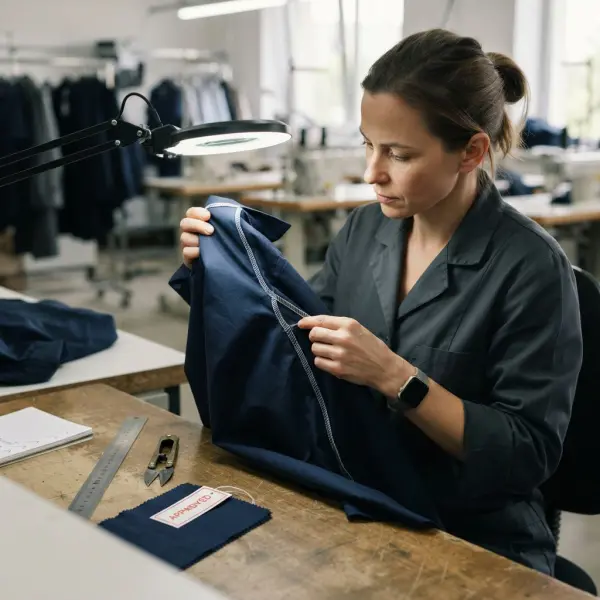
How Fashion Businesses Can Apply Seam-Finishing Decisions Strategically
For a fashion business, seam finishing should become part of the product architecture rather than a last-minute sewing-room detail.
A useful starting point is to create a construction matrix by product category. The matrix might identify approved finishes for:
- lightweight blouses and dresses;
- casual woven shirts;
- T-shirts and knit dresses;
- tailored jackets;
- denim and workwear;
- childrenswear;
- intimate apparel;
- lined and unlined outerwear.
Each approved construction should include fabric parameters, machine requirements, expected appearance, tolerance, care conditions, and any testing requirement.
During sourcing, the brand can use this library to assess whether a factory genuinely understands the construction. A supplier that owns the right machines but lacks control over tension, folders, pressing, or operator handling may still produce inconsistent results.
For pricing, brands should reserve labor-intensive finishes for places where customers can see, feel, or benefit from them. A premium interior can support storytelling, but customer communication should remain accurate. “Bound internal seams” is a verifiable construction detail. “Made to last forever” is not.
For quality management, inspectors should compare production against an approved physical sample or clear visual standard. Loose threads, trimming width, seam allowance capture, binding width, skipped stitches, puckering, and seam intersection bulk should be checked systematically.
The strategic principle is straightforward: select the simplest finish that reliably delivers the required performance and quality level. Simplicity reduces variation, but only when it does not remove a necessary function.
Frequently Asked Questions
What is the main purpose of a seam finish?
The main purpose is to control the raw edges within a seam so they do not fray, distort, shed yarns, or create an untidy garment interior. Depending on the method, the finish may also reduce bulk, improve comfort, reinforce the construction, or create a deliberate premium appearance. The exact priority varies by garment. A sheer blouse may need an enclosed edge because the seam is visible, while a knit top may need a flexible overedge construction that can stretch with the fabric. Seam finishing should therefore be selected according to material behavior, product use, and manufacturing conditions rather than appearance alone.
Is overlocking the same as sewing a seam?
Not always. Overlocking can be used solely to finish a raw edge, or it can join and finish fabric layers in one operation. In some woven garments, the main seam is sewn first with a lockstitch or chainstitch and the allowances are then overlocked together. In many knit garments, an overlock stitch joins the panels while wrapping the cut edges simultaneously. These alternatives have different stretch, strength, bulk, and repair characteristics. A technical pack should specify whether overlocking is the joining operation, the edge finish, or one part of a combined safety-stitch construction.
Which seam finish is best for lightweight fabric?
French seams, narrow turned finishes, fine overlocking, and narrow binding can all work, depending on the fabric and garment. French seams are especially useful for lightweight or sheer wovens because the raw edges are enclosed, but they may become visible or stiff when the finished channel is too wide. Fine overlocking is more production-efficient but must be carefully balanced to avoid curling or puckering. The decision should consider transparency, fraying, seam curves, garment fit, care method, and the available machine. A sample made in the actual fabric is more reliable than a universal recommendation.
Do lined garments still need seam finishing?
Some lined garments still need it, although not every concealed edge requires the same treatment. Fabrics that fray heavily may deteriorate during production, fitting, cleaning, repair, or long-term wear even when hidden behind lining. Overlocking or another controlled finish can stabilize those edges. However, a refined bound finish may be unnecessary when the seam is fully enclosed and receives little abrasion. Brands should evaluate fabric stability, seam stress, lining construction, care process, and expected product life rather than assuming that lining either solves every edge problem or requires premium finishing everywhere.
Can seam finishing make a garment stronger?
It can support durability, but the finish alone does not determine seam strength. Strength depends on the entire assembly, including fabric structure, seam type, thread size, stitch type, stitch density, needle, seam allowance, and sewing quality. An overlocked edge may prevent fabric yarns from unraveling without meaningfully reinforcing a poorly engineered joining seam. A flat-felled construction can provide both enclosed edges and a robust seam structure, but only when it is suitable for the material and sewn correctly. Performance-critical garments should be validated through relevant seam, stretch, slippage, laundering, or wear tests.
Why do finished seams sometimes pucker after washing?
Puckering after washing can occur when fabric, sewing thread, lining, binding, or reinforcement materials change dimensions differently. It can also result from excessive sewing tension, dense fabric construction, unsuitable thread or needle size, or uneven feeding of the fabric layers. Some problems are already created during sewing but become visible only after moisture, heat, pressing, or laundering. The solution depends on the cause; simply loosening the tension will not correct every type of pucker. Development samples should be washed or finished using conditions that represent the garment’s intended care process before production approval.
Should premium clothing always use French seams or bias binding?
No. Premium quality is better defined by appropriate, precise, and consistent construction than by one specific finish. French seams are effective in many fine woven garments but may be bulky or impractical in thick fabric, tight curves, or complex intersections. Bias binding can create a refined interior in unlined tailoring, yet it adds material, labor, and potential bulk. A discreet overlocked or turned finish may be more suitable in another product. The finish should support the garment’s design, comfort, durability, care needs, production method, and price positioning—not serve as a decorative quality signal without functional justification.
Conclusion
Seam finishing techniques convert exposed cut edges into controlled parts of a garment’s construction. They influence how the inside looks, how the material withstands wear and care, how comfortable the garment feels, and how reliably a factory can reproduce the design.
The correct decision is rarely “use the most refined finish everywhere.” Overlocking offers speed and flexibility. French seams enclose delicate edges. Flat-felled seams combine structure with a recognizable visual treatment. Bias binding creates a polished interior. Turned finishes provide a clean option with standard machinery, while pinking remains appropriate only under limited conditions.
Fashion businesses gain more value when they specify finishes as part of a complete seam-engineering system. Fabric behavior, seam location, thread, stitch formation, machinery, washing, labor cost, and quality expectations must be evaluated together.
A well-finished garment does not need to display technical complexity. It needs to show control. That control begins during product development, becomes measurable in the technical specification, and must remain consistent through production and real-world use.





Comments 0
Leave a CommentSend Comment
Anda harus Login terlebih dahulu untuk dapat memberikan komentar.