

Clothing Care Habits That Help Garments Last Longer
Clothing longevity is not determined by fabric quality alone. How a garment is worn, cleaned, dried, handled, repaired, and stored can influence how long it remains functional and presentable. Good clothing care therefore means managing the everyday stresses that gradually change a garment—friction, heat, moisture, chemicals, stretching, staining, and repeated cleaning—while following the care limits established for the complete product.
This matters for consumers, but it also matters commercially for fashion brands. Durability is partly engineered during product development through material selection, construction, trims, finishing, and testing. Once the garment reaches the customer, however, care becomes part of the product's real-life performance. A durable garment can still deteriorate prematurely if it is repeatedly treated more aggressively than necessary.
Quick Answer: What Clothing Care Habits Help Garments Last Longer?
The most useful clothing care habits are surprisingly practical: read the care label, clean garments according to actual need rather than automatically, use the least aggressive suitable care process, prevent unnecessary friction and heat, deal with stains and minor damage early, maintain garment shape during handling, and prepare clothing properly before longer-term storage.
The important qualification is that there is no universal care routine for every garment. A cotton T-shirt, wool sweater, structured blazer, stretch sports legging, embroidered dress, and coated jacket may react very differently to the same treatment. Construction, dyes, finishes, prints, linings, elastics, buttons, zippers, and decorative components can all influence appropriate care.
Care should therefore be treated as garment-specific maintenance rather than a generic laundry routine. For consumers, that approach can keep favorite pieces wearable for longer. For fashion businesses, clearer care guidance and realistic durability testing can help customers maintain the product closer to the condition its designers intended.

What Does Clothing Care Mean for Garment Longevity?
Clothing care is the set of maintenance practices used to keep garments clean, functional, appropriately shaped, and wearable throughout their useful life. It includes laundering when necessary, stain treatment, drying, pressing or steaming when permitted, minor repair, handling, and storage. The correct approach depends on the whole garment rather than simply the name of its main fiber.
That distinction matters because durability and longevity are related but not identical. Physical durability describes how well a product withstands stresses such as repeated washing, abrasion, stretching, tearing, snagging, dimensional change, and pilling. Longevity concerns how long the garment actually remains in useful or active service. Product quality influences both, but consumer behavior, fit, changing preferences, damage, care, and repair decisions can also affect how long something remains wearable.
Recent work by WRAP and the Leeds Institute of Textiles and Colour has treated clothing durability as something that should be measured rather than assumed. Their durability research includes wash and drying assessments alongside tensile strength, tear strength, dimensional stability, pilling, snagging, and abrasion testing. WRAP's 2026 durability work also reports that price, brand, and fiber composition alone do not reliably predict garment durability. WRAP clothing durability research
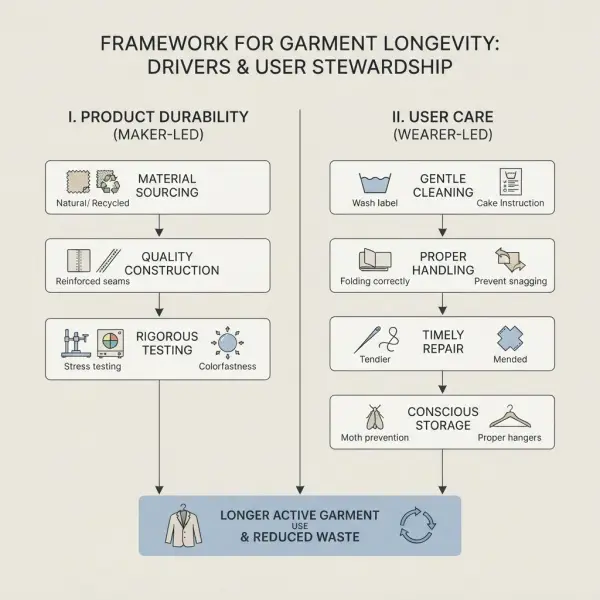
This is useful context for clothing care. Consumers cannot turn a poorly engineered garment into an exceptionally durable product simply by treating it gently. Equally, a well-constructed garment does not become immune to avoidable damage after purchase. Longevity is better understood as the interaction between product durability, frequency and conditions of use, and appropriate maintenance.
Start With the Care Label, Not With a Habit Learned From Another Garment
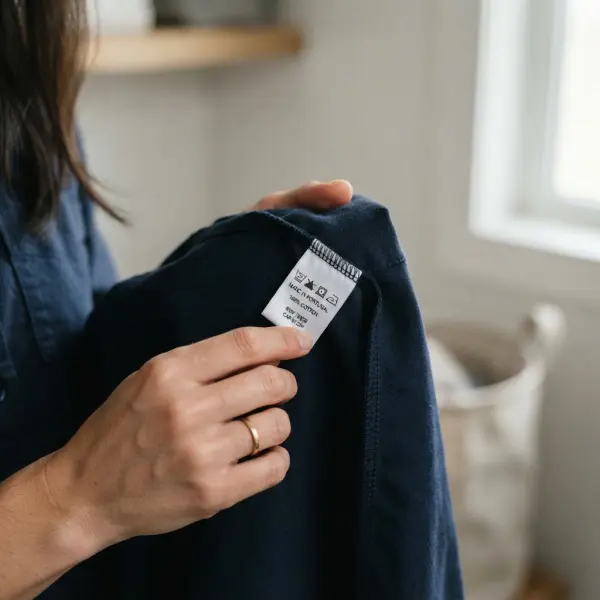
The care label is the best starting point because it communicates the treatment the manufacturer has determined the garment can tolerate. Under the GINETEX system reflected in ISO 3758, textile care information is organized around washing, bleaching, drying, ironing, and professional textile care. GINETEX explains that these symbols indicate the maximum permitted treatment and account for relevant elements of the textile article, including coloration, finishing, accessories, and applications. GINETEX care symbols
That is an important detail because care labels are sometimes interpreted too narrowly. A blouse may be predominantly cotton, for example, but its print, interfacing, buttons, decorative trim, elastic, lining, or surface finish may impose a different care limit from plain cotton fabric. Guessing solely from fiber content can therefore be misleading.
GINETEX also describes its symbols as indicating the maximum permitted treatment, meaning that a gentler process may generally be selected within that care system. It also warns that following the care instructions protects against damage but does not guarantee that every type of soil or stain will be removed. In other words, the strongest treatment a garment can tolerate is not automatically the treatment it needs every time.
Regulations differ between markets. In the United States, for example, the Federal Trade Commission's Care Labeling Rule requires covered manufacturers and importers to provide regular care instructions and to have a reasonable basis for those instructions. The FTC specifically requires the prescribed care process to consider the garment as a whole, including non-detachable linings, trims, and other components. FTC Care Labeling Rule
The Habits That Matter Most Are About Controlling Unnecessary Stress
A useful way to think about clothing maintenance is not to memorize hundreds of fabric-specific tips, but to recognize the stresses that care routines introduce. Clothing is exposed to mechanical action, moisture, detergents or other chemicals, temperature, pressure, and repeated handling. Those stresses are sometimes necessary to clean or restore the garment, but more treatment is not automatically better treatment.
This is why an effective care routine is selective. A garment that genuinely needs laundering should be cleaned appropriately rather than left soiled in an attempt to "save washes." On the other hand, an item that has been worn briefly and remains clean may not need to go automatically into a full wash cycle. Hygiene requirements, body contact, climate, activity level, staining, odor, and garment type all change that decision.
The principle is simple: apply enough care to restore the garment without repeatedly exposing it to more stress than its condition requires.

1. Check the Garment Before Automatically Washing It
A common household workflow is wear → laundry basket → washing machine. That is convenient, but it treats very different garments as if they had experienced the same amount of soil and wear.
Before laundering, it is more useful to check what actually happened during use. Is there visible soil? Perspiration? Odor? A localized stain? Has the item been worn directly against the skin, during exercise, or only briefly over another layer? The answers determine whether a full cleaning cycle is appropriate.
This does not mean that washing less is always better. Underwear, exercise garments, clothing exposed to heavy perspiration, contamination, or certain occupational conditions have different hygiene needs from an overshirt worn for a short period. Care frequency should respond to use conditions rather than a fixed minimalist rule.
For items that do require laundering, the specific mechanics of water temperature, machine action, drying, and storage deserve their own treatment. Those variables are explored more deeply in how washing, drying, and storage affect everyday fashion.
2. Use the Least Aggressive Suitable Treatment Within the Garment's Care Instructions
Garment care should not be a test of how much treatment a fabric can survive. If a moderate process achieves the necessary cleaning or finishing result, routinely choosing a harsher one adds no inherent longevity advantage.
This logic applies beyond washing temperature. Mechanical action, spin intensity, dryer heat, ironing temperature, bleaching, stain removal, and professional cleaning can all affect a product differently. The care label establishes the relevant limits, while the actual condition of the garment helps determine what treatment is necessary on that occasion.
That distinction becomes particularly important for garments that combine several materials. The outer fabric may tolerate one treatment while an elastic component, adhesive, printed surface, coating, structured interlining, or decorative element becomes the limiting factor.
3. Reduce Avoidable Mechanical Stress
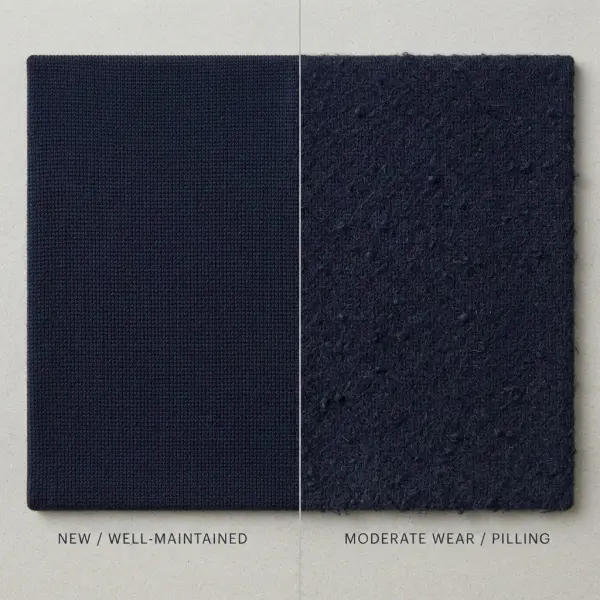
Friction is part of wearing clothes, but care routines can add further mechanical stress through rubbing, twisting, aggressive scrubbing, snagging, or repeated contact between garments and hardware. Durable garments are designed to withstand normal use, yet no textile surface is completely unaffected by repeated mechanical action.
Before cleaning, practical preparation can sometimes reduce unnecessary interaction between vulnerable surfaces and harder components. Fasteners, embellishments, exposed hooks, zippers, or delicate surfaces should be handled according to the product's instructions rather than treated identically in every load.
The broader point is not that consumers need complicated laundry rituals. It is that preventing predictable mechanical damage is usually easier than trying to restore a surface after severe pilling, snagging, distortion, or abrasion has developed.
4. Treat Heat as a Garment-Specific Variable
Heat appears at several points in clothing care: washing, tumble drying, ironing, steaming, and sometimes professional finishing. Its effect depends on the textile system involved, which is why care instructions distinguish permitted temperatures rather than prescribing one universal setting.
A common mistake is to assume that knowing the primary fiber tells you everything necessary. The finished garment may contain blended fibers, elastane, adhesives, prints, coatings, fusible materials, or trims with different sensitivities. GINETEX therefore advises users to select ironing conditions from the care label rather than simply inferring them from fiber content.
For consumers, this is another reason to keep care decisions product-specific. For brands, it reinforces the importance of testing the assembled garment, not merely relying on supplier specifications for the main fabric.
5. Address Stains Early, but Avoid Treating Every Stain the Same Way
A small stain can become the reason an otherwise functional garment leaves regular use. Early attention is therefore useful, but aggressive stain treatment can create a second problem if the method damages color, texture, coating, print, or surface finish.
Stains vary chemically, and so do textiles. A treatment suitable for a washable white cotton garment cannot automatically be transferred to dyed wool, silk, coated textiles, printed garments, or embellished products. When the appropriate method is uncertain, the care instructions and product-specific guidance should take priority over improvised internet remedies.
From a longevity perspective, successful stain care is not simply about maximum removal power. It is about removing enough contamination without creating fading, rings, fiber damage, finish changes, or visible abrasion that makes the garment less wearable.
6. Repair Small Problems Before They Become Structural Problems
Minor damage often begins locally: a loose button, opening seam, detached hem, weakened fastening, small tear, or unraveling thread. Continued wear can increase stress around that area and make the eventual repair more difficult.
Early repair is especially valuable because many simple failures do not mean the underlying garment has reached the end of its functional life. Reattaching a button or securing a small seam opening can preserve a product that still has substantial usable material and construction elsewhere.
WRAP's textiles resource hierarchy specifically encourages businesses to help customers maintain and repair products, including making repair guidance accessible and providing clear care information that supports longer use. WRAP textiles resource hierarchy
Not every defect is economical or safe to repair, of course. Severe material degradation, large areas of abrasion, damaged protective garments, or structural failures may require professional assessment or replacement. The useful habit is not "repair everything"; it is inspect damage before automatically discarding the whole garment.
7. Preserve Shape During Handling
Garments can become less wearable without technically "breaking." Necklines can stretch, knitted pieces can distort, creases can become difficult to remove, structured areas can lose shape, and elasticated sections can be stressed by inappropriate handling.
Shape preservation therefore deserves attention during cleaning, drying, folding, hanging, and storage. The appropriate method depends on construction. A heavy knit and a tailored jacket, for example, may require different support even if both are described broadly as outer layers.
This is one reason generic wardrobe advice frequently fails. "Hang everything" is no more reliable than "fold everything." Garment weight, structure, hanger design, fabric stability, and storage duration all matter.
8. Make Clothing Care a Routine, Not an Emergency Response
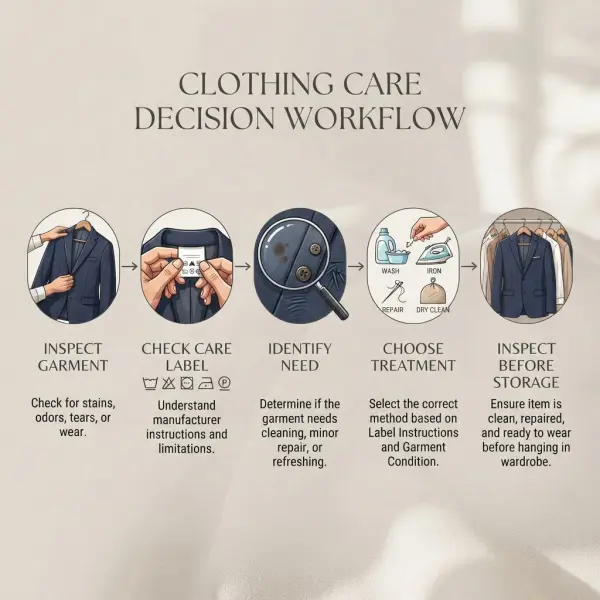
Garment maintenance is usually easier when small issues are noticed continuously. Checking clothing while dressing, laundering, folding, or returning it to the wardrobe creates several natural opportunities to identify stains, loose trims, damaged seams, or distortion before they become severe.
A simple recurring routine might include:
- checking pockets, closures, surface damage, and visible stains before cleaning;
- reviewing the care label when handling an unfamiliar garment;
- separating items that need specialized treatment from ordinary laundry;
- inspecting seams, buttons, hems, and fasteners before returning garments to regular rotation;
- ensuring items are clean and appropriately dry before longer-term storage.
The point is not to create more domestic work. It is to move maintenance earlier, when corrective action tends to be simpler.
Clothing Care Is Not One-Size-Fits-All
The same habit can produce different results across garment categories because construction changes what is vulnerable. The table below is therefore best read as a decision guide rather than as a substitute for individual care instructions.
|
Garment type |
What may require extra attention |
Practical care mindset |
|
Basic cotton or blended T-shirts |
Surface appearance, print, neckline shape, color |
Avoid assuming every T-shirt tolerates the same treatment; check prints, blends, and label instructions |
|
Knitwear |
Shape, snagging, pilling, dimensional change |
Minimize unnecessary distortion and support the garment according to its weight and construction |
|
Denim |
Color change, abrasion, trims, fit |
Clean according to actual wear and care instructions rather than following a universal wash-frequency rule |
|
Stretch activewear |
Elastic components, finishes, body soil |
Hygiene matters, but treatment should still follow the garment's permitted temperatures and processes |
|
Tailored garments |
Outer fabric, lining, interfacing, structure |
Treat the assembled garment as a system; the shell fabric alone does not determine care |
|
Embellished or decorated garments |
Beading, embroidery, prints, coatings, attachments |
Decorative components may determine the safest process even when the base textile seems robust |
This variation also explains why care communication should begin during product development. The person purchasing a garment sees the finished article, not a bill of materials describing every component. Brands therefore need to translate the product's real care constraints into instructions that remain understandable after purchase.
Why "Wash Less" Is Too Simple as a Longevity Rule
Reducing unnecessary laundering can be sensible, but "wash everything as little as possible" is not a technically complete care strategy. Clothing performs different functions, and some categories accumulate body oils, sweat, soil, microorganisms, or contaminants much more rapidly than others.
A lightly worn outer layer might reasonably return to the wardrobe without a full wash when it remains clean and the label permits appropriate freshening practices. An undergarment worn directly against the body is a different situation. Sportswear used during strenuous exercise, children's clothing, food-service uniforms, healthcare-related garments, or items exposed to specific contaminants can also have cleaning requirements that outweigh a simplistic objective of minimizing wash cycles.
The more useful question is: Does this garment need cleaning now, and what is the least damaging appropriate method for its current condition?
This approach reconciles hygiene with longevity rather than pretending one should always override the other.
What Clothing Care Cannot Fix
Good maintenance can help a garment remain usable, but it cannot compensate indefinitely for weak materials, unstable construction, inappropriate components, or poor product engineering. A seam that was inadequately constructed, fabric with low abrasion resistance for its intended use, an unsuitable trim, or a finish with poor durability may fail even under careful ownership.
This limitation matters because durability should not be shifted entirely onto consumers. WRAP and LITAC's durability work measures characteristics such as wash performance, dimensional stability, pilling, abrasion, tearing, and tensile performance specifically because longevity begins with product design and verification.
It also challenges the assumption that paying more automatically buys a longer-lasting product. In WRAP's UK durability research, price was not found to be a reliable predictor of durability, and its T-shirt testing found no simple correlation between higher price and stronger durability performance. Those findings relate to the tested product sets and should not be interpreted as proof that price never reflects quality; they show that price alone is not sufficient evidence of durability.
Common Clothing Care Mistakes That Can Shorten Useful Garment Life
Assuming Fiber Content Is the Same as a Care Instruction
Fiber composition provides useful information, but it does not describe every part of a finished garment. Dyes, blends, prints, linings, interfacings, coatings, elastics, decorative components, and manufacturing processes may alter the permitted care method. The better approach is to use fiber information as context while treating the garment's tested care instructions as the operational reference.
Using the Strongest Permitted Treatment Every Time
A maximum permitted temperature or treatment is not necessarily a recommendation to use that level for every care cycle. GINETEX explicitly frames its care symbols around maximum permitted treatment and allows milder treatment within its system. Choosing care according to the actual cleaning requirement can avoid exposing clothing repeatedly to unnecessary intensity.
Waiting Until Minor Damage Becomes Obvious
A loose hem or partially detached button can seem too insignificant to address, especially when the garment remains wearable. The problem is that continued use may increase stress around the damaged area. Periodic inspection and early repair can be more practical than waiting until a small repair becomes a larger reconstruction.
Copying Care Advice From a Similar-Looking Garment
Two black dresses may appear almost identical while differing in fiber blend, lining, adhesive construction, surface finish, embellishment, and colorfastness. Visual similarity therefore does not establish care compatibility. Product-specific instructions should override routines copied from another item.
Treating Care as Entirely the Customer's Responsibility
Fashion businesses sometimes communicate durability as a promise but provide little post-purchase guidance. That creates an operational gap: the product may have been carefully tested, but the customer does not necessarily understand how to preserve its performance.
Better care communication can include readable labels, product-page instructions, troubleshooting guidance, repair information, replacement components where appropriate, and customer-service knowledge. These measures do not guarantee longer use, but they make correct maintenance easier.
How Fashion Brands Can Turn Garment Care Into Better Product Support
For fashion businesses, clothing care should begin before the care label is printed. Product development teams need to understand how fabrics, trims, seams, prints, finishes, and assembled garments respond to the care process being recommended. Where relevant, testing should reproduce realistic repeated treatment rather than considering only a new sample's appearance.
The FTC's U.S. rule illustrates this principle particularly clearly: covered companies are required to have a reasonable basis for their stated care instructions, and that evidence can include testing, technical literature, previous experience, or other reliable evidence. Regulatory requirements differ by market, but the broader product-development lesson travels well—care claims should be substantiated rather than guessed.
Brands can then turn validated care information into several customer touchpoints:
- Product pages: explain unusual or important care requirements before purchase, particularly when they affect convenience.
- Permanent labels: provide the required and technically appropriate instructions in a form that remains available during use.
- Post-purchase guidance: clarify issues such as stain treatment, reshaping, repair, or handling when the garment needs more explanation than a small label can provide.
- Customer service: give teams access to product-specific care information instead of relying on generic laundry advice.
- Repair support: where commercially practical, offer spare components, simple repair instructions, alteration guidance, or repair services.
The commercial value is not simply that "sustainable customers like care tips." Clear guidance can help set realistic ownership expectations. A consumer deciding between an easily washable everyday garment and an item requiring specialist care may reasonably value that information before purchase.

Care Guidance Should Be Specific Enough to Help, but Simple Enough to Follow
There is a tension in care communication. A garment may have technically complex requirements, while a customer usually needs an instruction that can be understood within seconds. Adding more information does not automatically improve compliance if the result becomes confusing or contradictory.
A good hierarchy is to separate mandatory or essential treatment limits from optional longevity guidance. The care label can communicate the core process, while a product page, QR-linked guide, packaging insert, or support article can explain why certain practices are recommended.
Brands should also be careful not to turn routine care advice into unsupported sustainability claims. A recommendation to repair, use garments longer, or avoid unnecessary treatment can support longevity, but the environmental impact of a specific garment still depends on material production, manufacturing, logistics, use patterns, energy systems, actual lifespan, and end-of-life outcomes.
WRAP's UK research nevertheless provides useful directional evidence for why longevity matters. Its clothing longevity work has estimated meaningful reductions in carbon, water, and waste footprints when garments remain in active use longer. These figures are modeling results for specific UK assumptions rather than universal savings that can be attached automatically to every garment. WRAP extending clothing life research
The broader relationship between care, resource use, purchase behavior, and fashion consumption is explored further in why garment care is becoming part of conscious style.
What Brands and Consumers Should Verify Before Acting
Clothing care advice works best when it begins with the actual product rather than a broad fabric stereotype. Before choosing a treatment, consumers and fashion teams should verify the information that materially changes the decision.
Useful checks include:
- the permanent care instructions and any garment-specific warnings;
- whether the garment contains lining, interfacing, elastic, prints, coatings, embellishment, or detachable components;
- whether the problem is general soil or a localized stain;
- whether the garment genuinely needs full cleaning;
- whether a minor defect can be repaired before further wear enlarges it;
- whether professional cleaning or specialist advice is specified;
- whether advice found online applies to the complete garment or merely to a generic fiber category.
These checks are intentionally simple. Longevity does not require consumers to become textile technicians. It requires enough product awareness to avoid the most preventable care errors.
Important Technical Caveats
Care advice is always conditional on the garment. Fiber content alone does not establish safe temperatures, cleaning chemistry, drying methods, or pressing conditions. When a care label conflicts with generic advice, the garment-specific instruction normally deserves priority because it is intended to reflect the finished product.
"Milder" also does not automatically mean "effective enough." Lower temperature, less mechanical action, or spot treatment may protect a textile surface but may not adequately address heavy soil, oil, odor, biological contamination, or particular occupational hygiene requirements. Care must balance garment preservation with the actual purpose of cleaning.
Finally, care labels should not be mistaken for durability ratings. GINETEX explicitly notes that care labeling is not a guarantee of product quality. A label explains permissible care; it does not establish how many wear or cleaning cycles the garment will withstand before its performance becomes unacceptable.
Frequently Asked Questions About Clothing Care and Garment Longevity
Does Washing Clothes Less Often Always Make Them Last Longer?
No. Avoiding unnecessary laundering can reduce repeated exposure to water, detergents, heat, and mechanical action, but wash frequency must still reflect hygiene, soil, garment type, and use conditions. Underwear or heavily perspired activewear has different requirements from a jacket worn briefly over other clothing. A better longevity habit is to evaluate whether cleaning is needed and then use an appropriate process according to the care label rather than applying a universal "wash less" rule.
Is Cold Washing Always Better for Clothes?
Not universally. Lower-temperature treatment can be milder for many garments when permitted by the care instructions, but temperature is only one part of laundering and the necessary cleaning conditions depend on the garment and type of soil. Some articles have specific hygiene or cleaning requirements, while others are highly sensitive to heat. GINETEX's system treats the stated temperature as a maximum permitted treatment, but an effective care decision should still consider cleanliness and the complete garment rather than temperature alone.
Can I Decide How to Wash a Garment Just From Its Fiber Content?
Fiber composition is useful, but it is not enough. A finished garment can contain several fibers plus dyes, elastics, prints, linings, interfacings, coatings, zippers, buttons, adhesives, or decorative elements. Any of those components may affect the appropriate treatment. This is why both GINETEX guidance and regulatory approaches such as the U.S. FTC Care Labeling Rule treat care as an issue concerning the finished article rather than simply the primary fiber.
Does Expensive Clothing Usually Last Longer?
Price alone is not a reliable durability measure. Recent WRAP and Leeds Institute of Textiles and Colour research found that price did not consistently predict physical durability across the garments they tested, including a dedicated study of T-shirts. That does not mean construction quality or materials never affect price or performance. It means consumers and brands should evaluate durability through relevant product characteristics and testing rather than assuming a higher retail price automatically produces a longer service life.
Should Small Holes, Loose Buttons, and Open Seams Be Repaired Immediately?
Early attention is usually sensible when the garment is otherwise serviceable. Continuing to wear an item with a loose button, opening seam, or small tear may allow stress to spread and make repair more complicated. The appropriate repair depends on the fabric, construction, location, and intended use, so not every defect should be handled with the same technique. Where safety, waterproofing, protective performance, or specialist construction is involved, professional repair or replacement may be more appropriate.
Are Care Labels a Guarantee That a Garment Is High Quality?
No. A care label communicates permitted or required care; it does not certify overall garment durability or construction quality. GINETEX states explicitly that care labeling is not a guarantee of quality. A product can have perfectly accurate washing instructions yet perform poorly in abrasion, pilling, seams, fit retention, or other durability characteristics. Brands that want to make durability claims therefore need additional product testing rather than relying on the presence of care symbols alone.
What Is the Most Important Clothing Care Habit for a Beginner?
Start by checking the garment before treating it. Read the care label, determine whether full cleaning is actually required, identify stains or damage, and then choose the least aggressive suitable process within the permitted instructions. This single habit prevents many common mistakes because it replaces automatic treatment with garment-specific judgment. Over time, consumers can add more detailed knowledge about fabrics, stain care, repairs, drying, and storage without needing to memorize every possible textile rule at once.
Conclusion: Longer Garment Life Begins With Better Decisions, Not More Complicated Care
Good clothing care does not mean creating elaborate maintenance routines for every piece in a wardrobe. It means understanding that garments experience cumulative physical and chemical stress, then avoiding treatment that is unnecessary, unsuitable, or more aggressive than the product requires.
The care label provides the technical starting point. From there, practical habits—checking whether cleaning is necessary, treating stains appropriately, limiting avoidable friction and heat, maintaining shape, repairing minor damage early, and preparing garments properly for storage—can help preserve usability and appearance.
The responsibility is shared. Consumers influence what happens to clothing after purchase, while brands influence durability through material choice, construction, product testing, care labeling, and post-purchase support. Neither side can fully compensate for weaknesses on the other.
For fashion businesses, that makes garment care more than an after-sales footnote. It is part of the product experience. A garment designed to last should also be realistic to maintain, and customers should receive enough information to keep it functioning as intended.
The most credible longevity strategy therefore combines durable product design with understandable, garment-specific care. That is far more useful than promising that one laundry rule, one fiber, one price point, or one sustainability message can make clothing last indefinitely.




Comments 0
Leave a CommentSend Comment
Anda harus Login terlebih dahulu untuk dapat memberikan komentar.