
How Fewer Clothing Pieces Can Create More Outfit Options
A wardrobe does not need a large number of garments to produce a large number of usable outfits. What matters more is how well individual pieces connect with one another. When tops, bottoms, layers, footwear, and accessories share enough compatibility in color, silhouette, formality, and function, a relatively compact wardrobe can support considerably more combinations than its item count might suggest.
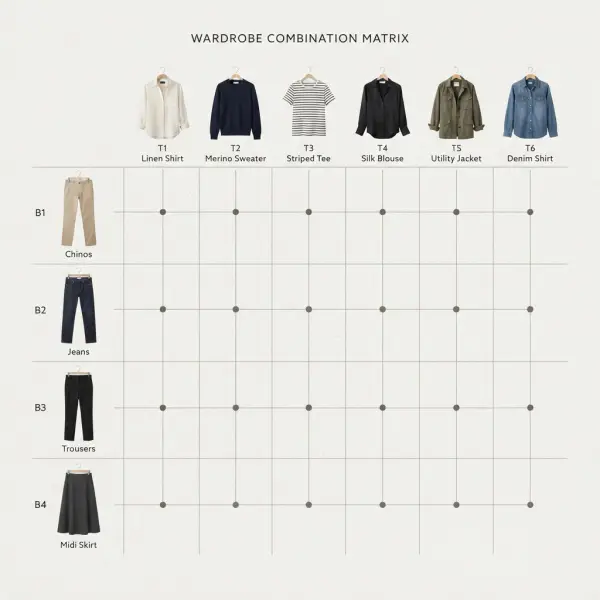
The principle sounds mathematical, and part of it is. Six tops and four bottoms create up to 24 different top-and-bottom pairings before jackets, shoes, or accessories are considered. But fashion is not pure combinatorics. A pairing that exists mathematically may fail in practice because the proportions look awkward, the fabrics belong to different seasons, the colors clash, or one garment requires footwear that does not work with the other.
The real opportunity is therefore not simply to own fewer pieces. It is to improve the number of useful relationships between the pieces already in the wardrobe.
That distinction is central to capsule wardrobe planning. A compact collection becomes versatile when garments are selected not only for their individual appeal but also for what they can do collectively.
Quick Answer: How Can Fewer Clothes Create More Outfits?
Fewer clothing pieces can create more outfit options when a high proportion of those pieces can be combined with several others. A wardrobe containing six compatible tops and four compatible bottoms has a theoretical maximum of 24 basic top-and-bottom combinations. If two useful outer layers can work across those outfits, the number of possible styling variations increases further.
The important word is compatible.
Ten unrelated garments do not automatically produce a versatile wardrobe. A statement blouse that works with only one skirt adds fewer practical combinations than a simpler shirt that works with four different bottoms, under two jackets, and with several shoe options.
This is why outfit planning is better understood as a network rather than a garment count. Every useful connection between garments expands the wardrobe’s potential. Color consistency helps, but so do silhouette, proportion, fabric weight, formality, climate suitability, and comfort.
The goal is not to maximize mathematical combinations for their own sake. It is to create enough genuinely wearable combinations that the wardrobe supports everyday life without requiring constant new purchases.
Outfit Variety Comes From Relationships Between Garments
A wardrobe is often counted item by item. From a styling perspective, however, its usefulness is better understood through relationships.
Imagine two wardrobes that each contain 12 garments.
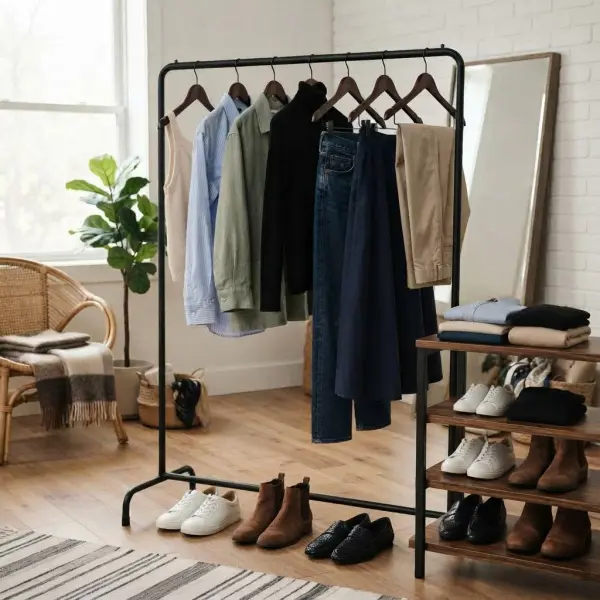
The first contains individually striking pieces purchased at different times: a patterned blouse that needs a specific skirt, cropped trousers that work with only one pair of shoes, a formal blazer that looks awkward over the casual tops, and several garments with incompatible color palettes.
The second wardrobe contains pieces chosen with more deliberate relationships. Its trousers work with most of the tops. A lightweight jacket works with trousers, a skirt, and a dress. Two different shoe options suit most of the silhouettes. A few stronger colors add personality without becoming isolated from the rest.
Both wardrobes contain 12 garments, yet their functional outfit capacity can be very different.
“Functional outfit capacity” is not a formal fashion-industry metric; here it is simply a useful way to describe the number of combinations a person would realistically consider wearable. That qualification matters because counting every possible mathematical combination can produce impressive-looking numbers that have little connection with real dressing.
A successful wardrobe therefore contains enough links between garments. The more useful links a piece has, the more work it can perform without necessarily looking repetitive.
The Basic Mathematics of Mix-and-Match Dressing
The simplest outfit combination involves one top and one bottom.
If every top works with every bottom, the theoretical number of basic combinations is:
Number of tops × number of bottoms = maximum basic combinations
For example:
|
Tops |
Bottoms |
Maximum Top-Bottom Pairings |
|
3 |
3 |
9 |
|
4 |
3 |
12 |
|
5 |
4 |
20 |
|
6 |
4 |
24 |
|
7 |
5 |
35 |
This illustrates why outfit potential can grow faster than the number of garments being added. Moving from a wardrobe with four tops and three bottoms to five tops and four bottoms adds only two garments, but the theoretical number of top-bottom pairings rises from 12 to 20.
There is an important caveat: this multiplication works only when every item in one category is genuinely compatible with every item in the other category.
Suppose six tops and four bottoms theoretically create 24 pairings. If half of those combinations are unsuitable because of color, proportion, formality, temperature, or comfort, the wearer does not really have 24 useful outfits. The practical number is closer to 12.
This is why compatibility can matter more than quantity.
One highly compatible garment can outperform several isolated purchases
Consider a wardrobe with four bottoms. Adding one new shirt that works comfortably and visually with all four creates four new basic outfit possibilities.
Now imagine buying a different shirt that only looks right with one of those bottoms. It adds one useful combination.
Both purchases increase the wardrobe by exactly one garment, but their practical contribution differs substantially.
This does not mean every purchase should maximize compatibility. Statement pieces, occasionwear, experimental fashion, and emotionally meaningful garments have legitimate roles. The point is that when versatility is the objective, evaluating relationships produces better information than simply counting new items.
This is the mechanism behind the capsule wardrobe approach to modern everyday dressing: wardrobe efficiency comes partly from selecting pieces that participate in multiple realistic outfits rather than operating as isolated looks.
Why “Maximum Possible Outfits” Can Be Misleading
Fashion content often presents formulas such as “10 items create 30 outfits” or “20 pieces create 100 looks.” These claims may be mathematically possible, but they should be interpreted carefully.
Consider a blouse, running shorts, tailored blazer, evening skirt, and hiking shoes. They technically create multiple combinations if every item is paired mechanically with every other item. Few people would regard all of those pairings as useful outfits.
Real-world outfit compatibility depends on several dimensions:
- Color compatibility: whether colors and prints can be combined intentionally.
- Silhouette compatibility: whether lengths, volume, waist position, and overall proportions work together.
- Formality compatibility: whether pieces belong to similar or intentionally complementary dress contexts.
- Climate compatibility: whether fabrics and layers make sense under the same weather conditions.
- Functional compatibility: whether an outfit supports the wearer’s actual activity.
- Footwear compatibility: whether trouser lengths, skirt proportions, and garment formality work with available shoes.
- Personal compatibility: whether the wearer actually feels comfortable and recognizable in the combination.
An outfit planner should therefore distinguish between a theoretical combination and a wearable combination.
That distinction protects capsule wardrobe planning from becoming a numbers exercise. A wardrobe of 15 carefully interconnected pieces may be more useful than a supposedly optimized 20-piece collection if the latter contains garments the owner rarely wants to combine.
Compatibility Begins With Silhouette, Not Just Color
Color is the easiest form of compatibility to see, which is why capsule wardrobe advice often focuses heavily on palettes. But silhouette frequently determines whether two garments actually work together.
A wide, long shirt may pair naturally with narrow trousers but overwhelm a full maxi skirt. A cropped fitted top may balance high-waisted wide-leg trousers but feel awkward with a low-rise straight skirt. An oversized knit can work over a slim dress yet become uncomfortable beneath a closely fitted jacket.
These interactions mean that a wardrobe can have a perfectly coordinated color palette and still offer limited outfit variety.
A practical capsule should therefore contain silhouette bridges: garments whose proportions connect different parts of the wardrobe. A moderately fitted shirt may work tucked into a wide skirt, worn loose with slim trousers, and layered underneath a jacket. A versatile trouser rise may accommodate both cropped and longer tops.
Footwear belongs in this system too. Wide trousers hemmed for sneakers may not fall correctly over high heels. A midi skirt can feel entirely different with boots, loafers, sandals, or athletic shoes. If every bottom requires a different shoe architecture, apparent wardrobe versatility can shrink quickly.
The strongest mix-and-match wardrobes therefore have compatibility at several levels simultaneously rather than relying on a single neutral color palette.
A Core Color System Makes Combinations Easier
Color still matters because it can substantially reduce friction between pieces.
A capsule does not need to be beige, black, white, or otherwise neutral. What it benefits from is a repeatable color logic.
One person might use navy, cream, denim blue, olive, and rust. Another might prefer black, cobalt, red, white, and gray. A third could build around warm earth tones and patterned textiles. Each can work when colors repeat often enough that new pieces connect with several existing ones.
One practical model is to separate colors into three roles:
- Core colors appear across high-use pieces such as trousers, skirts, jackets, or footwear.
- Supporting colors coordinate with multiple core colors and provide variety.
- Accent colors or prints contribute personality without needing to dominate the wardrobe.
The objective is not to create a rigid palette. It is to prevent accidental isolation.
A bright green blouse can be highly versatile if it works with navy trousers, denim, a printed skirt, and a cream jacket. A beige top can be surprisingly limited if its undertone clashes with most of the wearer’s existing colors or if its silhouette works with only one bottom.
Color should therefore be evaluated as part of the whole outfit system rather than treated as shorthand for versatility.
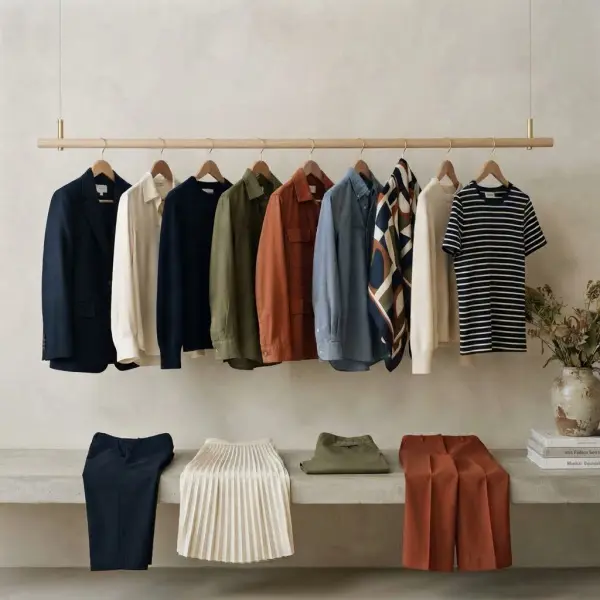
Category Balance Changes Outfit Potential
Adding garments indiscriminately does not produce the same result as adding them strategically.
Suppose a wardrobe contains ten tops but only two bottoms. If every piece is compatible, it offers 20 basic top-bottom combinations.
A wardrobe with six tops and four bottoms contains the same total number of garments—ten—but offers up to 24 basic combinations.
This happens because outfit potential depends partly on the balance between categories. When one category becomes extremely large while another remains very small, each additional piece may contribute less new variety.
The principle becomes useful when identifying wardrobe gaps. Someone who repeatedly buys tops may believe the wardrobe needs more variety when the actual constraint is the small number of useful bottoms. Adding another top simply creates more competition within an already crowded category.
A wardrobe audit can reveal these bottlenecks.
Instead of asking, “Which category do I like shopping for?”, ask, “Which category currently limits the outfits I can assemble?”
That question often leads to different purchasing decisions.
The bottleneck may not be clothing
Sometimes the limiting category is footwear, outerwear, or even underwear rather than tops and bottoms.
A person may have several dresses but only one pair of shoes appropriate for them. Another may own many office outfits that become unusable during wet weather because there is no practical outer layer. A light-colored trouser may remain unworn because the wearer lacks suitable undergarments.
These examples are mundane, but they reveal an important principle: wardrobe systems often fail at their least glamorous connection.
Buying another statement garment does not fix that.
A practical capsule therefore looks for constraints across the whole dressing process, including support garments, footwear, bags, coats, and other functional items when those categories determine whether clothing can actually be worn.
Layering Multiplies Variation Without Replacing the Base Outfit
Layering is one of the most effective ways to create visible variation from the same base clothing.
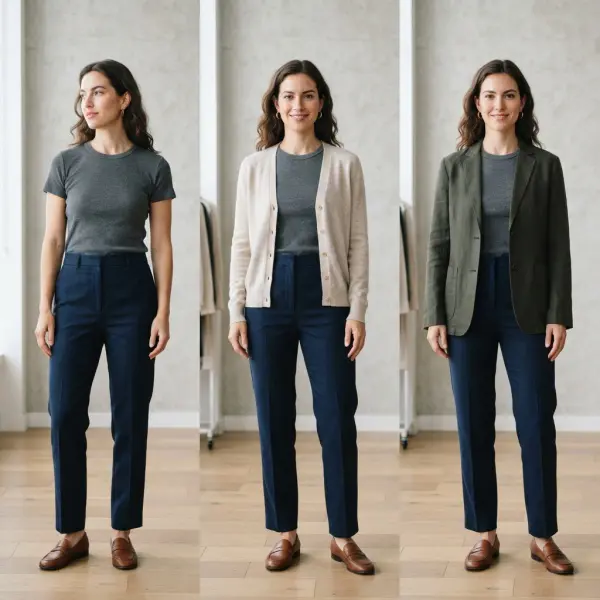
A shirt and trousers can be worn alone, beneath a cardigan, with a jacket, under an overshirt, or combined with weather-specific outerwear. Depending on the garment, the layer can change color balance, texture, formality, and silhouette enough that the outfit reads differently even though most of the underlying pieces remain the same.
The mathematics expands quickly. If 20 top-bottom combinations can each be worn either without an additional layer or with one of two compatible layers, there are theoretically 60 configurations:
20 base combinations × 3 layer states = 60 possibilities
The three states are no layer, layer A, or layer B.
Again, 60 should not be presented as 60 guaranteed outfits. A jacket may be too warm for certain days, one cardigan may not suit every top, and some combinations may look nearly identical. The calculation simply illustrates why a small number of strategically chosen layers can contribute disproportionate variety.
This is particularly valuable during transitional weather or in environments where indoor and outdoor temperatures differ significantly.
Accessories Change the Reading of an Outfit, but Not Every Accessory Creates a New Outfit
Accessories are another common source of wardrobe variation, but their contribution is easy to exaggerate.
A belt can alter waist emphasis. A scarf can add color near the face. Jewelry changes visual detail. Bags and footwear can move the same clothing toward casual, professional, evening, or travel contexts.
Yet changing earrings alone does not necessarily create a meaningfully different outfit.
For practical wardrobe planning, it is more useful to ask whether an accessory changes the visual or functional interpretation of the clothing. Replacing sneakers with polished loafers may substantially change how a trouser-and-shirt combination works. Switching between two very similar black bags may not.
This distinction helps prevent inflated outfit counts. The point is not to manufacture a large number for social media or a capsule challenge. It is to identify styling changes that genuinely extend the situations in which garments can be worn.
Accessories are especially effective when the clothing foundation is relatively coherent. They can introduce trend elements, stronger colors, texture, or occasion-specific character without requiring every seasonal change to happen through major garment purchases.
Repeating a Garment Is Not the Same as Repeating an Outfit
One reason people overestimate the amount of clothing they need is that repeating individual garments and repeating complete outfits are often treated as the same thing.
They are not.
The same navy trouser worn Monday with a white shirt and loafers, Wednesday with a knit top and sneakers, and Friday with a printed blouse and jacket creates three different outfit contexts while repeating one foundational garment.
Likewise, a jacket can appear several times per week over different bases without making each look identical.
This matters because high-use garments are precisely what make a compact wardrobe function. A capsule becomes inefficient if every piece is expected to wait for a long period before being worn again.
Research into clothing use has repeatedly drawn attention to underutilisation. The Ellen MacArthur Foundation’s A New Textiles Economy reported that global clothing utilisation—the average number of times a garment was worn before ceasing to be used—declined substantially over the 15-year period examined in the report. WRAP has likewise examined the active life of clothing and identified multiple reasons garments fall out of regular use, including changing fashions, body changes, special-occasion use, durability, and clothing-care knowledge.
Those findings do not prove that a capsule wardrobe automatically increases garment utilisation. They do, however, reinforce why actual wear matters more than wardrobe size alone.
Outfit Repetition Can Be Deliberate
There is no requirement to generate a different outfit every day simply because more combinations are technically available.
For some people, repeating a highly successful combination is a feature rather than a failure.
Work uniforms demonstrate the extreme version of this principle. More casually, someone may discover that particular trousers, shirt proportions, and footwear consistently feel right and build variations around that formula.
Vogue has even discussed outfit repeating through a simple mix-and-match example in which three similar trousers and four shirts provide more than 12 potential combinations, illustrating how repeated garment categories can still support multiple looks.
A personal outfit formula might be:
wide trousers + fitted top + light layer
or:
midi skirt + relaxed shirt + flat footwear
or:
straight jeans + knit + structured jacket
Once a useful formula is understood, variation can happen within it. Colors, fabrics, layers, and accessories change while the underlying proportions remain dependable.
This can be more realistic than trying to make every garment radically different.
The Most Versatile Piece Is Not Always the Plainest Piece
“Versatile” is frequently used in fashion marketing to describe neutral basics. But neutrality is only one source of versatility.
A striped shirt may work across more outfits than a plain beige blouse. A red cardigan may coordinate with most of a particular wardrobe. A printed skirt may connect multiple core colors and become one of the easiest pieces to style.
The relevant question is not whether a garment looks simple in isolation. It is whether it forms useful relationships with the rest of the wardrobe.
This distinction is especially important for brands. If versatility becomes synonymous with generic design, every capsule-oriented collection begins to look the same. Product differentiation weakens, and the consumer is offered another assortment of nominal “essentials” rather than products that complement a particular style identity.
Design teams can instead pursue recognizable versatility: garments with distinctive proportions, textiles, details, or colors that remain easy to integrate into several outfits.
That is a more demanding product-development challenge, but also a more commercially meaningful one.
How Fashion Brands Can Design for Outfit Compatibility
The mix-and-match principle has practical implications beyond personal wardrobe organization.
For fashion brands, a product does not exist only on its own product detail page. It exists in relationship with the rest of the assortment and, more importantly, with clothing the customer already owns.
Brands can support outfit compatibility in several ways.
First, color continuity across product groups can make cross-category styling easier. A jacket introduced in one delivery may still coordinate with trousers or skirts from another. This does not require reproducing identical colors indefinitely; it requires enough continuity for collections to communicate with one another.
Second, fit architecture matters. If tops, bottoms, and outerwear are developed independently without considering shared proportions, a collection can appear coherent on a line sheet but become difficult to style on real bodies.
Third, merchandising imagery can show products in multiple legitimate contexts. A blouse could appear tucked into tailored trousers, worn open over a casual base, and paired with a skirt. Such content gives customers more information than simply showing three poses of the same complete look.
Fourth, product descriptions can explain compatibility without making exaggerated claims. Useful information might address garment length, whether a shirt can be tucked comfortably, what degree of layering an outerwear piece accommodates, or which product families share a color story.

Build collections as connected product families
A brand that repeatedly changes every fit, color, textile, and silhouette can make prior purchases harder to integrate with new releases.
In contrast, maintaining selected continuity can create connected product families. A core trouser block may return in several materials. Shirts may evolve while retaining proportions that work with established bottoms. New seasonal colors can be selected partly for compatibility with existing core products.
This does not mean freezing design development. Fashion businesses still need novelty, creative direction, and reasons for customers to engage with new collections.
The strategic distinction is between novelty that extends the wardrobe and novelty that makes previous products feel obsolete.
That distinction becomes increasingly relevant when a brand wants customers to build a longer relationship with its products rather than treating each collection as a complete replacement.
Styling content can become part of product utility
Mix-and-match potential is difficult to communicate through a single product image.
A customer viewing a jacket may see the construction and color but still wonder whether it works with dresses, denim, tailored trousers, or casual knitwear. Showing several realistic applications can reduce that uncertainty.
This creates useful content opportunities for retailers:
- one piece styled for several activities;
- one bottom paired with different top proportions;
- a core outfit moved between casual and polished contexts;
- seasonal layering around the same foundational garments;
- new arrivals styled with previous collections.
The objective should not be to inflate an artificial “20 ways to wear it” claim. A smaller number of convincing combinations can be more valuable because they show the garment functioning in scenarios customers can actually recognize.
A Practical Framework for Increasing Outfit Options
Consumers do not need to calculate every possible permutation of their wardrobes. A simple compatibility review is usually enough.
Start by selecting one high-use garment, such as a pair of trousers, and place it against the available tops. Count only combinations you would realistically wear.
Then add layers and footwear.
Repeat the exercise with other foundational pieces. Patterns begin to emerge quickly: some garments connect throughout the wardrobe, while others repeatedly sit outside the system.
A practical review can follow five questions:
- How many existing pieces genuinely work with this item? Count combinations you would actually wear, not hypothetical pairings.
- Does it work across more than one context? A piece may move between work, casual, travel, or social settings without needing to cover all of them.
- Does the silhouette connect with existing proportions? Check length, volume, waist placement, and layering.
- Does it require additional purchases before it becomes usable? A garment that needs new shoes, underwear, outerwear, and accessories may be less versatile than it initially appears.
- Does it add a missing relationship? The best addition may be the piece that connects several garments currently difficult to style.
This process shifts wardrobe planning away from acquisition and toward system improvement.
It also provides a clearer foundation for the consumption questions explored in why wardrobe planning supports smarter fashion consumption.
Common Mistakes When Trying to Create More Outfits
Mistake 1: Counting combinations that would never actually be worn
A spreadsheet may show 50 possible combinations, but that number has little value if half of them feel wrong because of color, proportion, climate, or context. This usually happens when capsule planning prioritizes quantity metrics over real dressing. The better approach is to count only outfits that pass a basic wearability test: suitable fit, reasonable function, appropriate season, and a combination the wearer genuinely likes.
Mistake 2: Buying more tops when bottoms are the real bottleneck
Tops are often easy and enjoyable to buy, which can produce a wardrobe containing many shirts or blouses but very few dependable bottoms. Each new top then adds limited novelty because it is repeatedly paired with the same one or two trousers. Reviewing category balance can reveal whether another purchase actually expands outfit capacity or simply increases duplication in an already crowded category.
Mistake 3: Assuming matching colors guarantee compatibility
A navy top and navy-compatible trousers may still fail together if both have excessive volume, the lengths conflict, or the level of formality differs dramatically. Color coordination is only one layer of outfit compatibility. Silhouette, fabric weight, garment structure, footwear, and movement need to be considered at the same time.
Mistake 4: Making every garment extremely basic
Reducing everything to generic essentials can create a wardrobe that is technically interchangeable but visually uninteresting to the person wearing it. If that dissatisfaction leads to frequent novelty purchases, the system is not working particularly well. Strong capsules can include prints, texture, distinctive cuts, and accent colors as long as enough relationships remain between pieces.
Mistake 5: Treating every styling change as a completely new outfit
Changing earrings or switching between two nearly identical bags may produce a variation, but it does not necessarily create a meaningfully different look. Inflated combination counts can make wardrobe planning seem more effective than it is. A more useful standard is whether the variation changes silhouette, color emphasis, function, formality, layering, or another feature noticeable enough to affect how the outfit works.
Mistake 6: Optimizing combinations but ignoring laundry and garment recovery
A tiny wardrobe can look efficient on paper yet fail if several high-use pieces are unavailable simultaneously because they require washing, drying, ironing, or specialist care. People who wash clothing less frequently may need more rotation than someone with easy access to laundry. Delicate garments may also need recovery between wears. Practical outfit capacity therefore depends on garment availability as well as combinatorial possibility.
This is where wardrobe planning connects with washing, drying, and storage practices, because maintenance determines whether high-use garments remain functional over time.
What Outfit Mathematics Cannot Tell You
Combinatorics can help explain why a well-connected wardrobe generates many possibilities, but it cannot determine whether those possibilities are good.
It cannot measure confidence.
It cannot determine whether a fabric feels unpleasant after several hours.
It cannot know that one shirt constantly comes untucked, that a skirt catches when walking, or that a jacket works visually but feels too hot during the commute.
Nor can arithmetic determine whether five different combinations feel psychologically different enough to satisfy the wearer.
These limits are important because wardrobe optimization can become overly abstract. The purpose is not to engineer the theoretically highest number of outfits from the fewest possible objects.
The purpose is to make everyday dressing work better.
For that reason, real wear remains the strongest test. Photographs, outfit logs, wardrobe apps, or simple notes can help identify which combinations repeatedly succeed. Over time, those observations provide better evidence than a theoretical matrix alone.
What Fashion Businesses Should Verify Before Marketing Versatility
“Versatile,” “mix-and-match,” and “wear it multiple ways” are attractive product claims, but brands should be able to demonstrate what they mean.
A convertible garment that technically changes configuration may not be practically versatile if adjustments are difficult or if only one version fits well. A supposedly foundational blazer may not layer over the brand’s own knitwear. A neutral trouser may have a hem length that works with only one type of footwear.
Before emphasizing versatility, product and merchandising teams should verify:
- whether claimed outfit combinations actually work on the body;
- whether proportions remain balanced across different pairings;
- whether colors continue to coordinate under real lighting;
- whether layers have enough physical ease;
- whether closures, straps, or convertible features are practical;
- whether the garment performs in the activities used to market it;
- whether care requirements are reasonable for the proposed frequency of wear.
The underlying principle is straightforward: versatility should be demonstrated through product performance and styling relationships, not merely asserted in copy.
For products positioned as repeat-wear essentials, durability also deserves attention. The Ellen MacArthur Foundation has highlighted greater clothing utilisation as an important part of keeping garments in use, while WRAP’s research on active clothing life shows that regular use can be disrupted by factors ranging from durability to changing body shape and care knowledge.
Fewer Pieces Do Not Automatically Mean Better Dressing
There is no inherent virtue in reaching the smallest possible wardrobe.
A person with 25 garments is not automatically more stylish, organized, or responsible than someone with 70. The larger wardrobe may contain specialized clothing for work, exercise, religious activities, travel, different seasons, or formal events. It may also consist largely of garments accumulated and retained for many years.
Likewise, a small wardrobe can still function poorly if garments are uncomfortable, incompatible, or replaced frequently.
The useful principle is not less at any cost.
It is more use from what is appropriate to own.
This distinction also separates the current question from the broader consumption discussion. Improving outfit compatibility can reduce perceived wardrobe gaps, but responsible fashion consumption involves additional issues such as purchasing frequency, garment lifespan, repair, care, resale, production impacts, and end-of-life decisions. Those deserve their own analysis rather than being collapsed into the assumption that small wardrobes are automatically sustainable.
Frequently Asked Questions
How many outfits can 10 pieces of clothing make?
There is no single answer because it depends on what the ten pieces are. If a wardrobe contains six tops and four bottoms and every top works with every bottom, it has up to 24 basic top-bottom combinations. Ten garments arranged as eight tops and two bottoms would produce only 16 such pairings. Jackets, dresses, footwear, and layering can expand the possibilities further. These numbers are theoretical maximums; the useful total is usually lower because some combinations will not work due to silhouette, weather, color, formality, or personal preference.
What makes one garment more versatile than another?
A versatile garment has several useful relationships with other items and can often function across more than one realistic context. Color matters, but versatility also depends on silhouette, fabric, comfort, layering potential, care requirements, footwear compatibility, and the wearer’s routine. A bright printed shirt may therefore be more versatile than a neutral shirt if it coordinates with more of the actual wardrobe. Versatility should be judged within a specific wardrobe rather than inferred from how basic a garment appears in isolation.
Is it better to have more tops or more bottoms?
Neither category is universally more important, but very unbalanced categories can limit combination potential. If someone owns many tops but only one or two useful bottoms, another top may add less practical variety than another compatible trouser or skirt. The best decision depends on the current wardrobe bottleneck. Rather than following a fixed ratio, identify which category most often prevents otherwise useful garments from becoming complete outfits.
Do dresses reduce mix-and-match options?
A dress creates a complete clothing base without requiring a separate top and bottom, so it behaves differently from separates in combination calculations. That does not make dresses less useful. A dress can still change through jackets, shirts worn above or below it when construction permits, footwear, belts, scarves, and accessories. Its value should therefore be assessed according to actual versatility and wear frequency rather than whether it generates as many mathematical permutations as separates.
Can colorful clothing work in a small mix-and-match wardrobe?
Yes. A compact wardrobe does not need a neutral palette. Colorful capsules work when colors have deliberate relationships—for example, when one accent shade coordinates with several core colors or when a print contains colors repeated elsewhere in the wardrobe. Difficulties arise when every colorful piece belongs to an unrelated palette and requires its own supporting garments. Coordination, not neutrality, is the underlying requirement.
Should every item work with every other item?
No. Requiring complete interchangeability can make a wardrobe unnecessarily restrictive and may remove expressive, formal, seasonal, or specialized garments that serve legitimate functions. A better objective is for high-use pieces to have several strong relationships while accepting that certain statement or occasion pieces may have fewer. The wardrobe should contain enough connectivity to make everyday dressing easy without forcing every garment into the same styling formula.
How can a fashion brand prove that a garment is versatile?
The clearest evidence is realistic styling. Brands can show the garment with several bottoms, layers, footwear types, or usage contexts while ensuring those combinations genuinely fit and function. Product copy can also provide useful information about length, fit, layering ease, fabric behavior, and coordination with other collection pieces. Showing four convincing applications is more credible than claiming dozens of combinations that customers cannot easily reproduce.
Conclusion
The relationship between wardrobe size and outfit variety is not as straightforward as it first appears.
More garments can create more theoretical combinations, but only when those garments connect. A large wardrobe containing isolated colors, incompatible silhouettes, duplicate categories, and pieces suited to very different contexts can produce surprisingly few dependable outfits. A smaller wardrobe built around strong relationships can do considerably more.
The mathematics helps explain why. Several compatible tops multiplied across several compatible bottoms quickly create multiple base outfits, while layers, footwear, and accessories add further variation. But the calculation is only the beginning. Real outfit potential depends on fit, proportion, climate, comfort, personal style, care, and whether someone genuinely wants to wear the result.
That is why the most useful wardrobe question is not “How many items do I own?” or even “How many outfits can these theoretically create?”
It is “How many useful relationships exist between the clothes I already have?”
For consumers, answering that question can expose genuine wardrobe gaps and reduce the habit of solving every styling problem through another purchase. For fashion businesses, it encourages a more sophisticated view of versatility—one based on coordinated product architecture, fit, styling evidence, and continuity between products.
Fewer pieces can create more options, but only when the pieces are designed, selected, and styled to work together.





Comments 0
Leave a CommentSend Comment
Anda harus Login terlebih dahulu untuk dapat memberikan komentar.