
Why Wardrobe Planning Supports Smarter Fashion Consumption
Wardrobe planning can support smarter fashion consumption because it changes the starting point of a clothing purchase. Instead of asking only, “Do I like this garment?”, the wearer also asks whether it fills a real need, works with existing clothes, suits everyday activities, can be cared for realistically, and is likely to receive enough use to justify bringing it into the wardrobe.
That does not mean a planned wardrobe is automatically sustainable. A small capsule replaced every few months can still involve substantial consumption, while a larger wardrobe accumulated slowly and worn for many years may remain highly functional. Environmental impact also depends on materials, manufacturing, laundering, repair, reuse, disposal, and many other factors that wardrobe organization alone cannot solve.
The more defensible claim is narrower: planning can reduce avoidable purchasing mistakes and make existing clothes easier to use.
That matters because fashion consumption is not shaped only by what people buy. It is also shaped by what they already own but cannot see, combine, maintain, or remember. A wardrobe filled with disconnected purchases can continue generating a feeling of “nothing to wear,” even when the physical quantity of clothing is already substantial.
Wardrobe planning addresses that gap by treating clothing as a system rather than a sequence of individual purchases.
Quick Answer: Why Can Wardrobe Planning Lead to Smarter Fashion Consumption?
Wardrobe planning supports smarter fashion consumption by giving people a clearer picture of what they already own, what they actually wear, and what is genuinely missing before they buy more clothing. It can reveal duplicate purchases, inactive garments, styling gaps, fit problems, and categories that are already overrepresented.
The benefit does not come from simply owning fewer clothes. It comes from making better-informed acquisition and use decisions.
A planned wardrobe can help someone recognize that another black blouse adds little value, while a missing lightweight layer could make several existing outfits more useful. It can show that a garment appearing difficult to wear does not need replacing; it may simply need alteration, different styling, or more appropriate footwear.
This can increase the likelihood that purchases are integrated into everyday dressing rather than becoming isolated items.
The sustainability implications should still be treated carefully. Wardrobe planning is not a guarantee of lower environmental impact. Its contribution depends on whether it genuinely leads to longer use, fewer unnecessary replacements, better garment care, repair, reuse, or reduced purchasing—not merely a more organized closet.

Fashion Consumption Starts Before the Checkout
Fashion consumption is often discussed at the moment of purchase: how much someone buys, where it was made, what material it contains, or whether it carries an environmental claim.
But purchasing decisions begin earlier.
They begin when someone opens a wardrobe and cannot immediately see a suitable outfit. They begin when an existing shirt is forgotten behind newer clothing. They begin when several trousers no longer fit properly but remain in the closet, creating the impression that the category is already covered. They begin when promotional imagery makes a new garment appear useful without showing whether it has any relationship with what the buyer already owns.
Wardrobe planning introduces information before that decision.
A person who knows which categories are crowded, which garments receive regular wear, and which outfit combinations repeatedly fail can evaluate new products differently. A new garment is no longer assessed only on its own merits. It is tested against an existing system.
This creates a simple but meaningful shift:
unplanned consumption asks whether an item is desirable; planned consumption also asks whether it is useful in context.
Those questions can lead to the same purchase. The difference is that the buyer has more information about why the purchase belongs in the wardrobe.
Why Underused Clothing Matters
Clothing does not deliver much practical value merely by existing in a wardrobe. Its usefulness depends substantially on whether it is actually worn.
Research from WRAP provides a useful illustration of this issue in the UK. Its 2022 clothing longevity research found that the average surveyed wardrobe contained 118 clothing items, including underwear, socks, and hosiery, and that approximately 26% had not been used during the previous year. The same research found that almost 23% of respondents said they regularly bought clothes intending to use them only for a short period. These are UK findings rather than universal global figures, but they demonstrate how ownership and active use can diverge. WRAP clothing longevity research
More recent WRAP research published in 2026 continues to examine clothing underutilisation and reuse behavior in the UK. It reports that 45% of UK citizens purchase clothing at least monthly and again identifies a group of consumers who regularly purchase items for relatively short-term use. WRAP research on clothing reuse and underutilisation
Wardrobe planning cannot remove every reason for underuse. Bodies change. Jobs change. garments wear out. Special-occasion clothing is naturally worn infrequently. Some purchases simply turn out differently from what the wearer expected.
But planning can expose the avoidable portion of the problem.
It can reveal clothes that are unused because the wearer forgot about them, lacks one connecting garment, dislikes the fit, does not know how to style them, or repeatedly buys replacements for functions already covered.
A Wardrobe Audit Changes What Counts as a “Need”
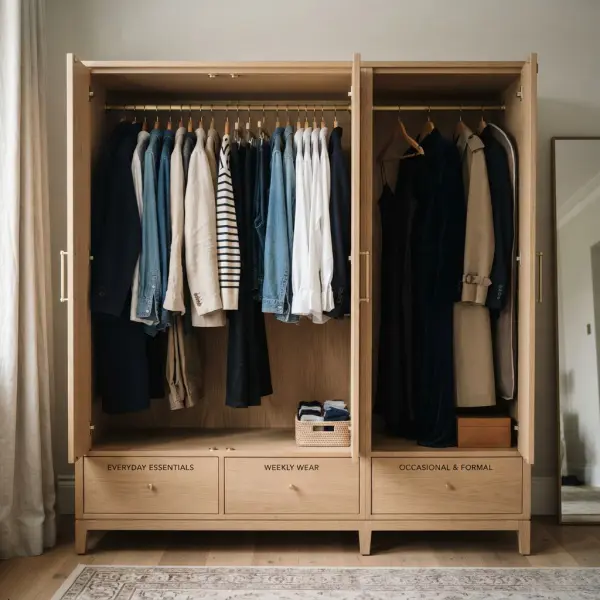
One of the most useful effects of wardrobe planning is that it separates perceived wardrobe gaps from actual wardrobe gaps.
A perceived gap might sound like, “I need more tops.”
An audit may reveal something different: the person already owns 18 tops, but most work with only two bottoms. The actual constraint could be poorly fitting trousers, unsuitable footwear, or a missing layer that prevents several tops from working in professional settings.
This is why the relationship between fewer clothing pieces and more outfit options matters. A wardrobe gap is not simply an empty product category. It is often a missing connection between clothes already owned.
The same process can reveal duplication.
Someone might own six similar black T-shirts because each purchase felt individually reasonable. Another might have several occasion dresses but very little clothing suited to ordinary weekdays. A third may repeatedly purchase jackets even though climate and commuting patterns mean those jackets receive little wear.
Planning makes these patterns visible.
That visibility can change consumption more effectively than an abstract instruction to “buy less,” because it gives the wearer a specific reason not to buy something—or a much clearer reason to buy something else.
Smarter Consumption Is Not the Same as Minimal Consumption
The phrase “smarter fashion consumption” should not be reduced to minimizing the number of garments owned.
A teacher, healthcare worker, frequent traveler, parent of young children, office worker, outdoor enthusiast, or person living across strongly contrasting seasons may have legitimate reasons for maintaining a larger wardrobe than someone with a more consistent routine.
Likewise, work uniforms, religious clothing, protective garments, formalwear, exercise clothing, and climate-specific items may each have limited interchangeability while remaining necessary.
The more useful objective is appropriate consumption.
That means considering whether the quantity and type of clothing correspond reasonably to actual life, whether products receive enough use for their role, and whether replacement happens because it is necessary rather than because the wardrobe has become difficult to understand.
This principle also prevents capsule wardrobe planning from becoming another purchasing trend. Replacing an existing wardrobe with a newly purchased set of coordinated “essentials” may produce an aesthetically cleaner closet, but it does not necessarily represent smarter consumption.
The better starting point is usually what is already there.
Planning Encourages a “Use First” Mindset
A wardrobe plan can move the decision sequence from:
want → buy → figure out how to wear
toward:
need or opportunity → check existing wardrobe → identify solution → buy only if necessary
The solution may still be a purchase. But it could also be styling, alteration, repair, care, rediscovery, borrowing, rental, resale, or simply deciding that the original gap is not important enough to solve.
For example, someone preparing for a wedding may initially assume a new outfit is necessary. A wardrobe review might reveal an existing dress that becomes appropriate with different shoes and tailoring. Another person beginning a new job may genuinely need additional work clothing because the current wardrobe does not meet the dress code.
Planning does not predetermine either outcome.
Its value is that the decision is made with better knowledge of existing resources.
This is also why fashion consumption cannot be improved only through product-level information. Fiber labels, certifications, country-of-origin information, durability claims, and environmental data can improve product evaluation, but consumers still need to know whether the product itself is necessary and whether they are likely to use it.
Cost Per Wear Can Be Useful—If Used Carefully
One simple way to think about wardrobe use is cost per wear:
purchase cost ÷ number of times worn = cost per wear
A $100 garment worn 50 times has a purchase-cost-per-wear of $2. A $20 garment worn twice has a purchase-cost-per-wear of $10.
The calculation is useful because it redirects attention from purchase price alone toward use. A more expensive product can provide strong economic value if it performs well and receives frequent wear, while a cheap garment can become expensive relative to use if it remains mostly inactive.
But cost per wear has limitations.
It does not measure environmental impact. It does not automatically capture alteration, cleaning, repair, storage, or resale value. It also does not mean every low-frequency garment is a bad purchase; occasionwear or specialized protective clothing may serve important functions even when worn only occasionally.
Nor does high cost guarantee longevity. WRAP’s recent durability work specifically cautions against assuming that price, fiber composition, or fabric weight alone reliably predicts clothing durability. WRAP durability research
Used thoughtfully, cost per wear is best treated as a reflection tool, not a sustainability score.
Garment Longevity Changes the Consumption Equation
Wardrobe planning becomes more meaningful when it is connected with garment longevity.
If a frequently worn trouser fails prematurely, the wardrobe needs another trouser. If a knit remains functional for years, replacement can be delayed. If a garment becomes unusable because of a broken zipper that could easily be repaired, disposal is not the only option.
This is where design quality and consumer behavior intersect.
WRAP’s durability work emphasizes that extending product life requires attention to product design, fabric and component performance, testing, quality assurance, and consumer use. Its Clothing Longevity Protocol addresses failure modes such as fading, pilling, and trim performance because these can cause garments to leave active use before consumers otherwise need to replace them. WRAP Extending Clothing Life Protocol
Planning therefore should not stop at deciding what to buy. It should also identify which garments perform foundational roles and deserve appropriate maintenance.
A pair of trousers worn twice a week has different maintenance significance from an occasional decorative piece. Care instructions, laundering frequency, drying method, storage, stain treatment, and repair can all influence whether high-use pieces remain available.
That relationship is explored in more detail in clothing care habits that help garments last longer.
Wardrobe Planning Can Slow Duplicate Purchasing
Duplicate purchasing is not always a mistake. Two similar white shirts may be entirely sensible for someone who wears white shirts frequently and needs laundry rotation.
The problem is unintentional duplication.
This occurs when shoppers buy another version of a product because they do not remember what they already own, cannot locate the original, or repeatedly respond to the same visual preference without recognizing the pattern.
Digital commerce can make this especially easy. A product appears independently on a screen, separated from the physical wardrobe it will eventually join. The consumer evaluates the garment against product photography and price rather than against the seven similar pieces already at home.
A basic wardrobe inventory can reduce that disconnect.
It does not need to involve sophisticated software. Photographs, notes, a spreadsheet, or simply reorganizing visible categories can provide enough information. The objective is to know whether an apparently attractive new product expands the wardrobe or repeats something already well represented.
This does not mean avoiding duplicates categorically. It means making duplication intentional.
Planning Can Reveal When Alteration Is Better Than Replacement
Poor fit is a common reason clothing falls out of rotation, but poor fit has more than one solution.
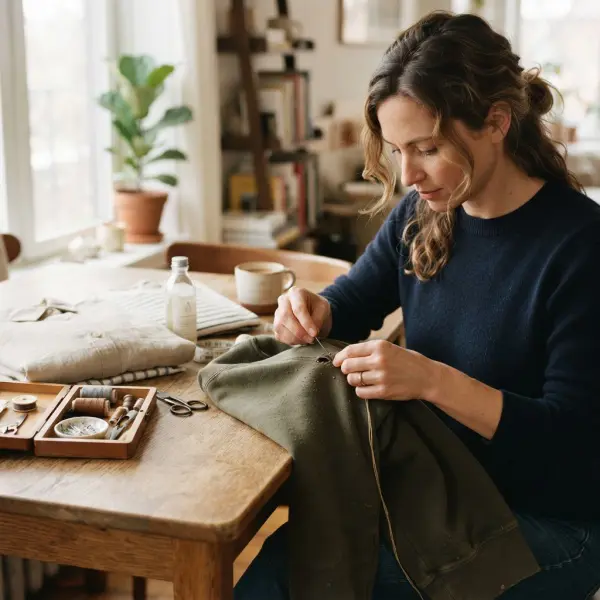
Sometimes the garment is fundamentally unsuitable. At other times, the problem is relatively small: trouser length, sleeve length, waist suppression, a loose button, or a minor repair.
A wardrobe audit can make these inactive-but-recoverable garments visible.
Before replacing a garment, the wearer can ask whether reasonable alteration would restore it to active use. The economics vary by garment, location, labor cost, construction, and quality, so alteration is not automatically the better option. Some garments are difficult or impossible to alter effectively.
But the question itself changes consumption.
Instead of treating every wardrobe problem as an acquisition problem, planning creates a sequence of possible responses: restyle, alter, repair, replace, or remove.
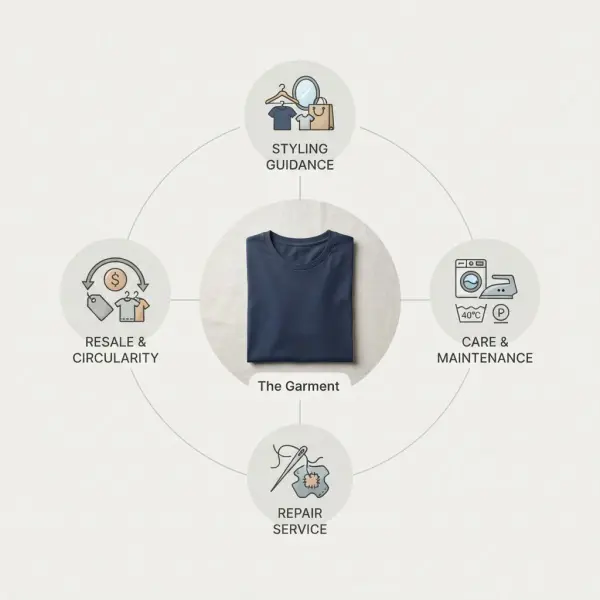
For businesses, this opens a broader view of customer service. Fit guidance, alterations, repair support, spare components, and aftercare can extend the relationship with a customer beyond the initial transaction.
Smarter Consumption Also Means Knowing When to Let Clothing Go
Wardrobe planning is not a mandate to keep everything indefinitely.
An item that no longer fits, is no longer wanted, or belongs to a lifestyle that has permanently changed can make the wardrobe harder to use. Keeping large quantities of inactive clothing simply because disposal feels undesirable does not increase utilisation.
The better question is what should happen next.
Depending on garment condition and local infrastructure, possibilities may include:
- alteration for continued personal use;
- repair;
- gifting to someone who genuinely wants the item;
- resale;
- donation through an appropriate channel;
- repurposing;
- textile collection or recycling where credible systems are available.
Each route has limitations. Donation does not guarantee local reuse. Textile recycling infrastructure varies significantly by material and region. Resale works better for some products than others. Recycling should not be treated as justification for rapid purchasing.
The priority should therefore remain keeping useful products in productive use where practical.
The European Environment Agency’s updated analysis illustrates why textile consumption deserves attention. Its data show that average EU consumption of clothing, footwear, and household textiles reached 19 kg per person in 2022, up from 17 kg in 2019. The EEA also ranks textile consumption fifth among 12 European household consumption categories for combined environmental and climate pressures measured through raw material use, greenhouse gas emissions, water, and land. European Environment Agency textile consumption analysis
Those are EU figures, not universal consumer benchmarks. They nevertheless demonstrate why reducing unnecessary product turnover is relevant to fashion-system discussions.
Wardrobe Planning Does Not Make Every Purchase “Sustainable”
Sustainability language is particularly vulnerable to overstatement.
Buying one versatile shirt instead of three poorly chosen shirts may reduce the number of garments purchased in that specific situation. But it does not automatically tell us whether the shirt has lower environmental or social impacts.
A garment can be highly versatile and still be produced using resource-intensive processes. A durable product can still involve problematic labor conditions. A garment made from a material with certain environmental advantages may still receive almost no use.
Conversely, a product with imperfections in one sustainability dimension may remain in active use for many years.
Wardrobe planning therefore operates mainly on the consumption and use side of the equation.
It can help address questions such as:
- Do I need this?
- Will I use it?
- Does it replace something?
- Does it work with what I own?
- Can I care for it?
- Can I keep it useful?
- What happens when I no longer need it?
Those are important questions, but they do not replace supply-chain due diligence, material assessment, chemical management, labor standards, durability testing, or product-level environmental evaluation.
A credible fashion sustainability strategy needs both sides.
Buying Better Is Not Simply Buying More Expensive Products
“Buy less, buy better” is an appealing phrase, but the word better requires definition.
Price alone is inadequate.
A better purchase is one that is appropriate for the intended function, fits properly, survives the expected level of wear, can be maintained realistically, and remains desirable enough that the owner wants to keep using it.
For a frequently worn garment, this may justify paying more for reliable construction or better-performing materials. In other cases, a lower-priced garment may perform perfectly well.
WRAP’s 2025–2026 durability work stresses that commonly used proxies such as price, fiber composition, and fabric weight do not reliably determine durability by themselves. Actual garment performance needs to be evaluated through appropriate testing and product-specific criteria.
Consumers rarely have access to laboratory durability data, which is a real limitation. They can still evaluate visible construction, fit, fabric hand, care instructions, return information, reviews, brand experience, and repairability, but uncertainty remains.
Brands can reduce that uncertainty by providing clearer product information and substantiating longevity claims rather than simply using vague language such as “timeless quality.”
Wardrobe Planning Can Support Repeat Wear Without Making Dressing Boring
Smarter consumption does not require suppressing enjoyment, novelty, or self-expression.
If wardrobe planning produces a collection that feels monotonous or disconnected from personal identity, the wearer may eventually seek novelty through additional purchasing. A system that works technically but fails emotionally may be difficult to maintain.
The capsule wardrobe approach to everyday dressing therefore benefits from including character pieces, prints, textures, color, and variation rather than reducing everything to generic basics.
Repeat wear also does not mean repeating one identical outfit indefinitely.
A familiar jacket can be worn with different bases. A dress can shift through footwear and layering. A trouser can move between professional and casual contexts. This is precisely where mix-and-match planning can expand outfit possibilities without requiring constant wardrobe expansion.
A successful wardrobe makes repetition feel normal because the clothes still allow sufficient visual variation.

What Wardrobe Planning Means for Fashion Brands
At first glance, encouraging consumers to plan wardrobes more carefully may appear commercially uncomfortable. If customers buy fewer unnecessary products, does that simply mean lower sales?
For businesses dependent entirely on increasing product volume, the tension is real.
But the alternative is not necessarily “sell nothing.” A more mature commercial model can focus on creating products that solve clearer customer needs, remain useful for longer, and support services around continued use.
The Ellen MacArthur Foundation’s current Fashion ReModel work examines business models designed to generate value without relying exclusively on new-product production, including resale, rental, repair, and remaking. Its 2025 guidance explicitly frames higher product utilisation and circular business models as areas fashion companies are trying to integrate into core business strategy rather than treating only as peripheral sustainability initiatives. Ellen MacArthur Foundation Fashion ReModel
Wardrobe planning intersects with this shift because it emphasizes product usefulness over product turnover.
That can influence several areas of fashion business.
Product development: design for integration
Products can be designed with awareness of how customers actually build wardrobes.
This may involve color continuity, dependable fit blocks, layers that physically fit over other products, hems compatible with common footwear, and textiles suited to the frequency of use suggested by the product positioning.
“Designed to work with your wardrobe” becomes more credible when compatibility is built into product architecture rather than added later through marketing language.
Merchandising: sell relationships, not isolated products
Traditional merchandising often presents each new product as an independent object of desire.
Wardrobe-oriented merchandising can instead show how a new product interacts with items customers may already own. A new jacket might be shown with denim, a dress, tailored trousers, and previous-season pieces.
This does not eliminate novelty. It contextualizes novelty.
For customers, that makes the decision easier: the question becomes not merely whether the jacket looks good on a model, but whether it has a plausible place in their own lives.
Customer service: support continued use
Fit guidance, care education, alterations, spare buttons, replacement components, repair services, and styling assistance can all help keep a product active.
These services have operational costs, and not every model will make sense for every price segment. But they illustrate a broader principle: customer value can continue after checkout.
For brands exploring repair and resale, product durability becomes particularly important because products need enough remaining physical life to survive additional use cycles. The Ellen MacArthur Foundation and WRAP both connect longer product use with circular models such as repair and resale, although the environmental benefits depend on whether these models actually displace new production and on how the systems are operated.
Practical Framework: Pause Before the Next Purchase
Wardrobe planning does not need to become an elaborate inventory project.
A short decision sequence can improve many ordinary purchases.
Before buying, first identify what triggered the desire. Is there a recurring clothing problem, an upcoming event, a worn-out product, or simply exposure to an attractive new item?
Then check what already exists.
After that, test the candidate product against the wardrobe.
A practical sequence is:
- Define the need. Identify the activity, gap, replacement requirement, or styling problem the purchase is meant to solve.
- Check existing alternatives. Look for garments that already perform the same function or could do so through styling, repair, or alteration.
- Test compatibility. Identify several realistic outfits using clothes already owned.
- Assess expected use. Consider climate, comfort, frequency, care, dress codes, and likely occasions.
- Check duplication. Decide whether another similar item adds useful rotation or simply repeats an overfilled category.
- Evaluate product performance. Examine fit, construction, material, care requirements, and available quality information.
- Consider the exit route. Think about repairability, resale potential, donation suitability, or other realistic next-use options without assuming those routes eliminate the impact of purchasing.
The framework does not instruct the consumer to reject the purchase.
It creates a better basis for saying either yes or no.
Common Mistakes in “Smarter” Wardrobe Consumption
Mistake 1: Throwing away usable clothes in order to become minimalist
A dramatic wardrobe clear-out can create the visual appearance of responsible consumption while shifting usable clothing out of the wardrobe before necessary. Some garments genuinely should leave because they no longer fit, serve no purpose, or are unlikely to be worn. But clearing items simply to reach an arbitrary capsule size can create replacement needs later. A better process identifies why each garment is inactive and chooses the next step deliberately.
Mistake 2: Replacing ordinary clothes with newly marketed “sustainable essentials”
Products with credible environmental improvements may have a role when a purchase is genuinely needed. However, replacing functioning garments merely because a new alternative is marketed as sustainable can undermine the value of keeping existing products in use. Sustainability claims also vary in scope and evidence. The first question should therefore be whether replacement is necessary, followed by a careful evaluation of the new product’s claims.
Mistake 3: Assuming expensive clothing will automatically last longer
Higher prices can reflect craftsmanship and material quality, but they can also reflect branding, distribution, design exclusivity, or margin. Recent WRAP durability work specifically challenges price as a dependable proxy for physical garment durability. Consumers should consider construction, fit, maintenance, intended use, and available evidence rather than treating price as a longevity certification.
Mistake 4: Keeping everything because discarding feels wasteful
Unused clothing does not become environmentally beneficial simply because it remains stored indefinitely. When an item has no realistic path back into use, the better decision may be to redirect it while it is still in suitable condition for another user. The appropriate route depends on local resale, donation, repair, and textile recovery systems. Wardrobe planning should improve active use, not simply maximize storage.
Mistake 5: Treating recycling as permission to consume freely
Textile recycling is valuable where viable systems exist, but it does not eliminate the impacts associated with producing and distributing new garments. Fiber blends, trims, coatings, elastane, contamination, collection systems, economics, and recycling technology can all affect what can realistically be recovered. Purchasing decisions should therefore not assume that every garment will eventually become an equivalent new textile product.
Mistake 6: Optimizing only environmental criteria while ignoring whether the garment will be worn
A product can have impressive material credentials and still become a poor wardrobe decision if the fit is uncomfortable, care is impractical, or the style does not suit the wearer. Sustainability attributes matter, but use matters too. Smarter consumption requires combining product impact information with a realistic assessment of whether the garment will actually remain in active rotation.
What Should Consumers Verify Before Calling a Purchase “Smarter”?
A smarter purchase should survive more than one test.
It should make sense economically, physically, functionally, and—where sustainability is part of the decision—environmentally and socially as far as credible information allows.
Useful questions include:
- What specific wardrobe problem does this product solve?
- Do I already own something that performs the same role?
- Can I create several realistic outfits with it?
- Will I still want to wear it when the current promotion or trend has passed?
- Is the fit comfortable enough for the intended activity?
- Are the care requirements realistic?
- Is there meaningful evidence behind durability or sustainability claims?
- Can common failure points such as buttons, zippers, hems, or seams reasonably be repaired?
- Am I buying this because I need greater rotation, or because I have forgotten similar items already owned?
- What would probably happen to this garment when I no longer use it?
No single answer determines whether a purchase is correct.
Together, however, these questions make fashion consumption less dependent on the immediate emotional context of shopping.
Wardrobe Planning Is One Part of a Larger Fashion System
Consumer behavior matters, but responsibility for fashion’s impacts should not be shifted entirely onto individual shoppers.
Brands influence product durability, design, marketing intensity, availability, pricing, repairability, transparency, and the frequency with which assortments are refreshed. Manufacturers influence production quality and process performance. Policymakers influence product standards, waste systems, extended producer responsibility, labeling, and market incentives. Infrastructure determines what happens when clothing enters resale, collection, sorting, reuse, or recycling systems.
The European Environment Agency explicitly frames the transition toward more circular textiles as requiring action from policymakers, industry, and consumers rather than consumers alone.
Wardrobe planning should be understood within that context.
It gives consumers a tool for making better decisions with the information and products available to them. It does not absolve the fashion industry from improving product durability, reducing waste, addressing production impacts, or changing business models that depend heavily on continually increasing material throughput.
Likewise, a brand should not use “conscious consumer” messaging to avoid responsibility for what it manufactures.
A smarter wardrobe and a smarter fashion system should reinforce each other.
Frequently Asked Questions
Does wardrobe planning really reduce clothing consumption?
It can, but the outcome is not guaranteed. Wardrobe planning may reduce unnecessary purchases when it helps people recognize duplication, rediscover existing clothes, identify the real source of an outfit problem, or choose products that integrate better with what they already own. However, someone can maintain a highly organized wardrobe while continuing to purchase frequently. The relevant measure is behavioral: whether planning changes acquisition, replacement, use, care, or disposal patterns rather than simply improving closet organization.
Is buying fewer clothes always more sustainable?
Not automatically. Purchasing fewer new garments can reduce demand for additional products in some circumstances, but environmental impact depends on what is purchased, how it is produced, how long it is used, care practices, transportation, and what the purchase replaces. Someone who buys a small number of garments but replaces them rapidly may not achieve the outcome implied by a minimalist wardrobe. “Fewer” is therefore most meaningful when combined with sufficient use and longevity.
Should I stop buying clothing if my wardrobe is already large?
Wardrobe size alone does not answer the question. A large wardrobe may still have legitimate functional gaps, while a small wardrobe may contain significant duplication. Audit the categories, fit, climate suitability, current lifestyle, and active use first. If a recurring need remains uncovered, a new purchase can be reasonable. The goal is not to prohibit buying; it is to avoid treating every dressing problem as evidence that more clothing is required.
Is second-hand clothing always the smarter choice?
Second-hand purchasing can keep existing products in use and reduce the need for new production when it genuinely displaces a new purchase, but it is not automatically impact-free or consumption-proof. Frequent low-cost resale purchases can still produce an overcrowded, underused wardrobe. Fit, condition, care, transportation, expected use, and actual need still matter. The most useful second-hand purchase is one that fills a real role and receives continued use rather than being acquired simply because resale lowers the financial barrier to buying.
Is repairing clothing always better than replacing it?
Repair is often worth considering when it can restore a useful garment at a reasonable cost and with acceptable performance. But not every product is economically or technically repairable. Severe fabric degradation, difficult construction, missing materials, safety concerns, or repair costs exceeding the practical value of the garment may change the decision. The key advantage of wardrobe planning is that repair becomes one of the options evaluated before replacement rather than being considered only after a new item has already been purchased.
Can fashion brands benefit if consumers buy more carefully?
Yes, although the business model matters. Brands dependent primarily on high product volume may face tension with reduced purchasing frequency. Other opportunities can come from higher-value products, stronger customer relationships, repair, alterations, resale, rental, remaking, care services, and coordinated products that customers integrate over time. The Ellen MacArthur Foundation’s Fashion ReModel is currently examining how such circular business models can become more central to fashion-company strategy.
What is the simplest way to start planning a wardrobe?
Begin with the clothes worn most frequently rather than with items you want to remove. Identify what those successful garments have in common—fit, color, comfort, material, silhouette, and function. Then review inactive garments to understand why they are not being used. Finally, identify genuine gaps only after checking whether existing clothing can solve them. This creates a wardrobe plan based on real behavior rather than an aspirational shopping list.
Conclusion
Wardrobe planning supports smarter fashion consumption because it introduces context into decisions that are otherwise easy to make one garment at a time.
It helps reveal what is already owned, what is genuinely used, which categories are duplicated, which clothes could return to active rotation, and which missing pieces would actually improve the wardrobe. It also creates space for repair, alteration, care, reuse, and more deliberate replacement before another purchase becomes the automatic solution.
Its limits are equally important.
A capsule wardrobe is not inherently sustainable. Fewer garments do not guarantee lower impact. Expensive garments are not automatically durable. Second-hand purchasing can still become excessive. Recycling does not erase production impacts. And consumers cannot solve systemic fashion problems through wardrobe organization alone.
The strongest case for wardrobe planning is therefore not that it produces a perfectly sustainable closet.
It is that better information can produce better decisions.
For consumers, that means moving from accumulation toward use: understanding why clothing enters the wardrobe, how it connects with what is already there, how long it can remain useful, and what should happen when its role changes.
For fashion businesses, the implication is broader. Products designed for genuine use, continued compatibility, repair, repeat styling, and longer customer relationships can create value differently from products whose primary role is to trigger another short-lived transaction.
Smarter consumption does not require fashion to become joyless or static. It asks the industry and its customers to place greater value on what happens after clothing is bought.




Comments 0
Leave a CommentSend Comment
Anda harus Login terlebih dahulu untuk dapat memberikan komentar.