

Maternity Wear vs Nursing Wear: Understanding Functional Design Differences
Maternity wear and nursing wear are often grouped together in fashion retail, sometimes appearing under the same product category or even sharing identical garment designs. Although the two categories can overlap, they address different clothing requirements that become particularly important during pregnancy and after childbirth.
Maternity clothing primarily accommodates changing body proportions during pregnancy. Nursing clothing focuses on providing practical access to the breasts for breastfeeding, while maintaining the fit, coverage, and everyday appearance expected from regular apparel.
The distinction may appear straightforward, but it has important implications for garment construction. A maternity dress can provide generous abdominal space without allowing convenient breastfeeding access. Conversely, a nursing blouse may include discreet feeding openings while offering little additional room for a pregnant abdomen.
For fashion designers, manufacturers, and retailers, understanding these differences is essential for developing products that genuinely perform their intended functions. It also helps brands avoid misleading product descriptions and unnecessary complexity when creating clothing intended for pregnancy, postpartum use, or both.
Quick Answer: What Is the Difference Between Maternity Wear and Nursing Wear?
Maternity wear is clothing designed to accommodate pregnancy-related changes in body shape, while nursing wear is clothing designed to provide convenient breast access for breastfeeding. Their primary functional difference is therefore body accommodation versus feeding accessibility.
Maternity garments commonly incorporate additional abdominal ease, flexible waistbands, expandable panels, or modified garment proportions. Nursing garments may feature concealed openings, lift-up fabric layers, wrap fronts, accessible buttons, or specially designed bra cups that allow the wearer to expose the breast without removing the entire garment.
A product can serve both purposes. For example, a maternity and nursing dress may combine a flexible abdominal silhouette with concealed breastfeeding openings. However, the presence of one feature does not automatically provide the other.
The distinction matters for product development because maternity fit and nursing access require different design decisions, testing procedures, and customer instructions.
For fashion businesses, the appropriate approach is to define whether a product is intended for pregnancy, breastfeeding, or both, and then verify that its construction supports each advertised function.
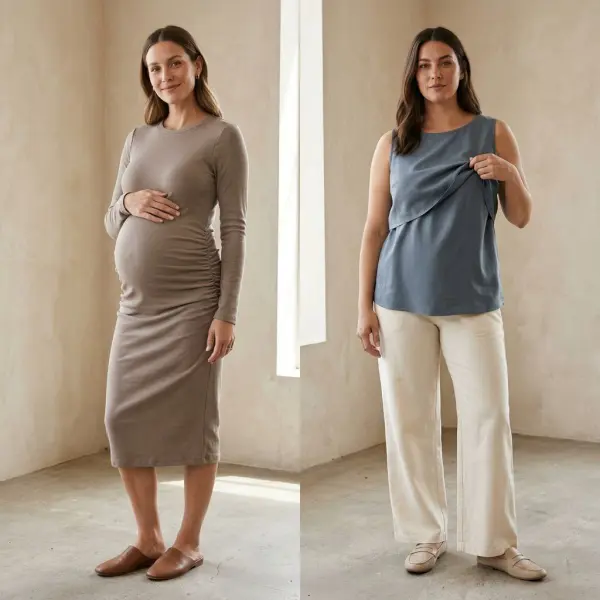
Maternity Wear vs Nursing Wear: Key Differences at a Glance
The two clothing categories are best distinguished by their intended function rather than the stage of life at which a customer purchases them. Some maternity garments remain useful after childbirth, and some nursing garments can be worn during pregnancy.
|
Design consideration |
Maternity wear |
Nursing wear |
|
Primary purpose |
Accommodate changing body proportions during pregnancy |
Provide convenient breast access for feeding |
|
Main fit consideration |
Abdomen, bust, waist, and changing garment balance |
Bust accessibility, breast comfort, and postpartum fit |
|
Typical construction |
Additional ease, gathering, stretch panels, adaptable waistbands |
Lift-up layers, overlapping panels, concealed openings, accessible closures |
|
Key functional area |
Abdominal and torso accommodation |
Breast and upper-torso accessibility |
|
Common garments |
Maternity trousers, leggings, dresses, tops, skirts |
Nursing tops, dresses, bras, sleepwear, feeding-friendly blouses |
|
Adjustment priority |
Responding to changing body dimensions |
Enabling repeated access without unnecessarily removing clothing |
|
Typical fit evaluation |
Sitting, walking, garment balance, changing proportions |
Opening reach, coverage, closure handling, feeding-position comfort |
|
Potential limitation |
May not provide breastfeeding access |
May not accommodate significant abdominal expansion |
|
Combined product possibility |
Can incorporate nursing access |
Can incorporate maternity-specific fit adjustments |
These differences create separate design responsibilities. A brand developing maternity trousers is primarily solving a fit-accommodation problem, while a brand developing a nursing top must consider how the customer will access and reposition the garment during feeding.
The overlap becomes commercially relevant when manufacturers create garments intended for both pregnancy and postpartum use. Combining the functions can be valuable, but only when neither is compromised by the other.
Understanding the Primary Purpose of Maternity Wear
Maternity wear is designed to accommodate the physical changes associated with pregnancy while allowing the wearer to maintain familiar clothing styles.
Pregnancy can affect abdominal circumference, bust dimensions, posture, and other body proportions, but these changes vary between individuals. Maternity garments therefore use pattern modifications and material choices intended to provide appropriate fit as the body changes.
The Australian Government-funded Pregnancy, Birth and Baby guidance on maternity clothing explains that regular clothing may remain suitable during parts of pregnancy and that a completely new wardrobe is not essential. It also identifies maternity tops, trousers, dresses, and bras among common clothing options.
This distinction is useful for fashion businesses. Maternity wear is not defined simply by clothing being larger than usual. Its value comes from addressing fit requirements that conventional garments may not accommodate effectively.
Abdominal Accommodation Is a Central Design Requirement
The expanding abdomen is one of the most recognizable fit considerations in maternity apparel.
A conventional fitted dress may become restrictive or rise at the front as abdominal volume increases. Maternity-specific pattern development can address this through additional front length, gathering, stretch fabric, or increased ease in selected areas.
In maternity trousers, specialized waistbands or abdominal panels can provide additional room without requiring the entire garment to be produced in a larger conventional size.
For a detailed overview of pregnancy-specific garment categories and wardrobe applications, see maternity fashion for modern everyday dressing.
Fit Adaptability Does Not Require Breastfeeding Access
A maternity garment may perform its pregnancy-related function effectively without incorporating any nursing mechanism.
For example, a maternity T-shirt can have side ruching and sufficient abdominal length while retaining a conventional crew neckline. It may be comfortable during pregnancy but inconvenient when the wearer wishes to breastfeed.
Similarly, a maternity dress with an empire waist and generous abdominal ease may not offer suitable breast access if its upper bodice is fixed.
This is an important point for brands positioning maternity products as suitable for extended use. Postpartum wearability and nursing functionality are not interchangeable concepts.
Maternity Construction Must Preserve Garment Balance
Additional abdominal room affects more than garment circumference. The relationship between the front and back lengths, side seams, waist positioning, and fabric drape may also need modification.
A maternity blouse with adequate stretch but insufficient front length can still fit poorly. Likewise, trousers with a flexible waistband may become uncomfortable if the rise or waistband placement is unsuitable.
These considerations belong to the broader technical discipline of maternity patternmaking. A deeper discussion of the mechanisms involved appears in how adjustable clothing designs support comfort during pregnancy.


What Makes Nursing Wear Functionally Different?
Nursing wear is clothing constructed to allow convenient access to the breast for breastfeeding, commonly through an opening, movable panel, or accessible neckline. Unlike maternity clothing, its defining function is not abdominal expansion but the ability to manage clothing during feeding.
This access requirement introduces a different set of design challenges. A nursing top must allow the wearer to reach the breast, position the garment, and return the fabric to its normal appearance without creating unnecessary complexity.
The UK's National Health Service guidance on breastfeeding clothing explains that specialized nursing garments are not essential for everyone. Loose tops, layered clothing, and ordinary garments that can be lifted or repositioned may also work, depending on personal preference.
From a design standpoint, nursing-specific clothing aims to make that process more deliberate and convenient.
Breast Access Is the Defining Functional Feature
A nursing garment typically provides access through its upper body construction.
A concealed horizontal opening may sit beneath an overlapping fabric layer, while a side-access design may use zippers positioned near the bust. Other garments incorporate wrap panels, functional buttons, or lift-up sections.
The position of these features matters. An opening can be technically present but poorly suited to feeding if it is too small, difficult to reach, or obstructed by the surrounding fabric.
For fashion manufacturers, the question is not simply whether the garment opens. It is whether the opening is appropriately positioned and usable in realistic feeding situations.
Nursing Garments Must Work in Seated Positions
Breastfeeding frequently involves sitting, holding, and positioning a baby. Nursing garments should therefore be evaluated in positions that differ from conventional fashion fittings.
A blouse that opens easily when the wearer stands may be awkward to use while seated. Fabric layers may fall back over the opening, or a fastening may become difficult to reach.
Designers should consider the interaction between the neckline, opening position, garment length, and surrounding fabric when the wearer is seated.
The objective is to enable convenient access while allowing the person feeding to choose their preferred level of clothing coverage.
Feeding Access Should Not Require Complicated Handling
Nursing clothing may be opened and closed repeatedly during ordinary use. Complex fastening systems can therefore make a garment less convenient even when they look discreet.
A concealed zipper may integrate well with a tailored silhouette, but its puller must be accessible and the zipper should operate smoothly. A nursing clip may be convenient when its release and reattachment are simple, but an awkwardly positioned clip can frustrate repeated use.
Brands should assess mechanisms for everyday operation rather than evaluating appearance alone.
This is particularly relevant for garments marketed around convenience, quick access, or one-handed use.
Common Nursing Access Designs and Their Construction Differences
Nursing clothing can achieve breast access through several different mechanisms. Each offers a particular balance of visual discretion, ease of operation, manufacturing complexity, and garment versatility.
The appropriate construction depends on the garment category. A relaxed jersey T-shirt can use a simple overlapping fabric panel, while a structured woven blouse may require a carefully positioned fastening or opening.
1. Lift-Up and Double-Layer Nursing Panels
Double-layer construction is commonly used in nursing tops and dresses. An outer fabric layer overlaps an inner section, allowing part of the garment to be lifted to access the breast.
This approach can preserve the appearance of a conventional top when the opening is closed. Because the access mechanism relies on overlapping fabric, it may also avoid the need for prominent buttons or zippers.
However, designers must calculate the overlap carefully. Insufficient coverage can expose an unintended gap, while excessive fabric may create unnecessary bulk around the bust.
The inner layer also requires a sufficiently accessible opening. Simply attaching two complete layers of fabric does not automatically produce functional nursing access.
2. Concealed Zippers and Side Openings
Nursing garments may use concealed zippers positioned near the bust, along a side-front seam, or within another suitable garment construction line.
Zippers can offer controlled opening dimensions and allow the garment to retain a relatively conventional appearance when closed.
Their effectiveness depends on placement, opening length, and the relationship between the zipper and surrounding garment fabric. A zipper positioned too far from the required access area may force the wearer to pull or distort the garment.
Manufacturers should also consider zipper-tape softness, puller accessibility, seam reinforcement, and protection from hard components contacting the skin.
A concealed zipper is not necessarily more comfortable or convenient than a fabric overlap. It is simply a different construction option with different production and usability considerations.
3. Wrap Fronts and Cross-Over Necklines
Wrap and cross-over nursing tops provide access by allowing fabric panels to be repositioned.
They can work well in knitted garments where the material has enough flexibility to move without excessive resistance. In woven garments, designers may need additional ease or more carefully calculated panel overlap.
These constructions may also suit combined maternity and nursing garments because a wrap silhouette can accommodate some changes in torso proportions.
However, the overlap must remain secure during normal activities. Neckline gaping, poor recovery, and insufficient fabric coverage can create problems when the garment is worn in its closed position.
A successful wrap design should work both as an ordinary garment and when temporarily repositioned for feeding.
4. Functional Button Plackets
Button-front garments can provide breastfeeding access without specialized nursing hardware.
A shirt or dress with functional buttons positioned across the bust can allow the wearer to open the necessary section while keeping the rest of the garment in place.
This makes button-front construction particularly relevant for brands that want nursing-friendly styles consistent with conventional ready-to-wear collections.
However, not all button plackets provide the same convenience. Small buttons, tightly spaced openings, stiff fabrics, and poorly positioned closures can make access awkward.
Designers should test whether the opening provides sufficient space without requiring unnecessary garment removal or difficult handling.
5. Nursing Bra Clips and Drop-Down Cups
Nursing bras present a more specialized design requirement because the garment provides both breast support and feeding access.
A common construction uses a cup that can be released from the strap or upper attachment, then lowered to expose the breast. Another approach uses sufficiently flexible fabric that can be repositioned without a separate clip.
The UK parenting charity NCT distinguishes soft maternity bras from nursing bras that incorporate drop-down cups, and also identifies pumping bras as a separate functional category. Its guidance emphasizes that fit and preferred support vary between individuals.
For lingerie manufacturers, the mechanism must work with the entire bra construction, including the underband, straps, cup material, elastic components, and support structure.
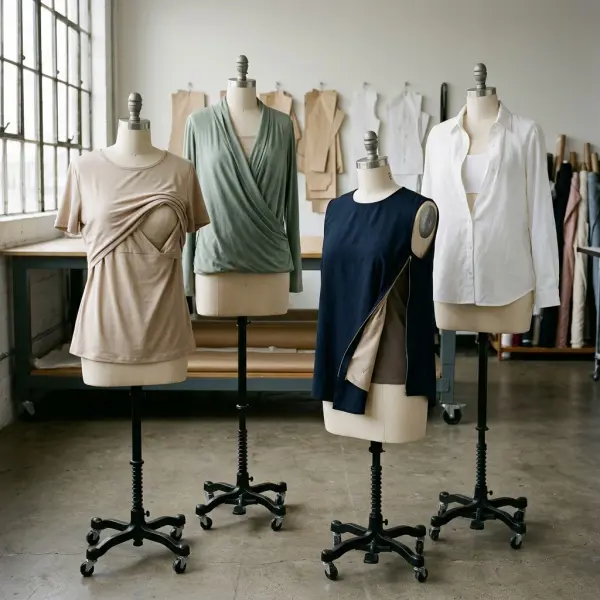
Nursing Bras, Maternity Bras, and Pumping Bras Are Not Identical
Bras provide one of the clearest examples of the functional differences within maternity and nursing apparel.
Although product terminology varies between retailers, maternity bras, nursing bras, and pumping bras can serve distinct purposes. Some designs combine functions, but their features should not be assumed to be interchangeable.
Maternity Bras: Fit and Support During Pregnancy
Maternity bras are generally designed with comfort and changing breast or rib-cage dimensions in mind. They may incorporate flexible cups, adjustable bands, soft materials, and suitable support.
These garments do not necessarily require specialized breastfeeding access. A soft maternity bra may be repositioned for feeding, but that possibility is different from a dedicated drop-cup mechanism.
According to NCT's guidance on maternity and nursing bras, breast size and shape can change during pregnancy and after birth, making ongoing fit assessment relevant.
This creates an important requirement for brands: maternity bra sizing and support must be evaluated independently of any future nursing functionality.
Nursing Bras: Support With Convenient Feeding Access
Nursing bras combine breast support with an accessible cup or fabric section.
The design should allow the wearer to expose the breast without unnecessarily removing the entire bra. Drop-down cups, clips, and flexible pull-aside structures are common approaches.
The cup's position when opened deserves attention. Fabric, elastic, or hardware should not create uncomfortable pressure or obstruct the intended access area.
Manufacturers should test the bra both closed and open, including the operation of clips, strap stability, and the fit of the support structure.
These requirements are different from evaluating whether a conventional bra fits comfortably while worn in its normal position.
Pumping Bras: Access and Flange Positioning
Pumping bras are designed around breast pump use rather than direct breastfeeding alone.
A pumping bra may incorporate specialized openings that allow pump flanges to be positioned and held against the breasts. Depending on the design and equipment, this can support hands-free or reduced-hand-support pumping.
However, a pumping opening is not automatically suitable for direct breastfeeding. The same NCT guidance distinguishes pumping bras from nursing bras because a pumping opening may not provide sufficient access for feeding a baby directly.
For fashion and intimate-apparel brands, this distinction has practical implications. A product marketed as suitable for both breastfeeding and pumping should be evaluated for both tasks, rather than assuming one access feature satisfies both functions.
|
Bra type |
Primary function |
Typical access design |
Main product-development consideration |
|
Maternity bra |
Accommodate changing fit and support needs |
May have no dedicated access |
Cup and band comfort |
|
Nursing bra |
Support the breasts while enabling feeding |
Drop-down cups, clips, pull-aside fabric |
Accessible opening and secure reclosure |
|
Pumping bra |
Position and help hold breast pump flanges |
Purpose-designed flange openings |
Compatibility, positioning, and stability |
|
Combined nursing/pumping bra |
Support both feeding and pump use |
Multiple or convertible openings |
Independent validation of both functions |
These categories can overlap, particularly in products marketed for pregnancy and postpartum use. The important distinction is the intended task, not simply the name used on the product label.
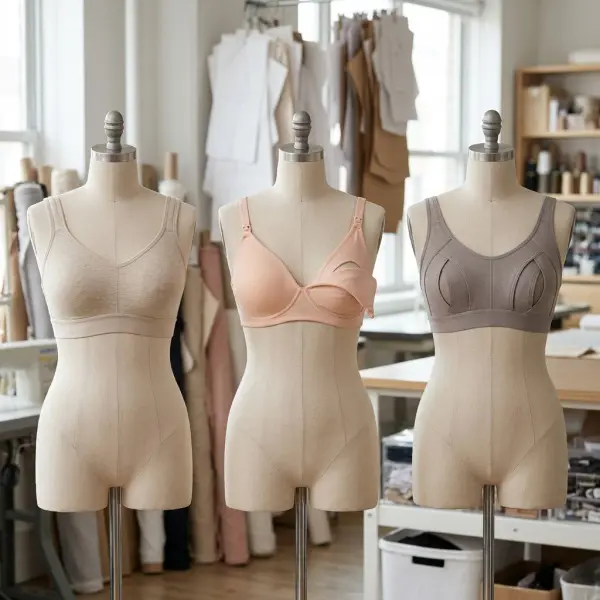
Can One Garment Work for Both Pregnancy and Breastfeeding?
Yes. A garment can be designed to accommodate pregnancy-related body changes while also providing convenient breastfeeding access. This type of product is commonly described as maternity-and-nursing clothing or dual-function maternity wear.
However, combining both functions requires deliberate design decisions. It is not sufficient to add a breastfeeding opening to a maternity garment without checking how the complete product behaves during pregnancy and after childbirth.
Combining Flexible Fit With Nursing Access
Consider a knitted maternity-and-nursing dress.
During pregnancy, the garment may use additional abdominal ease, soft gathering, or a flexible silhouette. Its upper bodice may incorporate concealed openings beneath overlapping fabric panels.
After childbirth, the wearer may continue using the dress for breastfeeding, provided the remaining garment dimensions and fit remain suitable.
The challenge is maintaining an attractive silhouette across different body proportions. Additional abdominal fabric that is useful during pregnancy may become excessive afterward, while a nursing opening positioned for one bust fit may behave differently as breast dimensions change.
These are not necessarily reasons to avoid dual-function products. They are considerations that should be addressed during pattern development and fit testing.
When Dual-Function Design Is Commercially Sensible
Dual-function maternity and nursing clothing may be a logical product strategy for garments that already have flexible silhouettes.
Soft jersey dresses, relaxed tops, wrap garments, and certain types of sleepwear can accommodate both functions without requiring highly complex pattern structures.
A structured trouser, by contrast, has little direct relationship to breastfeeding access. It may provide postpartum fit flexibility, but that does not make it nursing-specific apparel.
Brands should therefore avoid applying a maternity-and-nursing label across an entire collection without considering the individual garment's construction.
The best commercial opportunities are often those where the combined functions feel natural to the garment rather than artificially added.
The Trade-Off Between Versatility and Specialized Performance
A dual-function garment may provide useful flexibility for customers who prefer a smaller wardrobe. However, increased versatility can introduce design compromises.
For example, a highly elastic dress may accommodate changing abdominal dimensions but offer less structure than a customer expects for formal occasions. A concealed nursing layer may improve access while adding bulk around the bust.
The product development objective should be to balance these requirements rather than maximize the number of advertised functions.
A garment with fewer features that performs its intended tasks consistently may deliver more practical value than a complicated design promising universal adaptability.
How Fabric and Pattern Construction Requirements Differ
Maternity and nursing clothing share many general apparel requirements, including comfortable materials, suitable fit, and durable construction. Their technical priorities differ because they respond to different patterns of garment use.
Maternity wear places particular emphasis on body accommodation and garment balance. Nursing wear introduces an additional requirement: the garment must be repeatedly moved, opened, or repositioned around the breast-access area.
Maternity Fabric Priorities: Accommodation and Recovery
Maternity garments often rely on fabric stretch, appropriate drape, and carefully distributed ease.
A knitted maternity dress may need to accommodate changing abdominal dimensions without losing its intended shape. Maternity trousers may combine structured woven fabric with an elasticized abdominal panel.
Manufacturers should assess stretch, recovery, dimensional stability, and suitability for the intended silhouette.
These properties should be evaluated in relation to the garment pattern. A highly elastic material does not compensate automatically for inadequate front length or poorly positioned seams.
Nursing Fabric Priorities: Movement, Access, and Surface Comfort
Nursing clothing may benefit from fabrics that allow access panels to move easily and return to their normal position.
For example, a lift-up nursing panel should remain sufficiently stable when closed but be flexible enough for convenient use. A wrap neckline should allow repositioning without excessive resistance or permanent distortion.
Fabric handfeel and surface texture are also relevant, particularly where material may contact the breast or baby's skin.
However, no fiber type should be assumed universally superior. Cotton, viscose, modal, lyocell, and suitable synthetic or blended fabrics may all be used depending on fabric structure, finishing, and garment performance.
Fastening Durability Becomes More Important
Repeated opening and closing introduces additional wear considerations.
Buttons may become loose, clips can lose retention, and zipper operation may deteriorate if materials or construction are unsuitable. Fabric surrounding an opening may also stretch or distort through repeated handling.
For nursing garments, quality control should therefore consider the expected use of access mechanisms, not merely whether the garment survives an initial fitting.
A reasonable development program may include repeated opening-and-closing evaluations, seam inspection, laundering assessments, and wear testing.
The appropriate testing requirements depend on the chosen closure system and the product's intended use.
Garment Care Should Reflect Everyday Practicality
Maternity and nursing garments may be worn frequently, making laundering performance a meaningful design consideration.
Nursing tops and bras may need washing because of ordinary perspiration, milk leakage, or contact with feeding-related spills. The material and construction should be selected with expected care routines in mind.
In the United States, the Federal Trade Commission's Care Labeling Rule guidance explains that manufacturers and importers of covered garments must provide appropriate care instructions supported by a reasonable basis. This applies to the finished garment, including relevant components, rather than assuming that fabric-level testing alone establishes suitable care instructions.
Federal Trade Commission
For global manufacturers, labeling requirements should be verified separately for each target market.
Practical Product Development Implications for Fashion Brands
The distinction between maternity and nursing clothing should influence the entire product development process, from the initial design brief to ecommerce descriptions.
For brands developing specialist apparel, the first decision is not which construction technique to use. It is defining the specific problem the garment should solve.
Establish Separate Functional Requirements
A useful product brief should identify the intended customer, wearing occasion, functional requirements, and expected use.
For a maternity top, the brief may emphasize abdominal accommodation, front length, stretch recovery, and appropriate fit across a defined range of body proportions.
For a nursing top, the priority may shift toward breast accessibility, opening placement, secure closure, and maintaining the garment's appearance after repeated use.
A combined maternity-and-nursing design requires both sets of specifications.
These distinctions improve communication between designers, patternmakers, sourcing teams, and factories. They also provide a clearer basis for fit approval and quality control.
Use Different Fit-Testing Scenarios
Traditional garment fittings typically assess silhouette, proportions, construction, and movement. Specialist maternity and nursing products need additional evaluations reflecting their intended function.
For maternity clothing, fitting should consider abdominal accommodation, garment balance, waistband positioning, and comfortable movement.
For nursing clothing, testing should include how the garment opens, whether access is sufficient, how closures behave, and whether fabric can be repositioned without excessive difficulty.
Testing should be voluntary and respectful, with participants appropriately informed about the assessment. Garments should not need to be tested during actual breastfeeding when a suitable functional demonstration can establish the relevant apparel performance.
For combined garments, both functional requirements need evaluation. Success in one fitting scenario cannot automatically establish success in the other.
Plan Materials and Production Operations Carefully
Specialized construction features can introduce additional components and sewing operations.
Nursing garments with concealed zippers may require suitable zipper lengths, reinforced seams, and careful placement of zipper tape. Drop-cup nursing bras require clips and cup constructions that remain functional through repeated use.
Maternity garments may instead require elastic panels, specialized waistband components, additional pattern pieces, or controlled gathering operations.
These choices influence manufacturing costs, production capacity, minimum order quantities, and quality inspection procedures.
For smaller fashion brands, simplifying construction without compromising function may help maintain a manageable assortment. There is little commercial advantage in introducing elaborate nursing mechanisms if a simpler overlapping panel performs the required task effectively.
Separate Product Categories in Retail Communication
Customers should be able to understand whether a garment is intended for pregnancy, breastfeeding, or both.
An ecommerce store can use a shared maternity and nursing collection while still providing clear functional classifications at the product level.
For example, a maternity dress without nursing access should not be described as breastfeeding-friendly simply because it remains wearable after childbirth.
Likewise, a nursing top that has a concealed breast-access opening should not automatically be promoted as maternity clothing unless its fit supports pregnancy-related body changes.
Product photography can demonstrate these differences more effectively than generic descriptions. A nursing top may need both a standard front view and an image showing the access mechanism, while a maternity trouser may benefit from side views demonstrating abdominal fit.
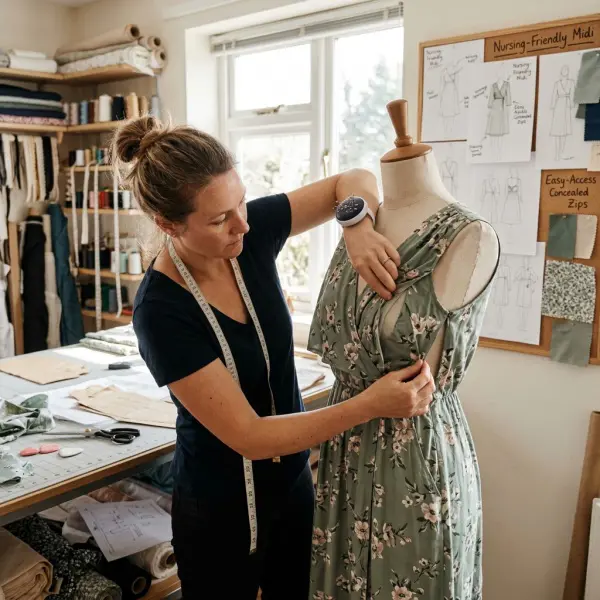
A Practical Decision Framework for Maternity and Nursing Collections
For apparel businesses, category selection should follow the functional requirements of each product rather than assuming that every garment must serve both pregnancy and breastfeeding.
A simple decision framework can help teams establish the appropriate design direction.
|
Product development question |
If the answer is yes |
Design implication |
|
Must the garment accommodate increasing abdominal volume? |
Maternity functionality is required |
Develop pregnancy-specific fit and ease |
|
Must the garment provide convenient breast access? |
Nursing functionality is required |
Incorporate appropriate openings or closures |
|
Must it perform both functions? |
Combined functionality is required |
Validate pregnancy fit and nursing access separately |
|
Is the product intended only for postpartum daily wear? |
Specialized functionality may not be necessary |
Prioritize fit, comfort, and everyday usability |
|
Must the garment support breast pump use? |
Pumping functionality may be required |
Evaluate flange openings and equipment compatibility |
|
Does the garment use repeated-access fastenings? |
Functional durability is relevant |
Test closure operation and component attachment |
This framework also helps prevent category inflation.
A relaxed cardigan that remains wearable during pregnancy and breastfeeding is not necessarily a technically specialized maternity-and-nursing garment. Similarly, a garment suitable for postpartum wear does not automatically require dedicated nursing construction.
Brands should reserve specific functional claims for products that genuinely incorporate and support those functions.
Common Mistakes When Designing or Marketing Maternity and Nursing Wear
Some of the most consequential mistakes occur when brands treat maternity and nursing clothing as interchangeable. Others arise from overlooking how garments perform during actual use.
Mistake 1: Assuming All Maternity Clothing Supports Breastfeeding
A maternity top may provide excellent abdominal accommodation while offering no convenient breast access.
This misunderstanding often occurs when brands associate all pregnancy and postpartum garments with a single customer journey. The result can be inaccurate product descriptions and disappointed customers.
The better approach is to classify products according to verified construction features. Maternity fit and nursing access should be identified independently.
Mistake 2: Adding Nursing Openings Without Testing Their Function
A concealed zipper or overlapping panel may look successful in a sample photograph but prove awkward during use.
An opening positioned too far from the breast, or one that cannot remain accessible while the wearer is seated, may reduce the garment's practicality.
Designers should test access position, opening dimensions, and ease of operation on the finished garment. The assessment should reflect realistic wearing conditions rather than relying entirely on appearance.
Mistake 3: Neglecting the Fit of Nursing Bras
Nursing bra development involves more than attaching a clip to a conventional bra.
The cup, band, straps, and access mechanism must function together. A poorly fitted garment can create unwanted pressure even when its nursing opening operates correctly.
Brands should evaluate bra fit carefully and avoid assuming that a particular fastening mechanism guarantees comfort or support. Because breast dimensions can change during pregnancy and after childbirth, adjustable features and clear fitting guidance are particularly relevant.
Mistake 4: Confusing Nursing Access With Pumping Compatibility
A drop-cup nursing bra may allow convenient breastfeeding but provide no mechanism to hold a breast pump flange in place.
Conversely, a pumping bra with a relatively small flange opening may not offer sufficient access for direct feeding.
Marketing a product for both purposes requires verifying each function. Brands should not present pumping compatibility as an automatic feature of nursing clothing.
Mistake 5: Overcomplicating Dual-Function Garments
Combining maternity and nursing functions can sound attractive from a product positioning perspective. Yet adding excessive fabric, multiple openings, and several adjustment mechanisms may make garments bulky or difficult to use.
Design teams should determine which functions genuinely benefit the intended customer and which features introduce unnecessary complexity.
Simpler construction can be commercially advantageous when it provides sufficient performance and reduces manufacturing variability.
Mistake 6: Overpromising Extended Wearability
A garment labeled as suitable before, during, and after pregnancy may create an expectation that it will fit consistently throughout every stage.
In reality, body changes and fit preferences differ between individuals. A product may work well during pregnancy but feel too loose afterward, or its nursing access may not suit every wearer.
Brands should communicate intended versatility accurately and avoid universal fit guarantees unless supported by appropriate evidence.
Important Technical and Commercial Caveats
Maternity and nursing apparel are specialist fashion categories, but their functional features should not be confused with medical or therapeutic performance.
An elastic maternity panel can provide additional garment accommodation without necessarily providing medical abdominal support. Similarly, a nursing bra can offer access and everyday breast support without being a medical device or guaranteeing protection from breastfeeding-related problems.
Brands should be particularly careful with claims involving pain prevention, milk production, blocked ducts, and other health outcomes. These require appropriate evidence and should not be inferred from ordinary garment construction.
There are also important limitations to consider when making commercial claims.
First, fit is individual. Pregnancy and postpartum body changes vary, so brands should avoid suggesting that a specific garment construction will suit every customer.
Second, nursing clothing is optional. Many people breastfeed successfully using ordinary clothing, loose tops, or layered garments. The NHS guidance specifically recognizes these options.
Third, longer usability is not automatically more sustainable. A combined maternity-and-nursing garment may reduce the need for additional purchases in some circumstances, but its environmental impact depends on material production, manufacturing, care, actual use, and end-of-life management.
Finally, market requirements differ. Sizing conventions, garment labeling rules, care requirements, and customer preferences vary internationally. Brands entering multiple markets should validate the relevant requirements rather than assuming that one product specification or labeling approach is universally sufficient.





Comments 0
Leave a CommentSend Comment
Anda harus Login terlebih dahulu untuk dapat memberikan komentar.