

Why Customer Data Quality Matters in Fashion CRM Systems
Quick Answer
Customer data quality matters in fashion CRM systems because customer profiles, segmentation, service decisions, automation, reporting, and personalization are only as dependable as the information behind them.
High-quality CRM data is fit for its intended purpose. It is sufficiently accurate, complete, unique, consistent, timely, and valid for the decision being made. This does not mean collecting every possible customer attribute or expecting a flawless database.
For a fashion brand, poor data can create duplicate profiles, send recommendations for returned products, assign customers to the wrong loyalty tier, promote unavailable sizes, misstate retention, or continue marketing after someone has withdrawn permission. These errors affect both customer experience and business decisions.
Improvement should begin with critical fields such as customer identifiers, contact details, communication permissions, order status, returns, product variants, and service cases. Brands should then define ownership, validation rules, authoritative sources, synchronization processes, monitoring thresholds, and correction procedures.
Good data quality is not a one-time database-cleaning project. Customer circumstances, products, systems, and business rules change, so quality must be managed continuously.

What Is Customer Data Quality in Fashion CRM?
Customer data quality is the degree to which customer information is fit for its intended purpose across service, marketing, retail, analysis, and relationship management.
This definition is deliberately practical. A field does not have to be perfect in every theoretical sense to be useful. It does, however, need to be reliable enough for the decision being made.
A confirmed delivery address may be suitable for fulfilling today’s order but become unsuitable for a future campaign after the customer moves. A previous dress size is factually correct as a transaction record, but it may not be a dependable recommendation for another garment. A browsing event may show that a product page was opened, but it does not prove that the customer liked the product or intended to buy it.
Data quality therefore depends on context. Before calling information “good,” a fashion brand should ask: good enough for what?
The Six Practical Dimensions of CRM Data Quality
The UK Government Data Quality Framework describes six commonly used dimensions: accuracy, completeness, uniqueness, consistency, timeliness, and validity. The framework also emphasizes that quality should be assessed according to the purpose for which data will be used. Fashion businesses can apply the same dimensions to CRM records.
|
Data-quality dimension |
Meaning in a fashion CRM |
Example of a problem |
Possible consequence |
|
Accuracy |
Information correctly represents the customer or event |
A return is recorded as a completed retained purchase |
The brand recommends a product based on a failed experience |
|
Completeness |
Required information is present for a defined use |
An order has no reliable customer identifier |
Online and store behavior cannot be connected safely |
|
Uniqueness |
Each real customer or event is represented without avoidable duplication |
One shopper has four CRM profiles |
Loyalty value and message frequency are fragmented |
|
Consistency |
Values and definitions agree across systems |
“Returned customer” means one thing in CRM and another in analytics |
Teams report conflicting retention results |
|
Timeliness |
Data is available and current when needed |
Inventory or complaint status updates several days late |
Automation sends an unsuitable promotion |
|
Validity |
Data follows required formats, types, and rules |
Telephone numbers lack country codes or consent values use free text |
Messages fail or permission logic becomes unreliable |
These dimensions are interdependent but not identical. An email address can be valid in format while belonging to the wrong person. A profile can be complete but duplicated. A purchase record can be accurate but arrive too late to prevent an inappropriate campaign.
Fashion brands should measure the dimensions that matter for each use case rather than collapsing them into one vague “data health” score.
Why Is Data Quality Especially Difficult in Fashion?
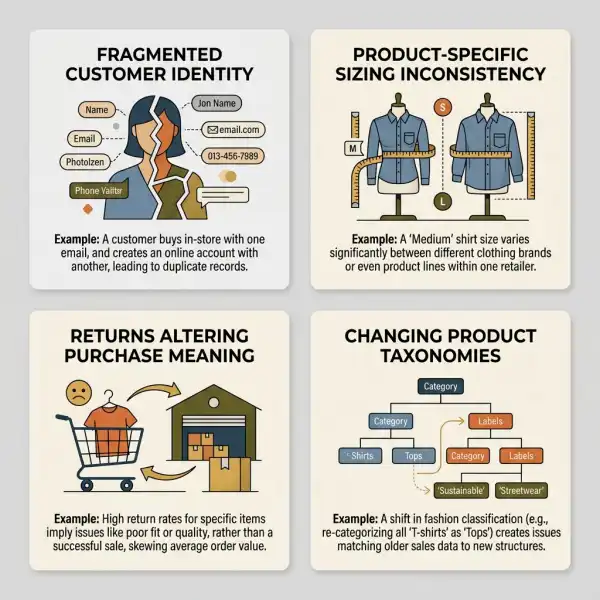
Fashion customer data is shaped by frequent assortment changes, product variants, fit uncertainty, seasonal demand, returns, gifting, promotions, and multiple sales channels. Each factor introduces interpretation problems that a CRM must handle carefully.
One Customer May Appear Under Several Identities
A shopper may purchase online using an email address, buy in a store with a telephone number, check out as a guest, join a loyalty program later, and contact customer service through a messaging platform. These records may all belong to one person, but the matching evidence is not always strong.
The opposite problem also occurs. Household members may share an address, telephone number, device, or email account. Automatically merging profiles because one attribute matches can expose purchase history to the wrong person or distort individual preferences.
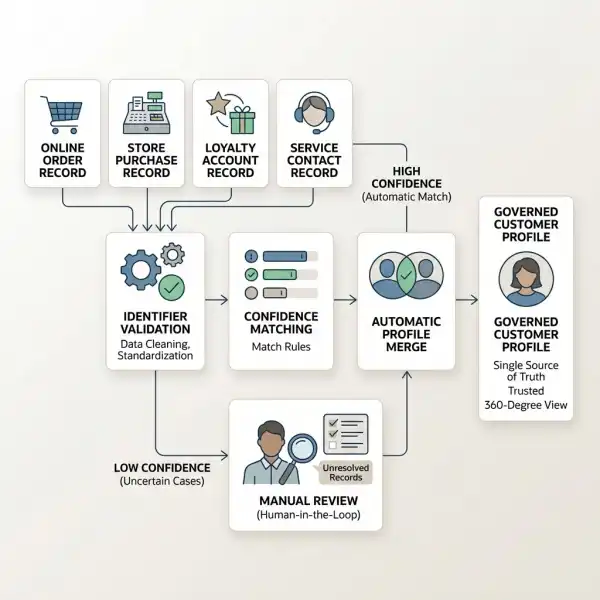
Identity resolution should use documented matching rules and confidence thresholds. Certain matches may be automated; uncertain cases should remain separate or be reviewed. One supposedly unified profile is not an improvement if it combines two customers incorrectly.
Size Is Product-Specific, Not a Stable Universal Attribute
Fashion CRM systems often attempt to store a “customer size,” but garment sizing is rarely that simple. A customer may wear one size in a relaxed knit and another in a fitted woven jacket. Brand grading, fabric stretch, ease, silhouette, construction, and personal fit preference all affect the result.
A purchase record should retain the size associated with the specific product and variant. The system should also distinguish between ordered, kept, exchanged, and returned sizes.
If the CRM converts a previous order into a permanent profile field such as “always size M,” future recommendations may be misleading. Historical behavior can inform a suggestion, but it should not be presented as certainty. The technical limits of this use are explored in fashion size recommendation technology.

Purchases Do Not Always Reveal Personal Preference
Someone may buy childrenswear for a relative, a formal dress for a single event, several gifts during a holiday period, or a product chosen primarily because it was discounted. Transactional records are factual, but the preference inferred from them may be wrong.
This distinction matters because CRM systems often mix observed events and derived attributes. “Purchased black evening dress” is an event. “Prefers black formalwear” is an interpretation. The profile should retain enough provenance to distinguish the two.
Returns Change the Meaning of Sales Data
A placed order is not equivalent to retained demand. If a customer buys three sizes and returns two, the CRM should not treat all three variants as successful preferences. If the entire order is returned because the fabric differed from expectations, a cross-sell based on the original purchase may be inappropriate.
Return status, return reason, refund status, and exchange outcome need consistent definitions. Even then, return reasons are not always reliable. Customers may select the nearest available option, while store associates may interpret the same problem differently.
Collections and Product Taxonomies Change
Fashion assortments are continuously refreshed. Product names, categories, seasons, colors, materials, fit labels, and merchandising hierarchies may change between collections.
If one system calls a product “wide-leg trousers,” another classifies it as “smart bottoms,” and a third stores only an internal stock-keeping unit, customer-category analysis becomes inconsistent. Historical categories may also be overwritten when current merchandising taxonomies are applied retrospectively.
A CRM does not need to contain every product detail, but it should receive stable identifiers and governed attributes from a dependable product source.
How Poor Data Affects Fashion CRM Decisions
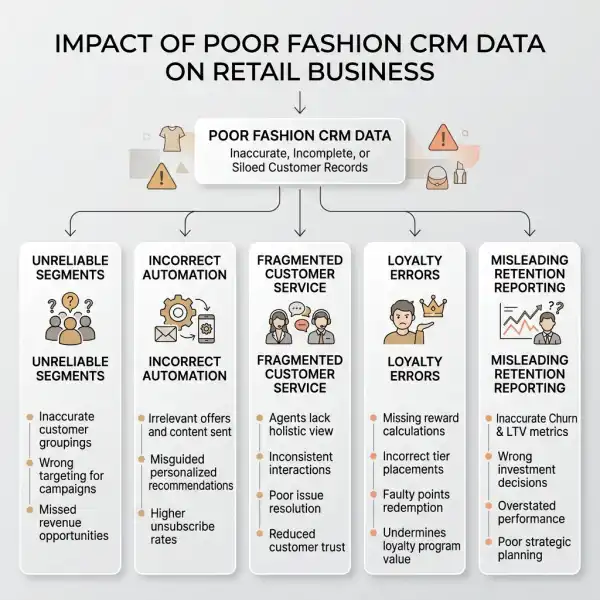
Poor customer data rarely remains confined to the database. It moves into customer service, automation, loyalty, merchandising, financial reporting, and management decisions.
Customer Segmentation Becomes Unreliable
A segment is only as credible as its definition and source data. Consider a “high-value loyal customer” audience based on total order value. The result may be misleading if it includes canceled orders, refunded purchases, taxes, shipping fees, or several duplicate profiles belonging to the same person.
Segment rules should specify:
- Whether value means gross revenue, net retained revenue, or contribution
- Whether returns and cancellations are excluded
- Which transaction channels are included
- How guest purchases are handled
- What time period applies
- Whether customer profiles have been deduplicated
- Which currency conversion method is used across markets
Without these definitions, two teams can use the same segment name and reach different customers.
Personalization Can Become Irrelevant or Intrusive
Personalization based on inaccurate data may recommend the wrong size, assume an occasion, repeat an already purchased product, or expose a mistaken identity match.
A customer who bought maternity clothing as a gift should not necessarily be classified by life stage. Someone who browsed a gendered collection should not have a sensitive identity inferred from that behavior. Even apparently harmless assumptions can feel intrusive when customers do not understand how the brand reached them.
Better personalization uses the strongest available signal, communicates with restraint, and allows customers to change declared preferences.
Marketing Automation Magnifies Errors
Manual errors affect individual actions. Automation can repeat an error across thousands of profiles.
If delivery status is delayed, a post-purchase journey may start before the parcel arrives. If return data is missing, a customer may receive recommendations based on a product they rejected. If unsubscribe status fails to synchronize, the system may continue contacting someone who opted out.
The operating structure of these journeys is discussed in how marketing automation helps fashion brands nurture repeat buyers. From a data perspective, every automation should document which fields it depends on, how current those fields must be, and what happens when a value is missing or uncertain.
Service Teams Lose Context
Duplicate or conflicting records force service agents to search several systems, ask customers to repeat information, or make decisions using incomplete histories.
The risk is more than inconvenience. An agent may overlook an unresolved refund, send an order to an outdated address, apply the wrong loyalty status, or see notes that belong to another person after an incorrect merge.
A CRM should present source, date, status, and confidence—not merely a collection of values without context.
Loyalty Programs Can Miscalculate Recognition
When purchases, returns, and profile identities are inconsistent, points may be duplicated, removed incorrectly, or distributed across several accounts. Customers then experience missing benefits or receive rewards they did not earn.
Corrections should be traceable. Simply changing a loyalty balance without retaining a reason and audit history makes repeated problems difficult to diagnose.
Retention Reporting Can Mislead Management
Customer retention depends on identifying the same customer across time. Duplicate profiles can make returning customers appear new. Incorrect merges can make different shoppers appear to be one highly active customer.
Returns, guest checkouts, wholesale orders, employee purchases, test orders, and marketplace transactions can further distort the calculation if inclusion rules are unclear.
Management may then invest in the wrong acquisition channel, customer segment, or retention program. Poor data quality does not merely reduce reporting precision; it can change commercial decisions.
What Does Good Fashion CRM Data Look Like?
Good CRM data is not the largest possible dataset. It is information that is sufficiently reliable, relevant, traceable, and governed for the decision being made.
A practical customer profile should help authorized teams understand:
- Who the customer is, within the confidence supported by available identifiers
- Which purchases, returns, and service interactions are associated with that profile
- What information the customer directly provided
- Which attributes were inferred and how recently
- Which communication permissions apply by channel and purpose
- When important fields were last updated
- Which system is authoritative for each value
- Whether any identity or data-quality issue remains unresolved
The profile should also make uncertainty visible. An inferred category interest may have a confidence score or expiration date. A size recommendation may be tied to a product family rather than stored as a universal size. A disputed address should not silently overwrite a verified fulfillment address.
Fact, Observation, and Inference Should Be Separated
Fashion CRM data can be understood through three layers:
|
Data layer |
Example |
Appropriate interpretation |
|
Confirmed fact |
Customer purchased and retained SKU 1042 in size 40 |
Reliable record of that transaction |
|
Observed behavior |
Customer viewed three linen dresses |
Evidence of browsing, not proven preference or purchase intent |
|
Inference |
Customer is likely interested in summer occasionwear |
A model or rule-based conclusion that may be wrong |
The difference should remain visible downstream. A customer-service agent may rely on a confirmed order status, while a marketing system should treat an inferred interest as a weaker and potentially temporary signal.
Completeness Should Be Purpose-Driven
A profile with every optional field filled is not necessarily higher quality than a smaller profile. The important question is whether the information required for a specific task is present.
A back-in-stock alert may require a valid contact channel, permission or other applicable eligibility, precise product variant, market, and notification status. It does not necessarily require date of birth, gender, income, or a full style profile.
This approach aligns quality with data minimization. Collecting additional attributes “in case they become useful” adds security, maintenance, and privacy obligations without guaranteeing business value.
Where Do Fashion CRM Data Problems Begin?
Many quality issues enter before the CRM performs any analysis. Preventing errors at the source is usually less expensive and more reliable than repairing them after data has spread into several platforms.
Customer Entry Forms
Free-text fields, unclear labels, unnecessary mandatory questions, and weak validation can introduce errors during account registration or checkout.
Brands should avoid making forms so restrictive that customers enter false placeholders. Requiring a telephone number when it is not genuinely needed may produce values such as repeated zeros. At the same time, formatting rules should accommodate legitimate international names, addresses, and telephone numbers rather than assuming one national structure.
Physical Stores
Store teams may create new profiles because searching is slow, a queue is forming, or incentives reward account creation rather than accurate matching. Names can be misspelled, shared telephone numbers overlooked, and consent recorded without a consistent explanation.
Good retail data quality depends on interface design and operating incentives. Staff training alone will not solve a process that makes correct data entry slower than duplication.
System Integrations
An integration may truncate fields, change time zones, map statuses incorrectly, or update data in only one direction. A successful technical transmission does not prove that the business meaning remained correct.
For example, an e-commerce field labeled “financial status” may not correspond directly to the CRM’s “order status.” A refunded order could still be fulfilled, while a fulfilled order could later be returned. Mapping both fields into one simplified value destroys useful distinctions.
Historical Imports
Legacy spreadsheets and previous platforms often contain duplicate profiles, obsolete tags, unknown permission status, and undocumented definitions. Importing everything may reproduce years of weak practices inside the new system.
Historical data should be profiled, classified, and migrated according to a defined purpose. Records with uncertain marketing eligibility should not be silently converted into permissioned subscribers.
Manual Staff Notes
Customer notes can support service continuity, but they may also contain opinions, abbreviations, irrelevant personal details, or outdated information.
Teams need guidance on what may be recorded, how facts should be distinguished from customer statements or staff judgments, and when notes should be reviewed or deleted. A useful note is factual, necessary, dated, and professionally worded.
Derived Scores and Predictive Models
Customer lifetime value estimates, churn scores, predicted sizes, and style affinities are not raw facts. They are outputs produced by assumptions, rules, or statistical models.
Derived values should include provenance, model or rule version, calculation date, and appropriate limitations. If a fashion brand changes its product mix or discount strategy, a score trained on older behavior may lose relevance even when the calculation still runs successfully.
How Can Fashion Brands Improve Customer Data Quality?
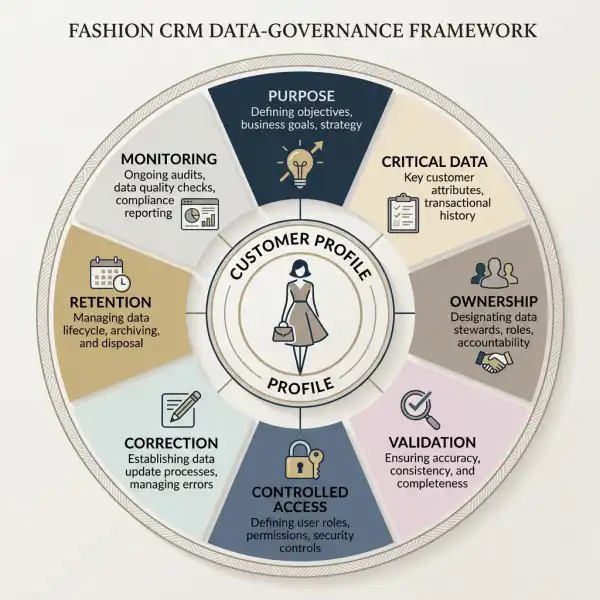
Improvement requires governance, prevention, monitoring, and correction. A one-time database cleanup may reduce current errors, but the problems will return if their sources remain unchanged.
1. Start With Critical Data Elements
Brands should first identify the fields that directly affect important customer or business outcomes. These might include:
- Customer identifier
- Channel-specific permission and suppression status
- Order, cancellation, return, and refund status
- Product and variant identifier
- Loyalty account and balance
- Country, language, and preferred store
- Open customer-service case status
- Timestamp and source system
These critical data elements deserve clear definitions, owners, validation rules, and monitoring. Optional profile fields can follow later.
2. Create a Data Dictionary
A data dictionary defines what each field means, its format, allowed values, source, update frequency, and owner.
For example, “repeat customer” might mean a person with at least two retained orders, excluding canceled and fully returned orders. The definition should state whether store and online purchases are combined, which date marks the purchase, and how guest transactions are treated.
Without shared definitions, marketing, finance, e-commerce, and analytics may produce incompatible figures from the same CRM.
3. Assign a System of Record
Each important attribute should have an authoritative source. Order status may come from the commerce or order-management system. Marketing permission may be managed by a consent service or CRM. Product composition may come from product information management.
Other systems may store copies, but synchronization rules should identify which value prevails when records conflict. “Last update wins” is unsafe when a secondary system overwrites a more authoritative value.
4. Prevent Errors at Entry
Controls at the point of collection may include:
- Valid formats and allowed values
- Clear field labels
- Address or telephone normalization appropriate to the market
- Search-before-create functions for store staff
- Duplicate warnings
- Required reason codes for important status changes
- Separate fields for fact, preference, and inference
- Confirmation for high-impact changes
Validation should support real customers rather than reject legitimate cultural or regional variations. A format designed only for one country can turn valid international information into apparently invalid data.
5. Use Cautious Identity Resolution
Identity matching rules should reflect the cost of both missed matches and false matches. Failing to merge two records may fragment a customer history; merging different people can expose information and create more serious privacy or service problems.
Brands should use stable identifiers where possible and apply confidence thresholds to combinations of weaker attributes. Manual review, reversible merges, and audit logs are valuable for ambiguous cases.
6. Monitor Quality Continuously
A data-quality dashboard should focus on actionable measures rather than a decorative overall score. Useful indicators may include:
- Duplicate-profile rate
- Percentage of orders connected to a dependable customer identifier
- Missing or unknown permission status
- Invalid contact rate
- Return-status latency
- Unresolved system conflicts
- Failed integration records
- Percentage of customer corrections completed
- Profiles containing expired inferred attributes
- Product records missing category or variant information
Targets should reflect risk and use. A delay of several hours may be acceptable for quarterly analysis but unsuitable for suppressing a promotion after a complaint.
7. Create Correction Workflows
Teams need a defined method to report, investigate, correct, and propagate an error. Changing the CRM alone may be ineffective if the incorrect value is reintroduced by the source system during the next synchronization.
A correction workflow should identify:
- Where the error originated
- Which systems received it
- Which business processes used it
- Which source value must be corrected
- Whether historical outputs or customer actions were affected
- How recurrence will be prevented
High-impact errors may also require customer communication, privacy review, or campaign suppression.
8. Retire Unused and Obsolete Data
Old fields and tags often remain because teams fear losing possible future value. Over time, nobody knows how they were created or whether they remain current.
Unused attributes should be reviewed against purpose, retention requirements, customer expectations, and legal obligations. Removing or archiving obsolete data can improve clarity while reducing privacy and security exposure.
How Should Data Quality Be Measured?
A useful metric connects a rule to a defined business use. “CRM completeness is 82%” says little unless the organization knows which fields were measured and why they matter.
|
Quality objective |
Example measure |
Fashion business use |
|
Reliable customer identity |
Percentage of identified orders linked without unresolved match conflicts |
Omnichannel retention analysis |
|
Current service context |
Percentage of open cases updated within the required interval |
Promotional suppression |
|
Valid communication eligibility |
Percentage of active contacts with documented channel status |
Campaign execution |
|
Correct transaction value |
Reconciliation rate between CRM and retained-order data |
Customer-value segmentation |
|
Usable product history |
Percentage of order lines with stable SKU, variant, and return outcome |
Recommendations and fit analysis |
|
Controlled duplication |
Confirmed duplicate profiles per 1,000 active customers |
Loyalty and frequency management |
Metrics should be segmented by source system, store, market, and integration where possible. An overall average can hide a serious problem in one region or channel.
Sampling also matters. Automated tests can detect missing formats and duplicates, but accuracy often requires comparison with authoritative records or human review. A valid telephone-number format does not prove that the number belongs to the customer.
Customer Data Quality and Privacy Are Connected
Data quality is not merely a marketing-performance issue. When CRM records contain personal information, accuracy, relevance, correction, retention, and transparency can also carry legal obligations.
The European Commission’s GDPR processing principles state that personal data should be accurate and kept up to date where necessary for the processing purpose, with inaccurate data corrected or deleted without delay. The same guidance includes data minimization, storage limitation, integrity, confidentiality, and accountability.
The UK Information Commissioner’s Office explains in its guidance on the accuracy principle that organizations should take reasonable steps to ensure personal data is not incorrect or misleading for the purpose for which it is used. What counts as reasonable depends on the circumstances and consequences.
Accuracy does not justify collecting excessive information. The ICO data-minimization guidance emphasizes holding personal data that is adequate, relevant, and limited to what is necessary for the purpose.
Applicable requirements vary by jurisdiction and business context. Fashion brands should obtain appropriate legal advice rather than assuming that a technically clean database is automatically compliant.
Customers Need a Practical Correction Route
A customer may notice an incorrect name, address, loyalty history, preference, or account association before the brand’s monitoring detects it. Correction routes should be easy to find and connected to an operational process.
The CRM should record the request, verify identity appropriately, update authoritative sources, propagate the correction, and prevent the old value from being restored. The ICO guidance on the right to rectification provides further information for organizations subject to UK GDPR.
Common Misconceptions About CRM Data Quality
“More Data Creates Better Personalization”
More data creates more possible attributes, not necessarily more accurate understanding. Weak, outdated, or irrelevant information can reduce personalization quality.
For most brands, dependable transaction status, current permissions, stable product identifiers, and accurate service context are more valuable than a large collection of speculative lifestyle attributes.
“A Single Customer View Is Always Correct”
A single customer view is an objective, not proof of accuracy. It may still contain incorrectly merged people, duplicated transactions, stale preferences, or conflicting source values.
Unified profiles need transparent matching logic, source lineage, confidence indicators, and reversible corrections.
“Completeness Means Filling Every Field”
Completeness should be assessed against a purpose. A profile can be complete for fulfilling an order without including birth date, gender, style identity, or household information.
Encouraging staff to fill optional fields merely to improve a dashboard score can produce fabricated or low-quality values.
“Data Cleaning Is a One-Time Migration Task”
Data changes continuously. Customers move, preferences evolve, products are returned, systems fail, and new channels create identities.
Migration cleanup is useful, but lasting improvement requires entry controls, monitoring, ownership, correction, and retirement rules.
“Artificial Intelligence Can Fix Poor CRM Data Automatically”
AI and probabilistic matching can help detect duplicates, normalize values, or identify anomalies. They can also create incorrect merges and plausible but unsupported attributes.
Automated corrections should be proportional to the risk. High-impact identity, permission, financial, and service changes may require deterministic rules or human review.
What Should Brands Verify Before Using CRM Data?
Before a fashion brand activates a customer segment, launches an automated journey, changes a loyalty status, or reports retention, the responsible team should verify:
- The intended purpose of the data
- The authoritative source for critical fields
- Whether the data is factual, observed, or inferred
- Whether returns, cancellations, and refunds are reflected
- Whether profiles have unresolved duplicate or merge issues
- Whether permission and suppression status is current
- Whether product, price, and inventory data is recent enough
- Whether the definition matches the metric or segment name
- Whether missing values create unsafe assumptions
- Whether customers can correct relevant information
- Whether the information should still be retained
- Whether the use complies with applicable privacy and marketing rules
Not every decision requires manual inspection of every record. The objective is to establish controls appropriate to the potential consequence. A minor editorial-content recommendation may tolerate more uncertainty than merging identities, changing a financial balance, or communicating about a sensitive inferred attribute.
Frequently Asked Questions About Fashion CRM Data Quality
What is the most important customer data in a fashion CRM?
The most important data depends on the intended use, but stable customer identifiers, current communication status, accurate order and return outcomes, reliable product-variant identifiers, and open service-case status are common priorities.
These fields support identity, service, segmentation, and responsible communication. Optional style attributes may add value later, but they should not take priority over dependable transactional and permission data. Brands should identify critical data elements for each workflow rather than copying a generic CRM template.
How often should fashion CRM data be cleaned?
Quality should be monitored continuously, while formal review frequency should reflect how quickly the data changes and how harmful an error could be. Permission and suppression failures may require near-real-time controls. Duplicate analysis or obsolete-field reviews may run weekly, monthly, or quarterly.
A scheduled cleanup is not enough if defective forms or integrations continue creating errors. Brands should combine recurring detection with source correction, clear ownership, and measurable prevention.
Should duplicate customer profiles always be merged?
No. Profiles should be merged only when evidence supports that they belong to the same person and the merge is appropriate for the intended use.
Shared addresses, devices, telephone numbers, or household emails can create false matches. An incorrect merge may expose purchase or service information and is often more serious than leaving two records separate. Uncertain cases should remain unresolved, receive a confidence status, or enter a controlled review process.
Is missing customer data always a quality problem?
No. A missing value is a problem only when the information is necessary for a defined purpose or required by an applicable obligation.
A missing product-variant identifier may prevent accurate recommendations. A missing birth date may be irrelevant when the brand has no legitimate birthday-related use. Treating every empty field as defective encourages unnecessary collection and may conflict with data-minimization principles.
Can purchase history accurately predict a customer’s style?
Purchase history can provide useful signals, especially when behavior is repeated across retained orders. It cannot establish a customer’s complete or permanent style identity.
Purchases may be gifts, occasion-specific, promotion-driven, or constrained by availability. Brands should distinguish historical facts from inferred preferences, use recent and repeated evidence, and allow customers to update declared interests. Predictions should guide options rather than restrict what the customer can see.
How do returns affect CRM data quality?
Returns change the interpretation of purchase data. A returned product should not normally carry the same preference weight as an item the customer kept, and an exchange may reveal more useful fit information than the original order.
CRM systems should retain order, return, reason, refund, and exchange states separately. Return reasons also need cautious interpretation because customers and staff may apply codes inconsistently.
Who should own customer data quality?
Ownership should be shared but explicit. A central data, CRM, or operations owner may establish standards, while marketing, e-commerce, retail, customer service, IT, privacy, and product teams remain responsible for the information they create or maintain.
Each critical field needs an accountable owner and authoritative source. Without field-level responsibility, teams may recognize that the data is wrong but lack authority to correct the originating process.
Does high-quality CRM data guarantee successful automation?
No. High-quality data improves the reliability of automation, but journey strategy, content, timing, product availability, channel choice, customer value, and measurement also affect performance.
Accurate data can confirm that a customer retained a jacket. It cannot determine automatically whether another promotion is desirable. Brands still need commercial judgment, customer-experience safeguards, testing, and meaningful exit and suppression rules.
Conclusion
Customer data quality determines whether a fashion CRM represents real customer relationships or merely stores a large volume of disconnected activity. Accurate transactions, governed identities, current permissions, consistent definitions, timely service status, and stable product records provide the foundation for credible segmentation and communication.
The fashion context makes interpretation particularly important. A purchased size is not universal. A product view is not a preference. An order is not necessarily retained demand. Two matching household details do not prove that two profiles belong to the same person.
Brands should therefore design data quality around decisions, not database completeness for its own sake. Define critical fields, assign authoritative sources, prevent errors at entry, treat uncertain matches carefully, monitor operational quality, and give customers a workable correction route.
A smaller CRM dataset that teams understand and trust is usually more valuable than a richly populated profile built from assumptions. Better customer focus begins with knowing not only what the data says, but also where it came from, how reliable it is, and what it does not prove.





Comments 0
Leave a CommentSend Comment
Anda harus Login terlebih dahulu untuk dapat memberikan komentar.