

How Adjustable Clothing Designs Support Comfort During Pregnancy
Clothing designed for pregnancy faces an unusual challenge: it must fit a body that can change considerably while still providing the comfort, appearance, and practicality expected from everyday apparel. A garment that fits well at one point in pregnancy may feel restrictive or sit differently several weeks later, even when the wearer has not changed their preferred clothing style.
Adjustable clothing design offers a practical response. Instead of depending entirely on oversized silhouettes or increasingly larger garment sizes, designers can incorporate flexible waistbands, expandable fabric panels, gathering, adjustable fastenings, and strategically positioned ease into the garment itself.
These details may appear relatively simple, but their effectiveness depends on thoughtful patternmaking and material selection. A flexible waistband can provide additional room, for example, but it may still create discomfort if its elastic tension, seam placement, or relationship to the garment's rise is poorly designed.
For fashion brands and manufacturers, understanding adjustable maternity clothing means looking beyond individual features. The real challenge is designing garments that respond to changing body proportions while maintaining fit consistency, structural quality, and a recognizable fashion silhouette.
Quick Answer: How Does Adjustable Clothing Improve Comfort During Pregnancy?
Adjustable maternity clothing uses adaptable garment construction to accommodate changing body measurements during pregnancy without requiring every part of the garment to become larger. Common design features include elastic waistbands, expandable abdominal panels, adjustable ties, drawstrings, gathering, wrap closures, and strategically placed stretch fabrics.
These mechanisms allow particular garment areas to expand, contract, or change position as the wearer's body changes. For example, maternity trousers may combine a conventional woven leg construction with a flexible abdominal panel, while a maternity dress may use gathering or adjustable ties to provide additional room without significantly changing its overall silhouette.
The primary advantage is controlled adaptability. Rather than adding excessive volume throughout a garment, designers can concentrate flexibility where it is most useful.
However, adjustability does not automatically guarantee comfort. Its effectiveness depends on pattern dimensions, fabric stretch and recovery, fastening design, seam construction, and individual fit preferences. A well-designed maternity garment must balance accommodation with comfort during sitting, walking, bending, and ordinary daily activities.
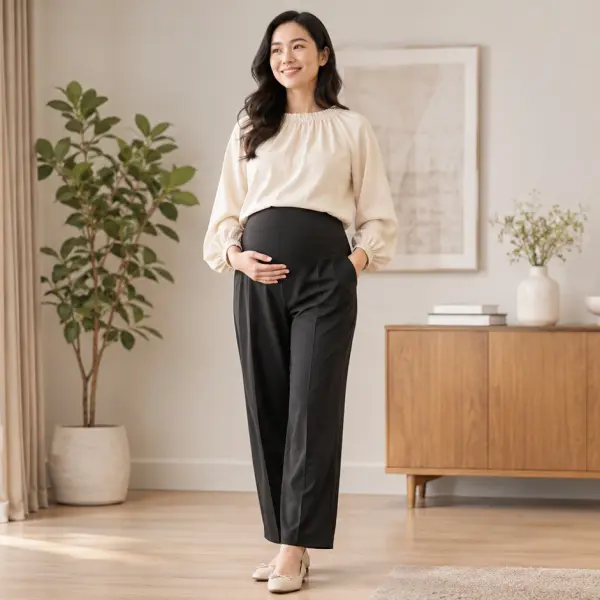
Why Does Maternity Clothing Need Adjustable Construction?
Pregnancy-related body changes are not confined to a single measurement. Abdominal dimensions generally increase, but changes in the bust, hips, posture, and body proportions can also affect garment fit.
Research on body shape changes during pregnancy has examined how these changes influence maternity clothing patterns. Using three-dimensional body scanning and digital draping, the researchers found that pattern changes did not occur proportionally across all garment sections. This supports an important principle: pregnancy-related fit adjustments cannot reliably be achieved by uniformly enlarging a conventional pattern.
Taylor & Francis Online
Adjustable clothing responds to this challenge by allowing selected garment areas to change more independently of others.
The Difference Between Adding Ease and Building Adjustability
Garment ease is the difference between a body measurement and the corresponding garment measurement. It contributes to fit, movement, and the intended silhouette. A loose maternity dress, for instance, may contain enough additional ease to accommodate abdominal growth without incorporating a mechanical adjustment system.
Adjustability is different. It refers to a construction feature that allows the garment's effective fit or dimensions to change, such as an elastic waistband, an adjustable tie, or a buttonhole elastic system.
The distinction matters because a garment can provide generous ease without being adjustable, and it can include adjustable components without necessarily being comfortable.
For example, a woven maternity blouse with carefully placed gathering may accommodate changing abdominal volume through its available ease. Meanwhile, trousers with an adjustable waistband may allow the wearer to change waist circumference more directly.
Both solutions are useful, but they solve different fit problems.
Why Simply Buying Larger Clothes Is Not Always Effective
Conventional garment sizing normally changes several measurements together. When a customer selects a larger shirt, the shoulders, neckline, chest, sleeves, and overall garment dimensions may all increase according to the brand's grading system.
During pregnancy, those proportional changes may not match the wearer's requirements. A larger shirt could provide sufficient abdominal space while producing an excessively wide shoulder or oversized neckline.
In maternity trousers, selecting a larger conventional size may create similar inconsistencies. The waistband could remain uncomfortable while the hip or leg measurements become unnecessarily loose.
Purpose-designed adjustable construction allows designers to preserve some of the original silhouette while accommodating changes in selected areas.
For a broader explanation of everyday maternity wardrobes and garment categories, see maternity fashion for modern everyday dressing.
Different Wearers Need Different Types of Adjustment
Not all pregnant customers experience body changes at the same rate or prefer identical garment fits. Some may favor over-the-abdomen waistbands, while others find lower-positioned waist construction more comfortable.
A narrative review of maternity wear design criteria identified adaptability, comfort, and appearance as relevant design considerations. The review also addressed the relationship between maternity clothing and individual perceptions of body appearance, indicating that functional accommodation should not be separated from wearer preferences.
For manufacturers, this means adjustability should not be treated as a universal feature with one ideal construction. Different mechanisms may be more suitable for different garment categories, materials, activities, and individual preferences.
Common Adjustable Design Features Used in Maternity Clothing
Adjustable maternity apparel can incorporate several construction techniques. Some rely on the elastic properties of materials, while others use adjustable components or pattern structures that provide room for expansion.
The most appropriate technique depends on where additional accommodation is required and how the garment is expected to look and function.
1. Elastic and Adjustable Waistbands
The waistband is one of the most important construction areas in maternity bottoms. As abdominal measurements change, a conventional fixed waistband may become uncomfortable even when the hips and legs of the garment still fit.
Elastic waistbands allow the garment circumference to expand within the elastic material's designed extension range. Some garments use a fully elasticized waistband, while others incorporate elastic only at the back or sides.
Additional adjustability can be introduced through drawcords, buttonhole elastic, or other mechanisms that allow the wearer to modify the effective waistband circumference.
For example, internal buttonhole elastic can be secured at different positions along a button, allowing circumference adjustment without changing the entire garment. However, the system requires appropriate button placement, a securely constructed casing, and sufficient fabric allowance.
The design objective is to provide usable adjustment without creating bulky folds or concentrated pressure.

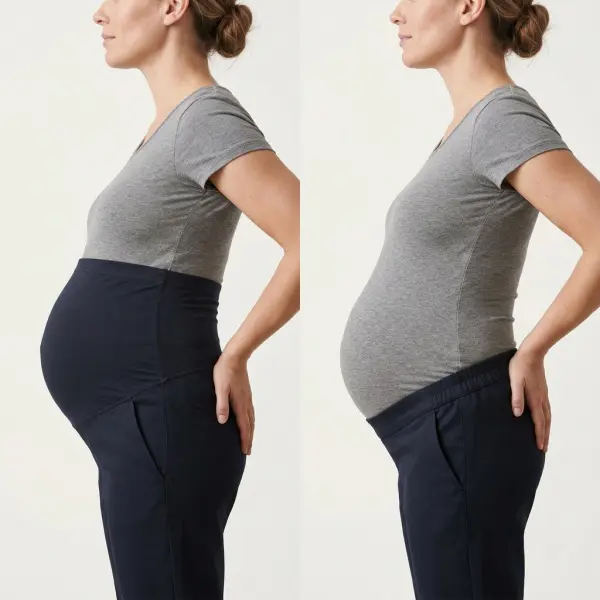
2. Over-the-Bump and Under-the-Bump Panels
Maternity trousers and jeans commonly use specialized abdominal constructions.
An over-the-bump panel extends upward over part or most of the abdomen, usually using a soft stretch material attached to the main trouser body. This construction can provide coverage and accommodate changes in abdominal circumference.
An under-the-bump waistband sits lower, beneath the abdomen, leaving the belly uncovered by the waistband itself. It may use elastic, curved pattern shaping, or flexible side sections.
The difference is not simply aesthetic. These constructions place material, seams, and elastic tension in different areas of the body, which can affect individual comfort preferences.
Neither construction is universally preferable. The outcome depends on abdominal shape, waistband position, panel elasticity, fabric recovery, and how the trousers behave while standing and sitting.
3. Ruching, Gathering, and Shirring
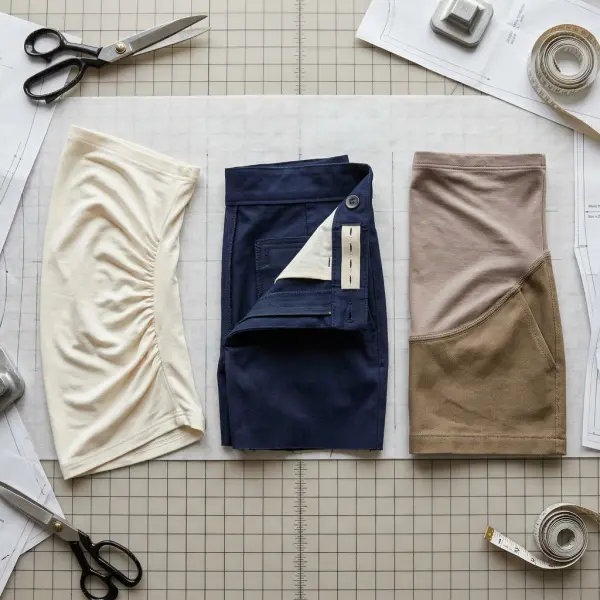
Ruching and gathering are often used to distribute additional fabric length or fullness across a selected garment area. In maternity tops and dresses, these techniques can allow the front body to accommodate an expanding abdomen while retaining a more fitted appearance elsewhere.
Side ruching is particularly useful in knitted tops. Additional length is incorporated into the pattern and gathered along sections of the side seams, allowing the fabric to distribute itself over a changing abdominal shape.
Shirring can provide a different effect. When produced using suitable elasticized stitching or thread systems, it creates a gathered area that can extend and recover within the limits of the fabric and construction.
These techniques are not identical. Ruching generally describes the gathered visual effect, while shirring commonly refers to closely spaced gathered stitching, often involving elastic thread. The distinction matters when communicating requirements to a garment manufacturer.
Good construction requires sufficient fabric allowance, consistent gathering distribution, and suitable stitching. Poorly controlled gathering can create excessive bulk or uneven drape rather than useful adaptability.
4. Wrap Closures and Adjustable Ties
Wrap garments provide adjustability through overlapping fabric sections and ties or fastenings that can be repositioned.
In a maternity wrap dress, the overlap may allow the wearer to modify the fit as body proportions change. The design can also preserve a defined waist appearance without relying on a rigid, fixed waistband.
However, the amount of useful adjustment depends on the width of the overlap, tie placement, neckline construction, and fabric behavior.
A wrap dress with insufficient overlap may create coverage problems as the abdomen expands. Similarly, ties positioned at an unsuitable height may interfere with the intended silhouette or become uncomfortable.
Designers should therefore evaluate wrap garments across the intended fit range rather than assuming that all wrap silhouettes are automatically suitable for pregnancy.
5. Expandable Side Panels and Inserted Fabric Sections
Expandable fabric panels allow a relatively structured garment to retain its original appearance while accommodating additional volume in selected areas.
In maternity trousers, stretch panels may be inserted near the side waist. In other garments, panels can be incorporated around the abdomen or body seams where additional flexibility is required.
The material used for the panel must be compatible with the main garment. A highly elastic knit attached to a rigid woven fabric can produce unwanted distortion if the seam construction, panel dimensions, or tension are poorly controlled.
Panel placement also influences appearance. A carefully integrated side panel may be relatively discreet, while a contrasting abdominal insert may become an intentional design feature.
For apparel manufacturers, inserted panels add material and assembly considerations. The construction should be evaluated for seam strength, dimensional stability, and consistent production quality.
6. Pleats, Gussets, and Convertible Details
Not every adaptable garment needs elastic or stretch fabric. Pattern construction can provide additional room through folds, inserted sections, or configurable components.
Pleats may release additional fullness in selected areas, depending on whether they are stitched down or left free to open. Gussets are inserted pattern pieces that can increase space or mobility at specific garment locations.
Convertible features, such as fold-over waistbands or adjustable hems, may also allow a garment to be worn in different configurations.
These solutions can be particularly relevant when a brand wishes to preserve the appearance of woven or tailored garments. Yet their success depends on accurately calculating the additional volume and determining how the garment will behave as its shape changes.
Comparing Adjustable Maternity Clothing Mechanisms
The effectiveness of an adjustable feature depends on the garment problem it is intended to solve. A mechanism that works well for maternity leggings may be inappropriate for a structured blouse or formal dress.
|
Adjustable feature |
Main function |
Common application |
Design limitation |
|
Elastic waistband |
Allows circumference to expand |
Leggings, skirts, relaxed trousers |
Excessive tension or poor recovery |
|
Buttonhole elastic |
Permits incremental circumference adjustment |
Maternity trousers, skirts |
Limited range; added hardware and assembly |
|
Over-the-bump panel |
Accommodates abdominal volume with extended coverage |
Jeans, trousers, leggings |
Panel height and tension affect comfort |
|
Under-the-bump waistband |
Positions the waistband beneath the abdomen |
Trousers, shorts, skirts |
Can shift or dig in if poorly shaped |
|
Side ruching |
Provides distributed fabric length and fullness |
Tops, jersey dresses |
Insufficient fabric or uneven gathering |
|
Wrap and tie closures |
Allows adjustable overlap and fastening |
Dresses, blouses, skirts |
Coverage depends on overlap and tie placement |
|
Stretch side panels |
Adds flexibility to selected garment areas |
Jeans, structured separates |
Material mismatch or seam distortion |
|
Expandable pleats |
Provides additional patterned fullness |
Dresses, tunics, woven garments |
Adjustment is limited by available fabric |
The practical lesson is that adjustability must be designed around a specific fit requirement. Combining several mechanisms does not necessarily create a better garment. An overly complicated product can become more expensive to manufacture and less convenient for customers to wear.
How Adjustable Construction Influences Garment Comfort
A garment can provide considerable expansion and still feel uncomfortable. The relationship between adjustability and comfort depends on how fabric tension, garment weight, seams, and fit are distributed across the body.
For maternity clothing, the design challenge is not simply achieving a larger circumference. It is ensuring that the garment accommodates changing proportions without creating avoidable pressure, unwanted movement, or excessive fabric bulk during ordinary activities.
Managing Waistband Pressure and Fabric Tension
Elastic waistbands create resistance as they stretch. That resistance helps garments remain in position, but it can also create localized pressure when the elastic is too narrow, too tight, or poorly positioned.
A wide stretch panel may distribute tension differently from a narrow elastic band. However, width alone does not guarantee comfort, because fabric modulus, recovery, pattern dimensions, and panel construction also influence the resulting fit.
For product developers, useful evaluation questions include whether the waistband rolls, digs into the body, slides downward, or changes position while the wearer is seated.
These observations should guide adjustments to elastic specifications, panel dimensions, waistband placement, and garment rise.
Accommodating Movement Without Excessive Fabric Bulk
Maternity garments must remain functional during sitting, walking, reaching, and bending. Additional fabric can provide greater accommodation, but uncontrolled fullness may create bunching or interfere with the intended silhouette.
Consider a maternity dress with generous abdominal gathering. When the wearer stands, the fabric may fall naturally. When seated, however, the gathering may shift or accumulate around the waist or lower abdomen.
A well-designed garment distributes the extra material through appropriate pattern shaping and construction. The objective is sufficient movement allowance without unnecessary fabric concentration in sensitive or high-friction areas.
Maintaining Coverage and Garment Balance
As abdominal volume increases, the front of a top or dress may rise relative to the back. This can produce an uneven hemline or inadequate coverage, even when the fabric stretches sufficiently around the body.
Patternmakers may address this through additional front length, modified hem shaping, or appropriately distributed gathering.
The same principle applies to wrap garments, where changing body dimensions can affect neckline and front-body overlap.
Garment balance should be assessed through both front and side views, with attention to how the garment hangs during normal movement. Additional stretch alone cannot reliably compensate for insufficient pattern length or poorly positioned construction lines.
Considering Seam Placement and Fastener Accessibility
The location of seams, elastics, buttons, and other fastenings can influence the usability of adjustable maternity clothing.
For example, an internal adjustable waistband may work technically but be inconvenient if the wearer must remove the garment to access its fastening. Exposed buttons or bulky seam intersections may also create discomfort when positioned against the body.
Designers should evaluate whether adjustment mechanisms are easy to operate and whether they remain secure during ordinary wear.
The best solution is not necessarily the one with the most adjustment settings. It is the one that provides the required flexibility with minimal interference in everyday use.
Fabric Stretch, Recovery, and Construction Compatibility
Fabric selection is central to adjustable garment design, but stretch should not be treated as a single performance characteristic.
A maternity product may combine knitted and woven fabrics, different stretch directions, elastic components, and multiple seam types. Each component contributes to how the completed garment behaves.
A fabric may stretch easily when pulled by hand, yet develop permanent deformation or fail to provide the intended comfort after repeated wear.
Understanding Stretch and Recovery
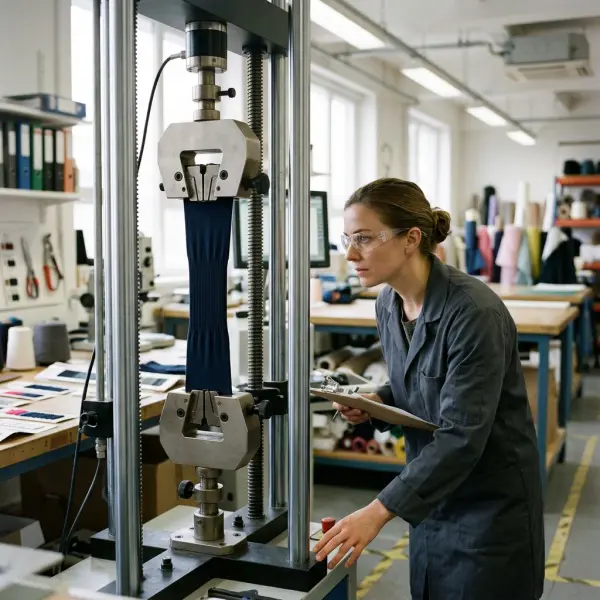
Stretch describes the ability of a fabric to extend under force, while recovery describes its ability to return toward its original dimensions after that force is removed.
Both characteristics matter for maternity garments. Stretch provides accommodation, while recovery helps the garment maintain its intended shape when body positions and garment tension change.
For example, a maternity legging fabric with substantial extension but poor recovery may become loose around the knees or abdominal panel. Conversely, a fabric with limited usable extension or high resistance may feel restrictive despite maintaining its original shape.
The relevant properties can be assessed using suitable textile test methods. ISO 20932-1:2018, Textiles — Determination of the Elasticity of Fabrics — Part 1: Strip Tests, which was confirmed as current in 2024, describes methods for evaluating fabric elasticity and related properties. It is not a universal maternity-garment certification, and the selected testing approach must match the material and intended application.
Combining Knitted and Woven Materials
A maternity trouser may use a woven fabric for the legs and a knitted panel for the abdomen. This combination allows the designer to retain the structure and appearance of traditional trousers while introducing flexibility where needed.
However, joining different materials creates technical challenges.
The fabrics may have different stretch properties, shrinkage behavior, thickness, and dimensional stability. If these characteristics are not considered, the finished garment may develop distorted seams, puckering, or uneven tension.
Manufacturers should select suitable stitching, seam allowances, reinforcement methods, and fabric combinations. Sample garments should be evaluated before and after laundering to identify changes in alignment or fit.
Why Fabric Weight and Surface Feel Matter
A soft lightweight jersey may feel comfortable against the body, but it may lack sufficient opacity or recovery for fitted maternity leggings. A heavier fabric may provide better coverage and structure while also feeling warmer or less flexible.
Similarly, a smooth surface does not necessarily indicate good moisture management or thermal comfort.
Material selection therefore involves compromises between stretch, opacity, handfeel, weight, drape, durability, and climate suitability.
Brands should test the fabric under conditions that resemble its intended use rather than selecting it solely from swatches or supplier descriptions.
Designing Adjustable Maternity Patterns for Changing Body Measurements
Pattern development determines how successfully an adjustable feature works within the complete garment.
A designer may select an appropriate fabric and fastening mechanism, but the finished product will still fit poorly if the pattern does not provide sufficient space or distributes that space incorrectly.
Pregnancy-related body changes do not follow an identical trajectory for every wearer. A longitudinal anthropometric study using three-dimensional body scanning examined changes in bust, waist, and hip measurements during pregnancy. Its findings illustrate the importance of accounting for changes at different anatomical locations, although results from a limited study population should not be used as a universal maternity sizing system.
Separating Fixed and Variable Measurements
One useful pattern development approach is to distinguish garment areas intended to remain relatively consistent from areas expected to accommodate more substantial dimensional change.
For a maternity blouse, shoulder width and sleeve construction may remain closer to a conventional style, while front-body length and abdominal circumference receive additional allowance.
For maternity trousers, the leg silhouette may remain familiar while the waistband and upper front construction are modified.
This does not mean that shoulders, hips, or other dimensions never change during pregnancy. Rather, it provides a practical framework for deciding where adjustability should be concentrated.
Developing an Appropriate Adjustment Range
Every adjustable mechanism has a finite usable range.
A buttonhole elastic system can only adjust through its available fastening positions. A stretch panel is limited by its dimensions and material properties. A wrap garment requires adequate overlap to maintain coverage.
During development, brands should define the intended adjustment range through relevant garment measurements and fit evaluations.
A garment should not be described as suitable throughout pregnancy unless that claim is supported by appropriate design evaluation. Even then, fit will vary between individuals.
Testing Fit Across Relevant Body Proportions
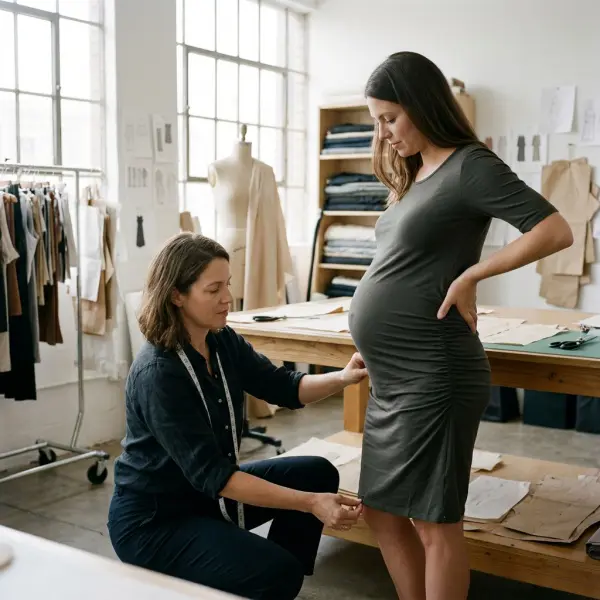
Maternity fitting should evaluate different body shapes rather than relying on a single sample model.
A practical process may involve fittings with pregnant participants representing relevant sizes, body proportions, and stages of pregnancy, provided participation is voluntary, comfortable, and appropriately managed.
Fit assessment should consider how the garment behaves when the wearer stands, sits, walks, and reaches. Designers should also ask whether adjustable components are easy to use and whether the garment remains in position.
Digital garment development tools can assist with visualization and pattern iteration. A published research workflow for virtual maternity clothing design demonstrated the use of three-dimensional body modeling and garment simulation during pregnancy-specific pattern development. Such tools can support sampling, but physical fittings remain important for assessing actual material behavior and wearer comfort.
Practical Applications for Fashion Brands and Garment Manufacturers
Adjustable maternity clothing has implications for product development, sourcing, production planning, quality control, and retail presentation.
From a business perspective, the challenge is to make adjustability commercially useful without introducing unnecessary manufacturing complexity.
A garment with several adjustable components may look versatile in a product concept. However, each additional mechanism can introduce new materials, construction operations, testing requirements, and opportunities for production inconsistency.
Product Development: Match the Mechanism to the Garment
The starting point should be the fit problem rather than a preferred design feature.
A fitted maternity T-shirt may benefit from additional front length and controlled side gathering. A tailored trouser may need a dedicated abdominal panel. A woven maternity dress may achieve sufficient accommodation through pattern ease, pleats, or an adjustable wrap construction.
Using the same adjustment solution across every product category can lead to compromised results.
Brands should create clear construction specifications describing the intended function, adjustment range, fabric requirements, and fit expectations of each mechanism.
Sourcing: Evaluate Materials and Trims Together
Adjustable garment construction often depends on components beyond the main fabric.
These may include elastic tapes, drawcords, buttons, toggles, stretch panels, and specialized thread or stitching systems.
For manufacturers, sourcing should consider whether these components can withstand expected wear and laundering. Elastic recovery, fastening strength, component compatibility, and color consistency may all affect quality.
Material availability also matters. A garment that depends on a highly specialized trim may encounter sourcing constraints or higher minimum order quantities.
A practical sourcing strategy balances functional performance with repeatable material availability.
Production: Account for Additional Sewing Operations
Adjustability can increase garment assembly complexity.
An internal buttonhole elastic waistband, for example, requires suitable elastic, a casing or attachment method, button placement, and quality checks. A gathered side panel may require controlled fabric distribution and appropriate stitching to achieve a consistent appearance.
These operations influence production time, operator training, and manufacturing cost.
Brands should therefore confirm that the intended adjustment feature can be produced consistently at the planned manufacturing scale. A sample that looks successful when sewn individually may require process refinement before bulk production.
Quality Control: Test the Complete Garment
Material tests are useful, but they do not replace finished-garment evaluation.
A fabric may demonstrate acceptable stretch and recovery in a laboratory while performing differently after it is sewn into a garment with multiple seams or restrictive components.
Quality teams should evaluate the finished product for seam stability, panel attachment, elastic recovery, laundering behavior, adjustment functionality, and overall fit consistency.
For knitted fabrics intended for low-power stretch applications, ASTM D2594/D2594M-21 provides a method for measuring fabric stretch and growth. Its scope also distinguishes such applications from higher-power or specialized support fabrics, which may require other methods.
Testing specifications should be agreed with suppliers and aligned with the product's actual requirements.
Retail: Explain How the Adjustment Works
An adjustable feature offers little customer value if shoppers cannot understand its purpose or use it correctly.
Product pages should explain what the mechanism adjusts, where it sits on the body, and how it is intended to be used.
For example, a trouser description might identify an adjustable internal waistband rather than simply claiming that the product grows with the customer.
Clear product photographs can demonstrate the position of abdominal panels, drawcords, and side gathering. Short instructional visuals may help communicate less familiar features.
This approach gives customers concrete information that supports purchasing decisions and reduces reliance on vague comfort claims.
Cost and Scalability: When Is Adjustability Worth the Investment?
Adjustable clothing design can increase product complexity, but it may also provide functional differentiation that is meaningful to maternity customers.
The business case depends on whether the feature addresses a genuine fit need and whether customers recognize its value.
A basic gathered maternity top may require relatively modest construction changes compared with a conventional knitted garment. A tailored maternity trouser with specialized stretch panels, adjustable elastic, and additional assembly operations may involve more substantial development costs.
Brands should evaluate the trade-offs between construction complexity and customer usefulness.
|
Commercial consideration |
Potential benefit |
Possible trade-off |
|
Adjustable waistbands |
More flexible fit |
Additional elastic or fastening operations |
|
Specialized abdominal panels |
Targeted accommodation |
Extra fabric sourcing and seam construction |
|
Side gathering |
Flexible front-body shaping |
More controlled sewing and inspection |
|
Wrap construction |
Adjustable garment overlap |
Greater pattern and coverage considerations |
|
Multiple fit configurations |
Increased wearing flexibility |
More complex product instructions and validation |
|
Extended intended usability |
Potential value for customers |
Requires evidence; does not guarantee longer use |
For smaller apparel brands, a focused assortment with a limited number of well-executed adjustment mechanisms may be more practical than introducing highly specialized features throughout the entire collection.
Scalability depends not only on production capacity but also on repeatability. A relatively simple construction that consistently meets its fit requirements can be commercially preferable to an elaborate mechanism that creates manufacturing difficulties.
Common Mistakes in Adjustable Maternity Clothing Design
Adjustable features are useful only when they improve the complete garment. Several common development decisions can undermine their intended benefits.
Mistake 1: Assuming More Stretch Automatically Means More Comfort
A highly extensible fabric may seem appropriate for maternity clothing, but stretch alone does not determine comfort. Excessive elastic resistance can create pressure, while inadequate recovery may cause garments to lose shape during use.
The better approach is to evaluate extension, recovery, material weight, and finished-garment fit together. A lower-stretch material with suitable pattern ease may sometimes provide a more comfortable result than an aggressively elastic construction.
Mistake 2: Adding Elastic Without Redesigning the Pattern
Replacing a fixed waistband with elastic may appear to be a straightforward maternity adaptation. However, the original garment may lack sufficient front rise, abdominal volume, or an appropriate waistband position.
The result can be a garment that expands in circumference but still fits awkwardly. Pattern dimensions should be reviewed alongside the elastic mechanism, especially in structured trousers and skirts.
Mistake 3: Ignoring the Position of Adjustment Mechanisms
A fastening can be technically effective while remaining inconvenient or uncomfortable in practice. Buttons, ties, and drawcords placed in high-pressure areas may interfere with movement or require awkward manipulation.
Design teams should assess accessibility, contact with the body, and the stability of the fastening during ordinary activities. Adjustment details should serve the wearer, not merely demonstrate technical ingenuity.
Mistake 4: Claiming Universal Pregnancy Fit
Body measurements and fit preferences vary, so a garment designed for a particular adjustment range cannot be assumed to fit every customer or every stage of pregnancy.
Universal fit claims can create unrealistic expectations and make size guidance less useful. Brands should document the intended fit range, publish accurate measurement information, and explain how each adjustable feature functions.
Mistake 5: Evaluating Samples Only on Dress Forms
Dress forms are useful for pattern development, but they cannot fully reproduce the changing proportions, movement, or comfort perceptions of actual wearers.
A garment may appear well balanced on a mannequin yet behave differently during sitting or walking. Physical fittings with appropriate participants can reveal issues involving waistband pressure, garment movement, seam placement, and fastening accessibility.
Mistake 6: Overcomplicating the Garment
Adding multiple drawcords, buttons, and adjustment points can make a product appear versatile while increasing manufacturing cost and user effort.
Complex systems may also introduce more potential failure points. Designers should prioritize mechanisms that solve a specific requirement with the least necessary complexity.
What Brands Should Verify Before Making Comfort Claims
Adjustability is a design characteristic. Comfort is a wearer experience influenced by the complete garment, individual body proportions, activity, climate, and personal preference.
This distinction matters when brands communicate product benefits.
A garment with a stretch waistband can be accurately described as incorporating stretch construction. Claiming that it provides clinically proven comfort, prevents pregnancy discomfort, or offers medical support requires a different level of evidence.
Brands should avoid treating ordinary maternity apparel as a medical product unless it has been developed and evaluated for the relevant intended use.
The same caution applies to post-pregnancy longevity claims. A garment may be designed for adjustable use beyond pregnancy, but that capability should be tested and communicated as a design intention rather than guaranteed for every wearer.
The Australian Government-supported Pregnancy, Birth and Baby guidance on maternity clothing emphasizes comfort, adaptable wardrobe choices, and the continued usefulness of some existing clothing. The guidance does not establish that a particular adjustable mechanism is universally superior.
For fashion businesses, the appropriate standard is straightforward: explain what the product is designed to do, verify the relevant technical performance, and avoid claiming benefits that have not been demonstrated.
Frequently Asked Questions About Adjustable Maternity Clothing
1. What is adjustable maternity clothing?
Adjustable maternity clothing is apparel designed with features that allow selected garment dimensions or fit characteristics to change as the wearer's body changes during pregnancy. Common mechanisms include elastic waistbands, expandable panels, ties, buttonhole elastic, gathering, and wrap closures.
Unlike simply purchasing a larger conventional garment, adjustable construction can concentrate additional accommodation in specific areas while preserving the intended fit elsewhere. However, the amount of adjustment depends on the garment's pattern and materials. A product described as adjustable should provide a clearly identifiable mechanism or functional construction rather than relying on a vague claim of flexibility.
2. Are adjustable waistbands better than regular elastic waistbands?
Not necessarily. A standard elastic waistband already provides flexibility through material extension, while a separately adjustable waistband allows the wearer to change the effective circumference through fastenings, drawcords, or other mechanisms.
A simple elastic waistband may be sufficient for relaxed maternity leggings or skirts. Adjustable elastic systems can offer additional control in garments where a more variable waist fit is desirable. The appropriate choice depends on garment design, material resistance, adjustment range, and user preference. Manufacturers should evaluate both options through completed-garment fittings rather than assuming that more adjustment points automatically create greater comfort.
3. How do expandable maternity panels work?
Expandable maternity panels introduce a flexible fabric section into a garment to accommodate changing body dimensions. They are commonly used in trousers, jeans, and leggings, where the main garment fabric may not provide sufficient abdominal flexibility.
The panel can be positioned over the abdomen or integrated into the side waist, depending on the design. Its performance depends on fabric extension, recovery, panel dimensions, seam attachment, and the fit of the surrounding garment. A panel that is too restrictive may feel uncomfortable, while one that lacks sufficient recovery may shift or lose shape. Proper pattern development and wear testing are therefore essential.
4. Can adjustable maternity clothes be made without stretch fabrics?
Yes. Adjustable clothing can use mechanical construction features such as ties, wrap closures, adjustable buttons, pleats, and gussets without depending entirely on stretch fabrics. These features can be useful in woven maternity dresses, blouses, and skirts.
However, the fabric still needs sufficient ease or an appropriate adjustment mechanism to accommodate the intended body changes. A tightly fitted woven garment with adjustable buttons but inadequate pattern volume may remain restrictive. Designers should distinguish between mechanical adjustability and material elasticity, then determine whether either approach, or a combination of both, provides the required fit.
5. How should maternity brands test adjustable clothing?
Brands should test both the adjustment mechanism and the complete garment. Material testing can evaluate properties such as stretch, recovery, dimensional stability, and seam performance, while fit sessions can assess how the garment behaves during actual wear.
Suitable fit evaluations may include standing, sitting, walking, and using adjustment features. Testing should represent the intended size range and relevant body proportions rather than relying only on one mannequin or fitting model.





Comments 0
Leave a CommentSend Comment
Anda harus Login terlebih dahulu untuk dapat memberikan komentar.