

Garment Pressing and Finishing Explained for Better Product Presentation
Quick Answer
Garment pressing and finishing is the controlled set of operations used to shape, clean, inspect, and prepare a sewn garment for packing, retail display, or delivery. Pressing uses a managed combination of heat, moisture or steam, pressure, time, and cooling or vacuum. Finishing is broader: it may also include thread trimming, spot cleaning, closure checks, label and accessory attachment, measurement verification, final inspection, folding, and packing.
The aim is not simply to remove wrinkles. A well-managed process restores the intended silhouette after sewing and handling, settles seams, improves edge definition, and presents the garment consistently without damaging the shell fabric, interlining, trims, print, coating, or construction. The correct method therefore depends on the complete product—not only the fiber named on the fabric specification.
For a fashion business, the most useful control is a style-specific pressing and finishing standard approved during sampling. It should define the equipment, garment support, safe operating window, sequence, appearance standard, cooling time, inspection points, and packaging method. Final appearance should be engineered and repeatable, not left to an operator’s personal interpretation.
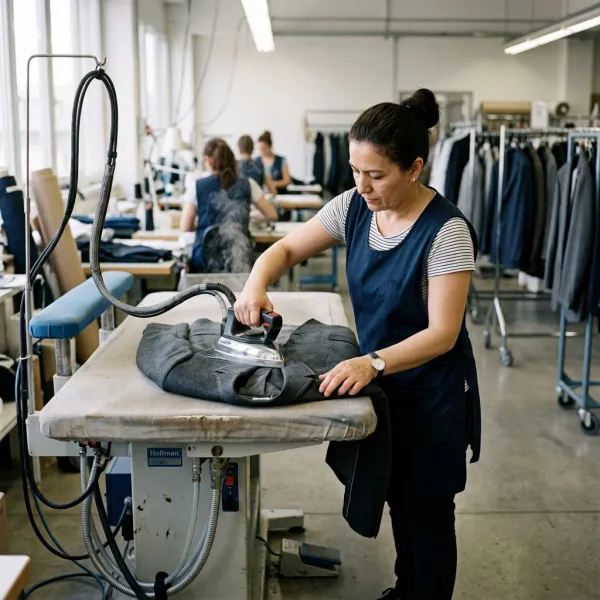
What Are Garment Pressing and Finishing?
Garment pressing is a controlled thermal and mechanical process that applies heat, moisture or steam, pressure, and time to improve a garment’s shape and surface, followed where necessary by vacuum or cooling to help stabilize the result. Garment finishing is the wider production stage that brings the sewn item to its approved saleable condition through appearance correction, cleaning, component checks, inspection, presentation, and packing.
The two terms overlap in factory conversation, but they are not synonyms. Pressing is one operation within finishing. A shirt can be pressed neatly and still fail because of an untrimmed thread, stain, mismatched button, incorrect label, or unwanted fold. A garment may also pass a checklist yet look weak because its collar, lapels, pleats, or hems lack the approved shape.
There is also a useful distinction between pressing and ordinary ironing. Ironing commonly involves moving a heated soleplate across a surface to remove wrinkles. Production pressing is more controlled and more shape-oriented. It may use shaped bucks, vacuum tables, form finishers, trouser toppers, steam tunnels, or specialized presses selected for a particular product and construction.
|
Term |
Main purpose |
Typical point of use |
What it does not guarantee |
|
Pressing |
Shape seams and garment areas; improve surface appearance |
During sewing and at final finishing |
Cleanliness, correct labels, complete inspection, or correct packing |
|
Ironing |
Smooth wrinkles, usually with a hand iron |
Sampling, repair, low-volume work, or final touch-up |
Repeatable three-dimensional shaping |
|
Underpressing |
Press components or seams during assembly |
Between sewing operations |
A finished retail presentation |
|
Final pressing |
Restore and define the completed silhouette |
After sewing and before final inspection or packing |
That every construction defect has been corrected |
|
Garment finishing |
Prepare the complete product for approval and delivery |
End of the production flow, with some tasks integrated earlier |
That poor construction can be hidden permanently |
This distinction matters commercially. If a supplier quotes “finishing” but measures only ironing output, the brand may assume that cleaning, thread control, accessory checks, measurement review, and pack presentation are covered when they are not.
Where Pressing Fits in Garment Production
Pressing should not be treated as a single end-of-line rescue operation. In better-controlled production, it appears at several points. Component pressing can set pockets, plackets, collars, cuffs, darts, pleats, and hems before or during assembly. Seam pressing can open, flatten, or direct seam allowances. Final pressing then restores the overall silhouette after the garment has passed through sewing, handling, transport bins, and in-process inspection.
The sequence varies by product. A tailored jacket relies heavily on underpressing because its form is built progressively through the shell, interlining, pads, seams, lapels, and lining. A jersey T-shirt may need only light treatment. Washed denim may move from wet processing to drying, trimming, inspection, and packing, with touch-up pressing only where the approved look requires it.
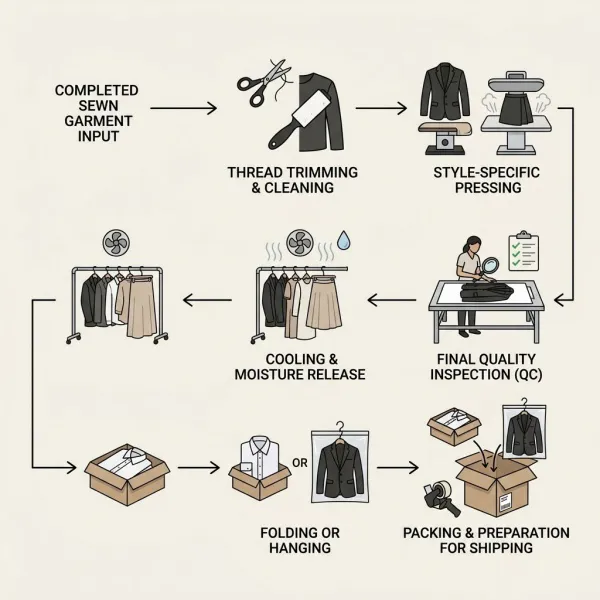
A practical end-stage flow often looks like this:
- Receive completed garments and confirm that any washing, drying, curing, or required relaxation is complete.
- Remove loose threads and visible production debris; route stains or construction faults to controlled repair rather than hiding them.
- Press or steam according to the approved style method, working in a defined sequence.
- Allow sufficient vacuum, cooling, and moisture release before stacking or folding.
- Check measurements, appearance, closures, labels, accessories, workmanship, and buyer-specific requirements.
- Fold, hang, tag, protect, and pack according to the packing specification.
The International Labour Organization has documented production approaches that integrate quality inspection, ironing, folding, and packing more closely with sewing flow rather than treating every activity as an isolated final department. The operational lesson is useful: finishing flow should be designed around movement and quality control, not merely around the rated speed of a press.
The Five Variables That Control Pressing Results
Successful pressing depends on a combination of variables rather than a universal temperature setting. The operator or process engineer must balance heat, moisture, pressure, dwell time, and garment stabilization. A change in one variable can alter the others: more steam is not necessarily helpful if the material retains moisture, and more pressure can turn an acceptable temperature into a visible shine or seam impression.

Heat
Heat softens or mobilizes parts of a textile structure so that wrinkles and shapes can be changed. The safe range depends on fiber content, yarn and fabric construction, dye, chemical finish, coating, print, interlining adhesive, elastic, trim, and exposure time. Thermoplastic fibers and heat-sensitive decorations require particular control because excessive heat can produce glazing, distortion, color change, shrinkage, adhesive movement, or irreversible surface damage.
Production teams should not copy consumer iron settings directly into factory specifications. The GINETEX care system, for example, uses maximum soleplate temperatures and warns that some low-temperature articles should be treated without steam; its official ironing-symbol guidance is useful for consumer care communication, but a factory recipe still needs validation on the actual assembled garment.
Moisture and Steam
Moisture can help fibers and fabric structures relax, while steam transfers heat and adds moisture quickly. Yet the response differs by material. Wool tailoring may be shaped with carefully controlled steam and handling, whereas some coated surfaces, acetate-containing materials, prints, adhesives, or water-sensitive fabrics can be marked or damaged by an unsuitable steam treatment.
Steam quantity is therefore not a quality score. It is a process input. The garment must also release residual moisture before it is folded or packed; otherwise wrinkles can return, layers can transfer marks, and humid packing conditions may create further quality risks.
Pressure
Pressure helps flatten seams, set edges, and bring the garment into contact with a heated surface. Too little may leave bulky seam allowances or poor definition. Too much may crush loft, flatten pile, force seam allowances through to the face, create shine, or leave press-bed and hardware impressions.
Pressure may come from a hand iron, a press head, a buck, tension on a form, or the way an operator handles the garment. That is why equipment settings alone do not fully describe the process.
Time
Dwell time determines how long the product is exposed to heat, moisture, and pressure. A brief application may not relax a stubborn seam, but a longer application can overheat a sensitive laminate or create shade change. Repeat pressing is also cumulative: three touch-ups at an apparently safe setting may expose one area more severely than the approved single-cycle method.
Vacuum, Cooling, and Support
Vacuum can draw steam and moisture through the garment, cool the area, and hold it in position on the pressing surface. Shaped bucks, sleeve boards, seam rolls, forms, and padding support the intended geometry and reduce unwanted impressions. Cooling is not dead time. Moving, stacking, or folding a garment while it is still warm and damp can partly undo the work just completed.
For a deeper explanation of how these variables influence silhouette and material behavior, see how pressing affects garment shape, drape, and perceived quality.
Pressing Equipment Should Match the Product
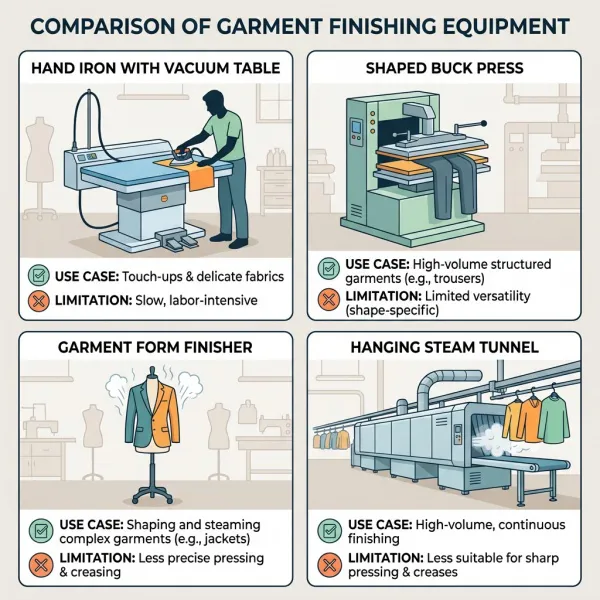
Equipment selection is a product, capacity, and quality decision. A blazer factory needs different support and shaping capability from one producing T-shirts, seamless knitwear, or waterproof jackets.
Hand Irons and Vacuum Tables
A professional steam iron with a vacuum table is flexible for sampling, small batches, complex styles, and corrective work. Operator technique remains a major source of variation; padding, soleplate cleanliness, steam quality, workstation height, and vacuum performance also affect the result.
Buck and Utility Presses
Buck presses bring a shaped lower surface and a press head together. They can improve repeatability for defined garment areas, including body panels, collars, shoulders, or trouser sections, depending on the machine design. Their productivity advantage depends on style compatibility, loading skill, maintenance, and whether the buck actually supports the garment’s intended geometry.
Form Finishers, Shirt Finishers, and Trouser Toppers
Form finishers use steam, hot air, tension, or a combination of these on a garment placed over a form. Category-specific versions can reduce manual handling, but may still require touch-up at collars, cuffs, plackets, waistbands, pockets, or seam intersections.
Steam Tunnels
Steam tunnels process hanging garments through controlled steam and drying zones. They are useful for wrinkle relaxation and presentation recovery in appropriate product flows, particularly when volumes are high and the required shaping is limited. They do not replace construction-specific pressing on tailored products, nor do they correct twisted seams, inaccurate measurements, or poor assembly.
Specialized Forms and Presses
Specialized presses and forms can raise consistency when volume justifies them. Socks offer a clear example: after knitting and wet processing, they are commonly hot-pressed over forms in a process called boarding; Cotton Incorporated describes sock boarding as a combination of a form, steam, heat, and pressure. This is category-specific shaping, not generic ironing.
One common source of confusion is the fusing press. Its principal job is to bond fusible interlining to a garment component under controlled temperature, pressure, and time. Although fusing affects later appearance and can resemble pressing mechanically, it should have its own validated recipe and quality controls. A final press cannot reliably correct poor bonding, bubbling, strike-through, or shrinkage caused during fusing.
Material and Construction Must Be Tested as a System
Fiber content provides a starting point, not a complete pressing instruction. Two fabrics labeled “100% polyester” may differ in filament type, texture, weight, dye method, heat-setting history, coating, print, and surface finish. The completed garment adds interlinings, sewing thread, elastic, labels, buttons, zippers, embroidery, transfers, sequins, padding, and bonded components, each with its own heat and pressure response.
The following are practical tendencies, not universal recipes:
- Cotton and linen fabrics may tolerate relatively robust pressing, but dark colors can shine, garment-dyed products can show shade effects, and resin or easy-care finishes may change the response.
- Wool fabrics can often be shaped effectively with moisture, heat, pressure, and skilled handling, but excessive pressure can flatten texture or create shine.
- Polyester and other thermoplastic materials may retain an unwanted crease or develop glazing, distortion, or damage if the temperature and dwell time are unsuitable.
- Viscose fabrics may be vulnerable to water marks, distortion, seam impressions, or surface change depending on construction and finishing.
- Velvet, corduroy, brushed surfaces, and other pile or nap fabrics need support and low-crush methods that protect surface direction and loft.
- Coated, laminated, printed, pleated, bonded, embellished, or elasticated products need testing that includes every sensitive component—not just the shell fabric.
Heat setting should also be separated conceptually from ordinary final pressing. Textile heat setting uses controlled heat to stabilize thermoplastic fibers or blends at the fabric-processing stage. Cotton Incorporated’s overview of mechanical textile finishing and heat setting describes this as part of fabric finishing. A garment press may alter a crease or shape locally, but it should not be assumed to reproduce the material control achieved in a properly engineered fabric heat-setting process.
The safest development method is a pressing trial on a complete garment or a representative assembly containing the same fabric, color, interlining, seams, trims, print, and decoration. Evaluate appearance immediately and again after cooling, relaxation, handling, and, where relevant, packaging simulation or care testing.
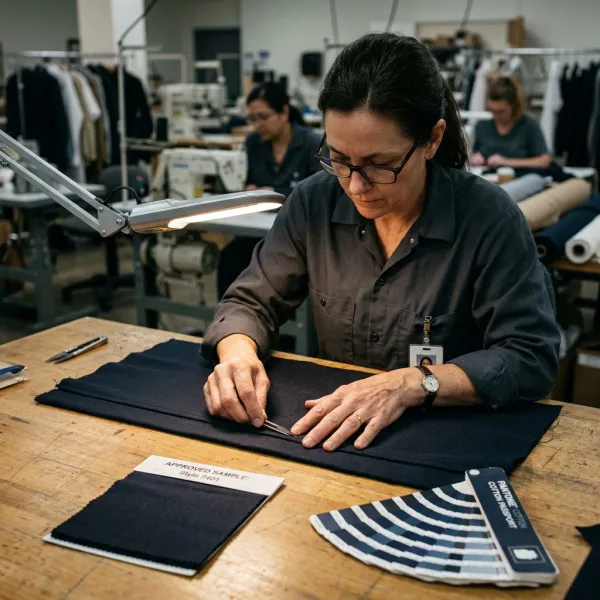
What Does Garment Finishing Include Beyond Pressing?
The finishing scope should be written into the technical package or quality manual because factories and product categories use the term differently. At minimum, the brand and supplier need a common definition of when a garment becomes ready for final approval.
Typical activities may include loose-thread removal, lint removal, controlled stain treatment, closure and fastening checks, accessory attachment, label verification, measurement sampling, visual inspection, needle or metal detection where specified, folding, tissue or form insertion, hangtag placement, polybagging or alternative protection, assortment control, carton packing, and shipping-mark verification.
Not every operation belongs at the very end. Delaying thread trimming can make defects harder to see. Attaching some accessories too early can expose them to heat damage. Folding before the garment has cooled can create fresh creases. The finishing plan should therefore define both scope and sequence.
Appearance Correction Is Not Defect Concealment
Finishing can remove temporary handling wrinkles, clean removable marks, settle a seam, and restore the approved presentation. It cannot make an incorrectly cut panel accurate, permanently straighten a twisted side seam, restore damaged coating, or compensate for poor stitch balance. Repeatedly pressing a structural defect may make it less visible for packing while allowing it to return after wear or care.
A clear repair route is essential. Operators should be able to separate correctable finishing issues from sewing repairs, material defects, measurement failures, and rejects. Otherwise, end-line teams are rewarded for cosmetic concealment rather than product conformity.
Care Information Must Agree With the Product
Production pressing and consumer care are different operating contexts, but they must not contradict each other without a technically defensible reason. Care instructions should be based on the complete garment and the regular care procedure it can withstand. In the United States, the Federal Trade Commission states that covered manufacturers and importers must provide care instructions and possess a reasonable basis for the information disclosed; its Care Labeling Rule guidance is a useful regulatory reference for products sold into that market.
For global distribution, brands should verify the requirements and symbol systems that apply in each destination market. A factory’s successful final press does not, by itself, prove that a consumer can safely iron the garment at the same setting.
Why Better Finishing Improves Product Presentation
Customers rarely see the technical specification, but they immediately see the result. The way a collar sits, a placket lies, a trouser crease runs, or a hem falls influences whether the garment appears deliberate and well made. Pressing also affects how products photograph, hang on fixtures, fit into ecommerce packaging, and recover after shipment.
Pressing does not upgrade the fabric or sewing quality, and a sharply pressed garment is not proof of durability. It can reveal the intended design more clearly and prevent avoidable presentation faults from weakening the customer’s first assessment.
For retailers and ecommerce operations, consistency matters as much as the appearance of one sample. If one unit arrives crisp and another arrives crushed, twisted, or marked, customers experience the style as variable even when both pieces came from the same production order. Packaging trials therefore belong in finishing validation: a garment may look excellent at the factory table but perform poorly after 48 hours compressed in a carton or parcel.
How Fashion Businesses Can Build a Repeatable Finishing Standard
The best starting point is not a new machine. It is a shared definition of the approved result. A brand, vendor, and factory should be able to compare a production unit with the same reference and reach a similar decision.
Create a Style-Specific Pressing Specification
The pressing specification can sit within the technical package or an approved factory work instruction. It should be short enough to use on the floor but detailed enough to prevent interpretation gaps. Useful fields include:
- operation sequence and areas to press, steam, avoid, or protect;
- approved equipment, buck, padding, form, and press cloth;
- validated operating window for heat, steam or moisture, pressure, dwell, and vacuum;
- correct positioning of seams, pleats, lapels, collars, pockets, and closures;
- cooling or hanging time before measurement, folding, or packing;
- visual acceptance criteria and known risk areas;
- method for each colorway, print, coating, embellishment, or trim variation;
- repair, escalation, and re-press limits.
Settings recorded at the control panel are only part of the instruction. Steam quality, table suction, padding condition, garment moisture, and operator loading technique can change the actual exposure.
Approve the Method During Sampling
Pressing should be reviewed during development and pre-production, not discovered after bulk sewing. The approved sample needs to represent the target appearance, and the method should be proven on production-equivalent materials. If a late trim substitution, color change, interlining change, print revision, or wash adjustment occurs, the pressing risk should be reassessed.
A useful approval compares several states: before pressing, immediately after pressing, after full cooling, after hanging or relaxation, and after simulated packing. For styles with critical care performance, the team should also compare the garment after the appropriate testing protocol.
Control the Finishing Environment
Steam generation, drainage, ventilation, lighting, workstation ergonomics, equipment maintenance, and material flow are quality inputs. Poor lighting hides shine and stains. Weak vacuum leaves moisture in the garment. Contaminated soleplates transfer marks. Worn padding creates impressions. Congested racks allow finished pieces to be crushed before inspection.
Heat and steam also create worker-safety concerns. An OSHA background document on workplace heat specifically notes that steaming garments can release excess steam into the surrounding work area. Factories should manage heat, steam, equipment, and work-area hazards through appropriate safety controls, maintenance, ventilation, training, and applicable local occupational-safety requirements.
Measure Quality and Flow Together
Output per hour is incomplete if it ignores re-pressing, repair, damage, moisture retention, and packing delay. A compact finishing dashboard might track first-pass acceptance, re-press rate, press damage by type, stain or thread defects found at final inspection, repair return rate, equipment downtime, and work-in-process waiting time.
Defect codes should distinguish causes. “Wrinkle” may originate in sewing bundles, washing, incomplete drying, poor pressing, premature folding, or transport compression. Combining them into one code makes corrective action difficult.
Align Packing With the Intended Sales Channel
A store-delivered blazer on a hanger, a folded wholesale shirt, and a direct-to-consumer dress shipped in a small parcel do not share the same presentation journey. Folding templates, tissue placement, collar supports, hangers, protective materials, carton dimensions, pack ratios, and recovery instructions should match the channel and product.
Run a pack-out trial before bulk approval. Open the package after a realistic storage and transit simulation, allow the specified recovery time, and assess the product under retail or photography lighting. This exposes whether the finishing result survives beyond the factory inspection table.
Common System-Level Mistakes
Many visible defects begin with management choices rather than the final operator’s skill. Detailed defect diagnosis belongs in common finishing mistakes that make apparel look less professional, but several system-level errors deserve attention here.
Using one setting for every style that appears to share a fiber overlooks construction, finish, color, interlining, trim, and decoration. Other errors include approving garments while warm, pressing over stains or threads, and allowing unlimited re-pressing without recording why the first cycle failed.
The most expensive misconception is that final pressing can correct upstream quality. It may temporarily disguise puckering, seam imbalance, poor fusing, distorted cutting, or incorrect handling, but those issues often return. A better response is to identify the process that created the defect and correct it there.
What Brands Should Verify Before Production
Before approving bulk pressing and finishing, verify the complete product and operating context. The following questions prevent many avoidable gaps:
- Has the process been tested on every materially different colorway, print, coating, interlining, and trim combination?
- Does the approved method protect pile, texture, pleats, bonded areas, waterproof seams, transfers, embroidery, elastic, and hardware?
- Are the press settings, garment positioning, sequence, cooling, and re-press limits documented?
- Do the appearance standard, measurement method, care label, buyer manual, and packing specification agree?
- Can the factory maintain steam, vacuum, ventilation, lighting, clean surfaces, and safe equipment at planned volume?
- Is there a clear route for stains, sewing faults, measurement failures, and irreversible damage?
- Has the packed product been evaluated after realistic compression, storage, opening, and recovery?
The purpose of verification is not to prescribe one global recipe. It is to ensure that each style has an evidence-based, repeatable method and that production teams understand where the method’s limits lie.
Frequently Asked Questions
Is garment pressing the same as textile finishing?
No. Textile finishing refers to mechanical or chemical processes applied to fabric or garments to change appearance, hand, stability, or performance, including compacting, heat setting, softening, coating, resin treatment, or garment washing. Garment pressing is a specific shaping and presentation operation. It may interact with those finishes but does not replace them: a final press cannot reproduce proper compaction, repair inadequate curing, or restore damaged coating. Purchase orders and technical packages should name the required processes separately so suppliers price, test, and approve them correctly.
At what temperature should garments be pressed in a factory?
There is no universally safe factory temperature by fiber name alone. The correct operating window depends on the complete assembly, including fabric construction, dye, finish, color, interlining adhesive, thread, elastic, print, trim, moisture, pressure, exposure time, and equipment contact. A supplier should validate settings on production-equivalent garments and record the approved range. Consumer care-label temperatures can inform risk awareness, but they are not a substitute for an industrial process trial because the equipment, pressure, dwell time, steam delivery, and desired result differ.
Can steam pressing shrink a garment?
It can contribute to dimensional change in some materials or constructions, but the mechanism and amount depend on the product’s prior processing, residual stresses, moisture response, mechanical handling, and pressing conditions. A garment that was cut or sewn from unstable fabric may relax during steam exposure and appear to have been “shrunk by pressing,” even though the underlying issue began earlier. Measure trial garments before treatment, after full cooling and conditioning, and after any required care test. Do not evaluate dimensions while the product is still warm or damp.
Why do dark garments sometimes become shiny after pressing?
Shine can occur when heat and pressure flatten or alter the fabric surface so that it reflects light differently. It is especially noticeable on dark colors and around seams, edges, pockets, and areas where allowances or hardware concentrate pressure. Fiber type matters, but so do weave, surface finish, padding, press cleanliness, contact time, moisture, and operator technique. Prevention may involve lower exposure, better support, a press cloth, reduced pressure, pressing from the reverse, or non-contact treatment—provided the chosen method has been tested on the actual garment.
Should final measurements be taken before or after pressing?
The measurement stage must follow the buyer’s approved method, but final garment measurements are commonly assessed after the specified finishing process and after sufficient cooling or conditioning. Measuring too early can capture a temporary state created by heat, tension, or retained moisture. For consistent decisions, the technical package should state when and how to measure, how the garment is laid or hung, whether closures are fastened, and what conditioning or recovery period applies. Pressing must not be used to stretch an out-of-tolerance garment temporarily into specification.
Does better pressing always mean a higher-quality garment?
No. Better pressing improves presentation only when it supports sound materials and construction. It can define a lapel, flatten a seam, and remove handling wrinkles, but it cannot prove seam strength, colorfastness, dimensional stability, fit consistency, or durability. Heavy pressing may conceal distortion until wear or care. Buyers should treat it as one part of a quality system covering materials, construction, measurements, workmanship, care performance, and packing. Inspection should therefore assess the garment after cooling and, where appropriate, after testing or pack-out recovery.
When does a small fashion brand need specialized pressing equipment?
Specialized equipment becomes useful when product geometry, repeat volume, labor consistency, or required throughput can no longer be controlled efficiently with a hand iron and suitable vacuum table. Before buying, compare the style range, expected volume, changeover time, operator skill, utilities, maintenance support, floor space, quality improvement, and remaining touch-up work. A shaped press that fits one trouser block may be inefficient for frequent silhouette changes. For small brands, a capable finishing partner and a clear specification may deliver more value than owning underused machinery.
Conclusion
Garment pressing and finishing translate a completed sewing operation into a product that is ready to be judged, handled, photographed, displayed, and delivered. Their value lies in control: the right silhouette, a clean surface, verified components, consistent measurements, and packaging that preserves the approved result.
The essential discipline is to treat the garment as a system. Fabric, interlining, trim, construction, color, finish, equipment, operator method, cooling, inspection, and pack-out all interact. A generic temperature setting or a skilled last-minute touch-up cannot replace that system.
For brands and manufacturers, the practical objective is a style-specific standard validated during development and repeatable at production volume. When pressing is integrated with upstream quality and downstream packing, it strengthens presentation without pretending to repair what should have been controlled earlier.





Comments 0
Leave a CommentSend Comment
Anda harus Login terlebih dahulu untuk dapat memberikan komentar.