

Why Visual Search Can Improve Product Discovery in Fashion Ecommerce
A customer lands on a fashion retailer's website looking for a particular type of jacket. They know the silhouette, color, and overall aesthetic they want, but cannot identify the correct product category or describe the design precisely. After several searches and filters, they are still scrolling through items that look nothing like the garment they had in mind.
The problem is not necessarily a lack of suitable merchandise. The retailer may already carry a similar jacket. The difficulty lies in connecting the customer's visual preferences with the products available in the catalog.
Visual search introduces another way to make that connection. Instead of translating a fashion idea entirely into keywords, shoppers can begin with a photograph, screenshot, or existing product image. The search system then uses visual information to retrieve potentially relevant merchandise.
For ecommerce businesses, this can influence more than the search box. It can affect how customers navigate assortments, explore alternatives, discover less visible products, and move between fashion inspiration and product evaluation.
Those possibilities are commercially meaningful, but they should not be confused with guaranteed performance improvements. Visual search only creates value when the results are relevant, the merchandise is available, and the shopping experience helps customers make informed decisions.
Quick Answer: Why Can Visual Search Improve Fashion Product Discovery?
Visual search can improve product discovery in fashion ecommerce by allowing customers to find merchandise through images rather than relying entirely on written search terms or category navigation. It helps bridge the gap between visual shopping preferences and the language used to organize online product catalogs.
When shoppers upload a photograph or select an existing product image, a visual search system can retrieve garments with related characteristics, such as silhouette, color, pattern, or visible design details. This gives customers another way to explore products they might struggle to locate through conventional searches.
For fashion retailers, the potential advantages include more accessible assortments, easier exploration of related styles, and alternative discovery paths when customers cannot find the exact product they want.
Visual search may also create opportunities for additional product engagement, but higher engagement does not automatically mean higher sales. Its commercial impact depends on relevance, available inventory, interface quality, customer demand, and implementation costs.
The strongest applications combine image-based retrieval with accurate product information, conventional search, and useful filters. Visual search should expand the ways customers can discover fashion products, not replace the information they need to evaluate them.
Why Product Discovery Remains Difficult in Fashion Ecommerce
Fashion shopping is strongly influenced by appearance, but ecommerce catalogs must organize merchandise through categories, product names, descriptions, attributes, and filters.
These systems work reasonably well when shoppers know what they want and can describe it accurately. They become less intuitive when a customer is searching for an appearance rather than a clearly defined product.
A shopper may want “that relaxed jacket with a slightly cropped shape and unusual neckline” without knowing whether the retailer categorizes it as a bomber jacket, blouson, cropped coat, or casual outerwear.
A keyword search can return results that are technically relevant to the written query but visually different from the shopper's expectations.
The Gap Between Customer Vocabulary and Fashion Terminology
Fashion contains specialized terms for silhouettes, garment construction, and styling. Retailers use these terms to organize catalogs, but customers do not necessarily share the same vocabulary.
A person looking for a square-neck blouse with gathered sleeves might search for “cute white top.” Another shopper might describe a barrel-leg silhouette as “loose curved jeans.”
The difficulty is not that shoppers are searching incorrectly. They are communicating a visual preference through language that may be too broad or different from the retailer's product descriptions.
Image-based search provides an additional form of input that can reduce dependence on exact terminology.
Large Assortments Can Make Relevant Products Harder to Locate
A large catalog offers customers more choices, but it also creates more products to navigate.
Consider a retailer carrying hundreds of dresses. Customers may be able to filter by category, size, color, and price, yet still struggle to distinguish between products with different waistlines, necklines, fabric appearances, or sleeve designs.
The relevant product may be several pages into the results, particularly when ranking favors other factors over visual resemblance.
Research from the Baymard Institute on ecommerce product lists and filtering demonstrates how product presentation, filtering, and sorting influence customers' ability to find and evaluate merchandise.
This research establishes the importance of product-finding usability. It does not, by itself, prove that adding AI visual search increases ecommerce conversion rates.
Fashion Inspiration Does Not Always Come With Product Information
A customer may discover a garment in a street-style photograph, editorial image, social post, or video screenshot without knowing its brand or product name.
The original item could also be discontinued or unavailable in their region.
Traditional search requires the customer to describe what they see before looking for a comparable product. Visual search can create a more direct route from the inspirational image to relevant inventory.
The underlying technology is explained in AI visual search for online fashion shopping. The more important business question here is whether that additional search route helps customers find merchandise they otherwise might overlook.

How Visual Search Creates Additional Paths to Product Discovery
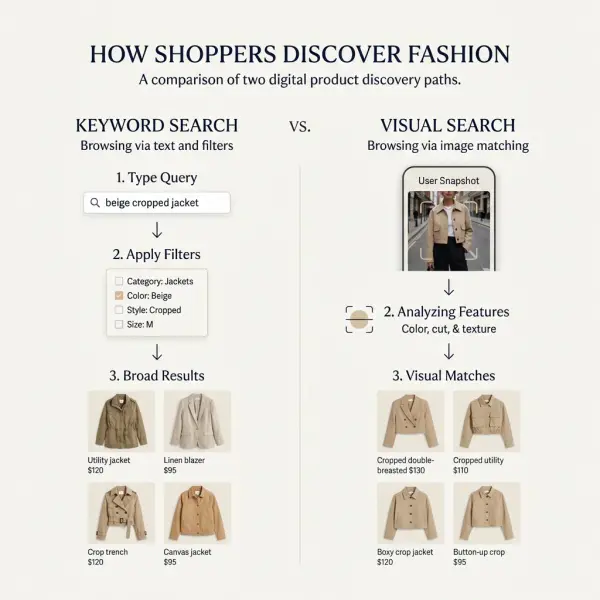
The primary benefit of visual search is not that it replaces traditional search. It introduces another way for customers to communicate what they are looking for.
A written query communicates intent through language. An image can communicate visible characteristics simultaneously, including relationships between shape, pattern, color, and styling.
A visual search system may use that information to retrieve relevant products, although matching quality depends on the model, reference images, and catalog coverage.
Several discovery mechanisms are particularly relevant to fashion retail.
1. Helping Customers Discover Products Without Knowing Their Names
When shoppers cannot describe a product accurately, they may use broad search terms that return too many unrelated results.
An image-based query can narrow the search toward products with visible similarities to the reference.
For example, a shopper looking for a sculptural silver handbag may struggle to identify its style category. An uploaded image can communicate its curved body, metallic appearance, and unusual shape more precisely than a generic search for “silver handbag.”
The system may retrieve closer alternatives without requiring the customer to understand specialized accessory terminology.
This mechanism is most useful when the visual reference contains clear information and the retailer's assortment includes appropriately indexed products.
2. Connecting Inspiration With Available Merchandise
A fashion photograph may generate interest without providing an immediate purchasing path.
Visual search can help turn that interest into product exploration by retrieving merchandise with a comparable appearance.
Google's September 2025 announcement about visual exploration and shopping in AI Mode illustrates how image understanding and conversational refinement can support product exploration. The announced experience combined visual information with additional search context to help users navigate related results.
That is an example of a broader search platform, not evidence that every fashion retailer's internal visual search system has the same capabilities.
For an ecommerce brand, the practical objective is narrower: help customers move from a visual reference toward relevant products that the business can actually offer.
3. Revealing Alternatives to Products Customers Cannot Buy
A customer may like a particular dress but discover that the required size is unavailable. They may also find that the material, price, or color does not meet their requirements.
A similar-product search option provides another opportunity to explore the assortment without restarting the search process.
For example, a shopper interested in a black tailored blazer could discover other jackets with comparable proportions but different fabrics, prices, or sizes.
This can help retain the customer's attention within the merchandise catalog when the original product is unsuitable.
The effectiveness depends on the quality of the alternatives. Returning unrelated products merely because they share the same category or color may create more frustration than value.
4. Supporting Exploration Beyond the Most Visible Products
Customers typically encounter products through search rankings, category pages, recommendations, promotional placements, and merchandising collections.
Products that receive limited exposure through these pathways may be difficult to discover, even when they are relevant to an individual shopper.
Visual similarity provides another possible route to these items.
A lesser-known cardigan might appear as an alternative to a frequently viewed knitwear product because the two share relevant design characteristics.
This does not mean visual search automatically distributes visibility fairly across an assortment. Ranking models can reinforce existing preferences or repeatedly prioritize a narrow selection of merchandise.
Retailers need to examine which products are being surfaced and whether the results are useful, varied, and commercially appropriate.
5. Allowing Customers to Explore Styles Without Repeated Keyword Searches
Fashion shopping often involves gradual refinement rather than a single precise query.
A customer may begin with a beige jacket, discover a similar style with a more relaxed silhouette, and then explore other products related to that alternative.
Visual search can support this progression by allowing customers to move between related products without repeatedly describing each new style.
A fashion retailer may offer this through a “Find Similar” feature on product detail pages or through an image-search option in its main search interface.
These are different interaction patterns, but both can help customers continue exploring merchandise from a visual starting point.
The detailed mechanics of finding close alternatives are covered in how image-based search finds similar fashion products.
Why Visual Search Can Improve the Customer Shopping Experience
The customer experience benefit of visual search comes from reducing certain types of search friction.
Search friction occurs when customers must perform unnecessary or confusing steps before locating products that meet their requirements. In fashion, this can include repeated keyword changes, broad category browsing, and difficulty narrowing large groups of visually related items.
Visual search may shorten some of these interactions, but not every customer will find image uploads easier than typing or browsing.
A More Natural Starting Point for Visually Led Shopping
Some customers approach shopping with a specific product in mind. Others begin with a visual impression.
A photograph may communicate the overall look more effectively than a description, particularly when the product has unusual proportions or design details.
For these customers, visual search can make the first interaction more intuitive.
A shopper looking for a softly structured shoulder bag, for example, may find it easier to upload a reference than to identify the correct combination of descriptive terms.
This advantage depends on interface design. If the customer must navigate several upload steps, grant unnecessary permissions, or wait through a slow search process, the feature may introduce new friction.
Easier Comparison of Visually Related Products
Once a customer finds a relevant garment, a similar-product feature can display alternatives that share some of its appearance.
This creates a more focused comparison environment than returning to a broad product category.
A shopper evaluating a longline blazer can compare alternatives with different lapels, fabrics, colors, and price points while keeping the preferred silhouette in mind.
The feature is particularly useful when the retailer presents enough product information to explain meaningful differences.
Visual resemblance alone does not establish comparable quality, fit, comfort, or material performance. Those characteristics still require reliable product specifications.
More Flexible Shopping Across Devices and Channels
Customers encounter fashion imagery on phones, tablets, laptops, and other digital environments.
Image-based queries may be convenient when a reference photograph or screenshot is already saved on the device.
However, the effectiveness of this experience depends on how the platform handles file selection, image cropping, device permissions, and mobile interface responsiveness.
The retailer should evaluate whether the feature is more useful in its mobile application, mobile website, desktop interface, or product detail pages.
A single visual search interaction design may not be equally suitable for every device or customer segment.
How Visual Search Can Influence Product Engagement and Ecommerce Performance
For retailers, the commercial interest in visual search is understandable. If customers find relevant products more easily, they may be more willing to explore merchandise and eventually purchase.
But that relationship contains several steps. An improved search result does not necessarily produce a completed transaction.
A customer may discover a visually suitable dress but reject it because of price, material, available sizes, delivery conditions, or personal preference.
This makes it important to separate product discovery improvements from downstream commercial outcomes.
Product Discovery and Engagement
Relevant visual search results may encourage customers to view more product pages, explore alternative styles, or save items for later consideration.
For example, a shopper who originally intended to purchase one pair of boots might explore several visually related options after encountering a similar-product feature.
This behavior can indicate successful product exploration, but higher engagement is not always desirable in itself.
A customer who spends more time browsing because the system repeatedly returns unsuitable results is experiencing more friction, not necessarily more value.
Retailers should therefore evaluate engagement alongside result relevance and task completion.
Product Consideration and Purchase Intent
A visual search feature may bring customers closer to products that match their preferences. This can create an opportunity for stronger purchase consideration.
The next stage still depends on conventional ecommerce fundamentals: clear product information, suitable pricing, available inventory, trustworthy presentation, and an effective checkout process.
An image-based search tool cannot compensate for incorrect sizes, misleading material descriptions, or unavailable merchandise.
Retailers should understand visual search as one component of the product discovery and evaluation journey, not a replacement for the rest of the retail experience.
Conversion Rate and Revenue
Visual search might increase conversion when it helps shoppers find suitable products they otherwise would not have discovered.
It might also leave conversion unchanged, particularly when customers already find products efficiently using conventional navigation.
In some implementations, a visually oriented interface could distract customers or introduce unnecessary steps.
The relationship between visual search and revenue therefore needs to be tested rather than assumed.
Retailers should evaluate whether the feature produces incremental value compared with the existing shopping experience, taking account of implementation costs, product margins, returns, and operational requirements.
What Real-World Implementations Show—and What They Do Not Prove
ZOZOTOWN provides a documented example of visual search being integrated into a fashion retail environment.
On August 26, 2019, ZOZO announced a similar-item search feature that allowed customers to select a product and explore merchandise related by shape, texture, color, and pattern. The feature operated from product detail pages rather than requiring shoppers to begin with an external reference image.
According to ZOZO's official product announcement, the initial implementation covered selected merchandise categories and was designed to help customers find alternatives when factors such as size, price, or minor product differences prevented them from purchasing the original item.
The company also reported substantially longer time spent on the service among feature users in its early testing. That observation is relevant as an example of product engagement, but it should not be treated as proof that visual search alone caused the difference. Customers who choose to use the feature may already be more interested in exploring products.
The broader lesson is not that retailers should expect the same results. It is that visual search can be integrated into an existing product exploration journey rather than operated as a completely separate search destination.
The appropriate business result must be established through measurements that distinguish customer selection effects from improvements caused by the feature.
Where Visual Search Can Deliver the Most Practical Retail Value
Different fashion businesses face different product discovery problems. A visual search feature that works well for one assortment may provide limited value in another.
The strongest candidates are generally situations where visual attributes heavily influence selection and conventional product descriptions do not fully communicate customer intent.
|
Fashion retail scenario |
Product discovery challenge |
Potential role of visual search |
|
Multi-brand fashion marketplace |
Large assortment with overlapping categories and styles |
Helps retrieve relevant alternatives across many product listings |
|
Occasionwear retailer |
Customers search for specific silhouettes or design details |
Connects reference photographs with visually related dresses and formalwear |
|
Footwear retailer |
Shoppers distinguish products through shape and visible details |
Supports exploration of comparable shoe styles |
|
Handbag and accessories retailer |
Product names may not describe distinctive shapes clearly |
Helps customers search through visual form, hardware, and color |
|
Boutique fashion store |
Limited assortment and highly curated styles |
May assist discovery where customers frequently use inspiration images |
|
Fashion resale platform |
Individual listings may use inconsistent descriptions or photography |
May help connect visual intent with secondhand listings, subject to image and catalog quality |
These applications should not be interpreted as a ranking of expected profitability.
A large marketplace may benefit from broader catalog coverage but also face higher indexing and integration complexity. A boutique may have clearer product data but too few relevant alternatives to justify the cost of a dedicated search feature.
Business value depends on the problems customers experience, not simply the sophistication of the technology.
The Role of Product Data and Merchandising in Visual Search Performance
A retailer's searchable catalog determines what the system can retrieve.
Visual search may be technically sophisticated, but inaccurate or incomplete product information can still prevent customers from finding suitable merchandise.
If a garment has no usable reference image, the system may not represent it correctly. If product variants are mapped incorrectly, a customer may open an item that differs from the search result. If inventory records are stale, the system may prioritize products that are no longer available.
These problems are operational rather than purely algorithmic.
Product Photography Determines What the System Can See
Different photographs reveal different product characteristics.
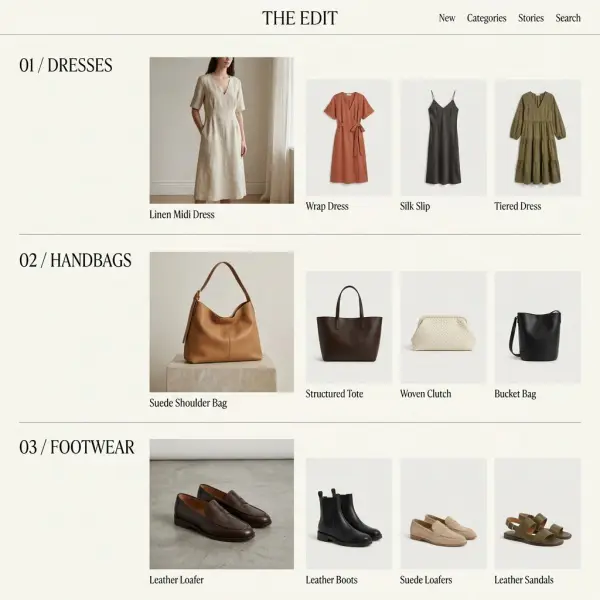
A flat-lay image may show surface design clearly, while an on-model photograph can communicate silhouette and drape. Detail photographs may reveal collar shapes, stitching, fastenings, or surface textures.
Google Merchant Center's product image best-practice guidance recommends clear, high-quality product imagery and a portfolio that includes multiple angles, lifestyle settings, and detail views.
These recommendations relate to Google's shopping surfaces, not a universal technical requirement for all visual search systems. Nevertheless, they illustrate the broader value of maintaining representative product imagery.
Fashion retailers should determine which image types best support their selected search provider and product categories.
Product Attributes Still Matter
Visual similarity is only one part of customer relevance.
A shopper may want an item that looks like the reference photograph but requires a particular size, price, material, or fit.
These characteristics need to be supported by accurate catalog information.
The retailer should maintain dependable product names, category assignments, color variants, size availability, material descriptions, and links between parent products and stock keeping units.
Visual retrieval can narrow an assortment, while structured attributes help customers make more precise purchasing decisions.
Inventory Freshness Influences Search Usefulness
A search result that leads to an unavailable product can disrupt the shopping journey.
Retailers should understand how frequently their search provider updates its indexed catalog and how quickly stock changes affect result eligibility.
For example, Google's Vision API Product Search documentation describes product collections built from reference images, while its implementation documentation explains the role of indexing in making product data searchable.
Search providers differ in their update mechanisms and latency. Businesses need to verify those operating characteristics rather than assume that every platform reflects inventory changes immediately.
Merchandising Decisions Influence What Customers Discover
A fashion retailer may want search results to reflect product availability, customer relevance, assortment diversity, and commercial priorities.
These goals can sometimes conflict.
Promoting higher-margin products may improve short-term merchandising objectives but reduce relevance if those items do not resemble the customer's reference image.
Likewise, displaying many closely related products could create the appearance of choice while offering little meaningful variety.
A well-designed system needs appropriate governance over ranking rules and merchandising interventions.
This connects visual search with fashion assortment planning for retail and online stores. Product discovery can only be effective when the assortment contains merchandise that satisfies customer needs.

How Should Fashion Retailers Measure Visual Search Success?
The effectiveness of visual search should be measured across three distinct areas: discovery quality, customer behavior, and commercial performance.
These areas are connected but not interchangeable.
A system may produce more product clicks without improving purchase outcomes. Another implementation may help customers find relevant products with fewer interactions, resulting in shorter sessions but better task completion.
Neither outcome can be understood through one metric alone.
Discovery Quality Metrics
Discovery metrics evaluate whether customers can find relevant products.
Retailers can create a representative collection of reference images and ask trained reviewers to judge whether returned products are appropriate matches.
Useful measurements include successful-search rate, relevance among top-ranked results, failed-query frequency, and the proportion of searches that return available merchandise.
A query should not be considered successful merely because the system produces results. The results must be meaningfully connected to the shopper's intended product.
Customer Engagement Metrics
Engagement metrics show what customers do after interacting with visual search.
These might include image-search usage, product result clicks, product detail views, filter applications, wishlist additions, and repeated searches.
However, retailers should distinguish productive engagement from repeated actions caused by poor results.
For instance, a customer submitting several different images might be exploring styles intentionally, or they might be struggling to obtain a useful match.
Qualitative usability testing can help interpret patterns that analytics alone cannot explain.
Commercial Performance Metrics
Commercial metrics assess whether visual search contributes to business outcomes.
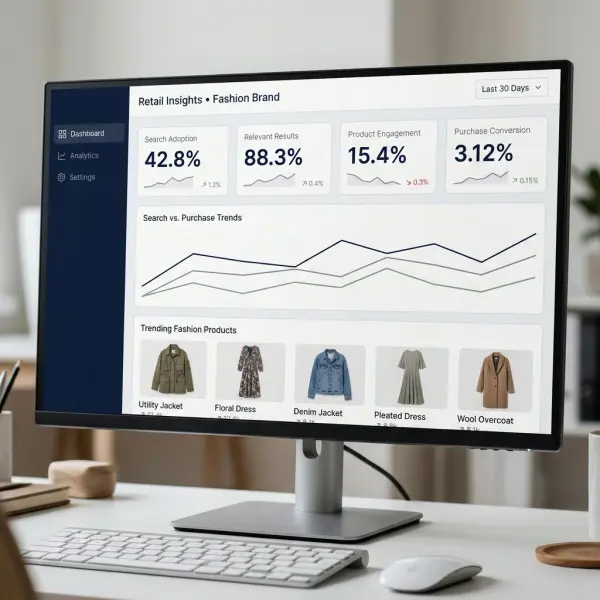
Relevant measures include add-to-cart rate, purchase conversion rate, revenue per visitor, and potentially contribution margin after associated costs.
Returns and cancellations may also matter, particularly if the feature encourages customers to buy products that look similar but differ substantially from their expectations.
The final evaluation should distinguish incremental results from purchases that likely would have occurred through conventional search or navigation.
A Practical KPI Framework
|
KPI |
What it measures |
Business interpretation |
|
Visual search adoption rate |
Share of eligible visitors or sessions using visual search |
Indicates customer interest and discoverability of the feature |
|
Relevant-result rate |
Share of evaluated queries returning useful matches |
Measures retrieval quality |
|
Available-match rate |
Share of queries with at least one suitable purchasable result |
Connects visual retrieval with actual inventory |
|
Result click-through rate |
Share of result impressions or searches producing product clicks, using a defined denominator |
Indicates interest in returned merchandise |
|
Add-to-cart rate |
Add-to-cart behavior following visual search |
Measures progression toward purchase |
|
Purchase conversion rate |
Share of users or sessions completing a purchase under a defined measurement method |
Evaluates commercial outcomes |
|
Revenue per eligible visitor |
Revenue divided by eligible visitors in each experimental group |
Supports comparison of overall commercial impact |
|
Search response time |
Time required to return results |
Identifies performance-related friction |
|
Return or refund rate |
Post-purchase returns for relevant orders |
Helps identify downstream customer-expectation issues |
Retailers using Google Analytics 4 can connect their custom visual search interactions with established ecommerce events. The official Google Analytics ecommerce measurement documentation describes events such as product views, item selections, add-to-cart actions, purchases, and refunds.
Visual search-specific events, including image upload, garment selection, search completion, and failed-query reasons, generally require additional implementation. They should not be assumed to be collected automatically.
Why A/B Testing Matters Before Claiming Better Conversion
A/B testing helps retailers determine whether visual search produces an incremental improvement over the existing shopping experience.
Simply comparing customers who use visual search with those who do not can produce misleading conclusions.
People who choose visual search may already have stronger shopping intentions, greater interest in product exploration, or more time available to browse.
Those differences can influence conversion and engagement even when the visual search feature itself has no measurable effect.
Define the Experiment Before Launch
A practical experiment might randomly assign eligible visitors to two groups.
The control group receives the existing ecommerce search and navigation experience. The treatment group receives the same experience with an additional visual search feature.
Both groups should be evaluated over an appropriate measurement period using consistently defined metrics.
Random assignment helps reduce selection bias, although experiment quality still depends on correct implementation, adequate sample size, and the absence of material interference between groups.
Choose a Primary Business Outcome
Retailers should select a primary measure based on the problem the feature is intended to solve.
If the objective is to improve product discovery, successful product finding or relevant product engagement may be appropriate primary outcomes.
If the objective is commercial performance, revenue per eligible visitor or conversion rate may be more suitable.
It is important to avoid selecting whichever metric looks most favorable after the experiment concludes. The primary outcome and analysis method should be defined in advance.
Include Guardrail Metrics
A feature can improve one metric while creating problems elsewhere.
For example, visual search might increase product clicks but slow down the mobile website. It may also encourage greater browsing while producing no additional purchases.
Guardrail metrics can include page performance, search latency, upload failure rate, return behavior, and support complaints.
Businesses should review costs and operational reliability alongside customer outcomes.
Interpret Results by Customer Segment
Different shoppers may respond differently to visual search.
Mobile users with saved screenshots may find the feature more useful than desktop visitors searching by known product names. Customers exploring occasionwear may use visual references differently from those purchasing basic apparel.
Segment analysis can provide useful insights, but excessive post-hoc subgroup analysis increases the risk of finding patterns that are merely random.
Retailers should predefine important segments where possible and interpret smaller subgroup results cautiously.
Common Mistakes That Limit Visual Search Value
Mistake 1: Measuring Engagement Without Measuring Relevance
A retailer may celebrate increased session duration or more product clicks after introducing visual search.
These metrics do not necessarily indicate a better discovery experience. Customers might be browsing longer because the system returns unsuitable products or requires repeated refinement.
A stronger evaluation combines engagement data with relevance testing, task-completion measures, and business outcomes. The objective is to help shoppers find appropriate products, not merely keep them interacting with the interface.
Mistake 2: Assuming Every Product Category Benefits Equally
Visual search may be useful for structured handbags, distinctive footwear, or fashion pieces with recognizable silhouettes. Other categories may rely more heavily on technical specifications, exact sizing, or functional requirements.
Retailers sometimes expand the feature across an entire catalog before testing these differences.
This can create uneven search quality and unnecessary operating costs. Category-level testing helps identify where visual retrieval provides genuine value and where conventional search remains more effective.
Mistake 3: Ignoring Catalog and Inventory Quality
Incomplete photographs, incorrect product variants, stale inventory, and inconsistent category assignments can undermine an otherwise capable search system.
The customer might receive a convincing visual match but arrive at the wrong product page or discover that the item is unavailable.
Improving catalog governance and fashion digital asset management is often a necessary part of making visual search dependable.
Mistake 4: Treating Visual Search as a Replacement for Conventional Navigation
Not every shopper has a reference image, and not every purchase requirement can be expressed visually.
Customers looking for specific garment measurements, certified materials, washing instructions, or precise brand models may still rely primarily on written queries and filters.
Removing these options can make the shopping experience less flexible. Visual search should complement established discovery methods and allow customers to move between them easily.
Mistake 5: Overriding Similarity With Aggressive Merchandising Rules
Retailers may be tempted to prioritize promotional products, sponsored items, or higher-margin merchandise regardless of visual relevance.
Commercial ranking rules are not inherently inappropriate, but excessive interference can weaken the customer's confidence in the search results.
A product that barely resembles the reference image may not become useful simply because it offers a better margin.
Retailers should assess how merchandising constraints affect relevance and clearly distinguish advertisements or sponsored placements where applicable.
Mistake 6: Promising Conversion Improvements Before Testing
Vendor demonstrations often emphasize how quickly a system can retrieve visually related products. Some marketing materials also highlight engagement or sales improvements from particular implementations.
These examples can demonstrate technical feasibility, but they do not establish the expected results for another retailer.
Differences in catalog size, customer behavior, product category, traffic, and implementation quality can materially change outcomes.
Retailers should base investment decisions on their own experiments and operating economics rather than assuming that published results will transfer directly.
Important Limitations: What Visual Search Does Not Solve
Visual search cannot remove every source of friction from fashion ecommerce.
It does not establish garment quality, determine exact fit, verify fabric composition, or guarantee product availability.
A photograph can reveal visible design characteristics, but many important purchasing considerations are not directly observable.
For example, two coats may have nearly identical silhouettes yet differ in lining, insulation, construction, and care requirements. Visual retrieval can place them near each other in search results without proving that they are interchangeable.
The technology also cannot ensure that every customer image will produce a useful result. Difficult lighting, complex backgrounds, layered outfits, incomplete garment views, and limited catalog coverage can reduce search quality.
Privacy and data governance introduce additional responsibilities. Customer-uploaded images may contain people, personal environments, or unrelated identifying details. Retailers must understand how images are processed, stored, shared, and deleted under applicable privacy requirements.
Finally, visual search does not guarantee an increase in conversion rate, average order value, customer retention, or revenue.
I cannot confirm a universal conversion uplift attributable to visual search across fashion ecommerce businesses. Such a claim would require comparable, reliable evidence across implementations and appropriate control of customer and business differences.
Its potential should be evaluated through a measurable customer problem and a commercially realistic implementation.




Comments 0
Leave a CommentSend Comment
Anda harus Login terlebih dahulu untuk dapat memberikan komentar.