

Digital Asset Management Explained for Fashion Brands
A fashion brand can produce hundreds of images from a single collection, yet still struggle to find the right photograph when a campaign is ready to launch. Product shots may sit in a photographer's folder, edited campaign images in a designer's cloud storage, and approved lookbook files in an email thread. The problem is rarely a shortage of creative content. It is the absence of a reliable system for managing that content.
Digital asset management addresses this operational gap. For fashion businesses working across e-commerce, wholesale, social media, retail, and seasonal campaigns, it provides a structured way to control visual assets from creation to distribution.
Understanding how digital asset management works helps brands decide what to organize, which processes to standardize, and when dedicated software becomes worthwhile.
Quick Answer: What Is Digital Asset Management in Fashion?
Digital asset management (DAM) is a system and set of processes used to store, organize, search, control, and distribute digital content such as product photography, campaign videos, lookbooks, design files, and brand graphics. For fashion brands, its primary purpose is to make the correct, approved creative assets accessible to the people and channels that need them.
Unlike ordinary file storage, a structured DAM system can connect assets with descriptive metadata, approval status, version history, usage permissions, and distribution requirements. A product photograph, for example, can be associated with a specific apparel style, colorway, collection, and intended sales channel.
The business value comes from reducing confusion over which files are current, where they belong, and whether they are authorized for use. This can support more consistent product presentation and smoother collaboration between creative, merchandising, and marketing teams.
Not every fashion business needs an enterprise DAM platform. Smaller labels may begin with disciplined shared storage and naming conventions, while larger organizations may require dedicated software, integrations, and automated workflows.

What Is Digital Asset Management?
Digital asset management refers to the coordinated management of digital files throughout their useful business lifecycle. A DAM platform typically functions as a searchable central repository where organizations can upload content, assign metadata, control access, track versions, and make approved materials available for reuse or publication.
Adobe's digital asset management documentation describes capabilities such as centralized asset storage, metadata management, versioning, and publishing. These functions explain why DAM is more than an electronic filing cabinet: it combines content storage with operational control over how assets are used.
In fashion, this distinction becomes particularly relevant because visual content is closely connected to product identity. A photograph of a black linen shirt is not merely an image file. It may represent a particular style, approved colorway, collection season, product detail, and photography treatment. If the wrong file is distributed, the resulting product presentation may be inaccurate even when the photograph itself looks professional.
A useful DAM system therefore connects creative content with enough business context to make it identifiable, usable, and traceable. The underlying software matters, but consistent asset ownership and information quality matter just as much.
Digital Assets Are Business Resources, Not Just Creative Files
Fashion businesses frequently treat photographs and campaign materials as outputs of individual projects. Once a photoshoot or product launch ends, those files may be archived and forgotten. Yet the same content can remain useful for wholesale presentations, product detail pages, press requests, advertising, and future collection references.
Treating digital assets as reusable business resources changes how teams manage them. Instead of asking where a photographer saved an image, employees can search for an approved asset connected to a product or campaign. Instead of manually collecting files from several colleagues, a marketing manager can assemble an authorized selection from a shared repository.
The goal is not to preserve every image indefinitely. It is to retain useful content with clear ownership, context, and lifecycle rules, while allowing irrelevant or expired material to be archived or removed according to company policy.
What Types of Digital Assets Do Fashion Brands Manage?
Fashion digital assets cover a broader range of content than finished advertising photographs. Different departments create files for different purposes, and the value of a DAM system depends partly on whether it can accommodate those differences without forcing every file into the same workflow.
Product Photography and E-Commerce Images
Product photography is one of the most operationally important asset categories for apparel businesses. A single garment may require front and back views, close-ups of construction details, flat-lay images, model photography, and alternative color presentations.
These photographs often need to correspond to product identifiers and specific variants. A navy dress should not accidentally receive the images intended for its black version, particularly when silhouettes or trims differ between colorways.
For brands selling through multiple channels, product images may also require different resolutions, aspect ratios, backgrounds, or file formats. Centralizing the original files and approved derivatives helps teams avoid treating each export as an unrelated asset.
Lookbooks and Campaign Content
Lookbooks communicate how individual garments fit into a larger collection or styling concept. Campaign content may include photographs, video footage, edited advertisements, promotional graphics, and creative layouts developed around a seasonal story.
These assets require different management considerations from ordinary product photographs. They may involve models, external creative agencies, licensed music, location permissions, or campaign-specific usage periods. An image approved for a brand's website may not automatically carry permission for unrestricted advertising or third-party distribution.
A structured DAM system can store relevant usage information alongside the creative files, provided that the brand records and maintains the underlying rights accurately.
Brand Identity and Creative Resources
Logos, typography guidelines, packaging artwork, presentation templates, and other brand materials are also digital assets. They influence how a fashion label appears across its website, wholesale communications, retail environments, and marketing campaigns.
These files may change less frequently than product photography, but version control is particularly important. A retailer using an outdated logo or an agency working with an obsolete brand guideline can create visible inconsistencies.
For this category, the most valuable feature is often not sophisticated image editing. It is ensuring that external partners and internal teams can identify the currently approved materials.
Design and Product Development References
Fashion design teams also produce sketches, technical illustrations, color references, material photographs, and visual development boards. Some of these belong naturally in a DAM repository, especially when they need to be shared as reference materials.
However, detailed product specifications, bills of materials, development approvals, and manufacturing change records may be better governed through Product Lifecycle Management (PLM) systems. DAM can complement those systems without becoming the authoritative record for every product development decision.
This distinction is useful when designing digital fabric libraries for fashion design teams, where visual material references need to remain connected to accurate technical information.


How Does Digital Asset Management Work?
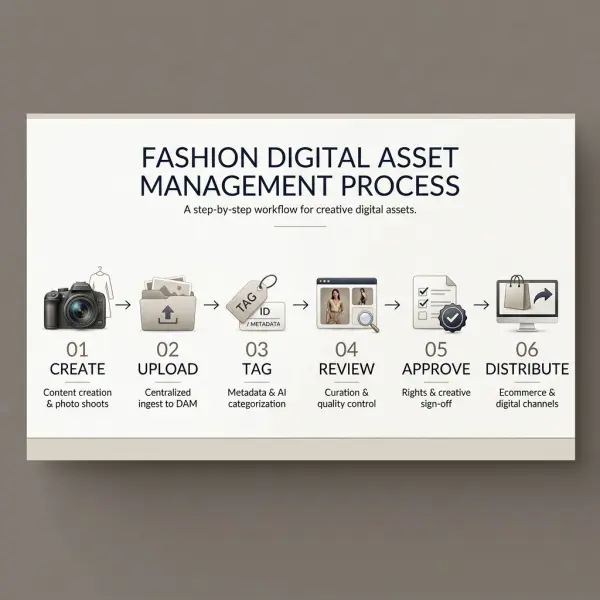
A DAM system typically manages digital content through a sequence of ingestion, identification, review, storage, retrieval, and distribution. The exact process depends on the platform and business requirements, but the underlying principle is consistent: an asset should carry enough information and controls to be used correctly by authorized people.
For a fashion brand, that process begins before a photograph appears on an e-commerce website. The team first needs to establish what the image represents, whether it is approved, which version should be used, and which channels are permitted to receive it.
Asset Ingestion and Classification
Asset ingestion is the process of bringing files into the managed repository. Files may arrive from photographers, designers, production teams, creative agencies, or existing storage systems.
During ingestion, the organization can apply naming conventions, establish asset ownership, and classify files according to their business purpose. Some platforms support automated metadata extraction or tagging, but automation does not eliminate the need for validation.
For example, image recognition may identify a photograph as a white blouse, but that observation alone cannot reliably establish the correct commercial style code, collection ownership, or usage authorization. Those details need to come from authoritative business records or approved human input.
Metadata and Searchability
Metadata is structured information describing a digital asset. It may include a title, description, keywords, file format, creator, associated product, approval status, or usage restrictions.
According to Adobe's guidance on asset metadata, metadata supports asset categorization, retrieval, rights administration, and permissions management.
For apparel businesses, a searchable filename is helpful, but product-related metadata is generally more useful at scale. A marketing employee might remember the garment's collection and color rather than the image's original filename.
A practical system should make those searches possible without requiring users to understand how the photographer arranged the source files.
Review, Approval, and Version Control
Creative assets often pass through several revisions before publication. A campaign photograph may be retouched, recolored, cropped, or adjusted to match a brand's visual direction.
Version control helps distinguish the current approved file from earlier drafts while maintaining a record of changes. Approval workflows can also prevent unfinished content from being distributed prematurely.
Not all changes should be treated as replacements. A retouched photograph that corrects an error may supersede a previous version, whereas an intentionally different crop for a particular platform may be better managed as a rendition or related derivative.
Distribution and Reuse
Once an asset is approved, authorized teams can retrieve it for specific applications. Depending on the DAM platform, files may be downloaded manually, shared through controlled links, delivered through integrations, or transformed into channel-specific versions.
A fashion brand could maintain one approved high-resolution product photograph and distribute appropriate renditions to its online store, wholesale portal, and marketing team. This does not mean every channel receives an identical file. Rather, the delivered versions remain traceable to an approved source.
Why Metadata Matters More Than Folder Structure Alone
A folder hierarchy can help users navigate a relatively small collection of files. However, fashion assets frequently belong to several categories simultaneously. One photograph might be relevant to a specific collection, product style, marketing campaign, seasonal launch, and retailer.
Folders generally describe where a file is stored. Metadata describes what the file represents and how it can be used. This is why a metadata-driven DAM repository can provide more flexible retrieval than a system built entirely around nested folders.
Consider a hypothetical fashion label preparing imagery for a linen capsule collection. One photograph is associated with style LN204, the ivory colorway, a spring collection, and an approved e-commerce shoot. Without consistent metadata, employees may need to search through campaign folders manually. With accurate classification, the photograph can be retrieved through several business-relevant searches.
A practical metadata framework might include the following fields:
|
Metadata field |
Fashion example |
Operational purpose |
|
Asset ID |
AST-004582 |
Uniquely identifies the media asset |
|
Product reference |
LN204 |
Links the image to a garment style |
|
Colorway |
Ivory |
Distinguishes product presentations |
|
Collection |
Spring Capsule |
Supports seasonal retrieval |
|
Asset type |
Product front view |
Identifies the intended visual role |
|
Approval status |
Approved |
Indicates readiness for use |
|
Usage rights |
Website and owned social |
Documents permitted distribution |
|
Rights expiry |
Contract-specific date |
Flags restrictions where applicable |
These are illustrative fields, not a universal industry schema. A small independent label may need only a subset, while a multi-brand retailer may require market, language, region, agency, retailer, and campaign identifiers.
There is also an important distinction between style references, stock-keeping units (SKUs), and standardized product identifiers. A style code may group several color and size variations, while operational SKUs may distinguish individual sellable variants. Where Global Trade Item Numbers (GTINs) are used, GS1's product variation guidance requires distinct GTINs for relevant size and color combinations. Asset relationships should respect the product identification model used by the business.
Metadata Quality Is a Governance Responsibility
Adding more metadata fields does not automatically improve asset management. If employees use different terminology for the same garment category, searches may become inconsistent despite the presence of a sophisticated platform.
Fashion brands benefit from controlled vocabularies for recurring attributes such as collection, asset type, status, and sales channel. Descriptive keywords may remain flexible, but critical commercial identifiers should follow agreed conventions.
The management responsibility is equally significant. Someone must determine which metadata is required, who can edit it, how errors are corrected, and how asset records remain synchronized when product information changes.
Digital Asset Management vs PIM, PLM, and CMS
DAM, Product Information Management (PIM), Product Lifecycle Management (PLM), and Content Management Systems (CMS) serve related but different business functions. Understanding their responsibilities can prevent fashion brands from purchasing overlapping software or expecting one platform to manage every information workflow.
|
System |
Primary responsibility |
Fashion business example |
|
DAM |
Organizes and governs digital media |
Product photos, videos, lookbooks, campaign images |
|
PIM |
Manages structured product information |
Descriptions, attributes, size information, product identifiers |
|
PLM |
Manages product development information and processes |
Specifications, revisions, materials, sampling approvals |
|
CMS |
Manages and publishes digital content experiences |
Website pages, articles, landing pages, editorial content |
|
Shared cloud storage |
Stores and shares general files |
Working folders, documents, basic image archives |
A DAM system specializes in the management of rich media assets, while PIM focuses on structured product information. Akeneo's comparison of PIM and DAM describes these technologies as complementary, including scenarios where a PIM product record references images managed in DAM.
For a fashion brand, this relationship can be illustrated through a product detail page. The PIM may maintain the item's commercial description, fabric composition, color, and available sizes. DAM manages the approved product photographs and potentially their different renditions. The e-commerce platform or CMS presents the information and images to shoppers.
These boundaries are not absolute. Some PIM platforms include substantial media management features, while some commerce systems provide enough asset handling for smaller businesses. Dedicated DAM becomes more compelling when asset volume, reuse, rights control, or cross-department coordination exceeds the capabilities of those existing systems.
Why Does Digital Asset Management Matter for Fashion Brands?
Digital asset management matters because fashion businesses depend on visual accuracy and creative consistency across multiple operational contexts. A garment can be photographed once but represented through many customer-facing and business-facing channels.
Without a shared asset governance process, the same photograph may be duplicated, modified independently, or distributed without a clear indication of its approval status. DAM provides a mechanism for reducing that ambiguity, although the benefits depend on accurate asset records and consistent team adoption.
More Consistent Product Presentation
Product photography helps customers understand garment appearance, construction, and styling. Inconsistent imagery can create confusion when photographs do not correspond to the listed product color or when different platforms display substantially different versions of the same item.
A managed repository allows teams to identify which visual assets are associated with particular products and which versions have been approved for customer-facing use.
That control is especially relevant to brands selling through wholesale partners and marketplaces, where external teams may otherwise work from previously downloaded files.
Google Merchant Center's product image documentation distinguishes primary product images from additional images and lifestyle imagery, illustrating why assets must be assigned to the correct channel role rather than treated as interchangeable photographs.
Better Collaboration Across Creative and Commercial Teams
Fashion marketing requires coordination between creative production and commercial execution. Designers may prioritize visual direction, photographers focus on image quality, merchandisers need product accuracy, and e-commerce managers need publication-ready files.
These priorities overlap but are not identical. DAM gives teams a common asset reference that can reduce the need to exchange repeated attachments or maintain disconnected versions.
For example, a wholesale account manager requesting approved imagery for a retailer can access a designated collection rather than asking the creative department to assemble the same files again. The actual time saved will depend on the previous workflow, platform performance, and how well assets are maintained.
Greater Control Over Brand Usage and Rights
Fashion campaign production frequently involves third-party contributors, including photographers, models, stylists, agencies, and videographers. Contracts may establish restrictions on commercial use, geography, channels, or duration.
A DAM system can record such conditions and, depending on platform capabilities, restrict access or flag assets approaching their permitted usage limits. Adobe documents metadata-driven permissions that can use properties such as an asset's approval status to control access.
However, software controls do not determine who legally owns an image or whether a particular use is permitted. Those conclusions depend on the applicable contracts and law. DAM should reflect verified rights information rather than substitute for that verification.

The Role of DAM in Fashion Marketing and Retail Operations
The value of DAM extends beyond the creative department because fashion imagery moves through a series of commercial activities. Each activity places different requirements on the same underlying content.
An e-commerce team needs photographs that represent the correct sellable product. A social media manager may require selected images adapted to campaign storytelling. A wholesale team may need high-resolution files that external buyers can download under agreed conditions. Meanwhile, the brand department may be responsible for ensuring the assets remain consistent with the approved visual identity.
These activities illustrate why DAM is most useful when positioned as shared content infrastructure rather than simply another creative software subscription.
For marketing teams, organized assets can make campaign preparation more predictable. For retail operations, the benefit lies in having approved visuals available when products are introduced or updated. For wholesale businesses, controlled sharing can make it easier to provide partners with usable assets without exposing unfinished material.
The practical implications of organizing product photographs, lookbooks, and campaign files are explored further in how fashion teams organize product photos, lookbooks, and campaign assets. The deeper workflow consequences of inconsistent or missing assets belong inwhy poor asset management slows fashion marketing workflows.
How Can Fashion Brands Implement Digital Asset Management?
An effective DAM implementation starts with the brand's operational requirements rather than a feature comparison between software providers. A system that looks sophisticated during a demonstration may be unnecessarily complex for a small label with limited asset volume.
The first decision is whether the organization needs better file management practices, dedicated software, or an integrated architecture connecting DAM with other business systems.
Start With an Asset Inventory
A brand should first identify where its important digital assets currently reside and which departments depend on them. The inventory should distinguish active content, archived materials, working files, and assets with uncertain rights or approval status.
The aim is not to migrate every historical file immediately. It is to identify the content categories that create the most operational value or risk.
For a small direct-to-consumer label, this may mean starting with product images and brand identity files. A larger organization managing multiple collections, retailers, and marketing regions may need to prioritize campaign content, product imagery, partner distribution, and rights management simultaneously.
Establish a Minimum Metadata Standard
Once the priority assets are identified, the brand can define the minimum information required for an asset to become usable. The standard should reflect how employees actually search for content.
A practical starting point may include asset type, product or campaign reference, collection, approval status, owner, and usage rights where applicable. Requiring dozens of fields from every employee can create unnecessary administrative work, especially if many attributes do not affect search, governance, or distribution.
The objective is reliable data, not maximum data.
Define Ownership and Approval Responsibilities
Fashion brands should establish who is responsible for uploading original files, validating metadata, approving creative output, and authorizing distribution.
For example, a photographer or creative coordinator may supply source imagery, while a merchandising employee validates product associations. A creative lead may approve the visual treatment, and an authorized marketing employee may release the approved asset to relevant channels.
These responsibilities can be combined in a smaller company. What matters is that the organization does not confuse file availability with publication approval.
Introduce Integrations When They Solve Real Problems
Integration becomes useful when manual asset transfer creates repeated work, inconsistent records, or publication delays. Depending on the technical environment, a DAM platform may connect to PIM, CMS, e-commerce, creative applications, or distribution infrastructure.
A particularly useful integration links a product record to its approved media without requiring users to upload copies into each downstream system. The feasibility depends on identifiers, APIs, access permissions, synchronization logic, and the destination platform's requirements.
For smaller organizations, a well-maintained shared repository with clear procedures may remain sufficient. Automation should follow stable operational processes rather than compensate for unresolved data ownership.

What Features Should Fashion Brands Look for in DAM Software?
DAM software selection should be based on the types of assets a business manages, the number of people using them, and the controls required for publication and sharing. Brand size alone is not a sufficient indicator of the right platform.
A small luxury label working with numerous external photographers may have more demanding rights-management needs than a larger business producing most content internally.
The following criteria provide a practical evaluation framework:
|
Capability |
Why it matters |
What to verify |
|
Search and metadata |
Helps employees locate the correct apparel imagery |
Product identifiers, custom fields, bulk editing |
|
Version control |
Distinguishes current assets from revisions |
Rollback, historical records, approval handling |
|
Access permissions |
Limits who can view, edit, or share content |
Role-based controls and external-user access |
|
Rights management |
Supports controlled commercial use |
Rights fields, expiry handling, audit trail |
|
Asset transformation |
Provides channel-specific versions |
Export formats, cropping, resizing, quality |
|
Integration |
Connects media with commercial systems |
APIs, product mapping, synchronization |
|
Reporting |
Provides evidence of system usage |
Search behavior, downloads, reuse, adoption |
|
Security and retention |
Supports protection and recovery |
Backups, authentication, deletion, retention |
A demonstration should test real fashion use cases rather than generic software features. Vendors may show impressive search results, but buyers should verify whether the platform can reliably distinguish similar garments, colorways, and approved image versions using the brand's actual data.
Implementation cost also extends beyond licensing. Migration, metadata cleanup, user training, integration development, and ongoing governance may require meaningful effort. These costs should be evaluated alongside the potential reduction in duplicated work and operational errors.
Common Digital Asset Management Mistakes Fashion Brands Should Avoid
Assuming Cloud Storage Automatically Provides DAM Governance
Shared cloud folders can be effective for basic collaboration, but storing files in one location does not automatically establish metadata standards, rights control, or approval procedures. The problem emerges when employees interpret access to a file as evidence that it is ready for unrestricted use.
Brands should define required controls independently of their chosen technology. Basic storage may support those controls manually, while dedicated DAM platforms can formalize them through workflows and permissions.
Creating Too Many Metadata Categories
A detailed taxonomy can appear attractive during system design, particularly when a business wants to classify every collection, silhouette, material, season, and campaign attribute. Excessive requirements, however, may discourage employees from completing asset records consistently.
The more useful approach is to prioritize information needed for real search and distribution decisions. Additional fields should be introduced when there is a clear operational purpose and someone responsible for maintaining their accuracy.
Mixing Draft and Approved Content Without Clear Status
Creative teams need to retain working files, but marketers and retail partners need to identify which content is authorized for publication. When those requirements are handled through informal filenames such as final, final-new, and final-approved-2, confusion becomes increasingly likely.
A defined approval status and revision policy is more reliable than relying on file naming alone. Where the platform supports access restrictions, brands may also prevent unapproved assets from appearing in distribution-ready collections.
Ignoring Licensing and Usage Restrictions
A fashion brand may own a finished campaign file without possessing every right needed for every potential use. Photography agreements, talent releases, stock content licenses, and other arrangements may impose conditions that are not obvious from the image.
Ignoring those conditions can create legal and commercial exposure. Rights information should be verified against underlying agreements and recorded in the asset system where appropriate, rather than inferred from who uploaded the file.
Purchasing Software Before Defining the Workflow
Enterprise DAM software can provide advanced capabilities, but those features cannot resolve inconsistent product identifiers, unclear responsibilities, or poorly managed creative approvals by themselves.
If the organization has not established who owns asset metadata or which version is authoritative, implementation may simply transfer existing confusion into a more expensive environment. A focused pilot using one collection or product category can reveal whether the workflow is ready to scale.
Important Technical and Commercial Caveats
Digital asset management should not be treated as a guarantee of faster marketing execution, stronger sales performance, or legal compliance. Its contribution depends on the quality of the asset repository, the reliability of underlying information, the adoption of defined workflows, and its relationship with other business systems.
DAM Does Not Automatically Verify Copyright or Commercial Permission
Asset metadata can document creators, copyright owners, licensors, and usage restrictions, but those records are only as accurate as the information entered. The IPTC Photo Metadata User Guide provides structured guidance on rights-related fields, including usage terms and licensing information. It also recognizes that rights can depend on contracts and applicable law.
Fashion businesses should therefore retain the relevant agreements and confirm that metadata reflects the permissions actually granted. Automated expiration alerts and permission restrictions can support compliance processes, but they do not replace legal interpretation when rights are disputed or unclear.
AI Tagging Requires Validation
Some DAM platforms provide automated image tagging, visual search, or other AI-assisted functionality. These capabilities may help classify large image collections, but fashion-specific distinctions can be difficult to infer accurately from appearance alone.
A system may recognize a jacket or identify a dominant color without knowing its correct SKU, approved commercial color name, precise fabric composition, or association with a particular seasonal collection. Those attributes should be validated against authoritative product records.
Centralization Creates Operational Dependencies
A shared asset repository can simplify access, but it also becomes an important dependency for teams that rely on it. Availability, backup procedures, access control, disaster recovery, and integration reliability deserve attention.
For international brands or businesses working with external partners, data residency, contractual obligations, and cross-border access may also influence platform selection. These requirements vary by organization and jurisdiction and should be verified before implementation.
Frequently Asked Questions About Fashion Digital Asset Management
1. What is the simplest explanation of DAM for a fashion brand?
Digital asset management is an organized way to control a fashion brand's digital content so employees can find and use the right files. It combines storage with information about what each asset represents, which version is approved, and who is allowed to use it.
For example, instead of searching through multiple folders for photographs of a particular dress, the marketing team can retrieve imagery associated with the relevant collection and product. A complete DAM platform may also provide search filters, permissions, versions, and integrations. Smaller brands can apply the same underlying principles through simpler tools, although more work may need to be handled manually.
2. Do small fashion brands need dedicated DAM software?
Not necessarily. A small fashion brand with limited product photography, a compact team, and straightforward distribution requirements may manage its assets effectively through shared storage, consistent naming, and documented approval procedures.
Dedicated DAM becomes more relevant when searching, version control, rights administration, or external sharing consumes significant staff time or creates repeated errors. The decision should reflect actual operational complexity rather than assumptions about what professional fashion brands are expected to use. A practical first step is to audit current assets and identify problems that cannot be handled reliably with existing systems.
3. Can DAM replace product information management software?
A DAM system generally does not replace the full role of PIM because the two manage different types of information. DAM focuses on digital media assets, while PIM manages structured commercial product information such as descriptions, attributes, and product references.
Some platforms combine selected capabilities, so the practical boundary depends on the software. For a brand with a small catalog, an existing commerce system may provide adequate product information and image management. More complex businesses may benefit from integrating specialized tools. The important principle is to establish an authoritative source for each category of information rather than maintaining conflicting records across systems.
4. Can DAM help fashion brands manage image copyright and licensing?
Yes, DAM can support copyright and licensing administration by recording rights holders, usage conditions, permitted channels, and applicable dates. Depending on the software, it may also control access or help prevent expired assets from being distributed through defined workflows.
However, DAM does not establish ownership merely because a file is stored in the repository. Rights depend on the underlying contracts and legal framework. Brands working with photographers, models, agencies, or stock content providers should verify those arrangements separately and maintain reliable documentation. Metadata should communicate verified rights, not substitute for permission.
5. How is DAM different from storing fashion images in Google Drive or Dropbox?
General cloud storage primarily provides file storage, synchronization, and sharing, although specific products and plans may include additional search, permission, or version-history capabilities. DAM is designed around the management of media assets and their business context.
Dedicated DAM platforms may provide configurable metadata, creative approval workflows, image transformations, rights administration, and connections to product or publishing systems. The distinction is functional rather than simply a matter of branding. A fashion company should compare the capabilities of its existing storage environment with its operational requirements before purchasing another platform. Basic storage may be sufficient where governance needs remain simple.
6. How can a fashion brand measure whether DAM is working?
A fashion brand can evaluate DAM by measuring whether its asset-related operations become more reliable and easier to complete. Useful indicators include time required to locate an approved image, the percentage of priority assets with complete metadata, the frequency of incorrect asset use, and the amount of repeated file preparation.
Measurements should begin before implementation so the brand has a realistic baseline. Asset reuse and user adoption can provide additional insight, but neither guarantees commercial success. Results should be interpreted alongside campaign complexity, staff training, product catalog changes, and the quality of integrations. A successful deployment improves the working process, not merely the number of files stored.
Conclusion: DAM as a Foundation for More Reliable Fashion Content Operations
Digital asset management gives fashion brands a structured approach to managing the photographs, videos, creative documents, and brand materials that support everyday business operations. Its main contribution is not simply keeping files together, but making those files identifiable, approved, accessible, and usable within defined commercial conditions.
For smaller fashion labels, the most sensible starting point may be consistent asset naming, essential metadata, clear responsibilities, and controlled shared storage. For larger businesses, dedicated DAM software can provide the governance, versioning, integrations, and distribution capabilities needed to coordinate more complex content operations.
The distinction matters because a brand does not improve its asset management merely by purchasing technology. It improves when its creative content becomes easier to find, more reliable to use, and better connected to product and marketing decisions.
As fashion businesses expand their catalogs and communication channels, that organizational discipline can become increasingly valuable. The long-term objective is a dependable content operation in which creative work remains useful beyond its original production project.





Comments 0
Leave a CommentSend Comment
Anda harus Login terlebih dahulu untuk dapat memberikan komentar.