

Straight Grain, Cross Grain, and Bias: Key Differences in Fabric Behavior
Two garment panels can be cut from the same roll of fabric, using the same pattern dimensions, and still behave differently when worn. One may hang with a relatively stable shape, while another feels more flexible or falls into softer folds. The difference may come from something as fundamental as the direction in which the fabric was cut.
In woven textiles, straight grain, cross grain, and bias describe three principal orientations relative to the yarn structure. Each orientation influences how the material responds to tension, moves around the body, and behaves during sewing.
For fashion designers and garment manufacturers, these differences are not merely technical details. They affect silhouette development, fabric consumption, pattern construction, production consistency, and ultimately the customer's experience of the finished garment.
Understanding when to use each direction allows clothing businesses to make informed design decisions instead of treating grainline as a fixed cutting rule.
Quick Answer: What Is the Difference Between Straight Grain, Cross Grain, and Bias?
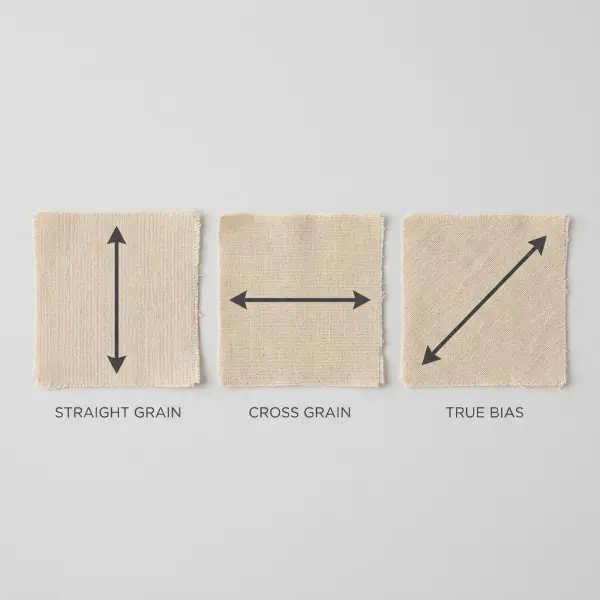
Straight grain, cross grain, and bias are three cutting directions in woven fabric that influence its stability, flexibility, and drape. Straight grain runs parallel to the lengthwise warp yarns and fabric selvages. Cross grain follows the weft yarns across the fabric width. True bias runs diagonally at 45 degrees to both yarn systems.
In many conventional woven fabrics, the lengthwise grain offers relatively high dimensional stability, while the cross grain may provide slightly more mechanical give. The bias generally allows greater distortion and flexibility because the warp and weft yarns can shift their angles relative to one another.
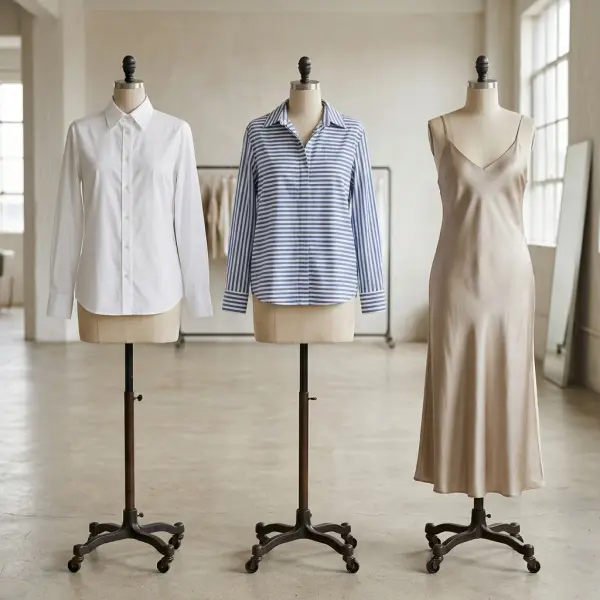
These differences affect garment behavior. Straight-grain cutting is commonly used for shirts, trousers, and structured apparel. Crossgrain placement can serve specific pattern, fabric-width, or design requirements. Bias cutting is often used in garments that benefit from fluid drape, such as slip dresses, flowing skirts, and selected garment details.
However, these are general tendencies rather than universal performance rules. Fiber composition, weave construction, elastane content, fabric weight, and finishing can significantly alter the behavior of each direction.
The most appropriate cutting direction is therefore the one that supports the intended garment design and has been validated using the actual fabric.
Why Fabric Direction Changes the Way Woven Textiles Behave
The behavior of woven fabric depends partly on the relationship between its two interlaced yarn systems. Warp yarns extend along the length of the fabric, while weft yarns extend across its width. These yarns form a structure that responds differently to forces applied along or between their directions.
This directional dependence is important because clothing is constantly exposed to tension and movement. A garment must respond to gravity, body motion, seam construction, and repeated handling without losing its intended appearance.
The basic relationship between warp, weft, and grainline is introduced in fabric grainline and accurate garment cutting. The more specific question is how the fabric's behavior changes when the same pattern piece is placed along different directions.
The Role of Warp and Weft Yarns
During weaving, warp yarns are held under controlled tension on the loom while weft yarns are inserted across them. This manufacturing process influences the final yarn arrangement and can contribute to directional differences in fabric performance.
In many conventional woven constructions, the lengthwise direction exhibits relatively limited extension under a given load. Crosswise behavior may differ because of variations in yarn properties, yarn crimp, weave geometry, or finishing.
The CottonWorks explanation of weaving basics describes the structural functions of warp and filling yarns during fabric production.
However, warp and weft do not necessarily use identical yarns or share identical mechanical properties. Some textiles are engineered specifically to provide greater stretch or flexibility in one direction.
As a result, the distinction between straight grain and cross grain is structural, while their exact performance must be determined from the particular fabric.
Why Diagonal Fabric Behaves Differently
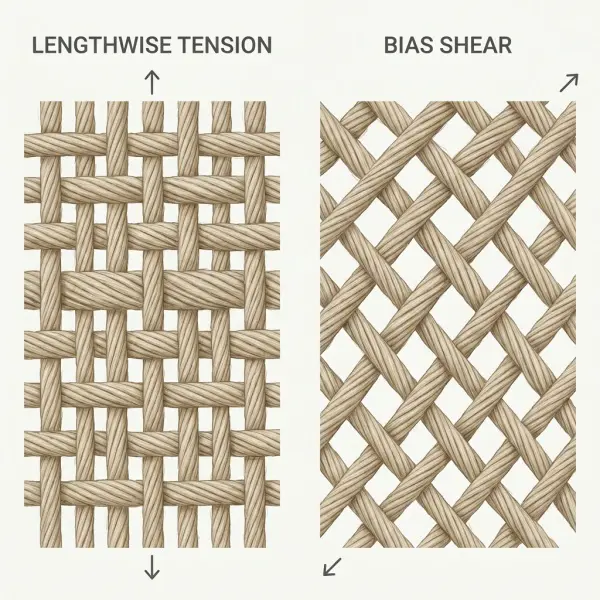
Bias behaves differently because it does not follow either principal yarn direction. Instead, force applied along the diagonal can cause the yarns to rotate or change their angle relative to one another.
In a simplified woven structure, the originally rectangular spaces between yarns can deform toward diamond-like shapes. This shearing movement allows the fabric to change shape without requiring the yarns themselves to elongate substantially.
That distinction explains why a woven fabric made entirely from non-elastic yarns can still exhibit noticeable flexibility when pulled on the bias.
The additional mechanical give can create attractive drape, but it can also make the fabric more sensitive to distortion during cutting, sewing, and hanging.
Straight Grain: Structure, Stability, and Controlled Garment Shape
Straight grain, also called lengthwise grain, follows the warp yarns parallel to the selvage edges of woven fabric. In conventional apparel pattern making, it is the most common reference direction for positioning major garment components.
Straight-grain cutting is generally associated with dimensional stability and controlled garment shape. These characteristics make it useful when a design requires panels to retain their intended proportions and hang consistently.
A classic woven shirt illustrates the principle. Its front and back body panels are commonly positioned so the lengthwise grain runs vertically through the garment. This helps maintain the relationship between the pattern's vertical dimensions and the fabric's principal lengthwise structure.
How Straight Grain Responds to Tension
In many woven textiles, pulling along the straight grain produces relatively little extension compared with pulling diagonally. The warp yarns provide direct resistance to the applied force, while the weave structure limits how freely the yarns can rearrange.
This does not mean straight-grain fabric cannot stretch. Mechanical extension can occur because of yarn crimp and construction, while elastic fibers can create deliberate stretch along the warp direction.
The practical advantage of straight-grain placement is usually predictability. Garment pieces positioned consistently along the intended lengthwise direction tend to respond more uniformly during construction.
For manufacturers producing standardized sizes, this predictability helps maintain the relationship between approved patterns and finished garments.
Common Straight-Grain Garment Applications
Straight-grain placement is frequently used in apparel categories where dimensional control matters.
Typical applications include woven shirts, tailored jackets, conventional trousers, uniform garments, and straight-cut skirts. In these products, maintaining the intended vertical orientation often supports a more controlled silhouette.
Consider a corporate uniform supplier producing several thousand woven work shirts. Using a consistent approved grainline orientation for the principal garment panels helps prevent unnecessary variation caused by rotating pieces between cutting markers.
The garment's actual stability still depends on its material and construction, but grainline consistency removes one avoidable source of variation.

Where Straight Grain Has Limitations
Straight-grain cutting may not provide the fluidity required for certain designs. A softly draped dress, for example, may look relatively structured if the chosen fabric is cut in a direction that restricts shear deformation.
Attempting to create a bias-like silhouette simply by increasing garment width or reducing pattern shaping does not necessarily produce the same result. Added fullness and directional fabric flexibility are different design mechanisms.
Straight grain is therefore not automatically the best choice. It is most appropriate when its behavior supports the intended silhouette and construction.
Cross Grain: A Different Direction with Its Own Design Possibilities
Cross grain follows the weft yarns across the width of woven fabric, perpendicular to the selvages. Although it is sometimes treated as secondary to lengthwise grain, crossgrain cutting can be a deliberate and useful design choice.
In many ordinary woven fabrics, the crosswise direction provides somewhat more give than the lengthwise direction. This tendency is related to the fabric's yarn arrangement and construction, but it should not be assumed without examining the actual material.
For apparel designers, crossgrain placement offers an alternative orientation that may affect flexibility, surface appearance, and pattern layout.
Crossgrain Flexibility Is Fabric-Dependent
Crossgrain performance varies considerably between textiles. A tightly constructed woven material may provide limited extension in both principal directions, while another fabric may exhibit greater crosswise flexibility because of its yarn structure or finishing.
Some fabrics are intentionally engineered to provide mechanical stretch across the width. For example, Cotton Incorporated's NATURAL STRETCH technology demonstrates how woven cotton construction and finishing can create flexibility in the filling direction without relying on elastane.
This illustrates why broad rules about crossgrain stretch require qualification. The crossgrain of one fabric may behave very differently from that of another, even when both fabrics share the same basic fiber composition.
For product developers, directional testing is more reliable than judging performance from fabric type alone.
Crossgrain Cutting for Visual Design
Crossgrain placement can be useful for changing the orientation of stripes, checks, and other directional features.
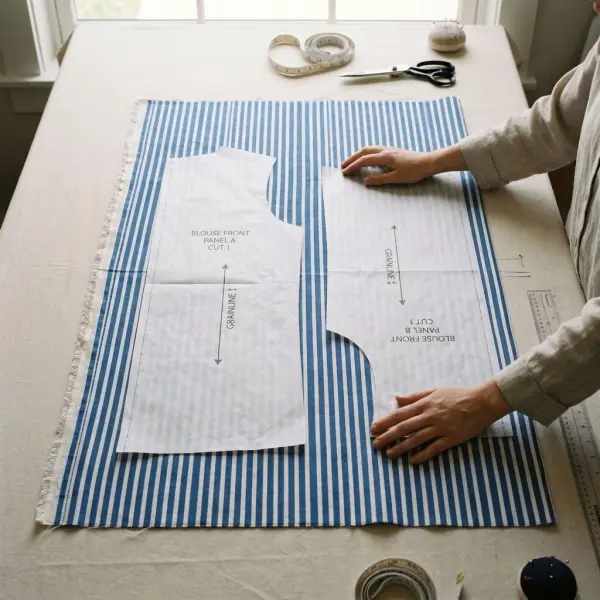
Suppose a designer is developing a striped woven blouse. If the fabric's stripes run parallel to the selvage, cutting a particular panel on the crossgrain may turn those stripes horizontally across the garment.
The resulting visual effect can become part of the design language without requiring a different fabric.
However, this choice also changes the panel's structural orientation. A designer should therefore consider both visual appearance and mechanical behavior before approving the change.
Crossgrain cutting is especially worth evaluating when a garment combines panels in different directions, because their behavior during sewing and wear may not be identical.
Crossgrain Cutting and Fabric Width
Fabric width can influence cutting decisions. A pattern piece that does not fit in the intended lengthwise orientation might fit when rotated, provided the design and material permit that change.
This does not automatically make crossgrain cutting a better material-efficiency strategy. A rotated piece may introduce a new directional behavior, alter printed motifs, or create inconsistent appearance between garment panels.
The correct decision depends on the approved construction requirements and the outcome of sample evaluation.
Crossgrain placement should be treated as an intentional technical choice rather than a convenient solution to every marker-layout limitation.
Bias Grain: Greater Flexibility and Fluid Garment Drape
Bias refers to a direction diagonal to the warp and weft yarns. The true bias lies at a 45-degree angle to both principal yarn directions in a properly squared woven fabric.
Unlike straight grain and cross grain, bias is not technically a separate set of yarns. It is an orientation through the existing woven structure.
This distinction is important because the characteristic flexibility of bias-cut fabric comes primarily from the ability of the yarn system to shear and rearrange.
The Seamwork guide to working on the bias explains the relationship between diagonal cutting, fabric flexibility, and the construction challenges associated with bias-cut garments.
Why Bias-Cut Fabric Drapes Differently
When a fabric panel is positioned on the bias, gravity acts along a direction that allows greater shear deformation within many woven structures. This can create softer folds and a more body-responsive silhouette.
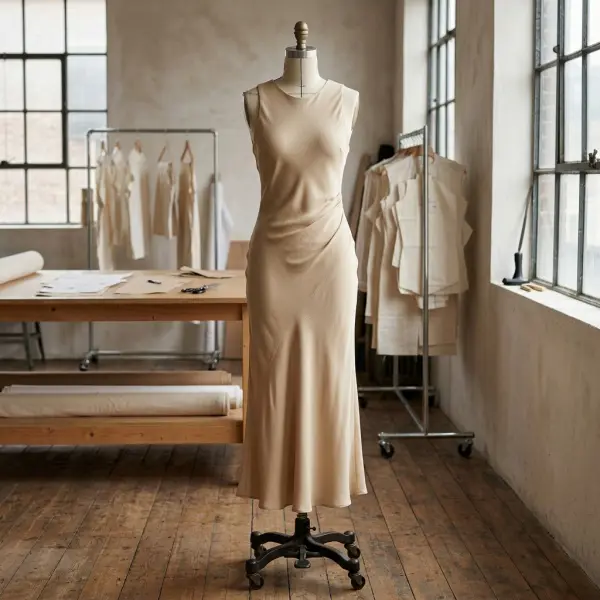
In a slip dress made from a suitable lightweight woven fabric, bias placement may allow the garment to follow the body's contours without requiring as much conventional shaping as a comparable straight-grain design.
The effect is influenced by the textile itself. A lightweight silk crepe may produce a noticeably fluid result, while a heavy, densely constructed canvas may remain relatively stiff even when positioned diagonally.
Bias does not automatically create graceful drape in every material.
Bias Stretch Is Not the Same as Elastic Stretch
Bias-cut fabric can exhibit mechanical give without containing elastane. Its flexibility comes from changes in the woven geometry rather than substantial elongation of elastic fibers.
This difference matters when evaluating fit and recovery. A fabric containing elastane may extend and recover through the behavior of its elastic yarns, while an ordinary woven fabric stretched on the bias may retain some distortion or change shape under sustained tension.
A bias-cut garment can therefore feel flexible without delivering the same recovery or close-fitting performance as a purpose-designed stretch textile.
Manufacturers should not substitute bias orientation for elastic stretch without testing the garment's movement, comfort, and dimensional behavior.
Popular Applications of Bias Cutting
Bias cutting is often associated with fluid dresses, but its applications extend beyond complete garments.
Bias-cut skirts and camisoles can use directional flexibility to create softer silhouettes. Bias-cut panels may introduce controlled drape or visual interest, while bias binding can conform around curved garment edges more readily than comparable straight-grain strips.
Historically, designers such as Madeleine Vionnet helped establish bias cutting as an important technique in fashion design. Threads magazine's discussion of bias-cut techniques provides both historical context and examples of its construction uses.
For contemporary fashion brands, bias cutting can support a particular design aesthetic, but it should be evaluated as a production method rather than merely a styling detail.
Construction Challenges of Bias-Cut Garments
The flexibility that makes bias cutting attractive also creates technical challenges. Bias-cut edges may stretch during handling, panels may lengthen under their own weight, and seams can become distorted if tension is not controlled.
These issues can make bias-cut production more demanding than a comparable straight-grain construction, depending on the textile and garment design.
A bias-cut dress may require careful single-layer cutting, suitable seam stabilization, controlled pressing, and time for the garment to settle before its hem is finalized.
The direction of the diagonal also matters. Woven fabric has two true-bias directions, and their relationship around the garment can influence balance. An approved pattern may use alternating bias orientations to control distortion.
These requirements become especially relevant when a fashion brand moves from one carefully handled sample to repeatable bulk production.
Straight Grain vs Cross Grain vs Bias: A Practical Comparison
The most useful way to compare these directions is to examine how each one changes the relationship between yarn structure, garment behavior, and production requirements.
The following table summarizes tendencies commonly encountered in conventional woven textiles. It should not be treated as a universal material specification.
|
Comparison Factor |
Straight Grain |
Cross Grain |
True Bias |
|
Orientation |
Parallel to warp yarns and selvage |
Parallel to weft yarns |
45° to warp and weft |
|
Relative dimensional stability |
Often relatively high |
Often moderately stable, depending on construction |
Commonly more susceptible to shear distortion |
|
Mechanical give |
Usually limited in many standard woven fabrics |
Often somewhat greater than lengthwise grain |
Generally greater diagonal flexibility |
|
Drape tendency |
More controlled |
Material-dependent, sometimes slightly softer |
Often more fluid and body-responsive |
|
Pattern placement |
Standard orientation for many major pieces |
Used where specifically intended |
Requires deliberate diagonal positioning |
|
Cutting sensitivity |
Usually comparatively manageable |
Usually manageable with correct alignment |
Often needs more careful handling |
|
Potential fabric consumption |
Baseline for many conventional markers |
Depends on layout and fabric width |
May increase because of diagonal nesting requirements |
|
Common applications |
Shirts, trousers, jackets, uniforms |
Selected panels, borders, directional design effects |
Slip dresses, flowing skirts, bias binding |
|
Primary technical consideration |
Maintaining intended structure and alignment |
Validating directional behavior |
Controlling distortion and garment balance |
The table highlights an important distinction: grain direction is not a quality ranking. Straight grain is not inherently superior to cross grain, and bias is not inherently more luxurious.
Each direction offers a different structural relationship to the pattern.
A manufacturer producing tailored trousers may prioritize the controlled behavior of lengthwise grain. A designer creating a fluid evening dress may choose bias orientation for its drape. A brand developing striped apparel may use crossgrain selectively to create visual contrast.
The appropriate choice depends on the design objective, material behavior, and production capability.
How Fabric Type Changes the Grain Direction Decision
A cutting direction cannot be evaluated independently of the material. Two fabrics with identical grain orientations may produce substantially different garment results because of differences in yarn, weave, weight, and finishing.
Consider three common apparel material categories.
Crisp Cotton Poplin
Cotton poplin commonly has a relatively firm, closely woven structure. Depending on its construction and finish, it can produce clean garment shapes and controlled drape when cut on the intended straight grain.
Crossgrain cutting may change its flexibility and the direction of stripes or other visual details, but it does not necessarily produce a major change in softness.
Bias cutting introduces greater potential for diagonal give, yet the resulting material may remain relatively crisp compared with lighter, more fluid textiles.
For a structured shirt, the most relevant decision is usually whether a different orientation preserves the desired fit and appearance.
Lightweight Viscose and Silk Fabrics
Lightweight woven viscose and silk fabrics can be especially responsive to cutting orientation, although their behavior varies with weave and finish.
A fluid fabric that already drapes softly on the straight grain may become even more responsive when cut on the bias. This can help create a body-skimming silhouette but may also make the material difficult to handle consistently.
Slippery fabrics can shift during cutting, and bias-cut edges may distort before assembly.
For manufacturers, these materials require careful evaluation of cutting methods, seam construction, handling procedures, and dimensional changes during hanging.
Stretch Woven Fabrics
Stretch woven textiles introduce another variable because their yarn systems may contain elastane or use constructions designed to create additional mechanical flexibility.
A stretch woven fabric may exhibit significant extension across the width, along the length, or in both directions, depending on its specification.
Rotating a pattern piece can therefore alter the direction in which the garment accommodates body movement.
For example, trousers designed to stretch around the hips may perform differently if a fabric's greatest-stretch direction is unintentionally rotated vertically.
In such cases, the direction of engineered stretch may be more important to functional fit than general assumptions about conventional woven grain behavior.
Choosing the Right Cutting Direction for Different Garment Designs
Selecting fabric direction begins with identifying the garment's functional and aesthetic requirements. The objective is not simply to follow a familiar convention but to understand why a particular orientation supports the design.
Structured Shirts and Tailored Apparel
Structured shirts, trousers, and tailored garments commonly use lengthwise grain for principal pattern pieces because predictable panel behavior helps maintain their intended shape.
If the design relies on controlled vertical lines, consistent seams, and stable garment proportions, straight-grain placement is generally a practical starting point.
This does not exclude bias-cut details or crossgrain components. However, such changes should be deliberate and incorporated into the approved pattern.
Flowing Dresses and Soft Skirts
A flowing silhouette may benefit from bias orientation when the textile has suitable shear flexibility and drape.
A fashion brand developing a slip-dress collection, for instance, might compare straight-grain and bias-cut prototypes using the same approved fabric. The comparison can reveal differences in how the garment follows the body, responds to movement, and hangs after relaxation.
The decision should also account for the additional cutting and sewing care that bias construction may require.
A more fluid silhouette is not automatically worth a higher production cost if it does not support the product's intended market positioning.
Decorative Panels and Directional Prints
Crossgrain or bias orientation can be used to create visual contrast with striped, checked, or textured materials.
A skirt with a diagonal striped panel may achieve its effect through bias placement, while a shirt with contrasting horizontal stripes may use crossgrain-oriented components.
The visual effect should be evaluated alongside grain stability, fabric matching, and seam compatibility.
Where different grain directions meet at one seam, the joined fabrics may respond differently to handling and tension. The seam construction must accommodate those differences.
Curved Edges and Bias Binding
Bias strips are commonly used for finishing curved edges because they can conform to shapes that would be difficult to follow with rigid straight-grain strips.
Necklines, armholes, and selected garment edges may benefit from this flexibility.
However, bias binding is not always interchangeable with straight-grain binding. The correct approach depends on the curve, material, finish, and intended durability.
Utah State University Extension's guidance on crosswise grain binding provides a useful comparison of straight crosswise binding and the flexibility needed for curved applications.
Business Implications: Grain Direction, Cost, and Production Efficiency
For fashion businesses, changing grain orientation can affect more than the finished garment's appearance. It may influence fabric utilization, cutting complexity, labor requirements, quality control, and the repeatability of production.
These implications are particularly relevant when a design moves from sample development to commercial manufacturing.
Fabric Consumption and Marker Efficiency
Cutting markers determine how pattern pieces are arranged within the available fabric width. Grainline requirements limit which rotations are acceptable, making them an essential constraint in marker planning.
Bias-cut garments may require more fabric than equivalent straight-grain designs because diagonal pattern placement can reduce nesting efficiency.
However, there is no universal percentage increase that applies to every bias-cut garment. The actual impact depends on pattern geometry, fabric width, size assortment, directional prints, and marker-development methods.
Before finalizing costing, manufacturers should calculate consumption using an approved marker rather than assuming a fixed allowance for bias cutting.
Labor and Handling Requirements
Straight-grain and crossgrain woven panels are often easier to handle than comparable bias-cut panels because they are generally less susceptible to diagonal distortion.
Bias-cut materials may require additional attention during spreading, cutting, transport, sewing, and pressing. A fabric panel that stretches while being moved between workstations can create sewing difficulties even if it was cut accurately.
Production teams may need specialized handling procedures or additional quality checkpoints for sensitive materials.
These requirements can affect labor allocation and production time, although the scale of the impact depends on the factory's experience and equipment.
Pattern Development and Sample Approval
Changing a garment's cutting direction should be treated as a pattern-development decision rather than a minor cutting adjustment.
A straight-grain pattern cannot automatically be rotated to the bias with the expectation that its fit and silhouette will remain unchanged.
The new orientation may alter how the garment settles around the body and how its seams respond to tension.
For a commercial collection, a revised sample should be assessed after appropriate relaxation and, where relevant, care testing.
This is especially important for products requiring consistent fit across several sizes.
Quality Consistency and Supplier Communication
If a brand works with multiple factories, the approved grain orientation should be communicated clearly in the technical package and production patterns.
A supplier may otherwise interpret marker efficiency or visual design requirements differently, particularly when a garment includes unconventional panel directions.
Clear documentation reduces the risk of unapproved changes between sampling and bulk production.
The broader causes of seam twisting and uneven drape, including cases where fabric orientation is not the only factor, are explored in common grainline mistakes and garment distortion.
How Fashion Brands Can Evaluate Fabric Direction Before Production
A useful grain-direction decision begins with controlled comparison. Rather than relying entirely on fabric descriptions or general rules, product developers can examine how the specific textile behaves in each orientation.
A simple fabric test can provide useful preliminary information, while more formal testing may be necessary when dimensional performance is a critical product requirement.
Compare Samples from the Same Fabric
Cut comparable samples from the same fabric in the lengthwise, crosswise, and true-bias directions. Keep their dimensions and preparation conditions consistent.
The samples can then be examined for differences in extension, resistance to distortion, drape, and ability to return toward their original dimensions.
A preliminary assessment might include:
- Directional extension: Compare how each sample responds to a consistent, gentle pulling force.
- Drape: Observe how the fabric hangs when supported in the same way.
- Recovery: Check whether the sample returns toward its original dimensions after handling.
- Edge stability: Note whether the cut edges stretch or distort easily.
- Surface appearance: Examine how stripes, textures, or sheen change with orientation.
These observations are useful for initial development, but an uncontrolled hand-stretch test is not a substitute for standardized laboratory measurements.
If performance requirements are commercially important, the brand should obtain suitable test data from the supplier or a qualified testing laboratory.
Evaluate the Garment, Not Only the Swatch
A swatch can reveal material tendencies, but garment construction introduces additional forces and constraints.
Seams, linings, interfacing, garment weight, and body movement can all affect how the fabric behaves once assembled.
For example, two bias-cut samples may feel similarly flexible in the hand, but the resulting garments can hang differently if one design has multiple seams or heavy decorative components.
The final decision should therefore be based on the behavior of the approved garment sample, not solely on isolated fabric testing.
Establish Orientation Rules Before Marker Approval
Once the design and material have been approved, the cutting direction should be documented for each relevant pattern piece.
Production teams need to know whether components must remain on the straight grain, whether crossgrain rotation is permitted, and whether bias direction must alternate between specific panels.
This information allows cutting efficiency to be optimized within the boundaries of approved construction requirements.
The result is a more controlled relationship between design intent, material utilization, and finished-garment performance.
Common Misconceptions About Straight Grain, Cross Grain, and Bias
Misunderstandings about grain direction often arise when general sewing guidance is interpreted as a universal textile rule. The most useful approach is to distinguish structural facts from material-dependent performance.
Misconception 1: Straight Grain Is Always the Strongest Direction
Straight grain is often associated with higher dimensional stability in conventional woven fabrics, but this does not establish that it is always the strongest direction.
Fabric strength depends on yarn properties, yarn density, weave construction, processing, and the direction of the applied load.
Some textiles are engineered with different yarns or performance characteristics in the warp and weft directions.
For sourcing and product development, directional strength should be verified when it is important to the product specification rather than assumed from grain orientation alone.
Misconception 2: Crossgrain Cutting Is Incorrect
Crossgrain cutting is not inherently a defect. It can be a legitimate design choice when the pattern and material are suitable.
The problem arises when a pattern intended for one direction is rotated without considering the consequences.
A deliberate crossgrain panel should be documented, sampled, and approved in the same way as any other construction choice.
Misconception 3: Bias Cutting Makes Every Fabric Soft and Stretchy
Bias orientation often increases mechanical give, but the extent depends on the textile structure.
A lightweight, loosely constructed woven fabric may become noticeably more fluid on the bias, while a heavy or densely constructed fabric may show a much smaller change in drape.
Bias flexibility also differs from the recoverable extension produced by elastic yarns.
For this reason, a designer should not assume that rotating a fabric diagonally will automatically create a comfortable stretch garment.
Misconception 4: Bias Cutting Is Always More Expensive
Bias-cut garments can require additional fabric and careful handling, but cost depends on the actual design, fabric width, construction complexity, and production process.
Some small bias-cut components may have little impact on total consumption, while a full-length bias-cut dress may create substantial marker constraints.
Accurate costing requires garment-specific evaluation rather than a blanket pricing rule.
Misconception 5: Knit Fabric Follows the Same Rules as Woven Fabric
Knitted fabrics have loop-based structures rather than the interlaced warp-and-weft system found in woven textiles.
They still have important directional characteristics, but their stretch and recovery depend on the knit construction, yarn, and finishing.
The direction of greatest stretch may not align with the assumptions commonly made for woven fabrics.
For knit apparel, pattern orientation should follow the specified course and wale directions, greatest-stretch requirements, and the garment's functional design.
Important Technical Caveats When Comparing Fabric Directions
The comparison between straight grain, cross grain, and bias is most directly applicable to woven textiles. Within that category, directional properties can differ substantially across fabric constructions.
A fabric's behavior reflects more than its cutting angle. Yarn twist, weave pattern, yarn crimp, finishing treatments, elastic components, and prior handling can all influence extension, drape, and stability.
Even the term bias stretch requires care. Mechanical deformation along a diagonal direction does not guarantee consistent elastic recovery, and sustained load can produce unwanted dimensional changes.
Another consideration is that fabric may arrive skewed or distorted. In that condition, an angle measured from the selvage may not correspond precisely to the true 45-degree relationship between the yarn systems. Accurate technical evaluation should use the actual yarn directions.
The Threads guidance on woven fabric grain provides additional context on why orientation and fabric construction must be considered together.
For commercial development, the appropriate conclusion is not that one grain direction always performs better. It is that directional behavior must be matched to the garment's design requirements and confirmed through relevant material and product evaluation.
Frequently Asked Questions About Straight Grain, Cross Grain, and Bias
What is the main difference between straight grain and cross grain?
Straight grain follows the warp yarns along the fabric length, while cross grain follows the weft yarns across its width. Both are principal yarn directions in woven textiles, but their mechanical properties may differ because of yarn selection, weave structure, and finishing. In many conventional woven fabrics, straight grain offers relatively limited extension, while cross grain may have slightly more mechanical give. This is a tendency rather than a universal rule. Garment designers should choose the direction that supports the intended silhouette, surface appearance, and fit, and verify its performance when directional behavior is critical.
Why is fabric usually stretchier on the bias?
Woven fabric often exhibits greater flexibility on the bias because diagonal tension allows its interlaced yarns to change their angles relative to one another. Instead of relying primarily on yarn elongation, the textile can deform through shearing of its woven structure. This can provide noticeable mechanical give even when no elastane is present. The amount of flexibility depends on weave density, yarn characteristics, finishing, and fabric weight. Bias stretching should not be confused with engineered elastic stretch, particularly because a fabric that deforms easily may not recover completely after repeated tension or prolonged hanging.
Is true bias always cut at 45 degrees?
True bias is defined as a direction at 45 degrees to both the warp and weft yarns in a properly squared woven fabric. Other diagonal directions are generally considered bias orientations, but they are not true bias. The distinction matters because the mechanical behavior of woven fabric changes with the angle of applied force. When fabric is skewed, measuring 45 degrees from a distorted selvage may not accurately identify the true bias relative to its yarn structure. Pattern makers should therefore establish reliable yarn directions before preparing an accurate bias-cut layout, especially for garments sensitive to asymmetrical drape.
Can a straight-grain pattern be converted into a bias-cut garment?
A straight-grain pattern can sometimes be adapted for bias cutting, but simply rotating its pieces does not guarantee an acceptable result. Bias orientation changes fabric flexibility and the way a garment responds to gravity, which can alter fit, balance, and finished dimensions. The pattern may require adjustments, while the sewing process may need additional stabilization and careful handling. Simple designs with relatively few construction details can be more manageable starting points, but they still need sampling. For commercial production, the revised garment should be assessed in the intended fabric before its measurements and manufacturing procedures are finalized.
Does bias cutting always require more fabric?
No fixed increase applies to every bias-cut design, although full bias-cut garments often require additional fabric compared with similar straight-grain layouts. Diagonal pattern orientation can reduce the efficiency with which pieces fit within the available fabric width. The consumption impact depends on pattern dimensions, garment sizes, fabric width, directional restrictions, and the cutting marker. Small bias-cut trims may have only a limited effect on total material usage. Fashion brands should calculate consumption from an approved layout instead of adding an arbitrary percentage to fabric requirements. This is particularly important when developing products with narrow margins or expensive materials.
Which grain direction is best for dresses and skirts?
The most suitable grain direction depends on the silhouette and material rather than the garment category alone. Straight grain is commonly used for designs requiring controlled shape and consistent panel dimensions. Crossgrain placement may support specific visual effects or approved construction requirements. Bias cutting can be useful for dresses and skirts designed to drape fluidly or follow the body more closely. However, the same fabric may behave differently in each direction, and bias-cut garments can require additional handling and stabilization. Product developers should compare the intended fabric and approved patterns before selecting a cutting method for production.
How should manufacturers test grain-direction differences before bulk cutting?
Manufacturers can begin by comparing samples cut in the lengthwise, crosswise, and bias directions under consistent conditions. Preliminary checks should examine extension, drape, recovery, edge distortion, and surface appearance. The results can then inform garment sampling and marker development. When measurable performance requirements are part of the product specification, appropriate standardized testing may be necessary to evaluate directional strength, extension, recovery, or dimensional stability. The final garment should also be assessed after the relevant handling and care processes. This combined approach helps ensure that the selected orientation performs as intended beyond the cutting table.
Conclusion: Choosing Fabric Direction Is a Design and Production Decision
Straight grain, cross grain, and bias represent different relationships between garment patterns and woven tex





Comments 0
Leave a CommentSend Comment
Anda harus Login terlebih dahulu untuk dapat memberikan komentar.