

Hemming Techniques Explained for Clean Garment Finishing
A well-finished garment often reveals its quality through details that are easy to overlook. The lower edge of a dress, the opening of a sleeve, or the bottom of a pair of trousers may seem like a small construction detail, yet these areas influence how clothing hangs, moves, and maintains its appearance during everyday wear.
Hemming is one of the finishing operations responsible for these results. A carefully constructed hem creates a neat edge, secures the fabric, and supports the intended shape of a garment. Poor hemming, on the other hand, can introduce visible puckering, uneven lengths, unnecessary bulk, or distorted fabric that makes an otherwise attractive design look unfinished.
For fashion brands and garment manufacturers, hemming is more than a routine sewing task. The selected technique affects production requirements, sewing efficiency, material consumption, quality inspection, and the consistency of finished products. A method that works well on structured cotton may not deliver the same appearance on lightweight chiffon or stretchy jersey.
Understanding hemming techniques helps apparel businesses make better decisions throughout product development and manufacturing. It also provides a practical foundation for evaluating garment quality, communicating specifications to suppliers, and selecting finishes that match both the fabric and the intended market.
Quick Answer: What Are Hemming Techniques?
Hemming techniques are garment-finishing methods used to secure and finish fabric edges, typically by folding, stitching, binding, or otherwise enclosing an edge to produce a neat and functional result. They are most commonly applied to the bottoms of dresses, skirts, trousers, shirts, and sleeves, although similar edge-finishing methods can be used elsewhere in clothing construction.
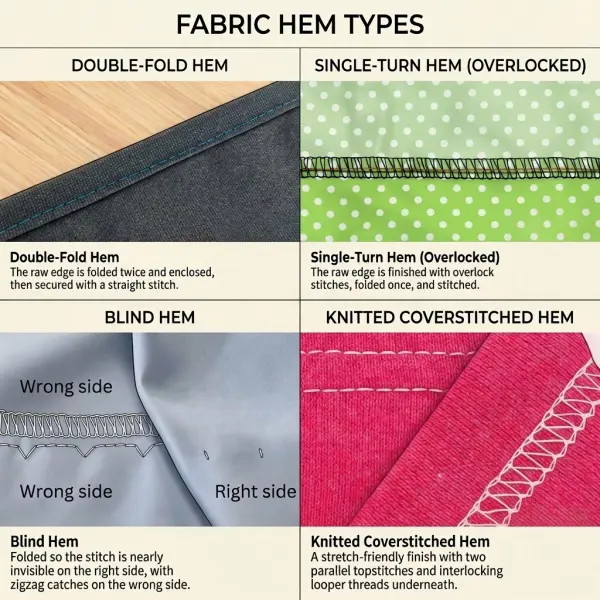
Common methods include double-fold hems, single-turn hems with finished raw edges, blind hems, narrow rolled hems, and coverstitched hems. Each creates a different combination of appearance, flexibility, thickness, and stitch visibility.
The most appropriate method depends on the garment design and fabric properties. Lightweight materials often require narrow, carefully controlled finishes that preserve drape, while structured fabrics may accommodate wider hems that contribute weight and shape. Stretch garments typically need stitching that can extend with the material during wear.
Clean hemming also requires more than choosing the correct method. Accurate measuring, controlled fabric feeding, suitable needles and thread, consistent stitch formation, and appropriate pressing all influence the final result.
For apparel businesses, an effective hemming specification should balance three priorities: visual quality, functional performance, and production practicality. A beautiful sample finish is valuable only when it can be reproduced consistently at the required manufacturing scale.
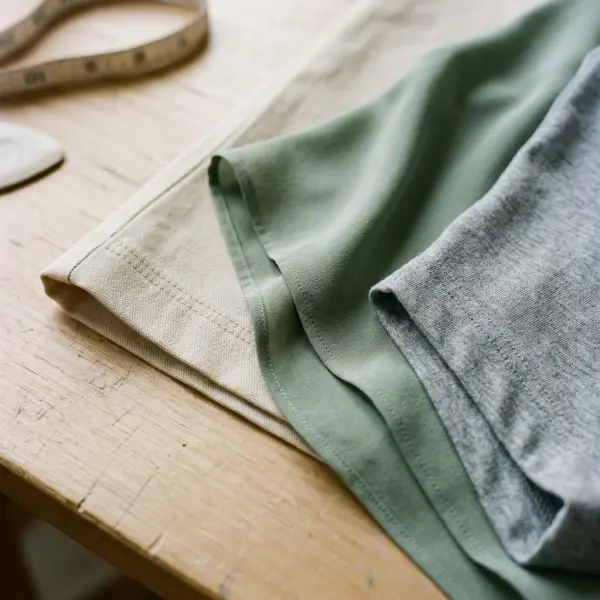
What Is a Hem in Garment Construction?
A hem is a finished edge of a garment, usually created by turning fabric toward the inside and securing it with stitches or another suitable construction method. Its primary function is to finish the raw edge while establishing the intended length and appearance of the garment. Depending on the technique, the edge may be fully enclosed, partially covered, or supported by another material.
In conventional garment construction, hems are most visible at the lower openings of clothing. A trouser hem establishes the finished leg length, a skirt hem defines the lower silhouette, and a sleeve hem completes the opening through which the arm passes. Although these areas share a similar purpose, their construction requirements can vary considerably.
Hemming also differs from general seam construction. A seam joins fabric components, whereas a hem primarily finishes an edge of a fabric component. An overlocked raw edge may form part of a hemming operation, but edge overlocking alone does not necessarily create the folded hem required by a particular design. The technical distinction matters when preparing sewing specifications or evaluating samples.
The industrial distinction between seam construction and edge finishing is reflected in the Coats technical guide to seam types, which includes hemming and blind-stitch hemming within edge-finishing applications.
Why Hem Allowance Matters
The hem allowance is the portion of fabric provided beyond the finished hemline to accommodate the selected construction. It determines how much material can be folded, enclosed, or otherwise manipulated during finishing.
A narrow hem allowance can reduce bulk and make certain curved edges easier to finish. A wider allowance may provide additional weight or structural support, particularly on some tailored and woven garments. Neither approach is universally preferable because the appropriate allowance depends on the desired finish, fabric characteristics, and pattern geometry.
In product development, the hem allowance should be established before finalizing the pattern and cutting specification. Changing the construction after fabric has been cut can create difficulties when insufficient material remains for the new fold arrangement.
This is particularly relevant when manufacturers produce several styles using similar materials. Standardizing hem allowances can simplify operations where designs genuinely share the same construction requirements, but imposing one allowance across unrelated silhouettes may compromise quality.
Why Hemming Quality Matters in Apparel Production
The quality of a hem contributes to both garment appearance and functional performance. A clean, stable edge can reinforce the impression of careful construction, while visible finishing defects may undermine the value customers associate with the product.
Unlike some internal seams, hems are frequently positioned along visible boundaries of a garment. They become especially noticeable when a person moves, sits, raises their arms, or when the garment hangs on a retail display. Small irregularities can disrupt an otherwise balanced silhouette.
Creating a Clean and Consistent Appearance
A well-executed hem follows the intended garment line without unnecessary twisting, rippling, or uneven folding. Stitching should be appropriate to the design, with consistent placement and a finish that complements the fabric surface.
For example, a minimalist blouse made from smooth poplin may benefit from a precisely aligned narrow stitched hem, while a tailored skirt might require a less visible finish. The objective is not to make all stitches invisible but to ensure that the selected construction looks intentional.
Clean finishing also involves the relationship between the hem and other garment components. Side seams, pleats, linings, decorative panels, and curved openings must meet the hem without creating distracting bulk or distorted transitions.
Supporting Garment Shape and Drape
Hemming can influence how fabric hangs because folding and stitching change the weight and stiffness along a garment edge. A wide hem may stabilize the lower portion of certain garments, but it can also make lightweight fabric appear less fluid.
A narrow finish generally introduces less folded material, which may help preserve the movement of soft or delicate textiles. This becomes important for flowing dresses, bias-cut garments, and curved hemlines where excessive width can create tension or visible distortion.
The interaction is not always straightforward. A heavier hem can improve the way some skirts hang, while the same construction might make another design appear rigid. Sampling the garment in its intended fabric remains essential.

Protecting Fabric Edges During Wear
Many woven fabrics can fray when exposed cut edges experience friction or repeated handling. A suitable hem helps contain or protect those edges, reducing the likelihood of visible unraveling during normal use.
However, a secure-looking hem is not automatically durable. Its performance also depends on the sewing thread, stitch formation, seam allowance, fabric characteristics, and stresses encountered during wearing and laundering.
Knitted garments introduce different considerations. Some knit fabrics do not fray like ordinary woven materials, but their edges may curl or require elastic stitching to prevent thread breakage when stretched.
Making Garment Quality Easier to Reproduce
Consistent hemming methods support production repeatability. When workers follow clear instructions for hem width, stitch type, machine configuration, and pressing, manufacturers have a stronger basis for maintaining uniform results across production batches.
For businesses outsourcing apparel production, these details should not be left entirely to supplier interpretation. Two factories may produce garments with the same overall measurements but use different hem constructions, resulting in noticeable differences in appearance and feel.
A documented hem specification helps maintain product consistency, particularly when manufacturing shifts between suppliers or production locations.
Common Hemming Techniques Used in Garment Manufacturing
There are several established ways to finish garment hems. They differ in how the fabric edge is prepared, whether stitching remains visible, how much bulk the construction introduces, and which equipment is required.
Understanding these general categories helps design and production teams communicate more effectively. The detailed selection criteria for three widely used methods are explored in Blind Hem, Rolled Hem, and Double Fold Hem: When to Use Each.
Double-Fold Hem
A double-fold hem is created by turning the raw edge inward and then folding the fabric again before securing it with stitching. This construction encloses the cut edge inside the fold, producing a tidy finish without requiring a separate overlocking operation.
It is commonly used on woven garments where the material can accommodate the additional layers. Depending on the hem width and stitching placement, it can create anything from a narrow casual finish to a more substantial edge.
The main consideration is bulk. Multiple folded layers can become difficult to manage around thick side seams, tightly curved edges, or heavyweight fabrics.
Single-Turn Hem With a Finished Raw Edge
This construction uses one main fabric turn-up, with the raw edge separately finished to control fraying. Overlocking is a common finishing method, although other suitable edge treatments may be used.
Because the fabric is not folded twice across the entire hem, the construction can be less bulky than a comparable double-fold hem. It may be useful for medium-weight and heavier woven garments where unnecessary thickness could affect appearance or sewing performance.
The quality of the raw-edge finish still matters. An exposed overlocked edge on the garment interior should remain neat, secure, and compatible with the required quality standard.
Blind Hem
A blind hem is designed to minimize visible stitching on the outside of a garment. The stitches secure the folded hem while catching only a small amount of the outer fabric at intervals.
This method is commonly associated with tailored garments, including dress trousers, skirts, and other clothing where a relatively uninterrupted outer surface is desirable. It can be sewn by hand or with specialized equipment.
The technique requires careful adjustment because excessive needle penetration can make stitches more visible, while insufficient catching can weaken the attachment.
Rolled Hem
A rolled hem creates a very narrow finished edge by turning or rolling the fabric into a compact fold and securing it with stitching. It is often considered for lightweight fabrics and garments where a wide conventional hem would introduce unnecessary weight.
The actual construction varies according to the fabric, equipment, and whether the work is performed manually or by machine. Rolled hemming can be particularly useful for delicate garment edges, although highly curved or slippery materials may require additional handling.
A rolled edge should be evaluated for consistency, not simply narrowness. Uneven rolling can become especially noticeable on lightweight fabrics.
Coverstitched Hem
Coverstitching is widely used in knitted apparel, especially T-shirts, activewear, and similar garments. Typical coverstitch formations create parallel rows of needle stitching on one side with looper threads forming the stitch structure underneath.
The construction is valued because it can provide greater seam extensibility than a conventional straight lockstitch, depending on the stitch configuration and thread settings. This helps the finished hem accommodate movement in stretch materials.
Industrial applications are documented in the JUKI MF-7900 coverstitch machine specifications, which identify sleeve and bottom hemming on T-shirts among the machine's intended operations.
How Fabric Properties Influence Hemming Decisions
Selecting a hem based only on garment category can lead to inconsistent results. Two dresses with identical silhouettes may need different finishing methods when one is made from structured cotton and the other from lightweight crepe.
The fabric's thickness, stability, stretch, surface texture, fraying tendency, and reaction to pressing influence both construction feasibility and the final appearance. These characteristics should be reviewed before approving a hemming method for production.
Lightweight and Delicate Fabrics
Lightweight fabrics such as chiffon, georgette, and certain fine crepes can be challenging because they may shift, stretch, or distort during sewing. A hem that introduces excessive layers can also interfere with the fabric's natural movement.
Narrow hems are frequently considered for these materials, particularly where a flowing edge is part of the design. However, the most suitable construction depends on the specific textile rather than the fabric's commercial name alone.
For delicate garments, the sewing team may need to adjust needle size, stitch density, presser-foot pressure, and fabric handling. Testing on a representative sample is preferable to assuming that settings used for another lightweight fabric will produce the same result.
Medium-Weight Woven Fabrics
Medium-weight cotton, poplin, twill, and many shirting fabrics generally provide a more stable foundation for folded hems than highly slippery or loosely constructed textiles. Their structure can make measuring, folding, and stitching relatively straightforward.
Nevertheless, fabric density and finishing treatments can affect stitch appearance. Closely woven materials may show puckering when thread, needle, or stitch density is unsuitable.
A factory producing cotton shirts, for example, may be able to standardize a particular hem construction across several related styles. That standard should still be validated whenever fabric weight, weave structure, or garment shape changes substantially.
Heavyweight and Structured Fabrics
Denim, heavy twill, canvas, and similar fabrics present challenges associated with thickness and multiple overlapping layers. These become especially apparent where hems cross side seams or other assembled sections.
A finish that appears manageable along a single fabric layer may become difficult to sew through at a bulky intersection. Inconsistent feeding can affect stitch formation or create uneven stitching around these locations.
Production teams may need appropriate heavy-fabric machinery, needle and thread combinations, pressing equipment, and approved methods for reducing localized bulk. The goal is to achieve a secure hem without creating an unnecessarily rigid or uneven edge.
Stretch and Knitted Fabrics
Stretch fabrics require particular attention because their hems must often extend during dressing and movement. A rigid stitch construction may break when the fabric stretches beyond the thread arrangement's available extension.
Coverstitches and suitable zigzag formations are among the options used to accommodate fabric movement. A twin-needle appearance alone does not guarantee adequate stretch; the actual stitch formation, thread tension, and garment application determine performance.
Fabric recovery also matters. Excessive stretching during sewing can create a wavy hem that does not fully return to its intended shape, especially on lightweight jerseys. Correct feeding and handling are therefore as important as stitch selection.
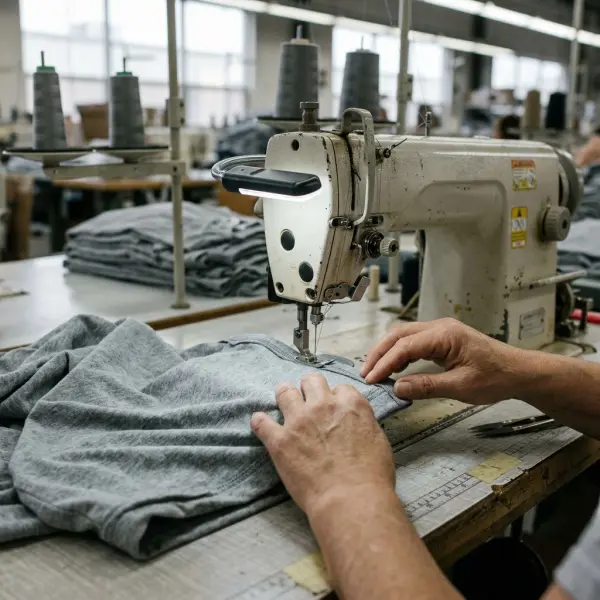
How Hemming Is Performed in Garment Production
Although individual methods vary, most hemming operations follow a sequence that begins with construction planning and ends with inspection. Treating hemming as a controlled process rather than an isolated sewing operation helps manufacturers identify problems before they spread across a production order.
A simplified process typically includes confirming the specified garment length, preparing the fabric edge, forming the required fold or finish, securing it with stitching, and evaluating the result. Pressing may take place before sewing, after sewing, or at multiple stages depending on the material and construction.
Establishing the Finished Hemline
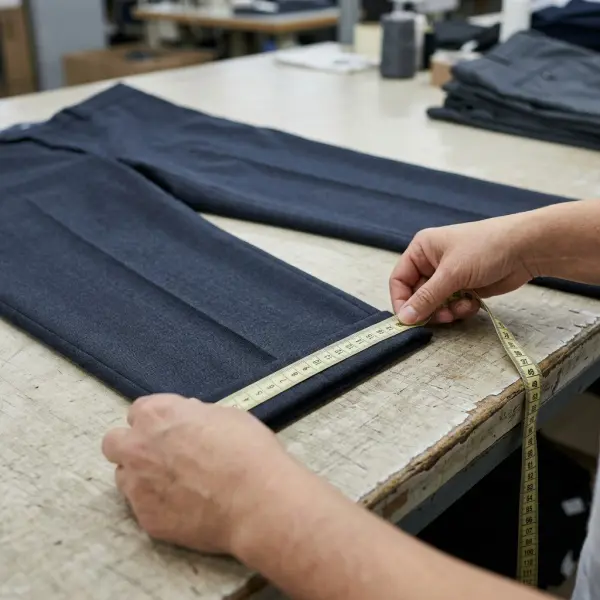
The first requirement is an accurate finished length. The design specification must identify where the hem should sit and how that measurement relates to the garment's other construction points.
In some products, the hemline can be established directly from pattern dimensions. Others may require adjustment after assembly or fitting, especially where drape and body shape influence the final hang.
For curved or bias-cut garments, allowing the fabric to settle before final leveling may help reveal changes in length caused by gravity and material behavior. This step should be based on the fabric and garment design rather than treated as a universal requirement.
Preparing and Folding the Edge
Once the hemline is established, the sewing team prepares the edge according to the approved construction. This may involve turning the fabric once or twice, overlocking, trimming excess allowance, or positioning binding or other finishing components.
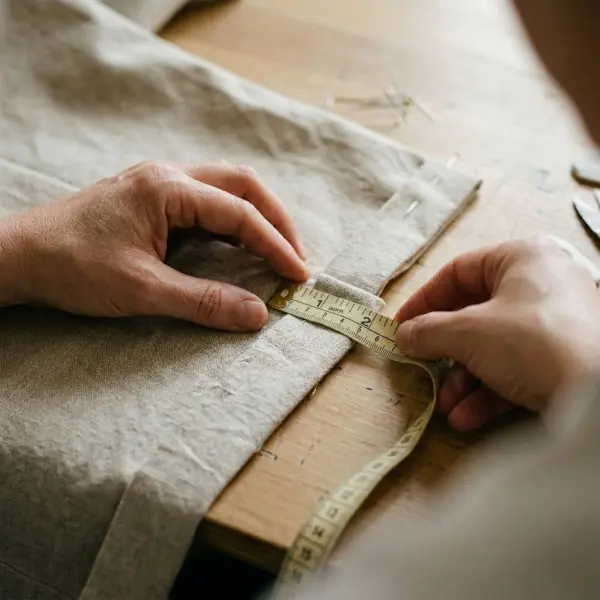
Consistent folding is essential because variations in width can change both appearance and garment length. Manual measurements, sewing guides, folders, or specialized attachments can help control the process.
At scale, a suitable guide or folder may improve repeatability, but equipment must match the material and desired construction. Poorly adjusted folding equipment can introduce distortion instead of preventing it.
Securing the Hem With Suitable Stitching
The stitching method must hold the fabric in position without creating unnecessary tension or damage. Depending on the product, manufacturers may use lockstitch, blind stitch, coverstitch, chainstitch, or another appropriate formation.
Stitch type is not interchangeable with appearance. Two seams may look similar from the outside but behave differently when stretched or laundered because of their underlying stitch formations.
The Coats guide to basic stitch types distinguishes conventional lockstitches from chainstitches, blindhemming, and coverseam formations, including their different applications and performance characteristics.
Pressing and Final Inspection
Pressing helps establish a neat fold and can improve the appearance of certain hems. However, excessive heat, pressure, or moisture can damage sensitive finishes, flatten fabric texture, or create visible impressions through the garment.
Operators should use pressing conditions appropriate to the textile, including protective cloths or other equipment where necessary. On some stretch or delicate fabrics, inappropriate pressing can introduce new distortion after an otherwise acceptable sewing operation.
The finished hem should then be inspected for measurement consistency, appearance, stitch security, and compatibility with the garment's intended movement.
Matching Hemming Methods to Garment Categories
Garment category offers a useful starting point for selecting a hem, but it should not replace material testing. The construction of a tailored trouser leg has different visual and functional priorities from a flowing dress or a knitted sportswear top.
The following table summarizes common considerations for apparel product development.
|
Garment category |
Typical hemming considerations |
Main quality priority |
|
Casual woven shirts |
Narrow or standard folded hems, fabric stability, consistent stitching |
Even edge and neat appearance |
|
Tailored trousers |
Controlled hem depth, reduced visible stitching where required, stable drape |
Clean silhouette and secure finish |
|
Dresses and skirts |
Fabric drape, curve shape, hem weight, stitch visibility |
Smooth movement and consistent hemline |
|
Denim trousers |
Fabric thickness, seam intersections, stitch strength, topstitch appearance |
Durable finish and uniform stitching |
|
Knitted T-shirts |
Fabric stretch, recovery, stitch extensibility, consistent feeding |
Flexible and flat hem |
|
Lightweight blouses |
Fine fabric handling, narrow finishing, minimal bulk |
Delicate, smooth edge |
|
Activewear |
High fabric extension, recovery, comfort, and stitch security |
Hem performance during movement |
These are general considerations rather than fixed construction standards. A fashion brand may intentionally select an unconventional hem for design reasons, provided the result meets its performance and quality requirements.
For example, a visible stitched hem can be a deliberate casual styling feature rather than a lower-quality alternative to blind hemming. Construction quality should be evaluated against the intended design, not against an assumption that invisible stitching is always preferable.
Hemming and Garment Production Efficiency
Hemming decisions affect production efficiency because finishing operations require labor, machine availability, handling, and quality control. Even when the sewing operation itself is relatively simple, small differences in process time can become operationally meaningful across repeated production orders.
Consider a manufacturer producing several thousand garments with a narrow folded hem. If the construction requires repeated manual measuring and adjustment, the operation may become slower or less consistent than an equivalent process using an appropriate folder. The actual improvement would depend on the fabric, machine setup, operator proficiency, and order quantity.
A construction that saves time at the sewing machine may also create costs elsewhere. Faster stitching is not beneficial if it increases defects, pressing requirements, or repair work.
Choosing Equipment for the Production Volume
Small workshops often rely on general-purpose sewing equipment and flexible operator skills. This arrangement can be effective for varied product lines, custom orders, or limited production runs where frequent style changes make dedicated setups less economical.
Larger manufacturers may use specialized hemming machines, folders, guides, or production arrangements to improve consistency and reduce manual handling. Such equipment can be particularly useful when a similar operation is repeated across high volumes.
The investment decision should consider production mix as well as speed. A dedicated setup that performs efficiently on one material may require significant adjustment or be unsuitable for another. Equipment flexibility therefore matters when factories handle many different fabric types.
Understanding the Cost of Hem Construction
The cost of hemming includes more than sewing thread and machine time. Manufacturers also account for handling, pressing, operator training, equipment requirements, inspection, and possible rework.
A commercially practical evaluation should consider:
- Labor and handling: How many operations are needed to complete the hem consistently?
- Machine requirements: Can existing equipment produce the required finish reliably?
- Material consumption: Does the construction require a wider allowance, binding, tape, or additional thread?
- Quality risks: Is the fabric likely to create puckering, distortion, skipped stitches, or other defects?
- Production repeatability: Can the process be maintained across operators, sizes, and batches?
A more complex finish may be justified for a premium garment where the construction contributes meaningfully to design and quality. For a basic apparel product, an efficient and reliable method may be preferable if it provides the appearance and performance customers expect.
The important distinction is between reducing unnecessary production cost and compromising an essential garment requirement. These are not the same objective.
Common Hemming Mistakes in Apparel Manufacturing
Many hemming problems begin before sewing, when a technique is selected without sufficient attention to fabric characteristics or production requirements. Others emerge during manufacturing because machine settings, measurements, or handling methods are inconsistent.
The following mistakes illustrate where product development and production teams should exercise particular care.
Choosing a Hem Based Only on Appearance
A finish that looks attractive in a design reference may behave differently on the actual production fabric. A wide folded hem, for instance, may create a desirable weight on one skirt but distort a lightweight curved dress. Approving the method without a material-specific sample increases the risk of later changes, rework, or inconsistent product appearance. A better approach is to assess both visual results and garment movement before confirming construction.
Using an Inappropriate Hem Allowance
Insufficient hem allowance can make folding difficult or leave too little material for secure attachment. Excessive allowance may create unnecessary bulk, particularly where the hem crosses multiple fabric layers. These errors often originate in pattern development rather than at the sewing machine. Reviewing hem allowance during sampling helps prevent problems after cutting begins.
Ignoring Fabric Stretch and Recovery
Applying rigid stitching to a stretch garment without verifying seam extensibility can produce broken stitches during wear. Conversely, allowing the fabric to stretch excessively during sewing can create unwanted waviness along the finished edge. Both problems can affect customer satisfaction and durability. Stitch selection, thread tension, and fabric feeding should therefore be tested together rather than adjusted independently.
Relying on Pressing to Conceal Sewing Defects
Pressing can improve the appearance of a properly constructed hem, but it cannot reliably correct poor stitch formation or unsuitable fabric handling. Temporary flattening may conceal distortion that reappears after laundering or wear. Depending on the fabric, excessive pressing can introduce glazing, impressions, or other surface damage. Manufacturers should address the sewing cause first and use pressing as a controlled finishing operation.
Failing to Standardize Quality Expectations
When production instructions describe a hem only as "neat" or "standard," operators and suppliers may interpret the requirement differently. One batch may have a slightly different hem width, stitch placement, or visible finishing method from another. These differences can become noticeable when products are displayed or compared together. A reference sample supported by measurable construction specifications provides a more reliable quality benchmark.
For a deeper examination of defects such as puckering, twisting, uneven hems, and visible stitching irregularities, see Common Hem Problems That Affect Garment Quality and Appearance.
How Fashion Businesses Can Improve Hemming Quality
Improving hemming quality starts with connecting the design, technical development, production, and inspection stages. Each team should understand not only what the finished hem should look like, but also why a particular construction has been selected.
For smaller apparel brands, this does not require an elaborate technical system. A clear sewing specification, representative sample, and consistent quality review can provide a useful foundation. Larger manufacturing operations may need more formal process controls, equipment settings, and documented inspection procedures.
Build Hem Specifications Into the Tech Pack
A garment tech pack should identify the intended hem construction rather than leaving it entirely to factory convention. The required detail depends on product complexity, but a useful specification can include the finished hem width, stitch formation, stitch position, seam allowance, and appearance on both sides of the garment.
When relevant, it should also define the required extensibility, acceptable visual variation, and pressing instructions. Reference photographs or construction diagrams can clarify requirements that are difficult to express through written descriptions alone.
A well-prepared specification reduces unnecessary questions during sampling and gives quality teams a consistent basis for inspection.
Test the Construction on the Actual Fabric
Fabric substitutions can affect hem appearance even when the original construction specification remains unchanged. Different weight, density, elasticity, or surface finishing may change the way material feeds through the machine and responds to stitching.
Manufacturers should therefore validate the hem using representative bulk fabric whenever possible. Sample approval should consider the garment after sewing and pressing, as well as after any relevant washing or finishing process.
Testing is especially useful when introducing new fabrics, changing suppliers, or adapting an existing pattern to a different product category.
Establish Practical Quality Control Criteria
Quality control becomes more useful when inspectors can evaluate specific characteristics rather than relying only on subjective impressions.
A practical hem inspection may cover:
- Consistency of finished hem width and garment length.
- Smoothness of the hemline without unintended puckering or twisting.
- Proper stitch formation, placement, and security.
- Absence of fabric damage, skipped stitches, or uncontrolled raw edges.
- Suitable flexibility and extension for the intended garment.
- Clean pressing without unwanted shine, impressions, or distortion.
Acceptance tolerances should be determined by the product specification, construction, and buyer requirements. There is no single universal hem-width tolerance or stitch-density setting appropriate for all apparel.
Important Technical Considerations Before Approving a Hem
Some hemming decisions appear straightforward in a sample but become problematic during bulk production. Before approving a method, product development teams should verify how it behaves under realistic manufacturing conditions.
Fabric Behavior Can Change After Washing
A hem that looks smooth immediately after sewing may develop puckering or distortion after washing or garment finishing. This can occur when the fabric and sewing thread respond differently to moisture, heat, or mechanical treatment.
The Coats technical bulletin on eliminating seam puckering identifies thread tension, fabric structure, feeding, and dimensional instability among the causes of puckering. The implications extend to hemming because folded fabric layers and stitched edges can be affected by these same mechanisms.
For washable garments, testing should reflect the care conditions reasonably expected during use.
Stitch Density Is Not a Universal Quality Indicator
A high number of stitches per unit length does not automatically produce a stronger or better-looking hem. Dense stitching may increase thread consumption, create structural distortion in sensitive fabrics, or interfere with the intended stretch.
Conversely, an unsuitable low stitch density can reduce attachment security or compromise the appearance of certain finishes. The appropriate setting depends on the stitch type, fabric structure, thread, garment application, and quality requirements.
This is why stitch density should be approved through material-specific testing rather than copied mechanically from an unrelated style.
The Best-Looking Hem Is Not Always the Best-Performing Hem
A nearly invisible hem may suit a tailored garment, while visible stitching can be desirable on casualwear. A narrow finish can preserve drape but may not provide the weight required for another silhouette.
Similarly, a highly extensible stitch may be valuable for stretch garments but unnecessary for stable woven fabrics. Performance should be considered in relation to how the clothing will be worn and maintained.
The objective is not to select the most elaborate or least visible construction. It is to choose a method that achieves the intended design without introducing avoidable production or durability problems.
Hemming as Part of Product Quality and Brand Positioning
Finishing quality contributes to how customers evaluate apparel, although the relationship between a particular hem construction and perceived value depends on the product category and customer expectations.
In tailored clothing, buyers may appreciate smooth surfaces and discreet finishing. In denim and casualwear, visible topstitching can reinforce a recognizable design language. Activewear customers may prioritize flexible seams that remain comfortable during movement.
These differences explain why premium quality does not correspond to one specific hemming technique. A technically appropriate finish can support a premium product, while an unnecessarily complex finish may add cost without improving the result.
For fashion brands building a consistent product identity, hem construction should be part of a broader quality approach. Decisions about fabric, silhouette, stitching, fit, and finishing need to work together rather than being evaluated separately.
This becomes especially relevant when expanding a collection or working with multiple manufacturers. Consistent construction details can help preserve the intended appearance across product variations, provided they remain appropriate for each fabric and design.
Frequently Asked Questions About Hemming Techniques
What is the main purpose of hemming in clothing?
The main purpose of hemming is to create a finished garment edge that supports the intended length, appearance, and functionality of the clothing. Many hemming methods also protect raw fabric edges from fraying or uncontrolled distortion during use.
However, hemming has an aesthetic role as well as a practical one. The construction can influence the weight and drape of a skirt, the flexibility of a sleeve opening, or the appearance of trouser legs. For garment manufacturers, selecting a hem should therefore involve both fabric performance and design requirements rather than treating edge finishing as a purely decorative operation.
What is the difference between hemming and overlocking?
Hemming generally establishes and secures a finished garment edge, while overlocking uses an overedge stitch formation to wrap or secure fabric edges. The two operations can be combined, but they are not technically identical.
For example, a manufacturer may overlock the raw edge of a woven trouser leg before turning it upward and securing the hem. In this case, overlocking prepares the edge, while the subsequent operation establishes the finished hem. Overlocking can also be used as an exposed edge finish where the design requires it. The correct construction depends on the fabric, garment category, and intended appearance.
Can the same hemming technique be used on woven and knitted fabrics?
Some hemming constructions can be adapted for both woven and knitted fabrics, but the stitching and handling requirements may differ significantly. Woven fabrics are often relatively stable, while knitted fabrics can stretch during sewing and wear.
A folded hem secured with conventional straight lockstitch may work on certain stable wovens but may not provide enough extension for a fitted jersey garment. Knitted apparel often benefits from stitch formations designed to accommodate stretch. Before standardizing one method across fabric categories, manufacturers should test seam extensibility, fabric recovery, stitch security, and appearance under realistic wearing conditions.
Why do some garments have visible hem stitching while others do not?
The visibility of hem stitching depends on the selected construction method and the garment's design requirements. Some hems use topstitching as a visible functional or decorative feature, while others use blind stitching to reduce the appearance of stitches on the garment exterior.
Neither approach is inherently superior. Visible stitching can complement casual garments, denim, and knitwear, while less visible finishes may be suitable for tailored clothing or minimalist designs. Thread color, fabric texture, stitch formation, and construction accuracy also influence visibility. Fashion brands should decide whether stitching is intended to be seen before communicating the requirements to manufacturers.
How wide should a garment hem be?
There is no universal hem width that works for every garment. The appropriate width depends on fabric weight, hem curvature, silhouette, garment function, and the selected construction method.
A narrow hem may be suitable for lightweight flowing fabric, while a wider hem can provide weight or stability in some structured garments. Curved hems also need careful planning because folding a wide allowance along a pronounced curve can create excess material or tension. Rather than relying on a single measurement for every style, pattern makers should determine hem width during product development and confirm it through sewing samples.
How can manufacturers prevent hems from becoming wavy or puckered?
Preventing unwanted waviness or puckering requires control over fabric feeding, stitch formation, thread tension, needle selection, and handling. The correct adjustment depends on the cause of the defect.
On stretch fabrics, excessive pulling or unsuitable differential feeding may distort the material during sewing. On tightly woven fabrics, dense stitching or inappropriate needle and thread combinations can contribute to puckering. A manufacturer should diagnose the problem before changing settings because reducing thread tension alone may not address the underlying cause. Sample testing, consistent machine setup, and inspection after pressing or washing can help identify whether the construction remains stable.
Should apparel brands specify hemming details in their tech packs?
Yes. Apparel brands should include sufficient hemming instructions in their tech packs to communicate the intended construction clearly, particularly when production is outsourced or repeated across suppliers.
The specification may identify hem width, allowance, stitch type, stitch placement, and any special finishing requirements. Photographs, diagrams, or approved physical samples can provide additional guidance. Not every garment requires an elaborate technical drawing, but vague instructions can lead to inconsistent results or unnecessary sampling revisions. Clear specifications are particularly valuable when a brand uses similar silhouettes across different fabric groups or needs reliable consistency between production batches.
Conclusion: Clean Hemming Begins With the Right Construction Decision
Hemming may appear to be a minor finishing operation, but it brings together several important aspects of apparel quality. Fabric characteristics, garment silhouette, stitch formation, equipment, handling, and pressing all influence whether the finished edge performs as intended.
A successful hem is not necessarily the narrowest, strongest-looking, or least visible option. It is the construction that provides the right balance of appearance, movement, security, and manufacturing practicality for a specific garment.
For apparel businesses, the greatest improvement often comes from making hemming decisions earlier in product development. When design teams specify appropriate constructions, sample makers validate them on the actual material, and manufacturers follow consistent quality standards, finishing becomes easier to control.
As product collections expand and manufacturing arrangements become more complex, these small technical decisions contribute to broader operational consistency. A clean garment edge may occupy only a small part of the finished product, but the discipline behind it reflects the quality of the entire production process.





Comments 0
Leave a CommentSend Comment
Anda harus Login terlebih dahulu untuk dapat memberikan komentar.