

How Strong Brand Stories Build Emotional Connection With Customers
A customer may appreciate the appearance of a garment without feeling connected to the label that produced it. The item may fit well, photograph beautifully, and meet an immediate need, yet remain interchangeable with dozens of similar products.
Emotional connection develops when the customer attaches personal meaning to the brand. The label may reflect how they see themselves, represent the person they are becoming, remind them of a significant experience, introduce them to a community, or repeatedly demonstrate that it understands a part of their life.
A strong brand story can help create that connection because it gives customers a structure for interpreting the product. Fabric, silhouette, color, craftsmanship, styling, and service stop functioning as isolated features. They become evidence of a recognizable point of view.
This does not mean emotional storytelling automatically produces loyalty or higher sales. Product quality, fit, price, availability, service, cultural relevance, and previous experience still matter. A moving campaign cannot compensate indefinitely for uncomfortable garments, inconsistent sizing, exaggerated claims, or poor customer support.
The commercial opportunity is more grounded: when a credible story aligns with a relevant customer experience, it can make a fashion brand easier to understand, remember, identify with, and recommend.

Quick Answer
Strong fashion brand stories build emotional connection by helping customers relate the brand to their identity, aspirations, memories, values, social groups, or everyday experiences. The story gives meaning to products by explaining what the label believes, which customer tension it understands, and how its design and business decisions support that point of view.
Emotional connection is deeper than simply liking a campaign. Consumer research distinguishes emotional attachment from satisfaction, involvement, and a favorable brand attitude. Attachment involves a stronger sense of affection, connection, or personal relevance, although the intensity and consequences differ between customers and product categories. research measuring emotional attachment to brands
For fashion labels, connection usually becomes credible through repeated alignment between narrative and experience. A story about inclusive fit must be supported by thoughtful grading and representation. A story about longevity needs durable products, care guidance, and appropriate service. A story about creative individuality should give customers room to interpret products rather than prescribing one correct identity.
The story opens the relationship. The product and experience determine whether that relationship can continue.
What Is Emotional Connection in Fashion Branding?
Emotional connection in fashion branding is the personal bond that forms when a customer experiences a label as relevant to their sense of self, relationships, memories, aspirations, or social belonging.
The connection may be positive and intense, but it does not need to resemble devotion or fandom. It can appear quietly through familiarity, confidence, trust, comfort, or a sense that the brand consistently “gets” a particular need.
A customer might feel connected because:
- the brand helped them dress confidently after a career transition;
- a particular silhouette reflects their personal style better than mainstream alternatives;
- the label represents a creative scene or community they value;
- its fit system reduces a frustration they have experienced for years;
- a garment became associated with an important life event;
- the company communicates with a degree of honesty they rarely encounter elsewhere;
- the products allow them to express cultural identity in a contemporary way.
These connections are not created by emotion alone. They emerge from the combination of meaning and experience.
A campaign may introduce the meaning, but the garment has to perform. The store environment has to feel consistent. The size information has to be useful. The customer-service response has to respect the promises made in the story.
Emotional Connection Is Not the Same as Brand Awareness or Satisfaction
A customer can recognize a brand without caring about it. They can also be satisfied with a product without integrating the label into their identity or feeling motivated to remain in the relationship.
Research on emotional brand attachment has treated attachment as distinct from satisfaction, involvement, and conventional brand attitudes. Later research has also differentiated attachment from simply holding a strong favorable opinion, finding that attachment can provide additional insight into demanding behaviors such as spending resources, defending a brand, or maintaining a larger share of purchases. research distinguishing brand attachment from brand attitude strength
For fashion businesses, the distinctions are operationally useful:
|
Customer response |
What it means |
Fashion example |
|
Awareness |
The customer recognizes the label |
They recall the logo after seeing an advertisement |
|
Interest |
The brand attracts attention |
They follow the account or visit the website |
|
Satisfaction |
A product meets expectations |
The trousers fit and arrive on time |
|
Preference |
The brand is favored over alternatives |
They check the label before considering competitors |
|
Identification |
The brand relates to the customer’s self-concept |
They feel the label reflects their personal style or values |
|
Attachment |
The relationship carries meaningful emotional weight |
They actively maintain the relationship despite some switching costs |
|
Loyalty behavior |
The customer repeatedly chooses the label |
They repurchase core styles or recommend the brand |
These outcomes can overlap, but they should not be treated as a guaranteed sequence. Someone may repeatedly purchase a basic garment because the fit is convenient, not because of emotional attachment. Another customer may admire a brand’s story yet never purchase because the price, sizing, location, or product category is unsuitable.
That is why fashion companies should evaluate both emotional indicators and concrete customer behavior.

Why Fashion Is Especially Connected to Identity and Meaning
Clothing is used in public, experienced on the body, and repeatedly interpreted by both the wearer and other people. This gives fashion products a distinctive role in self-presentation.
Customers may use garments to express profession, mood, gender presentation, cultural belonging, status, subculture, aesthetic preference, or resistance to an expected norm. The meaning is rarely controlled entirely by the brand. It is negotiated between the company, the wearer, observers, and the wider cultural environment.
Consumer research has long examined how people use brands in constructing or communicating aspects of their self-concept. Research on reference groups and brand meaning found that alignment with an in-group can strengthen self-brand connections, while associations with an unwanted out-group can have the opposite effect. research on reference groups and self-brand connections
This is highly relevant to fashion because customers do not evaluate only the garment. They also notice:
- who appears to wear the brand;
- where it is sold;
- which creators or celebrities represent it;
- how stores and campaigns frame the customer;
- which body types receive visibility;
- which communities engage with the label;
- whether the brand’s cultural references feel respectful;
- how wearing the product may be interpreted by others.
A fashion story therefore communicates two things at once: what the company says about itself and what choosing the brand may say about the customer.

How a Brand Story Creates Emotional Connection
A story does not inject emotion into a customer. It supplies meanings, characters, tensions, symbols, and experiences that customers may connect to their own lives.
Several mechanisms are particularly relevant to fashion.
Self-Recognition: “This Brand Understands People Like Me”
Connection often begins with recognition.
A customer sees a situation, body, styling challenge, ambition, or frustration represented accurately and feels that the brand has noticed something other companies overlook.
Consider a label designing formalwear for people who travel frequently. A generic campaign might show elegant suits in an architectural setting. A more relevant story could focus on the actual transition between airports, meetings, dinners, and hotel rooms. Product details such as wrinkle recovery, internal pockets, adaptable layers, and comfortable waist construction then become part of the narrative.
The customer is not being told simply that the clothing is stylish. They are being shown that the company understands the conditions under which the clothing will be worn.
Self-recognition becomes stronger when the details are specific. “Clothing for busy women” is broad. “Tailoring designed for consultants, founders, and creative professionals who move between formal meetings and less structured work environments” gives the intended customer a more precise point of entry.
However, precise positioning also creates exclusion. That is not always a failure. A brand trying to represent everyone often produces a story that feels relevant to no one.
Identity Projection: “This Helps Me Become Who I Want to Be”
Fashion stories can also connect to an aspirational self.
A customer may choose a label because it represents composure, creativity, independence, technical competence, cultural confidence, sensuality, rebellion, or understated status. The product functions as one tool through which the customer moves toward that desired identity.
The strongest aspiration is usually achievable enough to feel believable. A small label does not need to promise a complete transformation. It may help customers feel more prepared for work, more expressive at social events, or more comfortable experimenting with color.
Aspirational storytelling becomes less credible when it implies that purchasing the product will automatically produce confidence, success, social acceptance, or personal worth. Clothing can support self-expression and influence how someone feels in a situation, but it cannot guarantee a broader life outcome.
The practical task is to connect aspiration to a realistic use case.
Personal Memory: “This Brand Has Become Part of My Life”
Garments frequently accumulate meaning after purchase.
A coat may become associated with moving to a new city. A dress may be remembered because it was worn to an important celebration. A bag may become part of someone’s daily professional routine. These meanings are not created entirely by the company, but a thoughtful story can leave room for them.
Brands can support personal memory through:
- durable products that remain in use;
- repair and alteration services;
- care guidance;
- packaging customers choose to retain;
- product documentation;
- anniversary or archive programs;
- opportunities to share the history of a garment;
- designs that can be restyled across different life stages.
This approach is fundamentally different from forcing sentimentality into advertising. The brand provides a durable object and a respectful context. The customer supplies the personal meaning.
Social Belonging: “These Are My People”
Fashion has long helped people recognize affinity and group membership. The signals may be subtle—an unusual silhouette, a specific sneaker, a restrained logo—or highly visible.
A brand story can define the values, visual codes, behaviors, and rituals that make a community recognizable. Customers may connect not only to the company but also to other people associated with it.
Consumer–company identification research proposes that strong relationships can emerge when a company helps customers satisfy self-definitional needs. These needs may concern similarity, distinctiveness, prestige, or continuity of identity, depending on the customer and context. consumer–company identification framework
A community-centered story can be commercially valuable, but it also requires care. The brand should avoid turning belonging into hostility toward outsiders or encouraging customers to treat competing preferences as moral failures.
Healthy belonging gives customers a place to participate. It does not require an enemy.
Trust Through Repeated Consistency
Trust is not produced by one moving film. It develops when the brand repeatedly behaves in ways that match its story.
A label positioned around dependable wardrobe essentials should maintain reasonable fit continuity and communicate product changes clearly. A company celebrating craft should avoid reducing makers to anonymous decorative imagery. A brand centered on accessibility should examine whether its website, stores, pricing communication, and customer service create unnecessary barriers.
Consistency does not require perfection. Customers may accept delays, production changes, and mistakes when the company communicates transparently and responds appropriately.
The emotional connection can even become stronger when a brand handles a failure in a way that confirms its stated principles. Conversely, a small contradiction may feel more serious when the brand has built its identity around trust, ethics, or exceptional care.
Participation: “I Have a Role in This Story”
Customers connect more deeply when they can contribute rather than merely observe.
Participation may involve:
- styling products in their own way;
- providing fit feedback;
- voting on returning colors;
- attending workshops or community events;
- repairing or customizing garments;
- contributing stories about product use;
- joining resale or take-back programs;
- collaborating through customer advisory groups.
Participation should influence something meaningful. Asking customers to vote between two preselected campaign images may generate engagement, but it does not create the same sense of involvement as incorporating documented fit feedback into a revised pattern.
Brands should also maintain strategic control. Customer participation is an input, not an obligation to follow every request.

The Emotional Role of the Customer Matters More Than the Founder’s Drama
Many brand stories are structured around the founder:
- the problem they experienced;
- the journey they undertook;
- the obstacles they faced;
- the company they created.
This can be a compelling origin, but it does not automatically create customer connection. The customer still needs to understand how the founder’s experience relates to their own life.
A founder who struggled to find suitable maternity workwear may have a credible reason for starting the label. The emotionally relevant customer story, however, might concern maintaining professional identity during rapid physical and personal change.
The founder introduces the tension. The customer experiences its ongoing meaning.
A useful way to evaluate a narrative is to ask:
- Who experiences the central tension?
- Who makes the meaningful choices?
- Who changes or gains something?
- Whose perspective receives the most attention?
- Can customers locate themselves inside the story?
If every answer is “the founder,” the narrative may build admiration but not identification.
Product Evidence Converts Emotion Into Credibility
Emotional storytelling works best when customers can point to physical or operational evidence.
Suppose a brand’s story concerns freedom of movement. The narrative should appear in pattern construction, ease allowances, fabric selection, seam placement, fastening, fit demonstrations, and photography that shows realistic movement.
A story about reducing wardrobe complexity might be supported by:
- coordinated products across categories;
- consistent color systems;
- stable sizing;
- styling guides;
- cross-season compatibility;
- sufficient stock of core items;
- clear replacement or restock information.
A story about preserving a craft tradition requires different evidence:
- accurate identification of the technique;
- transparent attribution;
- information about the makers’ role;
- appropriate compensation and commercial arrangements;
- realistic explanation of production capacity;
- respect for cultural meaning;
- quality standards that do not erase legitimate handmade variation.
The foundational relationship between narrative, identity, and product is explained more broadly in fashion brand storytelling for modern labels. Emotional connection is a result of that alignment, not a substitute for it.
Customers Need Space to Interpret the Story
Fashion brands often weaken emotional connection by explaining too much.
When every image, product, and customer is given one approved meaning, the audience has little room to make the brand personally relevant. The label may say exactly how the garment should make someone feel, who should wear it, and what choosing it supposedly proves.
A stronger narrative establishes a recognizable world while allowing customers to participate in interpretation.
For example, a brand can consistently explore functional elegance without insisting that every customer shares the founder’s lifestyle. It can show multiple ways to style the same garment. It can feature people with different professions and routines. It can invite customers to connect the product to their own definition of elegance.
This flexibility does not dilute the story. It increases the number of personally meaningful ways the story can be lived.
Emotional Connection Should Develop Across the Customer Journey
A customer relationship rarely begins with deep attachment. It is more likely to develop through accumulated experiences.
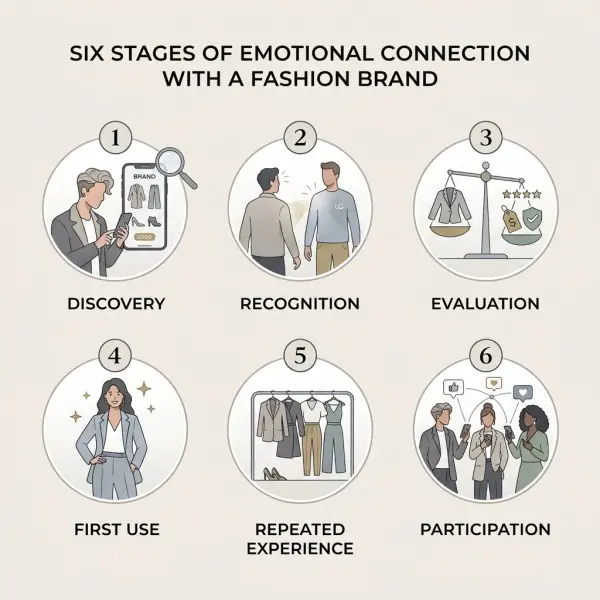
Discovery: Create Recognition, Not Immediate Devotion
At the discovery stage, the story should help the right customer recognize relevance quickly.
The useful question is not “How do we make people emotional?” It is “Which real experience will make the intended customer stop and think that this brand may understand them?”
This may be communicated through a specific problem, setting, visual code, person, garment detail, or point of view.
Evaluation: Connect Meaning to Evidence
When customers investigate, emotional language should be supported by practical information.
They need to understand:
- what the product is made from;
- how it fits;
- what it is designed to do;
- how it was produced;
- how the price relates to the offer;
- which claims are verified;
- whether returns, repairs, or alterations are available.
A story that becomes vague at the point of evaluation may attract attention without producing confidence.
First Use: Deliver the Promised Experience
The first wear is a decisive narrative moment.
Does the garment move as advertised? Is the fabric suitable for the stated use? Does the packaging match the brand’s values? Is care information clear? Does the product create the expected impression in the customer’s actual environment?
At this stage, sensory and functional experience often matters more than additional content.
Repeated Use: Build Familiarity and Reliability
Repeated successful use can turn a promising story into a trusted relationship.
The customer learns how the garment performs, whether the fit remains dependable, how the material ages, and whether the product integrates into their wardrobe.
For many brands, this quiet reliability is more commercially useful than highly intense but temporary campaign emotion.
Participation: Allow the Customer to Add Meaning
After customers gain experience with the product, the brand can invite deeper participation.
This might include reviews, styling contributions, events, repairs, product-development feedback, or access to an archive or resale program.
The invitation should arrive after the brand has provided value. Asking for constant participation before building trust can feel extractive.
The Most Useful Emotional Territories for Fashion Brands
Not every label should aim for the same emotional response. “Inspiration” and “empowerment” are so broadly used that they often fail to guide strategy.
A more useful approach is to identify the emotional function the brand can credibly deliver.
|
Emotional territory |
Customer need |
Possible fashion expression |
|
Confidence |
Feeling prepared and appropriately dressed |
Reliable fit, styling support, clear occasion guidance |
|
Belonging |
Feeling connected to people with shared interests |
Community events, recognizable codes, customer participation |
|
Distinctiveness |
Expressing an identity that feels personal |
Signature details, limited design language, customization |
|
Comfort |
Reducing physical or social friction |
Material choice, adaptive features, predictable fit |
|
Continuity |
Maintaining identity across life changes |
Flexible sizing, modular wardrobes, alterations |
|
Discovery |
Exploring new aesthetics or cultural ideas |
Editorial education, collaborations, thoughtful curation |
|
Care |
Feeling respected before and after purchase |
Responsive service, repair, honest communication |
|
Pride |
Valuing skill, origin, or considered design |
Maker attribution, product details, credible provenance |
|
Nostalgia |
Reconnecting with personal or shared memory |
Archive references, familiar forms, heritage materials |
|
Optimism |
Imagining a desirable but plausible future |
Forward-looking design, constructive cultural narratives |
The label should choose an emotional territory that its products and operations can repeatedly support.
A brand may work with more than one emotion, but one or two should usually dominate. Trying to communicate confidence, rebellion, intimacy, heritage, joy, activism, exclusivity, and universal belonging simultaneously creates a confused emotional proposition.
How Fashion Brands Can Build Emotional Connection Strategically
Step 1: Identify the Customer’s Emotional Job
An emotional job describes what the customer wants to feel, preserve, express, or avoid in a specific context.
For example:
- feel credible without dressing conventionally;
- remain connected to cultural identity in a modern workplace;
- feel physically comfortable without appearing underdressed;
- express creativity without buying an entirely new wardrobe;
- reduce anxiety about fit when shopping online;
- mark an important transition with a meaningful object.
The emotional job must be connected to a practical situation. “Customers want confidence” is too broad to guide design or communication.
Step 2: Find the Tension Behind That Job
Emotion usually appears because something is unresolved.
A customer may want professional recognition but dislike rigid tailoring. They may value individuality but feel overwhelmed by trend cycles. They may want to support craft but remain uncertain about authenticity and pricing.
A good story names the tension without exaggerating it. It helps the customer feel understood while leaving room for complexity.
Step 3: Define the Brand’s Role
The brand should decide whether it functions as:
- a guide offering expertise;
- a tool enabling self-expression;
- a curator reducing complexity;
- a specialist solving a neglected problem;
- a connector introducing customers to a community;
- a custodian supporting a craft or archive;
- a challenger questioning a category convention.
The brand should rarely cast itself as the hero that transforms the customer’s entire life. A more credible role is usually to provide useful products, knowledge, access, or confidence at a relevant moment.
Step 4: Design Emotional Proof Into the Product
Translate the emotional job into development requirements.
If the desired outcome is confidence in online fit, the proof may include:
- consistent blocks;
- detailed garment measurements;
- multiple fit references;
- photographs on different bodies;
- transparent notes about ease;
- responsive size support;
- straightforward exchanges.
If the desired outcome is creative freedom, proof may include reversible garments, modular components, generous styling content, or pieces designed to work beyond a single prescribed look.
Step 5: Build Repetition Without Copying
The same emotional meaning should appear across touchpoints, but each channel should contribute something new.
A campaign may introduce the customer tension. The product page explains the design response. Social content shows different interpretations. Packaging supports care. Customer service confirms the brand’s behavior when expectations are not met.
This repetition builds recognition without forcing the audience to read the same manifesto repeatedly.
Step 6: Let Customers Validate the Story
Customer evidence is powerful when it is voluntary, representative, and accurately presented.
A label can observe which parts of the story customers repeat naturally. Do they talk about fit, versatility, cultural representation, service, or community? Their language may reveal where the brand is genuinely creating meaning and where the official narrative is not being experienced.
Testimonials should not be edited to imply outcomes the customer did not report. The goal is evidence, not emotional amplification.
Operational Implications Across a Fashion Business
Emotional connection is often assigned to marketing, but the promise has consequences across the company.
Product Development
Design teams must understand which emotional outcome the brand wants to support.
A label built around reassurance may prioritize fit consistency, stable core products, and low-friction care. A label built around discovery may accept greater assortment change but needs stronger curation and education.
The emotional strategy can therefore affect:
- silhouette continuity;
- color planning;
- fabric handfeel;
- garment adjustability;
- sensory details;
- packaging;
- product naming;
- the balance between core and seasonal products.
Merchandising
Merchandising determines whether the emotional promise is commercially accessible.
A story about wardrobe building becomes weak if most products cannot be coordinated. A story about inclusion becomes questionable when the extended size range is permanently out of stock. A story about accessible design may conflict with unpredictable pricing and constant limited drops.
The assortment is part of the narrative architecture.
Retail Experience
Store layout, fitting-room design, music, staff behavior, signage, and after-sales service influence how the customer experiences the story.
A brand centered on experimentation might provide generous fitting space and styling assistance. A label emphasizing calm simplicity might reduce visual clutter and sales pressure. A craft-focused company may let customers handle materials and see construction details closely.
Retail should make the emotional proposition tangible, not simply display campaign images.
Customer Service
Emotional promises are tested most clearly when something goes wrong.
A delayed order, fit problem, damaged product, or confusing return can either weaken the relationship or confirm that the brand acts according to its values.
A company cannot promise care while making customers struggle for basic information. Nor can it claim transparency while giving scripted, evasive answers about production or delivery problems.
Community Management
A customer community requires moderation and boundaries.
The brand should decide:
- what participation it encourages;
- how feedback will be handled;
- which behavior is unacceptable;
- how customer content may be reused;
- how privacy and consent will be protected;
- whether criticism can remain visible;
- how conflicts between members are managed.
A community is not merely a free content channel. It creates an ongoing responsibility.
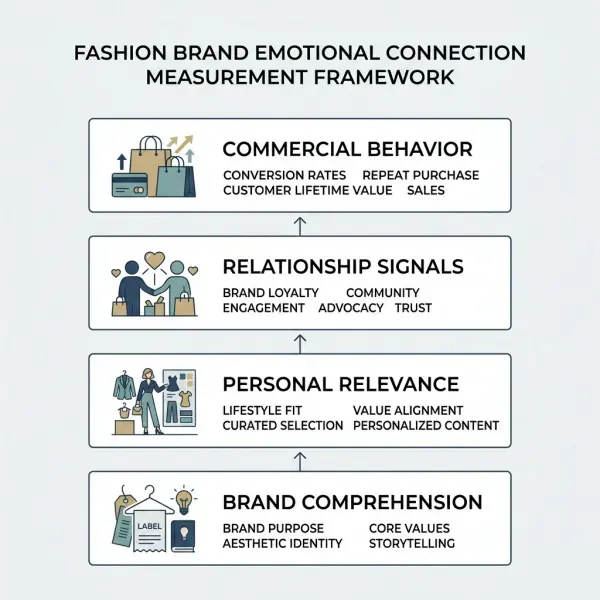
How to Measure Emotional Connection Without Overclaiming
Emotional connection cannot be inferred reliably from one metric.
High engagement may reflect controversy, novelty, incentives, celebrity attention, or platform distribution. Repeat purchases may reflect fit convenience or limited alternatives. Positive comments may come from followers who have never bought the product.
A balanced measurement approach combines several types of evidence.
Meaning and Comprehension
Ask whether customers understand the story the company intends to communicate.
Useful questions include:
- What does this brand stand for?
- Who do you think it is designed for?
- Which product detail best represents the brand?
- How would you describe the label to another person?
- What makes it different from similar companies?
Open-ended answers are often more revealing than agreement scores because they show which meanings customers retrieve without prompting.
Personal Relevance
Explore whether the story relates to the customer’s life or identity.
This can include:
- perceived similarity;
- aspirational relevance;
- sense of recognition;
- connection to personal values;
- relevance to specific situations;
- perceived fit with a social group.
Not every customer needs strong personal identification. Some businesses succeed because they solve a practical problem consistently.
Relationship Indicators
Brands can examine whether customers:
- voluntarily follow developments;
- save or share meaningful content;
- participate in events;
- provide detailed feedback;
- recommend the label;
- return for core products;
- use repair or resale services;
- defend the brand fairly when misinformation appears.
These behaviors should be interpreted cautiously. No single action proves attachment.
Commercial Outcomes
Track repeat purchase, customer retention, full-price purchasing, cross-category adoption, branded search, direct traffic, referral, and customer lifetime value where appropriate.
The company should not assume storytelling caused every movement. Product changes, promotional activity, distribution, inventory, economic conditions, seasonality, and competitor behavior may all contribute.
Important Caveats: What Emotional Storytelling Cannot Guarantee
Emotional Connection Is Not Universal
Different customers may interpret the same story differently because of age, culture, identity, language, income, previous experience, and social context.
A narrative that feels aspirational in one market may appear distant or artificial in another. A reference understood by an established community may be invisible—or inappropriate—to a wider audience.
Brands entering new regions should validate meaning rather than merely translate copy.
Intensity Is Not Always Desirable
A highly emotional audience can produce advocacy, but it may also create unrealistic expectations, hostility toward change, or conflict when the company makes decisions customers dislike.
Not every fashion label needs superfans. Many businesses benefit more from sustained trust, fit confidence, and habitual preference.
Connection Does Not Excuse Product Failure
Customers may forgive an occasional mistake, especially when the brand responds honestly. Repeated quality problems, unreliable sizing, misleading claims, or poor service eventually contradict the relationship.
Emotional goodwill is not an unlimited asset.
Belonging Can Become Exclusion
Strong community codes may make existing customers feel understood while discouraging people who do not match a narrow visual stereotype.
Brands should distinguish between clear positioning and unnecessary exclusion. This is especially important when using language related to bodies, age, gender, class, culture, or lifestyle.
Customer Emotion Must Not Be Manipulated Carelessly
Fashion marketing should avoid exploiting insecurity, grief, identity conflict, body dissatisfaction, or social fear simply to create urgency.
A story can acknowledge a real tension without implying that customers are inadequate until they purchase the product.
Common Mistakes That Weaken Emotional Connection
The most damaging storytelling errors are examined further in storytelling mistakes that make fashion brands feel generic. Several mistakes directly affect customer relationships.
Leading with abstract emotion
Telling customers to feel empowered, inspired, fearless, or authentic does not create those outcomes. The brand needs to show the situation, product decision, and customer role that make the emotion plausible.
Copying another brand’s community language
Terms such as family, tribe, movement, and collective imply a relationship that may not yet exist. Using them prematurely can make a young label appear self-important.
Confusing visibility with connection
A viral campaign may increase awareness without strengthening trust or relevance. Brands should examine what customers remember after attention declines.
Performing vulnerability
Founder vulnerability can create closeness, but repeated disclosure designed mainly to generate engagement may feel calculated. Personal stories should have a clear relationship to the brand and respect the privacy of everyone involved.
Ignoring operational contradictions
Nothing weakens an emotional promise faster than evidence that the company behaves differently. Storytelling teams need access to product, sourcing, retail, and service realities before making claims.




Comments 0
Leave a CommentSend Comment
Anda harus Login terlebih dahulu untuk dapat memberikan komentar.