

Common Grainline Mistakes That Cause Twisting and Uneven Garment Drape
A garment may look perfectly balanced on the cutting table but behave differently once it is sewn, worn, or washed. Side seams begin shifting toward the front, hems hang unevenly, and fabric panels seem to pull in directions that the original pattern never intended. These problems can be frustrating because the garment's measurements may still appear correct.
One possible cause is incorrect grainline alignment. When pattern pieces are cut against their intended fabric direction, the material may stretch, distort, or drape differently from the approved design. Yet not every twisted seam or uneven hem is caused by cutting. Fabric skew, knitted fabric spirality, sewing tension, and dimensional changes during laundering can produce similar symptoms.
For fashion designers, pattern makers, garment manufacturers, and quality control teams, the challenge is identifying where the distortion originates. Understanding common grainline mistakes can help prevent unnecessary pattern alterations, reduce rework, and improve consistency between approved samples and bulk production.
Quick Answer: What Grainline Mistakes Cause Garments to Twist or Hang Unevenly?
Common grainline mistakes include cutting pattern pieces at unintended angles, using distorted fabric, aligning patterns with prints instead of yarn directions, stretching fabric during cutting, and rotating pieces without considering their structural orientation. These errors can contribute to twisting seams, uneven hemlines, asymmetric drape, and inconsistent garment fit.
In woven fabrics, grainline determines how pattern pieces are positioned relative to the warp and weft yarns. When a piece is unintentionally cut toward the bias, its flexibility and response to gravity may differ from those intended by the pattern maker.
Problems may become visible immediately after sewing or emerge later as the fabric relaxes during wear and laundering.
However, garment twisting does not automatically indicate an incorrect grainline. Fabric skew introduced during textile manufacturing, residual yarn torque in knitted fabrics, differential shrinkage, and sewing-related distortion can produce similar results.
The most effective solution is to inspect fabric structure, verify pattern alignment, assess cutting and sewing processes, and compare garment behavior before and after care testing.
For apparel businesses, preventing distortion begins with identifying the actual cause rather than correcting only the visible symptom.
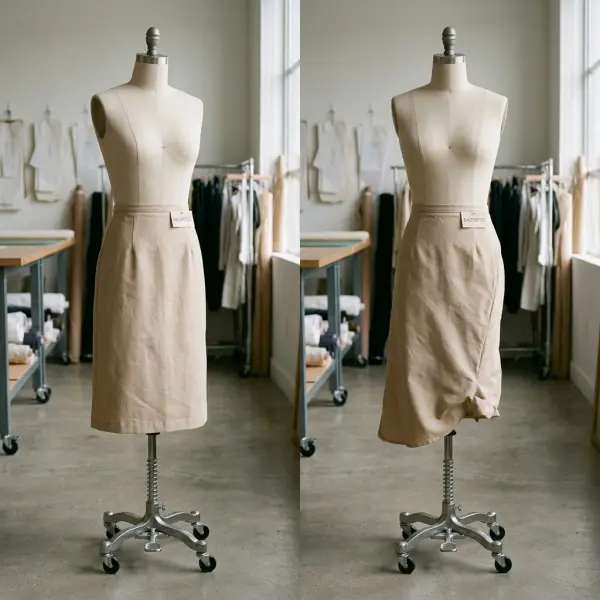
Why Grainline Errors Affect Garment Balance
Grainline alignment matters because a woven fabric does not necessarily respond to force in the same way along every direction. The relationship between warp yarns, weft yarns, and diagonal orientations influences mechanical flexibility, dimensional stability, and drape.
When a pattern is developed, its pieces are intended to work with particular fabric orientations. Changing those orientations without adjusting the design may alter how the garment responds to gravity and body movement.
The foundational relationship between pattern markings and fabric structure is explained in fabric grainline and accurate garment cutting. Here, the more important issue is what happens when that relationship is unintentionally changed.
How Off-Grain Cutting Changes Fabric Behavior
An off-grain cutting error occurs when a pattern piece is positioned at an unintended angle relative to the fabric direction specified in the pattern.
For example, a skirt panel intended to follow the lengthwise grain may be rotated slightly toward the bias. Depending on the material, this can introduce additional diagonal flexibility and change how the panel hangs.
The difference may be subtle when the fabric is lying flat. Once suspended from the waist or joined to neighboring panels, however, the changed directional behavior can become more noticeable.
Seamwork's explanation of off-grain cutting demonstrates how incorrect orientation can affect garment appearance and contribute to twisting.
The degree of distortion depends on the fabric and design. A slightly rotated panel in a relatively stable textile may behave differently from a similar error in lightweight, loosely constructed fabric.
Why Grainline Errors Do Not Always Appear Immediately
Fabric distortion can develop gradually because different stages of garment production introduce different forces.
During cutting, a panel may appear dimensionally accurate while lying flat. Sewing introduces handling tension, pressing affects the fabric structure, and wearing subjects the garment to repeated movement.
Laundering may also release stresses retained during textile manufacturing, finishing, spreading, or sewing.
Consequently, a garment can pass an initial visual inspection and still develop twisting after washing. This makes it necessary to distinguish cutting accuracy from fabric stability and post-care performance.
Mistake 1: Positioning Pattern Pieces Without Measuring Grainline Alignment
One of the simplest grainline mistakes is aligning a sewing pattern by visual judgment alone. The piece may appear parallel to the selvage, but a slight rotation can remain unnoticed.
This is particularly relevant for long pattern pieces such as trouser legs, dress panels, and skirt sections, where the effect of angular misalignment can extend over a substantial garment length.
Why Visual Alignment Can Be Misleading
A pattern piece may look straight because its outer edges follow a visually regular fabric feature. However, the pattern outline does not necessarily correspond to its designated grainline.
For example, a trouser pattern may have shaped side seams and an angled inseam. Neither edge is automatically a reliable reference for the intended lengthwise grain.
If a cutter aligns the piece using the outer pattern shape rather than its grainline marking, the orientation may differ from the approved design.
The same issue can occur when long printed stripes create the appearance of parallel alignment even though the underlying yarn direction is different.
How to Prevent the Error
For a standard straight-grain pattern piece, the grainline marking should be checked against the actual lengthwise grain. On ordinary woven fabric, the selvage provides a practical reference when it is properly aligned.
The distance from each end of the pattern's grainline arrow to the same selvage should be equal. This confirms parallel placement, provided the reference edge is reliable.
Cutters should secure the pattern only after completing the alignment check. Moving fabric or repositioning weights afterward can disturb the arrangement.
Mistake 2: Assuming the Fabric Selvage Guarantees a Correct Grain
The selvage is commonly used as a reference for identifying lengthwise grain in woven textiles. Although this is a useful starting point, it does not guarantee that the entire fabric is free from distortion.
A fabric may have apparently straight edges while its internal yarn directions have shifted during processing.
This distinction becomes important when working with textiles that have undergone uneven tension during weaving, dyeing, finishing, or handling.
Fabric Skew and Bowing Are Different Problems
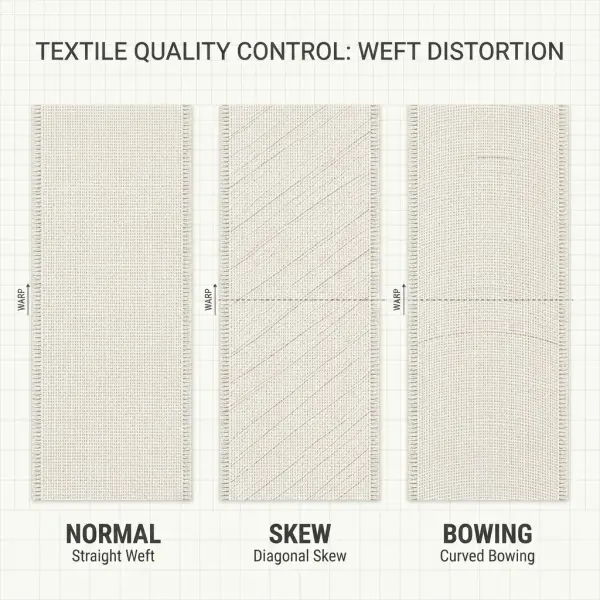
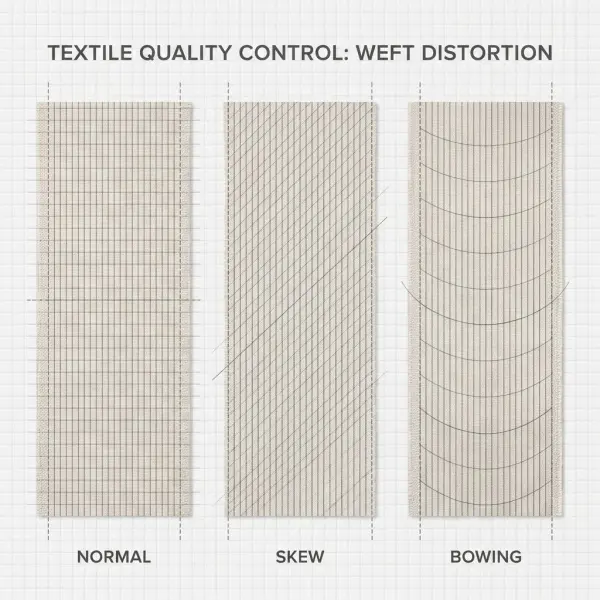
Fabric skew describes an angular displacement of yarn or course lines from their expected orientation across the fabric width. Bowing describes a curved displacement of those lines.
Both can affect the appearance of stripes, checks, and garment components, but they are not identical defects.
A skewed fabric may cause crosswise design elements to appear diagonal, while bowing may create a curved appearance across the textile width.
The recognized ASTM D3882-08(2025) test method for bow and skew addresses measurement of these distortions in woven and knitted fabrics.
The important manufacturing lesson is that grainline accuracy begins with textile inspection. A pattern cutter cannot necessarily eliminate a structural fabric defect through careful positioning alone.

Why Forced Straightening Can Make Matters Worse
When a fabric appears distorted, a cutter may attempt to pull it into a rectangular shape before cutting.
Gentle realignment can be appropriate for certain woven fabrics, but forcing the material into position may introduce tension that is released later. A fabric temporarily held square may return toward its previous geometry after cutting or laundering.
Some skew also forms part of an intentional textile-engineering process. Certain twill fabrics, including selected denim constructions, may undergo controlled skewing to reduce garment leg twisting.
Consequently, not every visible deviation from a perfect right angle should be corrected without understanding the material specification.
For production work, persistent or unexplained skew should be evaluated with the fabric supplier rather than concealed during cutting.
Mistake 3: Cutting Fabric While It Is Stretched, Twisted, or Poorly Relaxed
Even when a pattern is positioned accurately, the fabric beneath it may not be in a stable condition.
Cloth can be stretched during spreading, pulled over the edge of a cutting table, or distorted when several layers are handled together. These conditions can affect the accuracy of the pieces being cut.
If a panel changes shape after being released from tension, it may no longer correspond precisely to the approved pattern.
Excessive Tension During Fabric Spreading
In apparel manufacturing, fabric spreading prepares one or more layers for cutting. The spreading process should preserve the material's intended orientation and avoid introducing unnecessary tension.
If a fabric is pulled taut during spreading, its apparent length or width may differ from its relaxed dimensions.
After cutting, the panels may contract or distort as the tension is released. This can complicate sewing because the fabric pieces no longer match as expected.
The risk depends on the textile. Stretch fabrics and unstable constructions are particularly sensitive to handling, but woven materials can also be affected.
Incorrect Fabric Folding
Folding fabric for cutting can introduce another source of distortion.
If the two layers are not properly aligned, a pattern piece may be positioned correctly on the upper layer while the lower layer is twisted or stretched.
This problem can be overlooked when the fabric is folded neatly at the edges but not lying naturally throughout its width.
For delicate, slippery, or strongly directional textiles, single-layer cutting may provide better control than folded cutting.
The Threads guide to fabric preparation discusses the importance of preparing woven material and checking grain before cutting.
Insufficient Relaxation Before Production
Some textiles change dimensions after being removed from rolls or packages. The amount and timing of relaxation depend on fiber composition, construction, finishing, and storage conditions.
A manufacturer should follow the material supplier's recommendations and validate the required preparation process through sampling.
There is no universal relaxation period suitable for every fabric. A prescribed waiting time that works for one knit fabric may be inappropriate for a woven material or another knit construction.
The practical objective is to cut fabric in a condition that remains reasonably stable throughout subsequent operations.
Mistake 4: Rotating Pattern Pieces to Improve Fabric Utilization
Fabric consumption directly influences garment cost, so cutting teams often seek efficient ways to arrange pattern pieces.
However, rotating a pattern piece solely to reduce unused fabric can unintentionally change its grain orientation.
This is especially relevant when marker planning is treated as a geometric exercise without preserving the garment's construction requirements.
Why Better Marker Efficiency Can Create Quality Problems
Consider a manufacturer producing woven trousers. A cutting marker may leave spaces that appear large enough for smaller garment components.
Rotating a pocket, waistband component, or other piece may improve fabric utilization, but it can also change the way that component responds to tension or affects surface appearance.
For some pieces, alternative orientations may be acceptable. For others, grainline placement is necessary to maintain fit, appearance, or construction behavior.
The correct decision depends on the approved pattern, material specifications, and garment performance requirements.
Unapproved Rotation During Bulk Cutting
A change that appears insignificant in a single garment may become more consequential when repeated across a production order.
If the approved sample used one grain direction and bulk cutting uses another, the resulting garments may not behave consistently with the original reference.
When investigating the discrepancy, a brand should compare the approved sample's cutting layout with the actual production marker.
The cost of material saved through unapproved rotation must be considered against potential rework, inspection failures, and customer returns.
Mistake 5: Following Printed Stripes Instead of the Fabric Structure
Striped and checked materials are often easier to inspect visually because their surface patterns reveal apparent directional changes.
However, a printed pattern does not necessarily follow the actual yarn grain. A fabric may have a straight underlying structure but an incorrectly aligned print.
This creates a practical conflict between structural orientation and visual appearance.
When the Print and Grain Do Not Match
Suppose a manufacturer is producing a striped woven shirt. The fabric's warp yarns run vertically, but the printed stripes are applied at a slight angle.
If the shirt panels are cut on the structural grain, the stripes may appear crooked. If the panels are rotated to make the stripes look vertical, their fabric orientation may deviate from the intended grainline.
Neither outcome is necessarily acceptable.
The correct response is to assess the discrepancy before production rather than expect sewing operators to conceal it during assembly.
How to Handle Directional Print Problems
For commercially important stripes and checks, the design and sourcing teams should establish expectations for alignment before bulk fabric approval.
If the print is inconsistent with the underlying fabric structure, the material may need to be rejected, replaced, or approved for a different use.
In some designs, a limited orientation adjustment may be acceptable after sampling. That decision should be documented because it can affect drape and other directional characteristics.
A garment should not be described as correctly cut merely because the visible stripes appear straight.
Mistake 6: Treating Knit Fabric Spirality as an Ordinary Cutting Error
Knit garments are particularly vulnerable to misdiagnosis because twisting may develop after laundering even when cutting alignment appears correct.
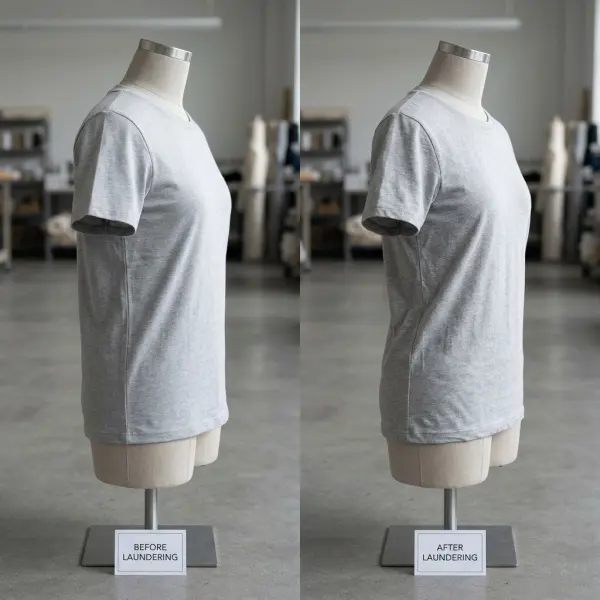
A common example is a single-jersey T-shirt whose side seams gradually rotate toward the front or back of the garment.
Although an incorrect cutting orientation may contribute, the underlying problem can originate in the knitted fabric itself.
What Causes Spirality in Knitted Fabric?
Spirality is a distortion associated with the inclination of knitted wales relative to the fabric's intended orientation. In weft-knitted constructions, it is often associated with residual yarn torque, loop geometry, knitting conditions, and relaxation.
When the material is washed, previously restrained stresses may be released, allowing the fabric structure to change orientation.
The result may appear as twisted side seams, uneven panel alignment, or garment rotation.
The academic textile resource Knitted Fabric Defects in Textile Manufacturing and Testing identifies yarn twist liveliness and knitting parameters as contributors to spirality in single-jersey fabrics.
This is a different mechanism from accidentally positioning a woven pattern piece at an incorrect angle.
How to Recognize Knit Spirality
A garment that looks balanced before washing but develops systematic twisting afterward should be investigated for fabric relaxation and spirality.
The inspection should compare the garment's seam position and knitted structure before and after the specified care process.
If multiple garments made from the same fabric lot develop a similar directional twist, this pattern may indicate a common material-related cause.
However, the final diagnosis should still consider cutting, construction, and laundering conditions. A repeated symptom is evidence worth investigating, not proof of a single mechanism.
Why Changing the Pattern May Not Solve the Problem
A manufacturer facing twisted T-shirts may try to rotate pattern pieces in the opposite direction or alter side seams to compensate.
Such adjustments can sometimes form part of an engineered solution, but they should not be made without evaluating the fabric's actual behavior.
If the textile continues changing after washing, a compensation designed around one sample may be unreliable across fabric lots, sizes, or care cycles.
The more appropriate approach is to investigate yarn, knitting, finishing, and dimensional stability alongside garment construction.
Mistake 7: Blaming Grainline When Sewing or Pattern Construction Is Responsible
Not every garment imbalance originates from fabric orientation.
Pattern geometry, cutting accuracy, sewing tension, differential feeding, and pressing can also affect how garment panels align.
A useful diagnostic process must separate these factors to avoid applying the wrong corrective action.
Unequal Pattern Panels
A garment may hang asymmetrically because its pattern pieces are not properly balanced.
For example, a skirt with inconsistent front and back panel shaping may pull toward one side even when both pieces are cut on the intended grain.
Similarly, trousers can develop fit-related twisting when their pattern balance does not suit the intended silhouette or body geometry.
Before blaming fabric, pattern makers should compare the approved dimensions, balance marks, notches, and seam relationships.
Uneven Sewing Tension
A sewing machine may feed two fabric layers differently, especially when one layer is more flexible or difficult to control.
The resulting seam can stretch, pucker, or create a local imbalance between joined panels.
This can alter garment appearance without changing the fabric's original grainline.
Checking stitch formation, machine settings, operator handling, and seam construction is therefore an essential part of troubleshooting.
Distortion During Pressing
Pressing can reshape certain fabrics, which is useful in tailoring but potentially harmful when applied unintentionally.
Excessive pulling, stretching, or unsuitable heat and moisture may distort sensitive panels.
Bias-cut and loosely constructed fabrics can be especially vulnerable, although the risk varies by material and finish.
Pressing should follow the approved construction procedure rather than being used indiscriminately to force distorted components into shape.
How to Diagnose Twisting and Uneven Garment Drape
The most effective troubleshooting process begins with observing the defect before assigning a cause.
A twisted side seam, uneven hem, or diagonal drag line is a visible symptom. Each can result from more than one technical mechanism.
The following diagnostic table provides a practical starting point for sample rooms and apparel quality teams.
|
Visible Symptom |
Possible Causes |
What to Check First |
|
Side seam twists immediately after sewing |
Off-grain cutting, pattern imbalance, sewing distortion |
Pattern alignment, panel geometry, seam construction |
|
Side seam twists after washing |
Fabric skew, knit spirality, shrinkage, latent stress release |
Pre- and post-wash measurements, fabric structure |
|
One side of a skirt hangs lower |
Uneven cutting, grain orientation, asymmetric pattern, bias relaxation |
Pattern dimensions, panel alignment, relaxed hang |
|
Trouser leg rotates around the body |
Pattern balance, fabric skew or torque, cutting orientation |
Pattern geometry, fabric specification, post-care behavior |
|
Stripes appear diagonal |
Printed pattern misalignment, yarn skew, cutting error |
Actual yarn direction versus surface design |
|
Garment panels differ in length after assembly |
Differential feeding, distortion during handling, cutting inaccuracies |
Cut-piece dimensions, sewing operation, fabric stability |
|
Hemline changes after hanging |
Bias extension, fabric relaxation, uneven construction |
Grain orientation, fabric weight, hanging conditions |
These symptoms are useful indicators, but they cannot establish a diagnosis on their own.
A factory should examine the problem at the earliest production stage where the deviation can be detected. If the cut panels were already distorted, correcting sewing-machine settings will not solve the underlying issue.
Step 1: Inspect the Fabric Before Reviewing the Garment
Start with an uncut or retained sample of the same fabric lot whenever possible.
Check its yarn or loop direction, visible skew, bowing, and ability to lie flat without forced tension.
If the fabric itself is distorted, the investigation should include supplier specifications, finishing history, and relevant material testing.
A garment cannot be expected to remain balanced simply because the cutting marker was positioned correctly on an unstable textile.
Step 2: Compare the Cut Panels with the Approved Pattern
If material inspection does not explain the problem, compare the garment panels with the original production pattern.
Confirm that their dimensions, grainline orientation, notches, and seam allowances match the approved version.
This is especially important when an error appears only in certain sizes or specific garment components.
A deviation limited to one pattern piece may indicate a cutting or marker issue rather than a problem affecting the entire fabric lot.
Step 3: Examine Sewing and Assembly
Where cut-piece accuracy is acceptable, inspect the relevant sewing operations.
Check whether fabric layers were stretched, whether the machine feeding was consistent, and whether seams were assembled according to the intended construction.
A twisted side seam can reflect more than one contributing factor. Fabric orientation and sewing distortion may occur together.
The inspection should therefore document findings rather than select a single cause prematurely.
Step 4: Evaluate the Garment After the Intended Care Process
Some defects appear only after washing or other care treatments.
A controlled before-and-after evaluation helps determine whether the garment changes during laundering rather than during initial construction.
Relevant test methods include AATCC TM207-2025 for seam twist in garments and ISO 16322-3:2021 for spirality after laundering.
These methods provide defined measurement procedures. The appropriate method, laundering conditions, and acceptance criteria must be selected according to the applicable product specification.
Passing an initial visual inspection does not replace post-care verification when the garment is intended to withstand repeated laundering.
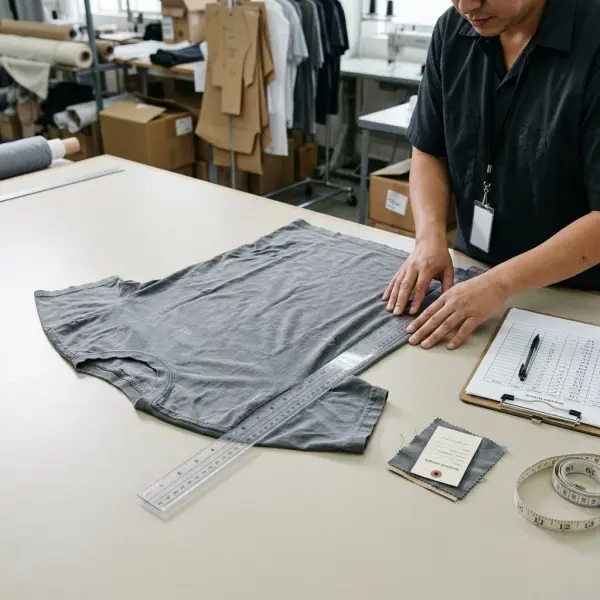
How to Prevent Grainline-Related Defects in Apparel Production
Preventing garment distortion requires coordination across fabric sourcing, pattern development, cutting, sewing, and quality assurance.
A cutting department cannot independently guarantee garment balance if the material arrives with unacceptable distortion or if the approved pattern does not reflect the intended fabric behavior.
The most reliable approach is to establish clear requirements before production and check them at the stages where corrections are still practical.
Fabric Sourcing and Incoming Inspection
Sourcing teams should confirm that fabric quality requirements include relevant dimensional and directional characteristics.
For woven fabrics, this may include assessing skew, bowing, and changes after appropriate relaxation or laundering.
For knit fabrics, spirality and dimensional stability may require particular attention.
The AATCC TM179-2025 method for fabric skew change after laundering provides a recognized testing reference where post-care skew is relevant.
Not every fabric needs every test. The correct testing program depends on garment type, material behavior, customer requirements, and the consequences of dimensional change.
Pattern Development and Sample Approval
Pattern makers should define grainline requirements for each relevant garment component and retain those instructions in the approved production pattern.
Unusual orientations should be intentional and validated through sampling.
For example, a dress may contain both straight-grain and bias-cut panels because the combination supports a specific silhouette. That is different from accidentally rotating pieces during marker preparation.
The structural differences between these directions are examined in straight grain, cross grain, and bias fabric behavior.
If a sample reveals unexpected distortion, the development team should investigate fabric condition and cutting accuracy before making major alterations to the pattern.
Cutting Room Controls
The cutting process should preserve both the approved pattern orientation and the fabric's stable condition.
Practical controls include verifying fabric relaxation, checking lay tension, confirming pattern or marker alignment, and identifying any directional restrictions.
For multi-ply cutting, the condition of layers throughout the lay matters. An accurate top-layer marker does not automatically confirm that every layer beneath it remains properly positioned.
When materials are highly unstable or slippery, the cutting method may need to be adapted to maintain accuracy.
Sewing and Pressing Controls
The sewing department should receive pieces that match the approved cutting specifications, but it must also avoid introducing new distortion.
Machine settings, differential feeding, seam construction, and operator handling should be appropriate for the material.
Pressing procedures should preserve the intended garment geometry unless deliberate shaping is required.
A correction that makes a garment appear balanced immediately after pressing may not remain effective if the underlying fabric or seam is unstable.
Finished-Garment Quality Assurance
Finished garments should be evaluated in a relaxed condition and, where relevant, after the specified care process.
The inspection should consider seam position, overall balance, hem alignment, and visible distortion.
When a problem is found, recording its location, direction, severity, fabric lot, and production batch makes it easier to identify recurring causes.
A consistent quality record is more useful than a general comment that a garment looks twisted.
What Fashion Brands Should Do When a Grainline Problem Is Found
Corrective action depends on when the defect is discovered and whether the cause lies in the fabric, pattern, cutting process, or assembly.
A problem found before cutting usually offers more options than one discovered after an order has been fully sewn.
When Fabric Has Not Been Cut
If an incoming fabric inspection identifies excessive or unexplained distortion, the material should be assessed against the approved specification.
Depending on the cause, the supplier may be able to recommend suitable conditioning, finishing correction, or replacement.
However, forcing distorted fabric into alignment without a validated procedure can create further problems.
For a commercial order, it is usually more effective to resolve material suitability before committing the fabric to cutting.
When Pattern Pieces Have Already Been Cut
If cut panels are confirmed to be off-grain, the most reliable correction may be recutting them from suitable material.
Minor deviations might be acceptable for particular components, but this requires technical evaluation against the garment design and quality requirements.
Pressing, stretching, or sewing adjustments cannot reliably reverse every structural orientation error.
A manufacturer should avoid approving a cosmetic correction without checking whether the garment remains stable after handling and care.
When Garments Have Already Been Assembled
Correcting an assembled garment is more complex because its components have already been constrained by seams and construction.
If twisting results from a local sewing defect, reworking the affected seam may solve the problem.
If the distortion originates in fabric skew, knitted spirality, or incorrectly oriented panels, sewing adjustments may provide only limited improvement.
For bulk orders, the manufacturer should isolate affected units, assess the severity and frequency of the defect, and agree on disposition with the relevant quality or buying team.
Commercial decisions should consider the approved specification rather than assuming every visible imperfection is automatically acceptable or unacceptable.
The Business Cost of Overlooking Grainline Problems
Grainline defects can affect more than garment appearance. They may contribute to sample rejection, additional cutting, sewing rework, inconsistent product quality, and customer complaints.
The financial effect depends on the defect's severity, the number of garments affected, and the stage at which it is discovered.
A misaligned sample panel may require only a small amount of replacement fabric and additional labor. The same error repeated across a production batch can require much more extensive corrective action.
Sample Development Delays
If a sample garment hangs incorrectly, the design team may initially assume the pattern requires modification.
Revising the pattern without checking the grainline or fabric condition can create unnecessary sample iterations.
This becomes especially costly when development involves several suppliers, multiple size ranges, or a fixed product launch schedule.
A structured troubleshooting sequence helps avoid changes that address symptoms instead of causes.
Production Rework and Material Loss
Incorrect grainline placement may require recutting garment components. When the original pieces cannot be reused, the factory incurs additional material consumption.
The impact becomes larger when the defect is identified after sewing because labor has already been invested in the affected garments.
Where the problem originates from defective fabric, responsibility for replacement or corrective action may also require discussion with the supplier.
Clear specifications and inspection records can help establish where the deviation occurred.
Customer Experience and Product Consistency
A shirt whose side seam twists after washing or a skirt that hangs unevenly may appear poorly constructed to the customer, regardless of the technical cause.
These issues can affect perceived quality and confidence in future purchases.
For brands that rely on consistent fit across repeated orders, fabric stability and grainline control are especially relevant.
However, customer complaints alone do not identify whether the issue came from fabric manufacturing, cutting, sewing, or care conditions. Technical investigation is still necessary before changing a supplier or production process.
Important Technical Caveats: Not Every Twisted Garment Is Off-Grain
Grainline mistakes are one possible cause of twisting and uneven drape, but they should not be treated as a universal explanation.
In woven fabrics, textile skew, asymmetric construction, seam tension, and differences in dimensional relaxation can contribute to distortion. In knitted fabrics, spirality may originate from yarn torque and loop structure even when cutting is carefully controlled.
Bias-cut garments introduce another consideration. Their greater diagonal flexibility can cause panels to lengthen under gravity, particularly when the material is lightweight and susceptible to shear deformation.
An uneven hem in this situation may reflect the expected behavior of the chosen construction and the need for appropriate garment settling rather than an accidental cutting error.
Twill fabrics also require careful interpretation because controlled skew may sometimes be deliberately introduced to reduce twisting during use or laundering.
Standards provide measurement methods, not a universal acceptance threshold for every garment. Brands and manufacturers must establish relevant tolerances according to their products, applicable specifications, and intended care conditions.
The technical objective is to identify the mechanism responsible for the deviation before selecting a corrective action.
Frequently Asked Questions About Grainline Mistakes and Garment Twisting
Why does my shirt twist around my body even when the seams were sewn straight?
A shirt can twist because the fabric panels behave differently from their intended orientation, even when the seams themselves were sewn accurately. Incorrect grainline placement is one possible cause, but fabric skew, knitted spirality, pattern imbalance, and dimensional changes can produce similar symptoms. The timing of the twisting provides useful information. A shirt that appears distorted immediately may require cutting and construction checks, while one that twists after washing should also be evaluated for fabric relaxation and structural torque. The most reliable diagnosis compares the original pattern, cut panels, fabric structure, and garment condition before and after the specified care process.
Can an off-grain garment be fixed after sewing?
Some minor problems can be improved through appropriate sewing or construction adjustments, but an incorrectly oriented fabric panel cannot always be restored to its intended behavior after assembly. If a garment has localized seam distortion, careful reworking may help. However, if the underlying panel was cut at an unintended angle, pressing or pulling it into shape may provide only temporary improvement. The feasibility of repair depends on the fabric, design, available seam allowances, and severity of the defect. For commercial production, recutting affected components may be more reliable than attempting an uncertain correction, particularly when garment stability is a quality requirement.
How much grainline deviation is acceptable in garment cutting?
There is no universal grainline deviation tolerance suitable for all garments and fabrics. Acceptability depends on the textile's directional behavior, pattern dimensions, garment design, and applicable production specification. A deviation that has little visible effect in a relatively stable material may cause noticeable distortion in a more flexible fabric. Manufacturers should establish tolerances based on sampling, technical evaluation, and customer requirements rather than apply an arbitrary angle to every product. Where fabric skew or garment twisting is a concern, suitable standardized testing can support more consistent measurement. Cutting tolerance and finished-garment performance should also be evaluated separately because one does not automatically guarantee the other.
Why do T-shirt side seams twist after washing?
T-shirt side seams may twist after washing because residual stresses in the knitted fabric are released during laundering. In single-jersey constructions, yarn twist liveliness, knitting geometry, and fabric finishing can contribute to spirality, causing the knitted structure to rotate or skew. Incorrect cutting orientation and sewing-related distortion may also influence the finished result. The manufacturer should compare the garment before and after laundering and examine whether the fabric's wale direction has changed. Testing multiple garments from the same fabric lot can help determine whether the problem is systematic. Simply moving or resewing the side seams may not address the underlying material instability.
Does an uneven skirt hem always mean the fabric was cut off-grain?
No. An uneven skirt hem can result from several factors, including pattern imbalance, cutting inaccuracies, fabric relaxation, bias extension, or garment fit on the body. The grainline should be checked, but it is only one part of the diagnosis. Bias-cut garments may require settling time because certain woven materials can lengthen unevenly under their own weight. A straight-grain skirt may also hang unevenly if its panels or waistline are incorrectly shaped. Before changing the cutting layout, the maker should inspect the garment on an appropriate form or wearer, verify the pattern dimensions, and consider the fabric's construction and handling history.
Can fabric skew be corrected before garment cutting?
Some forms of fabric distortion may be improved through suitable relaxation, finishing, or carefully controlled realignment, but correction is not always possible or appropriate. The result depends on the material's structure, finishing, and the cause of the skew. Pulling fabric into a square shape does not guarantee that it will remain stable after cutting or laundering. Certain textiles, including some twill constructions, may also have intentionally engineered skew. Manufacturers should identify the material's intended condition and consult the supplier when the deviation is significant. Fabric that cannot meet the approved quality requirements may need replacement or a different intended application.
How can a fashion brand prevent grainline problems when outsourcing manufacturing?
A fashion brand can reduce grainline-related problems by providing approved production patterns with clear orientation markings, agreeing on fabric-quality requirements, and reviewing cutting procedures during sample approval. The technical package should identify components that must maintain a particular direction and any permitted exceptions. Suppliers should verify material condition before cutting and use appropriate spreading and handling methods. For products vulnerable to post-wash distortion, the agreed quality-control program should include relevant care testing. Maintaining records of fabric lots, approved samples, cutting markers, and finished-garment inspections helps the brand investigate deviations more efficiently and distinguish supplier-material problems from cutting or assembly errors.





Comments 0
Leave a CommentSend Comment
Anda harus Login terlebih dahulu untuk dapat memberikan komentar.