
How Image-Based Search Helps Customers Find Similar Fashion Products
A shopper notices a chocolate-brown suede jacket in a photograph, but the brand is unknown and the original item may no longer be available. Searching for “brown suede jacket” produces plenty of results, yet most have different collars, proportions, pockets, and overall styling. The shopper is not necessarily looking for that exact jacket. They want something that captures the same appearance.
This is where image-based fashion search becomes useful. Instead of requiring customers to describe every garment detail, it allows them to use a visual reference to discover products with comparable characteristics.
The distinction matters because finding similar clothing is not simply a matter of recognizing what type of garment appears in a photograph. A useful matching system needs to distinguish between broad similarities, such as category and color, and the design details that make one product feel like an appropriate alternative to another.
For online fashion retailers, this creates a more nuanced form of product discovery. Customers can begin with an inspirational image, narrow their attention to a particular garment, and explore alternatives that reflect their preferences without necessarily knowing the correct fashion terminology.
Quick Answer: How Does Image-Based Search Find Similar Fashion Products?
Image-based fashion search helps customers find similar products by analyzing a reference photograph and comparing its visual characteristics with merchandise images in a searchable product catalog. Artificial intelligence and computer vision can identify relevant features such as garment category, silhouette, color, pattern, and visible design details, then retrieve products that appear visually or semantically related.
For example, a shopper can upload a photograph of a cream-colored cropped cardigan. The search system may identify similar knitwear with comparable lengths, necklines, button arrangements, and colors, depending on the capabilities of the model and the products available in its catalog.
The results do not have to be identical to the original garment. They may include closely matching items, stylistically related alternatives, or products that share only certain visual attributes.
Customers can then use filters, product descriptions, and other shopping information to determine which alternatives meet their requirements.
The practical value is straightforward: image-based search turns visual inspiration into a more focused product exploration process. However, accurate matching depends on image quality, garment recognition, catalog coverage, ranking logic, and the retailer's ability to present useful, purchasable alternatives.
Why Do Customers Search for Similar Fashion Products?
Fashion shoppers often recognize the look they want before they know the correct words to describe it. A particular jacket, dress, handbag, or pair of shoes may attract attention because of its proportions, color combination, texture, or distinctive styling.
Conventional search requires these impressions to be converted into text. That is not always easy.
A shopper may describe a garment as an “oversized jacket,” while a retailer categorizes it as a boxy cropped blazer. Both descriptions may refer to similar appearances, but differences in terminology can make relevant products harder to locate.
Image-based search addresses this problem by allowing the photograph itself to become the starting point for retrieval.
Finding Alternatives to Unavailable Products
Sometimes a customer discovers a garment that is discontinued, out of stock, vintage, or unavailable in their region. The original product may be recognizable, yet purchasing it directly is not possible.
A similar-product search can help identify alternatives with comparable silhouettes, colors, or design details.
For instance, someone searching for a sold-out burgundy shoulder bag may be interested in another structured bag with a curved body, short strap, and minimal hardware. The substitute does not need to be produced by the same manufacturer to satisfy the customer's visual preference.
The quality of the alternative still needs to be evaluated separately. Similar appearance does not establish equivalent materials, craftsmanship, durability, or fit.
Translating Outfit Inspiration Into Product Options
Fashion inspiration frequently comes from images that contain several garments rather than a single product photograph.
A customer might save a photograph of an outfit featuring a long wool-look coat, wide-leg trousers, and pointed ankle boots. Their actual interest may be limited to the coat.
An effective visual search experience helps isolate that garment and retrieve related outerwear rather than treating the entire outfit as a single product query.
This approach is sometimes described as street-to-shop search, where real-world fashion imagery is matched with products in an online catalog. A 2019 Amazon Science study on searching for fashion products from images in the wild describes an approach that localizes garments in photographs, categorizes them, and compares learned visual representations with catalog products.
The research illustrates both the usefulness and the difficulty of matching everyday fashion photographs with controlled ecommerce imagery.
Exploring Similar Styles Without Knowing Brand Names
Not every customer begins with a brand preference. Some are interested in a particular design language, such as minimalist tailoring, relaxed knitwear, vintage-inspired denim, or structured accessories.
A reference image can communicate these preferences more directly than a broad collection of descriptive keywords.
Visual search may therefore support style-led exploration, although the retailer still needs a relevant assortment. If the catalog contains few products with the desired appearance, even a technically capable matching system may have limited alternatives to offer.

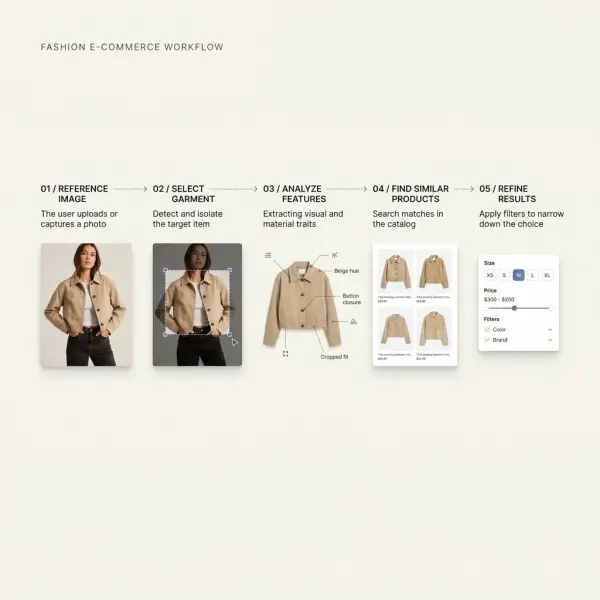
How Does an Image Become a Set of Similar Fashion Products?
The matching process involves more than looking for identical colors or repeating the same garment category. The system must interpret an image, determine which product is relevant, represent its appearance computationally, and retrieve suitable candidates from a catalog.
The exact method varies between platforms. Some systems use specialized fashion-recognition models, while others combine general-purpose visual models, product attributes, and additional ranking rules.
Step 1: The Customer Provides a Reference Image
The process begins with a photograph, screenshot, saved product image, or another supported visual input.
The quality of this image affects the information available for matching. A well-lit photograph showing the garment clearly may provide useful information about shape, color, texture, and details. A heavily filtered or partially obscured photograph may provide less reliable evidence.
Consider two images of the same pleated skirt. In one photograph, the skirt is shown against a plain background with its full silhouette visible. In the other, the skirt is partly hidden by a handbag, photographed in shadow, and distorted by the model's movement.
Both images may be usable, but the second creates more uncertainty about the details the matching system should prioritize.

Step 2: The System Identifies the Relevant Garment
A fashion photograph can contain several competing visual subjects. Before searching for alternatives, the system may need to identify the garment that the customer actually wants.
This can involve object detection, image segmentation, region selection, or simpler cropping methods.
For example, a full-body photograph may contain a blouse, trousers, belt, handbag, and shoes. A system that recognizes the blouse as the intended search target can focus retrieval on comparable tops.
Some implementations allow customers to select the desired object manually. Others automatically identify multiple products and present selectable regions.
Google Cloud's documentation on multi-product detection in visual product search illustrates how product-search responses can identify and return matches for more than one product appearing in an image.
For retailers, this means that garment selection is not merely a cosmetic interface detail. It can materially influence the relevance of the results.
Step 3: The Image Is Converted Into Searchable Visual Features
Once the relevant product has been identified, a visual model can generate a numerical representation of the image.
These representations, commonly called image embeddings, encode learned patterns that help systems compare different photographs. Products that are considered similar by the model may be positioned close together in the representation space.
This does not mean the system measures similarity exactly as a human stylist would. The representation depends on the model's training objectives, available data, and the characteristics it has learned to emphasize.
Etsy's engineering discussion of visual representation learning and evaluation describes how image-vector representations support visual search and visually similar product recommendations, while emphasizing the practical challenges of model efficiency and evaluation.
For fashion matching, these representations may capture relationships involving garment shapes, surface patterns, colors, and design features. They cannot reliably establish every material or construction property from the image alone.
Step 4: The System Retrieves and Ranks Candidate Products
The reference image representation is compared with indexed merchandise images or other product representations.
The retrieval system selects candidate products and ranks them according to its similarity method. Depending on the implementation, the ranking may also consider product categories, metadata, filters, availability, or additional relevance signals.
A shopper searching with a photograph of black ankle boots might initially retrieve many dark footwear products. Category restrictions and attribute-aware ranking can help prioritize ankle boots over visually related but less appropriate shoes.
Google Cloud's product-search documentation provides an implementation example that supports product-category selection and filtering using assigned product labels.
Retailers should not assume that every visual search platform uses the same ranking methodology or offers identical filtering capabilities.
Step 5: Customers Evaluate and Refine the Results
Retrieval produces candidates, not a final purchasing decision.
Customers still need to determine which products resemble the reference closely enough, which differences matter, and whether the alternatives satisfy practical requirements.
An interface may support additional refinement through size, price, color, category, or other product attributes. Some systems also allow customers to combine image queries with written instructions.
Google's Google Lens shopping information describes how users can search using photographs or screenshots and refine queries with text to explore different patterns, colors, or sizes.
This combination is particularly relevant when the customer wants to preserve one aspect of a design while changing another.
What Makes Two Fashion Products Visually Similar?
Similarity is not a single characteristic. In fashion, a product can resemble another in color but differ in silhouette, or share its silhouette while using a completely different fabric and pattern.
An effective matching experience must account for the fact that customers prioritize different attributes depending on the garment and their purpose.
Someone searching for a formal blazer may care most about shoulder structure and length. Another customer looking for a printed dress may place greater importance on pattern and color.
This creates a challenge for visual search systems: the attributes that determine relevance are not necessarily the same for every product category or shopper.
Garment Silhouette and Proportions
Silhouette describes the overall shape and proportions of a garment. It is often a central part of how shoppers evaluate similarity.
A cropped, boxy denim jacket and a fitted, hip-length denim jacket may share their material appearance and general category but create quite different looks.
Other examples include straight-leg versus wide-leg trousers, fit-and-flare versus column dresses, and oversized versus closely fitted shirts.
Matching systems that capture these distinctions can help narrow the results toward the appearance the customer intended. However, pose, garment movement, and perspective can make silhouette recognition difficult.
Color and Pattern
Color is one of the most immediately recognizable visual characteristics. Customers may search for a garment because of a particular shade or color combination.
Pattern can be equally influential. A small floral print, broad stripe, fine check, or abstract motif may give an otherwise ordinary garment its distinctive identity.
Matching these characteristics requires appropriate image interpretation. Lighting conditions, digital filters, shadows, and color correction can change the apparent color of a product, while differences in image scale can make patterns harder to compare.
A result that shares the reference garment's dominant color may therefore be visually close in one respect but unsuitable in others.
Necklines, Sleeves, Collars, and Design Details
Garment construction and styling details can differentiate products that otherwise appear similar.
Consider two white blouses. One has a high gathered neckline, puff sleeves, and concealed buttons. The other has a conventional shirt collar, straight sleeves, and a visible button placket.
Both may be classified as white blouses, but they communicate different design intentions.
A useful search system should ideally distinguish the features that are visible and relevant, although the accuracy of fine-detail matching depends on image resolution, model capability, and reference coverage.
Texture and Material Appearance
Visible texture contributes significantly to perceived similarity. Cable-knit sweaters, quilted jackets, ribbed tops, brushed outerwear, and washed denim can have recognizable surface characteristics.
However, the system may only identify how the surface appears. It cannot safely infer exact fiber composition, fabric weight, durability, or performance from visual appearance alone.
A shiny blouse could be made from silk, polyester satin, or another fabric with a comparable surface finish. Visually similar results should therefore be checked against product specifications before being treated as material substitutes.
Overall Style and Visual Relationship
Some products are perceived as similar even when individual details differ.
Two handbags may share a minimalist aesthetic, softly structured body, and understated hardware while differing in their precise dimensions and construction.
Likewise, two dresses may suit similar styling occasions despite having different necklines or sleeve lengths.
Models can learn broader visual or semantic relationships, but these relationships do not automatically align with every shopper's preferences. A customer seeking a very specific neckline may consider two dresses dissimilar even if the model assigns them a strong overall similarity score.
The definition of a good match therefore remains partly dependent on customer intent.
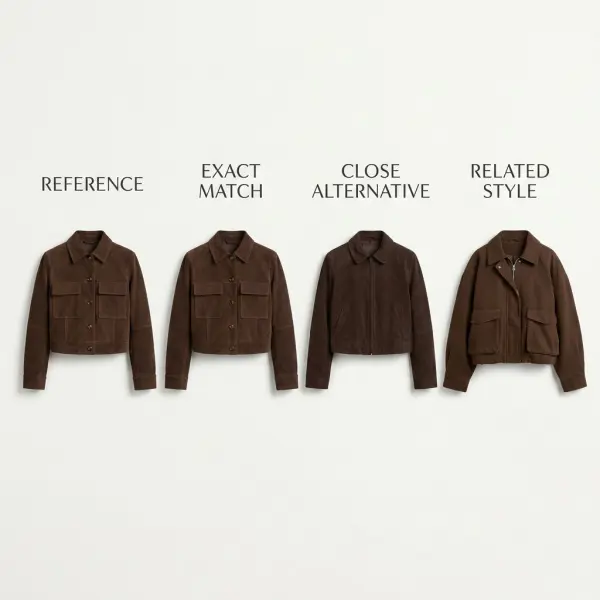
Exact Matches, Close Alternatives, and Related Styles
Not all similar-product results serve the same purpose. A customer who wants to replace an unavailable item may prefer a close alternative, while someone browsing for inspiration may welcome a wider selection of related designs.
A retailer should distinguish these intentions when designing result presentation and ranking.
|
Match type |
Practical meaning |
Fashion shopping example |
What customers should verify |
|
Exact product match |
The result is identified as the same underlying product |
Same handbag model in another retailer's listing |
Model identity, authenticity, condition, variant, and seller |
|
Close visual match |
A different product strongly resembles the reference |
Similar cropped jacket with comparable collar and proportions |
Materials, construction, fit, and distinguishing details |
|
Style-related alternative |
A product shares the general design direction |
Different minimalist shoulder bag with a similar aesthetic |
Whether the style fits the intended use |
|
Partial attribute match |
A product shares some visible features but differs substantially elsewhere |
Same floral print colors on a different dress silhouette |
Which characteristics matter most |
|
Category-level alternative |
A related product belongs to the same broad category |
Another casual jacket with a different shape and texture |
Whether the result is genuinely useful |
These are explanatory categories rather than a universal industry classification. Visual search providers may label, score, or group results differently.
The distinction becomes especially important when a system cannot locate the original garment. Displaying an approximate substitute as if it were the same product may lead to incorrect assumptions about brand, fabrication, or quality.
For fashion retailers, transparent descriptions such as “similar style” or “visually related products” can be more appropriate than claiming an exact match without sufficient identification evidence.
How Product Category Changes the Meaning of Similarity
The visual characteristics that matter for one category may be less relevant for another. This is a key reason why fashion visual search needs more thoughtful evaluation than a broad test of whether two images look alike.
Dresses and Occasionwear
For dresses, customers may prioritize silhouette, length, neckline, sleeve design, waist placement, and fabric appearance.
A photograph of a bias-cut satin-look midi dress, for example, could return other smooth, fluid dresses. Yet a structured sheath dress in the same color may not satisfy the intended look.
Occasionwear matching can be particularly sensitive to small design differences because proportions, drape, and detailing often influence perceived formality.
Denim and Casual Apparel
Denim products may share colors and textures while differing substantially in cut.
Wide-leg jeans, straight-leg jeans, and relaxed tapered jeans can appear similar when folded or photographed from certain angles. On-body photographs may reveal their proportions more clearly, although pose and styling can still distort visual interpretation.
For these products, search refinement through fit descriptors, rise, inseam, and other verified attributes can be important after the initial visual match.
Knitwear and Textured Garments
Knitwear creates an interesting challenge because texture may be a defining characteristic.
A ribbed cropped cardigan, a cable-knit pullover, and a fine-gauge sweater may share colors and categories but have distinct surface structures and silhouettes.
Image-based matching may detect prominent textures, although fine stitches and yarn characteristics can be difficult to distinguish in low-resolution photographs.
Retailers should retain material and care filters so customers can evaluate practical differences that visual matching cannot establish.
Footwear and Fashion Accessories
Footwear and accessories often provide distinctive shapes that can support useful matching.
A handbag's body shape, handle configuration, closure, and hardware placement may help distinguish it from alternatives. Shoes may be differentiated by toe shape, heel height, shaft length, or sole profile.
Even here, similarity is not comprehensive product equivalence. A visually comparable pair of boots may have different materials, heel construction, sizing, or comfort characteristics.
Matching should help customers identify candidates, with product specifications providing the information required for a more informed purchase.
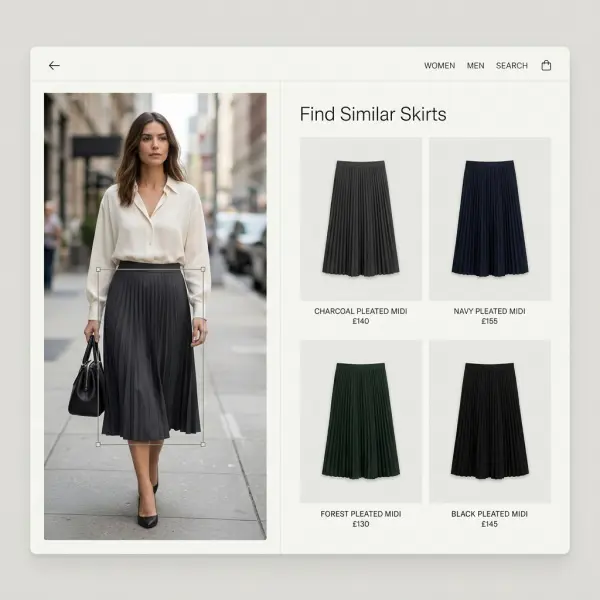
Why Cropping and Garment Selection Can Improve Search Relevance
A full outfit photograph contains more information than a shopper usually needs for a single-product search. The background, model's pose, styling accessories, and other garments can all influence what a visual model processes.
Cropping allows customers or an automated system to concentrate on the region containing the intended product.
For example, someone searching for a pleated midi skirt may obtain more relevant results when the image focuses on the skirt rather than the entire outfit, especially if a bright jacket would otherwise dominate the photograph.
However, tighter cropping is not always better. Removing too much of the garment may eliminate useful information about length, shape, or construction. A tightly cropped image showing only the skirt's fabric pattern might retrieve pattern-similar products with completely different silhouettes.
The objective is to isolate the relevant product while preserving enough visual context for recognition.
An interface can support this through object-selection markers, an adjustable crop area, or prompts that ask customers which garment they want to find.
A useful real-world example comes from ZOZO's 2020 announcement of a similar-item search feature for its WEAR fashion coordination application. The company described a workflow for finding similar merchandise from outfit images using garment selection and visual product matching.
This illustrates a practical interface approach: recognize that an inspirational outfit contains multiple potential search targets, then let the shopper focus on the relevant item.
How Customers Can Refine Similar-Product Search Results
The initial image identifies a general visual direction, but customers often have requirements that cannot be expressed through appearance alone.
A shopper may like the shape of a blazer but need a smaller size, prefer a lighter material, or want an alternative within a different price range.
This is where image-based retrieval and conventional ecommerce filtering can work together.
Keep the Style, Change the Color
A customer may upload a photograph of a black structured handbag while searching for the same general shape in burgundy.
Visual retrieval can identify shape-related candidates, while color filters or combined image-and-text queries can help narrow the selection.
A matching system should be able to support the customer's actual intent where its implementation allows. If it always gives dominant color the highest weight, it may struggle to find similarly shaped products in a different shade.
Preserve the Silhouette, Adjust the Price Range
Price is not a visual characteristic that can be reliably inferred from garment appearance. Similar-looking clothing can be sold at very different price points because of branding, materials, construction, distribution, and other factors.
The practical solution is to combine visual matching with accurate catalog price information.
Customers can then explore items that resemble the reference while staying within a defined budget. Retailers should avoid implying that lower-priced alternatives have equivalent quality merely because they look similar.
Match the Appearance, Filter for Practical Requirements
A photograph may communicate a preferred style but not whether the product is suitable for a customer's everyday needs.
A shopper could seek trousers that resemble a reference image while requiring a specific inseam, machine-washable fabric, or available size.
These requirements depend on structured product information rather than image matching alone.
Research on joint visual-textual embeddings for multimodal style search has explored combining a reference garment image with textual refinement to retrieve products that retain some visual qualities while changing selected attributes.
For ecommerce operators, the practical lesson is that visual search becomes more useful when customers can move from general resemblance toward specific purchase requirements.
What Makes a Similar-Product Search Result Useful to Customers?
A visually similar product is not automatically a useful product.
A customer searching for a fitted white blouse may receive a high-ranking result with a comparable neckline and sleeve shape, but the blouse may be unavailable in the required size. Another result may be available but produced from a fabric that does not meet the shopper's needs.
Fashion retailers therefore need to distinguish between visual relevance and shopping suitability.
A useful result typically brings together several dimensions:
- Visual relevance: The product resembles the intended garment in the characteristics that matter to the shopper.
- Category relevance: The result belongs to an appropriate merchandise category rather than merely sharing colors or patterns.
- Product availability: The item can be purchased in a suitable variant, region, or delivery market.
- Reliable product information: Details about sizes, materials, prices, and care requirements can be verified.
- Meaningful alternatives: Results provide useful choices rather than repetitive images of nearly identical or unavailable products.
The relative importance of these dimensions varies by customer intent.
Someone searching for an exact replacement may prioritize product identity. Someone exploring a broad aesthetic may prefer a wider assortment of styles. A customer with an immediate purchasing requirement may prioritize stock availability and delivery conditions.
The search system should therefore be evaluated according to the shopping task it is intended to support, not solely according to an image-similarity score.
Why Similar-Product Matching Sometimes Produces Poor Results
Visual search systems can return technically plausible results that customers still find irrelevant. Understanding these failure patterns helps retailers improve product discovery without assuming that every problem requires a more advanced AI model.
The System Focuses on the Wrong Attribute
A shopper uploads a photograph of a dress with distinctive balloon sleeves and a muted floral pattern. The results contain many floral dresses, but almost none have the desired sleeve design.
The model may have given greater weight to pattern or general category than to the feature that matters most to the customer.
A stronger implementation can consider attribute-specific evaluation, user feedback, or refinement controls that let customers indicate which characteristics they want to preserve.
Background and Styling Distract From the Product
A street-style photograph may contain a visually prominent environment or accessories. Without effective garment localization, the resulting image representation may not focus sufficiently on the desired item.
A neutral coat photographed against a colorful wall can create a different visual query from the same coat shown against a plain background.
Object selection and suitable product-focused representations can reduce this problem, although their effectiveness depends on the quality of the detection and retrieval models.
The Catalog Contains Too Few Appropriate Alternatives
A system cannot retrieve a genuinely close match if the searchable catalog lacks one.
This issue is particularly relevant when customers use inspiration images from outside a retailer's own assortment.
A boutique specializing in minimalist basics may receive visual queries for highly embellished occasionwear. The system could still return dresses, but those results might not reflect the intended design.
Retailers should avoid forcing unrelated results into a high-confidence presentation merely to avoid showing an empty or limited result set.
Product Images Do Not Represent the Garments Clearly
Catalog photographs may show products from inconsistent angles, in heavily styled environments, or with important details obscured.
A bag photographed only from the front may be difficult to compare with a reference image emphasizing its strap and side profile. A dress photographed only on a hanger may reveal different information from an on-body photograph.
Additional views can provide the model with more useful representations, although the best strategy varies by system and product category.
This operational requirement connects visual search with digital asset management for fashion brands, where image organization, product identifiers, and consistent asset handling become part of the foundation for dependable product discovery.
The System Confuses Visual Similarity With Product Identity
Different brands may sell garments with comparable colors, shapes, and detailing. A strong resemblance does not prove that the products are identical.
This is especially important when customers are searching for a specific designer item, vintage garment, or discontinued product.
Retailers should avoid presenting a visual similarity score as proof of authenticity, origin, or exact product identity. Those claims require additional evidence beyond appearance-based retrieval.
How Fashion Retailers Can Improve the Quality of Similar-Product Matches
Improving visual search relevance requires a coordinated effort across catalog management, image preparation, retrieval configuration, and customer experience design.
The most valuable improvements are not necessarily the most technically complex. A retailer may see better search usefulness simply by correcting product-image associations, excluding unavailable merchandise, or allowing customers to select the intended garment.
Build Reliable Product Image Collections
Each searchable product should have appropriate photographs associated with the correct merchandise record.
Where practical, retailers can provide useful alternate views that reveal silhouette, texture, closures, and other distinguishing characteristics.
The goal is not to produce the largest possible image library. It is to give the retrieval system representative visual information without introducing excessive noise, duplicate assets, or images of unrelated merchandise.
Maintain Accurate Categories and Product Attributes
A visually similar result can still be operationally incorrect when category and variant information is inconsistent.
For example, a catalog may incorrectly associate a cropped cardigan image with the SKU for a longer cardigan variant. The customer sees a relevant photograph but opens a product page with the wrong merchandise details.
Retailers should therefore verify associations among parent products, variants, images, stock records, and product URLs.
Consistent attribute definitions also allow search filters and ranking restrictions to work more effectively.
Evaluate Relevance With Human Judgment
Similarity is partly subjective, particularly for fashion.
A dataset of product photographs can be useful for technical testing, but real customer images introduce different conditions involving body poses, lighting, partial occlusion, and styling context.
Retailers can create evaluation sets that include representative queries and human judgments about which results are acceptable.
For example, a merchandising team may assess whether a retrieved coat resembles the reference in length, collar shape, structure, and overall styling. Those judgments can then support comparisons between search configurations or providers.
The evaluation should account for customer use cases rather than treating every search result as equally important.
Offer Useful Recovery Options
When the system cannot find an appropriate match, customers should have a reasonable next step.
Options may include selecting a different garment region, uploading a clearer image, broadening the category, applying filters, or switching to text search.
Showing weakly related products without explanation may create confusion. A clear message that close matches were not found can be more useful than presenting unrelated inventory as if it were highly relevant.
Integrate Search With Existing Retail Operations
The product discovery interface must remain connected to accurate pricing, stock availability, and merchandise updates.
If new products are added but not indexed, the search system may overlook relevant inventory. If sold-out products remain prominently ranked, the feature may send customers toward unavailable merchandise.
Retailers should confirm how frequently the chosen provider updates its search index and how product additions, image replacements, and deletions are reflected.
Google Cloud's Product Search tutorial, for instance, documents an indexing process in which updates may not appear in responses immediately. Actual synchronization behavior differs across implementations and must be verified with the provider.

What Should Retailers Measure When Testing Similar-Product Search?
A technically successful image search does not necessarily indicate a useful customer experience. Retailers need to evaluate whether the returned alternatives help shoppers find products that satisfy their preferences.
One useful starting point is retrieval relevance. A merchandising team can review a representative set of reference images and judge how many of the first several results qualify as acceptable matches.
Information-retrieval measures such as Precision@K or Recall@K may be appropriate when the business has established relevant ground-truth judgments. They should not be confused with a simple product-category classification accuracy score.
Search quality can also be assessed through customer interactions.
|
Evaluation dimension |
Useful measurement |
Practical interpretation |
|
Matching relevance |
Precision@K or human-judged top-result relevance |
Are the leading results visually appropriate? |
|
Garment selection |
Correct-target selection rate |
Does the system search for the intended item? |
|
Catalog coverage |
Queries with at least one acceptable available match |
Can the current assortment satisfy common searches? |
|
Result engagement |
Click-through rate from matching results |
Do customers find the alternatives worth inspecting? |
|
Refinement behavior |
Filter use and repeated search rate |
Are customers able to narrow the results effectively? |
|
Shopping outcome |
Add-to-cart and purchase behavior |
Do relevant matches lead to useful commercial actions? |
|
Reliability |
Search errors, latency, and stale result rate |
Does the system operate dependably? |
These measurements should be interpreted together. A high click-through rate does not prove that the matches are accurate, and a low purchase rate may reflect pricing or availability rather than poor visual retrieval.
A retailer should also examine the results by category and image type. Search performance on isolated handbag photographs may differ from performance on layered outfits or patterned dresses.
For a deeper discussion of how visual discovery contributes to ecommerce performance, see why visual search can improve product discovery in fashion ecommerce.
Common Mistakes When Implementing Similar-Product Search
Mistake 1: Treating All Visual Characteristics as Equally Important
A model may find two garments similar because they share a dominant color or category, while customers care more about neckline, length, or construction details.
This happens when the system's general similarity model does not align with the search task. The consequence is a result set that looks superficially relevant but fails to satisfy the shopper's actual preferences.
Retailers should evaluate matching quality by garment category and allow refinement when users need to prioritize specific characteristics.
Mistake 2: Testing Only With Perfect Catalog Photographs
Clean studio images make it easier to establish whether the retrieval system can identify visually similar merchandise, but they may not represent real customer behavior.
Customers frequently use screenshots, mirror photographs, editorial images, and pictures containing multiple garments. These introduce challenges involving lighting, perspective, object selection, and background complexity.
A realistic testing program should include both controlled product images and everyday reference photographs so that the retailer understands where the system performs reliably.
Mistake 3: Ignoring Stock and Variant Availability
A result can closely resemble a reference garment but still lead to a poor shopping experience when the desired color or size is unavailable.
This problem often emerges when search indexing and inventory systems are not synchronized or when the ranking process ignores variant-level availability.
Retailers should define how unavailable products are displayed and ensure that the merchandise information shown to customers matches the actual product page.
Mistake 4: Presenting Approximate Alternatives as Exact Matches
Visual similarity does not automatically establish product identity. A retailer that labels a close-looking alternative as the original product risks misleading the customer.
The distinction matters for branded apparel, luxury accessories, limited-edition products, and garments with specific material or construction require



Comments 0
Leave a CommentSend Comment
Anda harus Login terlebih dahulu untuk dapat memberikan komentar.