

Fabric Grainline Explained for Accurate Garment Cutting and Sewing
A garment can be drafted accurately, sewn with clean seams, and made from good-quality fabric yet still hang unevenly on the body. One possible reason is that its pattern pieces were cut without respecting the fabric grainline. The direction of the yarns—or the knitted structure—affects how fabric responds to tension, drapes under its own weight, and behaves during garment construction.
For clothing designers, pattern makers, sample rooms, and apparel manufacturers, understanding fabric grainline is therefore more than a basic sewing skill. It is part of translating a two-dimensional pattern into a garment that maintains its intended shape and appearance.
Quick Answer: What Is Fabric Grainline?
Fabric grainline is a directional reference used in garment cutting to align pattern pieces with the structure of the fabric. In woven textiles, the principal grain directions follow the lengthwise warp yarns and crosswise weft yarns. A diagonal direction, known as the bias, can also be used to achieve different stretching and draping characteristics.
Most conventional sewing patterns include a grainline marking, usually shown as a straight line with arrows, indicating how each pattern piece should be positioned on the fabric. For standard straight-grain cutting, this marking runs parallel to the fabric's selvage.
Correct grainline alignment helps garment panels behave as intended during sewing, fitting, and wear. Incorrect positioning may contribute to twisting, uneven drape, distorted seams, or mismatched fabric patterns.
However, straight-grain cutting is not the only correct approach. Some garments intentionally use crossgrain or bias placement to achieve a particular silhouette or design effect. The objective is to follow the intended fabric orientation rather than assume every pattern piece must be positioned identically.
For fashion businesses, grainline accuracy supports consistent sampling, cutting quality, and repeatable garment production.
What Does Grainline Mean in Fabric and Pattern Making?
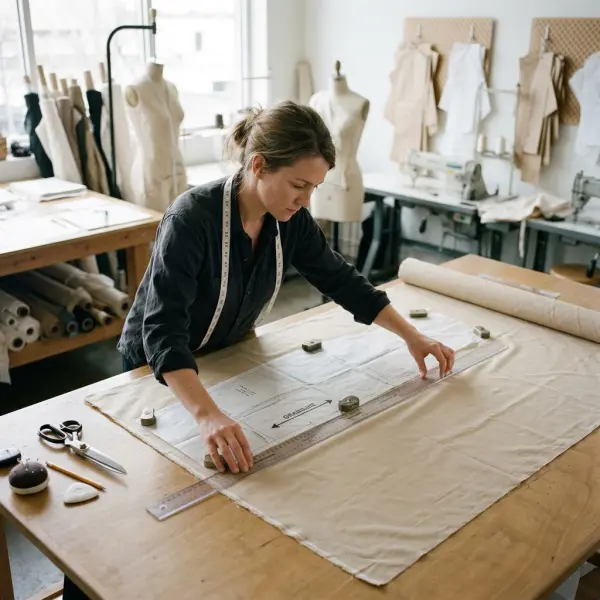
In textile construction, grain refers to the direction of yarns within a woven fabric. Grainline, in garment pattern making, usually refers to the directional marking that tells a cutter how to position a pattern piece relative to those yarns. Although the terms are often used interchangeably in sewing discussions, the distinction helps clarify what pattern makers are actually controlling.
Woven fabric is formed by interlacing two sets of yarns. Warp yarns run lengthwise through the fabric, while weft yarns run across its width. Their arrangement produces a structural framework that influences dimensional stability, mechanical stretch, surface appearance, and drape.
When a pattern maker draws a grainline onto a pattern piece, that marking establishes how the piece should be oriented within this framework. A trouser front, for example, may be designed with the lengthwise grain running vertically through the leg. A decorative panel may use a different orientation to achieve a specific visual or functional result.
The distinction between fabric grain and pattern grainline is also explained in Threads magazine's guidance on sewing woven fabrics.
Why a Pattern Grainline Is a Construction Instruction
A grainline marking is not simply a suggestion for arranging pieces efficiently on fabric. It communicates part of the intended relationship between the garment's pattern geometry and the textile's directional behavior.
If a pattern piece is rotated to fit into an unused space during cutting, the piece may no longer behave as originally designed. Even when its dimensions remain unchanged, its resistance to stretching, tendency to distort, and overall drape can differ because those properties are direction-dependent.
This explains why a pattern that produces a balanced sample may behave differently when the same pieces are cut at another angle. The pattern shape has not changed, but its relationship to the fabric structure has.
For manufacturers, recording grainline orientation in the approved pattern and production marker helps ensure that the cutting process preserves the designer's intended result.
Understanding Fabric Structure Before Cutting
Before aligning pattern pieces, cutters need to recognize the fabric's main directional references. These are especially straightforward in ordinary woven fabrics, where the yarn system creates two perpendicular directions.
Lengthwise Grain, Crossgrain, and Bias
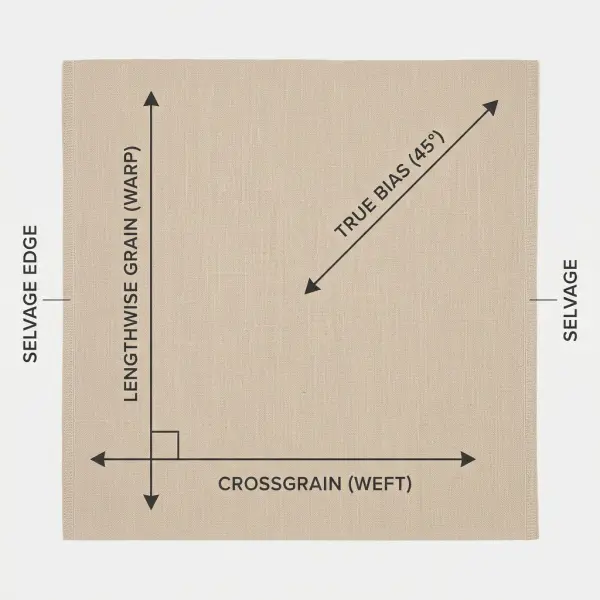
The lengthwise grain follows the warp yarns and runs parallel to the fabric's selvages. The crossgrain follows the weft yarns and extends across the fabric width. The bias describes a direction between these two yarn systems, with true bias positioned at 45 degrees.
|
Fabric Direction |
Structural Reference |
General Cutting Relevance |
|
Lengthwise grain |
Parallel to warp yarns and selvages |
Common orientation for standard garment pattern pieces |
|
Crossgrain |
Parallel to weft yarns, across fabric width |
Used when specifically required by the pattern or design |
|
True bias |
45° to the warp and weft |
Used for selected designs requiring greater mechanical give or fluid drape |
These directional behaviors are particularly relevant to woven textiles. Knitted fabrics have loop-based structures rather than a conventional warp-and-weft arrangement, so their orientation requires additional consideration.
The distinction between the three directions, including their mechanical behavior and suitability for different garment applications, is examined further in straight grain, cross grain, and bias fabric differences.
Why the Selvage Is Useful but Not Infallible
The selvage, also written selvedge, is the finished edge that runs along the length of woven fabric. Because it generally follows the warp direction, it provides a convenient reference when positioning pattern grainlines.
In ordinary cutting conditions, measuring from the selvage is one of the simplest ways to establish whether a pattern piece is correctly aligned. The method is effective when the fabric has been laid flat without distortion.
However, selvage alignment does not guarantee that every area of fabric is perfectly square or undistorted. Textile processing, tension during handling, and finishing can affect the relationship between yarn directions. A damaged or distorted edge may also be unsuitable as a reliable reference.
For that reason, a careful cutter examines the fabric body rather than relying exclusively on the outer edge.

Why Does Fabric Grainline Matter in Garment Cutting?
Fabric grainline matters because garment patterns are developed with particular directional properties in mind. Accurate cutting preserves those relationships, while unintended changes can affect the appearance and performance of the finished garment.
A grainline error is not necessarily obvious immediately after cutting. Its effects may become more visible when fabric panels are assembled, pressed, fitted, or washed.
Garment Balance and Hanging Position
Garment balance describes how a piece of clothing settles around the body in relation to its intended design. It depends on pattern geometry, body shape, material characteristics, construction, and fabric orientation.
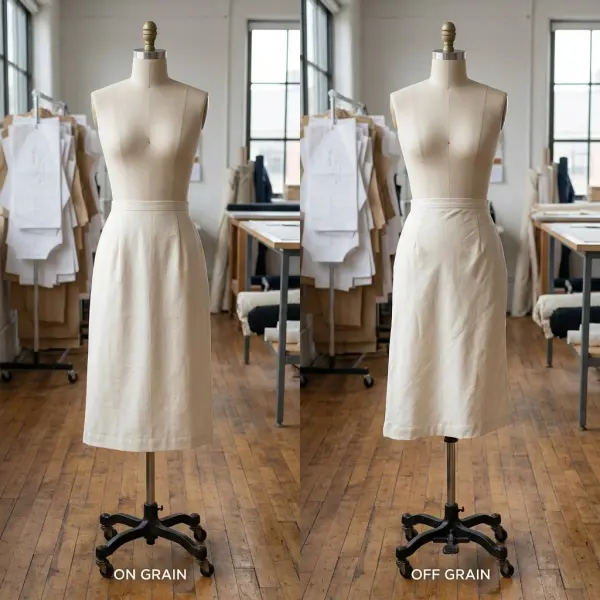
Consider a straight-cut woven skirt. If its front and back panels are cut with the intended lengthwise grain running vertically, they are more likely to hang as designed. If one panel is unintentionally rotated toward the bias, it may respond differently to gravity and tension.
The resulting imbalance may appear as a shifting side seam, uneven hemline, or asymmetric drape. These symptoms do not prove that grainline is the only problem, but they make fabric orientation an important item to investigate.
Fit Consistency Between Garment Panels
Two pieces cut from the same fabric can behave differently when their orientations differ. This is particularly noticeable in materials with substantial directional variation in mechanical stretch or drape.
A blouse may have accurately drafted left and right front panels, yet one side may appear longer or softer if the fabric was distorted during cutting. Depending on the textile, small differences can become more noticeable as the garment is sewn, pressed, or worn.
In sampling, a fitter might initially interpret the problem as a pattern imbalance. Changing the pattern before checking grainline alignment can introduce unnecessary alterations and potentially obscure the original cause.
This is why fabric orientation should be reviewed alongside pattern measurements and sewing quality when investigating unexpected fit differences.
Surface Appearance and Design Alignment
Grainline affects appearance as well as fit. Stripes, checks, ribs, and certain surface textures make directional errors easier to identify because they provide visible references against seams and garment edges.
For example, a striped shirt may show a noticeable diagonal shift when a panel has been cut at an unintended angle. Matching the stripes during sewing cannot fully resolve the underlying orientation difference if the fabric structure or printed design is skewed.
Even solid fabrics can reveal directional effects. Materials with a pronounced weave, luster, or surface texture may reflect light or drape differently when their panels are rotated.
How to Identify the Correct Grainline Before Cutting Fabric
Finding the fabric grainline begins with identifying the textile structure and allowing the material to settle into a relaxed, flat position. For ordinary woven fabric, the selvages provide the initial reference, but the yarn direction should be checked when the fabric appears distorted.
The preparation process matters because accurate pattern placement is difficult on cloth that has been stretched, twisted, wrinkled, or pulled out of shape during handling.
Start with Fabric Preparation
Before laying out the pattern, the fabric should be prepared according to its fiber composition, construction, finishing, and intended care instructions.
For washable materials, suitable prewashing or controlled relaxation may help reveal dimensional changes before cutting. Other textiles, including certain structured, delicate, or professionally finished fabrics, may require steaming, conditioning, specialist preparation, or no washing.
The goal is to establish the condition in which the fabric will be cut and assessed. Applying the same preparation procedure to every textile would be inappropriate.
Utah State University Extension provides a practical example of washing, straightening, and pressing woven fabric before cutting.
Find the Lengthwise Yarn Direction
For a typical woven fabric, the lengthwise grain runs parallel to the selvage. If the edge is intact and the material is reasonably square, it can be used as the primary reference.
When more precision is needed, the actual yarn system may be examined. On suitable fabrics with visible yarns, identifying a single warp or weft yarn can establish a more reliable direction than looking at the printed design.
A fine, evenly woven fabric may require closer inspection, while coarser woven materials make individual yarns easier to identify.
Check Whether the Fabric Is Square
An ordinary balanced woven fabric is generally constructed with warp and weft yarns crossing at approximately right angles. However, the geometry visible at the cutting table may differ because of processing, handling, or fabric distortion.
A fabric may appear straight along its outer edge while the internal yarns are skewed. This can complicate pattern placement, particularly when cutting long garment panels.
Before proceeding, the cutter should confirm that the fabric can lie flat without being forced into position.
Useful checks include:
- Examine the selvages: Confirm that the edges are identifiable and not excessively puckered or distorted.
- Inspect the yarn direction: Use visible weave lines or a suitable thread-tracing method where practical.
- Check the fabric surface: Look for diagonal skew, persistent ripples, or obvious distortion.
- Allow the cloth to relax: Avoid pulling the fabric taut merely to make the edges appear aligned.
- Verify the cutting layout: Confirm that the intended fold and grainline direction are compatible with the material.
These checks are more useful than assuming that a fabric is properly aligned simply because it was supplied neatly folded.
What If the Fabric Is Already Off-Grain?
A fabric that will not lie square should be assessed before cutting. Depending on its structure and finish, gentle relaxation, pressing, or carefully controlled realignment may improve its condition.
Some woven fabrics can be straightened by applying controlled diagonal tension, but that method is not universally suitable. Delicate materials, coated textiles, unstable fabrics, and certain finishes can be damaged or distorted further.
Severe or persistent skew is better treated as a material-quality concern rather than a problem that must always be corrected at the cutting table.
If the fabric does not return to an acceptable condition, a manufacturer may need to consult the supplier or reassess its suitability for the design.
How to Align Sewing Pattern Pieces with the Fabric Grainline
Once the fabric direction has been identified, the next task is to align the pattern's grainline marking accurately. This is one of the most direct ways to prevent avoidable orientation errors before cutting.
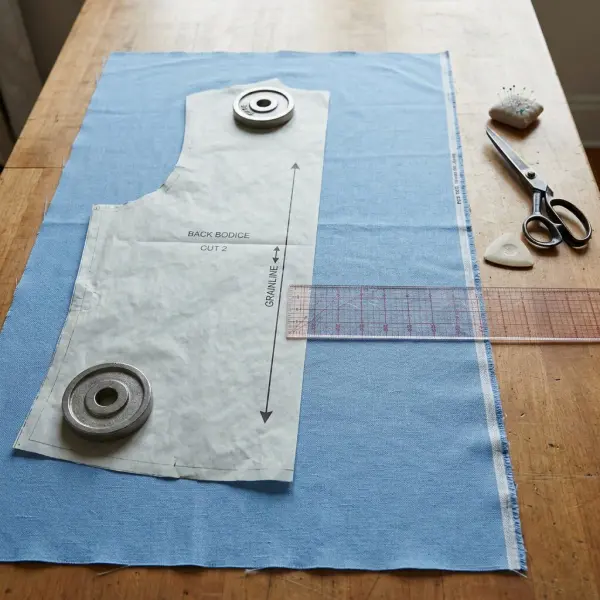
For a conventional straight-grain pattern piece, the grainline arrow should run parallel to the selvage. The important detail is that the arrow must remain parallel along its entire length, not merely appear aligned at one end.
Reading the Grainline Arrow
A pattern grainline is commonly represented by a straight line with an arrow at each end. On a standard lengthwise-grain piece, it identifies the direction that should correspond to the fabric's warp.
Other markings may indicate placement on a fold, crossgrain orientation, bias orientation, or a particular fabric direction. These instructions should be interpreted alongside the full pattern layout.
Not every double-headed arrow automatically means that the marked line must be parallel to the selvage. The pattern's specified cutting direction determines the correct placement.
Measuring Grainline Alignment Accurately
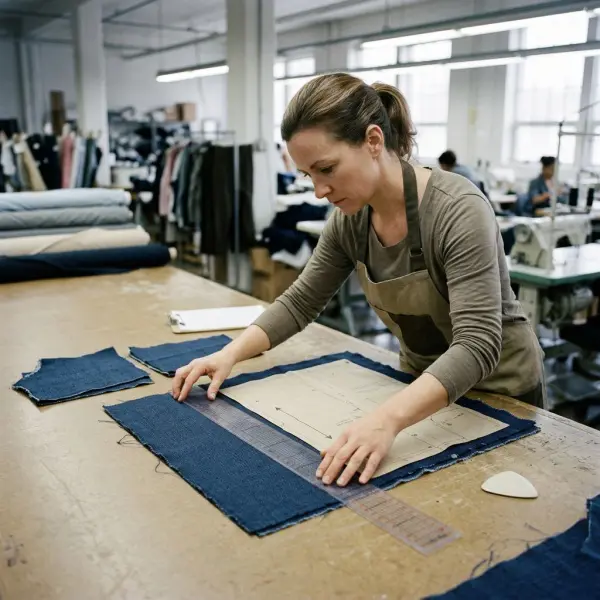
A simple measurement method is particularly useful in manual cutting and sample development. Rather than judging alignment visually, the cutter can compare the distance between the grainline arrow and the same selvage at two points.
For a pattern intended to follow the lengthwise grain, the procedure is:
- Spread the fabric flat on a stable cutting surface without stretching it.
- Position the pattern piece approximately where it will be cut.
- Measure from one end of the grainline arrow to the same selvage.
- Measure from the opposite end of the arrow to that selvage.
- Adjust the pattern until both measurements are equal.
- Secure the pattern without shifting or distorting the fabric, then cut according to the approved layout.
Equal measurements establish that the marked line is parallel to the selected selvage, assuming the fabric itself is correctly aligned.
The same principle applies in professional pattern development: the orientation must be measurable and repeatable rather than dependent on visual judgment alone.
Cutting on the Fold Versus Cutting in a Single Layer
Cutting on the fold is useful when a pattern requires a symmetrical piece without a center seam. The fabric is folded according to the approved layout, and the pattern's fold marking is placed directly on the fold.
However, the fold itself must be correctly positioned. If the fabric is twisted, stretched, or unevenly folded, a pattern piece can be distorted even when its edge appears to sit neatly against the fold.
Single-layer cutting may provide better control when working with slippery textiles, directional prints, asymmetric patterns, or difficult fabric surfaces. It also makes it easier to observe the full fabric structure and inspect the alignment of individual pieces.
The appropriate method depends on the design and material. Neither approach automatically guarantees accuracy.
How Fabric Grainline Influences Drape and Bias Cutting
Grainline is closely connected to fabric drape because a textile does not necessarily respond to movement and tension in the same way in every direction.
When woven fabric is pulled along its lengthwise or crosswise direction, the yarns provide relatively direct resistance. When force is applied diagonally, the yarns can change their angle relative to one another, creating mechanical give even when the fabric contains no elastane.
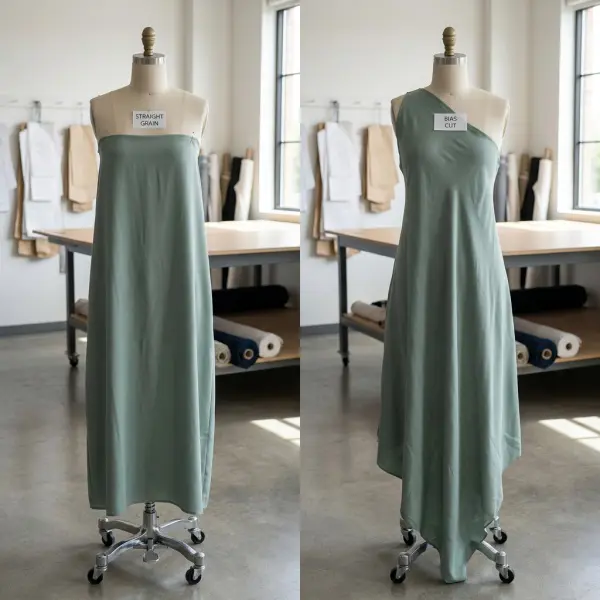
This behavior helps explain why a bias-cut woven garment can appear more fluid than a similar garment cut on the straight grain.
However, the result also depends on yarn type, weave density, fabric weight, finishing, and garment construction. Not every woven material produces an equally fluid bias-cut silhouette.
Bias Cutting as an Intentional Design Choice
In bias-cut apparel, the pattern pieces are deliberately positioned diagonally relative to the woven yarn directions. This changes the way the material conforms to the body and responds to movement.
Slip dresses, selected skirts, and softly draped garments may use bias placement to create a particular silhouette. The orientation is part of the design rather than an error.
Bias cutting also introduces additional production considerations. Fabric panels may distort during handling, seams may require appropriate stabilization, and garment hems may need time to settle before final measurement and finishing.
The Seamwork guide to working on the bias explains practical considerations such as stabilizing vulnerable areas and avoiding unnecessary stretching during sewing.
For product developers, the choice between straight-grain and bias construction should be evaluated during sampling, when its effect on drape, fit, construction time, and material consumption can be assessed.
Grainline Accuracy in Apparel Manufacturing
In industrial garment production, grainline becomes a repeatability requirement. A manufacturer may cut dozens or hundreds of pieces from a fabric lay, so alignment decisions affect more than a single garment.
Production cutting usually relies on approved patterns and markers that determine how pieces are arranged within the available fabric width. Marker planning must consider grainline, material characteristics, and any directional restrictions alongside material utilization.
CottonWorks describes a cutting marker as a layout showing how garment pattern pieces are arranged for cutting, providing useful context in its overview of garment construction and manufacturing.
Grainline Requirements in Pattern Documentation
A production-ready pattern should communicate the intended orientation of each piece. This information should remain consistent between the approved sample, the production pattern, and the final cutting marker.
For example, if a shirt's front panels are designed on the lengthwise grain, the marker should preserve that orientation. Rotating one panel to improve fabric utilization may create a difference between the approved design and production output.
Technical documentation can make the intended orientation explicit, especially for unusual panels, bias-cut components, or designs containing multiple grain directions.
Material Efficiency Versus Cutting Accuracy
Fabric consumption is a significant consideration in garment costing, and manufacturers understandably seek efficient cutting layouts. However, efficient nesting should not override a design's essential orientation requirements.
A marker that uses less material is not necessarily preferable if it causes unacceptable drape, visual inconsistency, or garment distortion.
The relationship becomes especially important with directional fabrics such as velvet, fabrics with nap, and one-way printed designs. Even pieces that appear geometrically suitable for rotation may need to maintain a consistent direction because of surface appearance.
A manufacturer should assess marker efficiency only after the essential fabric orientation and appearance constraints have been established.
Grainline as Part of Quality Assurance
Quality assurance should begin before the first garment is sewn. Incoming fabric inspection, spreading, marker verification, and cutting inspection can help identify orientation problems before they become embedded in production.
A production team may verify that the fabric is adequately relaxed, the lay is not distorted, and the marker matches the approved pattern requirements. Sampling and finished-garment inspection then provide opportunities to identify unexpected twisting or drape changes.
If a recurring problem appears, the investigation should examine the entire process rather than assume that the sewing operator or pattern maker is responsible.
Practical Grainline Control for Fashion Brands and Manufacturers
A fashion business does not need an unusually complex process to improve grainline consistency. It needs clear technical instructions, reliable fabric preparation, and a defined point at which cutting quality is verified.
The most useful practices depend on whether the business is producing individual samples, small-batch collections, or larger production orders.
During Product Development
At the development stage, fabric orientation should be evaluated using the intended material rather than only a substitute fabric. Differences in weave, finish, and mechanical give can change how the same pattern behaves.
A sample maker may construct a garment correctly but still produce misleading fit results if the fabric is not cut as intended. Before altering the block or pattern, the development team should check whether unexpected behavior could be related to grainline placement.
This is particularly relevant for fitted woven garments, long panels, asymmetric designs, and materials with visible directional features.
During Sourcing and Material Approval
Sourcing teams should consider grain stability when evaluating candidate fabrics. Two materials with similar composition and weight may behave differently because their yarn structure, construction, or finishing processes differ.
Checking a fabric's dimensional stability and tendency to skew can be more informative than relying exclusively on its initial appearance.
A swatch that looks straight when it arrives may behave differently after conditioning, steaming, washing, or handling. Where appropriate, these changes should be assessed before approving the material for production.
During Cutting and Production
Cutting teams benefit from having clear instructions on fabric face, direction, grainline, fold placement, and restrictions on rotating pieces. These details are particularly important when different garment components use different orientations.
Quality checks should be performed at points where errors can still be corrected efficiently, rather than waiting until finished garments reveal a problem.
For smaller fashion brands that outsource production, reviewing the approved cutting layout during sampling can prevent disagreements about whether an orientation change was intentional.
During Quality Inspection
Finished garments should be assessed for balance, visual alignment, and seam positioning in a relaxed condition. For relevant product categories, testing after the specified care process may reveal changes not visible immediately after sewing.
CottonWorks discusses how shrinkage and fabric skew can affect garment appearance and fit in its technical guidance on shrinking and skewing.
Inspection findings should distinguish between cutting errors and problems originating in textile construction or finishing. This helps manufacturers correct the actual source of a defect rather than repeatedly adjusting unrelated production steps.
Common Grainline Mistakes in Garment Cutting
Many grainline problems begin with seemingly minor decisions made before sewing. Some are caused by misunderstanding a pattern marking, while others arise from trying to maximize fabric utilization or working with distorted material.
Mistake 1: Aligning the Pattern by Eye Alone
A common error is positioning the pattern approximately parallel to the selvage without measuring both ends of the grainline marking. The pattern may look straight while being slightly rotated.
The consequence depends on the textile and garment design, but uneven drape or unintended diagonal give can develop in sensitive materials. A straightforward improvement is to verify the measurement at both ends of the marked line before securing the pattern.
Mistake 2: Cutting Fabric That Has Not Relaxed Properly
Fabric stretched during spreading or tightly pulled across the cutting surface may not retain its apparent dimensions after cutting. When the material relaxes, the panels can change shape or become difficult to assemble accurately.
This can create confusion during sewing because the cut pieces may no longer correspond precisely to the intended pattern. Allowing appropriate relaxation and avoiding unnecessary tension are particularly important for unstable or stretch-sensitive textiles.
Mistake 3: Rotating Pieces Only to Save Fabric
A cutter may rotate a sleeve, pocket, or body panel to fill an empty area within a cutting layout. While such changes may improve marker utilization, they can violate the intended grainline.
The resulting component may stretch, drape, or reflect light differently from other pieces. Any proposed rotation should therefore be evaluated against the approved pattern requirements rather than treated as a purely material-efficiency decision.
Mistake 4: Assuming Printed Lines Follow the Fabric Grain
Stripes, checks, and printed motifs can make layout easier, but they are not always reliable indicators of the underlying yarn direction. Some prints may be applied slightly off-grain, while woven patterns may reveal distortions introduced during production or finishing.
Cutting exclusively by the visible design can therefore produce a garment whose structural orientation differs from the intended grainline. The design and fabric structure should be checked separately, especially when visual matching is essential.
Mistake 5: Ignoring the Grainline of Smaller Components
Small garment components are sometimes treated as suitable for cutting from any leftover fabric area. However, collars, cuffs, pockets, facings, and other parts may also require particular orientations.
A small component cut incorrectly can distort, stretch during sewing, or behave differently from the surrounding fabric. The relevant grainline and construction requirements should be preserved even when a piece uses relatively little material.
More detailed discussion of twisting, distorted seams, and uneven garment drape is available in common grainline mistakes that cause garment distortion.
Important Technical Caveats Before Changing a Cutting Layout
Grainline guidance must be interpreted according to the actual fabric and garment design. The most stable orientation for one woven textile may not behave identically in another, particularly when stretch fibers, unusual weaves, or specialized finishes are involved.
The common statement that lengthwise grain has less stretch than crossgrain is useful as a general explanation for many conventional woven fabrics, but it is not a universal material rule. Performance should be checked on the specific fabric rather than inferred entirely from its grain direction.
Knitted fabrics require further care. Their loop structure creates directional behavior that differs from woven textiles, and the orientation of visible wales should be considered alongside the direction of greatest stretch. A knit garment can also develop spirality because of yarn torque, fabric construction, and finishing effects.
Research published in Textile Research Journal has examined how yarn and fabric construction parameters influence spirality in cotton single-jersey knitted fabrics.
This means a twisted garment is not automatically evidence of incorrect cutting. Fabric skew, knit spirality, sewing tension, pattern imbalance, differential shrinkage, and handling can also contribute.
For brands investigating a recurring defect, the practical objective is to identify the responsible mechanism before changing patterns or cutting procedures.
Frequently Asked Questions About Fabric Grainline
What is the difference between fabric grain and grainline?
Fabric grain refers to the direction of yarns in a woven textile, while grainline commonly refers to the directional marking on a sewing pattern that indicates how the piece should be placed on the fabric. The two concepts are related but serve different purposes. Fabric grain describes material structure; the pattern grainline communicates intended cutting orientation. In most conventional woven garments, the standard grainline marking aligns with the lengthwise warp direction. Understanding this distinction helps prevent mistakes when translating a pattern into a cutting layout, particularly when a design includes pieces intentionally positioned on different fabric directions.
Should every sewing pattern be cut on the straight grain?
No. Most conventional woven garment patterns use lengthwise grain for many major components, but some designs intentionally specify crossgrain or bias placement. The correct direction depends on the garment's construction and desired fabric behavior. Certain decorative panels, bias-cut dresses, and other design features may require a different orientation. The pattern's instructions should determine the placement rather than a general assumption that every piece must follow the lengthwise grain. If a brand changes orientation during production, the revised result should be evaluated in sampling before the change is approved for larger-scale cutting.
How can you tell whether fabric is on-grain without a printed pattern?
For woven fabric, start by locating the selvages and observing the yarn directions. The warp typically runs parallel to the selvages, while the weft runs across the width. On fabrics with visible yarns, tracing a thread can help identify the actual direction. Check whether the cloth lies flat and whether the yarn systems appear properly aligned. If the fabric is skewed, the selvage alone may not provide a complete assessment. Printed stripes or checks can assist visually, but they should not be treated as definitive proof of structural alignment because printed motifs can be off-grain.
Can incorrect grainline cause a garment to twist after washing?
Yes, incorrect grainline placement can contribute to twisting because the garment panels may respond unevenly to tension and relaxation. However, washing-related twisting has several potential causes, including fabric skew, yarn torque, knit spirality, differential shrinkage, and construction-related tension. If a garment changes shape after laundering, the inspection should compare its initial and post-care condition. Fabric orientation, seam position, and dimensional stability should be checked together. Blaming the cutting process without examining the textile can lead to ineffective corrections and allow a recurring material defect to remain unresolved.
Is it acceptable to cut fabric on the crossgrain to reduce material waste?
Crossgrain cutting can be acceptable when the pattern, fabric, and garment performance allow it. Some designs intentionally use crossgrain orientation, while other pieces may tolerate a carefully evaluated change. The decision should not be based on fabric savings alone. Crossgrain placement may change directional stretch, surface appearance, or drape, depending on the material. A manufacturer should confirm that the revised orientation preserves fit, appearance, and acceptable performance. If the orientation changes an essential construction characteristic, the resulting material savings may be offset by quality problems or additional sampling and rework.
Does grainline matter when cutting stretch fabrics?
Yes. Stretch fabrics still have directional structures that influence how garment pieces behave. In woven stretch fabrics, the stretch direction depends on the construction and placement of elastic yarns. In knitted fabrics, the loop structure determines the direction and degree of stretch, and some materials stretch in more than one direction. Pattern instructions may specify both grainline and greatest-stretch orientation. These requirements should be followed together. Ignoring the stretch direction can affect fit and movement even if the pattern appears to be positioned neatly on the fabric.
How can garment manufacturers control grainline accuracy in bulk production?
Manufacturers can improve grainline control by checking fabric condition, using approved production patterns, verifying marker orientation, and preventing unwanted tension during spreading and cutting. The cutting team should understand which pieces must retain a specific direction and which, if any, have approved flexibility. Quality control should include relevant checks before sewing and evaluation of garment balance after assembly. For recurring defects, material inspection and care testing may be necessary to distinguish cutting problems from fabric instability. The objective is to make grainline control repeatable across production batches rather than dependent on individual operator judgment.
Conclusion: Grainline Accuracy Begins Before Sewing
Fabric grainline connects textile structure with garment construction. It helps determine how pattern pieces should be positioned so that their dimensional behavior, drape, and appearance remain consistent with the intended design.
For individual dressmakers, understanding grainline improves cutting decisions and reduces preventable sewing problems. For fashion brands and manufacturers, the same principle becomes part of material evaluation, pattern approval, marker planning, and quality assurance.
The most effective approach is not to insist that every fabric must be cut in a single direction. It is to understand the textile, establish the design's intended orientation, and preserve that relationship through sampling and production.
When garment panels twist, hang unevenly, or behave inconsistently, grainline is one of the first technical factors worth checking—but it should always be examined alongside fabric stability, pattern construction, and sewing quality.





Comments 0
Leave a CommentSend Comment
Anda harus Login terlebih dahulu untuk dapat memberikan komentar.