

Garment Grading Explained for Apparel Production
Garment grading sits between an approved pattern and a production-ready size range. It is the stage where the measurements, proportions, construction details, and fit logic established in a base size are translated into smaller and larger sizes. When that translation is handled well, customers see a coherent product: the neckline still looks intentional, pockets remain usable, sleeves sit correctly, and the garment retains its visual character across the range.
The process is technical, but its consequences are commercial. A grading decision can affect sample approvals, marker preparation, factory communication, and product consistency. Grading cannot repair an unsuitable body measurement chart or an unresolved base pattern; it carries those decisions into additional sizes.
Quick Answer
Garment grading is the systematic process of creating smaller and larger pattern sizes from an approved base pattern by applying defined increases and decreases at selected pattern points. Its purpose is to produce a coordinated size range while preserving the garment's intended fit, balance, construction, and design proportions as far as the brand's sizing system allows.
Grading is not the same as enlarging a pattern by one percentage. Different areas of the body do not change at identical rates, and garment components must continue to sew together correctly. A sleeve cap must remain compatible with its armhole, a collar with its neckline, and adjoining seam lines with one another. Grade rules therefore specify how much particular points move horizontally and vertically between sizes.
For apparel businesses, reliable grading depends on four foundations: relevant body-measurement data, a clear size chart, an approved base pattern, and validation across the intended size range. Computer-aided design (CAD) software can apply and store grade rules efficiently, but software does not decide whether those rules suit the customer, fabric, silhouette, or construction.

What Is Garment Grading?
Garment grading, also called pattern grading or size grading, is a technical pattern-development process that changes an approved base-size pattern into a planned range of sizes according to a set of grade rules. Those rules direct the movement of key points on each pattern piece so the resulting sizes correspond with the brand's measurement framework and retain the original style logic.
The base pattern may be called the sample size, master size, or base size. It is normally used for core fit development. Once approved, the grader develops the other sizes around it. The choice of base size is a product-development decision, not a universal convention.
Body data gives this process its human reference. ISO 8559-1:2017 describes anthropometric measurements that can support physical and digital databases, population selection, size-and-shape profiles, and fit mannequins for clothing development. The standard does not supply one mandatory global size chart. A brand still has to define whom it intends to fit and how body dimensions will be converted into garment measurements.
Grading, sizing, pattern making, and alteration are different tasks
These terms are often used loosely, yet they describe different decisions.
|
Term |
Main function |
Typical output |
What it does not automatically solve |
|
Sizing system |
Organizes a target population into named or numbered sizes |
Body measurement chart and size labels |
Garment ease, styling, or pattern geometry |
|
Pattern making |
Creates the shapes needed to construct a garment |
Base or style pattern |
A complete commercial size range |
|
Garment grading |
Applies size-to-size changes to the approved pattern |
Graded pattern nest or separate pattern files |
A poor base fit or unsuitable size chart |
|
Garment alteration |
Adjusts a specific garment or pattern for an individual |
Personalized fit correction |
A repeatable ready-to-wear size system |
The distinctions matter because a grading problem is sometimes diagnosed when the underlying fault sits elsewhere. If the base-size shoulder balance is wrong, reproducing it accurately in seven sizes is still not a successful result. If the size chart does not represent the target customer, technically clean grading may continue to produce poor market fit.
Why Does Grading Matter in Apparel Production?
Grading converts one approved design into a sellable size assortment. Without it, a ready-to-wear brand has a sample rather than a scalable product. The process connects design development with production because factories need accurate pattern shapes and measurement expectations for every ordered size, not just the sample size presented during development.
A dependable graded set gives the cutting room patterns for each size, gives quality teams measurements to inspect, and helps product developers compare samples with approved specifications. It also allows marker makers to combine ordered size ratios into cutting layouts. Grading is not marker making, but incorrect patterns will compromise the marker.
The consumer-facing effect is fit consistency. That does not mean every person assigned the same label will have the same body shape or fit preference. Ready-to-wear sizes cover ranges of bodies, and a label such as M or 12 is not a precise anatomical description. The current ISO 8559-2:2025 size-designation standard addresses primary and secondary body dimensions used to designate sizes for specified garment types. This reinforces an important distinction: body dimensions describe the intended wearer, while finished-garment measurements include ease and design decisions.
The business value is consistency, not mathematical neatness
Grading quality becomes visible in whether factories interpret specifications consistently, end sizes still look like the same design, and customer feedback concentrates in a particular size or body area. A clean pattern nest is useful, but it is not the final performance test.
Poor grading may contribute to repeated pattern corrections, additional samples, delayed approvals, mismatched components, and inconsistent fit across sizes. The precise financial effect varies with the product, order volume, supplier agreement, and point at which the error is found. Catching a faulty sleeve grade during digital review is very different from discovering it after bulk cutting.
What Does a Grader Actually Work With?
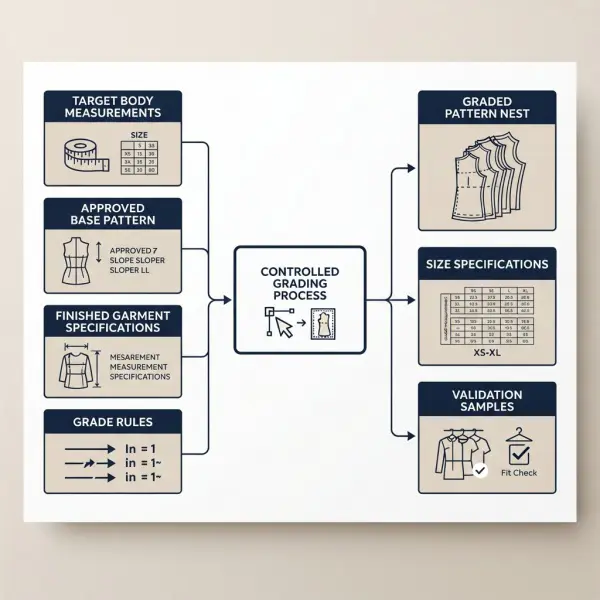
A professional grader does not begin with an isolated outline and improvise larger versions. The work should be based on a controlled set of inputs that explains the target body, the approved garment, and the required production range.
The core inputs usually include:
- an approved base pattern with seam relationships, notches, grainlines, and construction information checked;
- a body measurement chart or documented sizing standard for the target customer;
- a finished-garment specification showing the points of measurement for each size;
- grade rules or size-to-size measurement increments;
- the intended size range and any changes in increments within that range;
- fabric, stretch, recovery, wash-treatment, and construction information relevant to fit;
- design details whose position or scale must be controlled, such as pockets, plackets, artwork, and button spacing.
Together, these inputs establish what should change and what should remain visually or functionally stable. If the graded measurement chart and graded patterns are created by different parties, the documents need to reconcile. A pattern that measures one value while the specification states another creates uncertainty for the factory and quality team.
Grade rules and cardinal points
A grade rule states how a defined location changes from one size to the next. In a two-dimensional pattern, that movement is commonly represented through horizontal and vertical coordinates. The locations receiving those instructions are often called grade points or cardinal points. They may sit at recognizable positions such as a shoulder tip, neckline, underarm, waist, hip, hem, or dart endpoint.
The movement is distributed around the pattern rather than added as one uniform border. A bodice, for instance, must respond to changes in girth, length, shoulder position, armhole shape, and style ease. The exact distribution depends on the brand's size chart, block, fit model, product category, and grading method. That is why copying another company's rule library without validating its sizing assumptions is risky.
Pattern nests and graded specifications
When multiple graded sizes are overlaid, they form a pattern nest. It helps technicians inspect the progression of points and shapes. Sudden jumps, crossings, or details that fail to move with the pattern can signal an error. A visually orderly nest can still contain the wrong increments, so it must be checked against the specification.
The graded specification lists finished-garment measurements by size at defined points. Pattern measurements and specifications are related, although they may differ when seam allowances, darts, pleats, elastic, rib, gathering, or measurement conventions affect the calculation.
How Does Grading Fit Into the Product-Development Workflow?
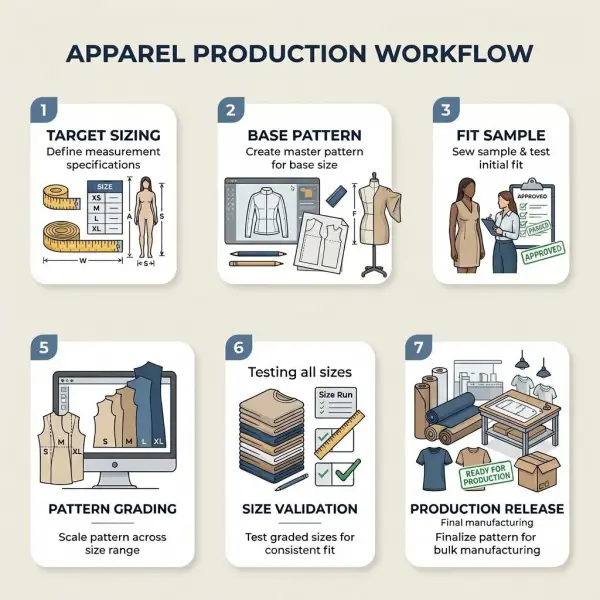
Grading should normally follow approval of the base pattern and precede final production release. If a brand grades too early, every later base-pattern correction has to be propagated through the nest. If it grades too late, size-set validation and factory preparation can become compressed.
A practical sequence is:
- Define the target customer, body measurement framework, size labels, and commercial size range.
- Develop the block and style pattern for the chosen base size.
- Make the prototype or fit sample, evaluate it, and correct the base pattern.
- Approve the base fit, construction, and key finished-garment measurements.
- Apply the grade rules to all pattern pieces and relevant internal details.
- Check the pattern nest, adjoining seams, notches, measurements, and specification alignment.
- Produce and assess selected sizes or a size set according to product risk and buyer requirements.
- Release controlled files for marker planning, cutting, sewing, and quality inspection.
The detailed mechanics of translating the base into multiple sizes belong in how size grading turns a base pattern into a full size range. At this foundation stage, the key point is sequencing: grading carries approved fit logic forward; it should not substitute for fit development.
What Changes During Grading—and What Should Be Preserved?
Grading changes the dimensions and positions required to serve adjacent sizes. Depending on the garment, these can include girths, widths, lengths, depths, rises, shoulder positions, armhole dimensions, sleeve dimensions, and the placement of functional details. The changes may be linear across part of a size range, but they do not have to remain identical across every size or every segment of an extended range.
What should survive is the design intent. The proportions do not need to be geometrically identical, but the garment should still read as the same style. A patch pocket should remain functional and appropriately positioned. A neckline should not become unintentionally broad or restrictive. A cropped jacket should retain its cropped relationship without becoming disproportionately short at one end of the range.
Several relationships deserve special attention:
- adjoining seams must retain compatible sewing lengths, subject to the intended ease or shaping;
- notches and drill points must remain meaningful for assembly;
- collars, facings, cuffs, waistbands, linings, and other dependent pieces must follow their corresponding seams;
- design lines and closures must remain visually balanced;
- minimum functional dimensions may need separate treatment rather than automatic reduction;
- seam allowances should remain controlled unless the production method specifically requires a change.
This is why grading is better understood as coordinated pattern engineering than simple resizing. Every pattern piece belongs to a sewn system.
Manual and Digital Grading Methods
Garment patterns can be graded manually or with CAD. Manual approaches include shifting or tracing in controlled steps and slash-and-spread methods that distribute changes through selected areas. Terminology varies, and graders may combine techniques depending on the pattern shape.
Digital grading stores rules and applies coordinate changes within pattern software. It supports rule libraries, nested views, measurement checks, multi-size editing, and file transfer. Some systems also let technicians review pattern placement across sizes; CLO describes a 2D grading review feature for comparing pattern and graphic positions.
Either manual or digital grading can be technically sound. CAD improves repeatability, visibility, revision control, and speed once the rules are correct. It can also reproduce an incorrect rule throughout a range. Human judgment is still required to establish the logic and inspect the result.

Why One Grade Rule Does Not Suit Every Garment
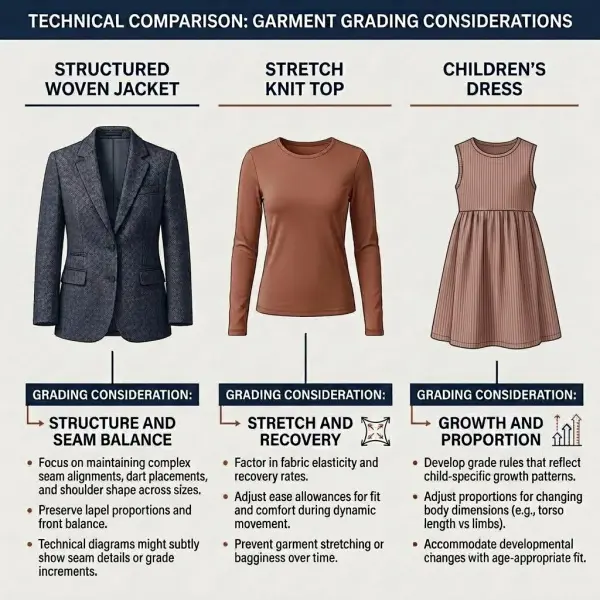
Grade rules sit inside a specific sizing and product context. Applying the same library indiscriminately to every category can distort fit or construction because a tailored woven jacket, a stretch legging, a soft jersey T-shirt, and a structured bra interact with the body in different ways.
Fabric behavior changes the amount and distribution of garment ease. Stretch percentage alone is not enough: recovery, direction of stretch, garment pressure, lining, elastic, wash behavior, and intended silhouette also matter. A knit pattern may use negative ease in some areas, while a non-stretch outerwear style needs enough room for movement and layering. Grading must preserve the intended relationship between body dimensions and garment dimensions, not merely match a generic increment table.
Product categories introduce their own dependencies. Tailored garments contain interlinings, lapels, shoulder structures, and carefully balanced seam shapes. Children's wear must reflect growth and changing proportions rather than treating a child as a scaled-down adult. Workwear may require mobility, protective coverage, or compatibility with equipment. Placement prints and embroideries can require size-specific review even when the underlying garment grade is correct.
Extended size ranges require particular judgment. A single continuous rule set may be appropriate for some styles and target populations, while other ranges may need different blocks, fit models, or rule segments. ISO 8559-3:2018 describes principles for establishing body-measurement tables and intervals and recognizes different population groups used in ready-to-wear development. The practical implication is clear: size intervals should come from a defined population and product strategy, not from the assumption that bodies expand uniformly.
Who Owns Grading Decisions?
The grader performs the technical work, but grading quality depends on shared ownership. Brand teams decide the target customer, price architecture, assortment, and intended fit. Pattern makers establish the base geometry. Fabric and product developers supply material and construction constraints. Factories confirm production feasibility. Quality teams need measurable standards for inspection.
|
Role |
Decision or responsibility |
Evidence to approve |
|
Brand or product lead |
Target market, size range, fit positioning, and commercial priorities |
Approved sizing brief and range plan |
|
Technical designer or pattern maker |
Base fit, construction logic, points of measurement, and style integrity |
Approved sample, pattern, and specification |
|
Pattern grader |
Rule application, pattern relationships, nested sizes, and file accuracy |
Graded nest and measurement checks |
|
Supplier or factory technician |
Equipment compatibility, seam feasibility, marker and production readiness |
Pre-production review and controlled production files |
|
Fit and quality team |
Validation of representative sizes and measurement tolerances |
Fit comments, size-set results, and approval record |
Outsourcing grading does not outsource the sizing strategy. A supplier can execute only the information it receives or substitute its own assumptions. If a brand sends a base pattern without its size chart, rule logic, or intended measurements, it should not assume that the supplier's default grade matches its customer.
How Can Fashion Businesses Apply Grading More Strategically?
The most useful starting point is documentation. A small brand does not need the largest CAD system or a complex global standard library before it can improve grading. It needs a controlled chain from customer body data to size chart, base fit, grade rules, finished measurements, pattern files, and validation feedback.
A practical grading brief should answer:
- Who is the intended wearer, and which body data supports the size chart?
- Which size is the base, and why is it appropriate for fit development?
- What is the full commercial range, including any petite, tall, plus, maternity, or adaptive segment?
- Which measurements change between sizes, by how much, and where do increments change?
- Which design features have fixed functional minimums or require separate placement rules?
- Which sizes will be sampled or fit-tested before production?
- Who approves pattern revisions, and how are version numbers controlled?
- How will return reasons, fit reviews, alterations, and quality findings feed back into the next season?
This turns grading from a vendor task into a product-data process. Over time, the brand can compare technical evidence with commercial signals. A high return rate in one size is not proof of a grading fault: assortment mix, customer selection, product description, fabric performance, sewing variation, and fit preference may also contribute. But repeated complaints at the same body area across several styles deserve investigation.
Match validation effort to risk
Not every basic T-shirt requires the same development budget as a fitted blazer or performance bodysuit. Validation can be prioritized according to silhouette sensitivity, material behavior, construction complexity, novelty of the block, width of the size range, order volume, and cost of failure.
For a familiar style using a proven block and stable fabric, measurement checks plus selected size samples may be proportionate. A new fitted style across a newly extended range calls for broader physical assessment. Digital simulation can help teams inspect proportion and identify candidates for correction, but its usefulness depends on avatar measurements, material data, pattern accuracy, and the limits of the simulation. It should support—not automatically replace—the fit decisions required for the product.
Common Misconceptions and Early Warning Signs
The first misconception is that grading is uniform scaling. Uniform percentage enlargement changes every dimension together, including elements that may need a different progression or should remain fixed. Professional grading distributes dimensional change according to body, garment, and construction logic.
The second is that an approved medium proves the whole range. It proves only that the evaluated sample met the approval criteria for that body, material, and construction. Smaller and larger sizes can reveal proportion or mobility issues that remain invisible at the base.
The third is that a familiar label guarantees a familiar fit. Alpha and numeric labels are communication devices, not universal measurements. Brands using the same label can target different body dimensions, ease, and silhouettes. This is one reason customer-facing size charts should provide meaningful body or garment information instead of relying on labels alone.
Early warning signs include seam pairs that no longer match, abrupt changes in nested outlines, pockets drifting toward side seams, necklines changing character, extreme sizes missing specification targets, and the same fit complaint appearing repeatedly at one end of the range. A fuller diagnostic treatment is covered in common grading mistakes that affect fit across sizes.

What Should Brands Verify Before Approving a Graded Range?
Approval should confirm more than the presence of every requested size. The team should verify that the governing size chart is relevant to the market, measurement definitions are unambiguous, the base pattern is the correct approved version, grade rules correspond with the graded specification, and all dependent pattern pieces remain compatible.
Important technical caveats belong close to that review:
- Body measurements, finished-garment measurements, and pattern measurements are related but not interchangeable.
- Ease can change by size when the fit strategy requires it; it should not be assumed to remain constant without review.
- Tolerances describe acceptable production variation, not the intended difference between sizes.
- Shrinkage compensation is a material and process decision, not automatically part of the grade.
- Seam allowance, elastic length, rib dimensions, lining, and trims may follow rules different from the main shell pattern.
- A mathematically correct grade can still be unsuitable for the target population or style.
Before bulk release, the strongest evidence is a reconciled technical package: approved patterns, finished measurements, rule records, representative size validation, construction details, and revision history all pointing to the same product version.
Frequently Asked Questions
What is the difference between garment grading and pattern drafting?
Pattern drafting creates the foundational pattern geometry for a garment, either from measurements, a block, draping, or a combination of methods. Garment grading begins after a base pattern has been developed and generally approved, then produces the additional sizes through planned dimensional changes. Drafting decides the base shape; grading decides how that shape progresses through a range. In practice, the work can overlap when a grader finds that the base pattern or block is unsuitable. That discovery should trigger a controlled correction to the source pattern rather than an undocumented adjustment to only one graded size.
Is grading the same as adding or removing the same amount around every edge?
No. Garment grading distributes size changes at defined points and in defined directions. Different measurements may grow or shrink by different amounts, and some details may remain fixed or follow separate rules. Adding an equal border would also alter seam lengths, necklines, armholes, pocket placement, and garment length without regard to fit or construction. Even where a finished circumference changes by a regular interval, the pattern maker must decide how that change is divided among front, back, side seams, darts, panels, or other components.
Does every brand use the same grading increments?
No. Increments depend on the brand's body measurement chart, size architecture, product category, base block, fit intent, and target population. Two brands can both sell a medium while using different body dimensions and garment ease. Even within one brand, a stretch top, tailored jacket, and children's trouser may require different rule libraries. Standards can support consistent measurement definitions and size designation, but they do not remove the need for a brand-specific product, fit, and customer strategy.
Can CAD software grade a pattern automatically?
CAD software can apply stored rules automatically, calculate point movements, display nests, and help check measurements. It still needs valid inputs. The system does not inherently know whether the brand's shoulder increment suits its fit model, whether a pocket has become too small to function, or whether a stretch fabric changes the required ease. Automation is most reliable when rule libraries are documented, pattern points are correctly assigned, and technicians review both measurements and pattern shapes before releasing production files.
Should every size be sampled before production?
Sampling every size can provide more evidence, but it is not always commercially proportionate. The validation plan should reflect the width of the range, order value, style complexity, fit sensitivity, fabric behavior, regulatory or buyer requirements, and the team's experience with the block. Many businesses evaluate a base size plus selected sizes toward the lower and upper ends, while higher-risk products may justify a broader size set. Measurement checks across all digital patterns remain necessary even when not every size receives a physical sample.
Can a brand extend an existing range simply by continuing the same grade rules?
Sometimes, but it should not be assumed. Extending beyond the range for which a block and rules were validated may create unsuitable proportions, ease, length, or detail placement. The target population may also require a different block or fit model rather than more of the same increments. A responsible extension starts with body data and customer needs, then tests whether the existing sizing architecture remains appropriate. If not, overlapping size segments or a separate block may produce a better result than one uninterrupted nest.
How is grading checked before bulk cutting?
Technical teams typically combine digital or paper pattern review with measurement comparison and selected physical samples. They inspect nested progression, seam compatibility, notches, grainlines, dependent components, and points of measurement. They may also walk adjoining seams and compare the measured pattern with the graded specification. Representative garments are then evaluated for fit, movement, proportion, and construction in the intended fabric. The exact approval process varies by buyer and factory, but a signature or status record should identify which file version is authorized for production.
Conclusion
Garment grading is the controlled bridge between one approved pattern and a commercial size range. Its job is not to make every pattern piece uniformly larger or smaller. It translates a sizing strategy into coordinated pattern changes while protecting fit logic, seam relationships, function, and design character.
The strongest grading systems begin before the grader opens a pattern file. They begin with a clearly defined customer, consistent body-measurement terminology, an appropriate size chart, an approved base fit, and product-specific rules. They finish with measurement reconciliation, representative fit validation, controlled production files, and feedback from manufacturing and customers.
For growing fashion businesses, that makes grading both a technical discipline and a management discipline. Better software can make the process faster and easier to audit, but the commercial value still comes from sound inputs, informed judgment, and clear ownership of fit across the complete range.





Comments 0
Leave a CommentSend Comment
Anda harus Login terlebih dahulu untuk dapat memberikan komentar.