
Chiffon Fabric Explained: Characteristics, Uses, and Care
Quick Answer
Chiffon is a lightweight, sheer woven fabric usually made with highly twisted filament yarns. Its open appearance, fine crepe-like surface, and fluid movement make it useful for dresses, blouses, scarves, sleeves, overlays, and other garments that need softness or visual lightness. Chiffon describes a fabric structure and character rather than one specific fiber: it may be woven from silk, polyester, nylon, regenerated cellulosic fibers such as viscose, or blends.
That distinction matters. Two fabrics sold as chiffon can look similar but behave differently in wear, production, and care. Silk chiffon may offer a refined hand and fluid drape, while polyester chiffon is often selected for price, availability, color consistency, and easier commercial scaling. Neither option is automatically superior for every product.
For fashion teams, the main challenge is not simply choosing a color or print. They must evaluate transparency, weight, surface texture, drape, recovery, snag resistance, seam stability, lining compatibility, and the care requirements of the finished garment. Chiffon can create an elegant result, but its lightness also makes cutting, sewing, pressing, and quality control less forgiving.
What Is Chiffon Fabric?
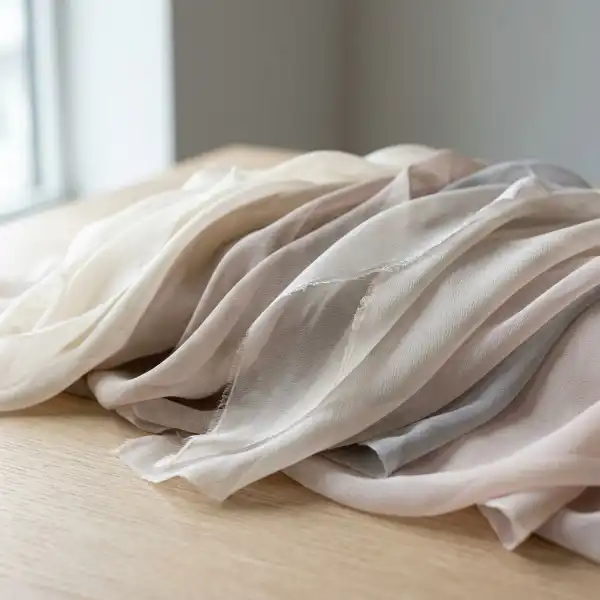
Chiffon is a sheer, lightweight woven fabric made to create a fine, slightly textured surface and a soft, floating drape, although its exact performance depends on the fiber, yarn, weave density, finishing, and garment construction.
The term is commonly associated with silk, but chiffon is not synonymous with silk. It is better understood as a fabric category. The Museum at the Fashion Institute of Technology describes silk chiffon as an airy plain-weave fabric, illustrating how the same fiber can produce very different results when its textile structure changes. Silk can become chiffon, satin, organza, or many other fabrics; likewise, chiffon can be produced from fibers other than silk.
This is one of the most important buying distinctions. A supplier quotation that says only “chiffon” does not provide enough information for product approval. A fashion team still needs the fiber composition, fabric weight, usable width, finish, colorfastness expectations, minimum order quantity, testing requirements, and an actual swatch or sample yardage.
How chiffon gets its characteristic surface
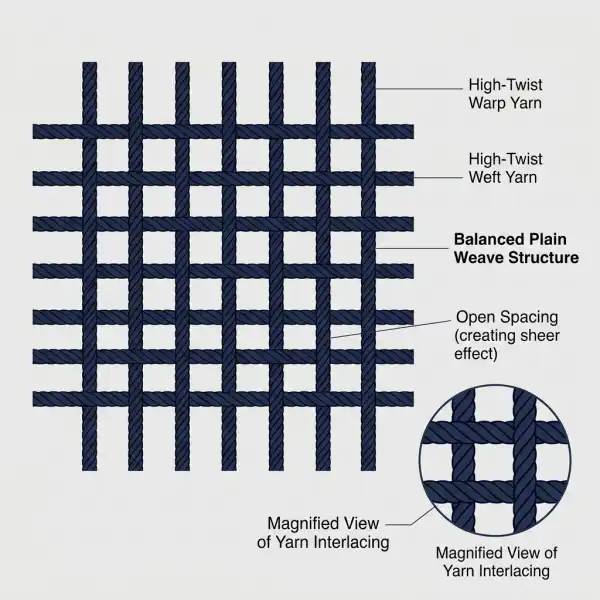
Most conventional chiffon is made in a plain-weave construction using fine, highly twisted yarns. The high twist contributes to the fabric’s faintly pebbled or crepe-like hand rather than the flat, glassy surface associated with some other lightweight woven fabrics. Yarn direction, twist level, density, fiber type, and finishing all influence the final effect, so not every chiffon feels equally crisp, dry, soft, or fluid.
The sheer appearance comes from the combination of fine yarns and a relatively open or low-density structure. Light passes between and through the yarns, while layering increases color depth and opacity. This is why a single layer can appear delicate and translucent, yet several layers can build visual volume without the heaviness of a dense cloth.
Chiffon is woven, not knitted. It may have some give—especially on the bias or because of yarn and finishing effects—but ordinary chiffon should not be assumed to have the elastic stretch of a knit or an elastane blend. Readers comparing basic textile structures can refer to the practical differences between woven and knit fabrics.
The Main Characteristics of Chiffon
Chiffon is valued because several visual and physical qualities appear together: transparency, low weight, movement, a fine textured hand, and the ability to form soft layers. These characteristics are related, but they should not be treated as fixed specifications. A dense polyester chiffon used for a modest blouse will not behave exactly like an ultra-light silk chiffon selected for an eveningwear overlay.
Sheerness and layered opacity
Transparency is central to chiffon’s identity. In product development, however, “sheer” is not a sufficiently precise instruction. Opacity changes with color, print coverage, fabric density, lighting, number of layers, garment ease, and whether the cloth is stretched across the body. A pale chiffon may reveal more than a darker version of the same base cloth, while a dense print can visually obscure areas without making the material physically opaque.
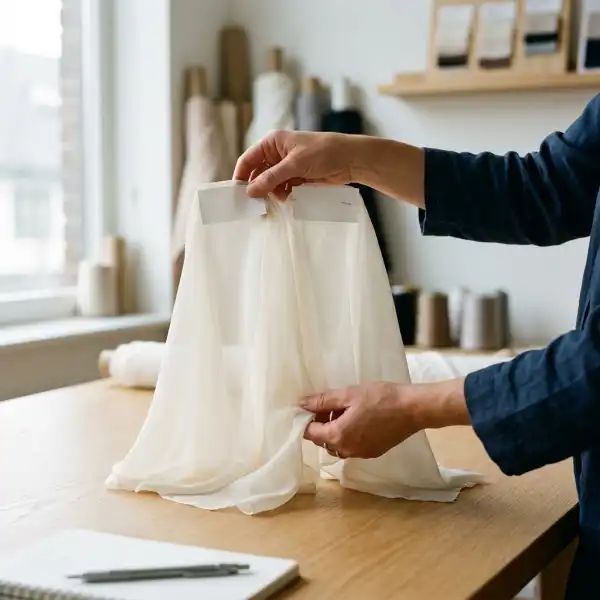
Brands should assess opacity on a full-size sample over the intended lining and under realistic lighting. A swatch viewed flat on a desk can hide problems that become obvious when the garment moves, sits against skin, or is photographed with flash.
Fluid drape and movement
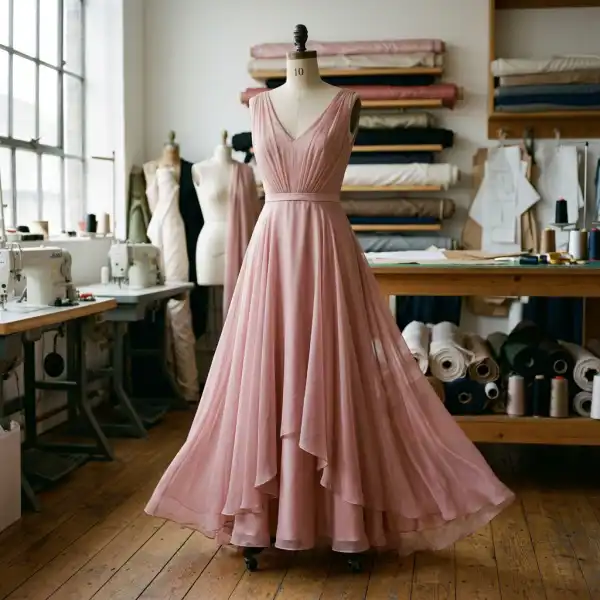
Chiffon generally falls in soft folds and responds visibly to movement. That makes it useful for gathered skirts, flutter sleeves, scarves, draped panels, and layered dresses. The fabric’s movement can add dimension without relying on heavy structure.
Yet “fluid” does not mean that every chiffon hangs identically. Silk, polyester, nylon, and viscose-based versions may differ in hand, density, static behavior, surface luster, and recovery. Finishes can also make a fabric softer or crisper. Designers should therefore approve drape on a half-scale or full toile rather than selecting from fiber content alone.

Fine texture rather than a completely smooth face
The high-twist yarns used in chiffon usually give it a subtle grainy or crepe-like feel. This texture distinguishes it from some smooth, sheer fabrics and helps diffuse reflected light. Depending on the yarn and finish, the surface may look matte, softly lustrous, or slightly sparkling.
This visual nuance affects merchandising. A softly matte chiffon can support understated occasionwear, while a brighter filament yarn may read as more formal or decorative. Product photography should preserve the texture instead of smoothing it away through excessive retouching.
Light weight with limited tolerance for abrasion
Chiffon’s delicacy is part of its appeal, but it creates practical vulnerabilities. Fine yarns and an open construction can be vulnerable to snagging from jewelry, rough surfaces, hook-and-loop fasteners, damaged hangers, or exposed zipper components. Seams may distort or show stress if the pattern is too tight, the seam allowance is inadequate, or the stitch and needle combination is poorly chosen.
The correct conclusion is not that chiffon is universally weak. Performance varies materially by specification and construction. The useful lesson is that fabric strength, seam performance, and snag resistance must be tested in the intended garment—not inferred from the name “chiffon.”
Chiffon Fiber Types and What They Mean in Practice
Fiber composition changes the commercial and sensory performance of chiffon. The table below is a decision guide, not a universal ranking; suppliers may use different yarn sizes, finishes, and fabric weights within each category.
|
Chiffon type |
Typical product character |
Potential advantages |
Points to verify |
|
Silk chiffon |
Fine, light, fluid, often softly lustrous |
Refined hand and strong luxury association |
Price, shade consistency, care method, colorfastness, seam behavior, and supplier traceability |
|
Polyester chiffon |
Widely available with varied weights, finishes, colors, and prints |
Commercial scalability, consistency, and often a lower material cost than silk |
Static, heat sensitivity, snagging, pilling or filament damage, handfeel, and required care |
|
Nylon chiffon |
Light, sheer, and potentially resilient depending on specification |
Useful where lightness and synthetic-fiber performance suit the design |
Heat sensitivity, yellowing or color change risk, snagging, and end-use suitability |
|
Viscose or other regenerated-cellulosic chiffon |
Often selected for a softer or more absorbent hand |
Fluid feel and a different moisture response from common synthetics |
Wet strength, shrinkage, dimensional stability, colorfastness, and care instructions |
|
Blended chiffon |
Engineered to balance cost, hand, durability, or appearance |
Can combine selected characteristics |
Exact percentages, batch consistency, testing results, and whether the claimed benefit is measurable |
Fiber names alone do not predict the whole result. A high-quality polyester chiffon can be more appropriate than a silk option for a uniform program that needs repeat ordering and color consistency. Conversely, a premium capsule collection may justify silk chiffon when its hand, movement, and material story are visible enough to support the price position.
Sustainability claims require the same discipline. “Natural,” “synthetic,” “recycled,” or “plant-based” does not by itself establish lower impact. Fiber origin, production process, energy source, chemical management, durability, care, yield loss, transport, and end-of-life conditions all shape the product’s actual profile. A credible claim should refer to traceable evidence rather than the fabric name.
Where Is Chiffon Used in Fashion?
Chiffon works best when its transparency and movement contribute to the design. It is less convincing when chosen merely because it is associated with femininity or formalwear. The fabric needs a clear job within the garment.
Dresses and occasion wear
Evening dresses, bridesmaid dresses, formal gowns, and celebration wear often use chiffon for floating skirts, gathered bodices, capes, draped panels, or layered overlays. Multiple layers can create volume and color depth while keeping the silhouette visually light. Linings, internal support, and opaque foundation fabrics usually carry the functional burden that chiffon cannot.
Chiffon and organza may both appear in formalwear, but they serve different structural intentions. Chiffon is commonly chosen for soft movement, while organza is generally associated with a crisper hand and greater shape retention. A detailed decision framework belongs in the comparison of chiffon and organza for fashion design.
Blouses, sleeves, and modest layering
In tops, chiffon can create volume without visual bulk. Balloon sleeves, tie necks, ruffles, and gathered yokes make use of its low weight. For modest-fashion applications, the fabric can provide a light outer layer, although sufficient coverage still depends on lining, layering, color, and garment ease.
Commercial teams should review the entire wearing experience. A blouse that looks elegant on a sample mannequin may feel static-prone, reveal undergarment lines, or pull at the armhole during movement. Fit testing should include sitting, reaching, walking, and exposure to several lighting conditions.
Scarves, overlays, and decorative components
Chiffon is also used for scarves, detachable capes, flounces, ruffles, bows, and sheer panels. These applications can make efficient use of a small amount of material, but narrow hems and bias edges require consistent workmanship. On printed chiffon, motif scale and placement also need attention because transparency allows underlying layers to alter the perceived color.
The broader appeal of transparency, layering, and movement is explored in why sheer fabrics remain relevant in dresses and occasion wear.
What Chiffon Means for Product Development and Manufacturing
Chiffon magnifies small production errors. A slightly uneven cut edge, inconsistent hem width, puckered seam, or distorted neckline is more visible because the fabric is light and often layered against a contrasting surface. Successful production therefore depends on controlling the cloth from sampling through packing.
Start with an end-use specification, not a generic fabric request
A useful development brief should state the intended garment, level of sheerness, target drape, approximate weight, composition, width, color or print, finish, lining plan, care expectation, testing standard, and acceptable shade variation. The team should also confirm whether the approved swatch represents bulk production or only a sampling quality.
Before approval, evaluate at least these points:
- appearance in single and multiple layers;
- drape in the grain and bias directions;
- surface consistency and visible barre or streaks;
- snagging and yarn displacement under realistic handling;
- seam appearance and slippage risk in the proposed construction;
- shrinkage, colorfastness, and dimensional stability under the intended care method;
- compatibility with lining, interlining, trims, embellishment, and closure components.
This assessment prevents a common sourcing failure: approving chiffon for its color and price, then discovering during sewing that the fabric shifts, shows needle damage, or does not provide the expected coverage.
Stabilize cutting before attempting to accelerate it
Chiffon can shift between layers and distort when handled with too much tension. Cutting teams may need lower lay heights, a stable underlay, sharp tools, controlled marker placement, and additional time for relaxation and alignment. The right method depends on the fabric, equipment, order volume, and factory capability.
For small runs, careful single-ply cutting may be more reliable than building a high lay that slips. For larger orders, the factory should validate spreading and cutting through trials before setting an efficiency target. The wider relationship between accuracy, lay control, and material loss is covered in the fabric cutting process for garment production.
Engineer seams, hems, and pressing around the actual cloth
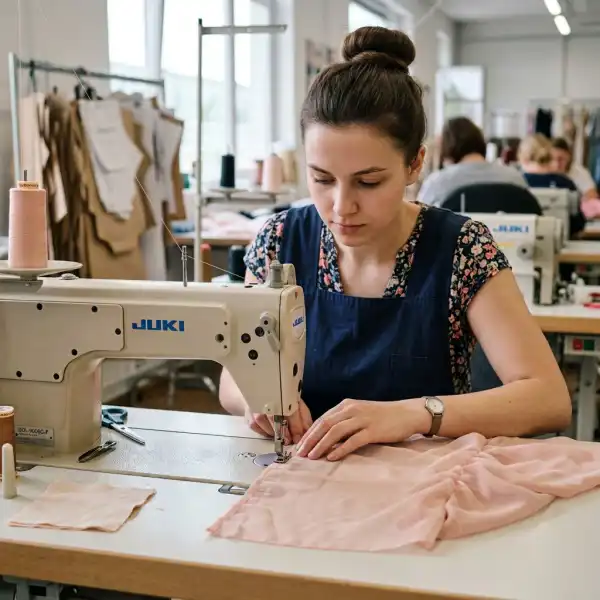
There is no single sewing recipe for all chiffon. Needle size and point, thread, stitch density, seam type, seam allowance, feed mechanism, and machine tension should be tested together. A fine needle may reduce visible damage, but an unsuitable stitch density or excessive tension can still create puckering. French seams or other enclosed seam treatments are often considered for sheer garments because the inside remains visible, yet suitability depends on seam shape, bulk, cost, and production skill.
Hems deserve a separate operation trial. Narrow rolled hems can suit chiffon, but consistency is difficult on curved or bias edges. Pressing should use the lowest effective heat and a test swatch, particularly with heat-sensitive synthetic fibers. Direct heat, pressure, or steam may change surface character, produce shine, or distort a delicate edge.
Build quality control around visible failure modes
Final inspection should go beyond measurements. Inspectors need consistent lighting and a contrasting surface to detect holes, pulls, shade variation, oil marks, seam grin, puckering, twisted panels, uneven hems, and damage from handling. Layered garments should be checked while hanging and moving because an overlay can appear aligned on a table but drop unevenly on the body.
Packaging matters as well. Rough tissue, exposed fasteners, sharp tags, or overcrowded cartons can create snags or deep creasing after the garment has passed inspection. For premium occasionwear, the last meter of handling can undo hours of careful sewing.
How Should Chiffon Be Cared For?
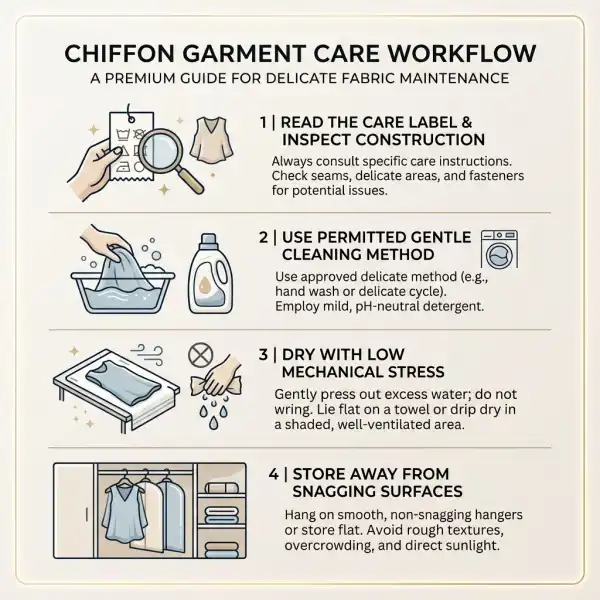
Chiffon should be cared for according to the permanent care label and the complete garment construction—not according to the fabric name alone. Fiber content, dye, print, pleating, lining, interlining, embellishment, and trim may each limit the safe cleaning method.
In the United States, the Trade Commission’s Care Labeling Rule guidance requires covered manufacturers and importers to provide a care method supported by a reasonable basis. Other markets have their own labeling requirements, so brands should verify the rules in every destination market rather than copying a competitor’s label.
Cleaning chiffon without making assumptions
If the label permits hand washing, use cool or lukewarm water, a suitable mild detergent, minimal agitation, and careful support when lifting the wet garment. Do not wring or twist. If machine washing is allowed, a protective mesh bag and delicate cycle may reduce mechanical abrasion, but the labeled method remains the primary instruction.
Some silk, embellished, structured, pleated, or multi-material chiffon garments may require professional cleaning. Polyester chiffon is not automatically machine washable; trims, dyes, heat-set pleats, coatings, or garment construction can still impose restrictions. When the label is missing or the garment is high value, advice from a qualified textile-care professional is safer than a generic internet remedy.
Drying, pressing, and steaming
Remove excess water by supporting the garment and gently blotting it with a clean towel when wet cleaning is permitted. Drying flat may help prevent distortion for some garments, while a well-supported hanger may suit others; the construction and weight determine the better method. Avoid strong heat unless the care instruction explicitly permits it.
For pressing, test an inconspicuous area or sample first. Use a clean press cloth, low effective temperature, and light pressure. Synthetic chiffon can be particularly sensitive to high heat, while silk can be affected by water spotting, excessive moisture, or inappropriate temperature. A steamer should not be held so close that it wets or deforms the fabric.
Storage and everyday handling
Store chiffon away from snagging hardware, rough hangers, direct sunlight, dampness, and crowded rails. Support heavy dresses so that embellished bodices or long skirts do not place prolonged stress on delicate shoulder seams. For valuable or long-term storage, the Smithsonian recommends minimizing abrasion, pressure, and sharp folds when storing textiles. Household garments do not require museum treatment, but the underlying principle—reduce stress on delicate cloth—is practical.
Common Chiffon Mistakes That Create Costly Problems
Treating “chiffon” as a complete material specification
This mistake usually begins with a visual reference and a price request. The sourcing team receives several fabrics that are all technically sold as chiffon, but they differ in weight, fiber, twist, finish, opacity, and drape. Sampling proceeds before a standard is defined, making later bulk rejection difficult to justify.
The better approach is to approve a physical standard, measurable specifications, test requirements, and tolerance limits. The name identifies a category; the approved standard defines the product.
Approving the fabric without the lining
A lining can change color, contrast, static behavior, warmth, drape, and perceived quality. When fabric and lining are sourced separately, the two may cling, move at different rates, or create unwanted shine. Teams should review both materials as a system and confirm how they behave after cleaning.
This is especially important for pale dresses, fitted blouses, and occasionwear photographed under strong light. Opacity must be judged on the finished layer combination, not on an isolated swatch.
Using a tight silhouette without testing seam stress
Chiffon may look fluid on a mannequin yet experience concentrated stress at armholes, side seams, zippers, and seat areas during wear. If ease is insufficient or seam engineering is weak, yarns can shift and the seam may open visually even when the stitches remain intact.
A wear trial on the intended size range is more informative than a static fitting. Pattern ease, reinforcement, seam allowance, stitch configuration, and fabric performance need to work together.
Assuming delicate care instructions solve a weak product
A restrictive care label should not compensate for untested dye, unstable pleating, fragile seams, or incompatible trims. Care instructions must be accurate, but product development still needs to create a garment that performs reasonably within its intended use and price position.
If a mass-market blouse requires specialist handling after every wear, customer dissatisfaction may follow even when the label is technically correct. Care expectations should be considered at the concept stage, not written after production is complete.
What Fashion Businesses Should Verify Before Buying Chiffon
The most effective chiffon decision combines creative intent with operational evidence. Before committing to bulk fabric, brands and manufacturers should align on five questions:
- What visual job must the fabric perform? Define the required transparency, movement, layering effect, surface luster, and color behavior.
- What performance must the garment survive? Identify likely abrasion, seam stress, laundering, pressing, packing, and wearing conditions.
- Can the factory control it consistently? Confirm spreading, cutting, sewing, hemming, inspection, and repair capability through production trials.
- Does the material suit the commercial model? Review cost, minimum order quantity, lead time, repeatability, shade continuity, yield, rejection risk, and care expectations.
- Are claims and labels supportable? Verify fiber composition, care instructions, origin or certification claims, and destination-market requirements with appropriate documentation.
For a small label, the practical choice may be a stable stock-service polyester chiffon that reduces minimum-order and repeat-color risk. For a luxury made-to-order line, silk chiffon may provide a material experience that customers can perceive and value. The strategic answer depends on the product promise, not on a universal hierarchy of fibers.
Frequently Asked Questions About Chiffon
Is chiffon a natural or synthetic fabric?
Chiffon can be either natural, synthetic, regenerated-cellulosic, or blended because the word describes a fabric type rather than one fiber. Silk chiffon uses a natural protein fiber; polyester and nylon chiffon use synthetic fibers; viscose chiffon uses regenerated cellulose. Always check the fiber-content label or supplier specification. Composition affects handfeel, heat response, moisture behavior, price, care, and sourcing decisions, but construction and finishing remain important. A brand should therefore avoid writing product copy that uses “chiffon” as proof of silk or any other fiber.
Is chiffon breathable?
Chiffon can feel airy because it is lightweight and sheer, but breathability and comfort depend on more than openness. Fiber type, weave density, number of layers, lining, finish, garment fit, humidity, and activity level all influence heat and moisture transfer. A loose single-layer chiffon sleeve may feel light, while a multi-layer polyester dress with a dense synthetic lining may feel warm. For product claims, test the complete garment or use careful language rather than assuming that every chiffon construction is breathable.
Does chiffon stretch?
Standard chiffon is a woven fabric and usually does not provide the elastic stretch expected from stretch knits. It may show limited mechanical give, particularly on the bias, and some products include elastane or use specialized yarns and finishes. That movement should not be treated as reliable stretch without testing. Designers planning close-fitting garments should verify extension, recovery, seam behavior, and dimensional stability. Using ordinary chiffon where the pattern requires significant stretch can create seam stress, distortion, or restricted movement.
Is silk chiffon always better than polyester chiffon?
No. Silk chiffon may be preferred for its fine hand, fluidity, material prestige, and luxury positioning, but it can also bring higher cost, sourcing complexity, care restrictions, and shade-control challenges. Polyester chiffon may offer more consistent supply, broad color availability, easier scaling, and a lower entry price, although handfeel, static, heat sensitivity, and fossil-based material concerns require evaluation. “Better” depends on the design, price point, customer expectation, production capability, performance target, and evidence supporting any material claim.
Why is chiffon difficult to sew?
Chiffon is challenging because its low weight and fluid structure can shift during laying, cutting, feeding, and hemming. Needle damage, puckering, seam grin, uneven edges, and distortion become conspicuous on a sheer surface. The solution is not one universal stitch setting. Factories should test the actual cloth with the intended needle, thread, stitch density, seam type, presser-foot pressure, feed system, and pressing method. Production planning should also allow for lower lay height, controlled handling, and more exact inspection where necessary.
Can chiffon be machine washed?
Some chiffon garments can be machine washed, but only when the care label permits it. Fiber content alone is not enough to decide. A washable polyester chiffon blouse may still include a trim, print, pleat, lining, adhesive, or embellishment that requires another method. Conversely, some unembellished products may be designed for gentle home laundering. Brands must validate care instructions on the finished garment, and consumers should follow those instructions rather than applying a generic rule to every chiffon item.
What lining works best under chiffon?
There is no single best lining. Selection depends on the required opacity, drape, stretch, color, static behavior, comfort, cost, and care compatibility. A lightweight lining may preserve movement, while a more structured foundation may support a fitted bodice. The lining and chiffon should be assessed together in motion and after the proposed cleaning process. Teams should also check whether the lining changes the face color, shows through seam allowances, clings to the overlay, or drops at a different rate over time.
Conclusion
Chiffon earns its place in fashion through a particular combination of sheerness, low weight, fine texture, and movement. Those qualities can create soft volume, layered color, and elegant motion in dresses, blouses, scarves, and decorative components. They also make errors in cutting, seams, hems, lining, pressing, and handling unusually visible.
The most useful sourcing principle is simple: chiffon is a fabric category, not a complete specification. Fiber content matters, but so do yarn, density, finish, weight, color, construction, and the capabilities of the factory that will turn the cloth into a garment. Care must likewise be based on the finished product and its validated label, not on a blanket rule for silk or polyester.
For fashion businesses, the strongest result comes from matching material character to a defined design purpose, then validating the decision through sample yardage, garment trials, testing, and realistic care expectations. Chiffon can look effortless. Producing it well rarely is.





Comments 0
Leave a CommentSend Comment
Anda harus Login terlebih dahulu untuk dapat memberikan komentar.