
Why Sheer Fabrics Remain Popular in Dresses and Occasion Wear
Quick Answer
Sheer fabrics remain popular in dresses and occasion wear because they let designers work with light, movement, volume, layering, and controlled visibility at the same time. A transparent layer can soften a silhouette, reveal an opaque foundation, carry embroidery, create volume without looking heavy, or make the garment change as the wearer moves.
Their appeal is broader than the highly exposed “naked dress.” Chiffon, organza, tulle, lace, georgette, mesh, and other sheer materials can be used for sleeves, yokes, overlays, veils, capes, skirts, panels, and decorative details. The amount of coverage can be adjusted through color, print, lining, embellishment, layer count, garment ease, and placement.
For fashion businesses, that versatility is both the opportunity and the risk. Sheer garments can photograph beautifully and support distinctive occasionwear, but they demand precise decisions about opacity, lining, fit, seam visibility, comfort, lighting, care, and customer communication. Editorial attention does not guarantee commercial demand. The most successful products translate the visual idea into a wearable garment for a defined customer, occasion, climate, price, and cultural context.
What Are Sheer Fabrics in Fashion?
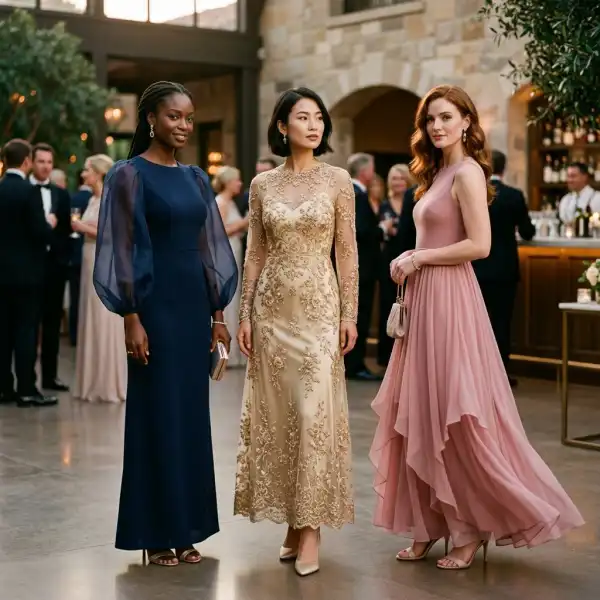
Sheer fabrics are textiles that allow light and varying degrees of visual detail to pass through their structure. “Sheer” describes an optical quality, not one fiber, weave, or manufacturing method. A sheer fabric may be woven, knitted, netted, embroidered, or constructed as lace, and it may use natural, synthetic, regenerated, or blended fibers.
This category includes materials with very different behavior. Chiffon is generally light, fluid, and softly textured; its construction and uses are covered in the complete chiffon fabric guide. Organza is usually crisp and shape-holding. Tulle is an open net structure. Lace creates transparency through patterned open and solid areas. Mesh may range from fine and flexible to technical and firm. Georgette is often more opaque and textured than very light chiffon, although actual specifications vary.
The visual effect depends on more than the fabric name. Yarn size, density, fiber, finish, color, print, embroidery, stretch, number of layers, and distance from the body all alter transparency. A pale fitted mesh can reveal more than a dark loose chiffon; a densely embellished tulle can appear more covered than an unembellished organza.
For sourcing teams, “sheer black fabric” is therefore not a useful specification. The request should identify the design role, required coverage, movement, structure, skin contact, stretch, surface, embellishment, and care expectation.
Sheer is a design system, not simply a material choice
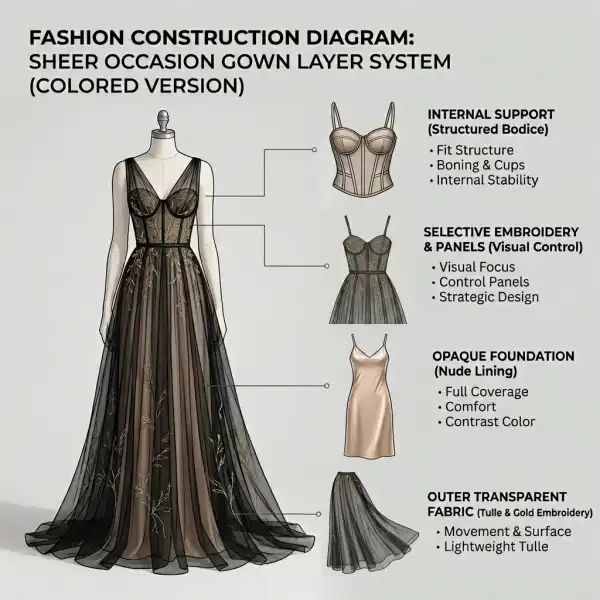
Most successful sheer garments rely on a system of layers. The sheer shell may provide movement or surface interest, while a lining, slip, bodysuit, facing, corset, modesty panel, or strategically placed embellishment provides coverage and support. Seams, darts, boning, closures, and pockets may be concealed, revealed, or deliberately incorporated into the visual composition.
This is why a sheer dress cannot be developed by approving the outer fabric alone. The foundation garment and the space between layers often determine whether the result feels refined, uncomfortable, overly revealing, or visually confused.
Are Sheer Fabrics Still Popular in 2026?
Sheer dressing continues to have strong editorial and runway visibility in 2026, but that visibility should be interpreted carefully. Vogue’s summer 2026 trend coverage described sheer dressing across spring/summer collections and its continuation into fall 2026, citing designers with different approaches rather than one uniform look. Vogue also included the sheer maxi dress among its notable summer 2026 dress directions.
These references establish current fashion relevance; they do not prove that every customer wants a fully transparent dress or that the same product will sell in every region. Runway collections, celebrity dressing, editorial styling, bridal retail, occasionwear marketplaces, and mainstream apparel operate under different levels of exposure, price, novelty, and wearability.
The commercially important development is not just more transparency. It is the widening range of ways to style it. Sheer fabric can be worn over slips, trousers, swimwear, base layers, tonal underwear, or another dress. Vogue’s spring 2025 sheer styling coverage paired chiffon, organza, and tulle with both romantic and casual wardrobe pieces. That kind of contrast moves sheer materials beyond a single red-carpet formula.
Popularity is cyclical, but the design language is persistent
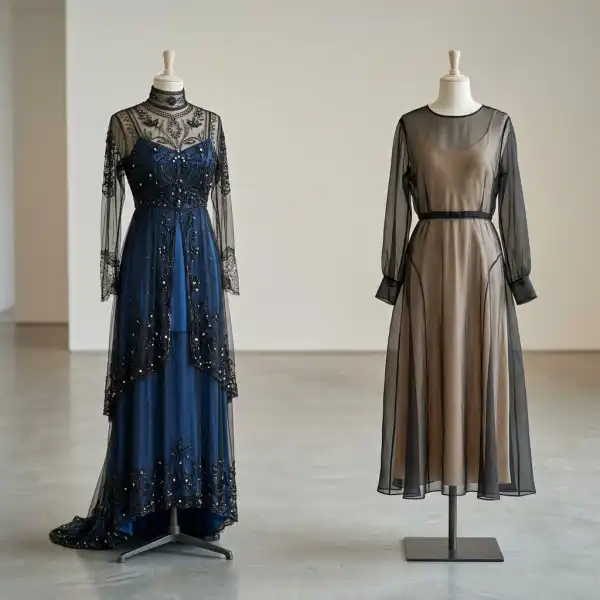
The prominence of sheer fashion rises and falls, yet transparency itself is not new. Historical eveningwear often used transparent nets, lace, gauze, chiffon, or other light layers over opaque understructures. A Fashion History Timeline analysis of a 1910–1914 Callot Soeurs evening dress describes an opaque underdress beneath a transparent, elaborately embellished overlay.
The styling, body ideals, social meanings, available fibers, and construction methods have changed substantially since then. The enduring principle is the interaction between what is revealed and what remains covered. Designers repeatedly reinterpret that relationship for the expectations of their own period.
Why Transparency Works So Well in Dresses
Dresses give sheer materials a large visual field. A sleeve, shoulder, bodice, skirt, train, or full-length overlay can interact with the body and foundation layer in different ways while remaining part of one coherent garment. This scale allows designers to control the pace of visual information from neckline to hem.
Sheer layers create depth without relying on heavy fabric
An opaque dress presents its surface directly. A sheer overlay creates distance between the viewer and the layer below. That space can make color appear deeper, soften a print, blur seam lines, or allow embroidery to seem suspended over the body.
Multiple fine layers can build volume and opacity gradually. This is especially useful in skirts, capes, and trains where the design needs visual presence without the solid mass of a dense cloth. The final garment may still become heavy when fabric consumption, embellishment, lining, or long trains are added, so “looks light” should not be confused with low physical weight.
Movement makes transparency dynamic
As the wearer walks, layers separate, overlap, and catch light differently. Chiffon can ripple and collapse into soft folds; tulle can float; organza can hold a projected curve; stretch mesh can follow the body. A dress may appear more covered while standing and more transparent when the skirt lifts or the fabric pulls across a moving joint.
This changeability is one reason sheer fabrics are effective in entrance moments, dance, performance, wedding photography, and red-carpet movement. It is also a fit and communication risk. Brands must show how the garment behaves rather than presenting only a carefully controlled front pose.
Sheer fabric can provide volume without visual blockage
Occasionwear often uses enlarged sleeves, overskirts, bows, peplums, and ruffles to create drama. An opaque version can dominate the wearer or hide the silhouette below. A sheer material introduces volume while allowing the underlying body line, garment, or negative space to remain visible.
Organza is particularly useful for crisp translucent shapes, whereas chiffon is generally more suitable for soft movement. The functional differences are explored in the fashion design comparison of chiffon and organza.
Transparency makes embellishment appear lighter
Embroidery, beads, sequins, appliqués, feathers, and dimensional flowers can be attached to a sheer ground so that the decoration appears to float. This effect is central to many evening and bridal designs. The base fabric becomes less visually dominant while the embellishment defines coverage and pattern.
The construction is rarely effortless. Concentrated decoration can pull, stretch, or distort a light base. Carrying threads, backing, seam allowances, and reinforcement may show through. The team needs to plan the reverse side and weight distribution with the same care as the visible motif.
Why Sheer Fabrics Suit Occasion Wear
Occasion wear is purchased for moments when customers expect clothing to feel different from everyday basics. Sheer materials can signal that difference through lightness, movement, surface complexity, and contrast with opaque foundations. They also respond strongly to event lighting, photography, and movement.
That does not make sheerness inherently formal. The same mesh or organza can look sporty, utilitarian, romantic, minimal, theatrical, or subcultural depending on pattern, color, styling, finishing, and what is worn underneath. Occasion context is created by the whole product.
Weddings and ceremonial dressing
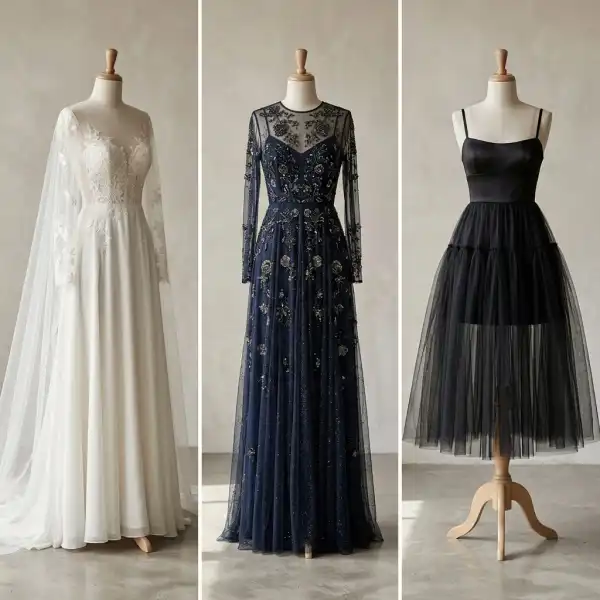
Veils, sleeves, yokes, capes, overskirts, and embroidered overlays allow bridal and ceremonial garments to create coverage and visual lightness in the same look. A transparent sleeve may provide more coverage than a sleeveless dress without adding the visual weight of an opaque sleeve. A detachable sheer cape can alter the silhouette between ceremony and reception.
Cultural and religious expectations vary widely. “Modest” cannot be defined through one global standard, and a nude-toned mesh may not be acceptable simply because it technically covers the skin. Brands serving multiple regions need local customer knowledge, accurate photography, and options for lining or customization.
Evening events and red-carpet dressing
Sheer surfaces interact well with directional light, flash, sequins, crystals, and metallic embroidery. They can create high visual impact without depending on print or saturated color. This makes them attractive for media-facing events where front, side, back, and movement views all matter.
Celebrity styling may tolerate exposure, fragility, or limited mobility that a retail customer will not. A gown worn once with a stylist, tailor, transport team, and controlled venue is not a direct product benchmark for a dress expected to survive shipping, dressing without assistance, sitting, dining, dancing, cleaning, and repeat wear.
Prom, party, and accessible occasionwear
At more commercial price points, sheer fabric can create a strong visual effect from a relatively small component: sleeves, a neckline insert, a gathered overlay, or a skirt layer. This can help differentiate a simple base pattern without rebuilding the entire garment.
Cost savings are not automatic. Fine hems, extra layers, lining, embroidery, specialist operations, snag-related rejection, and protective packaging can make the finished product more expensive than the shell price suggests. Product teams should calculate total garment cost rather than assuming lightweight fabric means low cost.
Sheer Does Not Have to Mean Highly Revealing
The most visible examples of sheer fashion often expose large areas of the body, but transparency can be calibrated. A garment can use sheer fabric to soften coverage rather than remove it.
Designers control exposure through several linked decisions:
- Placement: sleeves and upper yokes create a different effect from transparent bust, waist, or hip panels.
- Layering: slips, bodysuits, briefs, bandeaus, shorts, and partial linings change the visible area.
- Color: tonal foundations reduce contrast, while contrasting layers emphasize transparency.
- Print and embellishment: dense motifs interrupt the view and can create selective coverage.
- Volume: loose fabric generally reveals differently from a fitted sheer layer stretched over the body.
- Layer count: overlapping panels build opacity and can move between transparent and covered states.
- Styling: trousers, shirts, knitwear, jackets, and footwear can shift sheer garments toward everyday or occasion use.
These options broaden the potential audience, but they must be designed—not improvised by the customer after purchase. If the e-commerce image shows a slip that is not included, the product page should make that clear. If customers need a specific undergarment to reproduce the look, merchandising should explain or provide a compatible option.
The Business Value of Sheer Fabrics
Sheer materials can offer meaningful product value when they help a brand create a recognizable silhouette, adaptable styling, or surface detail that customers can perceive. Their strongest commercial advantage is not transparency itself but design flexibility.
One outer layer can support several styling levels
A sheer dress or skirt may be styled over an opaque slip for formal coverage, a tonal bodysuit for a more exposed evening look, or trousers and a shirt for fashion-led layering. Detachable linings, capes, sleeves, or overskirts can extend this flexibility further.
The idea is commercially useful only when compatibility is solved. Different underlayers can change fit, static, heat, color, and mobility. Offering several styling images without testing the combinations can create unrealistic customer expectations.
Sheer components can create a brand signature
Repeated use of translucent sleeves, layered hems, embroidered mesh, or organza volume can build visual recognition across collections. This works best when the technique connects to a clear design point of view rather than appearing as a seasonal attachment.
A signature also requires repeatable sourcing and workmanship. If each season uses an unrelated sheer fabric with different hand, shade, stretch, and care, the brand may struggle to deliver consistent fit and quality even when the photographs look coherent.
Sheer materials generate visually rich content
Light passing through a dress, moving layers, and floating embellishment can produce strong still images and video. These qualities support campaign storytelling, detail shots, movement clips, and social content.
Content must remain accurate. Backlighting can exaggerate transparency, while front lighting can hide it. Retouching can remove seam lines, wrinkles, or visible underwear that customers will see in real life. The goal is to communicate the material clearly, not only make the campaign dramatic.
Product Development Challenges Behind the Visual Appeal
Sheer designs reveal decisions that opaque fabric can conceal. Pattern lines, seam allowances, facings, labels, and internal support become visible, and small inconsistencies can interrupt the intended lightness.
Coverage must be tested in realistic conditions
Opacity should be reviewed on every approved color over the intended foundation and across the size range. Pale colors, dark colors, prints, and skin-adjacent shades may behave differently. Strong daylight, retail lighting, stage lighting, and camera flash can reveal details that are not visible in the sample room.
Fit changes transparency. A mesh or woven sheer fabric pulled tightly over the bust, hip, thigh, or arm can reveal more and place additional stress on seams. This makes accurate garment measurement and adequate ease particularly important. Teams can strengthen their process through clear garment measurements for apparel production.
Linings need their own specification
A lining affects opacity, color, comfort, heat, static, recovery, drape, and care. It should be selected with the shell, not after the dress has already been approved. The two layers need compatible movement; otherwise, the outer skirt may twist, cling, or hang at a different rate.
For inclusive product development, offer lining shades based on the actual target customer rather than treating one beige as a universal “nude.” Tonal does not always mean skin-matched, but the product description should use accurate color language.
Seams and edges become part of the surface
French seams, narrow hems, binding, appliqué coverage, or intentionally exposed construction may all work, depending on the design. No single finish is correct for every sheer textile. Chiffon shifts and puckers differently from crisp organza; stretch mesh requires different seam engineering from woven tulle.
The factory should test needle, thread, stitch density, tension, seam type, seam allowance, pressing, and handling on the exact bulk fabric. Fabric cutting also needs control because shifting layers and distorted grain can create mismatched overlays; see the garment fabric cutting process for the wider operational context.
Comfort can conflict with visual impact
Rough mesh, crisp organza edges, concentrated beads, exposed sequins, boning, or stiff seam allowances can irritate skin. Multiple layers may reduce the airy feel that customers associate with transparency. Fitted sheer garments may also limit the undergarments a customer can wear comfortably.
Wear tests should include sitting, walking, reaching, dancing, restroom use, dressing and undressing, and several hours of skin contact. A five-minute fitting cannot reveal the full occasionwear experience.

Retail and E-Commerce Implications
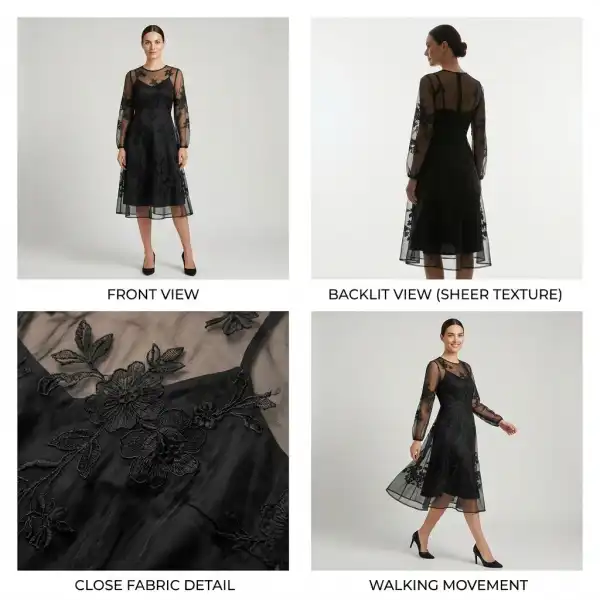
Customers cannot judge transparency reliably from a single image. The product page has to answer questions that would be obvious in a fitting room: what is included, what is visible, whether the lining is attached, how the garment looks in motion, and what undergarments are practical.
A useful sheer-garment product page should provide:
- front, side, and back views in consistent light;
- a close-up showing weave, mesh, lace, or embellishment density;
- an image with backlighting where it reflects realistic use;
- movement video for skirts, capes, sleeves, and overlays;
- explicit notes on lined, partially lined, or unlined areas;
- clarification on whether slips, bodysuits, briefs, or other styling pieces are included;
- fabric composition, stretch, care, and fit information;
- model measurements and the size worn, without implying identical coverage on every body.
Returns may still occur because personal comfort with visibility is subjective. Accurate content cannot eliminate that difference, but it can reduce avoidable surprise. The product description should use concrete language such as “unlined from mid-thigh to hem” rather than a vague phrase like “subtly sheer.”
Common Mistakes Brands Make With Sheer Occasion Wear
Copying runway exposure without translating it for retail
Runway and celebrity looks may prioritize image over repeat wear. A commercial version needs appropriate coverage, mobility, dressing access, care, and size grading. Reducing the exposure without reconsidering seam placement or embellishment can create an awkward compromise rather than a wearable adaptation.
Start from the target customer and occasion, then preserve the core design idea through proportion, layering, or surface—not through literal copying.
Treating the lining as an invisible commodity
The lining determines much of the color and comfort, yet teams sometimes source it late to reduce cost. A poor match can make an expensive outer fabric look flat, create static, show sweat, restrict movement, or require incompatible care.
Approve the shell and foundation as one material system and retain both physical standards.
Using “nude” as if it were one objective color
One pale beige does not disappear against every skin tone. It can also create an unintended contrast that changes the design. Brands should name colors accurately, show them on relevant models where possible, and consider multiple foundation options when skin-adjacent illusion is central to the product.
Assuming sheer means breathable or cool
Openness and low visual weight can contribute to an airy impression, but comfort depends on fiber, density, number of layers, lining, finish, fit, humidity, and activity. A heavily beaded mesh gown with a synthetic foundation may feel warm despite looking light.
Avoid comfort claims that have not been validated on the finished garment.
Hiding transparency through photography
If images make an unlined dress appear opaque, the first real-world wear becomes the customer’s discovery point. That may increase dissatisfaction and damage trust. Show both flattering and informative views. Accurate merchandising is especially important when coverage changes under flash or strong sunlight.
What Fashion Businesses Should Verify Before Acting
Sheer fabrics are strategically useful when the business can connect design intention, customer expectations, and operational capability. Before approval, verify five areas:
- Customer and occasion: Where will the garment be worn, and what level of coverage, mobility, care, and repeat use does that customer expect?
- Complete material system: Have the shell, foundation, trims, closures, embellishment, thread, and labels been tested together?
- Full-size behavior: Does transparency, drape, support, and movement remain acceptable across sizes and under several lighting conditions?
- Production feasibility: Can the factory cut, sew, finish, inspect, press, repair, and pack the design consistently at the planned volume?
- Commercial truth: Do the price, margin, product description, imagery, included components, care label, and material claims accurately reflect the finished garment?
For most brands, the best sheer product is not the most visually exposed or technically elaborate. It is the one whose transparency has a clear purpose and whose customer can understand, wear, and care for it without an unpleasant surprise.
Frequently Asked Questions About Sheer Fabrics
Why are sheer dresses popular again?
Sheer dresses have renewed runway and editorial visibility because transparency supports several current styling directions: soft layering, body-conscious dressing, lingerie references, embellished surfaces, and contrast between delicate fabric and casual pieces. Yet “again” can be misleading because sheer materials have recurring roles throughout fashion history. What changes is the proportion, styling, coverage, and cultural meaning. For brands, current visibility is a creative signal rather than proof of universal demand. Product decisions should still be based on the target customer, market, climate, occasion, price, and sell-through evidence available to the business.
What fabrics are commonly used for sheer dresses?
Common options include chiffon, organza, tulle, lace, georgette, voile, gauze, and knitted mesh. They are not interchangeable. Chiffon is usually selected for fluid movement, organza for crisp translucent volume, tulle for netted structure, lace for patterned transparency, and mesh for effects ranging from soft stretch to technical firmness. Each may also be made from different fibers and finishes. Designers should choose according to the required drape, stretch, coverage, surface, skin contact, embellishment, durability, care, and production method rather than selecting by appearance alone.
Are sheer fabrics appropriate only for evening wear?
No. Sheer fabrics also appear in blouses, shirts, skirts, knit layers, beachwear, active-inspired products, traditional dress, and everyday layering. Occasion wear makes especially visible use of them because events encourage movement, embellishment, dramatic silhouette, and special styling. The same fabric can shift categories depending on what is worn underneath and how it is cut. A semi-sheer organza shirt over a tank and trousers reads differently from an embroidered organza gown, even though both use transparency.
How can brands make sheer dresses more wearable?
Brands can improve wearability through considered lining, adjustable or detachable slips, strategic panel placement, comfortable seam finishes, adequate ease, inclusive foundation shades, and clear styling guidance. They should also test dressing access, sitting, movement, skin contact, lighting, and care on the complete garment. Adding coverage after the sample is finished may distort the original design, so wearability needs to enter the brief early. Product pages should state exactly which areas are lined and whether any slip or bodysuit shown in the images is included.
Do sheer fabrics work for different body types?
They can, but the same design will not create identical coverage or tension across bodies and sizes. Fit, fabric stretch, ease, panel placement, foundation color, motif scale, and lining shape influence the result. Size grading should not simply enlarge transparent areas proportionally without reviewing support and coverage. Fit sessions across the intended size range are particularly important for fitted mesh, illusion panels, bodices, and thigh-level linings. Inclusive design means engineering the garment for its customers, not claiming that one construction is universally flattering.
Are sheer fabrics difficult to manufacture?
Many are demanding because they shift, fray, snag, stretch, retain needle marks, or reveal internal construction. The exact difficulty depends on whether the fabric is woven, knitted, netted, embroidered, or embellished. Factories may need controlled spreading, lower lay heights, sharp tools, fine needles, specialized seams or hems, careful pressing, and more detailed inspection. A full operation trial should precede production costing. Lightweight appearance does not mean a low-skill or low-cost garment.
Are sheer dresses sustainable?
Sheerness does not determine sustainability. A sheer dress may use silk, virgin or recycled synthetics, regenerated fibers, blends, metallic decoration, adhesives, or multiple materials that have different impact and end-of-life implications. Layer count, cutting waste, durability, care, repairability, and how often the garment is worn also matter. Brands should avoid calling a product sustainable because it is lightweight or uses less-looking material. Environmental claims need specific, traceable evidence for the fibers, processes, and product attributes being described.
Conclusion
Sheer fabrics remain relevant because they give designers unusually precise control over light, movement, coverage, depth, and volume. They can reveal, soften, frame, or obscure. In dresses and occasion wear, those functions become especially visible because the garment has scale, movement, and a context that rewards visual distinction.
Their continued presence is not limited to one highly exposed trend. Transparent sleeves, layered skirts, embroidered overlays, veils, capes, mesh panels, and organza structures serve customers with very different preferences. The creative range is wide; the operational margin for error is not.
Fashion businesses need to develop sheer garments as complete systems. Fabric, foundation, fit, seam, embellishment, lighting, care, photography, and customer expectations all shape the result. When those parts agree, transparency feels intentional. When they do not, a striking sample can become an uncomfortable product, a confusing product page, or an expensive return.





Comments 0
Leave a CommentSend Comment
Anda harus Login terlebih dahulu untuk dapat memberikan komentar.