
Velvet vs Velour: What Makes These Soft Fabrics Different?
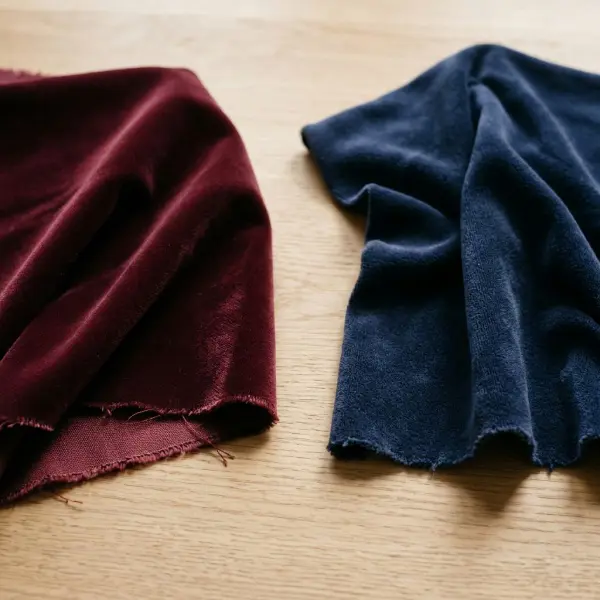
Velvet and velour are often mistaken for the same fabric. Both have soft, plush surfaces, reflect light through their raised fibers, and can give clothing a distinctive sense of texture. In photographs, the difference may be difficult to recognize. Even when handled in person, two fabrics with similar colors and pile finishes can initially feel almost identical.
Yet their underlying structures can be quite different.
Traditional velvet is a woven pile fabric, while velour used in contemporary apparel is commonly knitted. This difference influences how the materials stretch, drape, respond to movement, and behave during garment construction. It also helps explain why velvet is frequently associated with tailored occasionwear, while knitted velour is commonly used for tracksuits, loungewear, and relaxed clothing.
The distinction is not absolute. Some velour fabrics are woven, and certain fabrics marketed as velvet are knitted or contain stretch components. Commercial terminology varies among textile suppliers and product categories.
For fashion businesses, understanding these differences is essential for making informed sourcing decisions. A fabric may deliver the desired appearance but fail to provide the stretch, stability, recovery, or finishing characteristics required by a particular garment.
Quick Answer: What Is the Difference Between Velvet and Velour?
The main difference between traditional velvet and common apparel velour is their textile construction. Velvet is typically a woven fabric with a dense, short-cut pile, while apparel velour is often a knitted fabric with a soft, raised surface. This structural difference commonly affects stretch, drape, garment applications, and manufacturing requirements.
Traditional woven velvet generally has limited natural stretch unless additional stretch engineering is incorporated. Its smooth pile and directional sheen make it suitable for formal dresses, tailored jackets, decorative panels, and other garments where surface appearance is particularly important.
Knitted velour commonly offers greater flexibility because of its loop-based construction. This makes it useful for tracksuits, loungewear, casual dresses, children's clothing, and garments that benefit from comfortable movement.
However, neither name guarantees a specific fiber composition, pile height, weight, durability, or level of stretch. Velour may also refer to certain woven or napped textiles, particularly outside casual apparel.
The most reliable way to distinguish the fabrics is to examine their construction and technical specifications rather than relying on softness or appearance alone.
For fashion brands, the practical question is not simply which fabric looks better, but which construction supports the intended product.
What Are Velvet and Velour Fabrics?
Velvet: A Traditionally Woven Pile Fabric
Velvet is traditionally a woven textile with a dense surface of short, cut pile fibers. These pile fibers are formed by additional warp yarns and create the smooth, light-responsive appearance commonly associated with velvet.
The underlying woven structure gives conventional velvet different mechanical characteristics from most knitted pile fabrics. Its flexibility depends on the ground weave, fiber composition, yarn characteristics, and any stretch engineering incorporated during manufacture.
The CottonWorks textile encyclopedia defines velvet as a warp-pile fabric with a woven cut pile, emphasizing the construction that distinguishes traditional velvet from other raised-surface materials.
Velvet can be made from silk, cotton, viscose, polyester, and various fiber combinations. The pile and ground fabric may use different fibers, so a simple material name does not necessarily describe the entire composition.
Designers often select velvet because its surface offers visual depth without relying on printed patterns or elaborate decoration. A single-colored velvet dress can display changing shades as the pile reflects light from different directions.
The broader construction principles, surface characteristics, and fashion applications are explored inVelvet Fabric Explained: Structure, Texture, and Fashion Applications.
Velour: A Soft Pile Fabric Commonly Made Through Knitting
Velour is a textile term associated with soft, plush or closely napped surfaces resembling velvet. In contemporary apparel, it commonly describes a knitted fabric with a raised pile.
A typical knitted velour begins with a knit structure that incorporates yarn loops or another pile-forming arrangement. The surface may then be cut or sheared to create a relatively uniform plush texture.
CottonWorks explains in its technical overview of mechanical textile finishing that knitted velour can be produced by shearing terry-looped fabric, cutting the loop tips to create an even, lustrous pile.
Knitting creates a structure capable of deformation through the movement of its loops. As a result, many knitted velours offer greater mechanical stretch than conventional woven velvet, even without elastane.
However, the word velour is not restricted to knitted construction. Textile terminology also includes woven velours, such as heavier fabrics used for drapery, upholstery, and certain outerwear applications.
For this reason, fabric identification should begin with the actual construction rather than the commercial name.
Velvet vs Velour: Key Differences at a Glance
Although the fabrics may share similar surface characteristics, their typical structural and garment-performance differences are significant.
|
Characteristic |
Traditional woven velvet |
Common knitted apparel velour |
|
Basic construction |
Woven warp-pile fabric |
Knitted pile fabric |
|
Surface |
Dense, short-cut pile |
Soft raised or sheared pile |
|
Stretch |
Usually limited without stretch engineering |
Often stretches through knit loop movement |
|
Drape |
Depends on weight and ground structure; may be fluid or structured |
Often flexible and suitable for relaxed silhouettes |
|
Surface sheen |
Frequently pronounced and directional |
Varies from subdued to noticeably lustrous |
|
Fiber composition |
Silk, cotton, viscose, polyester, blends |
Cotton, polyester, viscose, elastane blends, and others |
|
Typical apparel |
Formal dresses, blazers, tailored garments, occasionwear |
Tracksuits, loungewear, casual dresses, relaxed separates |
|
Pattern requirements |
Often developed around woven-fabric stability |
Often requires attention to knit stretch and recovery |
|
Manufacturing concerns |
Pile direction, seam shifting, pressing, surface marking |
Stretch control, seam recovery, pile consistency, distortion |
|
Best selection basis |
Required visual effect, structure, drape, and performance |
Required flexibility, comfort, recovery, and appearance |
These are common industry distinctions, not universal rules. A stretch velvet may behave more like knitted velour than conventional woven velvet, while woven velour may possess little stretch.
The technical specification and representative fabric sample should always take precedence over a generalized comparison.
How Does Fabric Construction Change Their Performance?
Woven Velvet Relies on Interlaced Yarn Structures
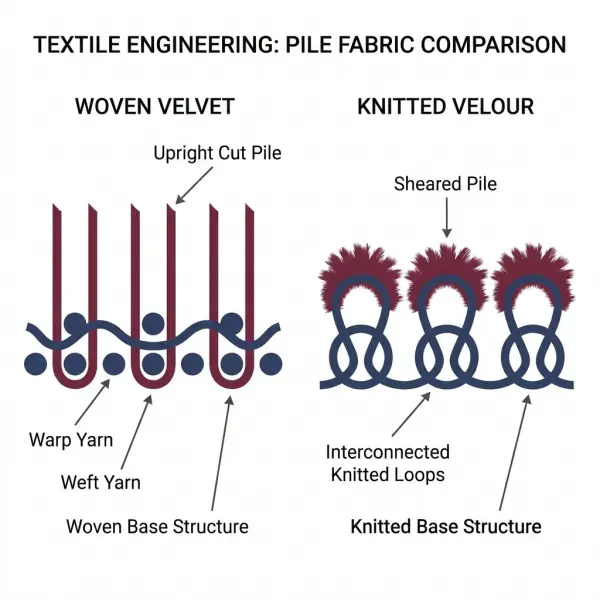
Traditional woven velvet begins with a ground fabric formed by interlacing warp and weft yarns. Additional warp yarns create the surface pile.
One established manufacturing method weaves two ground fabrics simultaneously, connecting them with pile yarns. Cutting the connecting yarns separates the layers and produces two velvet surfaces.
This process is described by Woolmark in its technical discussion of woven velvet and knitted velour.
The woven ground provides a comparatively stable framework, although its actual properties depend on weave structure, yarn selection, finishing, and any stretch components.
In apparel development, this stability can be useful for garments that rely on controlled shaping. A tailored blazer, for example, must maintain lapel geometry, shoulder construction, and panel alignment.
However, stability alone does not guarantee a suitable tailoring fabric. Some woven velvets are lightweight and highly fluid, making them less appropriate for structured garments without additional support.
Knitted Velour Uses Interconnected Loops
Knitted velour is built on interconnected yarn loops rather than a conventional woven grid.
These loops can deform under tension, allowing the fabric to stretch and recover to varying degrees.
The amount of stretch depends on knitting method, yarn characteristics, fabric density, finishing, and whether elastic fibers are included.
A cotton-rich knitted velour may stretch through its loop structure but recover differently from a polyester-elastane velour designed for close-fitting garments.
This distinction matters in casualwear.
For example, a velour tracksuit needs sufficient movement through the shoulders, knees, hips, and elbows. The material should also recover adequately after stretching so that the garment does not develop excessive bagging during wear.
Designers should therefore evaluate both extension and recovery rather than assuming that any knitted velour will perform satisfactorily.
Why Construction Matters More Than the Fabric Name
Consider a fashion brand developing a fitted velvet-style dress.
The designer selects a fabric described by the supplier as stretch velvet. The material has a smooth pile, strong directional sheen, and a knitted ground containing elastane.
Although its commercial name includes velvet, the garment's pattern requirements may resemble those of a stretch-knit dress rather than a conventional woven evening gown.
Using a pattern designed for non-stretch woven fabric could produce an unsuitable fit or unnecessary shaping details.
Conversely, a supplier might describe a heavier woven material as velour. Treating it as an elastic knit could lead to incorrect fit assumptions.
In both situations, the error comes from allowing a commercial fabric label to substitute for structural information.
For sourcing and pattern development, the construction must be verified before the garment is engineered.
How Do Velvet and Velour Differ in Texture and Appearance?
Pile Density and Surface Uniformity
Velvet is often recognized by its smooth, closely packed pile. This surface can produce a continuous appearance in which individual yarns are difficult to distinguish without close inspection.
Velour may also have a dense pile, but its texture can appear softer, more relaxed, or slightly less uniform depending on the yarns and finishing processes used.
Neither description is a universal quality standard.
A high-quality knitted velour may have an exceptionally uniform surface, while a decorative crushed velvet may intentionally display irregular pile orientation.
For apparel businesses, the visual objective should be defined independently of the material name.
If the design requires a smooth, uninterrupted surface, the relevant specification may include pile uniformity, height, surface orientation, and acceptable appearance variation.
A fabric's commercial classification alone does not establish whether it will meet those expectations.
Sheen and Color Depth
Both velvet and velour can display directional sheen because raised pile fibers interact with light according to their orientation.
Velvet is frequently associated with deeper color effects and noticeable changes in reflected light. These characteristics are useful for eveningwear and tailored garments intended to create visual richness.
Knitted velour can also have substantial sheen, particularly when manufactured using suitable filament fibers or surface finishes.
A polyester velour may appear brighter than a particular cotton velvet, while another velour construction may have a relatively muted appearance.
This is why it is misleading to claim that velvet is always shinier than velour.
For fashion photography, both materials require attention to lighting. A garment photographed under strong directional illumination may display highlights that are less visible under ordinary indoor conditions.
Retailers should aim to represent the actual surface behavior rather than exaggerating sheen through photography.
Drape, Body, and Movement
Fabric drape is influenced by construction, weight, yarn properties, finishing, and other mechanical characteristics.
Some woven velvets create fluid, elegant folds. Others are comparatively firm and better suited to garments requiring shape.
Knitted velour often follows body movement comfortably because the ground fabric can stretch and deform. This characteristic is useful for relaxed fashion silhouettes, but it does not automatically mean the material will drape attractively in every design.
A heavy velour dress, for example, may stretch downward under its own weight. The garment can become longer or lose its intended proportions if the pattern and supporting construction do not account for this behavior.
Designers should test representative fabric lengths and garment sections rather than judging drape from a small swatch.
Is Velvet More Luxurious Than Velour?
Velvet is more strongly associated with formal and luxury fashion, but that association does not mean every velvet is inherently more valuable or better manufactured than every velour.
Historical silk velvet, specialized woven constructions, and carefully controlled finishing processes can involve substantial manufacturing complexity.
However, contemporary velvet includes products across many quality levels, including relatively accessible polyester constructions.
Velour also spans different grades, fiber compositions, and manufacturing methods.
A well-developed velour with appropriate yarn quality, stable construction, controlled pile finishing, and reliable performance may be more suitable for a premium casualwear product than a visually attractive but poorly specified velvet.
Luxury positioning also depends on garment design, fit, construction, customer experience, and the consistency of the finished product.
For brand owners, material prestige is useful only when it supports a credible product proposition.
A premium loungewear brand may select an expensive, carefully engineered velour because comfort and tactile performance are central to its identity. An occasionwear brand may select velvet for the distinctive visual effect created by its pile and drape.
The two materials can support different interpretations of premium fashion.
Where Does Velvet Work Best in Apparel Design?
Formal Dresses and Eveningwear
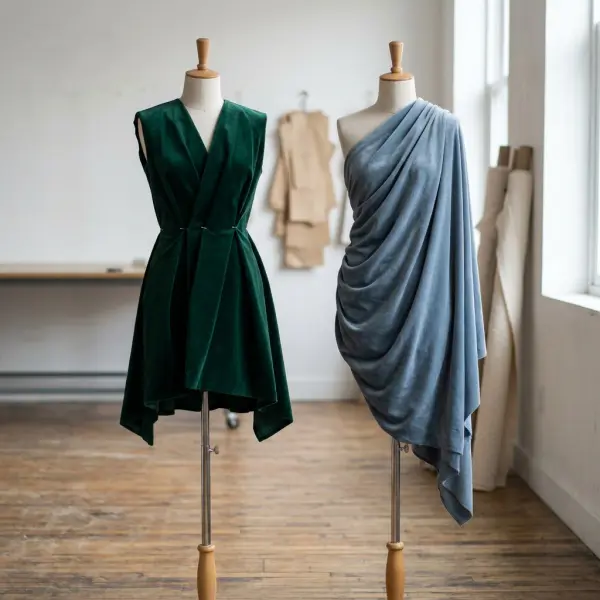
Velvet is commonly used in formal dresses because its pile surface creates rich visual depth without requiring complex prints.
The material can emphasize folds, curved seams, and changes in silhouette.
For an evening dress, designers may choose a fluid velvet that moves naturally with the wearer. A more substantial fabric can support structured dresses or fitted components.
The challenge is aligning appearance with actual garment construction.
A full-length dress requires sufficient stability to maintain its intended length, while a fitted bodice may require supporting construction that does not produce excessive bulk.
Velvet's surface should contribute to the silhouette rather than become an obstacle to assembling it.
Tailored Jackets and Statement Garments
Velvet is also suitable for tailored jackets, blazers, and decorative outerwear when the selected fabric offers appropriate stability.
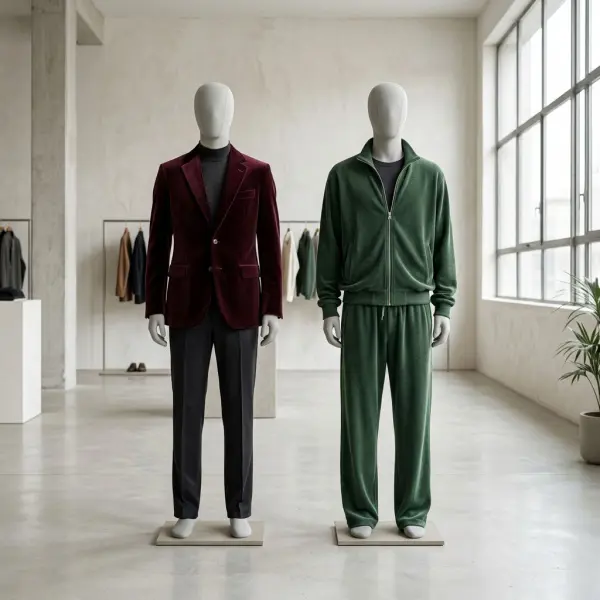
A velvet blazer can create a distinctive finish through texture alone, allowing the design to remain relatively restrained.
However, tailoring introduces specific construction requirements. Interfacing, lapel shaping, lining, seam allowances, and finishing must be compatible with the pile surface.
An unsuitable pressing method may flatten the pile or produce visible marks.
For these applications, material selection should be coordinated with the factory's tailoring capabilities.
A fabric that looks impressive on a sample hanger may require substantial construction adjustments before it can be used consistently in production.
Where Does Velour Work Best in Apparel Design?
Tracksuits and Sports-Inspired Fashion
Knitted velour is particularly relevant to tracksuits and sports-inspired casualwear because it can combine a soft pile appearance with garment flexibility.
A tracksuit normally requires movement around the shoulders, elbows, waist, knees, and hips.
The fabric's elasticity and recovery influence how the garment responds to those movements.
However, soft texture and stretch do not automatically make velour suitable for athletic performance.
Sportswear applications may require additional properties, such as moisture management, breathability, quick drying, or resistance to repeated abrasion.
A velour tracksuit designed primarily for leisure should not be described as high-performance sportswear without relevant testing.
Loungewear and Comfortable Casual Clothing
Velour is frequently selected for loungewear because its plush surface can provide tactile comfort while knitted constructions allow relatively unrestricted movement.
The combination can work well in relaxed pants, sweatshirts, coordinated sets, and casual dresses.
For these garments, softness is only one aspect of comfort.
Fabric weight, air permeability, thermal characteristics, stretch, recovery, and skin contact must also be considered.
A thick velour may feel pleasant in cooler environments but be uncomfortable for customers in warm or humid climates.
Brands targeting global markets should avoid treating velour as a universally comfortable material regardless of season or location.
Children's Clothing and Casual Separates
Knitted velour can also be used for children's clothing and flexible casual garments.
Its softness may suit products designed for everyday comfort, while knit construction can accommodate movement.
However, children's apparel requires appropriate evaluation of durability, dimensions, trims, and applicable safety requirements.
A soft pile surface should not be mistaken for evidence that a fabric is safe or durable for every children's product.
Garment development must account for age-specific use, washing frequency, friction, and the performance of the complete product.
How Do Velvet and Velour Affect Garment Manufacturing?
Material selection affects more than the finished garment's appearance. It also determines which production procedures are appropriate and how factories should control quality.
Cutting and Pattern Layout
Velvet and velour can both have directional pile surfaces.
When pattern pieces are cut in different directions, the material may reflect light differently across the garment.
This can produce apparent shade variation even when every component comes from the same fabric lot.
For woven velvet, a one-way cutting layout may be necessary to maintain a consistent surface appearance.
Knitted velour can require similar directional control, but additional considerations may arise from stretch and distortion during spreading.
An unstable knit may become stretched or distorted if the fabric is handled under excessive tension.
The cutting team must therefore consider both pile orientation and the mechanical behavior of the fabric.
Sewing Requirements
Woven velvet and knitted velour can present different sewing challenges.
With woven velvet, the pile surfaces may shift against each other during stitching. This can create seam alignment problems, especially on curved or shaped components.
Knitted velour may require seam constructions that accommodate stretch and movement. Poorly selected stitch settings or seam types can lead to restricted elasticity, seam damage, or inconsistent appearance.
Neither fabric should be treated as automatically easy or difficult to sew.
A lightweight velvet dress with relatively simple seams may be easier to assemble than a complicated stretch velour garment. Conversely, a basic velour tracksuit may be straightforward for a factory experienced in knit apparel.
Production difficulty depends on the interaction between fabric, garment design, equipment, operator experience, and quality requirements.
Stretch Recovery and Garment Stability
Stretch recovery is particularly important when evaluating knitted velour.
A fabric may extend comfortably during fitting but fail to return sufficiently toward its original dimensions.
In trousers, this can contribute to bagging around the knees. In fitted tops, inadequate recovery may affect the neckline, cuffs, or body shape.
A woven velvet product may have different priorities, such as dimensional stability and shape retention.
Yet stretch velvet and other engineered constructions can also require recovery testing.
The appropriate evaluation must reflect the actual garment and its expected use, not merely the category printed on a fabric label.
Finishing and Surface Appearance
Both materials have pile surfaces that can respond to pressure, friction, steam, and heat.
For velvet, pressing may create unwanted flattened areas or visible marks. The appropriate finishing technique depends on fiber composition and construction.
Velour can also experience surface changes during handling, washing, or heat exposure.
Knitted velour may additionally require evaluation for dimensional changes after laundering.
Manufacturers should establish finishing procedures using approved fabric samples and representative garment constructions.
A detailed examination of these production issues is covered in Why Pile Fabrics Require Special Care in Apparel Design and Production.
Velvet vs Velour: Which Fabric Is Better for Fashion Brands?
Neither fabric is universally better. The appropriate choice depends on product requirements, target customer, brand positioning, sourcing conditions, and manufacturing capabilities.
A useful decision begins with the garment rather than the fabric name.
|
Design requirement |
Material direction to evaluate |
Why it may fit |
|
Structured formal blazer |
Suitable woven velvet |
Can offer the surface appearance and stability required for tailored construction |
|
Relaxed tracksuit |
Knitted velour |
Often provides useful flexibility and a soft surface |
|
Fluid evening dress |
Lightweight, drapable velvet |
Can create pronounced color depth and elegant folds |
|
Comfortable lounge set |
Soft knitted velour |
Can support movement and relaxed silhouettes |
|
Fitted stretch dress |
Stretch velvet or suitable velour |
Requires verified stretch, recovery, drape, and fit |
|
Decorative garment panels |
Velvet or velour, depending on construction |
Choice depends on appearance, edge handling, and durability |
|
Frequent-wear casual garment |
Tested knitted velour or other appropriate material |
Maintenance, recovery, and abrasion performance are important |
The comparison should guide sampling rather than replace it.
A fashion brand might initially prefer velvet for an evening dress because of its sheen. However, if the intended silhouette requires substantial stretch, an appropriately engineered stretch velvet or velour may deliver better results.
Similarly, a velour selected for casualwear should not be approved solely because it feels comfortable during fitting. Its recovery and appearance after repeated use must also support the intended product.
What Should Fashion Businesses Verify Before Sourcing?
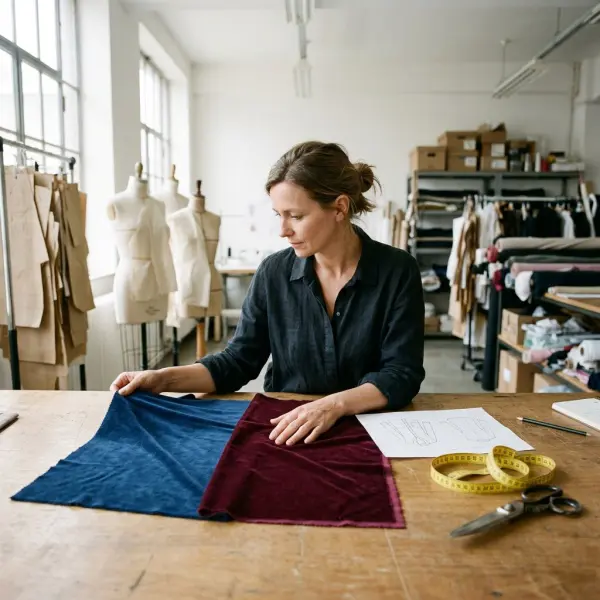
The most reliable sourcing approach is to evaluate measurable characteristics rather than relying on assumptions associated with velvet or velour.
Confirm the Actual Fabric Construction
The first question should be whether the material is woven or knitted.
Supplier descriptions sometimes use velvet and velour in overlapping ways. This can be especially confusing when purchasing stretch velvet, knitted velvet, decorative velour, or fabrics intended for interior applications.
Buyers should request confirmation of the ground construction and pile-forming method.
Examining the reverse side of the material may provide useful clues, but visual inspection alone does not replace a technical specification.
The resulting information should be consistent across material records, sampling documentation, and factory instructions.
Test Stretch and Recovery
For garments that require mobility, stretch testing is essential.
A fabric may stretch easily but recover poorly. Another may have relatively modest extension yet provide sufficient flexibility for a relaxed garment.
The relevant performance should be assessed in the directions that matter to the garment pattern.
For example, a fitted velour dress may require controlled stretch across the body, while a structured velvet jacket may prioritize dimensional stability.
Testing should include the effects of appropriate laundering or finishing procedures where relevant to the intended product.
Evaluate Fabric Weight and Drape
Fabric weight should be considered together with construction and garment design.
A relatively heavy velvet may work for a statement jacket but produce excessive bulk in a lightweight blouse.
Similarly, a soft knitted velour may be comfortable in a tracksuit but lose shape when applied to a long garment without adequate support.
Supplier weight measurements are useful for preliminary comparisons, but they do not replace physical evaluation.
Designers should test how the fabric hangs across garment-sized sections and how it responds to movement.
Check Pile Quality and Color Consistency
Pile uniformity influences how the finished garment looks, particularly across large visible panels.
Buyers should examine whether the surface has inconsistent pile height, visible directional differences, or unintended changes in texture.
Color evaluation must also account for light direction.
A fabric may appear darker from one side without having an actual dyeing inconsistency.
Approved samples should document the intended surface appearance so that factories can distinguish acceptable pile variation from defects.
Verify Care Requirements and Performance
Care requirements should be established for the complete garment, not inferred from fabric names.
A knitted velour containing polyester is not automatically machine-washable under every condition. A woven velvet is not necessarily limited to professional dry cleaning.
The suitability of a cleaning method depends on fiber composition, dyes, finishing, interfacing, lining, trims, and the final garment construction.
For covered clothing sold in the United States, the Federal Trade Commission's Care Labeling Rule requires manufacturers and importers to provide appropriate care instructions supported by a reasonable basis.
Businesses operating in other markets should verify the applicable labeling and consumer-information rules.
Common Mistakes When Comparing Velvet and Velour
Assuming Velvet Is Always Woven and Velour Always Knitted
Traditional velvet is woven, and many apparel velours are knitted, but commercial names are not completely consistent. Some fabrics marketed as stretch velvet have knitted constructions, while woven velours exist in other textile applications. When buyers treat the names as absolute technical classifications, they may select materials incompatible with the intended garment. Confirming the actual construction prevents this avoidable sourcing error.
Believing Velvet Is Always More Expensive
Material cost depends on fiber composition, manufacturing method, finishing, quality, order volume, and supplier conditions. A specialized velour may cost more than a basic polyester velvet, while a complex velvet can command a substantially different price from a simpler construction. Assuming a fixed price hierarchy can distort sourcing decisions. Brands should compare actual quotations alongside performance and garment requirements.
Selecting Fabric Only by Softness
Both materials can feel exceptionally soft, but softness does not establish suitability for a finished garment. A comfortable sample might lack dimensional stability, recover poorly after stretching, or show undesirable pile changes after friction. These problems may emerge only after sampling or wear testing. Product developers should evaluate the complete performance profile rather than treating handfeel as the primary measure of quality.
Using a Woven Pattern for Stretch Velour Without Adjustment
A sewing pattern developed for stable woven fabric may contain ease, shaping, and construction assumptions that are unsuitable for a stretch knit. Using it directly with velour can produce an oversized fit, distorted seams, or poor recovery. Pattern engineers should evaluate the actual stretch characteristics and adapt the garment construction accordingly. Fabric substitution should be treated as a development decision, not a simple purchasing change.
Ignoring Fabric Behavior After Washing
A garment may fit correctly during initial sampling but change after cleaning. Knitted velour may experience dimensional changes, while some pile fabrics can show alterations in surface appearance. A supplier's claim that a material is washable should be supported by relevant evidence. Evaluating garments after repeated appropriate cleaning can reveal problems before customers encounter them.
Important Technical Caveats: Why Fabric Names Can Be Misleading
The terms velvet and velour are useful commercial descriptions, but they do not provide complete technical identification.
One reason is that textile terminology has developed across different applications and markets.
Traditional woven velvet is a relatively well-defined warp-pile construction. Velour is broader in practical usage and can refer to knitted apparel fabrics as well as certain woven, napped, or pile materials.
The FabricLink textile dictionary, for example, describes velour as a closely woven pile fabric. Meanwhile, Woolmark describes knitted velour as a counterpart to woven velvet in its wool textile applications. These definitions illustrate why industry terminology cannot always be reduced to a simple woven-versus-knitted rule.
Other distinctions also require care.
Velveteen is not simply another name for velour. Traditional velveteen is a woven fabric with a filling or weft pile, whereas conventional velvet has a warp pile. The CottonWorks definition of velveteen makes this structural distinction explicit.
Stretch does not automatically mean velour. Some fabrics marketed as velvet are knitted, and others incorporate elastic fibers or specialized stretch constructions.
Fiber content does not determine the fabric category. Cotton, polyester, viscose, and other fibers can appear in different pile constructions.
Appearance does not prove quality. A deeper sheen or denser-looking surface is not, by itself, evidence of better durability, comfort, or manufacturing consistency.
For commercial sourcing, the most defensible classification combines the material name with the actual structure, fiber composition, and tested performance.
How Can Fashion Brands Make Better Material Decisions?
Fashion businesses can reduce sourcing mistakes by treating fabric selection as part of product engineering.
A designer may begin with a visual objective, such as a deep burgundy pile surface for an eveningwear collection. That objective is important, but it should be translated into technical requirements before the material is approved.
For a fitted occasionwear garment, those requirements might include drape, body stretch, recovery, pile direction, and compatibility with the planned lining.
For a lounge set, priorities may shift toward comfort, stability after washing, repeated-use appearance, and production efficiency.
The process should connect several decisions:
- Design intention: Define the desired appearance, silhouette, and garment movement.
- Material specification: Confirm woven or knitted construction, fiber content, weight, stretch, and pile characteristics.
- Prototype evaluation: Test the actual material in representative garment sections and complete samples.
- Production planning: Assess cutting direction, seam construction, finishing methods, and realistic material consumption.
- Commercial validation: Check cost, supplier consistency, customer expectations, and product-care requirements.
These steps are most useful when carried out collaboratively.
Design teams understand the intended silhouette, while sourcing teams understand material availability and supplier capabilities. Pattern engineers can assess fit implications, and production teams can identify sewing or finishing problems before the style enters bulk manufacture.
For smaller fashion brands, this does not necessarily require elaborate laboratory infrastructure at every stage. The initial requirement is a disciplined approval process supported by supplier documentation, representative samples, and appropriate testing.
A fabric should be selected because its actual characteristics work for the product—not because its name sounds more luxurious or more comfortable.
Frequently Asked Questions About Velvet and Velour
Is velour the same fabric as velvet?
No. Velvet and velour can have similar soft pile surfaces, but they are not necessarily constructed in the same way.
Traditional velvet is a woven warp-pile fabric, while velour commonly refers to knitted pile materials in contemporary apparel. However, the term velour is also used for certain woven or napped textiles, and some products marketed as velvet are knitted.
For garment development, these distinctions affect stretch, drape, pattern engineering, and manufacturing.
Buyers should examine the fabric's backing, request its technical specifications, and verify relevant performance characteristics before treating the materials as interchangeable.
Is velvet softer than velour?
Not necessarily. Both velvet and velour can have very soft surfaces, and the final handfeel depends on fiber selection, pile density, pile height, finishing, and fabric construction.
A finely finished knitted velour may feel softer than a relatively firm woven velvet. Conversely, some silk or viscose velvets can provide a particularly smooth, refined touch.
Softness is also subjective and does not establish durability or comfort during prolonged wear.
Fashion brands should evaluate handfeel alongside fabric weight, stretch, breathability, surface stability, and maintenance requirements. The best material is the one that meets the specific product's intended performance and customer expectations.
Which fabric is better for tracksuits: velvet or velour?
Knitted velour is often the more practical starting point for tracksuits because its loop-based construction can provide flexibility and comfortable movement.
Tracksuit garments generally require sufficient extension and recovery around moving body areas. A conventional woven velvet without appropriate stretch may restrict movement or require a substantially different pattern.
However, knitted velour does not automatically guarantee suitable sportswear performance.
Brands should evaluate recovery, dimensional stability, abrasion behavior, thermal comfort, and care requirements. If a tracksuit is intended for actual athletic activity rather than leisurewear, moisture management and other activity-specific performance characteristics may also need testing.





Comments 0
Leave a CommentSend Comment
Anda harus Login terlebih dahulu untuk dapat memberikan komentar.