
Woven vs Knit Fabrics: Key Differences for Apparel Design
Quick Answer
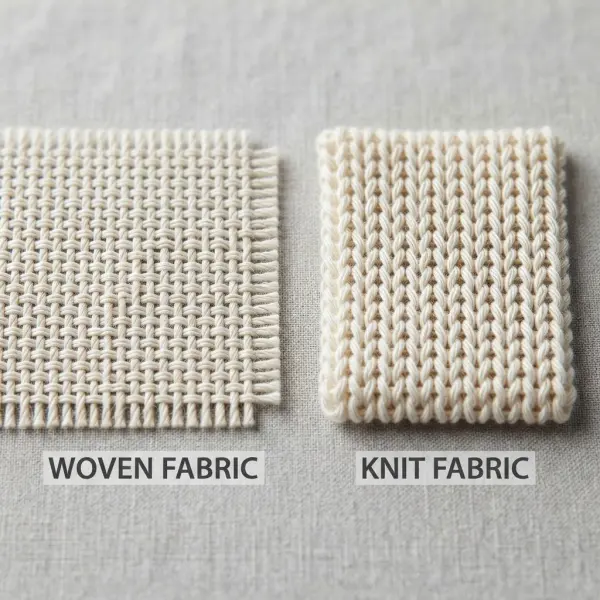
The main difference between woven and knit fabrics is how their yarns are arranged. Woven fabric is generally formed by interlacing lengthwise warp yarns with crosswise weft yarns, while knit fabric is formed through interconnected yarn loops.
This structural difference influences how a material stretches, drapes, conforms to the body, holds a silhouette, behaves during cutting, and responds to laundering. Woven fabrics often provide greater dimensional control and structural support. Knit fabrics often provide more inherent extensibility and body conformity. These are useful tendencies, not absolute rules.
A woven fabric can stretch through elastane, stretch yarns, mechanical construction, or bias orientation. Some double knits and warp knits are comparatively firm and stable. Fiber composition, yarn type, construction density, finishing, fabric weight, and garment engineering can substantially change the final result.
For apparel businesses, the decision should begin with the garment’s required movement, silhouette, fit, climate, care, durability, and manufacturing route. A tailored shirt, fitted legging, denim trouser, jersey dress, polo shirt, and structured knit jacket solve different product problems. None should be assigned a fabric category based only on whether woven or knit seems more “premium” or “comfortable.”
What Is the Difference Between Woven and Knit Fabric?
Woven fabric is a textile structure usually created by interlacing two yarn systems: warp yarns running along the fabric length and weft, or filling, yarns running across its width. Knit fabric is created by forming yarn into connected loops that can change shape under force.
In conventional weaving, warp yarns are prepared and controlled on a loom while weft yarn is inserted across them. The order in which warp and weft pass over or under one another creates structures such as plain weave, twill, satin, Oxford, dobby, and jacquard. CottonWorks’ weaving overview describes the dedicated warp-control elements and weft insertion involved in forming woven fabric. loops are formed through actions such as knit, tuck, and float stitches. Weft knitting creates courses across the width or around a circular machine, while warp knitting uses multiple yarns progressing generally along the fabric length. The mobility of these loops often allows a knit to extend and conform more easily than a conventional non-stretch woven fabric. on is structural, not chemical. Cotton can be woven into poplin or knitted into jersey. Polyester can become woven chiffon, stretch suiting, fleece, interlock, or warp-knit mesh. Wool can be woven into coating or knitted into sweaters. Fiber name alone does not tell a designer how the fabric will behave.
Why Fabric Structure Matters to Apparel Design
Garment design converts a two-dimensional textile into a three-dimensional form around a moving body. The fabric structure determines how much of that shaping must come from the pattern and how much the material can accommodate through its own deformation.
A relatively stable woven fabric may require darts, seams, pleats, gathers, panels, gussets, or added ease to fit around the bust, waist, hip, shoulder, elbow, or knee. A knit can often adapt to these areas through loop extension, allowing fewer seams or a closer fit.
That does not mean knitwear requires less technical skill. Stretch direction, recovery, negative ease, edge behaviour, seam elasticity, fabric growth, and laundering response can make knit pattern development highly sensitive. A pattern that works in firm Ponte may fail in fluid viscose jersey even though both materials are knitted.
Woven vs Knit Fabrics at a Glance
|
Comparison Factor |
Woven Fabric |
Knit Fabric |
Apparel Design Implication |
|
Basic structure |
Warp and weft yarns interlaced |
Yarn loops interconnected |
Structure affects movement, stability, drape, and construction |
|
Inherent extensibility |
Often limited along warp and weft; greater on bias |
Often greater, particularly across the width in many weft knits |
Knit patterns may use less ease or negative ease |
|
Shape support |
Often strong, depending on weave and density |
Ranges from fluid to firm |
Wovens often suit crisp silhouettes; stable knits can also support structure |
|
Body conformity |
Usually created through pattern shaping or stretch engineering |
Often created partly through loop deformation |
Knits commonly suit close-to-body products |
|
Edge behaviour |
Cut edges may fray |
Some knits curl, run, or unravel |
Different cutting and edge-finishing methods are required |
|
Surface possibilities |
Plain, twill, satin, dobby, jacquard, pile, gauze, and others |
Jersey, rib, interlock, piqué, fleece, mesh, jacquard, tricot, Raschel, and others |
Both categories support broad visual and functional variation |
|
Wrinkle behaviour |
Depends on fiber, yarn, weave, finishing, and garment use |
Loop mobility may help some knits recover from minor deformation |
Neither category is universally wrinkle-free |
|
Dimensional risks |
Shrinkage, seam puckering, skew, fraying, distortion |
Shrinkage, growth, spirality, curling, bagging, laddering |
Test programs must reflect construction-specific risks |
|
Pattern approach |
Often uses positive ease and structural shaping |
May use zero or negative ease depending on recovery |
Patterns are not interchangeable |
|
Typical products |
Shirts, jeans, tailoring, dresses, coats, skirts |
T-shirts, leggings, sweaters, underwear, activewear, sweatshirts |
End use should lead the choice |
These distinctions describe common behaviour, not guaranteed performance. A loose woven gauze may be less stable than a dense double knit. A stretch-woven trouser fabric may extend and recover more effectively than a low-recovery cotton jersey. Physical testing should take precedence over assumptions based on category names.
How Woven Fabric Construction Influences Apparel
Warp and Weft Create Directional Stability
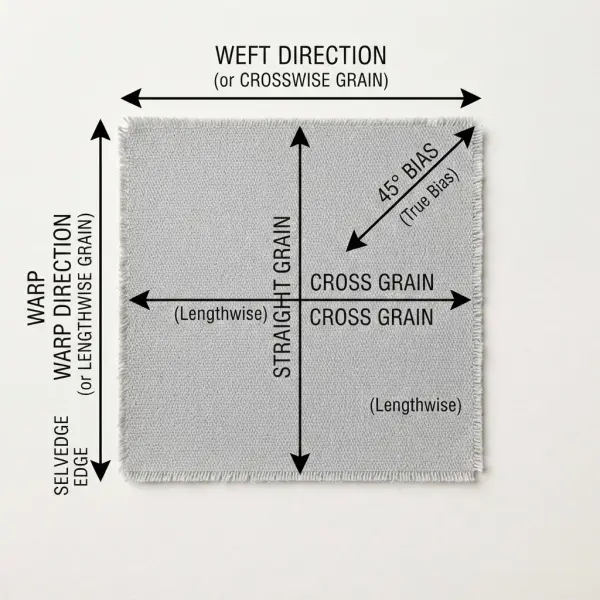
Warp yarns commonly carry substantial tension during weaving, while weft yarns are inserted across them. The finished material can therefore behave differently in the warp, weft, and diagonal directions.
In many woven fabrics, the warp direction provides greater stability. The weft may offer slightly more give, depending on yarn, density, and construction. The diagonal direction—often called the bias—can deform more because the yarns rotate relative to one another rather than extending significantly themselves.
Designers use this deliberately. A woven garment cut on the bias may drape more fluidly and conform more closely to the body than the same material cut on the straight grain. Bias cutting can also create growth, twisting, unstable hems, and higher material consumption if the pattern and production method are not carefully controlled.
Weave Type Changes the Result
A woven fabric is not automatically crisp or rigid. The weave design changes the number and distribution of interlacings, which affects stability, drape, surface, abrasion behaviour, yarn mobility, and snagging.
Plain weave has frequent interlacings and can provide a stable, balanced structure. Poplin, voile, canvas, and many shirting fabrics use variations of plain weave.
Twill weave creates diagonal lines through an offset interlacing sequence. Denim, chino, gabardine, and many workwear fabrics use twill structures. Longer floats can improve drape and surface coverage but may alter snagging and abrasion behaviour.
Satin or sateen structures use longer floats to create a smoother, often more lustrous face. These fabrics can drape attractively but may be more vulnerable to snagging or float damage, depending on yarn and density.
Dobby and jacquard systems create more complex patterns by controlling groups of warp yarns or individual warp ends. Visual complexity does not automatically indicate higher physical performance. retch Can Be Engineered
The idea that woven fabric does not stretch is inaccurate. Woven materials can gain extensibility through:
- Elastane or other elastic yarns
- Textured or stretch yarns
- Crimp and yarn mobility
- Lower-density constructions
- Specialized mechanical-stretch engineering
- Bias orientation
- Finishing processes
ASTM D3107 addresses stretch, growth, and recovery in woven fabrics containing stretch yarns. The current method also recognizes that some fabrics are engineered with stretch primarily in the filling direction, so directional testing matters. en trouser fabric may provide mobility while retaining a cleaner tailored appearance than a soft jersey. Yet its performance still depends on recovery. If the fabric stretches but does not recover, knees, seat areas, and waistbands may remain enlarged after wear.
How Knit Construction Influences Apparel
Loops Allow Structural Extension
A knit fabric can extend as its loops open, narrow, or change shape. This means the yarn itself does not need to elongate by the same percentage as the complete fabric.
Many weft knits have substantial widthwise extensibility. Rib structures can expand considerably across the width, while jersey, interlock, French terry, fleece, and double knits each offer different balances of flexibility and stability. CottonWorks notes that common weft knits can also curl, run, or unravel, which creates production considerations not normally seen in the same form with woven materials. ch as tricot and Raschel use a different loop arrangement and are often more resistant to laddering than basic weft knits. They can be engineered as stable linings, lingerie fabrics, sports meshes, lace, nets, or technical substrates.
Stretch Does Not Guarantee Recovery
A knit may extend readily but fail to return fully to its original dimensions. Stretch and recovery must therefore be treated as separate specifications.
Low recovery can produce:
- Enlarged neck openings
- Bagging at elbows or knees
- Sagging waistbands
- Length growth
- Distorted hems
- Loose seat areas
- Inconsistent fit after laundering
Elastane can improve recovery, but its percentage alone does not predict the result. Yarn placement, fabric density, heat setting, finishing conditions, garment fit, and pattern reduction all influence performance.
A basic explanation of knit structures, properties, and applications is available in Knit Fabric Explained: Types, Properties, and Fashion Uses.
Stable Knits Challenge the Usual Stereotype
Some double knits, including many Ponte and Milano-type constructions, can provide substantial body and dimensional control. They may be suitable for trousers, dresses, jackets, skirts, uniforms, and travel garments where comfort and cleaner shaping are both required.
Likewise, dense warp knits can be highly controlled. Calling every knit “soft and stretchy” overlooks a large technical range.
A designer choosing between a stretch woven and a stable double knit should compare actual drape, extension, recovery, thickness, opacity, heat retention, surface abrasion, seam compatibility, and garment weight. Category labels cannot settle the decision.
Which Fabric Has More Stretch?
Knit fabric usually has more inherent structural extensibility than a conventional non-stretch woven fabric, particularly in the width direction of many weft knits. However, an engineered stretch woven can outperform a low-stretch knit in a specified direction.
There are at least four separate properties to evaluate:
- Extension: How far the fabric stretches under an agreed force.
- Growth: How much enlargement remains after the force is removed.
- Recovery: How effectively the material returns toward its initial size.
- Power: How much force the fabric exerts while stretched.
These properties influence different garments in different ways. Leggings need adequate extension, reliable recovery, and suitable power. A comfort-stretch chino may require modest extension with low residual growth. A rib neckline needs enough expansion to pass over the head but enough recovery to sit flat afterward.
Testing conditions must be defined because hand-pulling fabric is not repeatable. ASTM and AATCC maintain textile methods covering stretch, dimensional change, appearance, colorfastness, moisture behaviour, and related performance areas. bric Holds Its Shape Better?
Woven fabrics often provide more predictable structural support because their interlaced yarn systems restrict movement. This makes many wovens suitable for shirts, tailoring, denim, uniforms, pleated garments, structured dresses, jackets, and outerwear.
Yet shape retention depends on more than construction category. A loosely woven fabric may distort at seams. A stable Ponte may recover better than a stretch woven with high residual growth. Interlining, seam placement, panel shape, fabric weight, fiber resilience, garment care, and stress concentration all influence whether the silhouette remains controlled.
For apparel design, “holds its shape” should be translated into specific questions:
- Must the collar remain crisp?
- Should a trouser crease remain visible?
- Can the knee area enlarge during sitting?
- Must a dress skim the body or stand away from it?
- Should the waist compress or merely follow the body?
- Will pockets carry significant weight?
- Must pleats remain sharp after washing?
- Can the garment tolerate fluid lengthwise growth?
Once the expected behaviour is clear, teams can select and test a construction that supports it.
Drape, Silhouette, and Visual Character
Woven Fabrics Can Range from Crisp to Fluid
Organza, canvas, poplin, denim, chiffon, crepe, satin, and wool suiting are all woven, yet their drape and surface differ dramatically.
A crisp woven fabric can support volume, pleats, sculptural sleeves, collars, lapels, and tailored edges. A lightweight or bias-cut woven may create a fluid dress with minimal apparent stiffness. Fiber, yarn twist, weave, density, weight, and finishing all affect the result.
This gives designers strong control over silhouette but may require additional pattern shaping. A woven blouse must usually accommodate shoulder movement, bust projection, and arm reach through ease, darts, gathers, pleats, panels, or stretch engineering.
Knits Often Follow the Body More Closely
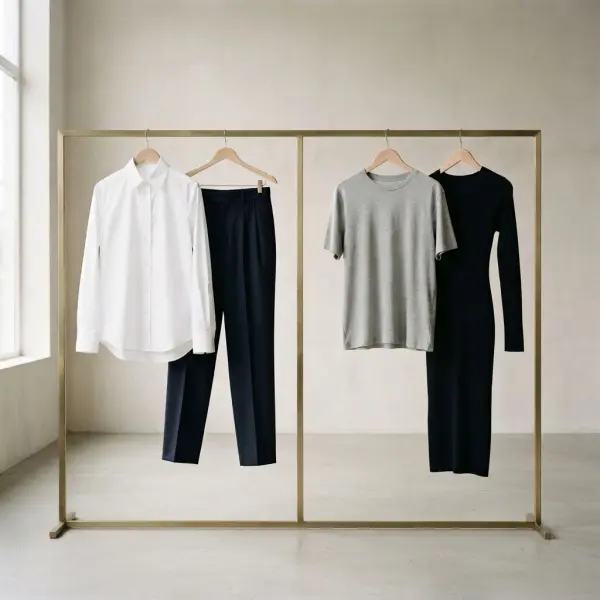
Many knits adapt to curved forms without extensive seaming. This can reduce visible shaping elements and support minimalist garments such as T-shirts, fitted tops, leggings, bodycon dresses, base layers, and underwear.
Body conformity can also expose problems. Lightweight knits may reveal undergarment lines, body contours, seam allowances, pocket bags, or print distortion. Fluid cellulosic jerseys may grow in length. Dense knits may feel heavy or warm.
The appropriate question is not simply whether the fabric drapes well. It is whether its drape supports the intended silhouette, customer, size range, and wearing context.
Comfort Is More Complex Than Woven vs Knit
Knit fabrics are strongly associated with comfort because their loop structure can support movement and reduce restriction. This is one reason they are widely used for T-shirts, underwear, loungewear, socks, sweaters, activewear, and body-fitting garments.
Comfort, however, includes several dimensions:
- Movement and pressure
- Thermal sensation
- Moisture absorption and transport
- Drying behaviour
- Surface softness
- Seam bulk
- Garment weight
- Air permeability
- Fit and ease
- Skin sensitivity
A dense synthetic knit may feel hotter than a light cotton woven. A soft woven flannel may feel more comfortable in cold conditions than a thin jersey. A stretch woven can provide mobility without the cling of a knit. A poorly fitted knit may create pressure, transparency, or chafing despite being elastic.
The role of knit structures in daily comfort is discussed more deeply in Why Knit Fabrics Are Essential in Comfortable Everyday Clothing. That discussion should still distinguish structural comfort from unverified claims about breathability, cooling, or moisture management.
Pattern-Making Differences Between Woven and Knit Fabrics
Ease Requirements Are Not Interchangeable
Ease is the difference between body measurements and garment measurements. Positive ease creates additional room, zero ease closely matches the body, and negative ease makes the garment smaller than the relevant body measurement so the fabric stretches during wear.
Woven garments commonly use positive ease unless the textile has engineered stretch. Knit garments may use positive, zero, or negative ease depending on silhouette, stretch, recovery, opacity, compression, and customer comfort.
A percentage of negative ease should never be copied mechanically from another fabric. A rib top and a firm interlock top can require different pattern reductions. Even two jerseys with the same nominal composition may have different recovery and growth.
Darts and Seams Serve Different Roles
Wovens often rely on darts, princess seams, yokes, pleats, gussets, and panel shaping to convert flat fabric into a three-dimensional garment.
Knits can sometimes eliminate darts because the fabric conforms around the body. That does not make darts technically forbidden in knitwear. Darts may still be used to control fullness, stabilize a silhouette, create visual detail, or accommodate limited stretch.
Removing all shaping from a knit pattern can produce drag lines, neckline gaping, armhole distortion, or excessive pressure when the material does not have suitable multidirectional extension.
Grain and Stretch Direction Must Be Controlled
Woven patterns are usually aligned to the straight grain, with deliberate use of cross grain or bias when the design requires it.
Knit patterns must account for courses, wales, greatest stretch direction, recovery, surface direction, nap, stripe repeat, print orientation, and potential spirality. “Place on fold” is not enough technical information when a fabric behaves differently in each direction.
For leggings, the direction with greater stretch commonly needs to wrap around the body. For a knit dress, lengthwise growth may matter more because the garment’s own weight can pull the fabric downward. For rib trim, the expansion and recovery must correspond to the opening it finishes.
Pattern Blocks Should Be Fabric-Specific
Using one universal woven block or one universal knit block is risky. Blocks should be grouped by realistic performance ranges.
A company may maintain separate foundations for:
- Non-stretch woven
- Comfort-stretch woven
- High-stretch woven
- Stable knit
- Moderate-stretch jersey
- High-recovery stretch knit
- Rib knit
- Heavy double knit
- Sweater knit
This makes development more repeatable, but each new fabric still needs verification.
Cutting and Spreading Differences
Woven Fabrics Require Grain, Fray, and Shade Control
Woven fabric is generally supplied open width, although formats vary. Spreading must account for grain alignment, face direction, nap, print repeat, bow, skew, shade, and fabric defects.
Cut edges may fray because yarns at the edge are no longer held securely by the complete interlacing system. The severity depends on weave density, yarn type, finish, and cut shape.
Loosely woven fabrics, satins, open gauzes, and slippery surfaces can shift during cutting. Stabilization, reduced lay height, paper underlays, vacuum cutting, or specialized handling may be needed.
Knits Require Relaxation and Tension Control
Knits can be supplied open width or tubular. Fabric stored under tension may change dimensions after unrolling, spreading, cutting, wet processing, or laundering.
Relaxation before cutting allows the material to move toward a more stable state. The required time and method depend on fabric construction, roll tension, finishing route, factory conditions, and buyer requirements.
During spreading, excessive tension can lengthen the fabric. After cutting, panels may contract and become smaller than intended. Uneven relaxation can create inconsistent garment measurements between bundles.
Some single knits also curl at their edges. This complicates alignment, notching, bundling, binding, and automated handling. CottonWorks’ garment-manufacturing guidance contrasts the cutting routes for products such as tubular knit T-shirts and open-width woven denim, illustrating why material format changes production planning. fficiency Is Product-Specific
Knits are not automatically more material-efficient than wovens. Yield depends on:
- Fabric width
- Tubular or open-width format
- Pattern shape
- Garment size mix
- Grain and stretch direction
- Nap or one-way surface
- Stripe or print matching
- Defect zones
- Shrinkage allowance
- Pattern quantity
- Lay planning
A knit T-shirt may use relatively few pattern pieces and achieve efficient markers. A bias-cut woven dress may have lower utilization. Yet a wide open-width woven with compact pattern pieces may outperform a narrow tubular knit.
Material cost should therefore be evaluated per saleable garment, not only per metre or kilogram.
Sewing and Construction Differences
Seams Must Move with the Fabric
A seam joins fabric panels but also changes how the material stretches, bends, and distributes stress.
Stable woven garments often use lockstitch seams because they provide controlled construction and a clean appearance. Overlock, chainstitch, flat-felled, bound, lapped, and other seams may be used depending on product type.
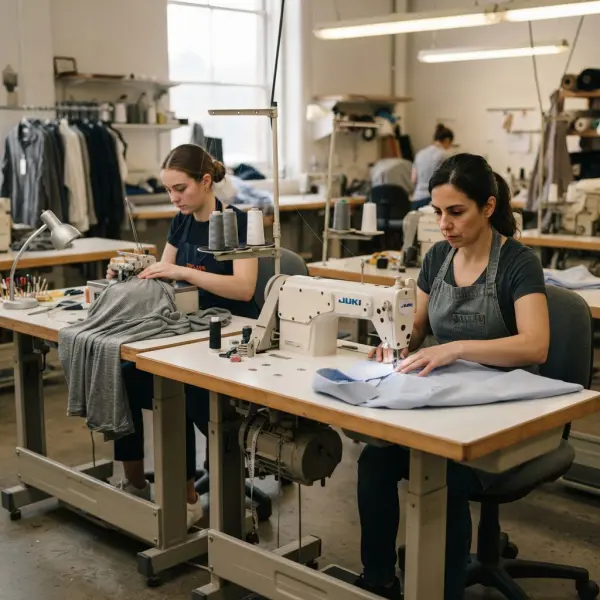
Highly extensible knits require seams that can accommodate the expected movement. Overlock, coverstitch, chainstitch, flatlock, or specialized stretch-compatible constructions are common. A rigid seam placed across a stretch-critical area may break before the fabric reaches its normal extension.
Apparel production uses many stitch and seam combinations, so fabric category alone does not determine the correct choice. CottonWorks emphasizes matching construction methods and garment components to the required product performance. election Matters
Sharp needles can penetrate many tightly woven structures effectively. Ballpoint or rounded-point needles are often selected for knits so the needle can move between yarns rather than cutting loops, although the precise point depends on fabric and yarn.
The wrong needle can cause:
- Yarn damage
- Needle holes
- Runs or laddering
- Skipped stitches
- Seam puckering
- Fabric pulls
- Heat damage
- Broken thread
- Poor seam appearance
Needle size, point, thread, stitch density, presser-foot pressure, differential feed, machine speed, and maintenance must be tested together.
Stabilization Solves Different Problems
Woven garments may use interlining to support collars, cuffs, waistbands, lapels, plackets, and closures. Knits may use lightweight fusibles, clear elastic, tapes, bindings, or stay stitching to control shoulders, necklines, zippers, and openings.
Over-stabilization can make a knit feel rigid or create a visible difference between fused and unfused areas. Under-stabilization may allow necklines, shoulders, pockets, or closures to stretch out.
Construction choices should preserve the intended material character rather than forcing knit to behave exactly like woven—or woven to behave exactly like knit.
Detailed seam selection is explored in Seam Finishing Techniques Explained for Better Garment Quality.
Dimensional Stability and Laundering
Both woven and knit fabrics can change dimensions. The causes and visible results may differ.
Woven products may shrink, skew, pucker at seams, lose crease definition, or show differential shrinkage between shell fabric, thread, interlining, lining, and trim.
Knits may shrink, grow, twist, develop spirality, lose recovery, distort at openings, or change surface appearance. Loop mobility can make some knits especially sensitive to relaxation and wet-processing history.
CottonWorks explains that dimensional change is influenced by fiber, yarn, construction, wet processing, finishing, apparel manufacturing, care labeling, and laundering—not by fabric category alone. ns separate methods for dimensional change in fabrics and garments as well as skew change and appearance after laundering. This distinction matters because a garment may behave differently from an isolated fabric specimen once seams, trims, orientation, and construction tension are introduced. therefore test both stages:
- Fabric before final pattern approval.
- Complete garment before bulk release.
Durability, Pilling, Snagging, and Surface Wear
Neither woven nor knit is inherently more durable in every application.
A dense canvas may resist abrasion well but feel unsuitable for a close-fitting base layer. A performance warp knit may withstand repeated movement but snag against rough surfaces. A fleece may remain structurally intact while developing visible pilling. A satin may have sufficient tensile strength but suffer float pulls.
Durability should be separated into relevant failure modes:
- Tensile or bursting strength
- Tear resistance
- Abrasion resistance
- Pilling
- Snagging
- Seam strength
- Seam slippage
- Yarn damage
- Color change
- Dimensional stability
- Recovery after wear
- Surface fuzzing
ASTM’s textile standards include different procedures for pilling, snagging, stretch, width, and other performance characteristics. Its random-tumble pilling method is applicable to both woven and knitted apparel fabrics, reinforcing that pilling cannot be assigned to one construction category alone. d reflect likely use. A polo shirt, upholstery-like jacket, running top, school uniform, lingerie item, and evening dress experience different stresses.
Woven vs Knit Fabric Applications
When Woven Fabric Is Often More Suitable
Woven fabric is frequently selected when the product needs:
- Crisp collars, cuffs, or plackets
- Controlled tailoring
- Sharp pleats or creases
- Structured pockets
- Firm waistbands
- Stable button placement
- Durable workwear construction
- Sculptural volume
- Limited body cling
- Traditional denim or shirting character
Common products include dress shirts, jeans, chinos, tailored trousers, blazers, coats, structured skirts, uniforms, corsetry, and many formal dresses.
This does not mean woven garments must be restrictive. Ease, gussets, pleats, articulated knees, stretch yarns, bias cutting, and pattern engineering can improve movement.
When Knit Fabric Is Often More Suitable
Knit fabric is frequently selected when the product needs:
- Close body conformity
- Freedom of movement
- Softness around the skin
- Easy pull-on dressing
- Stretch openings
- Minimal structural shaping
- Flexible layering
- Recovery around cuffs or waist
- Sweater-like texture
- Lightweight mesh or performance zones
Common products include T-shirts, leggings, underwear, sweaters, socks, sweatshirts, polo shirts, activewear, base layers, fitted dresses, and many forms of loungewear.
The choice must still consider recovery, opacity, thermal comfort, pilling, snagging, and dimensional change.
Products That Can Use Either
Many product categories can be developed in woven or knit form:
|
Product |
Woven Interpretation |
Knit Interpretation |
|
Trousers |
Tailored, crisp, denim, chino, or fluid draped |
Ponte, interlock, jersey, or stretch double knit |
|
Dress |
Structured, gathered, pleated, bias-cut, or tailored |
Body-conforming, fluid jersey, sweater dress, or stable double knit |
|
Jacket |
Tailored blazer, denim jacket, wind shell |
Knit blazer, cardigan jacket, track jacket, fleece layer |
|
Shirt or top |
Poplin, voile, linen, satin, crepe |
Jersey, rib, interlock, piqué, sweater knit |
|
Skirt |
Pleated, A-line, bias, denim, or tailored |
Pencil, tube, sweater knit, Ponte, jersey |
|
Sportswear |
Stretch woven shell or lightweight woven short |
Jersey, interlock, mesh, tricot, compression knit |
These are not interchangeable versions of the same pattern. Each route creates different fit, manufacturing, cost, and customer expectations.
Cost, Lead Time, and Supply-Chain Implications
It is tempting to say that knit is cheaper or faster than woven, but this is not consistently true.
Woven manufacturing usually involves warp preparation before weaving. Each warp yarn must be controlled through the weaving system, and complex designs, yarn-dyed effects, specialty widths, or low-volume orders can influence development and setup. avoid some weaving-specific warp preparation in common weft-knit systems, but costs still depend on machine gauge, yarn feeds, structure, width, fabric weight, elastane use, finishing, brushing, compacting, heat setting, dyeing, minimum lots, and available capacity.
A heavy double knit may consume substantially more yarn than a light woven. A specialty warp knit may require equipment unavailable to a general knit mill. A yarn-dyed woven check may create matching losses, while a striped knit can also require alignment and cut-part control.
Commercial evaluation should include:
- Fabric price in the relevant purchasing unit
- Finished usable width
- Finished weight
- Minimum order quantity
- Dye-lot minimum
- Sampling cost
- Development lead time
- Shrinkage allowance
- Marker utilization
- Defect allowance
- Cutting and sewing productivity
- Testing and rework
- Reorder continuity
- Freight weight and volume
- Expected reject rate
The lowest quoted fabric price may not produce the lowest landed cost per approved garment.
Sustainability Comparisons Require Caution
Neither woven nor knit construction is automatically more sustainable.
Construction may influence yarn consumption, fabric weight, cutting yield, production efficiency, durability, care, and end-of-life options. Fully fashioned or whole-garment knitting can reduce some cutting waste by shaping components during knitting, but this does not make every knitted product zero-waste. Programming losses, yarn waste, rejected panels, sampling, energy, finishing, and unsold inventory still matter.
Woven fabrics can offer long service life in applications such as denim, workwear, outerwear, and tailoring, but durability depends on actual product quality and use. Lightweight or delicate wovens can fail quickly if poorly matched to the garment.
A fair comparison should hold the intended function constant. Comparing a lightweight T-shirt with a heavy woven jacket says little about construction efficiency because they perform different jobs.
Brands should communicate measurable attributes—such as verified recycled content, product weight, tested durability, repairability, cutting yield, or certified processing—rather than claiming that “knit is sustainable” or “woven lasts longer” without context.
How Fashion Businesses Should Choose Between Woven and Knit
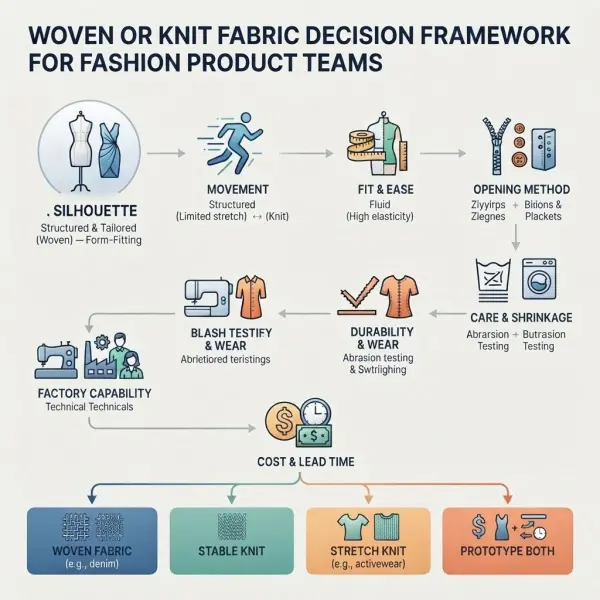
Start With the Garment Experience
Define how the product should feel and behave on the wearer:
- Should it follow the body or maintain distance?
- How much movement must it permit?
- Must the wearer pull it over the head or hips?
- Is a zipper, button, or elastic opening acceptable?
- Should the garment feel crisp, fluid, compact, soft, or compressive?
- Will it be worn in heat, cold, or changing conditions?
- How often will it be laundered?
- Which areas experience repeated stress?
These questions create a stronger brief than asking whether the designer “prefers woven or knit.”
Convert the Brief Into Measurable Requirements
The team can then specify:
- Weight
- Thickness
- Drape
- Extension by direction
- Recovery or growth
- Opacity under extension
- Air permeability
- Moisture behaviour
- Dimensional change
- Pilling
- Abrasion
- Snagging
- Seam performance
- Colorfastness
- Care method
- Required structure
Not every product requires every test. The package should reflect the end use and market risk.
Prototype in More Than One Construction When Necessary
When the commercial direction is uncertain, developing one woven and one knit prototype can reveal differences that swatches cannot.
For example, a travel trouser could be tested in:
- A comfort-stretch woven with a tailored waistband
- A stable double knit with a pull-on or partially elasticated waist
The woven version may produce a cleaner crease and pocket structure. The knit may improve movement and reduce restriction. Garment weight, bagging, drying, pilling, seam bulk, climate suitability, and customer positioning can then be compared.
Rebuild the Pattern for the Selected Fabric
Once the textile route is chosen, the pattern should be developed around its actual properties. Substituting the fabric without revising the block can invalidate fit approval.
This is particularly important when changing:
- Woven to knit
- Knit to woven
- Stable knit to fluid jersey
- Non-stretch woven to stretch woven
- Single jersey to rib
- Light woven to heavy woven
- Low-recovery fabric to high-recovery fabric
Confirm Factory Capability
A factory experienced in shirts or denim may not be equipped for fine jersey, seamless knitting, bonded activewear, or lingerie. A knitwear factory may not have the pressing, interlining, buttonhole, tailoring, or fabric-control capability needed for structured woven garments.
Review machine type, needle control, cutting equipment, spreading method, operator skill, pressing, finishing, laboratory capability, and previous product experience before assigning production.




Comments 0
Leave a CommentSend Comment
Anda harus Login terlebih dahulu untuk dapat memberikan komentar.