
Chiffon vs Organza: Which Sheer Fabric Works Better for Fashion Design?
Quick Answer
Chiffon usually works better when a design needs fluid drape, soft layering, gathers, or visible movement. Organza is generally the stronger choice when the garment needs crisp volume, sculptural shape, translucent structure, or a sheer layer that stands away from the body. Neither fabric is universally better.
Both are lightweight, sheer woven fabrics, and both may be made from silk, polyester, nylon, or other suitable fibers. Their most useful difference is behavioral: chiffon tends to fall and flow, while organza tends to hold and project. A chiffon skirt can create a floating effect; an organza overskirt can preserve a fuller silhouette with less dependence on heavy internal support.
Fashion teams should compare actual swatches rather than relying on fabric names. Fiber content, fabric weight, yarn, weave density, finish, color, number of layers, and supplier quality can change the result substantially. The final decision should also account for opacity, lining, seam visibility, edge finishing, snagging, comfort, care, production skill, and price. In some garments, the most effective solution is to use both fabrics for different functions.
What Is the Difference Between Chiffon and Organza?
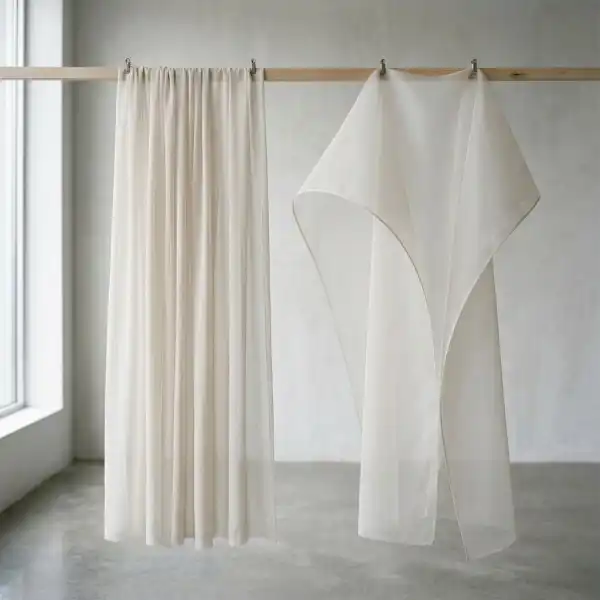
The main difference is drape and shape retention. Chiffon is a lightweight sheer fabric with a fine crepe-like surface and soft movement, while organza is a lightweight sheer fabric with a smoother, crisper hand that holds volume more readily.
Both are normally woven in a plain-weave structure, but the yarn and finishing choices produce distinctly different design behavior. Chiffon is commonly associated with highly twisted crepe yarns that contribute to its faintly grainy hand and fluid fall. Organza is woven to retain a firmer, springier character relative to its low weight. The result is visible before the first seam is sewn: chiffon tends to collapse into folds; organza tends to describe space.
This distinction matters more than the assumption that one is “luxurious” and the other is “practical.” Either fabric may be made from silk or manufactured fibers. The Museum at the Fashion Institute of Technology notes that silk can be woven into airy plain-weave chiffon with a silhouette that floats away from the body. The example illustrates a broader textile principle: fiber contributes to performance, but fabric construction determines how that fiber is organized.
For a deeper foundation on chiffon construction, fiber options, uses, and care, see the complete guide to chiffon fabric.
Where the two fabrics overlap
Chiffon and organza are both used when designers want transparency without the open net structure of tulle. They can appear in dresses, blouses, sleeves, overlays, veils, scarves, ruffles, and occasionwear details. Both can create layered color and reveal an underlying garment, lining, body, print, or embellishment.
They also share production challenges. Cut edges and seam allowances remain visible, lightweight panels can shift during cutting, needle damage can be conspicuous, and rough components may snag the surface. Their sheerness means that internal construction becomes part of the visual design rather than something completely hidden.
Where they separate most clearly
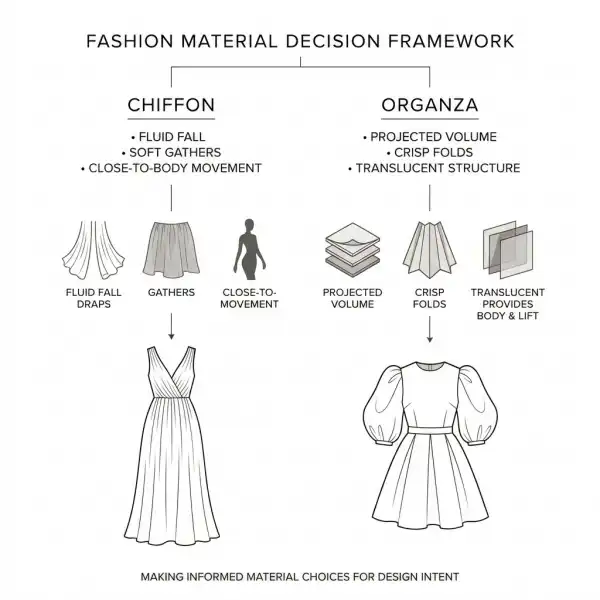
Chiffon is usually the more convincing choice for softness, cascading drape, and movement close to the body. Organza is usually more effective for bows, puffed sleeves, sculpted ruffles, projected skirts, and translucent forms that need to remain legible from a distance.
The difference is not absolute. A softer organza may drape more than expected, while a heavier or specially finished chiffon may feel crisper than a standard reference. That is why comparative sampling needs to use the exact bulk quality, not a generic showroom swatch.
Chiffon vs Organza at a Glance
The following table summarizes the usual design implications. It should guide initial selection, not replace physical testing.
|
Decision factor |
Chiffon |
Organza |
Practical implication |
|
Hand and surface |
Soft to slightly dry, with a subtle crepe-like texture |
Smooth to slightly wiry, with a crisp hand |
Chiffon reads softer; organza reads more architectural |
|
Drape |
Fluid and yielding |
Firm and shape-holding relative to its weight |
Choose according to whether the cloth should fall or project |
|
Movement |
Floating, rippling, and responsive |
Springy, airy, and more controlled |
Chiffon emphasizes motion; organza preserves volume |
|
Transparency |
Sheer; layers gradually build opacity |
Sheer to translucent; structure remains visually present |
Review both over the intended lining and under final lighting |
|
Typical design roles |
Draped dresses, soft skirts, gathered sleeves, scarves, overlays |
Overskirts, bows, structured sleeves, sculptural ruffles, veils, support layers |
Function matters more than garment category alone |
|
Surface visibility |
Fine texture diffuses light |
Smooth surface may catch light more clearly |
Photography and color perception can differ |
|
Edge behavior |
Soft edges can collapse or flutter |
Edges may hold a defined line but can look rigid |
Hem method changes the visual character |
|
Production risk |
Shifting, distortion, puckering, uneven narrow hems |
Fraying, visible needle marks, seam stiffness, crushing or permanent creases |
Each needs its own sewing trial |
|
Comfort consideration |
Often softer against skin, depending on fiber and finish |
Crisp edges and seam allowances may feel abrasive |
Placement, lining, and seam finishing affect wearability |
|
Best question to ask |
Does the design need flow? |
Does the design need shape? |
Start with silhouette, then verify performance and cost |
The table describes common tendencies, not quality levels. A premium silk organza and an inexpensive polyester chiffon are not direct substitutes simply because both are sheer. Nor does silk automatically guarantee the right performance. The design brief must state what the material is expected to do.

How Each Fabric Changes Silhouette and Movement
Material choice is a silhouette decision before it becomes a sourcing decision. The same skirt pattern cut in chiffon and organza can produce garments that feel unrelated because the fabrics distribute volume differently.
Chiffon creates movement by collapsing into soft folds
Chiffon responds to gravity and body motion. Gathers tend to fall downward, bias panels can form long fluid lines, and layered hems move independently. This behavior suits designs intended to look light, romantic, relaxed, or kinetic, although those associations depend on color, styling, proportion, and cultural context.
For a full skirt, chiffon may require several layers or an opaque foundation to build coverage and visual depth. The layers can move beautifully, but they also increase fabric consumption, cutting time, hemming operations, and the risk of uneven drop. A design that appears simple on the sketch may become labor-intensive in production.
Organza creates volume by resisting collapse
Organza maintains space between the cloth and the body more readily. In puff sleeves, bows, peplums, and overskirts, that resistance helps the shape remain visible without using a dense or heavy fabric. The material can create an enlarged silhouette while preserving transparency.
That crispness must be controlled. Too much organza, an overly dense quality, or a rigid hem can overwhelm the wearer and make the garment appear costume-like when that was not the intention. The appropriate scale depends on body proportion, garment size, fabric weight, seam placement, and how the product will be worn.
Movement affects how the product appears online
Static photography can flatten the distinction between sheer fabrics. Chiffon’s value often becomes clearest when the model walks or the hem moves; organza’s value may be clearer in a side view that shows projected volume and negative space. E-commerce teams should plan imagery around the material behavior rather than using one standardized pose for every dress.
Video can also expose construction problems. An uneven chiffon hem, clinging lining, collapsing organza sleeve, or distorted seam becomes more visible in motion. Product content is therefore not only a marketing asset; it can be a final check on whether the fabric is delivering the intended design.
Which Fabric Works Better for Different Design Applications?
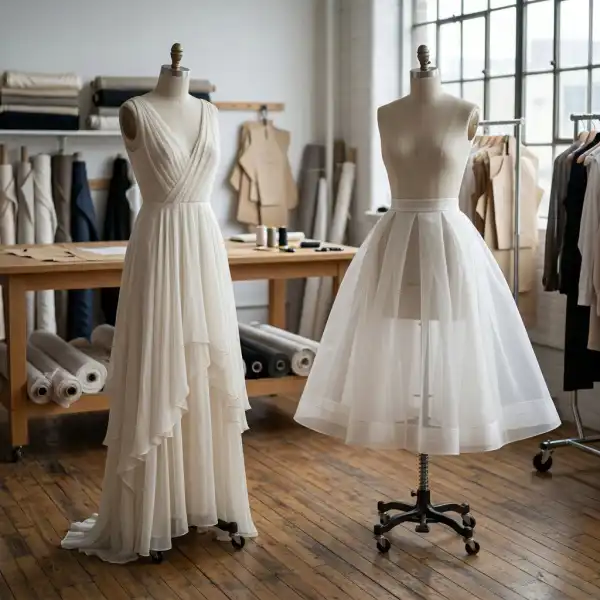
Garment category alone does not decide the answer. A wedding dress may use chiffon for a soft destination silhouette, organza for a formal architectural skirt, or both in a layered construction. The more useful approach is to identify the functional role of each fabric.
Flowing dresses and skirts: chiffon usually has the advantage
Chiffon generally performs better for softly gathered skirts, waterfall drapes, fluttering panels, and dresses intended to follow movement rather than hold a fixed outline. Its low weight allows several layers to create depth without the solid visual mass of a dense cloth.
However, a chiffon skirt still needs engineering. Designers must plan lining length, layer count, seam position, hem treatment, static control, and hanging time before final leveling. Bias sections may grow differently, and multiple layers may not settle at the same rate.
Sculptural volume and statement details: organza is usually stronger
Organza is commonly more suitable for pronounced bows, structured flounces, lantern sleeves, dimensional flowers, peplums, and overskirts that need to remain away from the body. It can provide form while allowing light and the underlying garment to remain visible.
The construction should use the material’s stiffness deliberately. If a large bow is expected to remain perfectly symmetrical after packing, transport, sitting, and repeated wear, the design may still require internal support or a recoverable construction. Organza holds shape better than chiffon, but it is not immune to crushing or permanent creasing.
Sheer sleeves and blouses: comfort may decide the choice
Either fabric can be used for transparent sleeves. Chiffon usually creates a softer sleeve that drapes or gathers close to the arm. Organza can make a puffed or lantern sleeve with clearer volume. The selection should also consider skin contact, arm mobility, cuff structure, underarm stress, and the feel of interior seams.
A beautiful organza sleeve may be uncomfortable if a crisp seam allowance rubs the arm. A soft chiffon sleeve may look limp if the design requires a distinct outline. Sample fitting should include movement, not only a front-view photograph.
Embroidery and embellishment: base stability is only one factor
Organza’s firmer surface can provide a useful base for embroidery, appliqué, beading, or three-dimensional decoration. Chiffon can also be embellished, but concentrated weight may distort or pull a fluid, lightweight base unless the design distributes load or adds support.
Neither fabric should be approved for heavy embellishment by appearance alone. The team should test needle damage, puckering, yarn displacement, weight distribution, cleaning compatibility, and whether the embellished panel can be repaired. On sheer materials, the reverse side and carrying threads may remain visible, making back treatment part of the design.
Veils, overlays, and translucent layers: decide how much structure is wanted
Chiffon overlays soften the surface below and move with the wearer. Organza overlays create clearer separation between layers and may show a sharper edge or silhouette. For veils, scarves, capes, and detachable layers, weight and hand should be evaluated against length: a fabric that feels pleasantly crisp in a small swatch may become too assertive at full scale.
This continuing use of transparency, layering, and lightness is examined more broadly in why sheer fabrics remain popular in dresses and occasion wear.
Silk, Polyester, or Nylon: Fiber Still Matters
Chiffon and organza are fabric names, not fiber names. Both have traditionally been associated with silk, and both are now widely available in manufactured fibers. A sourcing request must therefore state “silk organza,” “polyester chiffon,” or the verified blend rather than assuming that the fabric name communicates composition.
In the United States, Federal Trade Commission guidance explains that most covered textile products must disclose fiber content, country of origin, and the identity of the manufacturer or responsible business. Requirements vary by market, so international brands should verify destination-specific labeling obligations.
Silk versions
Silk chiffon and silk organza can offer a refined hand, nuanced luster, and material story aligned with luxury positioning. Yet they may also increase fabric cost, shade-management demands, care complexity, and the financial impact of cutting or sewing defects. Supplier traceability and any origin or production claims need documentation.
The choice between them remains functional. Silk does not make chiffon crisp or organza fluid; the structure and finish still differentiate the fabrics.
Polyester and nylon versions
Polyester and nylon can make chiffon and organza accessible across broader color ranges, repeat programs, and commercial price points. They may provide consistent qualities for scaled production, but heat sensitivity, static, snagging, surface shine, handfeel, and long-term appearance should be tested on the exact fabric.
Synthetic does not automatically mean durable, easy-care, or low-cost once the complete garment is considered. A low fabric price can be offset by high sewing difficulty, rejection, extra lining, specialist hemming, or customer returns.
Material claims need evidence, not category assumptions
A fiber label does not establish an environmental conclusion. Silk, virgin polyester, recycled polyester, and nylon each have different impact pathways and data limitations. Product durability, yield loss, energy, chemical management, care, and end-of-life conditions also matter. Brands should avoid presenting either chiffon or organza as inherently sustainable.
If recycled content, responsible sourcing, or another attribute is part of the product story, the claim should match supplier documents and applicable standards. The fabric category alone proves none of these attributes.

Production Differences Fashion Teams Should Not Overlook
Chiffon and organza are both demanding, but they fail in different ways. A factory experienced with one should not automatically be assumed to have mastered the other.
Cutting and lay control
Chiffon can shift, stretch on the bias, and distort when spread under uneven tension. Organza may be more stable in its plane, but layers can still slide, edges may fray, and creases introduced during spreading can remain visible. Lower lay heights, sharp tools, stable underlays, and trial cutting may be required depending on the quality and order volume.
Marker efficiency should not be pursued at the expense of grain alignment or surface quality. The operational principles behind lay stability and cutting accuracy are discussed in the fabric cutting process for garment production.
Seam appearance and internal visibility
On sheer fabrics, seam allowances, thread color, reinforcement, boning channels, pocket bags, and closure tapes can show through. Chiffon seams may pucker or grin under stress. Organza seams may remain visually prominent or feel stiff, particularly where several layers meet.
French seams and other enclosed finishes can create a clean interior, but they are not suitable for every curve, thickness, alteration requirement, or production budget. The seam specification must be tested on the actual fabric with the selected needle, thread, stitch density, tension, and pressing method.
Hem choice changes design behavior
A narrow rolled hem usually preserves lightness, but it can be difficult to keep even on chiffon curves or bias edges. On organza, a narrow hem may create a firmer line and change how the edge projects. Binding, horsehair braid, wire, or other edge supports can add further structure, but each changes weight, recovery, appearance, care, and cost.
The hem should therefore be sampled as a design component, not assigned late as a standard sewing operation.
Pressing and packing require separate trials
Synthetic versions can respond poorly to excessive heat, while silk versions may react to moisture, pressure, or unsuitable cleaning. Organza can acquire sharp creases; chiffon can develop distorted or shiny areas if handled aggressively. A press setting validated for one color or composition should not be copied to another without a test.
Packaging trials are equally useful for occasionwear. A voluminous organza sleeve that arrives crushed or a chiffon skirt with deep irregular creases creates finishing work for the retailer and disappointment for the customer.
A Practical Selection Framework for Fashion Brands
The strongest material decision begins with the product promise and ends with production evidence. Use the following sequence before approving chiffon or organza:
- Define the silhouette in verbs. Should the fabric flow, collapse, ripple, project, curve, stand, or frame? “Sheer and elegant” is too vague for sourcing.
- Assign the fabric a functional role. Decide whether it is the main shell, an overlay, a sleeve, a volume layer, a trim, an embellishment base, or internal support.
- Review full-scale behavior. Test a panel or toile large enough to show gravity, gathering, layer interaction, and edge response.
- Build the material system. Assess shell, lining, interlining, trims, closures, thread, and embellishment together.
- Validate production. Trial cutting, seams, hems, pressing, packing, cleaning, and repair with the intended factory.
- Model the real cost. Include consumption, yield loss, additional layers, sewing time, rework, inspection, packaging, and probable rejection—not only price per meter.
- Confirm claims and labels. Verify composition, care, origin, certifications, and market-specific disclosures before purchase and product copy are finalized.
For smaller brands, a stable stock fabric with reliable repeat availability may be more valuable than a visually perfect custom quality with an unmanageable minimum order. For premium limited production, a more demanding silk quality may be justified when the material behavior is central to the design and the workshop can control it.
Common Mistakes When Comparing Chiffon and Organza
Choosing from a photograph instead of handling the fabric
Photographs reveal color and approximate transparency but rarely communicate weight, surface feel, spring, static, or recovery. Online product descriptions also use terms such as “soft organza” or “crisp chiffon” inconsistently.
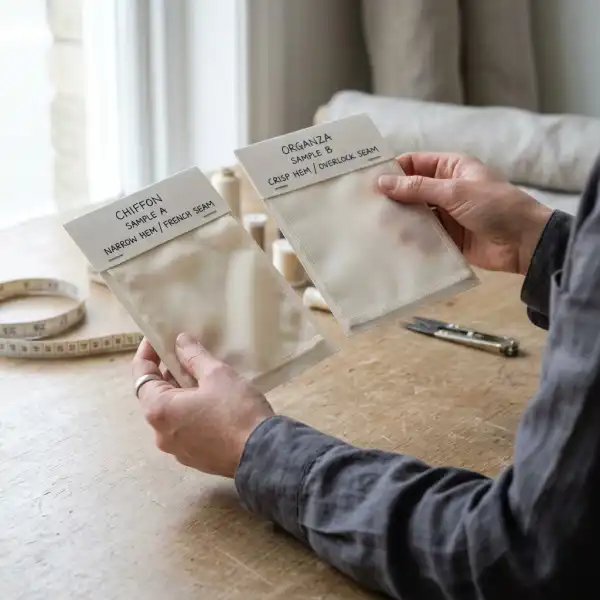
Request labeled swatches and enough sample yardage for a full-scale trial. Keep an approved reference sealed and protected for bulk comparison.
Assuming all silk versions are premium and all polyester versions are basic
Fiber prestige can distract from fabric quality and product fit. Poorly woven or inconsistently finished silk may not meet a luxury standard, while a well-developed polyester quality may perform reliably for a commercial program. The same applies to workmanship: expensive fabric cannot compensate for weak seam engineering.
Quality should be evaluated against the intended use, specification, testing, and customer promise.
Selecting softness or volume without considering the wearer
A dramatic organza sleeve can restrict movement or feel abrasive. A multilayer chiffon dress can become warmer, heavier, or more static-prone than the swatch suggests. Fit models should wear the full garment long enough to reveal rubbing, noise, cling, heat, and mobility issues.
The best-looking material on a dress form is not necessarily the best-performing product.
Copying construction from one sheer fabric to the other
Using the same needle, stitch density, seam allowance, hem, pressing temperature, and packing method for both fabrics can create preventable defects. Even two organzas from different suppliers may require different settings.
Operation bulletins should be based on approved production trials. Generic fabric-category knowledge is a starting point, not a substitute for line-specific validation.
Treating care as a customer problem
Care restrictions originate in product decisions. If a fabric, finish, embellishment, or combination creates an impractical cleaning requirement for the target customer, that conflict should be addressed during development. A correct label is essential, but it cannot turn a poorly matched product into a convenient one.
What Should Brands Verify Before Final Approval?
Before placing the bulk order, compare the two candidate fabrics using the same conditions: identical panel size, lighting, lining, gathers or pleats, seam samples, and cleaning protocol. This removes some of the visual bias created by different colors or sample dimensions.
The final approval file should include:
- verified fiber composition and fabric construction description;
- weight, usable width, color, finish, and approved physical standard;
- single-layer and layered opacity assessment;
- drape, recovery, snagging, seam, and dimensional-stability results appropriate to the product;
- approved lining, trims, thread, stitch, seam, hem, and pressing method;
- bulk tolerance and shade-control process;
- validated care instructions and required market labels;
- packaging method and full-garment wear-test observations.
The objective is not to generate paperwork for its own sake. It is to preserve the design intent when the fabric moves from a small swatch to hundreds or thousands of garments.
Frequently Asked Questions About Chiffon and Organza
Is organza heavier than chiffon?
Organza often feels more substantial because it is crisper and holds itself away from the body, but the actual weight depends on the specific fabric. A lightweight organza can weigh less than a dense chiffon while still appearing more structured. Compare grams per square meter, thickness, stiffness, and drape rather than relying on handfeel alone. For costing, also consider that chiffon may require several layers for opacity, while organza may require a foundation layer for comfort or coverage. Total garment weight and consumption are more useful than the weight of one swatch.
Which is more transparent, chiffon or organza?
Either can be more transparent depending on yarn size, weave density, color, finish, fiber, and number of layers. Organza often presents a clearer, glassier translucency, while chiffon’s textured surface may diffuse light, but this is a visual tendency rather than a fixed measurement. Test equal-size panels over the intended lining under daylight, retail lighting, strong backlight, and camera flash. Transparency also changes when the fabric is gathered or stretched across the body, so flat swatches do not provide a complete answer.
Which fabric is better for wedding dresses?
Chiffon is usually better for soft, flowing, lightweight bridal silhouettes, while organza is generally better for fuller skirts, sculptural details, and translucent volume. The venue, climate, dress structure, desired movement, embellishment, packing, alteration needs, and care expectations should guide the choice. A destination dress may benefit from chiffon’s fluidity, whereas a formal gown may use organza to maintain presence. Many wedding dresses combine fabrics: a structured foundation can support an organza layer, while chiffon may be used for a cape, drape, or softer secondary element.
Can chiffon and organza be used in the same garment?
Yes, and the combination can be effective when each fabric has a distinct job. Organza may provide a shaped sleeve, overskirt, flower, or support layer, while chiffon supplies soft drape, a floating cape, or moving skirt panels. The challenge is integration. Designers should test differences in weight, seam bulk, transparency, color reflection, static, cleaning, and drop over time. If both fabrics use different fibers or finishes, one care method must remain safe for the complete garment.
Which fabric is easier to sew?
Neither is inherently easy. Organza may be more stable to handle because of its crispness, but it can fray, retain needle marks, show every seam, and become bulky where layers meet. Chiffon can shift, distort, pucker, and make narrow hems difficult to control. Factory skill and the exact quality matter more than the category name. A short production trial should compare cutting accuracy, sewing speed, seam appearance, alteration practicality, pressing response, and defect rate before the team estimates which option is operationally easier.
Which is more comfortable against the skin?
Chiffon often feels softer and less rigid, but comfort depends on fiber, finish, seam construction, garment ease, climate, and lining. Silk organza may feel different from polyester organza, and a soft organza can be more comfortable than a rough or static-prone chiffon. Crisp edges, exposed seam allowances, beading, and tight armholes can create irritation regardless of fabric category. Wear testing should include movement and several hours of contact, especially for sleeves, necklines, and fitted bodices.
Is organza more durable than chiffon?
Organza’s firm structure may make it feel stronger, but durability cannot be determined from the fabric name. Chiffon and organza can both snag, abrade, split at stressed seams, or suffer heat and care damage. Fiber, yarn, density, finish, seam design, fit, embellishment, and use conditions influence service life. Brands should test relevant risks—such as seam slippage, snagging, tearing, dimensional change, and colorfastness—on the exact material and finished garment rather than describing organza as universally durable or chiffon as universally fragile.
Conclusion
Chiffon and organza solve different design problems. Chiffon excels when transparency needs to move, fall, and soften. Organza excels when transparency needs to hold, frame, and project. The distinction sounds simple, but the commercial choice involves more than drape: fiber, finish, opacity, comfort, construction, care, factory capability, and total garment cost can all change the answer.
The most reliable selection process begins with a clear silhouette objective and a full-scale sample. A fashion team should then test the entire material system—fabric, lining, seams, hems, trims, pressing, packaging, and care—under realistic conditions. This prevents a familiar development failure: choosing the correct-looking swatch but the wrong-performing garment.
There is no universal winner. There is only a material that performs the required job more convincingly and consistently within the product’s price, customer promise, and production reality.





Comments 0
Leave a CommentSend Comment
Anda harus Login terlebih dahulu untuk dapat memberikan komentar.