

Velvet Fabric Explained: Structure, Texture, and Fashion Applications
Velvet has a distinctive place in fashion because its visual appeal comes from the fabric's surface rather than from color or print alone. A velvet dress can appear deep and richly colored under soft lighting, while the same material may show bright highlights when it moves. That changing appearance is part of what makes velvet recognizable.
For fashion designers and apparel businesses, however, velvet is more than a decorative textile. Its pile construction affects how garments drape, how fabric panels are cut, how seams are assembled, and how the finished product looks under different lighting conditions.
Understanding velvet fabric means looking beyond its softness. The relationship between fiber composition, pile structure, finishing, and garment design determines whether a particular velvet is suitable for an evening dress, a structured jacket, a fashion accessory, or another application.
Quick Answer: What Is Velvet Fabric?
Velvet is a pile fabric traditionally made through weaving, with a dense surface of short, cut yarns that creates a soft texture, directional sheen, and distinctive depth of color. Its defining feature is the raised pile, rather than a particular fiber composition.
Traditional woven velvet uses additional warp yarns to form the surface pile. These yarns are cut to produce the smooth, closely packed texture associated with the material. Velvet may be manufactured using silk, cotton, viscose, polyester, or combinations of fibers, each producing different characteristics in drape, appearance, durability, and maintenance.
In fashion, velvet is commonly associated with evening dresses, tailored jackets, formalwear, decorative garments, and accessories. However, its suitability depends on fabric weight, pile density, backing construction, flexibility, and the intended garment silhouette.
For apparel brands, the central consideration is matching the velvet's construction to the design. A lightweight, fluid velvet may complement a softly draped dress, while a denser fabric may be more appropriate for a structured blazer or decorative panel.
The material's visual richness also introduces production considerations, especially pile direction, handling, cutting consistency, and finishing.
What Is Velvet Fabric?
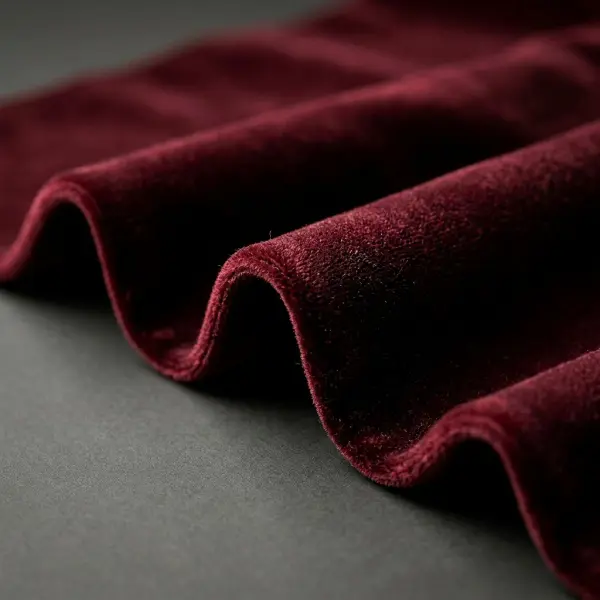
Velvet belongs to the broader category of pile fabrics, which have yarns or fiber loops projecting from the surface of a base fabric. In conventional woven velvet, this raised surface is created through supplementary warp yarns that are cut to form a dense, relatively short pile.
The structure is different from flat-woven fabrics such as poplin or many satin constructions. A flat fabric primarily presents the surface formed by interlacing yarns, while velvet adds a layer of upright or slightly inclined pile fibers. This additional surface changes how the textile feels and interacts with light.
The CottonWorks textile encyclopedia defines velvet as a woven warp-pile fabric with a cut pile of uniform height. That construction is the technical foundation of traditional velvet, regardless of whether the pile contains natural or manufactured fibers.
Velvet also has a long history in decorative textiles and luxury clothing. The Metropolitan Museum of Art's research on Renaissance velvet textiles describes how complex silk velvets were developed and used in historically prestigious garments and furnishings.
Modern velvet is available across a much broader range of fiber compositions, price points, and fabric weights. Its historical association with luxury remains relevant to design language, but it does not mean that every contemporary velvet has the same quality or cost.
How Is Velvet Fabric Constructed?
The Role of Warp Yarns and Surface Pile
The construction of traditional velvet begins with a woven ground structure. Warp yarns extend lengthwise through the fabric, while weft yarns cross them to form the base textile. Additional warp yarns create the pile that distinguishes velvet from ordinary woven materials.
These supplementary yarns are raised into loops or connected between fabric layers before being cut. The resulting pile forms a soft surface composed of numerous short yarn ends.
Pile density, yarn characteristics, and how securely the pile is anchored influence the fabric's appearance and performance. A dense surface may produce a more continuous visual finish, while variations in pile height or distribution can create different textures and light-reflection effects.
The surface pile is not simply a decorative coating placed on finished cloth. In genuine woven velvet, it forms part of the textile construction.
That distinction matters when evaluating materials marketed as having a velvet appearance. Some fabrics use different manufacturing techniques to imitate a plush surface, but they may not behave like traditionally woven velvet.
The Double-Cloth Weaving Method
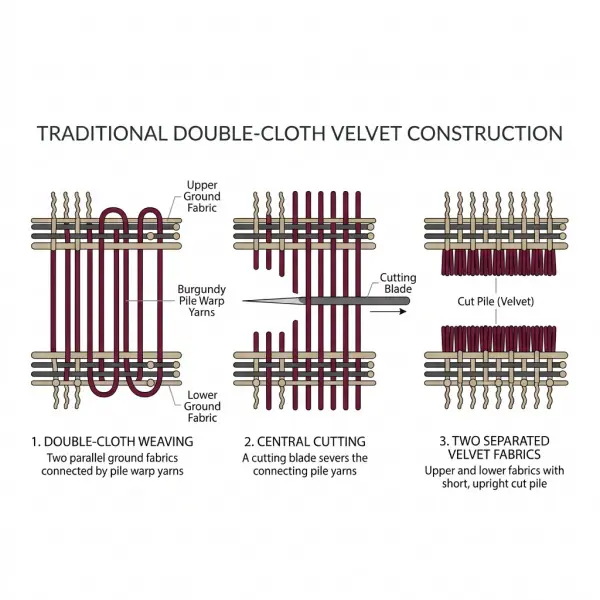
A widely used method of manufacturing woven velvet involves producing two fabric layers simultaneously.
During weaving, additional pile warp yarns connect the two ground fabrics. A cutting mechanism separates the connecting yarns, creating two individual fabrics with raised cut-pile surfaces.
This method produces the characteristic velvet texture while allowing relatively controlled pile formation.
An alternative historical method uses wires or rods to form pile loops, which may subsequently be cut. The exact process depends on the type of velvet and the manufacturing equipment.
The CottonWorks explanation of complex woven fabric structures describes velvet construction, including pile-binding structures and double-fabric manufacturing.
Why Pile Construction Changes Fabric Behavior
The raised surface introduces physical characteristics that designers must consider during development.
For example, a plain woven fabric can often be evaluated by inspecting its face, weight, and drape. Velvet requires attention to those factors plus the condition and orientation of its pile.
The pile may respond visibly to compression, handling, friction, and changes in direction. These responses can alter surface appearance without necessarily changing the underlying fabric color.
Pile construction also affects sewing. When two velvet surfaces are placed together, their raised fibers may shift against one another during stitching. This can make accurate seam alignment more demanding than with certain flat fabrics.
For manufacturers, these properties create additional requirements during sampling, cutting, sewing, and final inspection.
What Gives Velvet Its Soft Texture and Distinctive Sheen?
Dense Pile Creates the Soft Surface
Velvet's recognizable softness comes primarily from its closely distributed pile fibers.
When someone touches the material, their fingers contact the raised yarn ends rather than only the underlying woven construction. The sensation can vary considerably depending on the fiber, pile height, density, finishing, and backing.
A fine, fluid velvet made with viscose pile may feel different from a heavier cotton velvet intended for structured garments. Both can qualify as velvet, yet their handfeel and response to movement may be substantially different.
The term soft velvet therefore describes a sensory impression, not a complete technical specification.
For product development, softness should be evaluated alongside recovery after compression, stability, surface uniformity, and garment comfort.
Directional Light Reflection Creates Depth of Color
Velvet's color can appear to change when viewed from different directions because the raised fibers interact with light at different angles.
A dark velvet may appear particularly rich when the pile absorbs or scatters more light away from the viewer. When the surface orientation changes, reflected highlights can become more visible.
This optical effect helps explain why velvet is often selected for garments that rely on texture and movement rather than elaborate prints.
In a fashion presentation, a velvet jacket may show subtle tonal variation across the sleeves and body even when every panel comes from the same dye lot. Those differences are not necessarily manufacturing defects; they may be caused by the orientation of the pile.
However, inconsistent pile direction between garment panels can create unintended visual mismatches.
Fabric Weight and Backing Influence Drape
Velvet's pile contributes to its surface appearance, but garment drape depends on the complete fabric construction.
The ground fabric, fiber composition, yarn characteristics, finishing, and total mass influence how a velvet bends and falls. Two visually similar velvet samples may behave differently when suspended, gathered, or shaped into a garment.
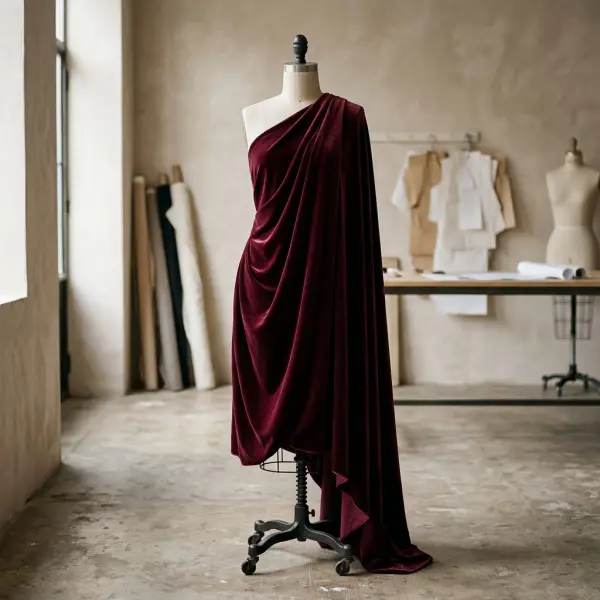
A lightweight velvet with a flexible backing may create fluid folds suitable for evening dresses or relaxed silhouettes. A heavier construction may provide more body for jackets, skirts, or accessories.
Designers should not assume that a velvet's appearance indicates its suitability for a particular silhouette. Physical drape testing on a representative sample is more reliable than selecting material solely from photographs or small swatches.
What Are the Main Types of Velvet Used in Fashion?
Velvet is not a single material specification. It is a textile category that includes different fibers, structural variations, and surface finishes.
For apparel businesses, distinguishing these characteristics helps prevent sourcing decisions based only on fabric names.
Velvet Types by Fiber Composition
The fiber used in the pile and ground fabric influences the final material's appearance, handle, performance, and cost.
|
Velvet type |
Typical characteristics |
Fashion applications |
Considerations |
|
Silk velvet |
Fine handfeel, potential for fluid drape and rich luster |
Luxury eveningwear, formal garments, decorative panels |
Often higher material cost; performance depends on full construction |
|
Cotton velvet |
Often substantial handfeel with relatively subdued luster |
Jackets, skirts, structured dresses, accessories |
Weight, crease recovery, and pile behavior vary |
|
Viscose or rayon velvet |
Often fluid with a soft pile and noticeable light reflection |
Dresses, blouses, scarves, draped garments |
Moisture response and surface handling require evaluation |
|
Polyester velvet |
Available in varied weights, finishes, and price points |
Fashion apparel, occasionwear, accessories |
Heat sensitivity, comfort, and appearance depend on construction |
|
Blended-fiber velvet |
Properties depend on the combination of pile and ground fibers |
Tailored apparel, dresses, specialty fashion products |
Fiber percentages alone do not establish performance |
These categories should be treated as general sourcing descriptions rather than fixed performance grades.
For example, a fabric sold as silk velvet may combine a silk pile with a ground woven from another fiber. A polyester velvet may have a soft drape or a relatively firm structure depending on yarn selection and finishing.
Buyers should therefore request a complete fiber-content specification instead of relying on a simplified commercial name.
Velvet Types by Surface Finish
Beyond fiber composition, velvet can be altered through finishing or pattern-development techniques.
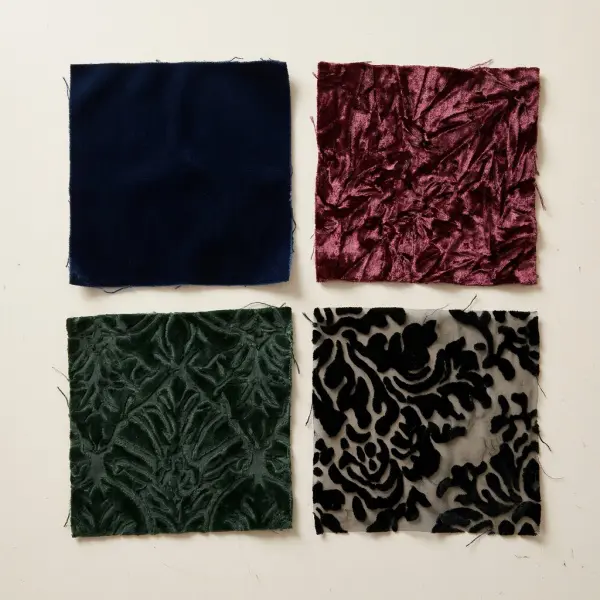
Plain velvet generally presents a relatively uniform pile surface. It is suitable for designs where color depth and texture are intended to remain visually consistent across the garment.
Crushed velvet has a deliberately irregular pile direction or compressed surface that produces a shifting, textured appearance. Its visual character can be useful in decorative or expressive fashion designs.
Embossed velvet features patterns formed by controlled pressure and finishing techniques. The result is a surface design created through variations in pile orientation or height.
Dévoré or burnout velvet uses a selective chemical process on compatible fiber combinations to remove portions of the material and create patterns. Its structure and performance depend on the fibers used and how the remaining fabric supports the design.
Stretch velvet refers to velvet materials with stretch properties, which may involve elastane, stretch constructions, or knit-based commercial fabrics. The name alone does not establish whether a product has a traditional woven velvet structure.
These distinctions should be recorded in material specifications. A decorative finish can significantly affect cutting, panel matching, surface appearance, and quality inspection.
Where Is Velvet Used in Fashion Design?
Velvet is particularly effective in garments where texture, depth of color, and surface movement contribute significantly to the design.
Its applications extend beyond formal clothing, although different product categories require different fabric specifications.
Evening Dresses and Occasionwear
Eveningwear is one of velvet's most recognizable applications.
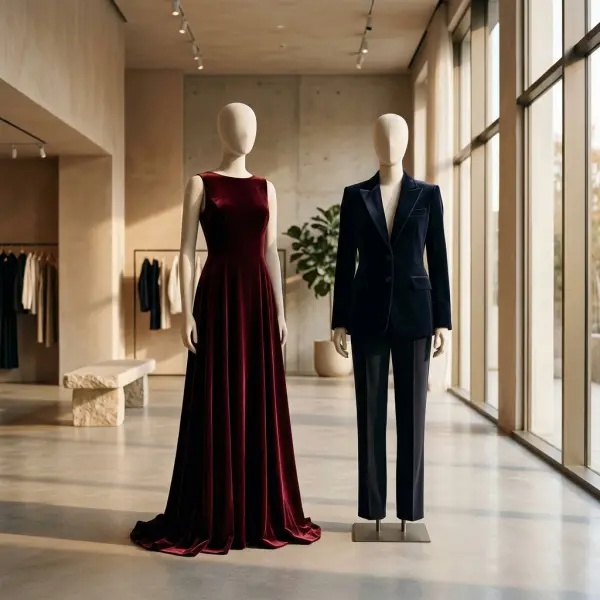
The fabric can create visual richness without relying on heavy prints or elaborate embellishment. Deep colors, controlled draping, and relatively simple silhouettes may be enough to establish a distinctive appearance.
For long dresses, fluid velvet can emphasize movement and folds. Structured velvet may be more suitable for fitted bodices, short formal dresses, or designs requiring greater shape retention.
A designer developing a floor-length evening dress should consider the combined weight of the fabric, lining, closures, and other components. An attractive swatch may become less suitable when applied across a large garment surface.
The best material choice depends on the desired silhouette and how the garment should move when worn.
Tailored Jackets and Blazers
Velvet can provide visual depth to tailored garments, particularly blazers, evening jackets, and statement outerwear.
Compared with a conventional smooth suiting fabric, velvet introduces a stronger surface character. This can influence how seams, lapels, collars, and shaped panels appear.
However, structured garments also require careful attention to interfacing, lining, seam bulk, and pressing.
A dense velvet may work well for a jacket body but become difficult to handle around narrow lapels or complex seam intersections. Designers may need to simplify certain construction details or adjust supporting materials.
The selection of a suitable lining is also important. For a broader discussion of garment interior construction, see how garment lining affects comfort, structure, and finishing.
Dresses, Skirts, and Fashion Tops
Velvet can also be incorporated into less formal apparel, provided that its fabric behavior matches the garment's intended use.
A softly draped velvet blouse may create an expressive surface without requiring a complex pattern. A midi skirt can use the material's weight and sheen to emphasize movement. More structured velvet may be suitable for A-line skirts or simple fitted garments.
Design complexity should be balanced against the pile surface.
Excessive seams, small details, or sharply pressed elements may interrupt the fabric's appearance or complicate production. This does not mean velvet garments must always be simple, but construction decisions should support the material's properties.
Accessories and Decorative Fashion Elements
Velvet is also used in handbags, footwear, hair accessories, belts, and decorative garment sections.
These applications can take advantage of the textile's tactile and visual qualities without requiring an entire garment to be constructed from velvet.
A fashion brand might use velvet as a collar material, decorative cuff, bag panel, or seasonal accessory detail.
However, products exposed to frequent handling or abrasion require appropriate testing. Material that performs acceptably on a decorative garment panel may not deliver the same durability on a handbag handle or frequently rubbed footwear surface.
For accessories, the pile's resistance to wear and changes in appearance can be as important as its original softness.
What Makes Velvet Different from Other Decorative Fabrics?
The main distinction is velvet's pile-based surface structure.
Materials such as satin, brocade, and jacquard can also produce sophisticated visual effects, but they do so through different textile mechanisms.
Satin is associated with a weave structure that creates relatively smooth, often lustrous surfaces. Velvet develops its distinctive appearance through raised pile fibers.
Brocade commonly uses decorative woven patterns, while jacquard describes a weaving system capable of producing complex designs through individual warp control. Velvet can also incorporate patterned construction, including jacquard techniques.
These textile categories are therefore not mutually exclusive.
A richly patterned velvet may combine surface pile with elaborate woven motifs, while a plain velvet may rely almost entirely on uniform texture and color.
For a closer examination of patterned weaving techniques, seethe structure and design characteristics of jacquard fabrics.
Velour is another material frequently associated with velvet because both can present soft pile surfaces. However, the names do not necessarily describe the same textile construction, particularly when comparing traditional woven velvet with knitted apparel velour.
The construction differences, stretch properties, and practical selection considerations deserve separate treatment in Velvet vs Velour: What Makes These Soft Fabrics Different?.
What Should Fashion Brands Consider When Sourcing Velvet?
Sourcing velvet requires more than selecting a color, fiber composition, or price per meter.
The fabric's surface structure introduces visual and operational variables that can influence material consumption, garment consistency, and manufacturing cost.
Define the Intended Garment Before Selecting the Fabric
A sourcing team should begin with the garment's intended silhouette, use, and price positioning.
For example, a fluid evening dress and a fitted velvet jacket may require different fabric characteristics even when both use the same color.
The dress may prioritize drape, surface movement, and lower bulk. The jacket may require dimensional stability, adequate body, and compatibility with supporting construction materials.
Material evaluation should therefore include full-size drape testing, not just visual comparison of swatches.
Designers should also confirm whether the fabric will be used for an entire garment or for limited decorative sections.
Request a Complete Technical Specification
A practical velvet sourcing specification should establish the characteristics that affect garment appearance and production.
Important details include:
- Fiber composition: The composition of the pile and ground fabric, including applicable fiber percentages.
- Fabric construction: Whether the material is woven or knitted, with relevant structural information.
- Fabric weight and usable width: Values needed for pattern development, marker planning, and material costing.
- Pile characteristics: Direction, relative height, density, and any special surface finish.
- Stretch and dimensional stability: Properties relevant to fit, cutting, sewing, and intended garment use.
- Color and finishing: Approved shade, appearance standards, and finishing requirements.
- Performance evidence: Supplier test data relevant to the intended product category.
A specification helps factories evaluate whether a material can meet the design requirements consistently. It also reduces the risk of approving an attractive sample that cannot be reproduced reliably in production.
Examine Color Under Multiple Conditions
Velvet can look noticeably different depending on light direction, surface orientation, and viewing angle.
For this reason, material approval should not rely exclusively on a single photograph or one lighting condition.
A dark green velvet, for instance, may appear almost black under subdued lighting but display brighter green reflections near a window or under directed retail lighting.
Sourcing teams should examine representative fabric panels under controlled, documented viewing conditions. Color comparison should also account for pile direction so that optical differences are not confused with actual dye-lot variation.
For brands selling products online, photography consistency deserves particular attention because the material's appearance can change significantly between images.
Evaluate Total Production Cost, Not Only Fabric Price
Velvet may introduce costs beyond its purchase price.
Directional cutting can limit how efficiently pattern pieces are arranged. Sewing may require additional handling or testing, and quality inspection may need closer attention to surface appearance.
These factors vary by fabric type, style complexity, supplier capability, and production volume.
A lower-priced velvet that creates frequent panel mismatches or handling defects may not be the most economical choice after production losses and rework are considered.
Material costing should therefore incorporate realistic marker efficiency, sample development, quality requirements, and expected manufacturing performance.
How Does Velvet Affect Garment Development and Manufacturing?
Velvet's surface characteristics become particularly important when a design moves from sampling into repeatable production.
The first successful sample does not necessarily prove that a garment can be produced consistently at scale.
Pattern Layout and Pile Direction
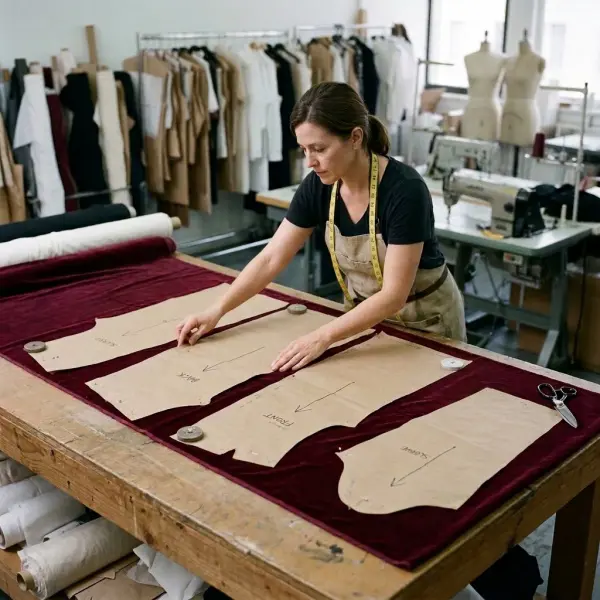
Velvet usually has a directional pile, commonly called the nap.
When the fabric is brushed in one direction, it may feel smoother and appear different from when it is brushed in the opposite direction.
Pattern pieces therefore need a consistent orientation when the design requires a uniform appearance.
If the front and back panels of a dress are cut in opposite directions, they may reflect light differently after assembly, giving the impression of a color mismatch.
A directional cutting layout may also reduce fabric utilization because pieces cannot always be rotated freely to fit available spaces.
The Seamwork guide to sewing velvet explains the importance of consistent nap direction and the handling challenges associated with pile fabrics.
Sewing and Seam Stability
The raised pile can cause two fabric layers to move against each other during sewing.
This movement may result in seam creeping, where fabric pieces become misaligned as they pass through the sewing machine.
Depending on the material, manufacturers may need to adjust feeding, temporary securing methods, stitch settings, or handling procedures.
A practical sampling process should test critical seams using the actual bulk fabric, thread, needles, and machinery intended for production.
The objective is not to create one universal sewing method for velvet. It is to establish a repeatable process for a specific fabric and garment construction.
Pressing, Shaping, and Finishing
Conventional pressing techniques may flatten or mark velvet's pile.
This is particularly relevant in structured clothing, where seams and shaped components often require controlled pressing.
Heavy pressure can alter the pile's orientation or compress its surface, producing an appearance that differs from adjacent areas.
Factories may use specialized supporting surfaces, controlled steam, or alternative finishing methods depending on the textile.
The appropriate method must be tested. A treatment that works on one velvet composition may damage another.
The wider production implications of compression, surface handling, and finishing are examined in why pile fabrics require special care in apparel design and production.
Production Quality and Appearance Consistency
Quality inspection for velvet should consider both standard garment requirements and the appearance of the pile.
A garment can meet its measurements and stitching requirements while still having visible shade differences caused by inconsistent pile direction.
Inspection should therefore assess the finished product as a whole, not only individual fabric panels.
For example, a velvet blazer may need to be examined under consistent lighting to confirm that the sleeves, front panels, collar, and other visible components have the intended relationship in sheen and color.
These evaluations should be based on an approved sample and documented acceptance criteria rather than subjective impressions alone.
How Can Fashion Businesses Use Velvet Strategically?
For apparel brands, velvet selection should connect material characteristics with the intended customer experience and operational capabilities.
Match Fabric Characteristics to Product Positioning
A luxury occasionwear collection may prioritize fine drape, sophisticated surface appearance, and carefully engineered finishing.
A commercially positioned fashion collection may place greater emphasis on repeatability, sourcing consistency, target cost, and suitable everyday performance.
Neither approach automatically makes one velvet superior to another.
The relevant question is whether the chosen material supports the brand's product promise.
For example, using an expensive silk-containing velvet does not necessarily improve the performance of a heavily handled accessory. Conversely, a well-selected manufactured-fiber velvet may satisfy the visual objectives of an occasionwear design when its construction and finish are appropriate.
Material prestige should not substitute for product suitability.
Develop Samples Around the Fabric's Behavior
A successful velvet product often begins with realistic material testing.
Instead of finalizing a complex pattern before evaluating fabric, designers can test how the textile behaves when draped, sewn, lined, or shaped.
For a formal jacket, this might involve sampling a lapel, a shaped seam, and a pocket construction before committing to a complete production pattern.
For an evening dress, an early drape test can reveal whether the material creates the intended folds or introduces unwanted weight.
Small development tests can reduce the likelihood of discovering major fabric incompatibilities after production decisions have already been made.
Build Supplier and Factory Alignment
Fashion businesses should ensure that their material suppliers and garment manufacturers use the same approved fabric specifications.
A sourcing team may approve a velvet based on its appearance, while a factory later receives material with a different pile finish or backing behavior.
Even modest differences can affect the finished garment.
An effective approval process identifies the approved material reference, shade, pile direction, finishing characteristics, and any critical production restrictions.
Factories also need sufficient reference material to compare incoming goods against the approved standard.
Communicate Velvet's Appearance Accurately in Retail
Velvet's directional sheen creates both an opportunity and a challenge for fashion merchandising.
Product photography can emphasize the material's color depth and texture, but lighting choices may make the garment appear different from its everyday appearance.
Retailers should aim for accurate visual representation across product images.
Showing both a full garment and a detailed fabric close-up may help customers understand the material. Short movement videos can also demonstrate how the fabric reflects light as the garment changes position.
Product descriptions should identify relevant material characteristics, including verified fiber composition and practical care information.
Rather than describing every velvet product as luxurious, retailers can communicate what actually distinguishes the fabric, such as its smooth pile, fluid drape, structured body, or decorative finish.
Common Mistakes When Designing or Manufacturing Velvet Apparel
Choosing Velvet Based Only on Appearance
An attractive swatch does not establish whether a fabric will work in a finished garment. Designers sometimes prioritize color or sheen before checking drape, stability, and construction. The result may be a dress that feels heavier than intended or a tailored jacket that lacks the necessary body. Evaluating the material in a representative garment sample helps connect visual expectations with practical performance.
Ignoring Pile Direction During Cutting
Inconsistent pile direction can create visible tonal differences between garment sections even when the material comes from the same batch. This problem may emerge when cutting teams use ordinary marker layouts that allow pattern pieces to be rotated. Establishing a one-way cutting requirement during pattern development helps prevent mismatched panels and avoids costly recutting after assembly.
Using Construction Techniques Without Testing the Fabric
Some designs require numerous shaped seams, sharp folds, or heavily pressed details. These elements can become difficult when the velvet pile is sensitive to pressure or the fabric layers shift during stitching. If factories rely on their standard construction procedures without material trials, defects may appear during production. Small tests using representative seam combinations provide a more dependable basis for process selection.
Treating All Velvet Fabrics as Equivalent
Velvet can be made with different fibers, constructions, and finishes, so identical commercial descriptions do not guarantee identical performance. A supplier's velvet sample may feel soft and drape beautifully, while another fabric with the same general name may be firmer or more sensitive to handling. Buyers should compare technical specifications and approved samples instead of assuming that all velvet behaves similarly.
Underestimating Material Consumption
Directional cutting requirements can reduce marker efficiency. Brands that calculate consumption using assumptions developed for nondirectional fabric may underestimate purchasing needs or production cost. Consumption should be established through realistic pattern layouts using the approved fabric width and nap orientation, with the appropriate allowance for the specific style and production conditions.
Important Technical Caveats About Velvet Fabric
Velvet's recognizable surface does not guarantee a particular level of comfort, durability, quality, or environmental performance.
Fiber composition is not the same as fabric construction. A velvet's behavior depends on its pile and ground structure as well as the fibers used. The appearance of the fabric alone cannot establish its complete composition.
Softness does not establish durability. A pleasant handfeel should be considered separately from abrasion performance, pile retention, and changes in appearance during use.
Pile sensitivity varies. Some constructions and finishes may be more resistant to compression or surface marking than others. These properties should be confirmed through material evaluation rather than assumed from the name velvet.
The Smithsonian Museum Conservation Institute's reference on velvet conservation and cleaning behavior identifies pile structure, density, and finishing as factors affecting how velvet responds to wear and care.
Environmental claims require evidence. Silk, cotton, viscose, polyester, and blended velvets have different production pathways. A statement that one velvet is environmentally preferable to another requires an appropriate assessment of fiber sourcing, processing, manufacturing, use, and end-of-life conditions.
Care instructions should be product-specific. Fiber composition alone is insufficient to determine safe cleaning procedures. Lining, interfacing, dye stability, decorative finishes, and garment construction may affect the appropriate method.
In the United States, the Federal Trade Commission's Care Labeling Rule requires covered manufacturers and importers to provide appropriate care information with a reasonable basis for their instructions. Businesses selling internationally should also verify applicable requirements in each target market.
For sourcing and product development, the practical approach is to confirm material claims with appropriate documentation and testing.
Frequently Asked Questions About Velvet Fabric
Is velvet a natural or synthetic fabric?
Velvet can be made using natural fibers, manufactured cellulosic fibers, synthetic fibers, or combinations of these materials. The word velvet primarily identifies a textile construction and surface character rather than a particular fiber origin.
Traditional luxury velvet was often associated with silk, while contemporary fashion uses materials such as cotton, viscose, polyester, and blends.
Some products also combine different fibers in the pile and ground fabric.
For fashion buyers, the correct way to identify a velvet's composition is to review verified supplier specifications and applicable fiber-content labels. Visual appearance alone cannot reliably distinguish silk, viscose, polyester, or blended velvet.
Why does velvet look darker or lighter from different directions?
Velvet changes in apparent color because the orientation of its pile affects how light interacts with the fabric.
When viewed from one direction, the raised fibers may produce deeper-looking shades. From another direction, reflected highlights may become more visible.
This is an optical characteristic of the pile surface, not necessarily a difference in dye concentration.
In garment manufacturing, inconsistent pile orientation between panels can create unwanted shade contrasts. Designers and cutting teams should establish the intended nap direction before production. Product photographers should also consider how lighting and fabric orientation influence the color customers see.
Is velvet suitable for everyday clothing?
Velvet can be suitable for everyday clothing, but the answer depends on its construction, fiber composition, garment design, and expected conditions of use.
A comfortable velvet top or skirt may work well for regular wear when the fabric has appropriate flexibility, stability, and care characteristics. Other velvet products may be better suited to occasional use because of their delicate surface or maintenance requirements.
Brands should evaluate comfort, abrasion resistance, colorfastness, and appearance retention rather than assuming that velvet is either inherently impractical or universally durable.
The intended customer lifestyle should guide material selection and product testing.
Can velvet be used for structured garments?
Yes. Velvet can be used for structured jackets, blazers, fitted dresses, and other tailored garments when its weight, backing, and surface characteristics are appropriate.
The main challenge is balancing the fabric's visual texture with the construction techniques required for shape and support.
Interfacing, lining, seams, closures, and pressing methods may need adaptation to prevent excessive bulk or unwanted pile marks.
A fashion brand developing a structured velvet garment should test critical construction details before finalizing its production specifications. The selected material must provide adequate garment support without compromising the intended appearance.
Does expensive velvet always mean better quality?
No. A higher price does not automatically establish that a velvet is better suited to a particular garment.
Material cost may be influenced by fiber composition, manufacturing complexity, finishing, order volume, and supplier economics. These factors do not guarantee better performance in every application.
A premium silk-containing velvet may be appropriate for a luxury evening dress but less practical for a product exposed to heavy abrasion.
Quality should be evaluated against the intended use, including surface consistency, pile retention, color performance, drape, stability, and manufacturing reliability.
For buyers, suitability and verified performance are more useful than price alone.
What is the difference between velvet and ordinary woven fabric?
The primary difference is that traditional velvet has an additional raised pile surface formed through supplementary warp yarns, while ordinary flat-woven fabric does not have that characteristic velvet pile.
This raised surface gives velvet its distinctive softness, directional sheen, and visual depth.
It also introduces specific production considerations, including pile orientation, seam handling, surface compression, and appearance inspection.
However, velvet is itself a woven textile in its traditional construction. The comparison is therefore between a warp-pile weave and flat-woven structures, rather than between woven and nonwoven materials.
Understanding the structure helps designers choose appropriate fabrics and manufacturing methods.
How should a fashion brand evaluate a velvet supplier?
A fashion brand should evaluate a velvet supplier using both material performance and production reliability.
The process should begin with complete fabric specifications, representative bulk-quality samples, and evidence supporting relevant performance claims.
Buyers should assess pile uniformity, fiber composition, shade consistency, fabric width, dimensional stability, and the supplier's ability to reproduce approved characteristics across production lots.





Comments 0
Leave a CommentSend Comment
Anda harus Login terlebih dahulu untuk dapat memberikan komentar.