

Why Pile Fabrics Require Special Care in Apparel Design and Production
A velvet blazer can look flawless when it leaves the cutting room but develop visible pressure marks after pressing. A velour dress may appear perfectly matched during sampling, only to show unexpected shade differences when its panels are assembled. Even a relatively simple garment can become difficult to manufacture when its fabric has a raised surface.
These problems often have less to do with the garment's design than with the physical structure of pile fabrics.
Unlike smooth, flat-woven materials, pile fabrics have yarns or fibers projecting from a supporting textile structure. This raised surface creates softness, texture, and distinctive light reflection, but it can also respond visibly to pressure, friction, handling, and changes in direction.
For fashion brands, these characteristics introduce challenges throughout product development. Pattern cutting must account for pile orientation, sewing techniques must control fabric movement, and pressing methods may need to avoid direct compression of the surface.
The consequences extend beyond manufacturing. Pile damage, inconsistent appearance, inappropriate care instructions, or poor packaging can affect how customers perceive a garment's quality.
Understanding these risks allows designers, sourcing teams, and manufacturers to build more reliable production processes without sacrificing the visual qualities that make pile fabrics desirable.
Quick Answer: Why Do Pile Fabrics Need Special Handling?
Pile fabrics require special care because their raised yarns or fibers can change direction, flatten, shift, or become damaged during cutting, sewing, pressing, finishing, and everyday use. These surface changes can affect the garment's texture, sheen, apparent color, and overall appearance even when its underlying construction remains intact.
Velvet, velour, velveteen, corduroy, terry fabrics, and various other pile textiles share some of these characteristics, although their behavior depends on pile structure, fiber composition, density, finishing, and fabric backing.
One of the most important production considerations is pile direction, also called nap. When fabric panels are cut with inconsistent pile orientations, they may appear to have different shades despite coming from the same dye lot.
Pile fabrics can also present sewing challenges. Raised surfaces may cause layers to shift during stitching, while inappropriate pressing pressure can flatten the pile and create visible marks.
For apparel manufacturers, successful handling requires coordinated decisions across design, sourcing, cutting, sewing, finishing, quality control, and garment care.
The goal is not to eliminate every natural variation in pile appearance. It is to distinguish intended surface characteristics from preventable manufacturing defects.
What Are Pile Fabrics and Why Do They Behave Differently?
Pile fabrics are textiles with a raised surface formed by yarn loops, cut yarn ends, or other pile-forming structures attached to a supporting fabric.
Unlike a conventional flat textile, where the visible surface is primarily formed by the ground weave or knit, pile fabrics add another structural element that influences both appearance and performance.
This distinction explains why two fabrics with similar weights or fiber compositions may behave differently during garment manufacturing.
The Difference Between Cut Pile and Loop Pile
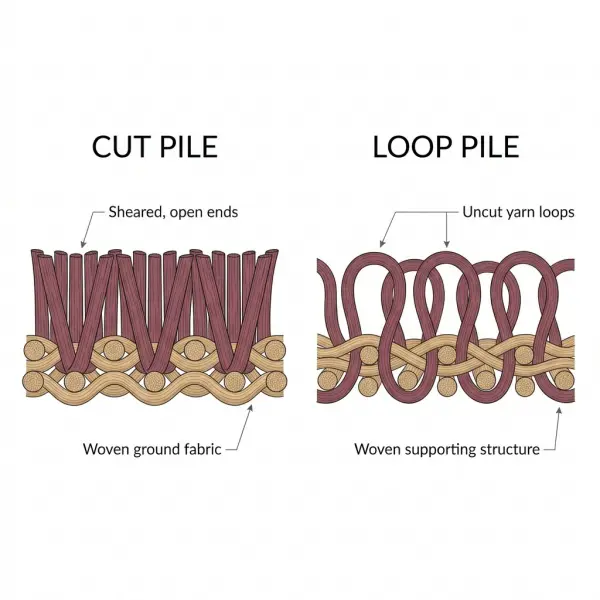
Pile fabrics can be classified partly according to whether their raised yarns remain as loops or are cut to create free yarn ends.
Cut-pile fabrics have exposed yarn ends that produce a soft or plush surface. Traditional velvet, velveteen, and many velour constructions use cut pile.
Loop-pile fabrics retain raised loops. Terry fabrics are a familiar example, although their loop height, construction, and performance vary.
These structures respond differently to mechanical stress.
Cut pile may show changes in direction, compression marks, or localized loss of surface fibers. Loop pile can be vulnerable to snagging when loops catch on rough objects or components.
The actual risk depends on how the pile is anchored, the yarn characteristics, and the intended use.
For garment developers, the difference matters when selecting sewing methods, trims, closures, and suitable surface-performance tests.
Why Pile Direction Affects Appearance
Pile direction refers to the orientation in which the raised yarns or fibers lie.
On directional fabrics, brushing the surface one way may feel smoother than brushing it in the opposite direction. The same movement can also change how light reflects from the surface.
A dark velvet panel may appear deeper in color when viewed against the nap and lighter when the fibers are oriented differently.
This does not necessarily indicate uneven dyeing.
The Threads guide to sewing velvet explains how pile direction influences apparent color and why consistent orientation matters during cutting.
For apparel production, this means fabric orientation is part of visual quality control.
Two panels made from the same material may look mismatched if their nap directions are inconsistent.
Compression and Friction Can Change the Surface
Pile fibers can bend or flatten when exposed to pressure. Depending on the textile, they may recover naturally, respond to appropriate steaming or brushing, or remain visibly altered.
Friction introduces another form of stress.
Repeated rubbing may change the pile's orientation, create localized matting, or contribute to wear. In some fabrics, pile fibers may gradually become detached or damaged.
These effects should not be treated as identical across all materials.
A dense woven velvet, knitted velour, and loop-pile terry fabric may react differently to the same handling conditions.
For fashion businesses, the central issue is whether the textile's surface can maintain an acceptable appearance throughout manufacturing and its expected service life.

The Main Production Risks Associated with Pile Fabrics
Pile fabrics introduce risks at several stages of apparel manufacturing. Some involve the visible surface, while others affect fit, construction efficiency, or finished-product durability.
|
Production stage |
Main risk |
Possible consequence |
Practical control |
|
Fabric sourcing |
Inconsistent pile, finishing, or backing |
Appearance and performance variations |
Approve representative material standards |
|
Pattern development |
Design incompatible with fabric behavior |
Excessive bulk, unstable shaping, poor drape |
Test critical construction details |
|
Fabric spreading |
Surface pressure or unwanted stretching |
Distortion and pile marks |
Control tension and handling conditions |
|
Cutting |
Inconsistent nap direction |
Apparent shade mismatch |
Use approved directional markers |
|
Sewing |
Fabric layers shifting |
Uneven seams or panel misalignment |
Test feeding and temporary stabilization |
|
Pressing |
Pile compression or heat damage |
Flattened areas and visible marks |
Validate fabric-compatible finishing methods |
|
Quality inspection |
Inconsistent visual assessment |
Defects overlooked or acceptable variation rejected |
Standardize lighting, orientation, and acceptance criteria |
|
Packaging |
Excessive folding or compression |
Creases, matting, and surface marks |
Validate packing and shipping conditions |
These risks are connected.
A fabric that appears acceptable during sourcing may behave differently after spreading, stitching, and finishing. Similarly, a successful sample does not guarantee consistent bulk production if the approved handling procedures are not communicated to the factory.
For brands producing pile-fabric apparel, quality control should therefore begin before cutting rather than relying entirely on final inspection.
How Should Designers Approach Garments Made from Pile Fabrics?
Designing with pile fabrics involves more than selecting an appealing texture.
The material's construction can influence seam placement, shaping methods, garment support, and the amount of finishing required.
Match the Silhouette to Fabric Behavior
Pile fabrics are available in very different weights, thicknesses, and levels of flexibility.
A lightweight velvet may support fluid draping, while a heavier construction may be more suitable for tailored garments. Knitted velour can offer flexibility for relaxed apparel, but its stretch and recovery need to be considered during pattern development.
Designers should assess how the selected textile behaves at the scale of the complete garment.
A small swatch may look elegant when held in the hand but become unexpectedly heavy when used in a floor-length dress.
Similarly, a structured jacket may require supporting materials to maintain its shape.
The design should be adapted to the actual fabric rather than assuming that all materials within a category will behave similarly.
For a foundational explanation of velvet construction and fashion applications, see Velvet Fabric Explained: Structure, Texture, and Fashion Applications.
Consider Seam Placement and Surface Continuity
Seams interrupt the surface of a garment.
On smooth fabrics, this may be relatively unobtrusive. On directional pile fabrics, adjoining panels can reveal differences in light reflection, surface orientation, or thickness.
Complex seam configurations can also make it more difficult to maintain consistent pile appearance.
This does not mean designers should avoid elaborate construction entirely.
Instead, seams should have a clear functional or visual purpose.
For a velvet evening dress, fewer major panels may help preserve uninterrupted surface movement. A tailored jacket may require more seams for shaping, but these can be positioned and constructed to maintain the intended appearance.
The best solution depends on the garment silhouette and the material's behavior.
Evaluate Darts, Pleats, and Decorative Details
Darts, pleats, gathers, and other shaping methods can interact differently with pile fabrics.
A dart may create localized bulk or require pressing that affects the surface. Pleats can introduce repeated folds that remain visible because of changes in pile orientation.
Gathering may work well with certain lightweight velvets but become bulky when used with dense, heavy materials.
Designers should therefore test shaping methods directly on the selected fabric.
A technically correct pattern is not necessarily suitable for every textile.
The garment may require adjusted seam allowances, different shaping methods, or modified construction details.
For more information about these techniques, see how pleats, tucks, and gathers influence garment construction.
Select Linings, Interfacings, and Trims Carefully
Supporting materials affect how a pile-fabric garment fits and maintains its shape.
A lining may reduce friction against the body or inner clothing, while interfacing can provide structure to collars, waistbands, or lapels.
However, these materials must be compatible with the outer fabric.
An unsuitable fusible interfacing may require heat and pressure that visibly alters the pile. A stiff supporting material can also change the drape of a fluid velvet.
Closures and decorative trims introduce additional considerations.
Zippers, buttons, hooks, and embellishments may trap pile fibers or create localized pressure during wear.
The construction should be evaluated as an integrated system rather than treating the outer fabric as the only material requiring attention.

Why Fabric Cutting Requires Special Attention
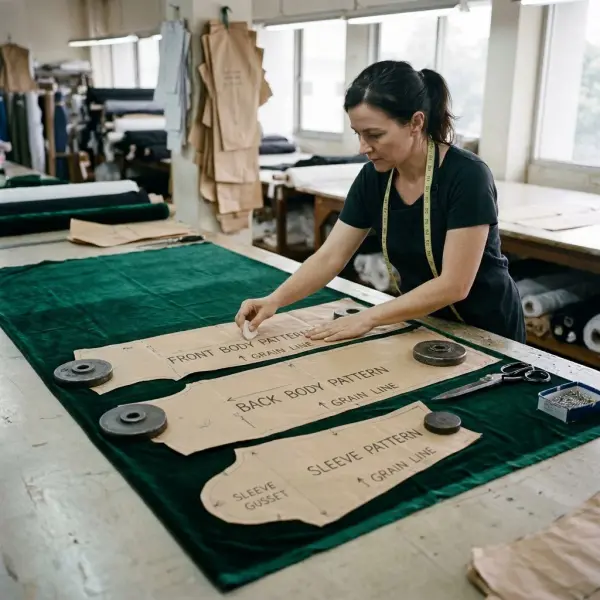
Cutting is one of the most critical production stages for directional pile fabrics because orientation errors can become highly visible after garment assembly.
Unlike some nondirectional textiles, these materials may not allow unrestricted rotation of pattern pieces.
Nap Direction Must Be Defined Before Marker Planning
A marker is the arrangement of pattern pieces used to plan fabric cutting and material consumption.
For directional pile fabrics, every relevant pattern piece may need to face the same lengthwise orientation.
If this requirement is ignored, pieces can be cut with opposing nap directions.
For example, the front panel of a velvet skirt may appear darker than its back panel despite both originating from the same fabric roll.
The problem may not become obvious until the garment is assembled and examined under suitable lighting.
A clear production specification should document the approved nap direction and identify any permitted exceptions for decorative effects.
Directional Cutting Can Affect Fabric Consumption
One-way cutting requirements may reduce marker efficiency because pattern pieces cannot always be rotated to occupy available spaces.
The additional consumption depends on garment design, pattern dimensions, fabric width, and cutting method.
It should not be estimated using a universal percentage.
For example, a simple straight skirt may have a different marker-efficiency impact from a tailored jacket with many irregular pattern pieces.
Factories should calculate consumption using the actual directional marker rather than relying on estimates prepared for nondirectional fabric.
This distinction becomes commercially important when production volumes increase.
Even a relatively small difference in material consumption per garment can affect purchasing quantities, production costing, and order profitability.
Spreading and Cutting Methods Must Protect the Surface
Pile fabrics may shift, stretch, or develop pressure marks during spreading and cutting.
Single-layer cutting is frequently recommended for delicate velvet because it can help control movement and provide greater cutting accuracy.
However, industrial cutting methods depend on the textile's stability, available equipment, production scale, and validated handling procedures.
The Seamwork guide to sewing velvet recommends single-layer cutting and consistent nap orientation when working with delicate velvet.
Industrial manufacturers may use different controlled approaches when their machinery and material allow it.
The important principle is to verify that the cutting process maintains dimensions and surface appearance without introducing unacceptable damage.
What Makes Sewing Pile Fabrics More Challenging?
Pile fabrics can be difficult to sew because their raised surfaces affect the interaction between fabric layers, the presser foot, and the feed mechanism.
The challenge varies by pile type and ground construction.
Fabric Layers Can Shift During Stitching
When two pieces of velvet are placed with their pile surfaces facing each other, the raised fibers may slide against one another.
This movement is commonly called seam creeping.
It can cause one layer to advance farther than the other during stitching, creating misalignment even when the pieces were correctly positioned beforehand.
On long seams, small differences can accumulate and become visible at the garment edges.
For production teams, the problem is not simply cosmetic. Misalignment may require unpicking and resewing, which can further disturb delicate pile surfaces.
Possible control methods include temporary basting, suitable presser-foot systems, controlled feeding, and adjusted machine settings.
Each technique should be tested on representative material before production approval.
Presser-Foot Pressure and Feeding Require Evaluation
Excessive pressure from sewing equipment may mark sensitive pile surfaces.
However, insufficient pressure can also contribute to irregular feeding or inconsistent stitches.
The correct setting is therefore not necessarily the lowest possible pressure.
Manufacturers should evaluate the combination of presser-foot pressure, machine feeding, needle selection, stitch formation, and fabric stability.
A walking-foot mechanism may improve feeding on some materials, but it can also leave marks on certain pile constructions.
The appropriate technique depends on the fabric and machine.
A successful sample should demonstrate consistent seam alignment without unacceptable surface damage.
Stitching and Seam Construction Must Suit the Ground Fabric
Pile fabrics may have woven or knitted ground structures.
This distinction affects seam requirements.
A woven velvet may need accurate feeding and careful management of seam bulk, while a knitted velour may require stitching that accommodates fabric extension.
A seam that performs adequately on a stable woven material may restrict movement when applied to a stretch knit.
Similarly, a flexible seam construction may not automatically provide the appearance or stability required for tailored velvet.
Needle selection and stitch settings should be validated for the specific textile.
Manufacturers should also examine whether repeated stitching or seam corrections leave permanent marks.
The correct method is the one that produces reliable seam performance while preserving the intended pile appearance.
Seam Bulk Can Affect Fit and Appearance
Dense pile surfaces add thickness to seam intersections.
When multiple layers meet at collars, pockets, waistbands, cuffs, or hems, the resulting bulk may affect the garment's shape.
This is especially relevant in tailored garments.
For example, a velvet blazer may require controlled seam grading or carefully selected internal construction materials to keep the lapel edge from becoming excessively thick.
However, seam allowances should not be reduced indiscriminately.
The factory must maintain adequate seam integrity while controlling the finished thickness.
Construction decisions should be based on tested sample details and the intended use of the garment.
Why Is Pressing One of the Biggest Risks for Pile Fabrics?
Pressing can permanently change the appearance of certain pile fabrics when heat, moisture, or pressure is applied inappropriately.
The raised surface may flatten, become directionally distorted, or develop visible marks.
Direct Pressure Can Flatten the Pile
Conventional pressing applies a combination of heat, moisture, and pressure to shape or smooth a textile.
For some pile fabrics, this combination can compress the raised fibers against the ground structure.
A flattened area may reflect light differently from the surrounding material, producing a visible patch.
This can occur around seams, darts, collars, or other areas where pressing pressure is concentrated.
The result is not necessarily a change in the fabric's dye color.
Instead, the surface geometry has been altered.
The effect may be temporary or persistent depending on the pile fibers, fabric construction, finishing, and severity of treatment.
Specialized Supporting Surfaces Can Help
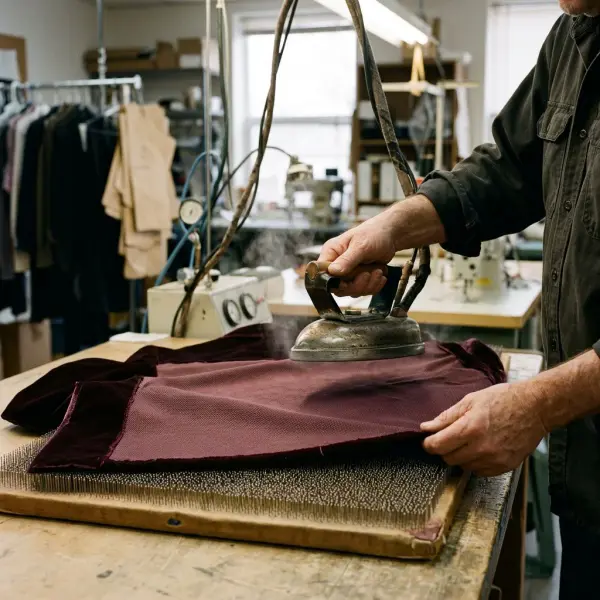
When appropriate for the material, manufacturers may use pile-supporting surfaces to reduce direct compression during pressing.
A traditional example is a needle board, which supports the pile while allowing pressure to be distributed differently from a flat pressing surface.
Other techniques may involve suitable textured supporting fabrics and carefully controlled steam.
The Threads technical guide to velvet pressing discusses needle boards, textured support surfaces, and steam-based techniques for reducing pile crushing.
These methods should not be treated as universally safe.
Steam, heat, and moisture can affect fibers and finishes differently. A method suitable for one velvet may produce shrinkage, water marking, or surface changes on another.
Factories should test the complete finishing method before using it on production garments.
Pressing Requirements Should Influence Garment Design
The pressing risk begins before the garment reaches the finishing department.
A design with numerous sharply pressed seams may be more difficult to manufacture from a sensitive pile fabric than a design using softer folds or fewer constructed details.
This creates a direct relationship between design complexity and production feasibility.
For example, a tailored velvet jacket may require careful shaping of lapels and edges without flattening the surface.
A soft evening dress may involve less structural pressing but still require seam finishing and hem control.
Product developers should identify these requirements during sampling.
If a particular design detail cannot be finished consistently without damaging the pile, the design or construction method may need revision.
How Should Manufacturers Test and Inspect Pile Fabrics?
Quality control for pile fabrics should distinguish structural defects, performance failures, and natural optical characteristics.
A fabric may appear different from multiple viewing directions without being defective. Conversely, a surface may look acceptable during initial inspection but perform poorly under repeated friction.
A suitable quality-control plan therefore requires both visual assessment and relevant physical testing.
Evaluate Pile Uniformity and Surface Appearance
Pile uniformity can influence the perceived quality of a finished garment.
Inspection may identify unintended variations in pile height, surface density, direction, or texture.
The assessment should use an approved material standard.
Lighting conditions and viewing orientation should also be controlled because directional surfaces can create apparent shade differences.
For example, two velvet panels should not be judged solely from photographs captured with different lighting angles.
A more reliable evaluation compares samples under consistent conditions while accounting for the intended nap direction.
Distinguish Optical Shading from Dyeing Defects
One of the most important inspection challenges is distinguishing surface reflection from actual color inconsistency.
A pile fabric can appear darker or lighter when its fibers point in different directions.
This effect may be acceptable when it is an inherent characteristic of the approved fabric.
However, actual dyeing inconsistencies, staining, or unwanted finish variation should not be dismissed as normal shading.
Inspectors may need to compare the material under controlled lighting and consistent pile orientation.
Instrumental color measurement can support evaluation, but directional pile surfaces can complicate readings. Sampling position, presentation, and measurement geometry must therefore be appropriate for the material.
A visual standard and documented inspection method help reduce inconsistent judgments.
Test Abrasion and Appearance Retention
Abrasion testing helps assess how textiles respond to repeated rubbing.
For pile fabrics, the visible appearance may change before the underlying structure reaches a clearly defined mechanical failure point.
This makes appearance retention an important consideration.
The ISO 12947-4:1998 standard addresses the assessment of fabric appearance change using the Martindale abrasion method.
However, not every abrasion test configuration is appropriate for every pile construction.
For example, ISO 12947-1:1998 describes the Martindale testing apparatus and specifies an applicability limit for pile textiles with a pile height of up to 2 mm.
Consequently, buyers should confirm that the chosen test method is technically suitable for the material and the performance question being investigated.
An abrasion cycle count alone does not provide a complete prediction of garment service life.
The results should be interpreted alongside expected use conditions and relevant appearance criteria.
Check Colorfastness to Rubbing
Colorfastness testing assesses whether color transfers or changes under specified conditions.
For garments, rubbing can be particularly relevant where fabric surfaces contact skin, bags, accessories, or other clothing.
The ISO 105-X12:2016 test method specifies procedures for assessing color transfer by rubbing, including dry and wet conditions, and explicitly covers pile fabrics.
The AATCC TM8 colorfastness to crocking method provides another recognized method for evaluating color transfer through controlled rubbing.
These tests examine color-transfer behavior, not every form of pile wear.
A fabric may perform satisfactorily in a colorfastness test yet still develop visible pile flattening under mechanical stress.
For this reason, performance requirements should be matched to the relevant failure modes rather than assuming that one test establishes overall quality.
Evaluate Dimensional Stability and Care Performance
Dimensional changes can affect both fit and appearance.
Some pile fabrics may shrink, stretch, distort, or develop surface changes during cleaning, depending on their construction and finishing.
For fabrics intended for domestic laundering, the AATCC TM135-2025 method addresses dimensional changes after home laundering.
Garment-level evaluation may also be necessary because seams, linings, interfacing, and trims can influence the performance of the assembled product.
For example, a knitted velour may maintain acceptable fabric dimensions while a completed garment develops seam distortion after washing.
The test program should therefore consider both the textile and the finished product.
A Practical Quality-Control Framework for Pile-Fabric Apparel
Manufacturers can organize pile-fabric inspection around the characteristics that matter most to the garment.
|
Quality characteristic |
What to inspect or test |
Why it matters |
|
Pile direction |
Orientation across visible garment panels |
Helps prevent unintended apparent shade differences |
|
Surface uniformity |
Pile height, density, and finish consistency |
Supports coherent garment appearance |
|
Abrasion behavior |
Appropriate wear and appearance-change testing |
Identifies potential surface deterioration |
|
Colorfastness to rubbing |
Dry and wet color transfer where relevant |
Helps assess staining or transfer risks |
|
Dimensional stability |
Changes following applicable cleaning procedures |
Protects intended fit and proportions |
|
Seam performance |
Alignment, integrity, and stretch where needed |
Reduces construction defects |
|
Pressing response |
Changes after approved finishing treatment |
Helps prevent flattening or visible marks |
|
Finished-product appearance |
Inspection under consistent lighting |
Confirms that assembled panels meet the approved standard |
This framework should be tailored to the product category.
A decorative velvet collar does not necessarily require the same performance priorities as velour trousers intended for frequent washing and movement.
Similarly, a pile fabric used in a handbag may face different abrasion conditions from a fabric used in an occasionwear dress.
The most effective testing program is proportionate to the product's expected use and its material-related risks.
Why Packaging, Storage, and Transportation Also Matter
Manufacturing quality can be compromised after the garment has passed final inspection.
Pile fabrics may respond to prolonged compression, tight folding, friction, or contact with hard packaging components.
A finished velvet jacket can leave the factory in acceptable condition but develop visible fold marks after being packed tightly for an extended period.
Whether these marks recover depends on the material and the packing conditions.
Avoid Unnecessary Compression
Dense packing can create localized pressure on pile surfaces.
For garments particularly sensitive to compression, hanging, appropriate folding methods, protective interleaving, or other validated packaging approaches may reduce visible marking.
However, hanging is not automatically preferable for every product.
A heavy knitted velour dress, for example, may stretch or distort if suspended improperly.
The appropriate storage method should account for garment weight, structure, and surface sensitivity.
Consider Friction During Transport
Garments can rub against packaging materials or other garments during handling and transportation.
This may affect sensitive pile surfaces, especially around raised seams, trims, or frequently contacted areas.
Packaging materials should be evaluated for their compatibility with the garment.
A smooth protective layer may be useful, but any packaging change should be tested under realistic conditions.
Manufacturers should avoid assuming that a packaging method suitable for flat woven fabrics will automatically protect delicate pile surfaces.
Test the Finished Packing Configuration
Packaging approval should include the finished garment, not only the empty packaging design.
A practical validation process can examine whether the product retains its acceptable appearance after representative folding, compression, handling, storage, and transport conditions.
For premium garments, the unboxing appearance may be commercially significant.
If a customer receives a velvet jacket with severe pressure marks, the product may be perceived as defective even when its stitching and measurements meet specification.
Packaging is therefore part of the quality system rather than a separate logistics detail.

How Should Fashion Brands Develop Care Instructions for Pile Fabrics?
Care instructions should reflect the performance of the complete garment rather than relying on generalized assumptions about velvet, velour, or other pile textiles.
Different pile fabrics can respond differently to cleaning, drying, pressing, and storage.
Cleaning Requirements Depend on Material and Construction
A pile fabric's fiber composition influences its cleaning behavior, but it is not the only factor.
The ground structure, dyes, finishes, linings, interfacings, trims, and other garment components must also be considered.
Some knitted velour garments may be engineered for routine domestic washing.
Other pile-fabric products may require more restrictive cleaning methods because of their construction or surface finish.
A label that simply states "dry clean only" should not be used as a precautionary substitute for a substantiated care assessment.
In the United States, the Federal Trade Commission's Care Labeling Rule requires covered manufacturers and importers to provide appropriate care information supported by a reasonable basis.
Requirements differ internationally, so fashion businesses should also verify applicable rules in their target markets.
Surface Restoration Is Not Always Guaranteed
Some pile surfaces may respond to carefully controlled brushing or steaming.
However, this does not mean all compression marks or texture changes are reversible.
The effectiveness and safety of a treatment depend on fiber properties, finishing, and the nature of the damage.
Strong brushing may disturb pile fibers, while excessive steam or heat may create additional problems.
Brands should avoid promising that customers can restore every surface mark through home treatment.
Care instructions should be specific to the garment and supported by testing or reliable technical evidence.
Customer Communication Can Reduce Misunderstandings
Customers may interpret normal pile shading as inconsistent color or a manufacturing defect.
Product information can help explain why a velvet or velour surface appears lighter or darker from different angles.
However, brands should not use this explanation to dismiss genuine quality problems.
Clear photography, accurate fabric descriptions, and appropriate care information can establish realistic expectations.
For online retail, detailed fabric close-ups and movement photography may be useful because pile appearance changes with light and garment position.
Customer communication should describe the material truthfully without exaggerating its durability or ease of maintenance.





Comments 0
Leave a CommentSend Comment
Anda harus Login terlebih dahulu untuk dapat memberikan komentar.