

Fashion Retail Operations Explained for Store and Online Teams
Quick Answer
Fashion retail operations are the coordinated processes used to make products available, sellable, fulfillable, and supportable across physical stores and digital channels. They connect merchandise planning, inventory control, product information, store execution, ecommerce orders, staffing, payments, returns, and performance reporting.
For store teams, the work is visible in receiving deliveries, preparing the sales floor, serving customers, checking stock, processing transactions, and handling returns. For online teams, it includes publishing accurate product data, synchronizing inventory, routing orders, picking and packing, monitoring delivery exceptions, and managing digital customer service. The channels may look different to shoppers, but they often depend on the same stock records, product identifiers, policies, and handoffs.
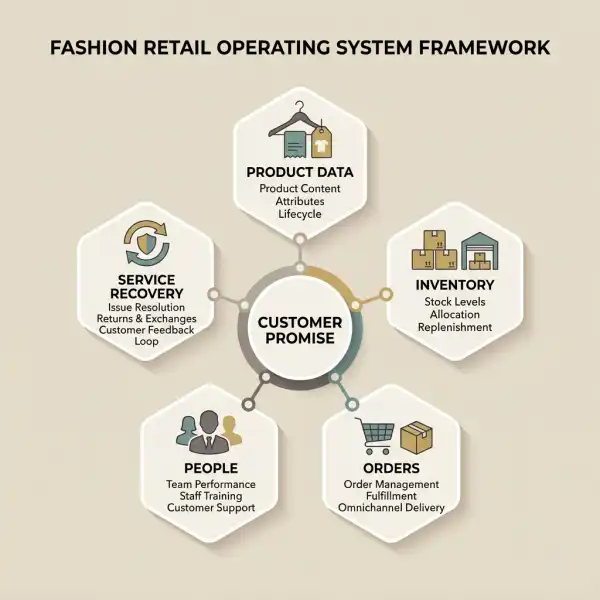
The practical goal is not simply to “run a store” or “manage a website.” It is to keep the customer promise aligned with operational reality. A product shown as available should be locatable and sellable. A delivery estimate should match fulfillment capacity. A return policy should be executable by the people and systems involved. When those conditions are met consistently, retail operations support sales, margin control, and trust without relying on constant firefighting.

What Are Fashion Retail Operations?
Fashion retail operations are the management system that turns a fashion assortment into a dependable customer experience and a commercially controlled flow of stock. The term covers the recurring work required after products have been selected or produced: receiving them, identifying them, making them available in the right channel, completing sales, fulfilling orders, managing returns, reconciling inventory, and learning from the results.
This is broader than store management. It is also broader than ecommerce administration. A fashion retailer may sell through boutiques, department-store concessions, marketplaces, social commerce, a direct-to-consumer website, or several of these at once. Retail operations determine how those channels share—or deliberately separate—inventory, pricing, promotions, product information, service policies, and responsibility.
Fashion adds variant-level pressure. One style may exist in several colors and sizes, each represented by a stock keeping unit (SKU), with uneven demand and fit-related returns. A black dress in size M cannot solve a stockout in size S even when total style stock looks healthy. Useful control therefore works by variant and location.
Reliable identification is part of that foundation. A retailer may use internal SKUs for its own operations and Global Trade Item Numbers (GTINs) when globally unique trade-item identification is required. GS1 explains how barcodes encode identifiers for electronic scanning, but the barcode itself is only the carrier. The retailer still needs disciplined master data, labeling, scanning, and transaction processes for the record to remain useful.
The operational scope in practical terms
The following areas belong to one connected retail system, even when different teams own them:
|
Operational area |
What the team controls |
Customer-facing consequence |
|
Product and channel setup |
SKUs, titles, descriptions, images, prices, tax settings, launch dates, and channel eligibility |
Whether the customer sees accurate and complete product information |
|
Inventory movement |
Receiving, put-away, transfers, reservations, adjustments, counts, and returns to stock |
Whether availability claims are dependable |
|
Store execution |
Opening routines, floor readiness, fitting-room flow, service, checkout, and closing controls |
Whether a visit feels easy, informed, and consistent |
|
Online order operations |
Order capture, fraud or payment checks, allocation, picking, packing, dispatch, and exception handling |
Whether the order arrives correctly and on time |
|
Returns and after-sales |
Eligibility checks, refunds, exchanges, inspection, disposition, and reason capture |
Whether recovery from a problem protects customer trust |
|
Performance control |
Daily reporting, variance review, conversion, sell-through, order quality, and root-cause analysis |
Whether recurring failures are corrected rather than repeated |
Ownership varies by business size: one person may update product pages and pack orders, while a multi-store retailer separates several functions. In either case, each transaction needs an owner, a source of truth, and a defined exception step.
Why Do Retail Operations Matter to Fashion Businesses?
Retail operations matter because fashion sales are constrained by availability, timing, presentation, service, and execution—not only by product appeal. A desirable item cannot generate its intended revenue if the size is unavailable, the online listing is incomplete, the store team cannot find the unit, or the order is cancelled after purchase because the recorded stock was wrong.
The first effects are revenue quality and working-capital control. Sound operations makes genuinely available stock easier to sell while distinguishing it from safety stock, damaged goods, display pieces, pending returns, and units reserved for open orders. Inventory ties up cash until it sells, yet cutting it too aggressively can remove important sizes or colors. The operating evidence may point to transferring a slow-moving size, correcting receipts, changing allocation, or stopping a channel from promising stock that cannot be fulfilled reliably.
Fashion shoppers already face uncertainty about fit, feel, color, and drape. Retailers should not add preventable uncertainty through inconsistent size data, mismatched images, unexplained delays, or returns that contradict the stated policy.
Operations also creates feedback for the rest of the business. A high return rate may reflect a fit problem, unclear photography, incorrect measurements, picking errors, or poorly matched demand. Reason codes, inspection notes, SKU-level patterns, and service context help buying, design, marketing, and product teams distinguish among them.

Store Operations and Online Operations: Where They Differ and Where They Meet
Physical and digital retail require different forms of execution. A store team works with a physical space, face-to-face service, live fitting behavior, cash or card transactions at a point of sale (POS), and stock that customers can move without creating a system record. An online team works through product pages, search and navigation, digital payments, order queues, carriers, remote communication, and fulfillment deadlines.
Treating the channels as unrelated businesses creates blind spots. Click-and-collect reserves store stock, an online return may arrive at a boutique, and a warehouse may inherit an order after a store unit cannot be found. Each scenario crosses an organizational boundary.
|
Operating question |
Physical store |
Online channel |
Shared requirement |
|
How is availability experienced? |
The customer or associate looks for the item on the floor or in the back room |
The website or marketplace displays an availability status |
Accurate SKU-location stock and clear reservation rules |
|
How is the product evaluated? |
Touch, fitting, styling support, and immediate comparison |
Images, video, copy, measurements, reviews, and remote support |
Consistent product facts and honest expectation-setting |
|
How is the sale completed? |
POS transaction with immediate handover in most cases |
Payment authorization followed by fulfillment |
Correct price, promotion, tax, payment, and transaction records |
|
What can disrupt completion? |
Queue, missing size, unreadable tag, poor handoff, or POS issue |
Payment failure, overselling, picking error, carrier delay, or address issue |
Exception ownership and a defined recovery process |
|
How are returns handled? |
Immediate inspection and refund or exchange according to policy |
Authorization, shipment or drop-off, inspection, refund, and disposition |
One understandable policy with channel-specific instructions |
Channels do not have to be identical. A marketplace, flagship store, and brand website may offer different services, provided the promise is clear before purchase and the internal process can execute it.
Omnichannel inventory management generally refers to tracking and coordinating stock across sales channels and locations. Shopify’s explanation of omnichannel inventory management describes the use of connected inventory updates when sales, returns, or restocks occur. In practice, “connected” does not automatically mean perfectly real-time or error-free. Integration frequency, offline transactions, reservations, marketplace latency, manual adjustments, and physical loss can still create discrepancies.
Shared inventory versus separate channel pools
A shared pool broadens access and reduces stranded stock, but requires higher accuracy. If store stock is offered online, staff must locate and reserve it before a walk-in sale. Rules are needed for priority, safety stock, cut-offs, cancellation, and reallocation.
Separate pools can be easier to control, but may leave one channel overstocked while another shows a stockout. The decision should reflect system capability, store workload, cancellation risk, and the commercial value of broader availability.
The Core Operating Cycle Behind a Fashion Sale
Retail operations is a repeating cycle: product and stock data enter; units move through locations and statuses; customers create demand; teams complete transactions; returns change the records; and analysis informs the next allocation or process change.
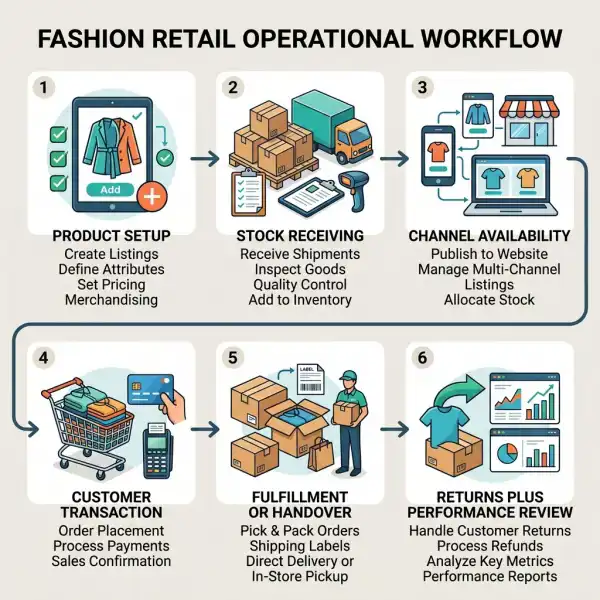
1. Product and channel setup
Before launch, every sellable variant needs a usable identity and complete channel data. Depending on the business, that may include SKU, style code, GTIN, color, size, material composition, care instructions, measurements, cost, price, tax class, image set, selling channel, supplier, and season. Teams should also define whether the item can be discounted, shipped internationally, returned, pre-ordered, or fulfilled from a store.
Poor master data travels. An incorrect size label can affect the product page, picking slip, customer communication, stock report, and return analysis; fixing the website alone may leave other records wrong.
2. Receiving and stock control
Receiving confirms what arrived against what was expected and records shortages, overages, damage, or labeling problems. Units then move to a known location and status such as available, quarantined, allocated, display-only, or damaged.
Inventory records gradually drift when movements are not captured. A unit may be in a fitting room, held for a customer, packed for an order, returned but not inspected, or moved between store zones. Regular cycle counts can help reconcile selected items or locations without waiting for a full physical inventory. Oracle’s retail documentation describes cycle counts as counts of a subset of inventory. The frequency and count design should follow the retailer’s risk, volume, systems, and control requirements.
3. Availability and selling readiness
On-hand stock is not automatically ready to sell. The unit may lack a correct price, photograph, security tag, channel assignment, or storage location. “Selling readiness” means the product is physically and digitally prepared for the promised channel.
In a store, this includes floor placement, size sequencing, signage, fitting-room readiness, staff knowledge, and back-room accessibility. Online, it includes publishable content, searchable attributes, mobile usability, inventory availability, payment configuration, and delivery rules. The deeper relationship among stock display, staff workflow, replenishment, and sales deserves its own operational analysis; here, the important point is that these activities convert nominal stock into genuinely purchasable stock.
4. Transaction and fulfillment
A store sale normally transfers the product immediately. Online sales continue through payment confirmation, applicable checks, allocation, picking, packing, dispatch, tracking, and delivery. Each handoff needs a status; “processing” is unhelpful if the team cannot distinguish a payment hold from a missing pick or carrier-ready parcel.
Visually similar variants are easy to confuse. Scanning can reduce identification errors when labels and records are correct, but it does not replace checks for damage, mismatched pairs, missing accessories, or presentation standards.
5. Returns, exchanges, and recovery
Returns affect service and inventory. A garment may return to saleable stock, require steaming, move to repair or markdown, go back to a supplier, or be written off. Restoring every return to availability before inspection can create a second customer problem.
Reason capture should guide action without making the process unusable. “Too small at waist,” “color differed from expectation,” “wrong item received,” and “arrived damaged” point to different owners and remedies. The evidence becomes more useful when connected with customer data in fashion CRM systems, subject to applicable privacy requirements.
6. Review and corrective action
Review closes the cycle by identifying exceptions, assigning action, and checking results. A stock-related cancellation may require a count, reservation change, retraining, or interface fix. Without root-cause categories, repeated cancellations remain a reporting problem.
What Should Fashion Retail Teams Measure?
Retail teams need measures that connect sales outcomes with the conditions producing them. Revenue can rise while margin, stock health, delivery reliability, or customer experience deteriorates; one weak conversion day may also reflect traffic quality or stockouts rather than poor staff performance.
Useful measures often include:
- Sales and demand: net sales, conversion rate, units per transaction, average order value, and sales by SKU, variant, location, and channel.
- Inventory health: stock accuracy, sell-through, weeks of supply or stock cover, aged inventory, stockout incidence, and availability by priority size.
- Execution quality: receipt discrepancies, pick accuracy, order cancellation rate, dispatch timeliness, and store task completion.
- Customer outcomes: return rate, return reasons, contacts per order, complaint themes, refund turnaround, and service recovery status.
- Commercial control: gross margin, markdown rate, discount dependency, fulfillment cost, return-handling cost, and shrink or unexplained variance where measurable.
Definitions must be documented. Sell-through formulas vary, store and online conversion use different traffic denominators, and “on-time dispatch” needs a cut-off time and service level. The same label should not hide different formulas.
Metrics should lead to decisions
Useful analysis links a result with an action. Strong traffic but weak conversion may require checking size availability, price response, product-page completeness, fitting feedback, or checkout errors. Healthy conversion with rising cancellations points instead toward stock accuracy, allocation, picking, or payment review. Segment only as far as the decision requires; too little hides the cause, while endless segmentation produces noise.

How Can Fashion Businesses Build a Practical Operating Model?
The operating model begins with the customer promise. Define services such as store pickup, dispatch times, cross-channel returns, or international delivery, then verify that inventory, staffing, systems, partners, and exception handling can support them consistently.
For most growing retailers, process clarity should precede advanced automation. A tool cannot resolve undefined ownership for overselling, returned stock, or cross-channel returns; it may simply move conflicting data faster.
Start with five operating decisions
The initial design can be grounded in five questions:
- What is the source of truth for product, price, inventory, customer, and order status? Different domains may have different systems, but ownership and synchronization must be explicit.
- Which stock can each channel promise? Define shared pools, channel allocations, safety stock, reservations, and the treatment of display or damaged units.
- Who owns each handoff and exception? Include payment holds, missing picks, late carrier collection, failed delivery, return inspection, and refund approval.
- Which service levels are realistic? Set cut-off times and response targets around actual capacity, time zones, working days, and partner performance.
- Which measures trigger action? Decide who reviews variances, how frequently, and what level requires escalation.
Together, these decisions form a minimum operational contract. A concise workflow with status definitions, owners, and exception paths is often more usable than a large policy manual.
Document the critical workflows
Document flows that affect money, stock, or trust: receiving, transfers, price changes, fulfillment, cancellation, returns, refunds, adjustments, and opening or closing. State the trigger, owner, system and physical actions, expected time, control, and exception route.
Launch activity should be included. Product setup deadlines, photography readiness, receipt timing, embargoes, promotional codes, staffing, and fulfillment capacity have to converge. The wider coordination is addressed in fashion product launch planning for growing brands. From an operations perspective, the launch is ready only when the stock and service promise are ready—not merely when the campaign assets are complete.
Design roles around accountability, not channel rivalry
Misaligned incentives can push channels into conflict. A store fulfilling web orders may lose stock and sales credit, while an ecommerce team may promise pickup without accounting for floor workload. Leadership should align attribution, labor planning, service metrics, and inventory ownership.
A basic responsibility map may identify:
- the owner of product master data and publication approval;
- the owner of inventory availability rules and adjustments;
- the team responsible for each fulfillment source;
- the authority for refunds, discounts, and goodwill remedies;
- the person monitoring unresolved orders and stock variances; and
- the escalation path when a cross-channel issue cannot be resolved locally.
The point is to prevent a customer problem from circulating because everyone can see it but no one owns it.
Introduce technology at the right level
The technology stack may include a point-of-sale system, ecommerce platform, order management system (OMS), warehouse management system (WMS), product information management (PIM), enterprise resource planning (ERP), customer relationship management (CRM), and business intelligence tools. A smaller retailer may cover several functions with one commerce platform and carefully controlled spreadsheets.
Selection should follow operational needs. Store fulfillment requires location-level inventory, reservation logic, pick workflows, routing, and cancellation controls; complex assortments may need stronger product-data governance. Also assess offline behavior, permissions, audit trails, error handling, and maintainability.
Automation should reduce a known failure or workload, such as through low-stock alerts, barcode-supported receiving, routing rules, pick verification, or exception reports. Customer notifications must use reliable statuses; automation can otherwise communicate the wrong information faster.
A Scalable Operating Rhythm for Store and Online Teams
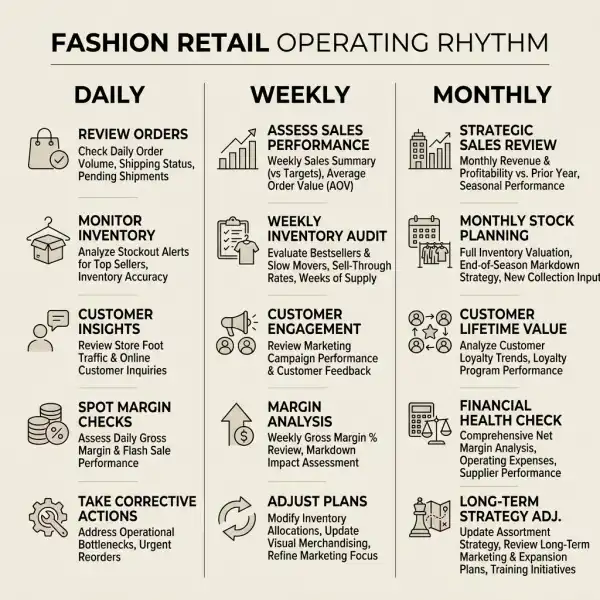
Review should follow the cadence of the risk. Payment or overselling exceptions may need attention within hours; assortment performance can be weekly; aged stock and seasonal capacity may be monthly or pre-season.
A practical rhythm could include:
- Daily: unresolved orders, stockout exceptions, failed payments, urgent customer cases, receipt discrepancies, floor readiness, and dispatch backlog.
- Weekly: SKU and size performance, inventory variance, returns by reason, staffing pressure, replenishment priorities, late deliveries, and open corrective actions.
- Monthly: margin and markdown position, aged stock, channel profitability, process failure trends, carrier or supplier performance, and training needs.
- Before major launches or peaks: capacity, cut-off times, packaging, stock allocation, customer-service coverage, contingency plans, and promotion configuration.
Meetings should focus on exceptions and decisions. A log of issue, impact, owner, due date, corrective action, and verification distinguishes recurring problems from resolved ones.
Common Operating Mistakes to Avoid
The most damaging mistakes are usually not isolated human errors. They are design gaps that make the same error easy to repeat. A detailed examination of retail operation gaps that hurt customer experience belongs in the companion article, but several system-level mistakes are important in an overview.
Treating the inventory record as unquestionable
A system quantity is a claim about physical reality, not proof. Movements, receipt errors, damage, reservation failures, and delayed returns create variance. Verification may include scanning controls, cycle counts, and root-cause review; adjusting the number without recording why preserves the cause.
Promising services before defining exception paths
Store pickup, ship-from-store, instant exchanges, and fast dispatch create new failure points. Test missing units, missed collection windows, reversed payments, understaffing, and failed carrier collection before launch. The exception path is part of the service.
Using one metric as a verdict on a team
Conversion, order speed, and sales per labor hour reflect factors beyond one team’s control. Rewarding dispatch speed without pick accuracy, for example, encourages distorted behavior. Balance metrics and investigate context.
Adding channels without adding operational capacity
A new marketplace may expand reach but also adds product mapping, inventory feeds, commissions, deadlines, messages, returns, and reconciliation. Assess workload and failure modes before assuming incremental sales will produce incremental profit.
Letting policies differ accidentally
Policy differences may be intentional; accidental conflicts are the problem. A website return window may contradict a packing slip, or marketplace dispatch may exceed the warehouse cut-off. Policy ownership and version control are operational controls.
What Should Retailers Verify Before Changing Operations?
Before changing a workflow, technology, or promise, verify the baseline and constraint. A slow step may protect against fraud or quality failure, or compensate for missing upstream data. Removing it without understanding the dependency can shift the problem downstream.
The verification should cover:
- the actual customer problem and how frequently it occurs;
- the SKUs, locations, channels, and teams affected;
- the current process, including unofficial workarounds;
- data quality and integration timing;
- financial, tax, privacy, consumer-protection, employment, and accessibility requirements applicable in each market;
- capacity during peak periods rather than only average days;
- vendor, payment, marketplace, and carrier dependencies;
- control requirements for refunds, adjustments, discounts, and personal data; and
- a rollback or contingency plan if the change fails.
Legal obligations vary by jurisdiction, so returns, pricing, labeling, tax, privacy, or employment processes may not transfer unchanged across markets. Local advice may be necessary where risk is material.
Frequently Asked Questions
What is the difference between fashion retail operations and merchandising?
Merchandising decides what assortment to offer, how it is ranged, priced, allocated, and promoted to meet commercial goals. Retail operations makes that assortment executable: receiving units, maintaining stock records, preparing channels, completing transactions, fulfilling orders, handling returns, and controlling exceptions. The functions overlap around allocation, pricing, launches, markdowns, and performance review. In a small brand, the same person may perform both. The useful distinction is decision versus execution: merchandising shapes the offer, while operations ensures customers can buy and receive it under the stated conditions. Neither function succeeds for long without feedback from the other.
Is ecommerce operations part of retail operations?
Yes. Ecommerce operations is the part of retail operations that manages digital selling and the physical or digital work triggered by an online transaction. It includes product publication, inventory availability, payment status, order allocation, picking, packing, dispatch, tracking, cancellations, returns, refunds, and customer-service handoffs. Website design and digital marketing influence demand, but they are not the whole operating system. Once a customer clicks “buy,” the retailer must connect the digital promise with actual stock, labor, packaging, payment providers, and delivery partners. Marketplace operations may add separate service levels, fees, message rules, and reconciliation requirements.
What is inventory accuracy in fashion retail?
Inventory accuracy describes how closely recorded stock matches the physical stock and its usable status at the required SKU and location level. A record can be numerically correct yet operationally misleading if units are damaged, reserved, missing labels, or impossible to locate. Fashion retailers should therefore distinguish on-hand, available-to-sell, allocated, in-transit, returned-awaiting-inspection, and non-saleable quantities where the business requires it. Accuracy is assessed through counts and transaction reconciliation, then improved by correcting the process that caused variance. The appropriate target and count frequency depend on volume, value, risk, channel promise, and system capability.
Can a small fashion brand run retail operations with spreadsheets?
It can, within limits. Spreadsheets may support a low-volume business with few SKUs, locations, users, and daily transactions, especially when one person controls updates. Risk increases when several channels sell the same units, staff edit separate copies, reservations are frequent, or the business needs reliable audit trails and rapid stock updates. The decision should be based on transaction complexity rather than brand age. A small retailer can delay a large enterprise system, but it should still standardize SKU naming, ownership, update timing, reconciliation, backups, and access. Migration becomes easier when the underlying data is already disciplined.
Which retail operations process should be improved first?
Start with the process creating the greatest combination of customer harm, financial exposure, and repeated manual effort. For many retailers, that may be stock accuracy, order exceptions, product-data errors, or returns—not an advanced analytics project. Establish a baseline, map the current handoffs, identify the root cause, and choose one measurable outcome. A narrowly defined pilot is safer than changing every channel at once. For example, a retailer might improve pick verification for high-error variants in one fulfillment location, then compare accuracy, cycle time, and workload before expanding the method.
Does unified commerce automatically solve omnichannel problems?
No. A unified platform can reduce fragmentation by connecting inventory, orders, customers, and transactions, but software does not define policies, repair incorrect master data, train staff, or resolve conflicting incentives by itself. Results depend on configuration, integration coverage, physical process discipline, exception handling, and governance. A retailer should test real scenarios such as split orders, offline store transactions, partial returns, cancelled pickup orders, and delayed carrier updates. The relevant question is not whether a platform is called “unified,” but whether the complete workflow remains accurate and recoverable under normal and exceptional conditions.
Conclusion
Fashion retail operations is the discipline of making a commercial promise executable. It connects product information, physical units, people, systems, policies, transactions, and service recovery across stores and online channels. When the connection is weak, the customer sees missing sizes, false availability, cancelled orders, confused returns, and inconsistent answers. Internally, the business sees stranded stock, avoidable labor, unreliable reporting, and margin leakage.
Retailers need not adopt the same channel model or technology stack. A boutique and a multi-country chain face different constraints, but both benefit from clear sources of truth, defined stock statuses, owned handoffs, realistic service levels, and disciplined exception management.
The practical priority is consistency before complexity. Build processes that the team can execute on an ordinary day and recover on a difficult one. Then add channels, automation, and faster promises where the operational evidence supports them. That is how retail operations contributes not only to smoother execution, but also to better merchandising decisions, healthier inventory, more credible customer communication, and scalable growth.





Comments 0
Leave a CommentSend Comment
Anda harus Login terlebih dahulu untuk dapat memberikan komentar.