

Crepe vs Chiffon: What Makes These Dress Fabrics Different?
Quick Answer
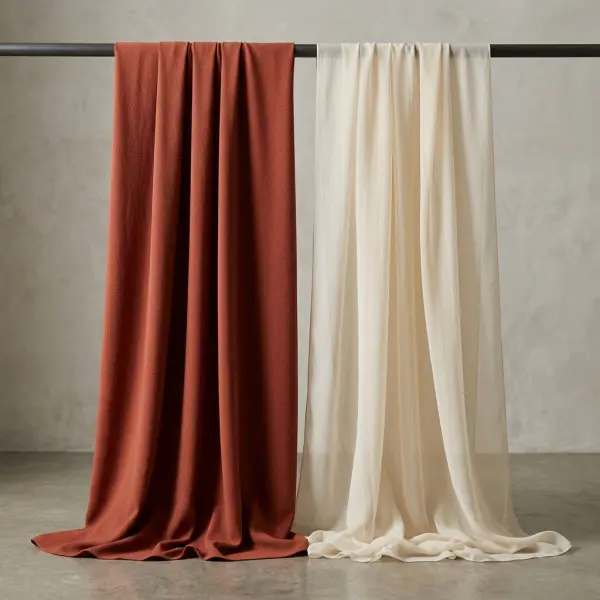
Crepe and chiffon can both create soft, flowing garments, but they are not interchangeable fabric categories. Crepe is a broad family of textiles identified mainly by an intentionally irregular, crinkled, or grainy surface, while chiffon is a more specific lightweight, sheer plain-weave fabric traditionally made with finely twisted yarns. Crepe can range from transparent and lightweight to opaque and relatively structured; chiffon is generally associated with low weight, translucency, and airy movement. Cameo
The distinction becomes less absolute at the edges. Chiffon itself can have a slightly crepe-like hand because tightly twisted yarns contribute to its characteristic surface, and historical textile records even document fabrics described as crepe chiffon. National Museum of American History For fashion businesses, the practical decision is therefore not simply which name sounds more suitable. Product developers should compare opacity, weight, drape, surface texture, fiber composition, layering requirements, sewing behavior, care, and the silhouette the fabric needs to create.
In general, chiffon works particularly well when the design depends on transparency, layering, ruffles, or floating volume. Crepe offers a much wider spectrum—from delicate flowing dresses to opaque trousers and more controlled silhouettes.
What Is the Main Difference Between Crepe and Chiffon?
The most useful distinction is that crepe describes a broad textured textile family, whereas chiffon describes a relatively specific lightweight and sheer fabric construction. The Museum of Fine Arts Boston's CAMEO materials database describes crepe as a finely crinkled fabric that may be made from silk, rayon, cotton, wool, or synthetic fibers, with its surface produced through twisted filling yarns, crepe weave, or finishing treatments. Chiffon, by contrast, is described as a lightweight, sheer plain-weave material made from finely twisted yarns. Cameo
That difference explains why comparing the two only by softness or appearance can be misleading. A lightweight silk crepe and silk chiffon may both move elegantly and feel delicate, yet a heavier dress crepe can be opaque enough for trousers or a fitted dress, while chiffon normally retains some degree of transparency. Commercial polyester chiffon, for example, is commonly sold at very low fabric weights and with an intentionally sheer construction. Mood Fabrics
A practical comparison looks like this:
|
Characteristic |
Crepe |
Chiffon |
|
Basic identity |
Broad family of textured fabrics |
Lightweight, sheer plain-weave fabric |
|
Surface |
Usually grainy, crinkled, pebbled, or dry |
Fine, slightly grainy or crepe-like surface |
|
Transparency |
Can range from sheer to opaque |
Usually sheer or semi-sheer |
|
Weight range |
Very broad |
Usually lightweight |
|
Drape |
Can be very fluid or moderately structured |
Typically light, floating, and fluid |
|
Body |
Varies from soft to relatively firm |
Usually low bulk with airy body |
|
Fiber possibilities |
Silk, rayon/viscose, polyester, wool, cotton, blends, others |
Commonly silk, polyester, rayon/viscose; other versions also exist |
|
Layering need |
Depends on opacity and garment |
Frequently layered or lined |
|
Common uses |
Blouses, dresses, trousers, skirts, tailoring, occasionwear |
Dresses, blouses, sleeves, overlays, scarves, bridal and evening layers |
|
Sourcing priority |
Match exact crepe construction to silhouette |
Verify transparency, weight, hand, layering, and stability |
The table should not be treated as a specification sheet. Individual commercial fabrics can sit outside these typical patterns, which is why fabric swatches and technical data remain essential.
Crepe and Chiffon Are Not Completely Opposite Categories
Fashion terminology often encourages buyers to think in neat either-or categories, but textile construction is rarely that tidy. Crepe and chiffon can overlap because both may use highly twisted yarns, and both can produce a slightly grainy rather than perfectly smooth surface.
CAMEO identifies chiffon as a plain-weave fabric made with finely twisted yarn, while Textile Society of America research demonstrates how yarn twist itself can create crepe effects even within a plain weave. Cameo This helps explain why chiffon may feel slightly dry, sandy, or crepe-like despite being categorized separately from most dress crepes.
Historical examples make the overlap even clearer. The Smithsonian National Museum of American History holds a 1931 silk fabric recorded specifically as "crepe chiffon." The museum describes it as a thin, gauze-like material made from hard-twisted warp and weft yarns and constructed in plain weave. National Museum of American History
For sourcing teams, the lesson is important: fabric names are useful shorthand, not perfectly rigid scientific classifications. Buyers should use them to narrow the search, then verify the actual construction.
How Do Crepe and Chiffon Differ in Texture?
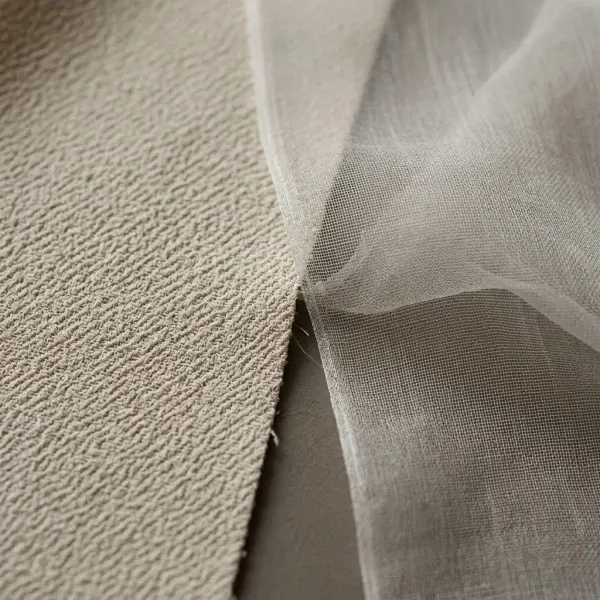
Crepe generally places more emphasis on surface texture. Depending on the specific construction, the face may appear finely pebbled, granular, crinkled, or distinctly irregular. This texture can create visual depth even in a solid-colored garment because the uneven surface changes the way light is reflected.
Chiffon is also not perfectly smooth. Fine, hard-twisted yarns can give chiffon a subtly grainy or slightly rough hand. However, the surface is usually visually subordinate to its other defining qualities: low weight, transparency, and airy movement. CAMEO's definitions capture this distinction well: crepe is explicitly identified by its crinkled surface, whereas chiffon is primarily characterized as sheer, diaphanous, lightweight, and plain woven. Cameo
This affects garment appearance. A medium-weight matte crepe can give a dress a calm, substantial visual surface, while chiffon tends to make edges, ruffles, sleeves, and layered panels appear lighter and less visually dense.

Which Is More Transparent: Crepe or Chiffon?
Chiffon is generally much more transparent. Sheerness is one of the fabric's defining characteristics, whereas crepe spans a much wider range from sheer crepe constructions to fully opaque dress fabrics.
Modern commercial examples illustrate this clearly. Polyester chiffons sold for apparel are commonly described as sheer and suitable for overlays, dresses, blouses, lingerie, or layered garments, with product weights around the lightweight end of the apparel spectrum. Mood Fabrics Crepe, meanwhile, may include lightweight crepe de Chine and georgette-like materials but also double crepes and heavier dress fabrics intended for skirts, trousers, and occasion dresses. Cameo
This difference has immediate costing implications. If a chiffon dress requires a separate lining, the garment may consume two fabric systems rather than one. That affects material cost, marker planning, labor, garment weight, care instructions, and production lead time.
Opacity should therefore be evaluated early. A material that appears sufficiently covered when folded twice on a sample card can behave quite differently once hung as a single garment layer under strong lighting.
Crepe vs Chiffon Drape: Which Fabric Falls Better?
Neither fabric universally "drapes better." They create different types of movement.
Chiffon usually creates an airy, floating drape because relatively little material mass needs to move. Ruffles can flutter easily, full skirts gain volume without excessive visual heaviness, and transparent sleeves can retain visible movement even when the underlying garment is comparatively structured.
Crepe can create a more substantial fall. Lightweight crepes may be exceptionally fluid, while medium and heavier constructions form deeper folds and may follow the body more closely. A double crepe, for example, can provide enough body for dresses, skirts, tops, or trousers while still retaining visible drape.
The difference becomes obvious when several meters of fabric are used. Ten centimeters of chiffon and crepe may both collapse softly in the hand, yet a full-length skirt can reveal very different behavior because total fabric weight, fold depth, opacity, and surface friction begin to matter.
How Weight Changes the Design Possibilities
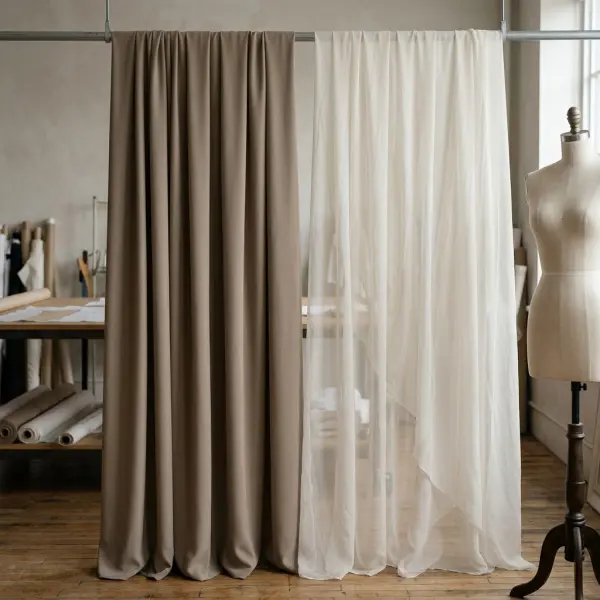
Weight is one of the most consequential differences between these categories. Chiffon occupies a relatively narrow lightweight zone, while crepe spans a broad continuum.
That range gives crepe considerably more versatility when the garment requires body. A designer may select a lightweight crepe for a blouse, a medium-weight stretch crepe for a fitted dress, or a heavier construction for trousers and tailored separates. The materials may share a creped surface while functioning very differently in pattern development.
Chiffon is more specialized. Its low mass makes it particularly effective where designers want floating volume without substantial bulk. Layering several chiffon panels, for instance, can create dimensional movement while preserving lightness. The same design executed in several layers of medium crepe could become visually and physically much heavier.
This is why fabric weight should be specified rather than inferred from the material name. For sourcing and costing, grams per square meter, width, composition, and sample behavior are far more useful than "light crepe" or "premium chiffon" alone.
How Does Fiber Composition Affect the Comparison?
Crepe and chiffon are fabric categories, not single fiber types. That distinction prevents one of the most common sourcing errors: attributing a fiber property to the fabric name.
Crepe may be produced from silk, rayon or viscose, cotton, wool, synthetics, or blends. Cameo Chiffon was historically strongly associated with silk and rayon, but contemporary apparel markets also contain numerous polyester versions; current commercial specifications provide clear examples of 100% polyester chiffon. Mood Fabrics
As a result, statements such as "crepe is easier to care for than chiffon" or "chiffon is more breathable than crepe" are too broad. A polyester chiffon and silk chiffon do not necessarily behave the same way, just as polyester crepe, wool crepe, and viscose crepe may differ substantially in moisture behavior, heat response, dimensional stability, pressing, and care.
When comparing candidate fabrics, the hierarchy should be:
fabric category → fiber composition → construction → weight → finish → tested performance → garment application.
Leaving out the middle stages can turn a useful textile label into an unreliable assumption.
Which Fabric Works Better for Dresses?
For dresses, the answer depends more on the silhouette than on whether one fabric is categorically superior.
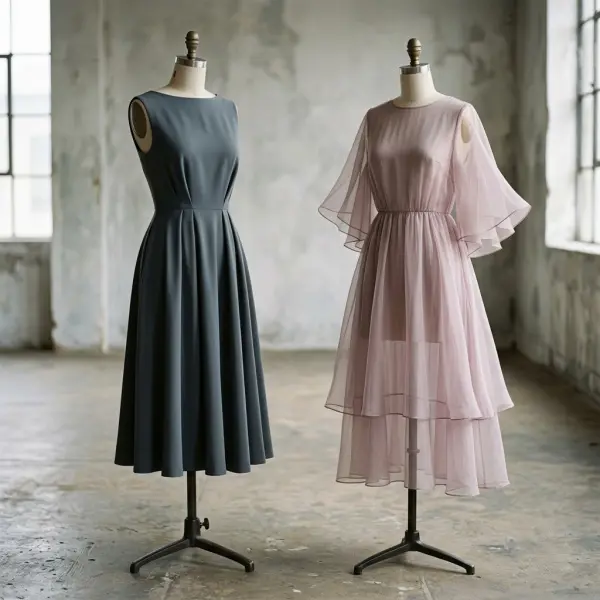
Chiffon is particularly effective for dresses that rely on layering, transparency, movement, gathers, ruffles, cape-like details, or lightweight volume. Bridalwear, occasion dresses, formal overlays, floating sleeves, and softly layered skirts frequently use these properties. Commercial chiffon suppliers likewise position the fabric for formalwear, blouses, skirts, gowns, and layered applications. Mood Fabrics
Crepe is usually more versatile when the garment needs greater opacity or controlled body. Depending on construction, it can support slip dresses, bias silhouettes, sheath dresses, wrap dresses, relaxed midi shapes, fitted stretch designs, or more tailored forms.
The practical distinction is therefore less "Which is more elegant?" and more:
- Does the dress need transparency or coverage?
- Should the skirt float away from the body or fall with more weight?
- Will the fabric be used as the main structural layer or as an overlay?
- Does the design require sharp seam definition or soft visual blending?
- Can the planned price point absorb lining and additional construction?
- How much movement should the garment show when the wearer walks?
Those questions lead to a more reliable material decision than fashion terminology alone.
Why Chiffon Is So Effective for Layering
Chiffon's transparency creates design possibilities that opaque fabrics cannot reproduce in the same way. A designer can overlap several colors, soften the outline of an underlying garment, create translucent sleeves, or build visual volume without creating equivalent physical bulk.
This also means chiffon is rarely evaluated in isolation. Its relationship with the layer beneath it becomes part of the design. A nude lining creates a different result from tonal lining; satin underneath produces different light behavior from matte crepe; a contrasting underlayer can turn transparency into a deliberate graphic effect.
From a production perspective, layering adds complexity. Two materials may need to be controlled simultaneously at the neckline, waist, armhole, or zipper. Hem lengths must remain visually balanced, and differential stretch or shrinkage between layers can distort the garment after finishing or cleaning.
Crepe can also be layered, but its strategic value is usually less dependent on transparency.
Where Georgette Fits Into the Comparison
Georgette often appears in crepe-versus-chiffon discussions because visually it sits near the boundary between the two. CAMEO describes georgette as a sheer fabric with a non-shiny crepe surface produced using alternating S- and Z-twisted yarns. Cameo
A Smithsonian silk georgette specimen provides a more technical example. Its museum record describes a thin, sheer plain-weave silk whose "crepy" effect comes from right- and left-twist yarns. Smithsonian Institution
In practice, georgette is often more visibly textured and slightly more substantial in hand than a very fine chiffon, although the exact comparison depends on the two fabrics being tested. It can therefore provide some of chiffon's transparency and movement while retaining a stronger crepe character.
This relationship is another reason not to treat commercial textile categories as isolated boxes.
Crepe vs Chiffon in Blouses and Sleeves
Blouses expose differences between these fabrics particularly well because the material must work simultaneously around shoulders, sleeves, neckline details, cuffs, and body panels.
Chiffon can produce soft gathered sleeves, ties, ruffles, pussy-bow necklines, and layered bodies with very little bulk. The disadvantage is that transparency may require a camisole, lining, double layer, or carefully designed placement of seams and facings.
Crepe provides more options when one fabric needs to deliver both coverage and drape. A medium lightweight crepe can create a flowing blouse without requiring the same degree of layering, although this varies with color and fabric density.
This distinction becomes commercially relevant when a brand wants visual lightness but also a simple garment architecture. A chiffon blouse may look minimal on a hanger yet require more components and more delicate sewing than an apparently similar opaque crepe blouse.
The broader reasons crepe remains important across blouse, dress, and covered silhouettes are explored separately in Why Crepe Remains Popular in Blouses, Dresses, and Modest Wear.

Which Is Easier to Sew: Crepe or Chiffon?
For many production teams, chiffon is the less forgiving material, although difficult crepes certainly exist.
Its low weight and transparency make distortion more visible. Layers can shift during spreading, narrow seam allowances are harder to control, feed imbalance can create puckering, and needle damage may be difficult to hide because every penetration occurs in a fine open-looking structure. Rolled hems, curved seams, gathers, and bias sections add further complexity.
Crepe presents a broader range of sewing behavior. Some medium-weight polyester dress crepes are relatively stable and production-friendly, while lightweight silk or viscose crepes can shift significantly during cutting. Stretch crepes introduce another set of challenges involving recovery and seam extension.
For both categories, production settings should be established through actual trials rather than copied from another style. Needle type and size, thread, stitch density, differential feed where available, pressing temperature, seam stabilization, and edge finishing should be evaluated on the intended bulk material.
Cutting and Pattern-Making Implications
Chiffon can make pattern accuracy difficult to preserve between the paper pattern and sewing machine. Lightweight cloth moves easily during spreading, and multiple plies may shift relative to one another. Production teams may therefore need different spreading, cutting, or stabilization methods than they use for firmer woven fabrics.
Crepe requires a more fabric-specific assessment. A stable medium-weight crepe may cut cleanly in multiple plies; a highly fluid or stretch version may require considerably more control. Grain, relaxation, and distortion should be reviewed before approving markers and cutting methods.
Pattern design should also acknowledge fabric behavior rather than expecting sewing to correct a poor material match. A structured neckline developed in firm crepe may collapse when transferred directly to chiffon, while a design built around several floating chiffon layers may become bulky if interpreted in heavier crepe.
The pattern and fabric are one system.
Which Fabric Usually Needs Lining?
Chiffon more frequently requires some form of lining, layering, or deliberate undergarment strategy because transparency is inherent to its visual identity. Current commercial chiffon descriptions routinely recommend lining when additional opacity or structure is required. Mood Fabrics
Crepe is much less predictable. Some crepes are sheer enough to need lining, while many dress crepes can function as a single visible layer. Pale colors can also behave differently from dark colors within the same fabric quality, so opacity should be approved by color rather than assumed from a black lab dip or dark development sample.
Lining decisions affect more than modesty or coverage. They alter drape, friction against the body, temperature perception, seam construction, garment weight, care, and cost.
A technically beautiful outer fabric can lose much of its intended movement if paired with an incompatible lining.
How Should Fashion Brands Choose Between Crepe and Chiffon?
The decision should begin with the garment's functional design brief rather than fabric preference.
A practical sequence is:
- Define the silhouette. Decide whether the garment should float, skim, fall heavily, cling, or maintain some structure.
- Decide whether transparency is an asset or a problem. If transparency is essential, chiffon becomes a strong candidate. If coverage matters, many crepes simplify construction.
- Set the layering strategy. Calculate whether a lining, double layer, slip, or contrast underlayer will be required.
- Establish the target fabric weight. This narrows an enormous crepe category and avoids comparing materially different options.
- Review fiber composition. Care, cost, handfeel, heat response, sourcing claims, and durability cannot be inferred from the fabric name.
- Sample at garment scale. Large panels reveal movement more accurately than small swatches.
- Test production behavior. Validate cutting, seam construction, pressing, hemming, and dimensional stability before bulk approval.
The final choice may also be a combination rather than an either-or decision. A dress can use crepe for the opaque body and chiffon for sleeves, cape panels, ruffles, or overlays, allowing each material to perform the role it handles best.

Crepe vs Chiffon for Fashion Sourcing
Fabric sourcing becomes more reliable when teams stop buying according to generic names and instead compare measurable properties.
For chiffon, buyers should pay particular attention to weight, transparency, weave consistency, snag sensitivity, color uniformity, width, handfeel, and behavior after finishing. Because the material is sheer, even subtle weaving or dyeing inconsistencies can become visible once several garment panels overlap.
For crepe, surface consistency deserves additional attention. A change in yarn twist, finishing, construction, or weight can alter the visual texture and drape even when the supplier continues to use the same broad fabric name.
A sourcing specification should therefore record at least:
- Fiber composition.
- Fabric construction.
- Weight and usable width.
- Approved surface and handfeel standard.
- Opacity or transparency expectation.
- Stretch and recovery, if applicable.
- Dimensional-change requirements.
- Color and shade standard.
- Care requirements.
- Relevant physical-performance requirements.
- Approved garment or bulk fabric reference.
The material name then becomes an identification field rather than the specification itself.
What About Cost?
Neither chiffon nor crepe is inherently cheaper because both categories can be produced in very different fibers and quality levels.
A silk chiffon and a commodity polyester chiffon occupy very different cost positions. The same is true of silk crepe, viscose crepe, wool crepe, and polyester dress crepe. Even within the same fiber, yarn quality, weight, finishing, minimum order quantity, dyeing requirements, certification, print process, and supplier capability can change the price substantially.
Garment cost adds another layer. Chiffon may require lining, additional panels, more delicate handling, narrow hems, or slower sewing operations. An inexpensive chiffon per meter can therefore produce a garment whose total manufacturing cost is not particularly low.
Crepe can simplify some designs by supplying opacity and drape in a single layer, but heavier weights increase material consumption by mass and may have their own production requirements.
Fashion businesses should compare total garment cost, not fabric price alone.
Common Mistakes When Comparing Crepe and Chiffon
Assuming crepe is thick and chiffon is thin
Chiffon is normally lightweight, but crepe does not automatically mean heavy. The crepe family includes very lightweight constructions as well as medium and heavier dress materials. Treating all crepes as substantial fabrics can eliminate suitable lightweight options before sampling even begins. A better comparison starts with actual weight and opacity.
Describing chiffon as smooth
Chiffon may look visually delicate, but its tightly twisted yarns often create a subtle grainy or crepe-like hand. Calling it uniformly smooth can lead designers or online shoppers to expect something closer to satin or charmeuse. Surface inspection and handfeel remain important, particularly when customers will wear the fabric directly against the skin. Cameo
Assuming every crepe is opaque
Crepe includes sheer constructions, including fabrics closely related to georgette and crepe chiffon. Using the category name as a guarantee of coverage is therefore unreliable. Opacity should be checked on a single layer, in the intended color, under realistic lighting.
Choosing chiffon without costing the underlayer
A chiffon shell can appear simple during design development, but an opaque lining, slip, or second layer may materially change cost and production. Ignoring these components until after fabric approval can create margin pressure or force late design compromises. Layer architecture should be included in the first costing exercise.
Assuming fiber performance from fabric appearance
A flowing fabric does not automatically indicate silk, and a textured crepe does not reveal whether it is viscose, polyester, wool, or a blend. Fiber composition changes care, cost, thermal behavior, pressing limits, and sourcing claims. Product information should therefore separate the visual fabric category from actual fiber content.
Selecting from photographs instead of physical behavior
Online images can communicate color and broad texture but cannot reliably show handfeel, exact transparency, friction, recovery, or how several meters behave under gravity. This limitation is particularly important when choosing between two fluid dress fabrics. Physical swatches and garment-scale drape tests remain much more informative.
Important Technical Caveats
Crepe and chiffon should not be presented as perfectly opposite textile constructions.
First, chiffon can itself have a crepe-like character. Fine, tightly twisted yarns create a slightly grainy surface, and historical museum collections explicitly document "crepe chiffon." National Museum of American History
Second, crepe does not specify a particular weight or transparency. The category extends from very lightweight silk crepes to heavier rayon or synthetic dress fabrics. Cameo
Third, fiber composition cannot be inferred reliably from either name. Contemporary chiffon can be polyester as well as silk or regenerated-cellulose based, while crepe spans an even broader fiber range. Mood Fabrics
Finally, performance claims such as breathable, wrinkle-resistant, durable, cool, easy-care, luxurious, or sustainable should be tied to the actual fabric specification. None of those qualities is guaranteed simply by choosing "crepe" or "chiffon."
FAQ: Crepe vs Chiffon
Is crepe heavier than chiffon?
Crepe can be heavier than chiffon, but the comparison is not universal. Chiffon is normally lightweight by definition, whereas crepe exists across a much wider weight range. Lightweight crepe de Chine or crepe-georgette constructions can approach chiffon territory, while double crepes and dress crepes may be considerably more substantial. For garment development, comparing actual GSM, thickness, opacity, and drape is more reliable than comparing names.
Which fabric is more suitable for a flowy dress?
Both can create flowing dresses, but they produce different effects. Chiffon is particularly suited to light, floating movement, layered skirts, ruffles, translucent sleeves, and overlays. Fluid crepe usually falls with somewhat more visual weight and can create cleaner uninterrupted panels. If the design requires transparency and airiness, chiffon may be more appropriate; if it needs greater coverage with fluid movement, an appropriate crepe often simplifies the construction.
Is chiffon a type of crepe?
Not in the simplest commercial classification, but the relationship is closer than a strict binary suggests. Chiffon is generally defined as a lightweight, sheer plain-weave fabric made with finely twisted yarns, while crepe is a broader family characterized by a crinkled or irregular surface. Because twist can create crepe effects, chiffon may have a crepe-like hand, and historical textiles described as "crepe chiffon" demonstrate that the terminology can overlap. Cameo
Which is more opaque, crepe or chiffon?
Crepe is usually more likely to offer opacity, simply because the category includes many medium-weight and dense dress fabrics. Chiffon is intentionally sheer or semi-sheer. That said, lightweight crepes may also require lining, and opacity changes with color, yarn density, finishing, and the number of layers. Product developers should therefore evaluate the actual fabric rather than treating the category name as a guarantee.
Which fabric is easier for beginner sewing?
A stable medium-weight crepe is generally more forgiving than very lightweight chiffon, but "crepe" covers too many constructions for a universal rule. Chiffon tends to shift during cutting, expose seam imperfections, and require careful control during narrow hemming and pressing. Some slippery or lightweight crepes can present similar problems, while stretch crepe introduces recovery and seam-extension issues. Beginners should evaluate the specific fabric rather than the generic category.
Can crepe and chiffon be used in the same garment?
Yes, and the combination can be technically useful. Crepe can provide an opaque main body while chiffon supplies transparent sleeves, overlays, cape panels, ruffles, or layered skirt sections. The fabrics should still be tested together because their weight, stretch, shrinkage, surface friction, and pressing requirements may differ. A visually attractive pairing is not automatically a production-compatible one.
Is chiffon better for summer than crepe?
Not necessarily. Chiffon's low weight can make it feel visually and physically light, but thermal comfort depends on fiber composition, fabric density, airflow, garment looseness, lining, humidity, and the amount of layering required. A chiffon garment with a dense synthetic lining may feel different from an unlined lightweight viscose crepe. "Summer fabric" should therefore be judged at garment-system level rather than from the outer fabric name alone.
What should a brand request from a supplier when comparing crepe and chiffon?
Request physical swatches together with composition, weight, width, construction, stretch information where relevant, care recommendations, finishing details, and any performance data required for the product. For chiffon, inspect transparency and snagging carefully; for crepe, evaluate surface consistency and whether the drape matches the approved sample. A larger cutting is particularly useful because small swatches do not reveal full-garment movement accurately.
Conclusion
Crepe and chiffon overlap in the world of soft dress fabrics, but they solve different design problems. Chiffon is fundamentally associated with lightness, transparency, plain-weave construction, and floating movement. Crepe is a much broader textile family whose irregular surface can appear in fabrics ranging from delicate and sheer to opaque, substantial, and moderately structured.
That breadth makes simple claims such as "crepe is heavier" or "chiffon drapes better" unreliable. A designer choosing between them should instead ask what the garment needs to do: float or fall, reveal or cover, layer or stand alone, create volume or create a clean silhouette.
For sourcing teams, the distinction is equally practical. Chiffon and crepe are starting points for material selection, not complete specifications. Fiber, weight, construction, opacity, finish, stretch, sewing behavior, and care must still be verified before the fabric moves into bulk production.
Understanding that nuance also strengthens the wider Crepe Fabric Explained: Texture, Drape, and Fashion Uses discussion. Once the technical differences are clear, the next question becomes commercial and stylistic: why certain crepe constructions continue to work particularly well across blouses, dresses, and covered fashion silhouettes.





Comments 0
Leave a CommentSend Comment
Anda harus Login terlebih dahulu untuk dapat memberikan komentar.