
How Functional Details Affect Garment Usefulness and Style
Quick Answer
Functional details are garment features designed to help clothing perform a practical task, such as storing objects, adjusting fit, improving movement, protecting the wearer, managing openings, or reinforcing high-stress areas. Examples include pockets, zippers, buttons, drawcords, adjustable tabs, gussets, vents, storm flaps, reinforced panels, belt loops, cuffs, and hoods.
These details affect more than usability. They also influence the visual language of a garment. Oversized cargo pockets can make trousers feel utilitarian. A concealed zipper can preserve a minimal silhouette. Drawcords and elastic adjustments often create a more casual or technical character, while welt pockets, covered plackets, and discreet hardware can support a cleaner or more tailored appearance.
The most successful functional details work on both levels. They solve a real user need while remaining consistent with the garment's material, silhouette, price point, and brand identity.
Adding more features does not automatically make a garment more useful. Poorly placed pockets, unnecessary hardware, difficult closures, excessive bulk, or decorative “utility” details can make clothing less comfortable, harder to manufacture, and more expensive without improving actual use.

What Are Functional Details in Garment Design?
Functional details are construction features added to clothing to perform a practical task while supporting the intended appearance and use of the garment. The word “functional” is important. A visible zipper may look technical, but if it opens nothing useful, its role is primarily decorative. A large pocket may suggest utility, but if its opening is too narrow for a hand or its structure cannot support normal contents, its practical value is limited.
Functional design therefore begins with use. A detail should answer a question such as:
- What does the wearer need to carry?
- Where does the garment need to open?
- Does the fit need to be adjustable?
- Does the wearer need additional movement?
- Where will abrasion or stress occur?
- Does the garment need protection from wind, rain, or debris?
- Does a component need to be secured or released quickly?
The detail then becomes part of the garment architecture rather than a styling accessory added at the end.
Why Functional Details Matter to Apparel Businesses
Functional details sit where product design, customer experience, manufacturing, and brand positioning meet. For the customer, they influence how easy the garment is to wear and whether it performs as expected. For the design team, they affect silhouette, proportion, visual hierarchy, and styling.
For the factory, they affect pattern pieces, sewing operations, trims, machinery, quality control, and assembly sequence. For the commercial team, they influence cost and sometimes the perceived reason to choose one product over another. Consider two jackets made from similar fabric.
The first uses a simple front zipper, two pockets, and elastic cuffs. The second adds multiple cargo pockets, an internal storage pocket, adjustable cuffs, a drawcord hem, hood adjustment, reinforcement panels, and several pieces of hardware. The second garment may offer more functions, but it will also require more components, more sewing operations, more quality checks, and potentially a higher selling price. Whether that extra complexity creates customer value depends on the product.
Function and Style Are Usually Connected
Functional details often become some of the most visually recognizable parts of a garment. The connection is easy to see in workwear. Work jackets, cargo trousers, field coats, and utility shirts traditionally use visible pockets, reinforcement, sturdy closures, loops, and adjustable elements because these features support practical use. Over time, the same construction vocabulary has also become a fashion language.
A garment does not need to be used for industrial work to visually reference workwear. The same pattern occurs in outdoor clothing, military-influenced design, tailoring, sportswear, and performance apparel. A fashion designer can therefore borrow the appearance of functional construction without necessarily reproducing its original performance requirements.
That is not automatically a problem. Fashion frequently adapts construction language between categories. The problem appears when visual cues imply functionality that the product does not actually provide.
Pockets: The Most Visible Example of Function Meeting Style
Pockets demonstrate this relationship particularly well. A pocket can provide storage while simultaneously changing garment proportion and identity.
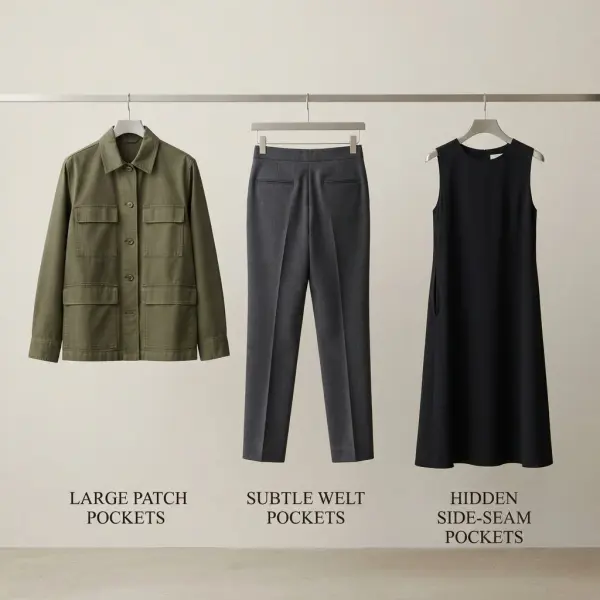
An oversized patch pocket on an overshirt becomes part of the composition. A narrow welt pocket creates a quieter effect. Side-seam pockets can provide storage while remaining almost invisible.
The fundamental engineering behind depth, reinforcement, pocket bags, and placement is covered in pocket construction for apparel design. For product development, the more strategic question is what the pocket communicates. Large external pockets can make clothing appear more utilitarian.
Small welt pockets can support a refined surface. Zipped pockets often create a more technical or active impression. Flapped pockets can add visual structure even before they are used. The detailed construction differences among patch, welt, and side-seam pockets matter because each type changes both production requirements and the overall character of the garment.

Closures Change Both Access and Appearance
Closures solve one of the most fundamental garment problems: allowing clothing to open, close, and remain secure during wear. Buttons, zippers, snaps, hooks, hook-and-loop systems, drawcords, buckles, and similar components perform this task differently. They also look different.
A metal zipper running down the front of a jacket can become a strong visual line. A covered zipper can nearly disappear. Large buttons may become a design focal point, while hidden buttons support a cleaner surface.
Snaps can create a utilitarian or sportswear feel, depending on size and finish. The choice should therefore begin with both operation and design.
Ease of Use Matters
A closure that looks appropriate but is frustrating to operate can weaken the user experience. Designers should consider:
- how often the closure will be opened;
- whether it must be operated with one hand;
- whether the wearer may use gloves;
- the amount of force required;
- whether the location is easy to reach;
- whether the closure creates pressure against the body;
- whether the hardware adds unwanted weight.
A tiny button may be visually elegant but inconvenient on a garment intended for rapid dressing. A heavy metal zipper may feel reassuring on outerwear but excessive on a lightweight dress. The most suitable closure is the one that fits the use case as well as the aesthetic.
Adjustability Extends the Useful Range of a Garment
Adjustable details allow one garment to accommodate changes in body position, layering, styling preference, or fit. Common examples include:
- drawcord hems;
- elastic adjustments;
- waist tabs;
- adjustable cuffs;
- buckle straps;
- buttoned waist systems;
- adjustable hood openings.
These components can improve practicality, particularly where the garment must work under several conditions. A jacket with an adjustable cuff, for example, may accommodate a bare wrist, a glove, or an additional layer more effectively than a fixed cuff. But adjustability also changes the design.
Visible cord locks, tabs, buckles, and webbing can make a garment appear more technical or utilitarian. Hidden elastic or internal adjustment systems can provide similar fit flexibility while preserving a quieter exterior.
More Adjustment Is Not Always Better
Adding adjustable components everywhere may sound customer-friendly, but it can create clutter. Every additional component introduces another decision for the wearer and another potential production or durability issue. For many fashion products, one well-positioned adjustment is more useful than several redundant ones. The goal should be meaningful flexibility rather than feature count.
Gussets, Pleats, and Vents Improve Movement in Different Ways
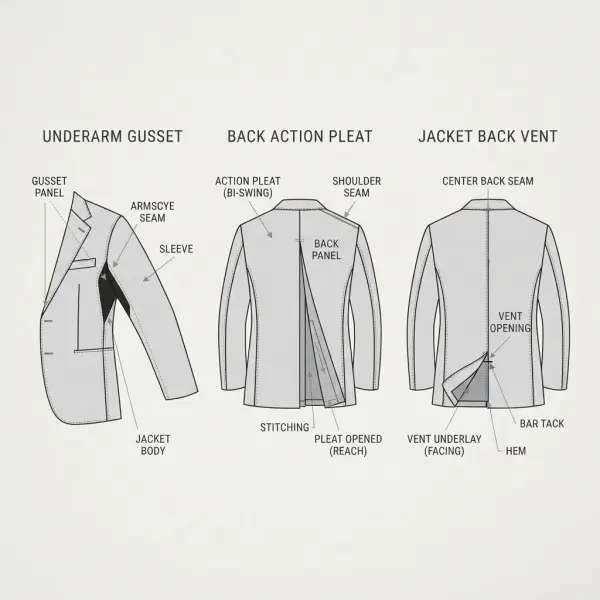
Not every functional detail involves hardware. Pattern construction itself can create additional mobility. A gusset is an inserted piece of fabric used to add room or distribute movement, often in areas such as the underarm or crotch.
Pleats can provide controlled expansion. Vents create an opening that allows garment sections to separate during movement. Each solution changes both function and appearance.
An underarm gusset may remain almost invisible while helping the garment accommodate arm movement. A large action pleat across the back of a jacket can become a noticeable feature associated with workwear or outdoor clothing. A center-back vent on a tailored coat or jacket provides movement while reinforcing a familiar tailored silhouette.
These details show that functionality does not have to look “technical.” Sometimes the most effective functional element is integrated quietly into the pattern.
Reinforcement Should Appear Where the Garment Needs It
Reinforcement is another area where function and style frequently merge. Additional fabric layers, patches, bartacks, tapes, stronger seams, or specialized panels may be used around areas exposed to repeated stress or abrasion. Common locations include:
- pocket openings;
- elbows;
- knees;
- seat areas;
- belt loops;
- zipper ends;
- strap attachments;
- high-tension seam intersections.
Some reinforcement is almost invisible. Other reinforcement is deliberately displayed. Contrast knee panels on work trousers, elbow patches on jackets, or visible bartacks can become part of the product's visual language.
However, reinforcement should respond to actual load. Adding thick panels to areas that do not need them increases fabric consumption, weight, stiffness, and cost. A stronger-looking garment is not necessarily a better-engineered garment.
Hoods, Collars, and Storm Details Can Add Protection
Outerwear often combines several functional components to manage exposure. A hood provides coverage. A collar can protect the neck.
A storm flap may reduce direct exposure around a zipper or opening. Adjustable openings can help control how closely the garment sits around the body. These features are especially relevant in outerwear, but their real performance depends on the complete garment system.
A hood does not automatically make a garment weatherproof. Neither does a storm flap. Protection also depends on fabric properties, seam construction, garment coverage, openings, closures, and finishing.
This distinction matters for fashion brands. Visual inspiration from performance clothing should not be translated into unsupported performance claims. If a fashion jacket looks like technical rainwear but has not been developed or tested to provide comparable protection, marketing should describe the design honestly.
Ventilation Features Can Affect Comfort and Styling
Some garments include openings, mesh panels, perforations, or vented construction to increase airflow. These may be useful in activewear, outdoor apparel, uniforms, and other products where heat management matters. However, the effect depends on the garment and conditions.
A small decorative vent does not necessarily provide meaningful ventilation. Position matters. So does fabric permeability, garment fit, activity level, and environmental conditions.
From a design perspective, ventilation can also create recognizable visual cues. Mesh panels, laser-cut openings, back vents, and zipped vents can contribute to a performance-oriented aesthetic even when used primarily as styling features.
Product teams should therefore separate two questions: Does the detail look technical? Does it deliver a measurable functional benefit? Those are not always the same thing.
Functional Details Can Change Garment Fit
Every functional component occupies space. A pocket bag sits between the body and outer fabric. A zipper adds stiffness along an opening.
A drawcord gathers fabric. A reinforcement panel can alter flexibility. A buckle or snap adds local thickness.
These effects become more noticeable in close-fitting garments. For example, adding a large internal pocket to a slim jacket can create a visible outline when filled. Placing bulky hardware directly at the hip may affect comfort while sitting.
A drawcord channel can change how fabric collapses around the hem. A reinforced knee may alter how trousers bend if the material becomes substantially stiffer at that point. Functional details should therefore be included in fit assessment rather than evaluated separately after fitting is complete.
Details Also Change Garment Weight and Drape
One metal zipper may seem insignificant. Several zippers, snaps, buckles, pocket bags, reinforcement panels, and adjustment components together can materially change how a garment feels. This is particularly relevant in lightweight clothing.
A soft, fluid jacket may lose part of its intended drape if heavy components are added without considering their combined weight. Similarly, large pockets can pull down certain areas of a garment when filled. Hardware weight also influences hanging behavior.
These effects are often difficult to evaluate from digital sketches or technical drawings alone. A physical prototype remains important because the product team needs to see how the complete assembly behaves under gravity and movement.
Functional Details Affect Manufacturing Complexity
Every feature has an operational footprint. A zipper requires insertion. A flap requires cutting, preparation, turning, attaching, and often topstitching.
An adjustable tab requires both the tab itself and whatever hardware or button secures it. A pocket may require several additional pattern pieces. A drawcord system can add channels, cords, eyelets, cord locks, and securing operations.
Complexity therefore accumulates quickly. A design that appears visually simple may still involve many sewing operations.

Complexity Has More Than One Cost
Manufacturing cost is not only about sewing minutes. Additional details can affect:
- pattern development;
- fabric consumption;
- trim purchasing;
- inventory management;
- cutting;
- sewing;
- pressing;
- machine changes;
- operator training;
- quality inspection;
- repair and rework.
The more components a product contains, the more opportunities exist for something to be missing, incorrectly positioned, damaged, or inconsistently assembled. This does not mean garments should always be simplified. It means each detail should justify its presence.
Functional Details Can Support Brand Identity
Repeated construction choices can become recognizable brand codes. A brand may consistently use oversized external pockets. Another may prefer concealed closures and minimal hardware.
A sportswear label might use visible drawcord systems and bonded details, while a tailored brand may favor restrained welt pockets, horn-style buttons, and precise cuff construction. Consistency can make functional design part of product identity. The important distinction is that the detail should make sense for the brand's actual products.
Copying a functional element only because it is trending can produce visual inconsistency. For example, adding cargo pockets to a minimalist dress collection may work if deliberately integrated into the design language. If added without considering silhouette, fabric, and customer expectations, the result may look arbitrary. Functional details are strongest when they reinforce the brand rather than compete with it.
When Does a Functional Detail Become Decorative?
The line between functional and decorative design is not always rigid. A feature may begin as a practical solution and later become an aesthetic reference. Epaulettes, straps, utility loops, cargo pockets, exposed zippers, and reinforcement panels can all be used in garments where their original functional purpose is reduced or absent.
That is part of fashion design. The key is accuracy in product communication. A decorative strap does not need to perform a technical function simply because its design references equipment.
A fashion garment can borrow outdoor visual language without being described as performance apparel. Problems arise when appearance is used to imply capabilities the product has not been designed to deliver.
Utility Details and Minimalism Are Not Opposites
Functional design is often associated with visually busy garments, but useful clothing does not need to look complex. A concealed pocket can be highly functional. An internal waist adjustment can provide flexibility without changing the exterior.
A two-way zipper can increase usability while remaining visually simple. A carefully designed side vent can improve movement without drawing attention. This is particularly relevant for brands with minimalist positioning.
The design challenge is not removing functionality. It is integrating functionality quietly. A useful principle is to decide which features deserve to be visible and which should disappear into the construction.
How Fashion Businesses Can Evaluate Functional Details
A structured evaluation can prevent unnecessary complexity.
Start With the User Need
Define the problem before selecting the feature. Instead of saying, “This jacket needs more pockets,” define the requirement more specifically: “The wearer needs secure storage for a phone and keys without creating bulk at the chest.” That leads to better design decisions.
Evaluate the Garment Context
The same detail behaves differently across garments. A large zipper may work well on a heavy jacket but dominate a lightweight blouse. A drawcord may be appropriate on casual trousers but inappropriate for a clean tailored silhouette unless deliberately concealed.
Review Material Compatibility
Check whether the fabric can support the detail. Heavy hardware can distort lightweight materials. Dense bartacks can damage delicate textiles.
Thick layers may become difficult to turn or press. Stretch fabrics may require stabilization around openings.
Test the Function Physically
A sketch cannot tell you whether a pocket is comfortable. A technical drawing cannot fully predict whether a buckle will press against the body.
- Use the sample.
- Open the closure repeatedly.
- Adjust the tabs.
- Load the pocket.
- Sit.
- Walk.
- Raise the arms.
- Observe what changes.
Review Production Cost
Ask what the detail adds in terms of materials and operations. Then ask whether customers are likely to value that difference. Not every feature needs to generate a direct price premium, but it should contribute meaningfully to product function or identity.
A Practical Functional-Detail Decision Framework
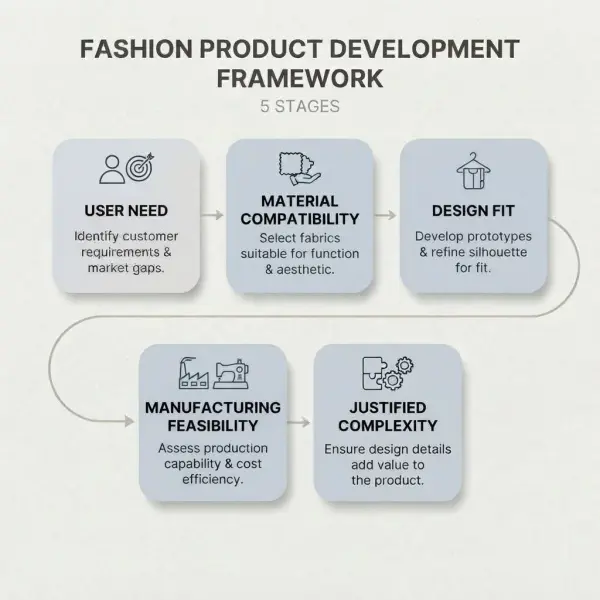
Before approving a detail, fashion teams can evaluate it through five questions.
|
Question |
What the Team Should Verify |
|
What problem does it solve? |
Clear wearer or garment need |
|
Does it work in this material? |
Weight, thickness, stretch, stability, drape |
|
Does it support the design? |
Silhouette, visual hierarchy, brand identity |
|
Can it be manufactured consistently? |
Equipment, skill, tolerances, operation sequence |
|
Is the complexity justified? |
Cost, customer value, product positioning |
A detail that performs well across all five areas is usually easier to defend during development.
A feature that exists only because “it looks interesting” may still be valid as decoration, but the team should recognize that decision for what it is rather than assuming decorative complexity automatically adds functional value.
Common Mistakes in Functional Garment Design
Adding Features Without Defining the User Need
This often happens when designers begin with visual references rather than product requirements. Multiple straps, pockets, zippers, and adjustments can create an impression of utility while contributing little to actual use. The better approach is to define the user problem first and then choose the simplest appropriate solution.
Assuming More Pockets Automatically Mean More Utility
Pocket count is not the same as usable storage. Poor placement, shallow depth, inaccessible openings, and weak construction can make additional pockets irrelevant. For many garments, two well-designed pockets are more useful than six poorly resolved ones.
Using Hardware That Is Too Heavy for the Fabric
A zipper, snap, or buckle should be compatible with the garment's textile and construction. Heavy components can pull, sag, distort, or create uncomfortable pressure points in lightweight clothing. Trim selection should therefore happen alongside material selection.
Ignoring How Details Behave When the Garment Moves
A feature that looks perfect on a hanger may behave differently on the body. Tabs can catch. Pockets can gape.
Cord ends can move excessively. Hardware can knock against other components. Fit and wear testing should include realistic movement.
Copying Performance Details Without Performance Engineering
Technical-looking features may imply protection, adjustability, or durability. If the garment has not been engineered for those functions, marketing language should not suggest otherwise. Fashion references are legitimate. Unsupported functional claims are different.
Overcomplicating Products at the Wrong Price Point
Every extra detail consumes resources. For value-sensitive products, unnecessary complexity can pressure margins or lead factories to simplify construction in ways that reduce quality. A better approach is to prioritize the few details customers are most likely to notice and use.
What Brands Should Verify Before Final Approval
Before approving a functional detail, the development team should verify four things.
- Function: Does the detail perform a clear task under realistic use?
- Compatibility: Does it work with the garment's fabric, fit, and construction?
- Manufacturability: Can the factory reproduce it consistently across production?
- Communication: Does the product description accurately represent what the feature does?
This final point is often overlooked. A design feature and a performance claim are not the same thing. A reinforced-looking panel does not prove higher abrasion resistance.
A hood does not prove weather protection. A mesh section does not automatically prove improved thermal performance. Brands should communicate functional benefits in proportion to what has actually been engineered and, where relevant, tested.
FAQ
What are examples of functional details in clothing?
Common functional details include pockets, zippers, buttons, snaps, drawcords, adjustable tabs, belt loops, cuffs, hoods, vents, gussets, pleats, reinforced panels, flaps, and internal storage systems. Each solves a different garment problem. Pockets provide storage, closures control access, adjustments modify fit, gussets add movement, and reinforcement supports high-stress areas. Some of these features also become strong style elements, so designers need to consider function and visual impact together.
How do functional details affect garment style?
Functional details change proportion, visual emphasis, and product character. Large patch pockets can create a workwear or utility aesthetic, visible zippers can feel technical, while concealed closures and welt pockets can support a cleaner or more tailored surface. The effect depends on scale, placement, material, and finish. The same feature can appear rugged in one garment and refined in another. Style comes from how the detail is integrated rather than from the component alone.
Do more functional details make a garment better?
Not necessarily. Every additional feature increases complexity and may add weight, cost, bulk, maintenance requirements, or manufacturing risk. A detail creates value when it solves a real problem or strengthens the product's design language. If customers rarely use it and it does not meaningfully contribute to appearance, the feature may simply make production more complicated. Good functional design is usually selective rather than maximal.
Can functional details affect garment comfort?
Yes. Pockets, hardware, reinforcement, cords, and closures all occupy physical space and may alter pressure, flexibility, weight, or movement. A bulky zipper can feel uncomfortable against the body, while a large loaded pocket can pull a garment out of balance. Conversely, gussets, vents, or adjustable cuffs can improve usability under the right conditions. Comfort should therefore be evaluated through physical fit and wear testing rather than assumed from drawings.
Why are functional details important in fashion product development?
They connect design intent with real-world use. A functional detail can influence pattern construction, fabric choice, trims, sewing operations, cost, fit, quality control, and customer experience simultaneously. Making these decisions early helps avoid late-stage changes to technical packages, patterns, bills of materials, or production sequences. This is especially important when features require specialized hardware, reinforcement, or close tolerances.
What is the difference between functional and decorative details?
Functional details perform a practical task, while decorative details primarily affect appearance. The distinction can overlap. A pocket may store objects and also create visual interest. A strap may originally come from functional clothing but be used decoratively on a fashion garment. The important issue is whether the feature actually performs the function suggested by its design. Brands should avoid implying performance benefits that have not been engineered or verified.
How should a small fashion brand choose which functional features to include?
Start with the customer and use case. Identify the two or three problems the garment genuinely needs to solve, then select details that address those problems without conflicting with fabric, fit, manufacturing capability, or price point. Prototype the garment and test every feature during realistic wear. For small brands especially, selective functionality is often easier to produce consistently than a product overloaded with hardware and construction details.
Conclusion
Functional details are where apparel design becomes tangible. A pocket stores something. A zipper creates access.
A gusset allows movement. A drawcord changes fit. A reinforcement panel supports a high-stress area.
But each of those details also changes how the garment looks, feels, hangs, costs, and moves through production. That is why functional design should not be reduced to adding features. The strongest products tend to be more deliberate.
They use visible functionality when it strengthens the garment's identity. They hide functionality when a clean silhouette matters more. They simplify features that add complexity without enough value. And they test construction on actual bodies rather than assuming that a technical drawing tells the whole story.
For fashion businesses, that approach creates a useful discipline: every detail should have a reason to exist. Sometimes the reason is practical. Sometimes it is aesthetic. The strongest garment designs know which is which—and make both work together.





Comments 0
Leave a CommentSend Comment
Anda harus Login terlebih dahulu untuk dapat memberikan komentar.