

Common Clothing Alterations That Improve Comfort and Appearance
Quick Answer
Clothing alterations are controlled changes made to a finished garment to improve its fit, proportion, comfort, function, or appearance for a particular wearer. Common alterations include shortening hems and sleeves, adjusting waistbands, taking in or letting out seams, tapering trouser legs, reshaping darts, shortening straps, and repositioning closures.
The most successful alterations correct a specific mismatch without disturbing the garment’s balance, construction, or original design. A trouser hem can often be shortened relatively easily, for example, while changing a jacket shoulder may require removing and rebuilding the sleeve, lining, padding, and armhole. The feasibility depends on available seam allowance, fabric condition, pattern placement, internal construction, and the location of nearby details.
Alteration should not be treated as a universal solution for poor sizing. Some garments can be adjusted efficiently; others would require disproportionate labour or would still not fit correctly after modification.
For fashion businesses, alteration services can help customers obtain a more personal fit, keep suitable garments in use, and reveal recurring product-development problems. Their value, however, depends on skilled assessment, transparent pricing, controlled workmanship, and realistic communication about what can and cannot be changed.
What Is a Clothing Alteration?
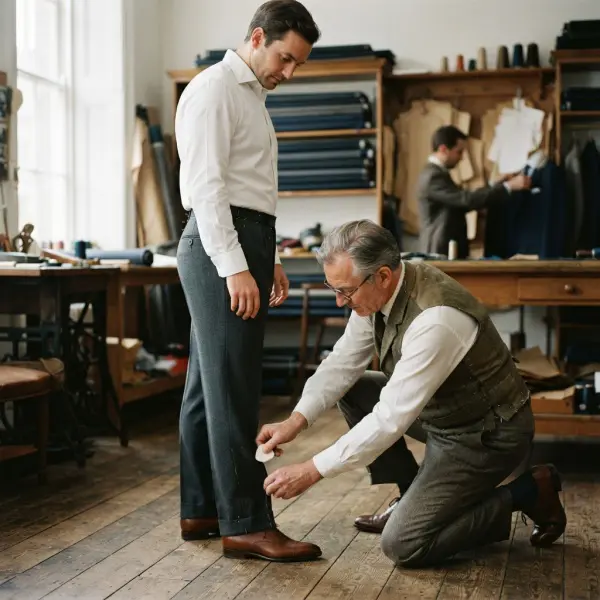
A clothing alteration is a modification made to the dimensions, shape, proportion, construction, or selected details of an existing garment so that it better suits the wearer or a revised design intention.
Most alterations retain the identity and primary construction of the original garment. Shortening a sleeve, reducing a waist, or tapering a trouser leg changes part of the product without turning it into an entirely different item.
Alteration overlaps with repair and restyling, but the terms are not identical.
|
Service |
Primary purpose |
Typical examples |
|
Alteration |
Change fit, dimensions, proportion, or selected design details |
Shortening a hem, taking in a waist, tapering sleeves, shortening straps |
|
Repair |
Restore a damaged or failed area to usable condition |
Replacing a broken zipper, closing an open seam, patching a tear |
|
Restyling or remaking |
Substantially change the garment’s design or intended use |
Converting a dress into a skirt, reshaping an oversized shirt, rebuilding vintage clothing |
|
Made-to-measure adjustment |
Modify a pattern or standard garment around an individual measurement profile |
Adjusting jacket length, trouser rise, waist suppression, or sleeve length before delivery |
In practice, tailoring businesses may provide all four services under one commercial category. The Ellen MacArthur Foundation, for example, uses a broad repair-business definition that includes alterations and repair services performed on products already owned by consumers. It distinguishes these activities from remaking, where an existing product is substantially reconstructed or repurposed.
This broader commercial grouping is useful, but technical communication should remain precise. Shortening trousers is an alteration. Replacing their damaged zipper is a repair. Reconstructing them as a skirt is remaking.
Why Do Clothing Alterations Matter?
Alterations matter because standard ready-to-wear sizes cannot correspond perfectly to every combination of body shape, height, posture, proportion, and fit preference.
A customer may choose the correct size through the hip but find the waist too loose. A jacket may fit the chest while its sleeves extend beyond the desired point. A dress may accommodate the bust but require shortened straps to hold the neckline correctly.
These are not necessarily signs that the entire garment is badly designed. They can arise because commercial sizing must group many different bodies into a limited number of sizes.
The principles behind these adjustments begin during product development. New Mexico State University’s pattern-alteration guidance explains that fit corrections should preserve grainlines, design lines, and appropriate ease, while related pattern pieces must be adjusted together. It also notes that correcting the pattern before fabric is cut avoids many later problems.
Once a garment has already been completed, the same correction usually becomes more constrained. Seams have been trimmed or finished, linings installed, buttonholes cut, pockets positioned, and fabric pressed or washed. A change that would have been simple on the pattern may require significant disassembly on the finished garment.
That distinction gives alterations two different roles in fashion:
- For individual wearers, alterations adapt an existing garment to a more suitable personal fit.
- For fashion businesses, repeated alteration requests can reveal where the original product, size chart, length offering, or fit communication requires improvement.
Alteration is therefore both a service and a source of product intelligence.
What Should Be Assessed Before Altering a Garment?
The first professional decision is not how to sew the alteration. It is whether the proposed alteration is technically viable and commercially sensible.
A tailor should inspect the garment on the wearer whenever possible. Measurements taken from the garment alone cannot show how posture, body distribution, undergarments, footwear, and movement influence the problem.
The assessment should answer several questions:
- Is the problem caused by width, length, balance, shape, or personal preference?
- Is there sufficient material to make the requested change?
- Will the alteration affect adjoining pieces or details?
- Can the original finish be recreated?
- Will previous stitching, fading, pressing, or washing remain visible?
- Could the change restrict movement or distort another area?
- Is the expected result proportionate to the cost and risk?
A garment should also be evaluated in the way it will actually be worn. Formal trousers should be fitted with the intended shoes. An evening dress should be assessed with the expected undergarments. A coat should be fitted over suitable layers rather than directly over a thin shirt.
Without this context, the alteration may be technically neat but functionally wrong.
Common Alterations and What They Can Improve
Hemming Trousers, Skirts, Dresses, and Sleeves
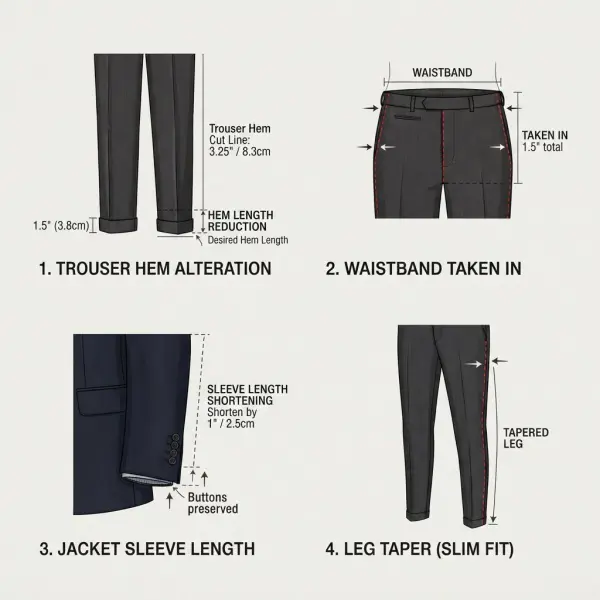
Shortening a hem is one of the most common clothing alterations because commercial garments are usually produced to standardized lengths, while customer height, leg proportion, shoes, and styling preferences vary.
The correct finished length is not determined by height alone. It depends on silhouette and garment category.
Wide-leg trousers may require enough length to maintain their vertical drape without collecting on the floor. Cropped trousers need a deliberate relationship with the ankle. Formal trousers may be adjusted according to the desired break over the shoe. A full skirt may need to be levelled while the wearer is standing because body shape can cause the fabric to hang differently at the front, sides, and back.
A successful hem alteration must consider:
- the original hem depth and finish;
- whether the edge is straight, curved, pleated, flared, or faced;
- fabric weight and drape;
- lining length;
- vents or side openings;
- decorative borders;
- cuff construction;
- visible fading at the former fold;
- footwear and intended styling.
Shortening is usually easier than lengthening because lengthening requires unused hem allowance. Even when extra material is available, the old fold line may remain visible through fading, abrasion, needle marks, or permanent pressing.
For sleeves, the alteration route depends on construction. A plain shirt sleeve can often be shortened from the cuff, but plackets, buttons, embroidery, or shaped cuffs increase the work. Tailored jacket sleeves may be shortened from the cuff or, in more complex cases, from the sleeve head. Working from the shoulder can preserve functioning cuff details but requires substantial technical skill.
Adjusting a Trouser or Skirt Waist
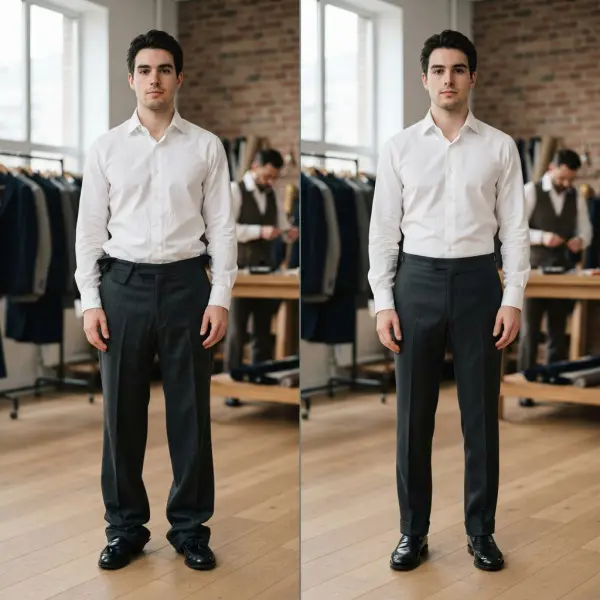
A waist alteration can improve comfort and stability when the garment fits through the hip but gaps, slips, or presses at the waist.
Taking in a waistband may involve opening part of the waistband, adjusting the centre-back seam, side seams, darts, or a combination of these areas, and then reconstructing the waistband. The best route depends on where the excess occurs and how the garment was built.
Removing all excess from one seam may create a visible distortion. On trousers, an aggressive centre-back reduction can change pocket spacing, waistband shape, back balance, and the angle of the seat seam. Distributing the adjustment may produce a cleaner result, although it requires more work.
Letting out a waist is possible only when sufficient seam allowance exists. Some tailored trousers include usable allowance at the centre back, while tightly overlocked, bound, or mass-produced constructions may contain very little spare fabric.
The hip remains an important constraint. New Mexico State University’s trouser-fitting guidance describes hip fit as difficult to alter and recommends selecting the initial pattern according to the fullest hip measurement. It also emphasizes that waist, hip, thigh, crotch depth, and posture interact rather than functioning as isolated measurements.
For finished garments, the practical implication is straightforward: a loose waist over a suitable hip is often more manageable than a garment that is already too small through the hip, seat, or upper thigh.
Taking In or Letting Out Side Seams
Side-seam alterations can reduce or increase garment circumference, but they should not be treated as a universal way to resize clothing.
Taking in side seams may improve:
- excess body width;
- waist definition;
- loose underarm areas;
- skirt or dress volume;
- trouser leg shape;
- overly wide sleeves.
The correction needs to blend gradually into the original seam. Abrupt changes produce angles, puckering, or uneven tension. On a fitted dress, changing the side seam may also affect the armhole, bust shaping, waistline, lining, and zipper relationship.
Letting out is limited by seam allowance. Even when enough fabric exists, previous stitching can leave holes or impressions, particularly in leather, coated fabrics, tightly woven cloth, velvet, satin, and some delicate textiles.
Patterned fabrics create an additional problem. Letting out a side seam can interrupt stripe, check, motif, or print alignment. The garment may become larger but visually less refined.
Shortening or Narrowing Sleeves
Sleeve alterations can improve both appearance and movement. Sleeves that are too long may cover the hand, obscure intended cuff placement, or make a tailored garment look oversized. Sleeves that are too wide can distort a slim silhouette or interfere with layering.
Narrowing a sleeve usually requires opening the seam and tapering the adjustment into the upper sleeve. The tailor must preserve enough room for elbow flexion and upper-arm movement. A sleeve that looks clean while the arm hangs straight may become restrictive when the wearer reaches forward.
Shortening becomes more complicated when the sleeve contains:
- working buttonholes;
- a shirt placket;
- shaped or contrast cuffs;
- zippers;
- embroidery;
- elastic;
- lining;
- a vent;
- decorative topstitching.
Moving or recreating these details can cost more than the visible length correction suggests. A professional quotation should reflect the entire reconstruction, not simply the number of centimetres being removed.
Tapering Trousers and Jeans
Tapering reduces the width of the trouser leg, usually from the thigh, knee, or calf toward the hem. It can update the silhouette or make an overly wide leg feel more controlled.
The adjustment may be made through the inseam, outseam, or both. The decision depends on leg balance, grainline, seam construction, topstitching, and nearby details.
On jeans, the outseam may contain characteristic felled construction or visible topstitching. Altering only the inseam can preserve the original side seam but may pull the leg out of balance if too much width is removed. Altering both seams can distribute the reduction more evenly, but it increases labour and may require recreating original stitching.
Tapering must allow sufficient room for sitting, walking, bending, and passing the foot through the opening. The desired silhouette should be tested in motion rather than judged only from a static front view.
Shortening Shoulder Straps
Shortening straps is common on dresses, camisoles, jumpsuits, and lingerie-style tops. A small change can lift the neckline, raise the armhole, stabilize the bust area, and reposition the waist or bodice.
It can also create unintended effects.
If straps are shortened too much, the armhole may cut into the body, the neckline may rise beyond the intended point, or the whole bodice may become too short. On a garment with a defined waist seam, raising the bodice can move that seam above the natural waist.
The alteration becomes more complex when straps contain embellishment, sliders, elastic, lining, or a continuous neckline finish. Strap length should therefore be pinned and tested before cutting.
Adding or Reshaping Darts
Darts control three-dimensional shaping by removing fabric volume in selected areas. Adding or modifying darts can improve waist contour, reduce neckline gaping, shape a blouse, or control excess fabric in a dress.
The correction should point toward the relevant body prominence without extending directly to it. Poorly positioned darts can create a sharp or unnatural projection.
Adding darts after a garment is complete is possible when enough fabric volume exists, but it may shift side seams, waistlines, hem levels, prints, pockets, or lining. The alteration should be viewed as a redistribution of fabric, not as a change that affects only the stitched wedge.
Repositioning Buttons, Hooks, and Other Closures
Moving a button, hook, or fastening point can provide a small fit correction at the waist, cuff, or neckline. It is often useful when the required adjustment is modest and the garment still closes securely without strain.
This method has strict limits. A button moved too far from its original position can pull the placket off-centre, expose the edge, distort the neckline, or create diagonal tension. It does not replace a proper seam alteration when substantial circumference change is needed.
Previous needle holes or button impressions may also remain visible, particularly on leather, suede, coated fabrics, and delicate textiles.
Adjusting Jacket Shoulders and Armholes
Shoulder alteration is frequently requested but is among the most technically demanding changes in tailored clothing.
The shoulder influences:
- neckline position;
- jacket balance;
- armhole shape;
- sleeve-head dimensions;
- chest line;
- back width;
- padding;
- canvas or interfacing;
- sleeve movement.
Reducing the shoulder may require removing the sleeve, altering the front and back shoulder, reshaping the armhole, adjusting internal structure, changing the sleeve head, and resetting the sleeve. The lining must also be opened and reconstructed.
Increasing shoulder width is even more limited because additional matching fabric is required. For many ready-to-wear garments, a major shoulder mismatch is a reason to choose another size or style rather than rely on alteration.
Adjusting Trouser Rise and Crotch Shape
Crotch and rise alterations address problems such as excess fabric under the seat, pulling across the front, a waistband that tilts, restricted sitting, or an uncomfortable crotch position.
These symptoms are easily misdiagnosed. The cause may involve crotch length, crotch depth, seat shape, thigh room, posture, or the distribution of front and back body volume.
A small centre-back or inseam adjustment may improve some garments. Major corrections are difficult once the trousers are cut because the alteration may require fabric in a direction where none remains.
The original pattern should ideally accommodate these differences. NMSU’s fitting guidance treats crotch depth, front and back crotch length, hip, thigh, and posture as related variables and advises correcting crotch depth before crotch length during pattern work.
This is precisely why a finished-garment crotch alteration requires diagnosis rather than trial-and-error sewing.
Which Alterations Are Usually Simple, Moderate, or Complex?
Complexity depends on the garment, but the following framework helps set realistic expectations.
|
Alteration |
Typical complexity |
Main variables |
|
Shortening a plain straight hem |
Low |
Fabric, hem finish, lining |
|
Replacing a simple machine hem |
Low |
Original stitch and fold depth |
|
Shortening plain straps |
Low to moderate |
Lining, hardware, neckline effect |
|
Repositioning a button slightly |
Low |
Placket alignment and visible marks |
|
Taking in an unlined waist |
Moderate |
Darts, seams, closure |
|
Tapering plain trousers |
Moderate |
Balance, inseam, outseam, hem opening |
|
Shortening lined sleeves |
Moderate to high |
Cuff, vent, lining, buttons |
|
Letting out a fitted garment |
Moderate to high |
Available allowance, fabric marks, details |
|
Altering a trouser rise or crotch |
High |
Shape, posture, available fabric |
|
Reducing tailored jacket shoulders |
High |
Sleeve, armhole, padding, canvas, lining |
|
Recutting an armhole |
High |
Sleeve compatibility and movement |
|
Substantially resizing a structured dress |
High |
Boning, cups, lining, closures, embellishment |
“Simple” does not mean that accuracy is unimportant. A visibly uneven trouser hem can damage the appearance of an otherwise well-made garment. Complexity describes the amount of reconstruction and technical interaction, not the value of precision.
How Alterations Improve Comfort
Alterations improve comfort when they remove concentrated pressure, provide movement where it is needed, prevent excess fabric from interfering with the body, or stabilize the garment in its intended position.
Comfort problems can occur in garments that are both too small and too large.
A tight waistband may press into the abdomen when sitting. A narrow upper sleeve may restrict reaching. A short rise may pull the waistband downward. At the other extreme, a loose shoulder can cause a garment to slide, while excessive trouser length may catch under the shoe.
Useful comfort-oriented alterations include:
- releasing a waistband when allowance permits;
- adding local room through a seam or gusset;
- reducing excess fabric that bunches under outerwear;
- raising or stabilizing straps;
- shortening hems that obstruct walking;
- increasing a vent or opening where construction allows;
- adjusting sleeve or trouser width without restricting movement.
The most important principle is localization. Comfort should be improved where the problem occurs rather than by indiscriminately enlarging or reducing the whole garment.
How Alterations Improve Appearance
Appearance depends on line, balance, proportion, drape, and the relationship between the garment and the wearer.
A small length correction can change the apparent proportion of the entire outfit. Raising a skirt hem may make footwear more visible and alter the leg line. Correcting a sleeve length can make a jacket appear more intentional. Reducing waist gaping can stabilize trousers and prevent the back from collapsing.
Alterations may improve appearance by:
- levelling a hem;
- aligning a waist seam with the intended body position;
- removing unintended drag lines;
- restoring garment balance;
- improving the relationship between sleeve and cuff;
- controlling excess volume;
- placing design details more appropriately;
- preserving the intended silhouette during movement.
A closer fit is not automatically a better-looking fit. Removing too much ease can expose every body contour, distort the grain, pull seams out of position, and make a refined garment appear strained.
The alteration should clarify the design, not force every garment into a slim silhouette.
Technical Limits That Can Make an Alteration Difficult
Insufficient Seam or Hem Allowance
A garment can only be let out or lengthened when spare material exists in the required location. Overlocked seams are often trimmed relatively close to the stitching. Bound seams, French seams, taped seams, and certain flat constructions may provide little recoverable width.
Matching fabric can sometimes be added as a gusset, facing, cuff, waistband extension, or design insert, but this becomes a visible redesign rather than an invisible adjustment.
Fabric Memory and Previous Stitching
Fabric may preserve evidence of its former construction. Old needle holes, crease lines, fading, abrasion, adhesive residue, and pressing marks can remain after a seam or hem is moved.
The risk varies by material and finish. Leather and coated fabrics retain punctures. Velvet and pile fabrics can show crushed seam lines. Denim may fade around the original hem. Satin can mark easily under stitching and pressing.
A tailor should identify these risks before opening the garment.
Prints, Stripes, Checks, and Embellishment
Alterations can disrupt visual continuity.
Taking in a checked jacket may misalign the pattern at the side seam. Shortening a bordered dress may remove an important motif. Reducing an embroidered bodice can cut through decorative work. Moving a pocket may leave visible stitching or fading.
Sometimes the technically easiest alteration is not the visually best one. The location of pattern and decoration must be treated as part of the construction.
Linings and Internal Structure
Lined garments require access to the main seams and enough lining allowance to accommodate the change.
Tailored jackets, formal dresses, corseted garments, and coats may contain:
- fusible or sewn interfacing;
- canvas;
- shoulder pads;
- sleeve heads;
- boning;
- cups;
- underlining;
- insulation;
- multiple lining layers.
An external seam cannot be altered responsibly without considering these internal components.
Technical and Performance Garments
Waterproof shells, bonded sportswear, protective clothing, compression products, and seam-sealed garments require special caution.
Opening a seam may compromise:
- water resistance;
- protective coverage;
- reflective-detail placement;
- stretch performance;
- compression distribution;
- certification-related construction;
- seam-seal continuity.
A visually acceptable alteration may change functional performance. Brands and alteration providers should not claim that original protective properties have been retained unless the relevant construction has been properly restored and validated.
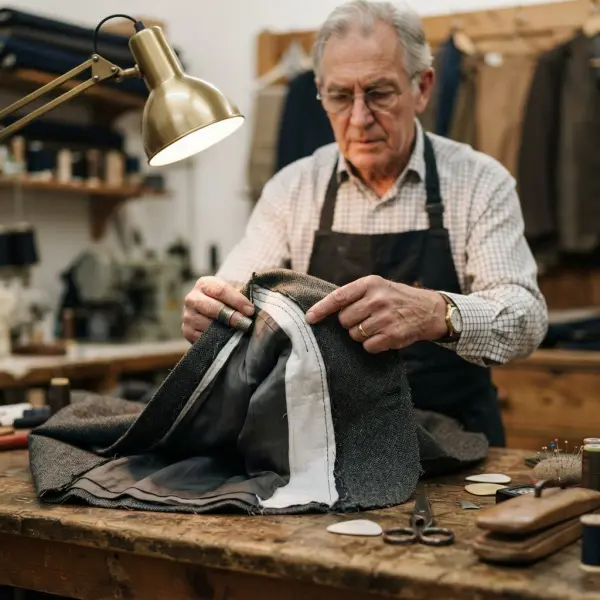
A Practical Clothing Alteration Workflow
A professional alteration workflow should make the requested outcome, technical risk, cost, and responsibility clear before the garment is changed.
1. Clarify the Wearer’s Objective
The customer may say that a garment is “too big,” but the actual concern could be waist gaping, excessive sleeve width, low armholes, unwanted length, or a silhouette that feels less fitted than expected.
The tailor should identify the specific outcome rather than interpret vague language literally.
2. Inspect the Garment
The garment should be checked for:
- fabric and stretch;
- seam and hem allowances;
- previous alterations;
- damage or wear;
- lining and internal structure;
- washing or fading;
- matching requirements;
- closures, pockets, vents, and decorative details.
This inspection determines whether the requested result is feasible and where visible limitations may remain.
3. Fit and Mark the Garment
The wearer should stand naturally rather than pulling the abdomen in, lifting the chest unnaturally, or holding a rigid posture. Both sides should be reviewed because human bodies are not perfectly symmetrical.
Pinning should preserve sufficient movement. The wearer should sit, walk, reach, or bend according to the garment’s purpose.
4. Agree on the Result and Price
The provider should explain:
- which seams or details will be changed;
- whether the result will be visible;
- whether original stitching or finishes can be reproduced;
- whether the alteration is reversible;
- whether a second fitting is required;
- what happens if concealed damage is found.
This prevents a customer from expecting a complete reconstruction at the price of a basic hem.
5. Record the Alteration
Pins alone are not a reliable production record. Measurements, chalk marks, photographs, garment diagrams, and written instructions should be used where appropriate.
For brand programmes or multi-location services, consistent recording is essential. A centre-back waist reduction, for example, is not equivalent to the same total reduction distributed across side seams and darts.
6. Complete, Press, and Inspect
After sewing, the garment should be pressed using methods appropriate to the material. Pressing is part of the construction process, not merely a cosmetic final step.
The final inspection should check:
- measurement accuracy;
- symmetry where intended;
- seam smoothness;
- stitch security;
- lining behaviour;
- closure operation;
- hem level;
- movement;
- overall balance.
A final fitting is particularly useful for structured, asymmetric, or multi-stage alterations.

How Fashion Businesses Can Use Alteration Services Strategically
Offer Alterations Where Fit Variation Is Predictable
Retail alteration services are especially relevant for product categories where customers commonly need length or localized fit adjustments, including:
- tailored trousers;
- denim;
- formalwear;
- suiting;
- occasion dresses;
- uniforms;
- bridal products;
- premium outerwear.
A brand does not need to promise that every part of every garment can be changed. A controlled service menu is often more operationally realistic.
For example, a retailer might support trouser hemming, basic waist reduction, and sleeve shortening while excluding shoulder reconstruction, technical outerwear, or heavily embellished products.
Design Products With Alteration in Mind
Alteration-friendly design may include:
- usable seam and hem allowances;
- accessible centre-back seams;
- replaceable components;
- sufficient lining ease;
- modular or adjustable closures;
- consistent construction methods;
- spare buttons or trim;
- clear material and care information.
This does not mean adding unnecessary fabric everywhere. Extra allowance affects material consumption, seam bulk, cost, and production efficiency. The design team should identify which adjustments are most valuable for the target category.
Repairability and longer product use are also receiving more policy attention. The European Commission’s textiles strategy includes a 2030 vision in which textile products are durable, repairable, and recyclable, with profitable reuse and repair services more widely available. It also identifies product design and circular business models as areas for action.
Feed Alteration Data Back Into Product Development
Alteration records can identify patterns that ordinary return data misses.
A high number of trouser hems may simply reflect a one-length product strategy. Repeated centre-back waist reductions may indicate a mismatch between the brand’s waist-to-hip proportion and its target customer. Frequent sleeve shortening could justify petite or short options.
Useful alteration data includes:
- style and size;
- alteration type;
- amount changed;
- body region;
- store or market;
- material;
- customer reason;
- whether the alteration solved the issue;
- cost and completion time.
This information should be interpreted alongside sales, reviews, returns, and garment fit principles. It should not be used to redesign a block based on a small or unrepresentative customer group.
Connect Alterations With Resale and Product Care
Alterations can help suitable second-hand products reach new wearers. Hemming, waist adjustments, and sleeve changes may increase the usable range of resale inventory, particularly for premium garments with sufficient construction value.
Alteration can also support product care by correcting minor fit problems that might otherwise leave a garment unworn.
The Ellen MacArthur Foundation includes repair, alteration, resale, rental, and remaking among business models that can help keep fashion products in use. It also cautions that labour-intensive repair and remaking costs do not decline at scale in the same way as conventional mass production, creating a structural economic challenge for service providers.
This has a practical commercial consequence: alteration should be priced as skilled work, not treated as an almost costless addition to the original garment.
Choose the Right Delivery Model
Brands can provide alteration through several operating models:
- in-house tailors at selected stores;
- centralized alteration workshops;
- authorized local partners;
- customer reimbursement within a defined allowance;
- mobile fitting services;
- alterations integrated with made-to-order or made-to-measure programmes;
- digital booking platforms connected to local providers.
Each model creates different challenges around quality consistency, logistics, customer communication, liability, turnaround, and data ownership.
A centralized workshop may improve process control but adds transport and lead time. Local partners provide convenience but require training and quality standards. In-store service offers a strong customer experience but only works where demand supports skilled staffing.
Common Alteration Mistakes
Altering a Garment Before Expected Shrinkage Occurs
Natural-fibre garments, washed denim, and other products may change dimensions during laundering. If the material has not been stabilized, a perfectly adjusted length can become too short later.
NMSU’s trouser-construction guidance advises prewashing or preshrinking fabric before cutting because this allows the fabric to relax and reduces later dimensional problems. The same underlying risk applies when altering a new garment whose care behaviour is uncertain.
The care label and expected laundering method should be considered before finalizing precise length alterations.
Fitting With the Wrong Shoes or Underlayers
A trouser hem pinned barefoot may be unsuitable with formal shoes. A jacket fitted over a thin top may become restrictive over normal workwear. A gown adjusted without its intended foundation garments may sit differently at the neckline, bust, waist, and hem.
Fit conditions need to reproduce actual use.
Removing Too Much Fabric at the First Fitting
An aggressively pinned garment may look sleek while the wearer stands still but fail during sitting or movement. Fabric should be basted or provisionally pinned when the alteration is difficult to reverse.
This is particularly important for non-stretch garments, sleeves, trousers, and fitted bodices.
Treating the Body as Perfectly Symmetrical
One shoulder may sit lower. One hip may be more prominent. Leg length may appear different because of posture rather than skeletal length.
A skilled alteration may accommodate visible asymmetry, but the decision should be deliberate. Automatically forcing both sides to the same measurement can leave the garment looking uneven on the wearer.
Solving a Balance Problem With a Width Adjustment
Adding width does not correct every pull line. A garment may need more front length, a different dart, a reshaped crotch curve, or a shoulder adjustment.
Taking in fabric can also hide the symptom temporarily while worsening grain, movement, or proportion.
Ignoring Related Garment Components
Changing one seam often affects another component. Reducing an armhole changes sleeve compatibility. Altering a neckline affects its facing or collar. Changing a waist seam may affect lining, zipper, pockets, and belt loops.
Related pieces and finishes must be adjusted as a system. The same principle is fundamental in pattern alteration, where changes must be carried through to corresponding pattern pieces.
Promising an Invisible Result Without Inspecting the Fabric
Previous stitching, fading, permanent creases, and finishing may prevent an alteration from being invisible. These risks should be communicated before sewing, especially when letting out seams or lengthening hems.
What Brands Should Verify Before Offering Alterations
An alteration programme requires more than a list of tailors.
Before launch, a fashion business should define:
- eligible products and alterations;
- excluded materials and constructions;
- pricing responsibility;
- customer approval procedures;
- measurement and marking standards;
- quality acceptance criteria;
- liability for damaged garments;
- service turnaround;
- returns and refunds after alteration;
- logistics between store and workshop;
- data protection for customer measurements;
- escalation procedures;
- partner training and evaluation.
The returns policy deserves particular attention. A garment customized for one wearer may no longer be suitable for ordinary resale. The customer should understand how alteration affects return eligibility before authorizing the work.
The programme should also specify whether the service corrects a manufacturing defect or provides optional personalization. Those situations may require different commercial and customer-service treatment.
Recurring problems connected to product fit should be escalated to technical development rather than repeatedly absorbed by alteration teams. A service can correct individual garments, but it should not become a permanent substitute for sound pattern engineering, grading, appropriate seam finishing, or production control.





Comments 0
Leave a CommentSend Comment
Anda harus Login terlebih dahulu untuk dapat memberikan komentar.