

Bust Darts, Waist Darts, and Shoulder Darts: Where They Work Best
Two garments can have nearly identical measurements yet fit very differently. One may follow the body naturally, while the other develops unwanted fullness around the bust, waist, or upper back. Often, the difference lies in how shaping has been distributed across the pattern.
Bust darts, waist darts, and shoulder darts are common methods for controlling fabric around specific areas of the body. Although they share the same basic construction principle, their positions influence where fullness is accommodated, how the garment hangs, and which parts of the silhouette appear more defined.
For fashion designers and apparel manufacturers, choosing a dart is not simply a matter of following a standard pattern. The decision affects design appearance, fit consistency, fabric handling, and production requirements.
Understanding where each type works best helps product development teams create garments that balance structural accuracy with the intended aesthetic.
Quick Answer: What Is the Difference Between Bust, Waist, and Shoulder Darts?
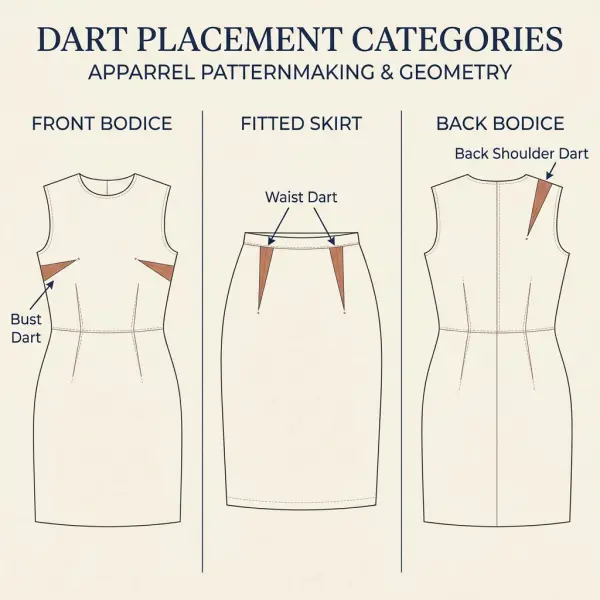
Bust darts, waist darts, and shoulder darts are garment-shaping features distinguished by their location, the body contours they accommodate, and their role in the pattern.
Bust darts create shaping around the bust. They are often positioned at the side seam, but bust shaping can also be transferred to the waist, shoulder, neckline, or another suitable location.
Waist darts control fabric intake around the waist and adjacent body contours. They are commonly used in fitted bodices, dresses, skirts, and tailored trousers to manage differences between waist measurements and fuller areas of the body.
Shoulder darts begin at a shoulder seam. On front bodice patterns, they can provide bust shaping through a relocated dart. On back bodice patterns, they commonly accommodate shoulder-blade prominence and upper-back contours.
These categories overlap. A dart beginning at the front waist and directed toward the bust can function as both a waist-positioned dart and a bust-shaping dart.
The most suitable placement depends on body proportions, garment style, pattern geometry, fabric characteristics, and the required fit. No single dart position is universally better.
Why Dart Location Matters in Garment Patternmaking
The position of a dart determines how shaping is distributed across a garment panel and where the fabric is taken in. Two darts can create related amounts of shaping but produce different seam arrangements, fabric grain relationships, and visual effects.
In a fitted bodice, for example, a shaping wedge can be directed from the side seam toward the bust or relocated toward the shoulder. Both arrangements can accommodate bust volume when drafted correctly, yet they create different visible lines and construction requirements.
The same principle applies to the waist. A patternmaker can distribute waist suppression through darts, side seams, princess seams, or combinations of these features. The selected arrangement affects the finished silhouette and the complexity of the garment.
The Dresspatternmaking explanation of garment darts demonstrates how front bodice patterns distribute shaping between bust and waist darts, while back bodice and skirt blocks use darts to control other body contours.
For commercial apparel production, dart placement must also consider repeatability. A design that works on a single sample needs sufficiently accurate pattern specifications to maintain its intended appearance across sizes and production batches.
Location and Function Are Not Always the Same
Darts can be described by where they begin or by the body contour they are intended to shape.
This distinction explains why a dart may belong to more than one category.
A dart starting at the waistline and directed toward the bust is positioned at the waist but contributes to bust shaping. Similarly, a front shoulder dart may be another placement for a bust-shaping wedge rather than a completely different fitting requirement.
Back shoulder darts serve a different purpose. They generally shape the fabric over the shoulder blades and upper back rather than accommodating bust projection.
Recognizing these relationships prevents designers from treating dart names as rigid, mutually exclusive classifications.
Bust Darts: Shaping Around the Bust
A bust dart is a tapered fabric intake used to shape a bodice around bust projection. It helps the garment accommodate the difference between the fuller bust area and the surrounding torso without leaving excessive fabric in adjacent regions.
Bust shaping is particularly relevant in fitted woven garments, where fabric stretch may be limited and the pattern must establish much of the garment's three-dimensional form.
Where Are Bust Darts Usually Positioned?
A conventional side bust dart begins at the side seam and points toward the bust apex, the fullest projection of the bust.
The sewn dart normally ends before reaching that apex. This provides a gradual transition between the dart and the fuller area of the garment.
The precise distance depends on the patternmaking system, body proportions, dart intake, and fabric characteristics. A fixed universal measurement should not replace evaluation on a fit model.
Bust shaping can also originate from other areas, including the waist, shoulder, neckline, and armhole.
The Bust Dart terminology guide from Dresspatternmaking identifies these alternative locations and explains why distributing shaping between more than one dart may be useful in fitted bodice patterns.
When Do Bust Darts Work Best?
Bust darts are particularly suitable when a design needs controlled fullness around the bust while retaining a relatively simple garment panel.
Common applications include fitted blouses, woven shirts, sheath dresses, structured tops, and tailored dresses.
Consider a woven blouse designed with a smooth front panel and moderate waist definition. A side bust dart may provide the required bust shaping while leaving the central front relatively uninterrupted.
This can be useful when the designer wants to avoid prominent princess seams or additional panel construction.
However, the most suitable solution depends on the desired bust shape, the amount of intake, and how the fabric behaves.
For a more structured design requiring extensive contouring, distributing shaping through multiple darts or shaped seams may produce a more practical result than concentrating everything in one large dart.
How Bust Dart Intake Influences Fit
Bust dart intake determines part of the shaping introduced around the bust.
A larger intake can accommodate a greater difference in contour, but it also changes the geometry of the pattern. It should not be increased automatically simply because the wearer has a larger overall bust circumference.
Two individuals with similar bust measurements may have different relationships between bust projection, upper chest, waist, and torso length.
Consequently, commercial sizing systems and made-to-measure patterns may require different shaping adjustments.
During pattern development, designers should evaluate whether the bust dart supports the required contour without introducing an overly pointed appearance, unwanted pulling, or excessive looseness below the bust.
The objective is controlled three-dimensional fit, not the removal of as much fabric as possible.


Waist Darts: Controlling the Relationship Between Waist and Body Fullness
A waist dart is a tapered intake positioned at or around the waist to control garment shaping between the waist and adjacent fuller areas.
Unlike bust darts, which are defined by their shaping function, waist darts are commonly named for their position.
They are used in several garment categories, but their purpose differs depending on whether they appear in a bodice, skirt, dress, or trousers.
Waist Darts in Fitted Bodices
In fitted bodices, waist darts help shape the transition between the bust or upper torso and the waist.
A front waist dart commonly extends upward toward the bust area, gradually reducing fabric intake until the dart ends before the relevant body contour.
Back waist darts shape the relationship between the upper back, waist, and lower torso. Depending on the pattern, they can work alongside side-seam shaping or other construction features.
Consider a tailored sleeveless blouse.
The garment needs sufficient room around the bust while achieving a closer fit around the waist. Front waist darts can help manage this difference, especially when the designer wants a clean side seam and an uninterrupted central front.
Nevertheless, a front waist dart may also form part of the garment's bust shaping. Its relationship with any side bust dart must therefore be evaluated as part of the complete bodice pattern.
Waist Darts in Skirts
In skirts, waist darts primarily manage the difference between waist circumference and the fuller hip or seat area.
A skirt pattern generally requires more circumference around the hips than at the waist. Darts help distribute part of this difference within the front and back panels rather than placing all the shaping into the side seams.
Front skirt darts are typically directed from the waist toward the lower abdominal or upper hip area. Back skirt darts extend toward the seat or upper hip contour.
Their lengths, positions, and intakes may differ because the front and back body contours are not identical.
For example, a straight woven skirt may use two back darts and one or two front darts on each side of a symmetrical pattern. The exact arrangement depends on the block, size range, fabric, and intended silhouette.
A skirt with a substantial waist-to-hip difference may benefit from distributing intake across more than one dart, rather than concentrating it in a single large fold.
Waist Darts in Trousers
Tailored trousers may use waist darts, especially in the back panels, to manage the transition between the waist and the seat.
Their function must be considered alongside the waistband, rise, hip ease, and seat shaping.
A dart that produces an attractive waistline on a standing fit model may still require adjustment if the trousers pull uncomfortably when sitting.
This is why trouser dart placement should not be evaluated solely by the appearance of the flat pattern or the garment while standing.
Movement and wearing ease remain essential parts of the fit assessment.
When Are Double-Pointed Waist Darts Useful?
A double-pointed dart, sometimes called a fish-eye dart, tapers toward a point at both ends, with the greatest intake between them.
It is commonly used to shape the waist area of a continuous garment panel, such as a fitted dress or long bodice.
Unlike a conventional single-point dart beginning at a seam edge, a double-pointed dart can control fullness within the middle of a panel.
This allows the garment to narrow at the waist and gradually provide more room above and below it.
Double-pointed darts are useful when a designer wants waist shaping without dividing the garment at the waistline. However, their dimensions must be coordinated with the torso length, hip contour, and intended ease.

Shoulder Darts: Shaping the Upper Body and Back
A shoulder dart is a tapered intake that begins at the shoulder seam and extends into the bodice panel.
Its function differs depending on whether it is positioned on the front or back of the garment.
This distinction is important because shoulder darts are sometimes described too broadly as if they always serve the same anatomical purpose.
Front Shoulder Darts for Bust Shaping
In a front bodice, a shoulder dart can provide bust shaping when a shaping wedge is transferred from another location.
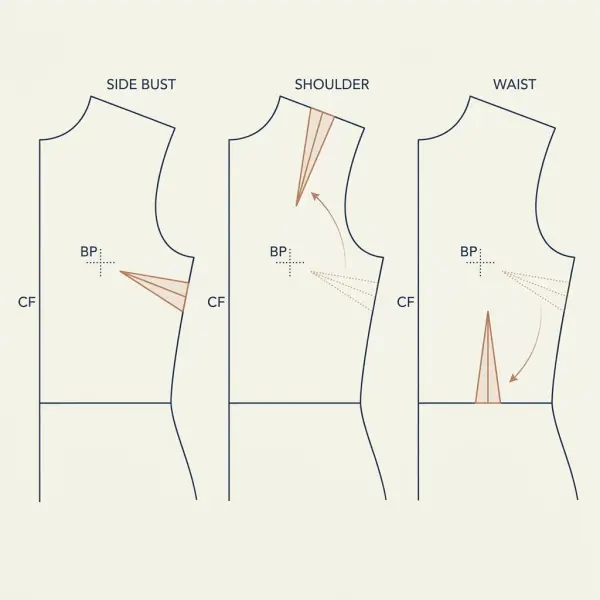
For example, a patternmaker may reposition a side bust dart into the shoulder seam through dart manipulation.
The resulting shoulder dart is directed toward the bust area and provides part of the fullness required by the front bodice.
This construction can create a different visual emphasis from a side bust dart.
A shoulder-origin dart introduces a shaping line from the upper part of the garment, which may suit certain tailored blouses, dresses, or design variations.
However, shoulder construction also influences how the garment sits across the upper chest. Dart placement must therefore be coordinated with the neckline, armhole, shoulder seam, and overall pattern balance.
The University of Fashion lesson on transferring a front shoulder dart to a waist dart demonstrates how shaping can be repositioned within a front bodice pattern.
Back Shoulder Darts for Shoulder-Blade Fullness
On a back bodice, shoulder darts are commonly used to shape the fabric over the shoulder blades.
The upper back is not a flat surface. Shoulder-blade prominence, shoulder slope, and individual posture affect how fabric lies between the neckline, shoulder seam, and armhole.
A back shoulder dart provides a controlled way to accommodate this contour.
In a fitted woven jacket or blouse, the dart may reduce unwanted looseness around the back armhole or upper shoulder while preserving the necessary shape across the shoulder blades.
The fitting discussion in Threads' guide to improving garment fit with a yoke explains how shoulder or neck darts can provide shaping over the upper back and how a yoke can offer an alternative construction.
Not every garment requires a back shoulder dart. Relaxed silhouettes, alternative seam arrangements, and different body shapes may allow the necessary contour to be handled in other ways.
When Do Shoulder Darts Work Best?
Back shoulder darts are particularly useful in garments requiring controlled upper-back shaping, including fitted woven blouses, tailored jackets, and structured dresses.
They may also be useful when a garment exhibits excessive fullness around the back armhole or neckline that is attributable to the upper-back contour.
Front shoulder darts are better understood as an optional location for distributing bust shaping rather than an automatically superior method.
Designers should evaluate how visible the dart will be, whether the shoulder seam can accommodate the added construction, and how the chosen fabric responds to the stitching.
In heavier materials, shoulder seam bulk may become an important consideration. Alternative techniques, such as shaped yokes or panel seams, may be more suitable for certain designs.
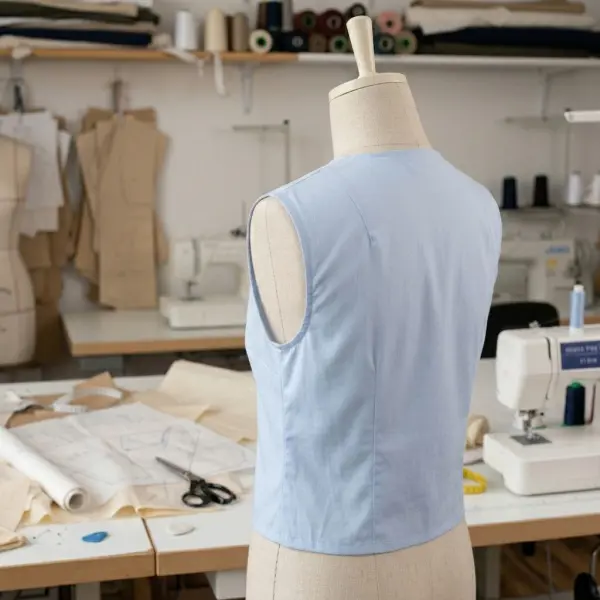
Bust Darts vs Waist Darts vs Shoulder Darts: Key Differences
The following comparison summarizes how these dart categories are commonly used in garment construction.
|
Feature |
Bust dart |
Waist dart |
Shoulder dart |
|
Primary description |
Dart shaping the bust |
Dart positioned at or around the waist |
Dart beginning at the shoulder seam |
|
Common location |
Front bodice, often side seam |
Bodice, skirt, dress, or trousers |
Front or back bodice |
|
Main shaping function |
Accommodates bust projection |
Controls waist-to-body contour transitions |
Shapes front bust or back shoulder-blade area |
|
Typical direction |
Toward the bust apex |
Toward the adjacent fuller body contour |
Toward the bust or shoulder-blade region |
|
Common applications |
Fitted blouses and dresses |
Fitted bodices, skirts, trousers |
Tailored blouses, dresses, jackets |
|
Main patternmaking concern |
Bust position and shaping distribution |
Waist intake and overall garment balance |
Shoulder fit, upper-body contour, seam relationships |
|
Possible alternative |
Waist-positioned bust dart or princess seam |
Side-seam shaping or panel seam |
Neckline dart, yoke, or shaped seam |
The key distinction is that these terms describe different combinations of position and function.
A front shoulder dart may perform a bust-shaping role. A front waist dart may also contribute to bust shaping. A back shoulder dart, by contrast, is normally intended to accommodate the upper-back contour.
For fashion businesses, the useful question is not which dart is universally better, but where the required shaping should be placed to support the design and fit specifications.
Can Bust, Waist, and Shoulder Darts Be Moved or Combined?
Dart manipulation allows patternmakers to reposition or redistribute shaping within a garment pattern.
This technique makes it possible to develop multiple garment styles from a fitted pattern block while preserving the underlying shaping requirements, provided the manipulation is performed correctly.
For example, a side bust dart can be transferred to the shoulder, neckline, or waist. A larger shaping wedge can also be divided into smaller darts when appropriate.
However, this principle should not be interpreted as permission to transfer any dart anywhere without considering its original purpose.
Front bust shaping and back shoulder-blade shaping address different body contours. Their pattern adjustments need to be evaluated separately.
Moving a Bust Dart Into a Shoulder or Waist Position
A common patternmaking method involves pivoting around the bust point.
The original dart is closed while a new dart opening is created at another position on the pattern.
After the transfer, the dart legs and point are redrawn, and the affected seamlines are checked or trued.
The new dart opening may have a different linear width because its distance from the bust point has changed. The shaping relationship is preserved through the drafting geometry, not by copying the original intake measurement directly.
This is especially important when converting a fitted base pattern into a different blouse or dress design.
A transferred dart should be tested because fabric grain, seam position, and stitching behavior can alter the finished appearance.
Combining Shaping Into Princess Seams
Dart shaping can also be incorporated into panel seams.
Princess seams are a familiar example. They use curved seams to provide shaping across a larger area of the bodice, often extending through the bust toward the waist.
This construction may be preferable when a design requires pronounced shaping or when the designer wants continuous vertical seamlines.
However, princess seams introduce additional pattern pieces and sewing operations, so the decision should account for both the appearance of the garment and manufacturing requirements.
The relationship between darts and curved seams illustrates a broader principle: a similar fitting objective can often be achieved through different pattern constructions.
Converting Darts Into Design Features
Some garment designs deliberately reinterpret dart shaping as a visible design feature.
Darts may be incorporated into pleats, released into soft fullness, or positioned to create an intentional visual line.
These changes can affect the distribution of fabric and should not be assumed to produce the same finished fit as a completely stitched dart.
For commercial product development, any such conversion should be supported by a revised pattern and approved sample.
How to Choose the Right Dart Placement for a Garment
The most effective dart arrangement depends on the interaction between garment design, body proportions, material characteristics, and manufacturing requirements.
Rather than selecting darts only by garment category, fashion teams can evaluate where shaping is needed and which construction method provides the most suitable result.
Start With the Intended Silhouette
The first consideration is whether the garment should be fitted, semi-fitted, or relaxed.
A fitted woven dress generally requires more deliberate shaping than an oversized blouse. Its pattern may need bust, waist, and back shaping distributed across several locations.
In contrast, a relaxed garment may use fewer darts because its design intentionally retains more ease.
The amount of shaping should therefore follow the intended silhouette rather than a fixed rule about which darts every garment must contain.
Match the Dart to the Body Contour
Dart placement should be based on the contour the pattern needs to accommodate.
A useful practical distinction is:
- Bust projection: Consider bust shaping from an appropriate front bodice location, such as the side seam, waist, or shoulder.
- Waist-to-hip difference: Consider waist darts and side-seam shaping in skirts or trousers.
- Torso waist definition: Consider front and back waist darts, shaped seams, or a combination.
- Shoulder-blade prominence: Consider back shoulder darts, neckline darts, or suitable upper-back seam construction.
These are starting points for pattern development rather than universal prescriptions.
The actual dart position must be established through the chosen patternmaking method and fit evaluation.
Evaluate Fabric Thickness and Drape
Fabric behavior affects which dart arrangement will produce a clean result.
Lightweight woven fabrics may allow relatively discreet darts but can reveal puckering or marking. Structured medium-weight fabrics may hold shaped contours effectively but can make large dart allowances visible.
Heavy fabrics may create bulk when substantial intake is concentrated into one location.
Stretch fabrics may require different shaping strategies because their extension and recovery contribute to fit.
For these reasons, the same dart arrangement should not be transferred between different fabric categories without evaluating the result.
Consider the Visual Effect of the Dart
Darts are structural features, but their visible orientation also contributes to garment design.
A side bust dart creates a line entering from the side seam. A front waist dart introduces vertical or slightly angled shaping from the waist. A shoulder dart produces an upper-body construction line.
Each option affects the visual organization of the garment.
For a minimalist blouse, the designer may prefer discreet side-seam shaping. For a structured dress, visible vertical shaping may complement the intended silhouette.
These are design choices rather than universal aesthetic rules.
Assess Manufacturing Feasibility
Finally, fashion businesses should consider how consistently the selected dart can be produced.
A complex arrangement may be appropriate for premium tailored garments but less practical for products designed around simplified, high-volume construction.
The manufacturing assessment should include fabric marking, sewing accuracy, pressing requirements, seam allowances, operator skill, and inspection criteria.
Eliminating a dart is not necessarily a cost saving if doing so requires additional pattern panels or creates a less satisfactory fit.
Practical Applications for Fashion Brands and Apparel Manufacturers
Dart placement should be evaluated during product development rather than left as an isolated sewing-room decision.
This is especially relevant for brands that use standardized patterns, outsource production, or manufacture several size variants.
Establish the Correct Base Pattern
A dependable base pattern provides the foundation for consistent garment shaping.
The pattern should reflect the intended target measurements, fit profile, ease, and garment category.
A fitted blouse block, for instance, may contain side bust darts and waist darts. A tailored jacket block may use a different distribution of shaping because of its structure, lining, and intended wearing ease.
Once the base pattern is approved, designers can manipulate dart locations to create different styles without repeatedly starting the fitting process from an unsuitable foundation.
This approach can support consistency, but it does not eliminate the need to test meaningful changes.
Include Dart Information in Technical Specifications
Technical packages should make the approved dart construction clear enough for production teams to reproduce it.
Depending on the garment, specifications may need to document:
- Dart location and reference points.
- Intake and length measurements.
- Dart endpoint placement relative to key pattern landmarks.
- Seam allowances and stitching requirements.
- Pressing direction and finishing instructions.
- Size-specific pattern adjustments and relevant tolerances.
The appropriate level of detail depends on the production arrangement and the complexity of the style.
A technically accurate pattern is useful only if the cutting, sewing, and inspection teams can interpret it consistently.
Check Dart Placement During Size Grading
Dart placement deserves particular attention when a garment is graded into multiple sizes.
The intended shaping relationship may not remain satisfactory if all measurements and positions are scaled mechanically.
For example, changing bust circumference does not necessarily imply an identical proportional change in bust projection or apex position.
Similarly, differences in waist and hip measurements may affect how skirt dart intake should be distributed.
Fashion brands should use their target size specifications and fitting process to verify these relationships, especially when the size range covers substantially different body proportions.
Evaluate Fit on Relevant Wearers
A sample can appear technically correct on a dress form yet behave differently on a moving wearer.
Fit evaluations should therefore assess the entire garment, including posture, movement, comfort, and visual balance.
For a blouse, this may include sitting, reaching, and lifting the arms. For trousers and skirts, sitting and bending can reveal whether the waist and hip shaping provide appropriate ease.
Dart adjustments should be documented and incorporated into the approved pattern rather than remaining undocumented corrections made by the sample maker.

Common Dart Placement Mistakes to Avoid
Choosing the correct dart category is only part of achieving an accurate garment fit. Problems also arise when the selected position is not coordinated with the pattern's proportions and construction.
Assuming Every Waist Dart Serves the Same Purpose
Waist darts do not perform identical functions across garment categories.
A front bodice waist dart may contribute to shaping around the bust, while a skirt waist dart mainly controls the difference between waist and hip contours.
Applying the same placement logic to both can produce unsuitable pattern geometry.
Patternmakers should identify the body contour being shaped before selecting the dart's direction and dimensions.
Treating Front and Back Shoulder Darts as Equivalent
A front shoulder dart may be a transferred bust dart, while a back shoulder dart commonly provides shaping over the shoulder blades.
Their anatomical purposes are different.
Using identical dart dimensions or orientations without considering the front and back body contours may distort the garment's balance.
Each should be drafted from the relevant pattern block and evaluated independently.
Concentrating Too Much Shaping in One Dart
A large dart may be mathematically possible but difficult to sew or press smoothly, particularly in stiff or thick material.
Concentrating substantial intake in one location can create unwanted bulk or a sharp visual transition.
Depending on the design, distributing the intake across several darts or shaped seams may produce a more manageable construction.
However, redistribution must preserve the required garment shape and be verified through sampling.
Selecting Dart Placement Without Considering Movement
A garment may appear well fitted when the wearer is standing still but become uncomfortable during normal use.
This is particularly relevant to fitted bodices, skirts, and trousers, where dart intake works together with seam shaping and garment ease.
A pattern should not be approved solely because the darts look smooth on a static dress form.
For a deeper examination of sewing defects, dart-point problems, puckering, and garment imbalance, see common dart sewing mistakes that affect garment balance.
Important Technical Considerations Before Changing Dart Placement
Dart manipulation and pattern adjustments should be evaluated carefully because a successful flat-pattern change does not automatically guarantee a successful finished garment.
First, dart location and dart function must be distinguished. A front waist or shoulder dart may provide bust shaping, whereas a back shoulder dart generally accommodates shoulder-blade contours. These are not interchangeable fitting requirements.
Second, dart measurements are dependent on the pattern. Intake, length, and endpoint placement should follow the intended body proportions, patternmaking method, and garment fit. Generic measurements may provide an initial reference but are not universally suitable.
Third, fabric changes can alter the result. Moving an approved dart arrangement from stable cotton poplin to a heavy suiting fabric or lightweight satin may change how visible the allowance is and how smoothly the dart can be pressed.
Fourth, dart manipulation requires proper pattern truing. After transferring a dart, affected seamlines and dart legs need to be checked so the pattern can be assembled accurately.
Finally, multiple fitting variables interact. An apparent dart problem may be influenced by overall garment circumference, shoulder slope, torso length, waist position, or insufficient ease.
Apparel teams should verify the full fit rather than modifying a single dart in isolation.
Frequently Asked Questions About Bust, Waist, and Shoulder Darts
1. What is the difference between a bust dart and a waist dart?
A bust dart is defined primarily by its function: it provides shaping around the bust. A waist dart is generally described by its position at or near the waistline.
These categories can overlap. A front waist dart directed toward the bust can serve as part of the bust-shaping system, while a skirt waist dart primarily controls the transition between the waist and hips.
The distinction becomes important during pattern development because the direction and amount of intake must reflect the relevant body contour.
Rather than treating the terms as competing construction options, patternmakers should identify both the dart's location and its shaping purpose.
2. Can a bust dart be moved to the shoulder?
Yes. Bust shaping can be transferred from a side-seam or other location into a front shoulder dart through appropriate pattern manipulation.
The process generally involves using the bust point as a pivot reference, closing the original shaping wedge, and creating a new opening at the desired shoulder position.
Afterward, the dart must be redrawn and the affected pattern edges trued.
Although this can preserve the underlying shaping geometry, the finished garment may behave differently because of fabric grain, seam construction, and visual orientation.
A sample should be evaluated before adopting the transferred dart for production.
3. Why do skirts often have waist darts?
Skirts commonly use waist darts to distribute the difference between waist and hip measurements.
A straight or fitted skirt needs sufficient room around the hips and seat while maintaining a smaller circumference at the waist. Darts allow some of this difference to be controlled within the front and back panels.
The exact arrangement depends on the pattern block, body proportions, silhouette, and fabric.
Some skirts use several darts, while others rely more heavily on shaped seams, gathers, pleats, or elastic construction.
The presence of waist darts is therefore a design and fit decision rather than an essential requirement for every skirt.
4. What is the purpose of a back shoulder dart?
A back shoulder dart helps accommodate the three-dimensional contour of the shoulder blades and upper back.
In fitted woven garments, the upper-back shape may require localized intake to prevent unwanted looseness around the shoulder seam, neckline, or back armhole.
The dart provides one possible method of distributing that shaping.
Other constructions, including neckline darts, yokes, or shaped panel seams, may also achieve the intended fit.
A back shoulder dart should be evaluated with the garment's shoulder slope, upper-back ease, armhole shape, and wearer movement. Its purpose is not simply to tighten the back panel.
5. Which dart is best for a fitted blouse?
There is no universally best dart for every fitted blouse. The appropriate arrangement depends on the intended silhouette, bust shaping requirements, fabric, and design details.
A simple woven blouse may use side bust darts to accommodate bust projection while keeping the front panel relatively clean. Waist darts can provide additional definition, and a back shoulder dart may support upper-back shaping if needed.
A blouse with extensive contouring may instead benefit from princess seams or other panel construction.
The final decision should be based on the approved fit rather than selecting a particular dart solely because it is common in similar garments.
6. Can a garment have bust darts and waist darts at the same time?
Yes. Many fitted bodice patterns use more than one dart to distribute shaping across the bust and waist.
For example, a front bodice may contain a side bust dart and a vertical waist dart. Together, they can control fabric around the bust while shaping the transition toward the waist.
This distribution can be useful when concentrating all the required intake into one dart would create an undesirable shape or difficult construction.
However, the combined intake must be developed as part of the complete pattern. Adding a second dart without adjusting the original shaping can change the garment dimensions and compromise fit.
7. Do shoulder darts make a garment fit better?
Shoulder darts can improve fit when the garment requires localized shaping around the front upper bodice or shoulder-blade region.
A front shoulder dart may provide an alternative placement for bust shaping. A back shoulder dart may help manage the contour of the upper back.
However, adding shoulder darts does not automatically improve every garment.
Relaxed clothing, garments with suitable yokes, or patterns with shaping incorporated into other seams may not require them.
The relevant question is whether the shoulder area needs additional shaping and whether a dart is the most suitable construction for the fabric and design.
Conclusion: Choose Dart Placement According to the Shape the Garment Needs
Bust darts, waist darts, and shoulder darts are variations of a shared garment-shaping principle, but their applications are not identical.
Bust darts accommodate projection around the bust. Waist darts help manage differences between the waist and adjacent fuller areas. Shoulder darts provide upper-body shaping, either by distributing bust fullness from the front shoulder or by accommodating shoulder-blade contours from the back.
The relationships between these categories matter more than their names. A waist-positioned dart can contribute to bust shaping, and a front shoulder dart can represent a transferred bust dart.
For fashion businesses, successful dart selection begins with the intended silhouette, relevant body measurements, and fabric behavior. It continues through sample fitting, pattern refinement, and clear production specifications.
A well-designed dart arrangement should support the garment without drawing unnecessary attention to construction problems.
The practical objective is not to use more darts or fewer darts, but to position shaping where it produces the most appropriate balance of fit, appearance, comfort, and manufacturing feasibility.





Comments 0
Leave a CommentSend Comment
Anda harus Login terlebih dahulu untuk dapat memberikan komentar.