

Common Grading Mistakes That Affect Fit Across Sizes
A garment can fit well in the approved sample size and still fail at the smaller or larger ends of its range. The neckline may widen too quickly, the rise may become uncomfortable, pockets may drift, or sleeves may stop matching their armholes. These problems are often described collectively as “bad grading,” but the visible symptom does not always reveal the real cause.
Some failures begin in the grade rule. Others come from an unresolved base pattern, an unsuitable size chart, inconsistent measurement definitions, untested fabric behavior, sewing variation, or the wrong production file. Accurate diagnosis matters because correcting the wrong layer can introduce a second problem while leaving the first one intact.
Quick Answer
The most common garment grading mistakes are grading an unapproved base pattern, treating grading as uniform scaling, confusing body and garment measurements, using inconsistent size increments, overlooking vertical proportions, failing to grade dependent components, extending one rule system too far, ignoring fabric behavior, relying on a clean CAD nest without measurement checks, and approving a full range from the base-size sample alone.
These mistakes affect fit because a graded range is an interconnected system. A change at the shoulder can alter the armhole; an armhole change affects the sleeve; a waist change affects a waistband; and a neckline change must be reflected in its collar, facing, or binding. Even mathematically consistent movements may be unsuitable if the brand's body chart does not represent its intended customer.
The safest diagnostic method is to compare five layers in order: the approved base pattern, body measurement chart, graded finished-garment specification, graded pattern, and physical production sample. Material test results and sewing measurements must also be checked. The goal is to correct the source of the discrepancy, regenerate affected sizes where necessary, and validate the range before bulk cutting.

Why Grading Problems Are Easy to Misdiagnose
Grading affects how pattern geometry changes between sizes. It does not control every factor that determines the dimensions or fit of a finished garment. Fabric can shrink, stretch, relax, or recover differently from the development sample. Cutting and sewing can introduce variation. A measurement can be taken at a different location or with a different tension. A factory can also use an obsolete pattern while the brand reviews the latest specification.
That makes symptom-based correction risky. If a finished large shirt is narrower than specified, increasing the grade at the side seam may appear logical. But the true cause could be excessive wash shrinkage, an incorrect seam allowance, a cutting problem, or a measurement-method difference. Changing the grade would then make future correctly processed garments too large.
The first distinction should be among four error classes:
|
Error class |
Where it originates |
Typical evidence |
|
Sizing error |
Target body chart, size intervals, or customer assumptions |
Repeated fit mismatch across styles using the same sizing system |
|
Base-pattern error |
Fit, balance, ease, or construction in the source size |
The same problem is already visible in the approved or revised base size |
|
Grading error |
Size-to-size increments or coordinate movements |
The problem grows, shrinks, or appears progressively away from the base |
|
Production error |
Material behavior, cutting, sewing, pressing, washing, or file use |
Pattern measures correctly but the finished garment or one batch does not |
These categories can overlap. A weak body chart can lead to inappropriate grade rules, while a production process can amplify a marginal pattern problem. Diagnosis should identify the primary source and any contributing factors rather than forcing every issue into one label.
Mistake 1: Grading Before the Base Pattern Is Approved
Grading an unstable base pattern multiplies unresolved fit and construction problems across the range. If the base shoulder angle is wrong or the side seam is unbalanced, technically precise grading preserves that fault in every new size. When the base is corrected later, teams may patch individual graded sizes rather than regenerate the nest, creating inconsistent pattern histories.
This mistake often happens when development calendars are compressed. A supplier may start grading while the brand is still commenting on a fit sample, or two teams may work simultaneously from different base versions. The apparent time saving disappears when collars, sleeves, linings, specifications, and markers all require revision.
A better control is a formal grading-release gate. The approved base should have a version number, fit status, confirmed finished measurements, checked seam relationships, and a complete pattern-piece inventory. The process described in how size grading turns a base pattern into a full size range should begin from that controlled package, not from the latest file found in an email thread.

Mistake 2: Treating Grading as Uniform Scaling
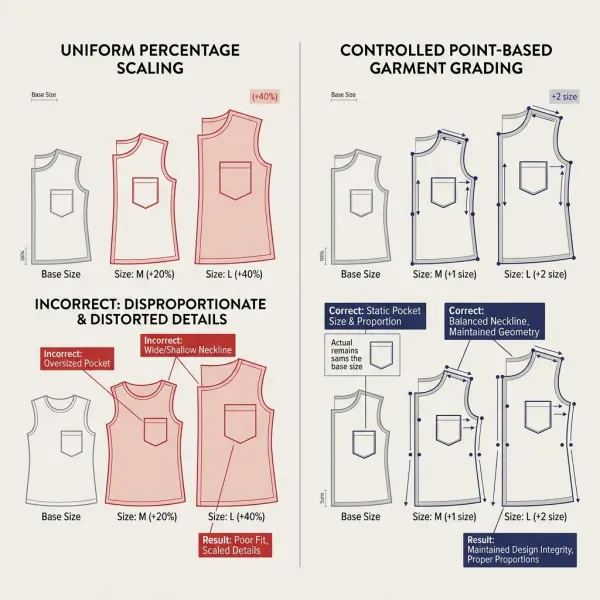
Uniform scaling enlarges or reduces every dimension by the same percentage from a common origin. Garment grading instead distributes planned changes at selected pattern points. Bodies do not change as simple two-dimensional enlargements, and many garment elements must follow functional or aesthetic rules different from the main outline.
When uniform scaling is used, neckline depth, pocket size, button diameter, seam allowance, hem depth, and garment length can all change whether or not they should. Curves may also distort. A scaled armhole and sleeve may remain mathematically related yet produce the wrong mobility, sleeve-cap height, or visual proportion for the intended size.
The better approach is to begin with size-to-size body and finished-garment increments, then distribute those changes through horizontal and vertical grade rules. Fixed elements, position-only changes, and category-specific exceptions should be documented separately. Grading is coordinated pattern engineering, not image resizing.
Mistake 3: Confusing Body, Garment, and Pattern Measurements
Body measurements describe the intended wearer. Finished-garment measurements describe the completed product at defined points. Pattern measurements describe two-dimensional pieces under stated calculation conventions. They influence one another, but they are not the same dataset.
ISO 8559-1:2017 provides standardized anthropometric definitions for clothing-related body measurement work. The current ISO 8559-2:2025 addresses primary and secondary body dimensions for size designation. Those body dimensions should not be mistaken for the measurements of the garment itself, which include ease and design choices.
Problems arise when a body-bust interval is copied directly into a finished chest grade without considering intended ease, or when a finished measurement is compared with a pattern edge without accounting for darts, pleats, gathers, elastic, seam allowances, or the number of cut pieces. A half-pattern, half-garment, and full-circumference value can also be confused, producing an error two or four times larger than intended.
Every technical package should identify the measurement layer, unit, orientation, and calculation basis. A useful rule is simple: no number should travel from a body chart to a pattern rule unless the team can explain how it becomes the intended finished-garment result.
Mistake 4: Using Inconsistent Measurement Definitions or Tolerances
Two teams can use the same measurement name and still measure different lines. “Body length” may be taken from different neck or shoulder reference points. Hip depth can follow the body contour or a vertical direction. A stretched waistband, relaxed waistband, and garment-waist seam are not interchangeable. If the point of measurement is unclear, a correct pattern can appear wrong.
Grade increments and production tolerances are also frequently confused. The grade is the intended difference between sizes. The tolerance is the acceptable manufacturing deviation around the target measurement. If a chest grade is 4 cm and the tolerance is plus or minus 1 cm, the tolerance does not authorize a factory to redefine the adjacent size interval as 3–5 cm. It describes acceptance around each size target under the agreed inspection method.
The corrective action is to define every critical point of measurement with a diagram, endpoints, garment condition, fastened or unfastened status, stretch instruction, and measurement path. Units and rounding rules should be consistent. When pattern and finished-garment measurements legitimately use different methods, the reconciliation formula should be recorded rather than left to memory.
Mistake 5: Applying the Same Increment Everywhere
Even when a brand has a regular circumference interval, every pattern location should not necessarily receive the same movement. Chest, waist, hip, shoulder, neck, armhole, sleeve, rise, and length dimensions interact with different body regions and construction requirements. One repeated X/Y rule can make the nest look tidy while progressively distorting the garment.
This is especially visible in vertical grading. Teams sometimes focus on width because tightness is the most obvious complaint, then under-grade back length, armhole depth, rise, or waist-to-hip placement. Larger sizes may gain circumference without adequate vertical room, causing garments to ride up, pull, or place shaping above the intended body level.
The reverse can also happen. Automatically lengthening every feature may push pockets too low, create excessive rises, or alter a cropped silhouette. The grade plan should distinguish body-related length, style length, and feature placement. Each needs a reasoned progression rather than one universal increment.
Mistake 6: Extending One Rule System Beyond Its Valid Range
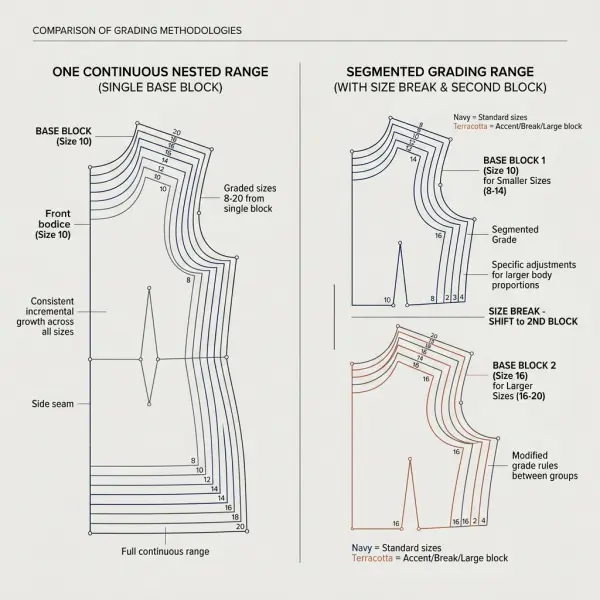
A rule library may perform well near its approved base but become less suitable several sizes away. Continuing the same shoulder, bust, hip, or rise progression indefinitely assumes that the target population's proportions remain represented by that model. That assumption must be tested.
ISO 8559-3:2018 describes principles for body-measurement tables and intervals and recognizes different population groups and subgroups used in ready-to-wear development. The commercial implication is that a size range should be grounded in a defined population; a regression or proportion model derived for one group should not be casually transferred to another.
Warning signs include shoulders becoming disproportionately broad, darts no longer addressing the intended fullness, waist-to-hip relationships drifting, and end sizes needing repeated one-off corrections. The appropriate solution may be segmented rules, a planned size break, or another base block. Multiple blocks add development and control work, so they should be chosen from fit evidence rather than treated as an automatic answer.
Mistake 7: Grading Main Pieces but Missing Dependent Components
A front and back bodice may meet their target measurements while the garment remains unsewable because its collar, facing, lining, cuff, waistband, binding, or pocket component was not graded to match. Smaller pattern pieces are easy to overlook, particularly when they sit in separate files or are supplied by another team.
Internal marks can fail in the same way. A pocket outline may grade but its drill points stay in the base location. A button stand widens while buttonholes do not move. Sleeve notches shift without the corresponding armhole notch. These mistakes affect both assembly and appearance, and they may not be visible in a headline measurement table.
Prevention requires a pattern-piece inventory and a dependency review. Each piece and internal feature should be classified as graded in size, moved in position, held constant, or controlled by a separate rule. Seam walking should then confirm that adjoining components retain their intended relationship in every size, allowing for deliberate ease, gathering, or stretch.
Mistake 8: Ignoring Fabric and Process Behavior
Grading defines pattern differences; fabric and manufacturing determine how those patterns become garments. A rule set validated in a stable woven fabric may not transfer directly to a high-stretch knit, washed denim, bonded material, or garment-dyed product. Stretch direction, recovery, relaxation, thickness, shrinkage, fusing, pleating, and finishing can all affect measurements and fit.
Ignoring shrinkage is particularly costly because the production sample may appear to show a grade error after laundering or finishing. The right response is not automatically to modify the grade. Teams should compare pre-process and post-process dimensions, review the compensation method, and confirm whether the tested material and process match production. AATCC explains that standardized laundering for textile testing relies on controlled equipment and materials to support consistent results; the appropriate test method and conditions still need to match the product's intended care and specification.
Stretch garments create a related challenge. Two fabrics with similar nominal stretch can behave differently because recovery and force differ. A finished garment can meet its relaxed measurement yet feel tighter or become less stable in wear. Material approval, pattern ease, grade validation, and physical fitting therefore need to refer to the same production-representative fabric.
Mistake 9: Trusting a Clean CAD Nest Without Independent Checks
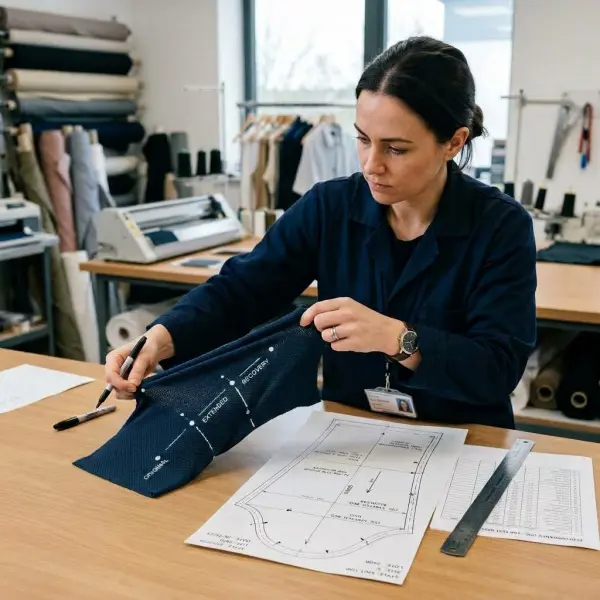
CAD can apply thousands of point movements consistently and display an orderly nest. That consistency is valuable, but it proves only that the entered rules were applied. It does not prove that the rules came from the right size chart, that a half measurement was interpreted correctly, or that the resulting garment will suit the target body.
Data-entry errors can also be systematic. A swapped sign may move a point inward rather than outward. A missing rule can hold one notch or detail stationary. A copied rule table can use a different axis convention. Because the resulting lines may still look plausible, independent measurement checks are essential.
A robust review combines several views:
- compare the graded finished specification with measured pattern results;
- inspect the nest for progression, crossings, and stationary or displaced features;
- walk critical adjoining seams in selected and end sizes;
- confirm the base size has not changed during grading;
- generate a difference or audit report where software permits;
- physically validate representative sizes in production-relevant material.
Software improves speed and traceability when this control system exists. It does not replace the sizing, pattern, and fit judgment explained in garment grading for apparel production.
Mistake 10: Approving the Range From One Fit Sample
An approved base sample confirms the evaluated size under its sample conditions. It cannot demonstrate that smaller and larger sizes preserve proportion, mobility, comfort, and construction. Problems at the edges of a range may remain invisible until customers or production teams encounter them.
Validation does not necessarily mean sampling every size for every style. The plan should reflect product risk: range width, novelty of the block, garment closeness, construction complexity, fabric behavior, order volume, and past performance. A proven relaxed T-shirt may need less physical sampling than a fitted blazer, bra, compression garment, or new extended-size block.
Representative size samples should be evaluated against both specifications and intended bodies. Reviewers should observe movement, closure, balance, seam position, neckline scale, pocket access, print placement, and silhouette—not only whether a tape measurement falls within tolerance. A size can pass its measurements and still fail the design or wearer.
A Diagnostic Workflow for Grading-Related Fit Problems
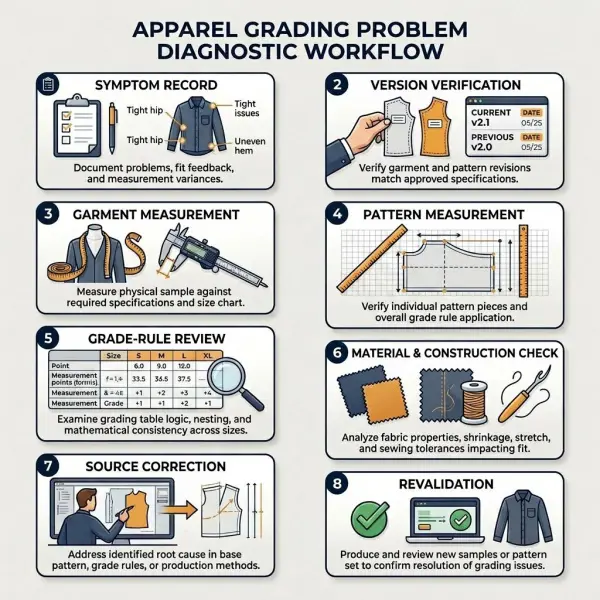
When a problem appears, the first task is containment. Identify affected styles, colors, materials, suppliers, production lots, and sizes. Stop uncontrolled file changes while the team establishes which version produced the sample or bulk garment.
Then work backward through the evidence:
- Describe the symptom precisely. Record size, body area, movement, measurement, garment condition, and whether the issue is progressive across sizes.
- Verify the production version. Match the sample or lot with its pattern, marker, specification, material, shrinkage allowance, and revision record.
- Measure the physical garment. Use the approved method and compare pre- and post-process data where relevant.
- Measure the graded pattern. Reconcile pattern dimensions with the intended finished measurement and all calculation allowances.
- Inspect grade rules and the base. Determine whether the discrepancy begins in the base or appears between sizes.
- Check material and construction. Review shrinkage, stretch, seam allowance, cutting, sewing, pressing, and finishing evidence.
- Correct the authoritative source. Update the body chart, specification, base pattern, grade rule, process allowance, or production control that actually caused the issue.
- Regenerate and validate affected outputs. Recheck dependent pieces, sizes, samples, markers, and superseded files before release.
This sequence prevents symptom chasing. The purpose is not to decide which department is responsible as quickly as possible; it is to preserve a traceable technical truth and prevent recurrence.
Use the shape of the evidence to narrow the cause
Certain patterns of evidence help prioritize the investigation, although they do not prove the cause by themselves.
|
Observed pattern |
First checks to prioritize |
|
Same issue in every size |
Base pattern, measurement definition, fabric/process, or universal construction setting |
|
Issue worsens with each step from the base |
Grade increment, coordinate direction, distribution, or size-break logic |
|
One size is an isolated outlier |
Data entry, file corruption, marker, cutting, sewing, or one-size rule exception |
|
Only one material or color is affected |
Shrinkage, stretch, finish, fusing, relaxation, or supplier-lot behavior |
|
Pattern is correct but garment is outside tolerance |
Cutting, seam allowance, sewing, pressing, laundering, or inspection method |
|
Garment meets specification but wearers reject fit |
Body chart, ease, fit model, silhouette, or measurement targets |
The table is a triage tool, not a final diagnosis. A clear conclusion requires evidence from the relevant source files and physical product.
How Fashion Businesses Can Prevent Repeated Grading Errors
Prevention depends less on a single expert check than on a controlled workflow. The brand, pattern team, grader, supplier, and quality team need shared definitions and clear approval ownership.
A practical prevention system includes:
- one approved body chart and size architecture for each relevant product or customer segment;
- illustrated points of measurement and documented calculation conventions;
- versioned base patterns, grade-rule libraries, specifications, and production releases;
- pattern-piece inventories covering shell, lining, support pieces, trims, and internal marks;
- automated or manual measurement reports for every graded size;
- seam and dependency checks at the base, selected intermediate sizes, and range ends;
- risk-based size-set fitting in production-representative materials;
- structured capture of production deviations, alterations, returns, and fit feedback.
For smaller brands, these controls can begin with disciplined filenames, locked approval PDFs, one measurement dictionary, and a signed release checklist. Larger organizations may integrate the same logic into CAD, product lifecycle management, and quality systems. Complexity should increase only when it improves traceability or reduces a known risk.
Treat fit feedback as evidence, not an automatic pattern instruction
Customer feedback is valuable but noisy. “Runs small” can mean insufficient garment ease, unexpected compression, poor product-page guidance, a preference for looser fit, or an incorrect size choice. Return reasons may also be selected from limited menus and lack body-area detail.
Teams should look for repeatable patterns by style, size, material, region, supplier, and complaint area. When a signal persists, compare it with fit-session notes, actual garment measurements, pattern data, and the size chart. The goal is to revise the right layer. Otherwise, a brand may loosen a pattern that was correctly made while leaving inaccurate size communication untouched.
What the Data Can and Cannot Prove
A graded specification can prove the intended measurement progression. A pattern audit can show whether the digital or paper pattern follows that progression. A finished-garment inspection can show whether production meets specified dimensions. A fit session can assess the garment on selected bodies under defined conditions.
None of these alone proves that a size range fits an entire market. Ready-to-wear sizing groups varied bodies into limited categories, and people sharing key dimensions can differ in shape, posture, distribution, and preference. Fit evidence should therefore be interpreted against the brand's defined target population and product promise.
Avoid absolute conclusions such as “the grade is correct because every measurement passes” or “the grade is wrong because several customers returned the style.” Both may overlook material behavior, size selection, ease, body shape, construction, or communication. Reliable decisions come from triangulating technical and commercial evidence.
Frequently Asked Questions
How can you tell whether a fit problem is caused by grading?
A grading problem often changes progressively as sizes move away from the approved base, but that pattern is only an indicator. Confirm the production version, measure the physical garments, and compare them with the graded specification and pattern. Then inspect the relevant grade rules and dependent pieces. If the pattern measures correctly but one production lot does not, material or manufacturing variation is more likely. If the same issue already exists in the base, correct the base pattern or fit strategy before changing size-to-size rules.
What is the difference between a grade increment and a tolerance?
A grade increment is the intended measurement difference between sizes. A tolerance is the permitted production deviation around each size's target measurement. They answer different questions: the grade defines the size system, while the tolerance supports quality acceptance. Using tolerance to cover a wrong grade can blur the distinction between adjacent sizes and hide a technical discrepancy. Both should appear clearly in the specification, with the measurement method and units defined, so the factory and quality team evaluate the same target.
Why can a garment pass measurements but still fit badly?
Specifications capture selected dimensions, not every aspect of three-dimensional fit. A garment can meet chest, waist, length, and sleeve targets while having an unsuitable armhole shape, shoulder angle, crotch curve, balance, ease distribution, or fabric response. The body chart or fit model may also differ from the intended customer. Measurement control remains essential, but it should be combined with movement, proportion, construction, and wearer assessment in representative sizes and production-relevant material. Passing a measurement table is evidence, not a complete fit verdict.
Can incorrect grading affect only one size?
Yes. One size can contain a data-entry error, missing coordinate, incorrect sign, accidental pattern edit, or file-export problem while neighboring sizes remain correct. A factory may also cut one size from an obsolete marker or apply a one-size construction setting incorrectly. An isolated outlier should prompt a comparison of that size's pattern, rule values, marker, production measurements, and file history. Do not automatically smooth the entire range when the evidence points to a local error; isolate and revalidate the affected output first.
Should grade rules stay the same across an extended size range?
Only if body data, pattern proportions, and fit validation support that decision. Some garments can use a continuous rule system successfully. Others need segmented increments, a size break, or another base block because the target population and design cannot be served well by indefinite continuation. Changing rules adds technical and operational complexity, but continuing unsuitable rules shifts that cost into poor fit and corrections. Test the range ends and document where and why any transition occurs before releasing production patterns.
Does a different fabric require new grading?
Not automatically, but it requires technical review. If stretch, recovery, thickness, shrinkage, drape, or finishing differs materially, the garment may need different ease, compensation, construction, or validation even when the labeled size range stays the same. Compare the new material with the approved fabric under relevant test and production conditions. A minor color change in the same controlled quality may require little adjustment; moving from stable woven cloth to stretch knit is a different product-development problem requiring renewed fit evidence.
How many sizes should be fit-tested before production?
There is no universal number. The plan should reflect range width, block history, garment closeness, construction complexity, fabric risk, order volume, and buyer requirements. A common risk-based approach checks the approved base plus representative lower and upper sizes, while a new or technically sensitive range may justify every size. Regardless of physical sampling scope, every graded pattern should be measured, its nested progression reviewed, and critical seam relationships checked before production release and final marker preparation for every ordered size.
Conclusion
Grading mistakes affect more than the spacing between pattern outlines. They can change mobility, proportion, assembly, visual balance, and the relationship between a size label and the garment a customer receives. The most damaging errors often begin with an apparently small assumption: an unapproved base, an undefined measurement, a copied rule, a fixed detail that should have moved, or a fabric behavior that was never tested.
Good diagnosis separates sizing, base-pattern, grading, and production evidence. Teams should verify the file version, measure the garment and pattern, inspect rule progression, review material and construction, and correct the authoritative source. That discipline avoids compensating for a production problem with a pattern change—or masking a grading problem with tolerance.
For fashion businesses, prevention is a governance issue as much as a technical one. Clear measurement definitions, controlled pattern versions, complete component checks, risk-based size validation, and structured feedback create a range that can be improved with evidence rather than guesswork.





Comments 0
Leave a CommentSend Comment
Anda harus Login terlebih dahulu untuk dapat memberikan komentar.