

Garment Measurements Explained for Apparel Production
Garment measurements translate a fashion design into dimensions that pattern makers, sample rooms, manufacturers, and quality control teams can consistently interpret. They define where a garment should be measured, how the measurement should be taken, and what dimension the finished product is expected to achieve.
This sounds straightforward until two people measure the same shirt and produce different results.
One may measure the chest directly under the armhole, while another measures at a specified distance below it. One may include the rib trim in the body length, while another stops at the seam. A sleeve may be measured from the shoulder seam, the side neck point, or the center back neck, depending on the garment and the brand’s measurement method.
For apparel businesses, the number alone is therefore not enough. A usable garment measurement needs a defined point of measure, a repeatable method, an agreed garment position, and a clear relationship to the intended fit.
Quick Answer
Garment measurements are dimensions taken from a sample or finished garment to control its fit, proportion, construction, grading, and production consistency. They commonly include measurements such as chest width, body length, shoulder width, sleeve length, waist, hip, rise, inseam, and leg opening, although the exact points depend on the product category and design.
Each measurement should be connected to a specific point of measure, often abbreviated as POM. The POM explains exactly where the measurement begins and ends, whether it is taken straight or along a curve, and whether the garment should be fastened, relaxed, stretched, folded, or laid flat.
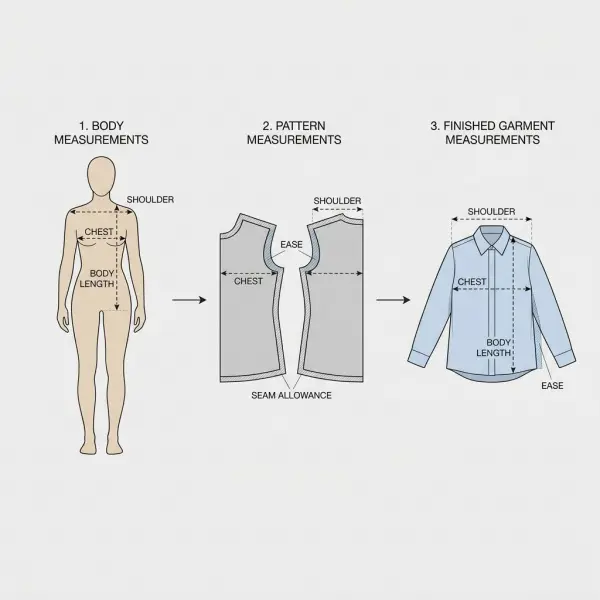
Garment measurements are not the same as body measurements. Body measurements describe the intended wearer, while garment measurements include the space, shaping, construction, and design decisions required to create a particular fit. They are also different from pattern measurements, which may include seam allowances, darts, shaping, and construction values that are not visible in the finished garment.
Reliable measurement control allows designers, pattern makers, suppliers, and quality inspectors to evaluate the same product against a shared technical reference.
What Are Garment Measurements?
Garment measurements are the measurable dimensions of a sample or completed apparel product, taken according to defined locations and methods for product development, production control, or quality evaluation.
ISO 18890:2018 defines principal garment measurement points and methods for measuring garment dimensions. The standard is intended to support activities including measurement-table creation, prototype development, sample approval, production control, garment inspection, and dimensional-change testing. Additional measurement points may still be agreed between the parties involved because individual designs often require product-specific dimensions. ISO 18890 standard method of garment measurement provides a useful international reference, but brands still need internal measurement manuals. A cropped jacket, compression legging, oversized sweatshirt, tailored blazer, and structured bra cannot be controlled through an identical set of measurements.
A measurement system therefore needs two levels:
- A consistent company-wide measurement language.
- Product-specific instructions for the design being developed.
The first supports repeatability. The second protects the intended silhouette.

Why Do Garment Measurements Matter in Apparel Production?
Garment measurements create a shared technical language between the creative and operational sides of an apparel business. A designer may describe a sweatshirt as relaxed, cropped, and slightly dropped at the shoulder. Those descriptions communicate the aesthetic direction, but they do not tell a factory how wide the chest should be, where the shoulder should end, or how much shorter the front body should be than the back.
Measurements turn those intentions into controllable product dimensions.
During development, they help the pattern maker create and refine the pattern. During sample review, they allow the technical team to determine whether an observed fit issue comes from proportion, construction, material behavior, or workmanship. During bulk production, they give quality control teams an objective basis for evaluating finished garments.
A useful measurement system supports several operational decisions:
- Whether the sample reflects the intended silhouette.
- Whether proportions remain balanced after pattern revisions.
- Whether graded sizes maintain the desired fit relationship.
- Whether factory output remains within approved specifications.
- Whether washing, finishing, pressing, or handling has changed the garment dimensions.
- Whether repeated fit complaints may be connected to a particular measurement.
Measurement control does not guarantee that a garment will fit every customer. Fit also depends on body shape, posture, styling preference, material performance, and the brand’s target customer. It does, however, make the product development process more measurable and diagnosable.
That distinction matters. Measurements cannot eliminate subjective fit decisions, but they help teams understand which physical dimensions are producing the result they see.
Garment Measurements, Body Measurements, and Pattern Measurements Are Not the Same
These three types of measurement are closely connected, but they serve different purposes.
Body measurements describe the dimensions of the intended wearer. ISO 8559-1 provides anthropometric definitions for body measurements used in clothing size designation, while ASTM D5219 compiles terminology relating to body dimensions for apparel sizing. These references help standardize where and how human-body dimensions are identified. rements describe the finished product. Pattern measurements describe the shapes and dimensions used to cut the garment components before assembly.
|
Measurement type |
What it describes |
Typical use |
Important limitation |
|
Body measurement |
The dimensions of the intended wearer |
Sizing research, fit models, size charts, customer guidance |
Does not include garment ease or design volume |
|
Garment measurement |
The dimensions of a sample or finished garment |
Fit approval, specifications, production control, quality inspection |
Must be accompanied by an exact measurement method |
|
Pattern measurement |
The dimensions and geometry of pattern pieces |
Pattern development, grading, cutting, construction planning |
May include seam allowance, darts, overlaps, and shaping that do not appear as direct finished measurements |
For example, a person with a 100-centimeter chest will not necessarily wear a garment with a 100-centimeter finished chest. A fitted woven shirt normally needs enough room for movement and breathing. An oversized sweatshirt may contain substantially more volume. A close-fitting stretch top may have a finished dimension smaller than the body because the material is intended to extend when worn.
The difference between the body dimension and the corresponding garment dimension is often discussed as ease. Yet even that explanation requires nuance: the way the extra or reduced volume is distributed across the pattern may matter as much as the total amount.
A wide chest with a narrow upper back can behave differently from a garment in which the same total circumference is more evenly distributed. Fit cannot be understood through circumference alone.
What Is a Point of Measure?
A point of measure is a precisely defined location or route used to take a particular garment measurement. In apparel documentation, it is commonly abbreviated as POM.
A POM should identify more than the name of the dimension. “Sleeve length” is incomplete because the measurement could begin at the shoulder seam, side neck point, center back neck, or another reference point. It could follow the sleeve curve or be taken as a straight distance. It may include or exclude a cuff.
The method must remove as much ambiguity as practical.
A complete POM instruction generally establishes:
- The starting point and ending point.
- The garment position during measurement.
- Whether the measurement is straight, curved, or circumferential.
- Whether trims, waistbands, bindings, or extensions are included.
- Whether closures should be fastened.
- Whether elastic should be relaxed or stretched.
- Whether the measurement is recorded as a half width or full circumference.
- Any fixed placement needed to locate the measurement line.
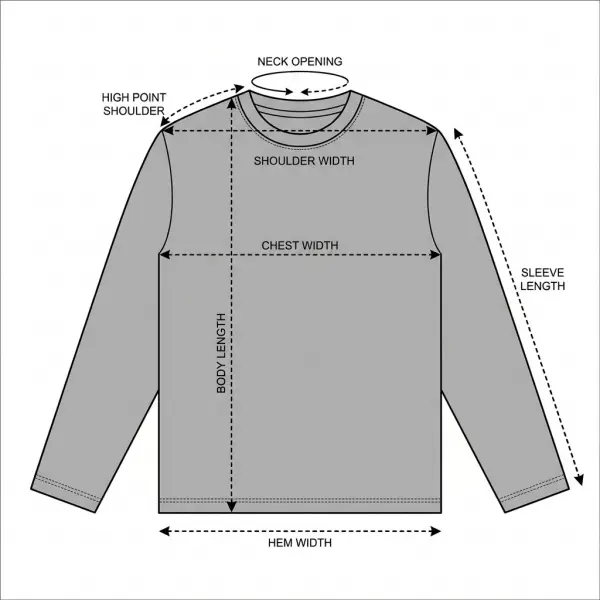
Technical diagrams are especially valuable because written terminology can be interpreted differently across companies, countries, and product categories. ISO 18890 recognizes reference concepts such as the side neck point—also commonly called the high point shoulder or HPS—center front, and center back. These reference locations make it easier to define repeatable garment measurements. rking with several factories, the practical objective is not to use the most terminology. It is to make sure that a new technician can reproduce the approved method without relying on verbal explanation.
The detailed structure used to document POM codes, target dimensions, grade rules, and tolerances belongs in the size specification sheet. The measurement method is the language; the specification sheet records the approved values.
Flat Measurements and Circumference Measurements
Many garment measurements are taken with the product laid flat. A chest or waist width may therefore represent only the visible edge-to-edge dimension of one side.
A flat chest width of 52 centimeters may correspond to approximately 104 centimeters around a simple symmetrical garment. That conversion should not be assumed blindly, however. Plackets, overlaps, seam positioning, gathers, pleats, asymmetric construction, and stretch can affect the relationship between the flat dimension and the effective circumference.
Technical documents should state whether the value represents:
- A flat half measurement.
- A full circumference.
- A doubled value calculated from a flat measurement.
- A measurement taken on only one component or side.
Without that clarification, even a numerically correct specification can be operationally misleading.
Straight Measurements and Contoured Measurements
A straight measurement records the shortest direct distance between two points. A contoured measurement follows the garment’s shape or seam line.
This difference frequently appears in armholes, neck openings, rises, shoulder seams, and curved hems. Measuring a curve with the tape lifted above the surface can produce a different result from carefully following the garment contour.
The method should specify which result is required.
Common Garment Measurements by Product Category
The correct measurement set depends on what must be controlled for the product. A basic T-shirt may need relatively few critical dimensions. A tailored blazer can require additional measurements for lapel positioning, front balance, back balance, pocket placement, sleeve pitch, vent length, and internal construction.
The objective is not to measure every visible feature. It is to identify the dimensions needed to preserve fit, proportion, functionality, and manufacturing consistency.
|
Product category |
Common measurement areas |
What they help control |
|
T-shirts and tops |
Chest, body length, shoulder, sleeve length, sleeve opening, neck width, front neck drop, hem width |
Overall volume, neckline proportion, sleeve balance, body silhouette |
|
Shirts and blouses |
Chest, waist, sweep, across shoulder, back width, sleeve length, cuff, collar, armhole, front and back length |
Tailored fit, mobility, collar proportion, sleeve position |
|
Trousers and shorts |
Waist, hip, front rise, back rise, thigh, knee, inseam, outseam, leg opening |
Seat fit, crotch comfort, leg silhouette, garment length |
|
Skirts |
Waist, high hip, low hip, sweep, front length, back length, slit or vent length |
Waist placement, hip shaping, hem volume, balance |
|
Dresses |
Bust, waist, hip, shoulder, bodice length, total length, armhole, sleeve, sweep |
Bodice balance, waist position, body shaping, overall proportion |
|
Jackets and coats |
Chest, waist, sweep, shoulder, across back, sleeve, bicep, armhole, lapel and pocket placement |
Layering room, structure, mobility, visual balance |
|
Knitwear |
Chest, body length, shoulder, sleeve, armhole, hem, cuff, neck opening |
Relaxed dimensions, stretch recovery, shape retention |
These are examples rather than universal rules. A raglan sweatshirt does not have a conventional shoulder seam, while a drop-shoulder top may require measurements that locate the sleeve join relative to the neckline. A wrap dress needs control points for overlap. Elastic-waist trousers may need both relaxed and extended waist dimensions.
The measurement list should follow the design rather than forcing the design into an inherited template.
Measurements for Tops and Shirts
Chest width, body length, shoulder width, and sleeve length are common starting points for tops, but their methods need to be product-specific.
Chest width may be taken directly below the armhole or at a fixed distance beneath it. Body length may be measured from the side neck point to the hem, from center back neck to hem, or through another defined route. Sleeve length may begin at the shoulder seam or be measured from the center back neck for raglan and similar constructions.
Neck measurements need equal care. Neck width, front neck drop, back neck drop, collar length, collar stand height, and neckline circumference describe different aspects of the garment. Substituting one for another can alter both appearance and wearability.
Measurements for Trousers and Shorts
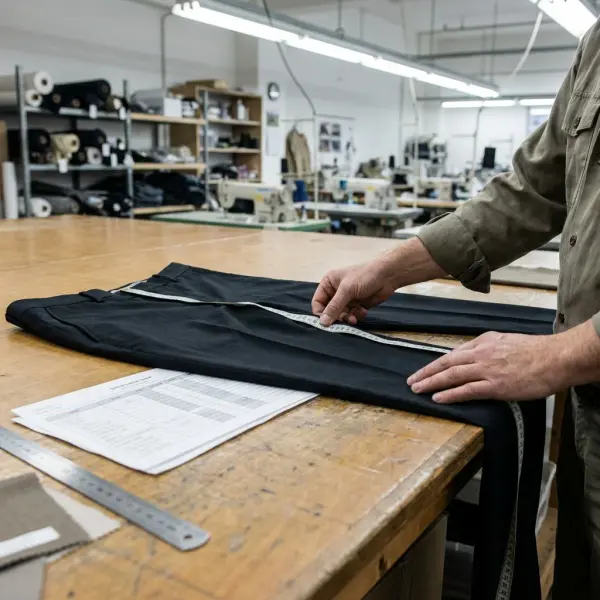
Bottom garments require careful control around the waist, hip, crotch, and leg.
The waist may be measured along the top edge, along the waistband seam, or at another defined line. Front rise and back rise depend on an exact crotch reference point. Hip width is often taken at a specified distance below the waistband or waist seam because “the fullest part” is difficult to reproduce consistently on a garment laid flat.
Inseam and outseam measurements also need clear start and end points. A trouser with a shaped waistband, dropped crotch, cuff, or curved hem may not fit a generic measurement instruction.
How Measurements Shape Ease, Silhouette, and Fit
Measurements do not merely determine whether a garment is large or small. They determine where its volume is placed.
Two jackets can have the same chest circumference but very different fits. One may have a wider back and smaller front. Another may distribute more volume through the side panels. Shoulder width, armhole depth, sleeve width, and body length can further change how the garment hangs and how freely the wearer moves.
This is why a single “key measurement” rarely controls the entire fit.
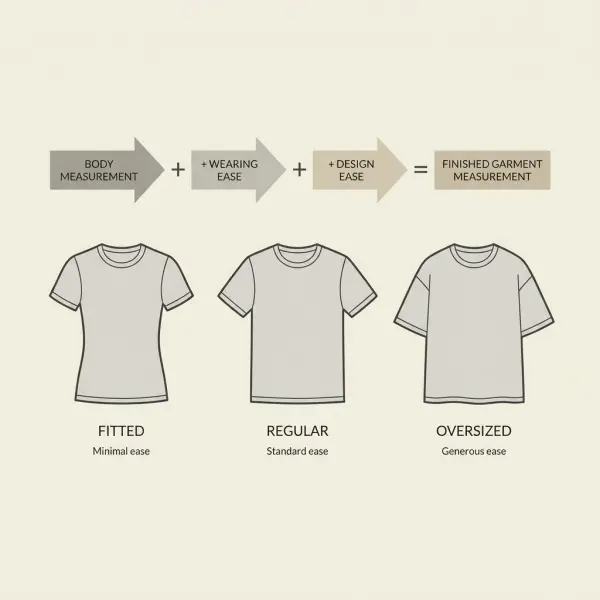
Three concepts should be considered together:
Wearing Ease
Wearing ease is the allowance that supports breathing, movement, sitting, bending, layering, and normal use. The required amount depends on the garment category, material, construction, and expected activity.
A woven work shirt and a highly elastic performance top do not need identical finished dimensions for the same body.
Design Ease
Design ease creates the intended silhouette beyond basic movement requirements. An oversized T-shirt, boxy jacket, flared dress, and slim tailored trouser each distribute volume differently.
Design ease is therefore an aesthetic and commercial decision, not simply an additional number added equally around the body.
Negative Ease
Negative ease occurs when a garment dimension is intentionally smaller than the corresponding body dimension. It is common in products made from stretch materials, including leggings, swimwear, compression products, and fitted knit tops.
Its success depends on stretch, recovery, fabric direction, construction, seam performance, comfort requirements, and the intended level of compression. A smaller garment is not automatically a better-fitting stretch garment.
The measurement system must be developed alongside fabric testing and fit evaluation. Dimensions copied from a stable woven style cannot safely be transferred to a highly extensible knit without considering how the material behaves.
For a broader discussion of how proportion, comfort, mobility, and appearance interact, see why good garment fit matters.
How Fabric and Construction Affect Finished Measurements
A pattern establishes the intended geometry, but the finished garment is also affected by the material and manufacturing process.
Fabric can relax, extend, shrink, distort, or recover differently depending on fiber composition, yarn structure, fabric construction, finishing, cutting direction, handling, pressing, washing, and drying. Knitted materials may relax after being removed from the cutting table. Bias-cut woven fabrics can lengthen or shift. Quilted, bonded, or heavily washed products may finish differently from their unprocessed components.
Construction also influences the final dimension. Seam type, seam allowance, binding, elastic application, gathering, pleating, interlining, padding, topstitching, and pressing can alter both measurement and shape.
For this reason, the approved pattern measurement should not be treated as automatic proof of the finished-garment measurement. The product must still be evaluated after assembly and, where relevant, after finishing or laundering.
ISO 5077 specifies a method for determining dimensional change in fabrics, garments, and other textile articles after specified washing and drying procedures. ISO 3759 addresses the preparation, marking, and measurement of specimens and garments used in dimensional-change testing. These standards concern controlled testing rather than routine production measurement, but they illustrate why the stage and condition in which a garment is measured must be documented. ISO method for determining dimensional change after washing and drying is particularly relevant when a product’s fit could change after home laundering.
A brand may need to distinguish among:
- Before-wash sample measurements.
- After-wash sample measurements.
- Relaxed measurements after a defined resting period.
- Measurements after pressing or finishing.
- Measurements after repeated performance testing.
The correct reference depends on how the product is manufactured, sold, and expected to perform.
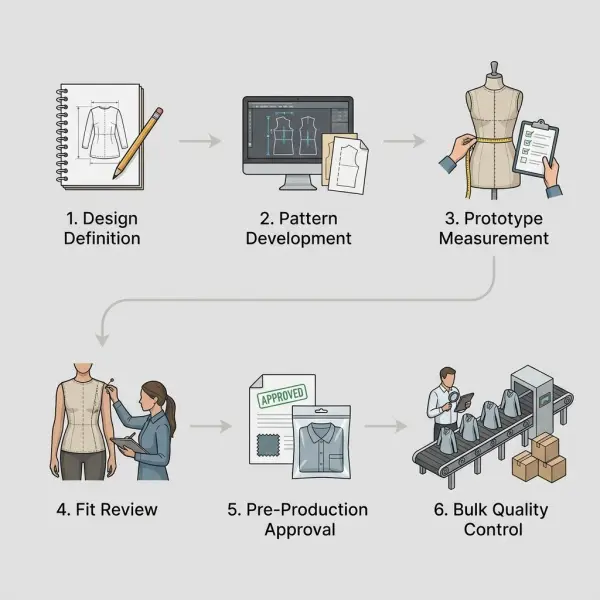
Where Garment Measurements Enter the Development Process
Garment measurement is not a single inspection performed at the end of production. It connects several stages of apparel development.
Initial Design and Technical Definition
At the beginning, the designer and technical team identify the dimensions that establish the silhouette. Existing approved styles, fit blocks, target-body data, competitive products, or design sketches may provide reference points.
The initial values are still working assumptions. They need to be tested through pattern development and fitting.
Pattern Development
The pattern maker converts the design and measurement requirements into pattern geometry. Pattern measurements include construction values that do not transfer directly to the finished product, so the relationship must be evaluated rather than assumed.
In digital pattern making, measurements may be stored as editable parameters, but software does not remove the need for fit judgment or physical validation.
Prototype and Fit Samples
The sample is measured before or alongside the fitting session. This helps the team separate two questions:
- Does the sample match the requested garment dimensions?
- Do those dimensions create the intended fit on the target body?
A sample can meet the specification and still fit poorly because the original specification was unsuitable. It can also fit acceptably by accident while failing several measurements, creating a risk that later samples or graded sizes will not reproduce the result.
Size-Set and Pre-Production Approval
After the base size is approved, selected additional sizes may be sampled to check grading and proportional balance. The pre-production sample then confirms that the factory can reproduce the approved design using the intended materials, trims, construction, and finishing process.
This stage is where measurement instructions should already be stable. Rewriting POM methods during bulk production creates unnecessary ambiguity.
In-Line and Final Quality Control
During production, garment measurements can be checked at selected points rather than waiting until every unit is finished. Final inspection compares sampled garments with the approved requirements and tolerances.
Quality inspection providers describe this as checking dimensions at defined measurement points against the brand’s specifications and acceptable tolerances. nspection should be integrated with workmanship and material evaluation. A garment can meet dimensional requirements while still containing twisted seams, puckering, poor alignment, damaged components, or unacceptable visual defects.
How Fashion Businesses Can Build a Reliable Measurement Process
A reliable system begins with standardization, not with collecting more numbers. For many brands, the first improvement is to make existing measurements easier to interpret and reproduce.
Establish a Company Measurement Manual
The manual should define standard POM names, codes, diagrams, garment positioning, measurement routes, and terminology. Product-specific instructions can then be added where the standard method does not apply.
Consistency is especially important when the business works with multiple factories. Each supplier may already use its own internal conventions. The brand needs to state which method governs approval.
Use a Controlled Base Size
The base size is normally the size in which the design, fit, and proportions are first established. It should represent the brand’s intended customer and fit strategy rather than being selected only because a supplier already has a convenient block.
Once the base size is approved, grade rules determine how measurements change across the size range. Grading deserves separate technical control because body dimensions do not increase uniformly and design proportions should not simply be enlarged by one percentage.
Identify Critical Measurements
Not every measurement creates equal risk. Critical POMs are the dimensions most likely to affect fit, function, visual balance, safety, or assembly.
For trousers, rise and hip measurements may deserve closer control than a minor decorative placement. For a close-fitting woven blouse, chest, waist, upper arm, and armhole relationships can be especially sensitive. For a long coat, front-back balance and sleeve position may be commercially important even when the chest is correct.
Prioritization allows teams to focus sample review and production inspection where deviations would matter most.
Maintain One Approved Source of Truth
Factories, pattern makers, quality inspectors, and internal teams should work from the same approved document revision. Measurement changes made during fitting must be updated in the specification rather than remaining only in an email, chat message, annotated photograph, or meeting note.
This is one of the central functions of a structured garment size specification sheet.
Train People Using Real Garments
A diagram may look clear until someone applies it to a garment with a curved seam, asymmetric panel, bulky trim, or elasticated section. Training should therefore include demonstrations using representative products.
Teams can compare measurements taken by several people, identify differences, and refine any method that still permits multiple interpretations.
What Brands Should Verify Before Using Garment Measurements
Measurement tables can create a false sense of precision. A value recorded to the nearest millimeter is not necessarily reliable if the method, product condition, or reference point remains unclear.
Before using garment measurement data for approval or production decisions, verify the following.
Is the Measurement Describing the Body or the Garment?
Clothing size designations are generally intended to communicate body dimensions, while finished-garment measurements incorporate allowances for style, movement, construction, and positioning. ISO 8559-2 explicitly distinguishes size designation based on body measurements from garment measurements selected by designers and manufacturers. ISO framework for primary and secondary clothing size dimensions should therefore not be interpreted as a universal finished-garment specification.
Was the Garment Prepared Consistently?
The garment may need to be fastened, smoothed, aligned, or allowed to relax before measurement. It should not be stretched unless the method specifically requires an extended measurement.
Pressing can temporarily change dimensions. Knit products may continue relaxing after production. Elasticated garments can produce different readings depending on how firmly the operator positions them.
Is the Unit of Measurement Clear?
Centimeters and inches must not be mixed. Conversions should follow an agreed rounding rule, particularly when a company develops in one unit and manufactures in another.
A small conversion difference repeated across multiple graded sizes can create confusion even when it does not materially affect fit.
Does the Tolerance Reflect the Measurement Risk?
A tolerance is an allowed deviation from the target garment measurement. It should consider construction difficulty, material behavior, measurement repeatability, product function, and fit sensitivity.
Using one universal tolerance for every POM may be easy administratively, but it is not always technically appropriate. A small collar measurement and a wide skirt sweep do not necessarily require the same control limit.
Is the Method Compatible With the Design?
Inherited measurement templates are useful only when they match the construction being evaluated. Raglan sleeves, wrap fronts, curved waistbands, asymmetric hems, gussets, panelled leggings, and convertible garments may require additional or modified POMs.
Standards create common ground, but product-specific agreement remains necessary.
Common Garment Measurement Mistakes
Measurement problems often originate in documentation and process design rather than in the act of reading the tape.
Naming a Measurement Without Defining the Method
Terms such as body length, hip, rise, or sleeve length may appear obvious. In practice, each can be measured through several legitimate routes.
The better approach is to pair the name with a diagram and short instruction. A new operator should be able to reproduce the method without asking the document’s author.
Reusing the Same POM List for Every Style
Templates save time, but indiscriminate reuse can hide product-specific risks. A standard trouser sheet may not control a dropped crotch, shaped waistband, articulated knee, or asymmetric pocket position.
Start with a category template, then remove irrelevant POMs and add dimensions that define the new design.
Measuring Against an Unstable Garment Condition
A freshly steamed knit, wet-finished denim garment, or stretched elastic waistband may not represent its stable condition. Approving it immediately can produce a misleading reference.
The measurement stage and conditioning method should be agreed before comparing results.
Correcting Measurements Without Rechecking Fit
Changing the number does not always solve the fit issue. Increasing chest width, for example, may add volume without correcting a tight upper back, restrictive armhole, poor sleeve pitch, or incorrect front balance.
Measurement changes should be linked to a fit diagnosis and pattern action.
Treating All Deviations as Factory Workmanship Problems
A factory can produce a garment outside specification because of cutting, sewing, pressing, finishing, or handling. But the original specification itself may also be unrealistic or internally inconsistent.
Before assigning responsibility, teams should verify the approved pattern, sample history, material behavior, measurement method, and revision status.
Ignoring Measurement Relationships
Individual POMs interact. Increasing armhole depth without reviewing sleeve shape can affect mobility and appearance. Changing front rise without balancing back rise and hip shape may alter the way trousers sit.
Good technical review looks at the measurement system, not only isolated rows.
A deeper diagnostic discussion appears in common garment measurement errors that cause fit and production problems.
The Business Impact of Better Measurement Control
Measurement discipline affects more than technical accuracy. It influences development speed, supplier communication, product consistency, costing, and customer expectations.
When methods are unclear, teams may repeat samples without understanding why the previous version failed. Factories may add contingency to quotations because the product is difficult to interpret. Quality inspectors may report discrepancies that the brand’s own team cannot reproduce. Customer service may receive fit complaints without enough technical data to trace the underlying product dimensions.
A stronger measurement process can help a business:
- Compare samples across suppliers and production periods.
- Preserve approved fit when a style is reordered.
- Diagnose whether a problem originates in specification, pattern, material, or manufacturing.
- Communicate fit changes more precisely.
- Build reusable blocks and product standards.
- Evaluate customer feedback against actual production data.
- Reduce avoidable interpretation disputes.
These benefits depend on execution. A detailed specification that is not updated, followed, or verified offers little protection.
For smaller fashion brands, the priority is usually not sophisticated software. It is establishing repeatable POM definitions, disciplined sample measurement, controlled revisions, and a clear approval record. Once those foundations are stable, product lifecycle management systems and digital fit tools can make the process more scalable.
Frequently Asked Questions
What is the difference between garment measurements and a clothing size chart?
Garment measurements describe the physical dimensions of the product, while a consumer-facing size chart usually communicates the body dimensions or general size guidance for the intended wearer. A size chart may say that a medium is designed for a particular chest range, but the finished garment chest will usually differ because it includes wearing ease, design volume, stretch, or compression. Brands should clearly label whether online measurements refer to the body or the actual garment. Mixing the two can confuse customers and make fit comparisons unreliable.
Should garment measurements be taken flat?
Many routine garment measurements are taken with the product laid flat because this method is practical and repeatable. It is not appropriate for every measurement, however. Some dimensions follow a curve, use a full circumference, require an extended elastic measurement, or depend on a defined three-dimensional position. The specification should state how the garment is arranged and whether a reported width is a flat half measurement or a complete circumference. “Measure flat” alone is not a complete method.
What does HPS mean in garment measurement?
HPS usually means high point shoulder, the upper shoulder-neck reference area commonly used for body length, neckline, and placement measurements. ISO 18890 refers to the comparable garment reference as the side neck point and notes that it is also known as HPS. The exact location should still be illustrated because collars, hoods, bindings, and unusual necklines can obscure the reference. Instructions should also state whether neck trim is included or excluded from the measurement.
How many points of measure should a garment have?
There is no universally correct number. The measurement list should be detailed enough to control fit, proportion, function, and key construction features without filling the specification with dimensions that do not support a decision. A basic jersey top may need a relatively compact list, while a tailored jacket, bra, technical garment, or asymmetric design may require many more POMs. Teams should prioritize critical measurements and add product-specific points wherever a generic category template leaves room for interpretation.
Are finished-garment measurements the same before and after washing?
Not necessarily. Washing and drying can change garment dimensions depending on the fiber, fabric construction, finishing, garment construction, and care procedure. Some products are designed and approved using post-wash measurements because washing is part of manufacturing. Others are checked both before and after laundering to evaluate dimensional stability. The technical documentation should identify which condition represents the production target and which method is used for performance testing. Results from different conditions should not be compared as though they were equivalent.
Can a garment pass all measurements and still fit badly?
Yes. Measurements are selected indicators of garment dimensions; they do not capture every aspect of three-dimensional fit. Balance, shaping, sleeve pitch, contour, fabric drape, posture, body shape, and distribution of ease can affect fit even when listed measurements are within tolerance. The specification itself may also be inappropriate for the intended wearer. Measurement checking should therefore support—not replace—fit evaluation on a suitable fit model, mannequin, or validated digital and physical process.
Who should approve garment measurements?
Approval usually requires coordination among the designer, technical designer or garment technician, pattern maker, and relevant production or quality personnel. The designer protects the intended silhouette, the technical team controls fit and documentation, the pattern maker confirms construction feasibility, and the supplier verifies production capability. The exact responsibility structure varies by company, but one authorized source should control the final specification revision. Informal changes from several people are a common source of contradictory instructions.
Do international standards replace a brand’s own measurement manual?
No. International standards provide common terminology and reference methods, but brands still need product-specific instructions. A standard cannot anticipate every proprietary fit block, trim construction, design feature, fabric behavior, or commercial requirement. The strongest approach is to align internal methods with recognized terminology where practical, then document any additional or modified POMs required by the product. Suppliers should be told clearly when the brand’s method differs from their normal internal practice.
Conclusion
Garment measurements are the operational bridge between a design idea and a repeatable apparel product. Their purpose is not simply to record chest, waist, sleeve, or length values. They define how fit and proportion will be communicated, tested, approved, produced, and inspected.
The most reliable systems distinguish body dimensions from garment and pattern measurements. They define every important point of measure, identify the condition in which the garment is evaluated, and connect numerical changes to fit, material behavior, and construction.
For fashion businesses, the strategic value lies in consistency. When the same measurement produces the same interpretation across designers, pattern makers, suppliers, and quality teams, product decisions become easier to trace. Samples can be evaluated with more precision. Reorders are less dependent on individual memory. Production deviations can be investigated rather tshan debated.
Measurements do not replace skilled pattern making or fit judgment. They make those decisions visible and transferable—which is exactly what apparel production requires.





Comments 0
Leave a CommentSend Comment
Anda harus Login terlebih dahulu untuk dapat memberikan komentar.