

Garment Lining Explained: Function, Comfort, and Finish
A garment can look beautifully constructed from the outside while telling a different story on the inside. A tailored blazer may have a clean silhouette, yet exposed seams and rough interior fabrics can make it uncomfortable to wear. A dress may drape elegantly on a hanger but cling to the body during movement. In both cases, the lining can make a significant difference to how the garment feels, moves, and performs.
Garment lining is often associated with premium tailoring, but its purpose extends beyond creating a polished interior. It can reduce friction, conceal construction details, protect certain fabric surfaces, improve opacity, and help garments move more comfortably over the body or other clothing.
For fashion designers, product developers, and apparel manufacturers, lining is therefore a functional construction decision. Choosing the right lining involves understanding the outer fabric, intended use, garment silhouette, wearer expectations, and production requirements.
Quick Answer: What Is Garment Lining and Why Is It Used?
Garment lining is an inner layer of fabric attached to a garment to improve comfort, conceal construction details, protect interior surfaces, and create a clean finish. It is generally constructed separately from the outer garment and joined at selected edges, such as the neckline, front opening, waistband, armhole, or hem, depending on the design.
Lining is commonly used in jackets, coats, dresses, skirts, tailored trousers, and other garments where a smooth interior contributes to wearability and appearance.
Its main functions include reducing friction between clothing layers, covering seam allowances and internal reinforcements, providing additional opacity, and limiting direct contact between the wearer and potentially irritating outer fabrics.
However, lining does not automatically make a garment more comfortable or durable. Its performance depends on fiber composition, fabric weight, surface texture, breathability, pattern engineering, and compatibility with the outer fabric. A poorly selected or incorrectly constructed lining can restrict movement, trap unwanted heat, or interfere with the intended silhouette.
For fashion businesses, effective lining construction means matching the inner fabric to the garment's actual performance requirements rather than treating it as an optional decorative finish.
What Is Garment Lining in Clothing Construction?
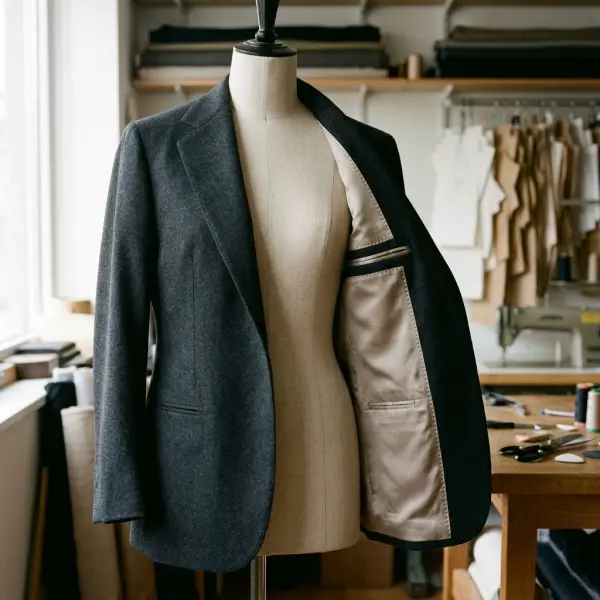
In garment construction, lining refers to a separate fabric layer positioned inside the outer shell of clothing. It generally follows the shape of the garment but is engineered with the necessary allowances and attachment methods to preserve movement and avoid distorting the exterior.
The outer shell provides the main visible appearance of the garment. The lining creates a secondary surface that interacts with the wearer's body, undergarments, or other clothing layers. Although the lining is mostly hidden during wear, its texture and construction can influence the overall wearing experience.
A wool blazer offers a practical example. Its outer fabric establishes the jacket's appearance, while interfacing or other internal support materials help maintain the intended shape. A smooth lining covers much of this internal construction, allowing the jacket to slide over a shirt and providing a finished interior when the garment is opened or removed.
This distinction is important because lining is not responsible for creating all aspects of a garment's structure. According to New Mexico State University's garment construction guidance, lining primarily provides an interior finish and helps preserve the garment's established silhouette, while interfacing and underlining perform different structural functions.
Lining vs Underlining, Interlining, and Interfacing
These construction terms are sometimes used interchangeably in everyday conversation, but they describe different layers and functions.
|
Construction element |
Primary purpose |
Typical application |
|
Lining |
Comfort, interior finishing, concealment, and reduced friction |
Interior of blazers, coats, skirts, and dresses |
|
Underlining |
Supports the outer fabric and can improve stability or opacity |
Delicate fabrics, lightweight dresses, tailored garments |
|
Interfacing |
Reinforces selected garment areas and helps maintain shape |
Collars, cuffs, waistbands, lapels, and closures |
|
Interlining |
Adds insulation or other internal support, depending on garment construction and industry terminology |
Insulated coats and selected tailored constructions |
|
Facing |
Finishes and may support garment openings and edges |
Necklines, front openings, and armholes |
The distinction becomes especially relevant during product development. Adding lining to a soft jacket will not necessarily create the crisp lapels or structured chest associated with traditional tailoring. Those characteristics depend primarily on the pattern, shell fabric, interfacing, canvas, and other construction techniques.
Similarly, a lightweight dress that requires greater opacity may need a lining, underlining, or another suitable inner layer, depending on whether the goal is to conceal the body, stabilize the outer fabric, or preserve its drape.
The Main Functions of Garment Lining
Lining contributes to several aspects of garment performance, but its value differs according to product category. In a tailored coat, ease of dressing and interior finishing may be priorities. In a lightweight dress, opacity and comfort against the skin may matter more. Understanding these functions helps designers identify where lining is genuinely useful.
1. Improving Comfort and Reducing Friction
One of the most practical functions of garment lining is to reduce unwanted friction between the outer garment and the surfaces beneath it. A smooth lining allows a jacket sleeve to slide more easily over a shirt and can help a skirt move over tights without catching as readily.
This is particularly relevant to garments made from textured wool, certain crepes, or other materials with relatively rough interior surfaces. The lining acts as a barrier between the outer fabric and the skin, potentially reducing irritation without requiring the designer to change the visible material.
Comfort, however, involves more than smoothness. A lining that feels silky to the touch may still be uncomfortable in hot or humid conditions if the finished fabric and garment construction restrict heat or moisture transfer. Designers therefore need to consider thermal comfort, air permeability, moisture management, and the amount of fabric covering the body.
For example, a tropical-market blazer may benefit from a lightweight, suitable lining and a less extensive coverage design, while a cold-weather coat may prioritize warmth and smooth layering over maximum airflow.
2. Concealing Seams and Internal Construction
Garments often contain seam allowances, darts, pocket bags, interfacing, reinforcement materials, and other components that are necessary for construction but not intended to remain visible.
Lining covers these elements and creates a more uniform interior appearance. This is especially valuable in tailored garments, where the internal construction can be more complex than in a basic T-shirt or casual shirt.
A clean lining also affects how customers perceive the product during inspection. When a shopper opens a blazer or examines the inside of a skirt, visible finishing details can reinforce the impression of careful manufacturing.
However, lining should not be used to conceal defective stitching, inadequate reinforcement, or poorly secured components. These remain quality issues even when hidden from view.
3. Protecting Garment Materials From Wear
Lining can protect parts of the garment's interior by reducing direct contact between the outer fabric and the wearer's body or clothing. This may limit certain forms of abrasion and help reduce the transfer of body oils and soil to the outer shell.
For a wool suit jacket, a suitable lining separates much of the inner wool surface from shirts and skin. In a skirt, lining can reduce friction between the outer fabric and the garments worn underneath, although the extent of protection depends on coverage and fit.
This does not mean that lining guarantees a longer garment lifespan. Lining itself is subject to abrasion, perspiration, seam stress, and laundering. If the lining fabric is weaker than the surrounding construction, it may become the first component requiring repair or replacement.
Durability therefore depends on the performance of the complete garment system, not simply the presence of an additional fabric layer.
4. Supporting a Clean Silhouette and Natural Drape
A well-engineered lining can help a garment hang more consistently by reducing friction and interference between its inner and outer layers. It may also help protect the garment's established shape during wear.
Consider a straight wool skirt. Without a suitable lining, the textured fabric may catch against tights, causing the skirt to ride upward or move unevenly. A smoother interior can reduce that interference and allow the outer fabric to fall more naturally.
The relationship between lining and drape is nevertheless sensitive to fabric characteristics. A lining that is too stiff, heavy, or poorly shaped may introduce unwanted bulk or tension. The desired result is not necessarily a more structured garment, but one whose layers work together without compromising the intended silhouette.
5. Adding Opacity and Visual Coverage
Lining can provide coverage beneath fabrics that are lightly woven, pale-colored, or partially transparent. This function is common in dresses, skirts, and occasionwear, where the designer may want the visual character of a lightweight outer fabric without excessive transparency.
The lining color also matters. A tonal lining may maintain the intended appearance of the outer fabric, while a contrasting lining can subtly change the way a translucent material looks.
More lining is not always the solution. Some garments require localized coverage rather than another fabric layer across the entire design. The appropriate approach depends on the degree of transparency, desired movement, neckline construction, and wearer expectations.
Common Lining Fabrics and Their Characteristics
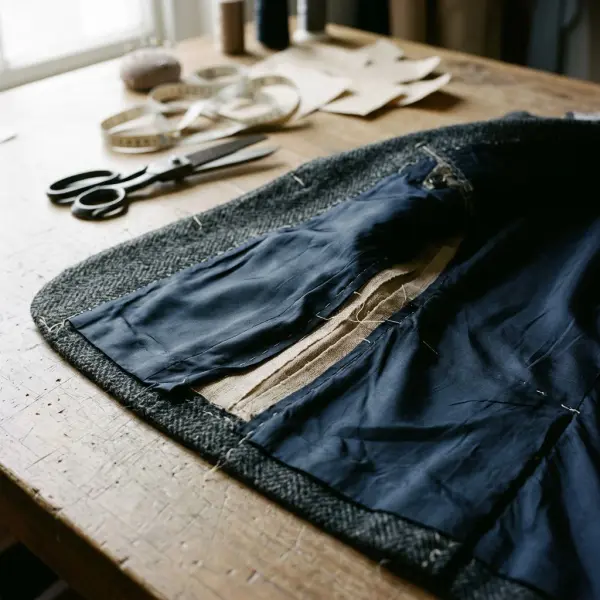
Garment lining is not a single textile category defined by one fiber or weave. Manufacturers use different woven and knitted fabrics as linings, selecting them according to surface smoothness, weight, flexibility, durability, and the intended garment.
A traditional tailored jacket may use a smooth woven lining with a satin or twill structure, while a fitted stretch dress may require a lightweight knitted lining that can follow the movement of the outer fabric.
The fabric's actual properties matter more than its name. Two polyester linings, for example, may behave differently because of differences in yarn construction, weave, weight, finishing, and stretch.
Common Materials Used for Garment Lining
|
Lining material |
Typical characteristics |
Common considerations |
|
Polyester |
Available in many weights and smooth finishes; generally economical and practical |
Moisture comfort, static, heat sensitivity, and fabric construction |
|
Viscose (rayon) |
Often soft, fluid, and comfortable against the skin |
Shrinkage, wet strength, care requirements, and dimensional stability |
|
Cupro |
Regenerated cellulose lining often valued for smoothness and drape |
Supplier availability, cost, finishing, and care compatibility |
|
Acetate |
Traditionally used for lightweight, smooth linings |
Heat sensitivity, durability, moisture exposure, and cleaning requirements |
|
Silk |
Soft, lightweight, and suitable for selected premium garments |
Higher material cost, abrasion resistance, and care |
|
Cotton lawn or voile |
Soft, lightweight woven options often suited to casual and summer garments |
Generally less slippery than smooth filament-based linings |
|
Stretch tricot or jersey |
Flexible knitted lining that can accommodate garment stretch |
Stretch direction, recovery, weight, and compatibility with the outer fabric |
The selection should reflect the garment's construction and intended use. A smooth woven lining may work well inside a tailored wool blazer, but the same fabric could restrict movement in a stretch dress if its extensibility is insufficient.
For lightweight summer clothing, cotton or selected regenerated cellulose fabrics may offer desirable comfort characteristics, although performance must be evaluated at the finished-fabric level. The fiber name alone does not establish breathability, moisture management, or wearer comfort.
Why Fabric Weight and Surface Texture Matter
Lining fabric should generally be sufficiently lightweight and pliable to avoid overwhelming the outer shell. Its surface texture should also support the intended movement between fabric layers.
A stiff lining inside a soft crepe dress may alter the drape that made the outer fabric attractive. Conversely, a very delicate lining inside a frequently worn work jacket could be vulnerable to abrasion and seam stress.
Fashion brands should evaluate lining and shell fabrics together rather than approving them independently. Material compatibility often determines whether the finished garment performs as intended.
How Garment Lining Is Constructed
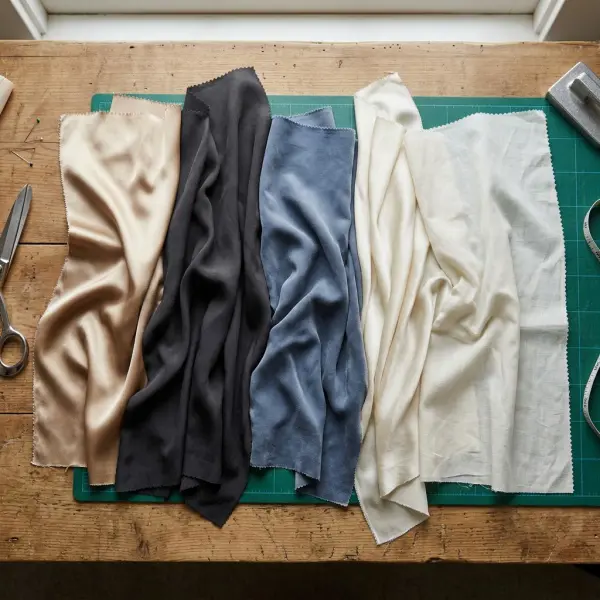
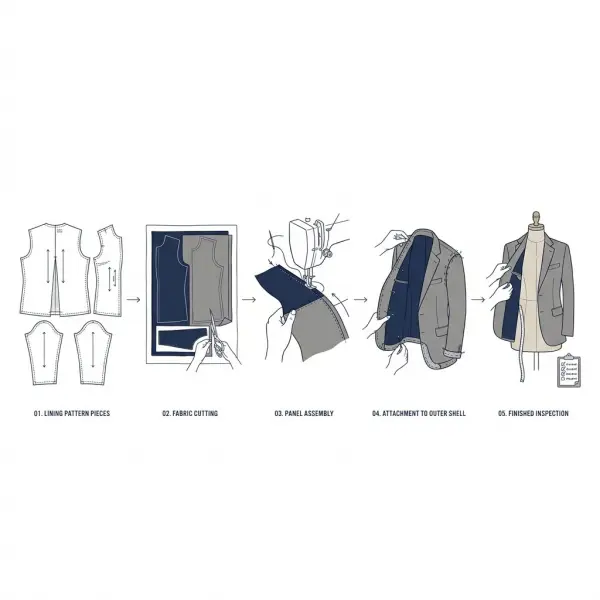
Garment lining is generally constructed as a separate inner assembly and then attached to the outer garment at designated points. Although specific sewing techniques vary by garment type, production method, and design complexity, the underlying principle is consistent: the lining must fit within the garment without restricting its intended shape or movement.
The lining pattern is therefore not always an exact duplicate of the outer shell pattern. Adjustments may be required for facings, hems, seam allowances, and movement ease.
Step 1: Determine the Lining Requirements
Before pattern development begins, the design team should establish what the lining needs to accomplish. A tailored coat may require extensive interior coverage, while a lightweight skirt may need lining primarily for opacity and reduced friction.
Designers should consider the outer material, silhouette, intended wearing conditions, cleaning method, and manufacturing complexity. Defining these requirements early helps prevent unnecessary sampling revisions.
Step 2: Develop the Lining Pattern
The lining pattern is usually derived from the garment pattern, with modifications appropriate to the construction.
For a tailored jacket, the pattern may account for front facings, neckline construction, sleeve attachments, and additional movement ease. A center-back ease pleat is one technique used in certain jackets and coats to accommodate arm and shoulder movement.
The relationship between the inner and outer patterns requires careful engineering. Some lining edges are positioned inside the outer garment's finished edges, while functional ease is introduced in selected areas.
Published research in Fashion and Textiles, based on interviews with patternmakers from 13 South Korean menswear brands, identified trouser style and outer-shell stretch as relevant considerations in lining pattern development. The findings illustrate the need for garment-specific pattern decisions rather than a universal lining template, although the study is not a global manufacturing benchmark.
Step 3: Cut and Assemble the Lining
Once the lining pattern has been approved, fabric is cut according to the specified grain direction, pattern markings, and construction requirements.
Lining panels are assembled using appropriate seams and stitching methods. The sewing team must maintain dimensional accuracy because small inconsistencies can affect the relationship between the lining and the outer garment.
Unlike many exposed garment seams, lining seam allowances are often concealed when the garment is completed. Nevertheless, their construction must remain secure and appropriate for the selected material.
Step 4: Attach the Lining to the Outer Garment
The lining is joined to the shell at designated attachment points. These may include the neckline, facings, front openings, waist, sleeve openings, and hem.
Some garments use machine-based bagging methods, in which the lining and shell are sewn together and turned to the finished side. Other garments use combinations of machine sewing and hand finishing.
A lining may be secured along the hem or allowed to hang separately, depending on the design. Where an attached hem is used, a fold of additional lining fabric, often called a jump pleat or ease pleat, can help accommodate movement.
As explained in Threads magazine's technical guide to lining hem pleats, this additional ease can allow the lining to respond when the wearer sits or bends an arm without pulling excessively against the outer garment.
Step 5: Press, Inspect, and Test the Finished Garment
After construction, the garment undergoes pressing and inspection to confirm that the layers lie correctly and the lining does not distort the outer silhouette.
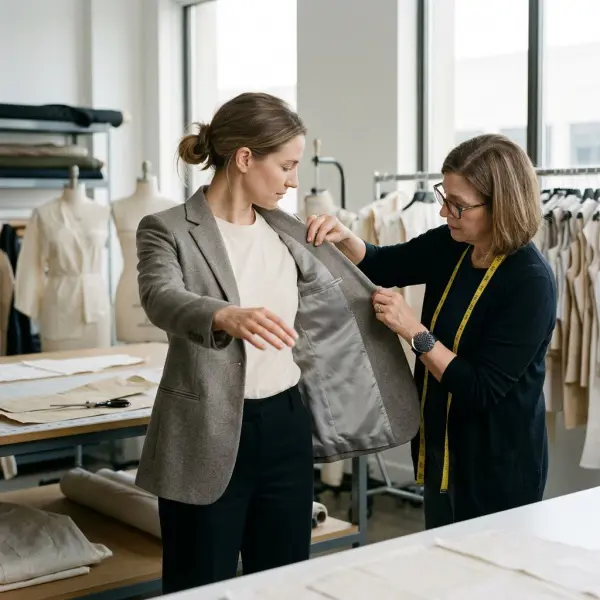
Inspection should assess more than visual neatness. A lining may appear satisfactory when the garment is displayed on a hanger but create discomfort when the wearer sits, reaches forward, or walks.
Functional fitting and appropriate care testing are therefore important parts of production approval.
How Lining Influences Fit, Movement, and Garment Appearance
Fit is usually associated with pattern measurements and the shape of the outer garment. However, the relationship between the lining and shell can influence how that fit behaves during actual wear.
A jacket may have sufficient room across the back, but a tight lining can restrict the wearer's ability to reach forward. A dress may be appropriately shaped at the hips, yet an overly narrow lining can create tension when sitting.
These issues demonstrate why garment fit cannot be evaluated by the outer shell alone.
Movement Ease Must Be Designed Into the Inner Layer
Movement ease refers to the additional allowance needed for comfortable body movement. In lined garments, the inner layer must accommodate the movement expected from the overall design.
For example, the lining of a fitted jacket may require appropriate ease at the back, shoulders, and sleeves. The lining inside a skirt needs sufficient room to accommodate walking and sitting without producing excessive tension.
The exact allowance depends on the garment category, fabric properties, construction method, and target fit. Applying a universal allowance to every lined garment would be technically unreliable.
Drape Depends on the Interaction Between Fabrics
Lining affects drape through its weight, flexibility, surface friction, and attachment to the outer garment.
A lightweight lining can allow a structured skirt to fall more smoothly over the body. In contrast, a bulky or rigid lining may interfere with the fluid movement of a soft dress.
This relationship becomes particularly relevant when developing garments made from crepe fabric and other fluid materials, where the outer textile's drape is a central design characteristic.
The most suitable lining is not necessarily the smoothest or lightest available fabric. It is the one that produces the intended result when combined with the shell.
The Business Value of Lining in Fashion Product Development
Lining decisions affect more than the sewing process. They influence material sourcing, garment costing, product positioning, manufacturing lead time, and customer expectations.
For fashion businesses, the key question is whether the functional and perceived benefits of lining justify the additional construction requirements.
Product Quality and Customer Experience
A lined garment can provide a more finished wearing experience, particularly when the outer fabric would otherwise feel rough, cling, or expose complex interior construction.
Customers may notice lining during fitting, dressing, and product inspection. A blazer that slides comfortably over a shirt and feels neat inside communicates a different experience from one whose interior repeatedly catches on clothing.
However, lining is not an independent measure of quality. A well-constructed unlined jacket may be more suitable for lightweight summer wear than a poorly ventilated lined alternative.
Quality should be assessed against the garment's intended purpose.
Production Cost and Material Consumption
Adding lining introduces another material into the garment's bill of materials and may require additional patternmaking, cutting, sewing, pressing, and inspection.
The cost impact depends on the fabric selected, coverage area, pattern complexity, labor requirements, and production method.
For example, a tailored jacket with extensive lining coverage may require more fabric and assembly operations than an unlined version. Yet lining may reduce the need for some elaborate interior seam finishes, partially offsetting the additional work.
A reliable cost comparison should therefore evaluate the complete manufacturing process, not simply the price per meter of lining fabric.
Product Positioning and Retail Communication
In premium tailoring and occasionwear, lining can contribute to perceived refinement, particularly when the fabric, color, stitching, and construction complement the garment.
A brand may use a tonal lining for understated consistency or select a contrasting interior fabric as a recognizable design detail.
But lining should not be marketed as evidence of superior comfort without considering the actual material and garment performance. A product description that explains smooth interior finishing or comfortable layering is more useful than a broad claim that the garment is automatically more luxurious or breathable.
How Fashion Brands Can Make Better Lining Decisions
Lining should be specified during product development rather than treated as a last-minute addition after the outer garment has been approved.
For an apparel business developing multiple styles, a consistent lining evaluation process can reduce ambiguity between design, sourcing, technical development, and manufacturing teams.
A practical workflow should address the following priorities:
- Define the intended function. Determine whether the lining is primarily required for comfort, opacity, reduced friction, interior finishing, or a combination of these needs.
- Evaluate fabric compatibility. Compare weight, drape, stretch, recovery, colorfastness, dimensional stability, and care requirements between the lining and outer shell.
- Review the lining pattern independently. Confirm that facings, hems, movement allowances, and attachment points are appropriate to the garment.
- Test the complete garment. Evaluate appearance and comfort during realistic movements, not only static fitting.
- Confirm manufacturing consistency. Include lining material specifications, construction details, and inspection criteria in the approved technical package.
These steps are especially useful when the same style will be produced across multiple sizes or by different manufacturing partners. A sample that looks satisfactory in one size may reveal lining tension or proportion issues elsewhere in the size range.
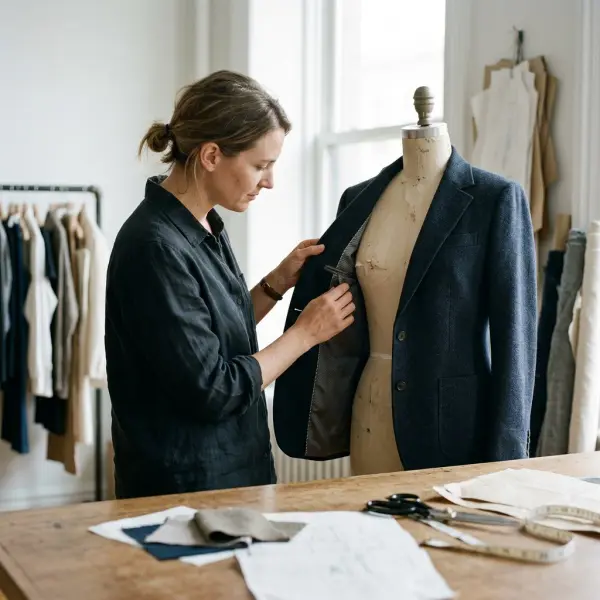
A Practical Example: Developing a Lightweight Tailored Blazer
Consider a fashion brand designing a lightweight blazer for office wear in a warm climate.
The outer fabric provides the desired professional appearance, but the brand must decide whether additional interior fabric is necessary to improve comfort and finishing. A fully lined construction might create a polished interior, yet it could also increase heat retention or material consumption depending on the lining fabric and design.
The technical team should first examine where the outer fabric creates friction or exposes construction details. It can then evaluate several lining options through samples, taking into account comfort, visual quality, and manufacturing cost.
A complete discussion of coverage choices belongs to full lining versus partial lining in garment construction. The broader principle is that lining coverage should follow the garment's functional requirements rather than a fixed assumption about premium construction.
Common Mistakes When Selecting and Constructing Garment Lining
Many lining-related quality issues begin before the sewing stage. Fabric selection, pattern assumptions, and unclear technical specifications can produce problems that become visible only during fitting or repeated wear.
Choosing a Lining Based Only on Price
Selecting the least expensive available lining may reduce the initial material cost, but the decision can create problems if the fabric lacks adequate durability, smoothness, or dimensional stability.
For example, a frequently worn jacket requires a lining capable of tolerating regular friction and movement. Brands should compare the total cost and expected performance rather than judging options solely by the supplier's quoted fabric price.
Ignoring Stretch Compatibility
A stretch garment can become restrictive when paired with a lining that cannot accommodate similar movement.
This problem may occur when a non-stretch woven lining is selected for a fitted knitted garment without appropriate pattern adjustments. The better approach is to evaluate stretch and recovery in the intended directions and verify the complete garment through fitting.
Treating the Lining Pattern as an Exact Copy
Using the outer shell pattern without considering facings, hem relationships, and movement allowances can lead to construction difficulties.
Although lining pieces are commonly derived from the shell pattern, they often require specific adjustments. Technical teams should establish those changes during pattern development rather than relying on sewing operators to compensate during assembly.
Overlooking Care Compatibility
Two fabrics may perform well together during the first fitting but react differently after washing or professional cleaning.
If the lining and outer shell experience substantially different dimensional changes, the finished garment may develop distortion or tension. Testing should therefore reflect the intended cleaning procedure before production approval.
For more detailed troubleshooting, the related article common lining problems affecting fit, movement, and durability examines how these issues appear in finished garments.
Important Technical and Sustainability Considerations
Lining introduces additional material and construction complexity, so its effects should be assessed across the garment's intended life rather than only at the sampling stage.
The first consideration is compatibility. The lining and shell may have different fiber compositions, but they still need to work together in terms of movement, maintenance, and expected service life. Testing for abrasion, seam performance, dimensional change, and color transfer may be relevant depending on the product.
The second consideration is comfort. A smooth fabric does not necessarily provide adequate thermal or moisture comfort in every climate. The complete garment's fit, ventilation, coverage, and textile structure influence the wearing experience.
The third consideration is end-of-life processing. A garment combining several fiber types may be more difficult to separate and process for some textile recycling systems, particularly when materials are tightly integrated.
Research on garment composition and textile recycling has identified linings and other secondary textile layers as potential complications for sorting and material recovery. The European Environment Agency's guidance on textile design and circularity also emphasizes material identification and construction choices that support practical recycling processes.
This does not mean every lined garment is environmentally inferior to an unlined alternative. A lining that improves comfort, maintainability, or service life may provide functional value, while additional materials and construction create their own impacts. The appropriate assessment depends on product use, durability, fiber composition, repairability, and available recovery systems.
Frequently Asked Questions About Garment Lining
1. Does Every Garment Need a Lining?
No. Lining is useful when it provides a clear functional or aesthetic benefit, but it is not required for every garment.
Basic T-shirts, casual shirts, many lightweight trousers, and some summer jackets are designed to function without conventional lining. These garments may use overlocked seams, bound edges, facings, or other finishing techniques.
Whether lining is appropriate depends on the outer fabric, intended use, garment structure, and customer expectations. Adding lining unnecessarily can increase material consumption, production complexity, and heat retention. A carefully finished unlined garment can be entirely appropriate when the design prioritizes lightness, ventilation, or a relaxed construction.
2. Does Lining Make Clothing More Comfortable?
Lining can improve comfort by reducing friction, covering rough interior surfaces, and helping garments slide over other clothing. However, comfort depends on the combination of lining material, outer fabric, garment fit, and wearing conditions.
A smooth lining may make a wool blazer easier to put on over a shirt. The same construction could feel less comfortable in hot weather if the fabric combination limits heat and moisture transfer.
Manufacturers should evaluate comfort through actual wear testing rather than relying on fabric handfeel alone. Movement, humidity, skin contact, and the intended layering system all influence whether lining improves the overall wearing experience.
3. What Is the Difference Between Lining and Interlining?
Lining generally forms the inner finishing layer of a garment, while interlining is an additional internal material used for insulation or support, depending on the garment category and technical terminology.
In a winter coat, an insulating interlining may sit between the outer shell and the inner lining. The interlining contributes to warmth, while the lining creates a finished interior and supports comfortable dressing.
In tailored apparel, the term interlining can also refer to internal structural support materials. Because terminology varies across manufacturers and product categories, technical specifications should describe both the material and its intended function rather than relying exclusively on the component name.
4. Which Lining Fabric Is Best for a Tailored Jacket?
There is no single lining fabric that is best for every tailored jacket. Polyester, viscose, cupro, acetate, and silk-based fabrics may all be suitable under different design and manufacturing conditions.
A brand developing an affordable everyday blazer may prioritize abrasion resistance, consistency, and care compatibility. A premium tailored garment may place greater emphasis on drape, handfeel, and the desired interior appearance.
The selected lining should work with the shell's weight and structure while providing appropriate smoothness and movement ease. Before approval, brands should compare fabric samples, confirm the intended care method, and test complete jacket prototypes.
5. Can Lining Improve the Durability of a Garment?
Lining can help reduce certain forms of interior abrasion and shield parts of the outer fabric from direct contact with the body or other garments. This may contribute to durability in some applications.
Nevertheless, adding lining does not automatically extend garment life. A low-quality lining can tear, abrade, or separate from its seams, creating maintenance problems even when the outer fabric remains serviceable.
Durability depends on the relationship between material quality, seam construction, fit, care, and frequency of use. For products intended for extended wear, manufacturers should evaluate lining durability as part of the complete garment rather than treating it as a secondary quality requirement.
6. How Should Fashion Brands Specify Lining in a Tech Pack?
A garment tech pack should identify the lining material, fiber composition, color, applicable fabric properties, placement, construction method, and quality expectations.
Where relevant, it should also document lining pattern references, movement allowances, attachment details, hem treatment, and care compatibility with the outer shell.
For a tailored blazer, technical drawings can clarify which interior areas receive lining and how the lining connects to facings and sleeve openings. Approved physical samples or construction photographs can reduce interpretation differences between the brand and manufacturer.
The objective is to translate design intent into repeatable instructions that sourcing, patternmaking, cutting, sewing, and quality-control teams can consistently follow.
Conclusion: Lining Is a Construction Choice With Lasting Consequences
Garment lining may be hidden during normal wear, but it can influence some of the most noticeable qualities of clothing: how easily a garment moves over the body, how comfortable it feels, how its interior is finished, and whether the layers work together as intended.
The effectiveness of lining depends on the relationship between material selection and garment engineering. Smoothness, fabric weight, dimensional stability, movement ease, and the chosen attachment method all contribute to the finished result.
For fashion businesses, the most valuable approach is to treat lining as part of the original product specification. When its function is defined early, designers and manufacturers can make more informed decisions about fabric selection, pattern development, production cost, and quality assurance.
A good lining should complement the garment rather than compete with its construction. The result is not simply a cleaner interior, but clothing whose appearance and performance remain consistent with its intended purpose.




Comments 0
Leave a CommentSend Comment
Anda harus Login terlebih dahulu untuk dapat memberikan komentar.