
Private Label vs Reseller Fashion Business: Key Differences
Private label and reseller businesses offer two different ways to participate in fashion retail without operating a garment factory. Both allow entrepreneurs to sell clothing through online stores, marketplaces, boutiques, or other retail channels, but they differ in who controls the product, how inventory is sourced, where commercial risks arise, and what kind of business the retailer is trying to build.
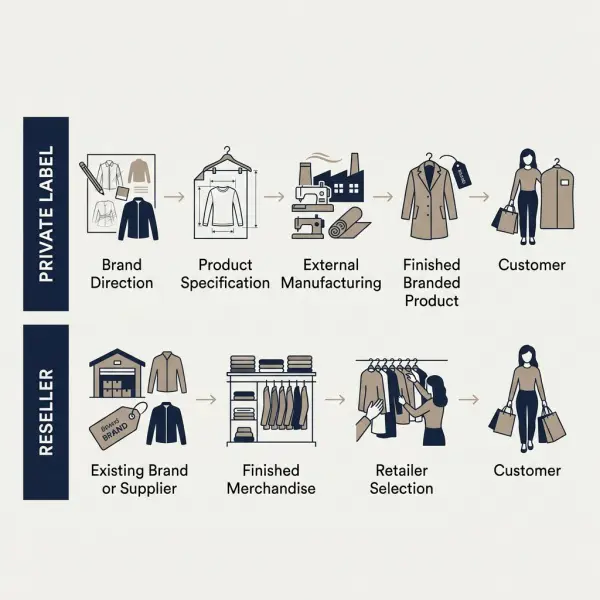
A private label fashion business sells products under its own brand, typically working with external manufacturers or suppliers to develop or customize merchandise. A reseller fashion business purchases existing products from brands, wholesalers, distributors, retailers, or other sources and sells them to customers, generally without directing the original manufacturing process.
The difference affects much more than the label attached to a garment. Private label operators may need to manage specifications, sampling, production minimums, quality standards, and brand development. Resellers concentrate more heavily on merchandise selection, purchasing, inventory turnover, supplier relationships, pricing, and retail execution.
Neither model is automatically more profitable or commercially superior. Private label can provide greater product control and opportunities for differentiation, but it often requires more development work and earlier inventory commitments. Reselling can offer a more flexible route to market, although competition, supplier availability, and limited control over the underlying product can constrain the business.
Understanding these trade-offs helps fashion entrepreneurs choose a model that fits their available capital, customer knowledge, operational capabilities, and long-term objectives.
Quick Answer: What Is the Difference Between Private Label and Reseller Fashion?
The main difference between private label and reseller fashion is who develops and brands the merchandise being sold.
In a private label business, a retailer or entrepreneur sells garments under its own brand using products manufactured by an external supplier. The business may customize existing products or commission more extensively developed apparel, depending on supplier capabilities and contractual arrangements.
In a reseller business, the retailer acquires existing merchandise for resale rather than commissioning its original development. Products may come from fashion brands, wholesalers, distributors, liquidation channels, or secondhand markets. In conventional branded resale, the original brand identity remains attached to the merchandise.
Private label generally offers more influence over product specifications and brand positioning, while reselling often requires less product-development work and can support faster inventory acquisition. However, either model can involve substantial inventory costs, supplier dependencies, and retail risks.
For entrepreneurs, the practical decision is whether they want to concentrate primarily on building differentiated branded products or on selecting, sourcing, and selling merchandise that already exists.

Understanding the Two Fashion Business Models
What Is a Private Label Fashion Business?
A private label fashion business sells clothing or accessories under a brand controlled by the retailer or entrepreneur, while an external manufacturer produces the goods.
The model can operate at different levels of customization. Some businesses select established garments from a manufacturer's product range and add their own labels, colors, or packaging. Others provide original designs, technical specifications, measurements, fabrics, trims, and construction requirements.
The common feature is that the customer-facing merchandise is sold under the private label business's brand rather than the manufacturer's own consumer brand.
This separation allows entrepreneurs to develop branded fashion products without investing in production facilities. However, the business still needs to manage relevant decisions involving product development, manufacturing orders, quality expectations, inventory, pricing, and sales.
The broader operating structure is explained in Private Label Fashion Explained for Retailers and Entrepreneurs.
What Is a Reseller Fashion Business?
A reseller fashion business acquires existing garments or accessories and sells them to other buyers without necessarily participating in their original design or manufacture.
In a conventional boutique, this might involve purchasing finished clothing from established fashion brands or wholesale suppliers and reselling it through a physical store or ecommerce website. Other resale businesses specialize in discounted stock, liquidation merchandise, vintage garments, secondhand clothing, or limited-availability products.
The Shopify guide to starting a resale business describes several resale models, including wholesale purchasing, retail arbitrage, secondhand merchandise, and liquidation sourcing.
The essential commercial activity is acquiring merchandise and finding customers willing to buy it at prices that support a viable business.
Resellers may still build strong retail identities through curation, customer service, styling expertise, community relationships, convenience, or specialization. However, their identity as a retailer is distinct from ownership of the brands whose products they sell.
Why These Terms Are Sometimes Confused
The terminology becomes less clear when businesses operate between the two models.
For example, a retailer might purchase unbranded wholesale T-shirts and add its own printed designs. If those garments are sold under the retailer's brand, the arrangement may be described as private labeling, product customization, or branded merchandise, depending on how the products are sourced and developed.
Similarly, a business that primarily resells third-party brands might introduce a small private label collection alongside its existing assortment.
It is therefore more accurate to treat private label and reselling as different approaches to product ownership, brand positioning, and sourcing rather than as rigid categories that cannot coexist.
The terms also should not be confused with wholesale and dropshipping. Wholesale describes a business-to-business purchasing or selling arrangement, while dropshipping describes an order-fulfillment method in which a supplier ships products directly to customers. Either concept can overlap with different product and branding models.
Private Label vs Reseller Fashion: Side-by-Side Comparison
The following table summarizes the typical operational differences between the two models. Actual arrangements may vary according to product category, sourcing channel, supplier contract, order size, and market positioning.
|
Business factor |
Private label fashion |
Reseller fashion |
|
Brand ownership |
Sells products under its own brand |
Usually sells existing third-party brands or merchandise |
|
Product development |
May influence specifications, design, fit, fabrics, or trims |
Generally selects already-developed products |
|
Manufacturing |
Outsourced to a manufacturing partner |
Completed before sourcing or acquisition |
|
Product customization |
Possible, depending on supplier capability |
Usually limited; post-purchase customization may be possible |
|
Starting investment |
May require sampling, development, and production commitments |
Can be lower with flexible sourcing, but bulk buying may still require significant capital |
|
Minimum order quantity |
Often affected by factory and material minimums |
Depends on wholesalers, brands, distributors, or individual sellers |
|
Time to market |
May include sampling and production lead times |
Often faster when finished inventory is available |
|
Pricing control |
Sets pricing for its own products, subject to market conditions |
Sets or negotiates resale pricing within applicable legal and contractual constraints |
|
Product differentiation |
Can be developed through product features and brand positioning |
Often depends on assortment, curation, service, availability, or retail experience |
|
Inventory risk |
Includes risks from customized or branded inventory |
Includes risks from unsold purchased merchandise |
|
Quality influence |
Can specify requirements and approve production |
Usually evaluates finished goods and supplier quality |
|
Supplier dependence |
Relies on manufacturing capacity and consistency |
Relies on inventory availability, sourcing terms, and supplier relationships |
|
Replenishment |
May require new manufacturing orders |
May reorder existing products if suppliers have stock |
|
Scalability |
Requires repeatable product development and manufacturing execution |
Requires reliable sourcing, merchandising, and retail operations |
The most important distinction is not that one model is complex and the other is simple. Their complexity exists in different parts of the business.
Private label shifts more responsibility toward the product and its production system. Reselling concentrates more responsibility on inventory selection, purchasing decisions, retail positioning, and commercial execution.

Product Control: The Most Fundamental Operational Difference
Private label operators can influence the characteristics of the products they sell, depending on their manufacturing arrangements. This may include fabric specifications, garment measurements, color selection, construction details, trims, labeling, and packaging.
Resellers usually work with products whose fundamental characteristics have already been determined by another company. They can decide which products to stock, how to present them, which customers to target, and how to support the retail experience, but they typically cannot instruct the original manufacturer to redesign the garment.
This distinction has important consequences for differentiation.
A private label entrepreneur might identify demand for women's trousers with a particular rise, relaxed hip measurement, and specific fabric weight. Working with a suitable manufacturer, the business could develop or modify a pattern to address that requirement.
A reseller serving the same customers might search several brands and wholesalers to find trousers offering comparable characteristics. The reseller's value comes from identifying and making those products accessible rather than creating the underlying specifications.
Both businesses can serve the same customer need, but they solve it through different capabilities.
Product Differentiation Is Not Guaranteed by Private Label
Private label provides the opportunity for product differentiation, not an automatic guarantee of exclusivity.
A manufacturer may supply similar products to several customers. Even if every retailer uses a different neck label, the garments may share the same fabric, pattern, construction, and appearance.
More extensive customization can strengthen product identity, but it also introduces development costs and production complexity.
Private label businesses therefore need to decide which characteristics are worth controlling. The process of establishing recognizable attributes through design, material selection, fit consistency, and manufacturing standards is explored in How Private Label Brands Build Product Identity Without Owning Factories.
For resellers, differentiation may come from different sources. A curated store specializing in hard-to-find sizes, carefully selected vintage garments, regional designers, or category expertise can offer value even when it does not control product manufacturing.
Product control and retail differentiation are related, but they are not identical.
Startup Costs: Which Model Requires More Capital?
Private label often requires more upfront product-development investment than reselling existing merchandise, but the actual capital requirement depends on the sourcing arrangement.
A private label founder may need to pay for sampling, patterns, product customization, technical documentation, materials, labels, packaging, and manufacturing deposits before products become available for sale. A highly customized collection can therefore require meaningful working capital even without factory ownership.
A reseller can sometimes start with smaller purchases of finished goods. For example, a curated vintage seller may buy individual garments, while a small boutique may order selected products from wholesalers offering manageable minimum quantities.
However, reselling is not necessarily a low-investment business. A retailer purchasing premium branded inventory or large seasonal wholesale orders can face substantial upfront commitments, supplier credit requirements, storage expenses, and markdown exposure.
The correct comparison should account for total capital tied up before sales occur.
Private Label Cost Structure
A private label fashion business may need to finance product development as well as inventory.
Beyond the cost of finished garments, expenses can include sample revisions, technical work, custom labels, packaging, quality inspections, freight, import duties where applicable, warehousing, sales commissions, fulfillment, returns, and customer acquisition.
Some development costs are incurred before any production order is placed. Others are paid at manufacturing milestones or after goods are shipped.
The larger the initial commitment relative to expected demand, the greater the exposure if the product fails to sell.
Reseller Cost Structure
A reseller typically concentrates more spending on purchasing finished merchandise and operating the retail channel.
Costs may include wholesale acquisition, inbound shipping, warehousing, authentication or condition assessment where relevant, product photography, marketplace fees, payment processing, packing, fulfillment, marketing, and returns.
A retailer selling new branded apparel may face different expenses from a vintage reseller that spends time cleaning, measuring, photographing, and documenting individual pieces.
The Shopify guide to buying wholesale products for resale emphasizes evaluating the full cost of inventory acquisition and selling rather than treating the wholesale purchase price as the complete economic picture.
For both models, cash-flow planning matters as much as the apparent markup.
Profit Margins: Is Private Label More Profitable Than Reselling?
Private label can offer greater control over the product's cost structure and retail positioning, but it does not guarantee a higher profit margin.
The absence of a third-party consumer brand markup may create room for margin improvement. However, the private label operator also absorbs product-development work, quality management, production coordination, brand marketing, and inventory risk that may otherwise sit elsewhere in the supply chain.
Resellers purchase merchandise at prices determined by suppliers or negotiated commercial agreements. Their gross margin depends on acquisition cost, achievable selling price, freight, discounts, and other costs included in inventory valuation.
An established reseller with strong purchasing terms, efficient operations, and reliable sell-through may outperform a private label business struggling with expensive development, oversized orders, or weak customer demand.
An Illustrative Margin Comparison
Consider two hypothetical retailers selling similar categories of apparel at a retail price of $50 per garment.
|
Illustrative metric |
Private label |
Reseller |
|
Retail selling price |
$50 |
$50 |
|
Landed inventory cost per unit |
$20 |
$28 |
|
Gross profit per unit |
$30 |
$22 |
|
Gross margin |
60% |
44% |
These figures are examples for explaining the calculation, not verified industry averages or typical margins.
Gross margin is calculated as:
Gross Margin = (Selling Price − Cost of Goods Sold) ÷ Selling Price × 100
On this simplified basis, the private label product appears more attractive because the landed cost is lower.
But the comparison changes when the business considers product-development expenses, marketing, fulfillment, returns, markdowns, unsold inventory, and operating overhead. Depending on accounting treatment, some relevant costs may be included in inventory valuation while others affect operating profit.
For example, a private label collection might require multiple sampling rounds and a substantial initial order. If customer demand is overestimated, unsold inventory and discounting can quickly reduce the economic advantage suggested by the original gross margin.
A reseller with a lower initial gross margin might achieve stronger cash flow through faster inventory turnover, repeatable purchases, or flexible buying quantities.
The critical financial question is therefore not simply which model offers the larger markup. It is which model can produce sustainable contribution and cash flow after realistic operating costs and inventory risks.
Inventory Risk: Who Bears the Consequences of Unsold Clothing?
Both private label and reseller businesses can lose money when merchandise does not sell. The nature of that risk, however, differs.
Private label operators may hold inventory created specifically for their brand. Custom labels, exclusive colors, unusual fit specifications, or distinctive packaging can make that merchandise difficult to sell through alternative channels without discounting or reworking it.
A reseller holding third-party branded merchandise may have more flexibility to discount, bundle, transfer, or liquidate products, but this depends on contractual restrictions, product condition, market demand, and the existence of suitable secondary channels.
Neither business should assume unsold products can be returned to the original supplier. Return rights, stock rotation programs, consignment arrangements, and buyback commitments must be confirmed rather than assumed.
Minimum Order Quantities Affect Risk Differently
For private label businesses, minimum order quantities may be tied to production economics, fabric requirements, color processes, or custom components. A manufacturer may require a minimum quantity per style, colorway, or order.
A reseller purchasing finished merchandise may encounter case packs, brand opening-order requirements, minimum wholesale order values, or distributor purchase conditions. Conversely, a reseller sourcing individual secondhand garments may have no factory-related production minimum at all.
This means the term MOQ can refer to very different commitments.
A private label buyer should ask what quantity must be manufactured or purchased. A reseller should clarify the quantity and assortment required to obtain merchandise on acceptable commercial terms.
Time to Market: Why Resellers Often Launch Faster
Reseller businesses can often bring merchandise to market faster because product development and manufacturing have already taken place.
If inventory is available from an established supplier, the retailer can focus on purchasing, receiving, inspecting, photographing, listing, merchandising, and selling it.
Private label businesses may have additional stages involving design approval, technical specifications, sampling, revisions, material confirmation, manufacturing scheduling, quality checks, and shipping.
These stages can make the first product launch more time-consuming, particularly when original patterns or specialized fabrics are involved.
However, the difference is not absolute. A private label supplier offering ready-made products with limited branding options may deliver relatively quickly. Meanwhile, a reseller importing merchandise from overseas, seeking rare inventory, or negotiating with restricted distribution networks can face substantial delays.
The relevant measure is the actual time from sourcing commitment to sellable inventory, not the business-model label alone.
Branding and Customer Relationships Work Differently
Private label businesses develop demand around products sold under their own brand. Their marketing may emphasize consistent fit, recognizable aesthetics, material choices, product functionality, customer experience, or a particular fashion positioning.
The brand can gradually establish associations between its name and the physical characteristics of its merchandise.
Resellers usually build recognition around the retail business rather than the original product brand. A multi-brand boutique may become known for selecting particular designers, providing styling expertise, offering unusual sizes, or introducing customers to products they would not otherwise discover.
This distinction affects repeat purchasing.
A customer may return to a private label brand because a previous product delivered a satisfying fit or wearing experience and the buyer expects related products to offer similar characteristics.
A customer may return to a reseller because the store reliably selects attractive merchandise, offers competitive prices, provides trusted service, or makes shopping easier.
Both are forms of customer loyalty, but their foundations differ.
A reseller can build a powerful retailer identity without owning the products' original brand identities. Likewise, a private label operator still needs a credible retail experience. Owning the label does not automatically create demand.
Pricing Control and Competitive Pressure
A private label operator generally has direct responsibility for setting retail prices for its own merchandise. Prices must cover product costs and support the desired positioning while remaining acceptable to the target customer.
Because the products carry the business's own brand, direct item-for-item comparisons with other stores may be less straightforward when the merchandise is genuinely differentiated.
However, customers still compare private label products against alternative garments offering similar functions, quality, aesthetics, and value. Limited direct price comparability is not the same as freedom from competition.
Resellers often face more visible price comparisons when several retailers carry the same branded product or SKU. Customers can compare offers across marketplaces, websites, and stores, potentially increasing pressure on retail margins.
Supplier agreements may also contain pricing policies, promotional conditions, or distribution terms. Their enforceability and legality vary by jurisdiction, so retailers should verify the actual rules rather than assuming every recommended retail price is mandatory.
Resellers can reduce dependence on price competition through assortment curation, trusted sourcing, exceptional product information, reliable service, convenience, and customer relationships.
The more widely available an identical product becomes, the more important those retail capabilities may be.
Quality Control and Customer Responsibility
Private label operators generally have more opportunity to influence product quality before manufacturing is completed.
They may approve fabric specifications, measurements, construction methods, trims, prototypes, and production samples. This can support consistency when the business has sufficient technical expertise and reliable factory processes.
Resellers usually evaluate goods after production. They can inspect merchandise, reject defective deliveries, choose reputable suppliers, and decide which products to carry, but changes to the underlying manufacturing process are normally outside their direct control.
This does not mean resellers have no quality responsibilities.
Customers expect retailers to describe products accurately, handle complaints, honor applicable consumer rights, and avoid selling unsafe or misrepresented merchandise. The specific legal duties depend on the retailer's location, the product category, the source of goods, and the jurisdiction in which the item is sold.
For the U.S. market, the Federal Trade Commission's textile labeling guidance explains requirements concerning fiber composition, country of origin, responsible-business identification, and certain responsibilities that differ according to the manufacturer's, importer's, or retailer's role.
The guidance also distinguishes circumstances in which retailers may rely on supplier representations from situations involving private label merchandise or information the retailer knows or should know is incorrect.
Businesses should therefore avoid the assumption that a reseller has no product compliance responsibility or that a private label company can delegate every obligation to a factory.
Supplier Dependence Exists in Both Models
Private label operators depend on manufacturers capable of producing the right product at acceptable cost, quality, and lead time.
This relationship can become commercially sensitive when a successful garment relies on a particular fabric mill, specialized manufacturing process, custom pattern, or supplier-controlled component.
If a factory increases its prices, loses capacity, or stops accepting smaller orders, the brand may need to qualify another manufacturer. Moving production can require fresh sampling and validation to maintain the product customers expect.
Resellers face a different form of supplier dependence. They may lose access to a popular brand, experience changes in wholesale pricing, receive fewer desirable sizes, or find that a distributor has allocated limited inventory to other accounts.
For fashion businesses, the ability to replenish proven merchandise is often more important than the ability to purchase it once.
A private label brand can improve resilience by documenting product specifications, maintaining supplier alternatives where feasible, and planning reorders early.
A reseller can diversify suppliers, build dependable purchasing relationships, monitor stock availability, and avoid relying too heavily on a single brand or distributor.
The correct approach depends on how much of the business's revenue and customer demand is tied to a specific product or source.
Which Model Is More Suitable for Different Business Goals?
The choice between private label and reselling should begin with the capabilities and constraints of the business, not a belief that owning a label automatically makes an enterprise more sophisticated.
An entrepreneur with strong retail knowledge but limited product-development expertise may be better positioned to start by reselling carefully selected merchandise. This allows the business to learn about customers, size preferences, price acceptance, and inventory demand before introducing customized products.
A company with a clearly identified product gap, relevant technical support, reliable manufacturing partners, and sufficient capital may find private label more aligned with its objectives.
Neither starting point determines the long-term ceiling of the business. Reseller retailers can grow into specialized retail destinations, while private label brands can grow into substantial product businesses. Both paths depend on execution, demand, and financial discipline.
The following framework illustrates how different priorities may affect the decision.
|
Business priority |
Model to investigate first |
Why |
|
Launch an assortment quickly |
Reseller |
Finished merchandise may already be available |
|
Test demand without original development |
Reseller |
Can begin with products already produced |
|
Control fit, fabric, or product details |
Private label |
Allows specification and manufacturing input |
|
Develop a proprietary customer-facing product range |
Private label |
Products carry the business's own brand |
|
Offer multiple established brands |
Reseller |
Supports multi-brand curation |
|
Build around a distinctive garment specification |
Private label |
Better aligned with product customization |
|
Buy merchandise in very small quantities |
Reseller sourcing channels |
Some allow individual or low-volume purchasing |
|
Establish a curated retail destination |
Reseller or hybrid |
Retail identity can be independent of product ownership |
|
Combine established demand with original products |
Hybrid |
Balances third-party merchandise and private label development |
These are starting hypotheses, not universal prescriptions. The best choice should follow supplier quotations, demand validation, cash-flow analysis, and realistic evaluation of the team's capabilities.
Can Fashion Businesses Combine Private Label and Reselling?
Yes. A hybrid business combines third-party merchandise with products sold under its own private label.
This approach is particularly relevant for retailers with an established audience. Existing third-party brands can provide product variety and recognizable merchandise, while a private label assortment may address gaps identified through customer feedback and sales information.
Consider a hypothetical independent boutique selling casual clothing from several regional brands. Its sales data shows repeat demand for relaxed-fit trousers in a narrow range of neutral colors, but existing suppliers do not consistently offer the required fit and sizes.
Rather than replacing the entire assortment, the retailer develops a limited private label trouser collection. The new products complement the established merchandise, giving the business an opportunity to test its own specifications while continuing to generate sales from existing brands.
This approach can reduce the commercial disruption associated with changing the business model all at once.
However, a hybrid retailer also manages two different sourcing systems. Third-party products involve purchasing and merchandise planning, while private label products may require development, manufacturing coordination, technical approval, and production forecasting.
These responsibilities should be clearly allocated rather than assuming that ordinary retail buying processes are sufficient for custom manufacturing.

A Practical Business Scenario: Two Entrepreneurs Enter the Same Market
Imagine two entrepreneurs targeting customers looking for versatile everyday clothing.
Both intend to sell through ecommerce and operate within similar retail price ranges. Their initial business decisions differ because they prioritize different capabilities.
Entrepreneur A: Building a Private Label Collection
The first entrepreneur believes that available clothing does not consistently meet a particular fit and fabric preference.
The business works with a manufacturer to develop several garments using agreed measurements, fabric characteristics, colors, and finishing standards.
Before launching, the entrepreneur must review samples, verify production costs, confirm quality expectations, arrange packaging, and finance an initial manufacturing order.
The advantage is greater control over the resulting products. If customers respond positively, the brand may be able to build recognition around the specific fit and material qualities it has developed.
The risk is that the business has committed to inventory and product-development expenses before acquiring enough real sales evidence to validate demand.
Entrepreneur B: Opening a Curated Reseller Store
The second entrepreneur believes customers need a more convenient way to discover well-selected garments from existing fashion suppliers.
Instead of developing products, the business sources finished merchandise from several wholesalers and brands, selecting items that fit a coherent style and price range.
The entrepreneur focuses on merchandising, product photography, customer communication, inventory purchasing, and sales.
The advantage is that product-development work has already been completed, making it possible to test the retail proposition without managing original manufacturing.
The risk is that competitors may source similar products, successful styles may become unavailable, and customer recognition may remain concentrated on the original merchandise brands rather than the retailer.
What the Scenario Reveals
Neither entrepreneur has a guaranteed advantage.
The private label operator may establish stronger product differentiation but must manage development and manufacturing risk. The reseller can concentrate on retail performance and sourcing flexibility but must find ways to create value beyond selling merchandise that other businesses may also carry.
The commercially appropriate model depends on which assumptions each entrepreneur can validate and which risks the business has the resources to manage.
Practical Steps Before Choosing a Model
Fashion entrepreneurs can make a more informed decision by evaluating both models against the same commercial assumptions.
The first task is to understand demand. A business should know what customers are seeking, why current alternatives may be insufficient, and whether the opportunity depends primarily on product characteristics or on access, selection, service, and convenience.
Next, the business needs comparable financial estimates.
For private label, this includes development expenses, manufacturing quotations, order quantities, lead times, freight, inspection, and expected sales performance. For reselling, it includes wholesale or acquisition prices, purchasing terms, inventory availability, shipping, returns, and likely price competition.
A useful pre-launch checklist is:
- Validate the customer opportunity. Identify whether buyers need a different product or simply a better way to purchase existing merchandise.
- Compare landed inventory costs. Include sourcing, manufacturing where relevant, freight, duties, and other attributable costs.
- Assess minimum commitments. Evaluate order quantities, deposits, payment terms, and inventory exposure.
- Estimate realistic selling prices. Compare against products customers already consider substitutes.
- Model sell-through and markdown scenarios. Test what happens if demand is lower than expected.
- Evaluate operating capabilities. Determine whether the business is prepared for technical development, supplier management, or intensive retail merchandising.
- Verify supplier and legal requirements. Review product authenticity, documentation, labeling, safety, contracts, and applicable market rules.
- Consider replenishment. Determine how quickly successful products can be sourced again and whether the same specifications or inventory will remain available.
The purpose of this evaluation is to select the model whose obligations match the business's resources and competitive proposition.
A smaller pilot, whether through a limited wholesale assortment or a carefully scoped private label order, may provide more useful evidence than making a large initial commitment based on assumptions.
Common Mistakes When Comparing Private Label and Reseller Businesses
Assuming Private Label Always Provides Higher Margins
Private label can improve control over product economics, but additional development, production, marketing, and inventory costs can offset apparent savings. Entrepreneurs sometimes compare a factory quote against a reseller's wholesale price without accounting for differences in order quantities, quality requirements, freight, development expenses, and markdown exposure. A fair comparison requires landed inventory cost, gross margin, inventory turnover, contribution, and realistic cash-flow scenarios.
Believing Reselling Does Not Build a Brand
A reseller generally does not own the brands attached to the products it sells, but it can still establish a strong identity as a retailer. Curated assortment, trusted product selection, styling expertise, service quality, convenience, and customer relationships can distinguish one store from another. The mistake is treating product-brand ownership and retail-brand recognition as the same thing. A successful reseller needs a differentiated retail proposition even without proprietary garment designs.
Treating Every Private Label Product as Exclusive
Adding a custom label to a manufacturer-developed garment does not necessarily prevent other buyers from sourcing an identical or similar product. Entrepreneurs may invest in marketing based on an assumption of exclusivity that has never been discussed or documented. Brands should verify which design elements are unique, what intellectual-property rights apply, and whether exclusivity is supported by a suitable contract. Genuine differentiation depends on the product and agreement, not merely the supplier's use of the term private label.
Underestimating Inventory Commitments
Both models can create expensive inventory problems. Private label operators may be required to manufacture more units than early demand justifies, while resellers may purchase too broadly across brands, colors, and sizes. In either case, the cost of unsold merchandise can pressure working capital and force discounting. A better approach is to use realistic demand assumptions, manage assortment breadth, understand supplier minimums, and monitor sell-through rather than equating a large product range with business strength.
Choosing Suppliers Based Only on Unit Price
A low manufacturing or wholesale price can be offset by defects, delayed deliveries, unreliable availability, expensive shipping, or poor communication. Private label buyers need to assess technical capability, material consistency, and production controls. Resellers should evaluate product authenticity, supplier reliability, condition, stock availability, and commercial terms. Supplier selection should reflect the complete purchasing and operating risk, not simply the lowest advertised price.
Confusing Reselling With Dropshipping
Reselling describes selling products acquired or sourced from others, while dropshipping describes a fulfillment arrangement in which the supplier ships directly to the end customer. A reseller can hold physical inventory, use a fulfillment partner, or adopt a dropshipping arrangement.





Comments 0
Leave a CommentSend Comment
Anda harus Login terlebih dahulu untuk dapat memberikan komentar.