

Quick Answer: Why Are Puckered Fabrics Popular in Summer Clothing?
Puckered fabrics are used in lightweight summer apparel because their raised, crinkled, or rippled surfaces can reduce continuous contact between the textile and the skin while creating a relaxed, textured appearance. These characteristics make them suitable for garments such as casual shirts, dresses, blouses, resortwear, and loose-fitting summer separates.
Unlike completely flat textiles, puckered fabrics contain intentionally uneven surface areas. These structures may create small spaces between the fabric and the body, potentially influencing air movement, skin contact, and the sensation of clothing during wear.
Common examples include seersucker, plissé, and certain crinkle or crepe fabrics. Their textures can be produced through specialized weaving, differential shrinkage, yarn twist, or finishing processes.
However, a puckered surface does not automatically make a fabric cooler, more breathable, or better at managing perspiration. Actual comfort depends on fiber composition, fabric thickness, air permeability, moisture behavior, garment fit, and environmental conditions.
For fashion brands, puckered textiles combine practical design possibilities with recognizable visual character. Their value lies in developing garments that balance surface texture, lightweight construction, comfort expectations, manufacturing consistency, and realistic product performance.
Understanding Puckered Fabrics in Summer Fashion
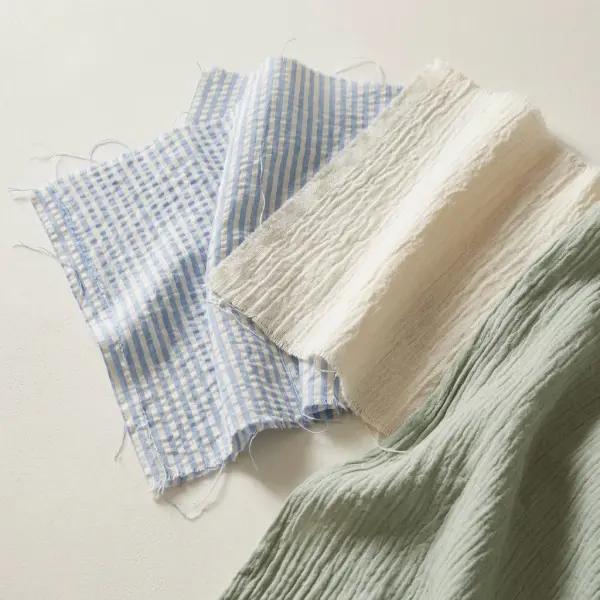
Puckered fabrics are textiles with deliberately raised, gathered, crinkled, or uneven surface areas created through yarn construction, fabric formation, or finishing. Their distinctive appearance comes from variations in surface geometry rather than necessarily from printed patterns or decorative embellishments.
These variations can be subtle or pronounced. Some fabrics contain regularly spaced raised stripes, while others have irregular crinkles distributed across the entire surface. The resulting texture influences how the material looks, handles, folds, and sits against the body.
In summer apparel, this matters because designers often aim to combine low garment weight with sufficient visual interest. A completely smooth lightweight fabric may appear simple or flat, whereas a textured material can add depth without requiring heavy trims, embroidery, or multiple fabric layers.
Texture can also make a basic garment silhouette more visually distinctive. A loose cotton blouse or straightforward button-up shirt may require few additional design features when the fabric already contributes surface character.
Still, puckering is not a single standardized textile construction. Different manufacturing methods can produce visually similar fabrics with different performance and care characteristics.
What Makes a Fabric Puckered?
Puckering develops when selected areas of a textile contain different yarn lengths, shrink at different rates, or are shaped into raised structures during processing.
For example, a woven fabric may use different warp tensions to form alternating flat and raised areas. Another fabric may receive a localized treatment that causes certain sections to contract while surrounding sections remain relatively unchanged.
Other textiles develop crinkles through highly twisted yarns or controlled heat-setting processes.
The common result is a three-dimensional surface, but the mechanisms behind it are not interchangeable. A texture formed directly through weaving may behave differently from one created primarily through chemical or thermal finishing.
This distinction becomes important when assessing durability, laundering performance, and the ability to reproduce the same fabric appearance across production batches.
Puckered Texture Versus Ordinary Fabric Wrinkles
Puckering should not be confused with the random wrinkles that appear when clothing is folded, worn, or stored.
An intentionally puckered textile has a surface effect established during manufacturing. Depending on the construction and finish, the texture is designed to remain visible through normal use and appropriate care.
Ordinary wrinkles, by comparison, result from deformation during handling and wear. Their appearance may change substantially after washing or pressing.
The distinction influences both garment design and customer expectations. Consumers buying a crinkled summer dress may expect the texture to remain visible, while customers purchasing a smooth cotton shirt may consider similar surface irregularities undesirable.
For brands, product photography and care communication should make the intended surface appearance clear.
Common Types of Puckered Fabrics Used in Summer Apparel
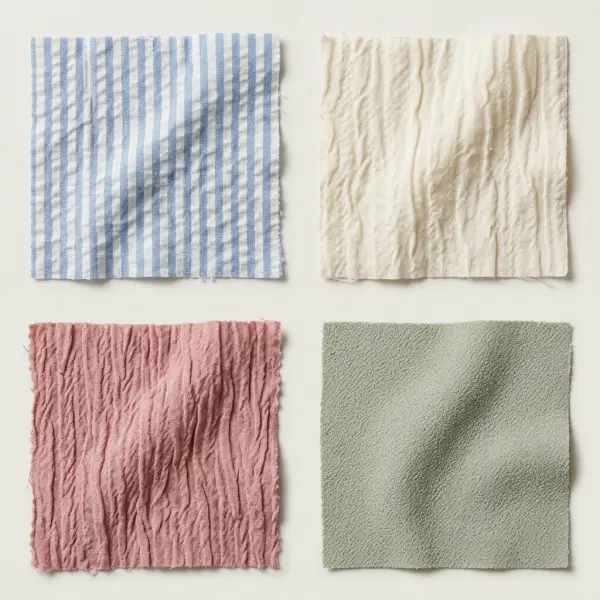
Several textile categories can provide the raised or irregular surfaces associated with lightweight summer clothing. Although they share certain visual characteristics, they differ in how their texture is produced and how they respond to garment manufacturing.
Understanding these distinctions helps sourcing teams avoid treating every crinkled textile as a direct substitute for another.
Seersucker: Alternating Flat and Raised Areas
Seersucker is one of the most recognizable puckered fabrics. Traditional woven seersucker contains alternating flat and raised sections, commonly arranged as stripes running along the fabric length.
Its characteristic appearance is often created through differential warp tension during weaving, although alternative processes can produce similar effects.
Cotton seersucker is frequently used for casual shirts, dresses, shorts, children's clothing, and lightweight tailored garments.
The material is associated with warm-weather dressing because its raised areas can reduce continuous contact with the skin. However, the actual thermal performance depends on its construction.
For a detailed explanation of its weaving structure, material characteristics, and garment applications, see seersucker fabric construction and fashion uses.
Plissé: Texture Created Through Controlled Shrinkage
Plissé describes a puckered or crinkled textile surface traditionally produced by applying a chemical treatment to selected areas of a fabric.
For cotton plissé, localized treatment with sodium hydroxide can cause certain areas to contract, creating raised sections in the surrounding material.
The Vintage Fashion Guild's definition of plissé identifies this controlled shrinkage mechanism and notes its similarity in appearance to seersucker.
Plissé fabrics can have delicate, relatively regular textures suitable for lightweight tops, dresses, nightwear, and relaxed clothing.
However, the term is also used commercially for other pleated or textured fabrics. Buyers should confirm the actual manufacturing method rather than assuming that every product labeled plissé has undergone the same treatment.
Crinkle Fabrics: Irregular Surface Texture
Crinkle fabrics contain small wrinkles, ripples, or folds that are intentionally created or stabilized during textile manufacturing.
Unlike traditional striped seersucker, crinkle textures may be irregular and distributed across much of the fabric surface.
The effect can be created through high-twist yarns, controlled shrinkage, thermal processing, or other finishing techniques.
The Threads guide to sewing plissé and crinkled fabrics describes several approaches used to create permanent crinkle effects, including twisted yarns and heat-based methods.
Crinkle fabrics are useful for relaxed dresses, blouses, wide-leg trousers, and lightweight layered clothing. Their surface can create visual movement even when the garment silhouette is simple.
Nevertheless, the word "crinkle" does not guarantee a particular fiber composition or texture durability.

Crepe Fabrics With Crinkled or Pebbled Surfaces
Some crepe fabrics also have irregular, granular, or crinkled surfaces that make them relevant to lightweight textured apparel.
Crepe is a broad textile category, and its texture may arise from highly twisted yarns, specialized constructions, or finishing techniques.
Not every crepe fabric is strongly puckered, and the category includes materials with very different weights and draping characteristics.
Lightweight crepe may be suitable for loose blouses, flowing dresses, and elegant summer separates. Heavier qualities, however, may be less appropriate for hot-weather clothing.
For product development, the important distinction is whether the specific fabric provides the required combination of texture, weight, drape, and wearing comfort.
How Puckered Surfaces Affect Comfort in Warm Weather
The relationship between fabric surface geometry and wearer comfort is one of the main reasons puckered textiles are considered for summer apparel.
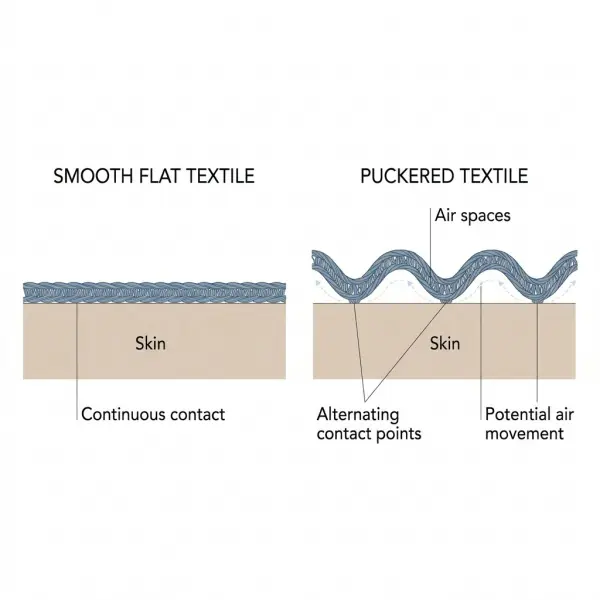
A fabric that rests continuously against the skin behaves differently from one with raised areas and small spaces underneath. These differences can affect contact, heat transfer, and the sensation of the textile during movement.
However, thermal comfort is not determined by surface structure alone. Garments operate as part of a larger clothing system involving body heat, perspiration, ambient temperature, humidity, airflow, and physical activity.
Reduced Continuous Contact With the Skin
A raised textile surface can reduce the amount of fabric that remains in continuous contact with the body.
In a loosely fitted shirt, the puckered sections may hold portions of the textile slightly away from the skin. This can create a different tactile sensation from a smooth, closely fitted material.
The effect may be useful in warm-weather garments where wearers prefer fabrics that do not feel continuously pressed against the body.
However, the amount of separation depends on the fabric's surface geometry and garment fit. Shallow puckering may produce little practical difference, while pronounced raised structures may be more noticeable.
Skin-contact behavior should therefore be assessed with the actual finished garment.
Small Air Spaces Between Fabric and Skin
Puckered structures can create localized spaces between the textile and the skin. Depending on garment movement and fit, these spaces may influence air circulation within the clothing microclimate.
In a relaxed shirt or dress, movement can help exchange air between the garment and its surroundings. This may contribute to a comfortable wearing sensation under some conditions.
Yet the presence of air spaces does not guarantee improved cooling.
Air held within a textile structure can also resist heat transfer. Whether this is helpful or undesirable depends on the environment and the clothing system.
For summer apparel, the goal is not simply to maximize the amount of air trapped around the fabric. It is to achieve an appropriate balance of airflow, heat transfer, moisture behavior, and body contact.
Why Thermal Resistance Matters
Thermal resistance describes how strongly a textile or clothing system resists dry heat transfer.
A fabric with a raised surface may have greater effective thickness and contain additional air spaces, potentially increasing thermal resistance.
This creates a more nuanced explanation of seersucker's traditional association with warm-weather comfort.
Research published in the International Journal of Clothing Science and Technology, Comfort-related properties of seersucker fabrics in dry and wet state, found that the investigated seersucker constructions had substantially higher thermal resistance than typical flat woven fabrics.
The study also showed that yarn selection and textile structure affected air permeability and handfeel.
These findings do not establish that puckered fabrics are unsuitable for summer. Rather, they show that reduced skin contact and increased thermal insulation can occur within the same textile.
A comfortable warm-weather garment requires the appropriate balance of these properties.
Air Permeability Is a Separate Property
Air permeability measures how readily air passes through a fabric under defined testing conditions.
A pronounced puckered surface does not necessarily mean the textile contains large or open pathways for airflow.
For instance, a densely constructed seersucker may have less air permeability than a lightweight flat woven fabric with a more open structure.
The ISO 9237 standard for determining fabric air permeability provides a recognized testing method applicable to many textile materials.
For brands developing apparel around verified airflow performance, such testing is more informative than relying on surface appearance.
The same principle applies to moisture transport and water-vapor resistance: these properties require independent consideration rather than being inferred from visible texture.
Why Lightweight Construction Matters as Much as Texture
A puckered surface can contribute to the wearing experience, but fabric weight and construction remain fundamental.
Lightweight textiles are often selected for warm-weather products because they can reduce the amount of material carried by the garment and support comfortable movement. However, a low fabric weight does not automatically establish high breathability or low thermal resistance.
A very lightweight fabric with a dense structure or unsuitable coating may still perform poorly in certain hot-weather conditions.
Similarly, a moderately weighted fabric with a relatively open structure and appropriate garment design may offer comfortable wear.
Fabric Weight and Effective Thickness
Fabric weight is commonly expressed in grams per square meter (GSM). This indicates the mass of material over a specified area but does not describe the entire structure.
Puckered textiles can have greater effective thickness than flat fabrics because their raised sections extend above the main fabric plane.
This means two materials with a similar GSM may have noticeably different thickness, drape, and tactile characteristics.
For designers, it is useful to evaluate weight and surface geometry separately.
A lightweight seersucker may create more visual volume than its mass suggests, while a smooth fabric of similar weight may lie flatter against the body.
Drape, Flexibility, and Garment Movement
Puckering changes the way fabric bends and folds. Depending on its construction, a textured material may create small, irregular folds or retain a fuller shape.
Some lightweight crinkle fabrics drape softly and move easily with the body. Other puckered fabrics have enough stiffness to support structured sleeves or relaxed, voluminous silhouettes.
This variation creates opportunities for summer apparel design.
A loose dress made from a soft crinkled textile may move fluidly, while a puff-sleeve blouse made from a more structured puckered cotton can retain a defined shape without heavy additional support.
The actual material should be tested during garment development because surface appearance alone cannot predict drape.
The Importance of Fiber Composition
Puckered summer fabrics can be manufactured from cotton, rayon, polyester, silk, and different blends.
Fiber selection affects moisture absorption, drying behavior, mechanical properties, texture stability, and care requirements.
Cotton can provide a familiar natural-fiber handfeel, but it may require shrinkage control and appropriate finishing. Regenerated cellulosic materials can offer fluid drape, although their strength and dimensional behavior depend on fiber type and processing.
Polyester can support certain heat-set textures, but its moisture behavior and wearer sensation are influenced by yarn engineering and fabric construction.
The material composition should therefore support the intended product characteristics rather than being selected simply because it can create an attractive crinkled appearance.
How Puckered Fabrics Support Summer Apparel Design
Puckered textiles offer aesthetic advantages beyond comfort considerations. Their raised surfaces introduce depth, shadow, and tactile variation, allowing simple garments to appear visually developed without complex decoration.
This is particularly useful in seasonal collections where designers want lightweight construction, easy styling, and recognizable material character.
Adding Texture Without Heavy Embellishment
Embroidery, appliqués, layered panels, and other decorative techniques can increase garment complexity and, depending on the design, add weight or stiffness.
A puckered fabric provides another route to visual interest because the decoration is integrated into the textile surface.
A monochromatic plissé blouse, for example, may appear distinctive through its ripples alone.
This does not necessarily make the garment cheaper to manufacture. Specialized fabric processing can increase material cost, and unusual textures may require careful handling.
Nevertheless, using the textile itself as a design feature can reduce the need for additional decorative components.
Supporting Relaxed Silhouettes
Loose silhouettes are common in lightweight summer apparel because they can provide ease of movement and space between clothing and the body.
Puckered fabrics often complement these designs visually.
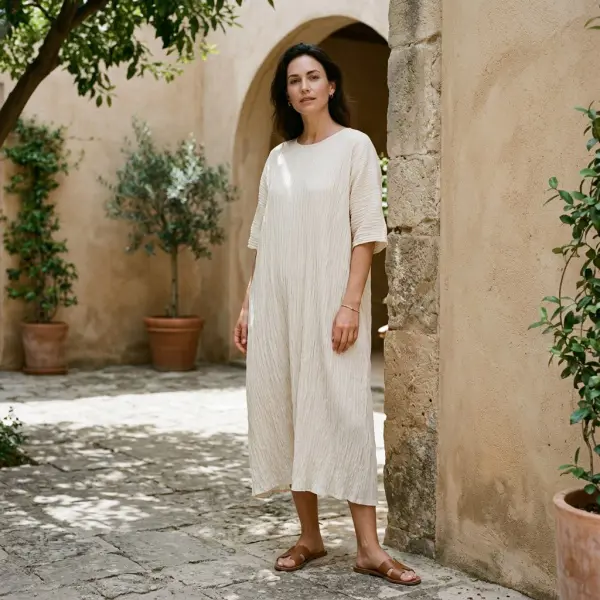
A relaxed shirt made from seersucker can retain a slightly textured appearance without looking improperly pressed. A crinkle dress may fall into irregular soft folds that reinforce its informal styling.
The combination of textile structure and garment ease can be more important than either feature alone.
A strongly textured fabric used in an excessively tight garment may lose some of the intended visual and tactile benefits.
Creating Volume Without Excessive Fabric Layers
Certain puckered textiles can create the perception of fullness through raised surfaces and irregular folds.
This can be useful in sleeves, tiered skirts, oversized tops, and other garments where designers want visual volume.
However, texture does not automatically replace structural support.
A deeply puckered fabric may have sufficient body for a modest puff sleeve, but a more dramatic silhouette might still require gathering, interfacing, or additional construction.
Brands should evaluate whether the fabric supplies the necessary shape before adding extra layers that could increase garment weight.
Which Summer Garments Benefit From Puckered Fabrics?
The suitability of a puckered textile depends on how its surface interacts with garment shape, movement, and intended use.
Loose-fitting clothing is often a practical starting point, but different fabric qualities can support more structured products when carefully selected.
|
Garment category |
Useful puckered-fabric characteristic |
Design consideration |
|
Casual summer shirts |
Raised texture adds visual interest |
Avoid excessive stiffness around collar and cuffs |
|
Loose blouses |
Soft crinkles create natural surface movement |
Confirm drape and texture recovery |
|
Summer dresses |
Texture supports relaxed silhouettes |
Check opacity, weight, and lining requirements |
|
Resortwear sets |
Coordinated texture creates collection identity |
Maintain consistency across fabric lots |
|
Lightweight trousers |
Textured surfaces add dimension |
Evaluate seat, knee, and seam behavior |
|
Children's summer clothing |
Simple shapes can use textured materials |
Verify skin comfort, wash durability, and safety |
|
Unlined summer jackets |
Surface detail creates visual character |
Check structure, interfacing, and total garment weight |
The table provides design starting points rather than universal recommendations. A fabric that performs well in a loose blouse may not be appropriate for trousers requiring dimensional stability or resistance to repeated abrasion.
Relaxed Shirts and Casual Tops
Puckered fabrics are especially useful for straightforward shirt patterns because the material provides much of the garment's visual character.
Short-sleeved resort shirts, loose button-down shirts, and simple pull-on tops can all benefit from textured fabrics when the selected construction provides the required drape and comfort.
For brands producing coordinated collections, the same fabric may support several variations of a basic shirt design.
However, collars, plackets, and button areas require careful construction. Interfacing and pressing procedures should preserve an acceptable balance between clean garment details and the intended puckering.
Dresses and Lightweight Separates
Crinkle and plissé fabrics can support dresses with simple shapes and generous movement. Their textures provide interest across relatively large fabric panels without requiring elaborate print designs.
The effect is especially noticeable in solid-color materials, where surface geometry becomes a prominent visual feature.
Designers should nevertheless assess transparency and lining requirements.
A very lightweight crinkle fabric may look appropriate for hot weather, but an additional lining can significantly alter garment weight and comfort.
Testing the complete garment is therefore more useful than evaluating only the outer fabric.
Resortwear and Coordinated Collections
Puckered materials can help establish a recognizable visual identity across coordinated shirts, shorts, skirts, and dresses.
A brand may use one textured fabric in several silhouettes to create consistency without requiring identical garments.
This approach can also simplify certain aspects of collection planning when the same approved material is suitable for multiple products.
However, efficiency gains depend on cutting yields, material availability, and how consistently the fabric can be processed.
A textured fabric with specialized handling requirements may introduce production costs that offset the advantages of using fewer material variations.
Practical Manufacturing Considerations for Puckered Fabrics
Puckered fabrics require production teams to distinguish between intentional surface irregularity and genuine manufacturing defects.
The challenge is not necessarily that these materials are difficult to sew. Rather, their surface geometry can behave differently during fabric spreading, cutting, stitching, and pressing.
Handling requirements also vary by manufacturing method. A woven seersucker may need different procedures from a delicate heat-set crinkle fabric.
Cutting Without Distorting the Texture
Fabric spreading can influence the accuracy of garment components.
If a puckered textile is stretched excessively while being placed on a cutting table, the surface may temporarily flatten or change dimensions.
After the cut pieces relax, their measurements may differ from those expected during cutting.
To reduce this risk, production teams should examine the fabric's relaxation behavior and establish suitable spreading tension.
The cutting method should also account for the direction of the texture, particularly when the fabric contains regular stripes or lengthwise crinkles.
Sewing Seams Across Uneven Surfaces
The raised surface of a puckered fabric may affect how material passes through a sewing machine.
Inappropriate feeding or thread tension can create additional seam distortion, making the finished garment appear uneven.
For some fabrics, lightweight seam finishes and carefully selected machine settings may provide better results than heavy or rigid construction.
The best approach should be established through sample sewing.
A narrow hem may complement a lightweight crinkle textile, while an overly bulky hem could interfere with the material's natural drape.
The Threads sewing guidance referenced earlier recommends gentle handling and appropriate seam and edge finishes to protect intentionally crinkled surfaces.
Pressing Without Removing the Intended Texture
Pressing is particularly important because raised or crinkled areas are part of the fabric's design.
Applying heavy pressure may flatten portions of the texture or create visible differences between processed and unprocessed sections.
Heat-sensitive materials may also respond differently from cotton-based constructions.
The correct temperature, steam level, pressure, and pressing duration should be established using the actual material.
In some cases, controlled steaming or minimal-pressure finishing may be appropriate, but no single technique applies to every puckered fabric.
Technical packs should communicate the desired final appearance so production teams do not unintentionally remove the design effect.
Checking Texture Stability After Laundering
A fabric can appear stable during sampling but change after repeated washing.
Depending on how the texture was formed, puckered sections may relax, contract, or become less uniform after inappropriate care.
The material may also experience dimensional changes that affect finished-garment measurements.
A realistic evaluation should include the care cycles expected for the intended product.
For fashion brands, the key question is whether the garment maintains an acceptable appearance and fit after consumer use, not simply whether the fabric retains every original surface detail.

What Fashion Brands Should Consider Before Sourcing Puckered Fabrics
Selecting puckered fabrics for summer collections requires more than identifying an appealing surface.
Brands should understand how the textile is produced, whether its properties meet the product specification, and whether suppliers can maintain acceptable consistency across repeat orders.
This is especially important when the visual effect depends on specialized weaving or finishing.
Verify the Texture-Forming Method
A supplier may describe a fabric as crinkle, plissé, or seersucker without identifying how the surface was created.
For commercial development, the production method matters because it can affect texture retention, finishing requirements, and cost.
Research published in Materials, Assessment of Surface Geometry of Puckered Area of SeerSucker Woven Fabrics, identifies weaving, thermal, and finishing methods used to create seersucker effects and discusses challenges in achieving repeatable pucker geometry.
For sourcing teams, similar-looking samples should not automatically be considered technically equivalent.
The supplier should identify the relevant material construction and explain any special care requirements.
Establish a Practical Material Specification
A sourcing specification should describe more than color and fiber content.
For puckered fabrics, it may need to include the intended surface appearance, fabric weight, usable width, dimensional stability, and relevant laundering requirements.
Where texture is a prominent design feature, an approved physical sample can provide a useful reference.
Additional testing should reflect the end use and the brand's performance claims.
A dress made for occasional resortwear may have different requirements from a uniform designed for frequent commercial laundering.
The purpose of the specification is to reduce ambiguity between product development, purchasing, manufacturing, and quality control.
Consider Production Scalability and Cost
Specialized fabric effects can create operational trade-offs.
Traditional woven seersucker may require more complicated tension control than ordinary flat fabrics. Certain finishing processes may introduce additional chemical, thermal, or mechanical operations.
These differences can affect cost, capacity, and delivery planning, although they do not establish that every puckered fabric is more expensive.
A large apparel brand needs to know whether its supplier can reproduce the same fabric quality across repeated orders.
A smaller seasonal collection may be able to accept greater variation when the texture itself is intentionally irregular.
The appropriate level of standardization depends on customer expectations, collection size, and the garment's intended appearance.
Evaluate Performance Before Making Comfort Claims
Descriptions such as "airy," "breathable," and "cooling" are common in summer fashion marketing, but they communicate different concepts.
An airy appearance is primarily visual. Air permeability is measurable. Cooling performance involves heat and moisture exchange under actual wearing conditions.
Brands should avoid treating these terms as interchangeable.
A product description may accurately emphasize a lightweight construction and intentionally puckered texture. More specific claims about airflow, thermal comfort, or moisture management should have suitable technical support.
This approach protects product credibility while still communicating the genuine advantages of textured fabrics.
Common Mistakes When Using Puckered Fabrics in Summer Collections
The most frequent errors occur when brands select a fabric for its visual texture without considering how the material will behave during production, care, and wear.
Mistake 1: Assuming Every Puckered Fabric Is Breathable
A raised textile surface may create spaces between the garment and skin, but those spaces do not directly measure airflow through the fabric.
A dense fabric can remain relatively impermeable to air despite its visible puckers.
This misconception may lead to unsupported marketing claims or disappointing wearing experiences.
The better approach is to evaluate fabric density, air permeability, garment fit, and other relevant performance characteristics before presenting breathability as a product benefit.
Mistake 2: Choosing Texture Without Considering Fabric Weight
Deeply puckered textiles may appear light because their surfaces contain open-looking areas and irregular folds.
However, some constructions are relatively heavy or stiff.
If designers select fabric entirely by appearance, the finished garment may feel bulkier than intended.
A reliable evaluation should include actual weight, effective thickness, drape, and garment sampling.
Mistake 3: Ignoring Texture Changes During Manufacturing
Cutting, sewing, and pressing can influence the appearance of puckered fabrics.
Production teams unfamiliar with the material may stretch it during spreading or apply excessive pressure during finishing.
These actions can alter the intended texture and produce inconsistencies between garment panels.
Brands should establish a controlled handling procedure using approved samples and documented finishing instructions.
Mistake 4: Overlooking Shrinkage and Care Performance
Some textured fabrics may change significantly during washing or drying.
The amount and direction of dimensional change depend on the fiber, texture-forming process, and finishing.
If shrinkage is not evaluated, a garment may lose its approved fit even when the surface still looks attractive.
Testing should therefore examine both garment measurements and texture retention after the intended care process.
Mistake 5: Assuming Textured Fabric Automatically Creates a Sustainable Product
Puckered fabrics may sometimes reduce the desire for smooth pressing or eliminate certain decorative elements, but these possibilities do not establish an overall environmental benefit.
Chemical finishing, textile processing, energy use, fiber production, garment longevity, and consumer care can all influence environmental performance.
A chemically treated plissé fabric, for example, should not be described as environmentally preferable without evidence supporting that specific claim.
Brands should evaluate the actual production and use conditions instead of equating texture or low-maintenance styling with sustainability.
Important Technical Caveats About Puckered Summer Fabrics
The commercial appeal of puckered fabrics is clear, but several limitations are important when interpreting their performance.
First, reduced skin contact does not guarantee lower thermal resistance. Some raised fabrics retain additional air within their structure and can provide greater insulation than comparable flat textiles.
Second, textile weight and thickness are separate properties. A fabric may have low mass per square meter but greater effective thickness because of its surface geometry.
Third, visible puckering does not establish moisture-wicking performance. Sweat absorption, liquid transport, drying, and water-vapor resistance depend on specific material and construction characteristics.
Fourth, a permanently textured appearance does not mean that the material is resistant to all wrinkles, shrinkage, or damage. Its stability must be evaluated under suitable care conditions.
Finally, not every puckered fabric is appropriate for every summer garment. A strongly textured material may work well in a relaxed blouse but create excessive bulk or unpredictable shape in fitted clothing.
These distinctions help brands develop realistic performance specifications rather than relying on surface appearance as a substitute for textile testing.
Frequently Asked Questions About Puckered Summer Fabrics
Why are puckered fabrics commonly used for summer clothes?
Puckered fabrics are commonly used in summer clothing because their raised surfaces can reduce continuous contact with the skin and create a relaxed visual appearance. Their texture also adds dimension to lightweight garments without necessarily requiring additional decorative components.
However, puckering alone does not establish cooling performance. Fabric weight, porosity, fiber composition, moisture behavior, and garment fit all influence comfort. A loosely constructed puckered cotton shirt may provide an appropriate wearing experience, while a dense or heavily finished textured fabric may behave differently. Brands should evaluate the finished garment rather than assuming that any puckered material is suitable for hot weather.
Are puckered fabrics cooler than smooth fabrics?
Not necessarily. Puckered fabrics can create small spaces between the textile and skin, potentially reducing continuous contact and influencing air movement. However, these air spaces may also increase thermal resistance.
Research on seersucker has shown that certain puckered constructions provide substantially greater thermal resistance than typical flat woven fabrics. This means that surface geometry can influence both the sensation of skin contact and the transfer of heat. A lightweight smooth fabric with high air permeability may perform better in some conditions. Meaningful comparisons require consideration of the specific materials, garment design, and environmental conditions.
What is the difference between puckered fabric and crinkle fabric?
Puckered fabric is a broad descriptive term for textiles containing intentionally raised or uneven surface areas. Crinkle fabric is a more specific commercial description for materials with fine, irregular wrinkles, ripples, or folds distributed across the surface.
Seersucker and plissé can both have puckered textures, but their appearance and manufacturing methods may differ from those of crinkle fabrics. Crinkling can result from high-twist yarns, shrinkage treatments, or heat-based processes. For sourcing teams, these names describe appearance but do not fully identify fiber composition, construction, durability, or care requirements. The actual textile specification is therefore essential when selecting a material.
Which puckered fabric is best for a lightweight summer dress?
The most suitable puckered fabric depends on the dress silhouette, desired drape, comfort requirements, and care expectations. Soft crinkle or plissé fabrics may work well for loose, flowing dresses, while lightweight cotton seersucker can support styles with slightly more body and recognizable surface texture.
Designers should assess transparency, fabric weight, bending behavior, skin contact, and dimensional stability. A material that looks attractive in a swatch may require lining or behave differently when gathered into a full skirt. The preferred option should be selected through garment sampling rather than assuming that one type of puckered fabric is universally superior.
Do puckered fabrics require less ironing?
Some puckered fabrics may require less ironing to achieve their intended appearance because the texture is already part of the design. Consumers generally do not need to press intentionally crinkled or raised sections completely flat.
However, not all puckered fabrics are equally easy to maintain. The texture may be vulnerable to excessive heat, pressure, or unsuitable laundering conditions. Garment details such as collars, seams, and facings may still require controlled pressing. The correct care method depends on fiber composition and the process used to establish the texture. Brands should verify care performance before advertising a product as easy to maintain.
Can puckered fabrics lose their texture after washing?
Yes. Some puckered fabrics can lose part of their intended texture or change surface geometry after washing, particularly when the effect depends on treatments sensitive to heat, moisture, or mechanical action.
Other constructions, including certain woven textures, may retain their appearance more effectively under appropriate care. Nevertheless, texture retention should not be assumed without evaluation. Repeated laundering can also affect fabric dimensions, drape, and garment fit. For commercial apparel, suppliers should provide suitable care recommendations, and brands should test finished garments under realistic washing and drying conditions. This is particularly important for products marketed as washable everyday summer clothing.
Are puckered fabrics suitable for large-scale apparel manufacturing?
Yes, puckered fabrics can be used in large-scale manufacturing when suppliers can maintain consistent specifications and production teams understand the material's handling requirements.
The main considerations include fabric availability, texture repeatability, dimensional stability, cutting behavior, sewing performance, and finishing procedures. Certain specialized weaving or finishing methods may require additional production controls. Buyers should also establish acceptable variation between fabric lots, especially for regular striped or highly visible textures. Before committing to volume production, brands should approve material samples, assess garment performance, and confirm that the supplier can reproduce the intended quality within the required commercial conditions.
<h2 class="tm9"





Comments 0
Leave a CommentSend Comment
Anda harus Login terlebih dahulu untuk dapat memberikan komentar.