

How Seam Finishing Affects Durability, Comfort, and Appearance
Quick Answer
Seam finishing affects garment durability, comfort, and appearance by controlling what happens at the cut fabric edges after garment panels are joined.
A suitable seam finish can reduce fraying, protect seam allowances during laundering and wear, limit loose yarns, create a smoother garment interior, and support a clean external appearance. A poorly selected or poorly executed finish can instead produce bulky ridges, skin irritation, restricted stretch, seam puckering, visible thread through sheer fabrics, or premature edge deterioration.
The result depends on more than whether the garment uses overlocking, a French seam, binding, or another named technique. Fabric structure, stitch type, thread size, seam allowance, machine tension, seam location, garment fit, care method, and production consistency all influence performance.
Seam finishing also cannot compensate for a weak primary seam. A neatly overlocked edge may still fail through thread breakage, fabric rupture, or yarn slippage. Conversely, an elaborate bound finish may reduce comfort if it creates unnecessary thickness in a close-fitting garment.
The best finish balances edge control, seam performance, wearer experience, visual quality, cost, and manufacturing capability.
Seam Finishing Is Part of a Larger Garment Quality System
Seam finishing is the treatment used to secure, cover, fold, or enclose the raw edges of a garment seam allowance. Its immediate function is edge control, but its effect extends into the way a garment wears, washes, moves, hangs, and looks.
A seam should be evaluated as an assembly rather than as a single row of stitches. That assembly may include:
- the shell fabric;
- sewing thread;
- stitch formation;
- stitch density;
- seam type;
- seam allowance;
- edge finish;
- binding or reinforcement;
- pressing;
- lining;
- garment washing or finishing.
The international standards ISO 4916 for seam-type classification and ISO 4915 for stitch-type classification treat seam configuration and stitch formation as related but distinct technical entities. This is an important distinction because the edge finish alone does not describe how the garment panels are joined or how the complete seam will behave.
For example, two garments may both have overlocked seam allowances. One may use a separate lockstitch as the primary joining seam, while the other is joined directly with a four-thread overlock construction. The interiors may look similar to an untrained eye, yet the seams can differ in extensibility, bulk, repairability, and response to load.
A broader overview of these construction options is available in seam finishing techniques for better garment quality. The comparison between three frequently used techniques is covered separately in when to use overlock, French seams, and bias binding.
How Does Seam Finishing Affect Garment Durability?
Seam finishing supports durability by controlling raw-edge deterioration and protecting seam allowances, but the finish is only one part of the complete seam-engineering system.
Durability in this context does not mean that the garment will never wear out. It means that the seam assembly remains functional and visually acceptable under the expected conditions of dressing, movement, laundering, abrasion, pressing, and repeated use.
A finish that works adequately in a lightly worn occasion blouse may not be suitable for workwear, childrenswear, activewear, uniforms, or garments subjected to frequent industrial laundering.
Controlling Fraying and Edge Breakdown
Cut woven fabrics can release yarns from the seam allowance, particularly when the weave is loose, the yarns are smooth, the edge receives abrasion, or the garment is washed repeatedly.
Overlocking controls the edge by wrapping thread around it. French seams and flat-felled seams enclose the edge within the construction. Bias binding covers the cut edge with another material. Turned-and-stitched finishes fold the edge before securing it.
These approaches reduce exposure, but they do not provide identical protection. A pinked edge may slow visible fraying in a relatively stable material, for example, but it generally offers less control than a stitched, enclosed, or bound finish when the garment receives frequent laundering or friction.
The consequences of edge breakdown can include:
- loose yarns inside the garment;
- reduced seam-allowance width;
- exposed or unsupported stitch lines;
- lint and thread shedding;
- difficulty during alteration or repair;
- an interior that looks prematurely worn.
The problem can progress gradually. A garment may pass final inspection while new but develop loose fibers after several wash cycles because the selected finish was not validated under realistic care conditions.
Seam Finish Is Not the Same as Seam Strength
A common quality misconception is that a fully finished raw edge automatically creates a strong seam.
It does not.
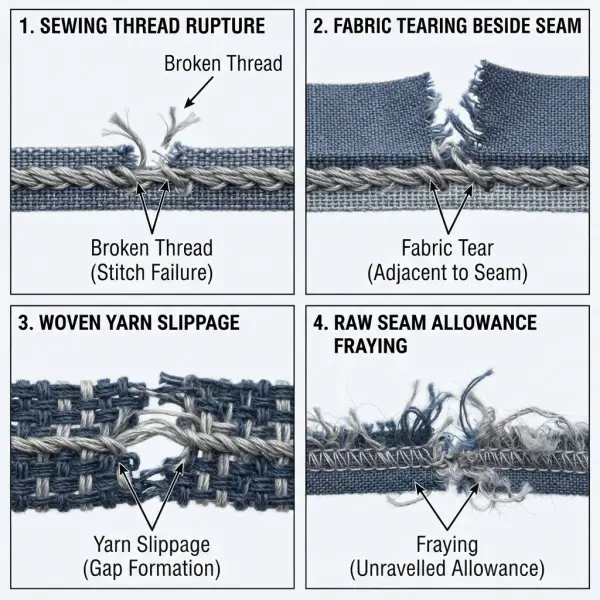
The active ASTM D1683/D1683M-22 test method for failure in sewn seams of woven fabrics identifies thread size, stitch type, seam type, and stitch density as seam-engineering variables that affect sewn-seam strength and structural integrity. The method evaluates forces applied perpendicular to sewn seams and distinguishes possible outcomes such as fabric rupture, sewing-thread failure, and yarn displacement. ASTM also states that the test does not by itself predict actual wear performance.
A seam allowance may therefore be neatly bound while the joining stitches remain too weak for the intended load. Equally, an overlocked edge may remain intact while the fabric yarns pull apart beside the stitch line.
The quality team should distinguish among several failure mechanisms:
|
Failure mechanism |
What happens |
Why the finish may not prevent it |
|
Thread rupture |
Sewing thread breaks under load or fatigue |
Edge coverage does not increase inadequate thread strength |
|
Fabric rupture |
Fabric tears beside or through the seam |
The material may be weaker than the seam |
|
Seam slippage |
Woven yarns shift away from the stitch line |
Raw edges may remain enclosed while the fabric structure opens |
|
Stitch extension failure |
Stitch cannot extend far enough |
A neat finish may still restrict a stretch garment |
|
Edge fraying |
Yarns leave the cut seam allowance |
The joining seam may remain intact initially |
|
Needle damage |
Needle cuts or weakens fabric yarns |
Failure may develop after sewing or laundering |
|
Abrasion failure |
Thread, binding, or fabric wears through |
A visually refined finish may use an unsuitable material |
This distinction matters commercially. Repair may be possible when the stitching fails without damaging the fabric. When yarn displacement or fabric rupture permanently changes the material structure, replacement may be more realistic than repair. ASTM D1683/D1683M-22 discusses this difference when considering the integrity of sewn woven-fabric assemblies.
Seam Slippage Can Occur Without Stitch Breakage
In some woven fabrics, the sewing thread remains intact while warp or weft yarns move away from the seam line. This creates an opening, ladder-like distortion, or visible gap beside the stitches.
The ISO 13936-1 fixed seam-opening method defines seam slippage as movement of yarn systems in woven fabric under pulling action and explicitly distinguishes it from seam strength. The method is intended to evaluate the resistance of woven-fabric yarn systems to slippage at a sewn seam and is not suitable for every textile category, including certain stretch and industrial fabrics.
Loose weaves, smooth filament yarns, low yarn density, narrow seam allowances, unsuitable stitch density, and highly fitted garment areas can increase the practical risk of visible seam opening.
An enclosed seam finish may hide the raw edge but does not necessarily prevent yarn movement near the stitch line. Product developers therefore need to test the fabric-seam combination rather than assuming that a French seam or bound allowance automatically solves slippage.
Seam Allowance Width Matters
The distance between the joining seam and the cut edge provides material that supports the construction. If the allowance is trimmed too narrowly, fraying or yarn movement can approach the stitch line more quickly.
Overlock operators may unintentionally reduce the approved allowance when the cutting knife removes too much material. French seams can become vulnerable when the first allowance is trimmed inconsistently or when loose yarns remain outside the enclosed channel. Bound seams can fail when the binding does not fully capture the raw edge.
A wider seam allowance is not always better. Excess width can create bulk, show through lightweight fabric, interfere with curves, or increase material consumption. The correct width depends on fabric stability, seam type, finish, garment stress, and the space available within the construction.
Laundering Exposes Weak Finishing Decisions
Repeated washing introduces moisture, heat, detergent, agitation, drying, and dimensional change. These conditions can reveal problems that were not visible in the newly sewn garment.
Potential changes include:
- increased seam puckering;
- shrinkage of binding or thread;
- edge curling;
- loss of seam smoothness;
- fraying beyond the overlock coverage;
- thread abrasion;
- twisted seam lines;
- color bleeding from binding;
- distortion caused by incompatible materials.
AATCC maintains standardized laundering procedures and test methods so variables such as washing conditions, detergent, and evaluation can be controlled more consistently. Its laundering training materials include methods for dimensional change, seam smoothness, seam twist, and the appearance of finished apparel after home laundering.
This does not mean every garment requires every available method. The brand should select tests according to the care label, product category, customer specification, and known risks.
Repairability and Long-Term Maintenance
Seam finishing can also affect whether a garment is easy to alter or repair.
Separately overlocked seam allowances that are pressed open may provide easier access than a tightly enclosed French seam. Generous allowances inside tailored garments can support alteration, while heavily trimmed edges may leave little material for adjustment.
Bias binding can protect an allowance during repeated wear, but it may need to be removed and replaced during alteration. Flat-felled seams offer strong edge enclosure but can require more labor to open and reconstruct.
These are not reasons to avoid secure finishes. They are reminders that durability includes maintainability for some products, particularly uniforms, tailoring, workwear, rental garments, and apparel sold with repair services.
How Does Seam Finishing Affect Comfort?
Seam finishing affects comfort through seam bulk, softness, flexibility, placement, surface texture, and the way the construction moves against the body.
Comfort is strongly context-dependent. A prominent seam may cause no problem in a loose outer jacket but become distracting in underwear, leggings, sleepwear, compression garments, or childrenswear.
The wearer rarely experiences the seam finish as an isolated technical feature. They feel the complete interaction between fabric, thread, seam thickness, fit, movement, moisture, and skin contact.
Bulk Can Create Pressure and Visible Ridges
Every fold, thread loop, binding strip, and overlapping seam allowance adds thickness.
A French seam contains multiple folded fabric layers. Bias binding adds another material around the seam allowance. Overlocking places a concentration of thread around the cut edge. Flat-felled seams fold and topstitch several fabric layers together.
In a loose blouse, this thickness may be insignificant. In a fitted garment, it may create:
- pressure against the skin;
- a ridge visible from the outside;
- stiffness at a curve;
- reduced drape;
- discomfort beneath a belt, backpack, or protective layer;
- bulky intersections at the crotch, underarm, or shoulder.
The most refined-looking finish is therefore not automatically the most comfortable. A narrow, flexible overlock may be preferable to a heavily bound seam in a close-fitting garment, even when the binding appears more luxurious on a sample board.
Thread Selection Influences Surface Feel
Thread composition, size, twist, filament structure, finish, and tension affect how the seam feels.
A coarse or tightly tensioned thread can create a hard edge. A bulky textured thread may improve coverage and softness in some looper positions but can also increase total seam mass. Excessively loose loops can rub, snag, or create an untidy interior.
Coats’ technical guidance for activewear and intimate apparel states that next-to-skin seams need to balance security with softness. It also explains that stitch configuration and the placement of needle and looper threads affect the handfeel of the completed seam; even seams using soft yarns can feel rough when thread loops or unbalanced formation remain prominent against the skin.
Thread should therefore be selected for the complete seam application rather than by fiber name or strength alone.
Stretch Compatibility Is Essential in Close-Fitting Garments
Stretch fabric does not guarantee a stretchable seam.
A garment opening or fitted panel may need to extend substantially during dressing and movement. If the seam cannot extend with the material, the wearer may feel restriction before visible failure occurs.
Potential causes include:
- lockstitch construction with insufficient extensibility;
- excessive needle-thread tension;
- unsuitable thread elongation;
- high stitch density;
- seam stabilization in the wrong location;
- rigid binding;
- excessive layers;
- seam allowance that limits extension.
An overlocked or coverseamed construction is often selected for knitwear because its thread formation can provide useful extensibility, but the exact performance depends on stitch balance and the chosen thread system. A bound edge in a stretch garment must also be made from material that can accommodate the required extension.
Comfort testing should reproduce dressing and use. A seam can survive a slow laboratory pull yet still feel restrictive during squatting, reaching, running, or pulling a neckline over the head.
Seam Location Can Matter More Than the Finish Name
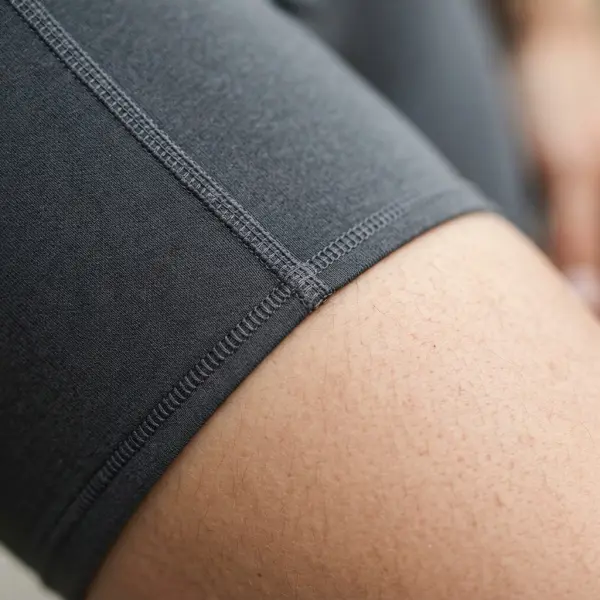
The same construction can feel comfortable in one part of a garment and irritating in another.
High-contact locations include:
- underarms;
- inner thighs;
- crotch seams;
- waistbands;
- bra bands;
- shoulder areas beneath straps;
- sock toes;
- necklines;
- side seams in compression garments;
- areas underneath protective equipment.
Moving a seam away from a pressure point may improve comfort more effectively than changing the finishing technique. Likewise, placing the smoother face of an asymmetric stitch structure toward the skin can be more useful than switching thread brands without reviewing stitch orientation.
Pattern making, fit, seam placement, and seam finishing should therefore be evaluated together.
Loose Threads and Rough Edges Reduce Perceived Comfort
Comfort is partly physical and partly perceptual. A wearer may notice scratchy thread tails, protruding yarns, stiff binding ends, or a rough overlock chain even when the seam is structurally secure.
These details can be especially significant in childrenswear and next-to-skin products. Securing thread chains, trimming tails correctly, controlling binding joins, and covering rough terminations can make a meaningful difference without changing the main seam construction.
How Does Seam Finishing Affect Garment Appearance?
Seam finishing affects external appearance by influencing seam smoothness, drape, bulk, show-through, edge definition, and the consistency of the garment after pressing and laundering.
An internal finish may become visible indirectly. The customer may not see the raw edge, but they can see a ridge, pucker, shadow, twisted seam, or distorted panel caused by the construction underneath.
Seam Puckering Can Make a Garment Look Poorly Made
Seam puckering appears as unwanted waviness, wrinkling, or gathering along the seam line. It can occur during sewing or become more pronounced after pressing, finishing, or washing.
Possible causes include:
- excessive sewing-thread tension;
- unsuitable thread or needle size;
- high stitch density in a tightly constructed fabric;
- unequal feeding of fabric layers;
- structural compression around the stitches;
- differential shrinkage between thread and fabric;
- poor operator handling;
- unsuitable machine settings.
Coats’ technical guidance describes multiple forms of seam puckering and emphasizes that the corrective action depends on the underlying mechanism. Reducing tension may help in some cases, but it will not correct every form of puckering.
The finishing method can contribute to the problem. A dense overlock may compress a light edge. A wide French seam may form a visible ridge. Bias binding may draw up the seam allowance if stretched during application. Overly aggressive pressing may temporarily hide the problem without resolving its cause.
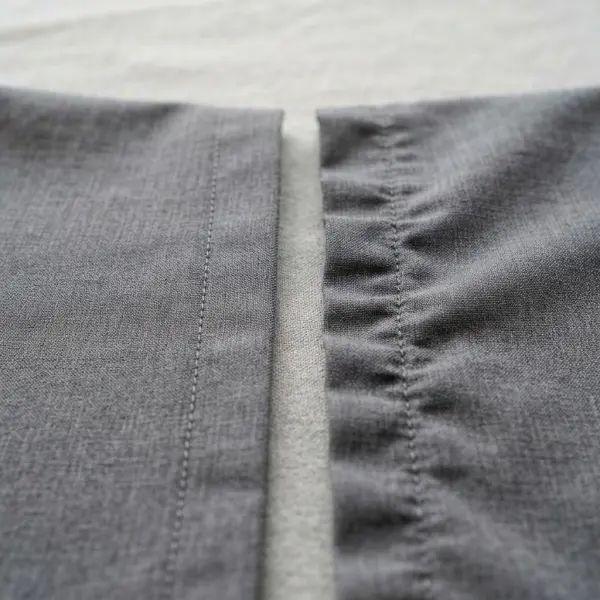
Wash Testing Is Important for Appearance Approval
A seam can appear smooth immediately after sewing but change when the garment is washed.
AATCC TM88B specifically addresses seam smoothness in fabrics after home laundering, while AATCC TM143 covers the appearance of apparel and other textile end products after home laundering and can include seam-smoothness evaluation. These methods help standardize the care process and visual assessment rather than relying only on an informal wash conducted under unknown conditions.
For fashion brands, the operational implication is straightforward: appearance approval should match the condition in which customers will use the garment.
A washable shirt should not be approved only in its freshly pressed factory condition. A garment-dyed product should not be assessed only before dyeing. A washed denim seam should be reviewed after the intended laundry process, because shrinkage, abrasion, and seam roping may alter the visual result.
Show-Through Matters in Fine and Sheer Fabrics
Seam finishes can create visible shadows through lightweight fabric.
Potential causes include:
- dark or contrasting overlock thread;
- wide seam allowances;
- multiple folded layers;
- bulky binding;
- thick thread;
- seam allowances pressed inconsistently;
- trapped raw-edge yarns;
- binding that changes opacity.
French seams are often used in sheer garments because they enclose the raw edge without visible overlock loops. Even so, an excessively wide French seam can create a strong line through the garment.
The design team should evaluate samples under realistic lighting and on the body or dress form. A seam that appears acceptable while lying flat on a white table may become far more visible against skin, lining, or contrasting undergarments.
Seam Bulk Influences Drape and Silhouette
Lightweight fabrics rely on fluid movement. Heavy finishing can interrupt that movement by creating rigid vertical or horizontal lines.
A bulky side seam may pull a skirt away from the body. A thick enclosed armhole seam can affect sleeve hang. Bound princess seams may change the way a fitted bodice follows the body. Heavy intersecting finishes can create bumps under close-fitting areas.
In heavier tailoring, some structure is intentional. A bound seam allowance inside an unlined jacket may support a controlled interior without noticeably affecting the outer silhouette. The same finish in a delicate bias-cut dress could interfere with drape.
Appearance must therefore be judged relative to design intent rather than according to one universal ideal of flatness.
Internal Appearance Supports Perceived Quality
Garment interiors are increasingly visible during product photography, customer reviews, resale inspection, repair, and retail handling. Unlined garments, reversible products, rolled cuffs, open jackets, and transparent fabrics expose construction directly.
A consistent seam finish can signal production control. This does not mean the interior must be decorative. A clean, narrow overlock in matching thread may be more appropriate than contrast binding in a minimalist product.
Visible quality depends on details such as:
- consistent seam-allowance width;
- balanced stitch formation;
- complete raw-edge coverage;
- straight and evenly spaced stitching;
- clean binding joins;
- controlled seam intersections;
- secured thread chains;
- absence of skipped stitches;
- compatible thread color;
- correct pressing direction.
The value comes from consistency and suitability, not simply from complexity.
Durability, Comfort, and Appearance Often Compete
A seam-finishing decision rarely improves every quality dimension equally.
|
Construction decision |
Potential benefit |
Possible trade-off |
|
Increase thread coverage |
Better raw-edge control |
Greater bulk or roughness |
|
Use wider seam allowance |
More material around the stitch line |
More show-through and fabric consumption |
|
Enclose the raw edge |
Clean interior and reduced fraying |
Additional layers and stiffness |
|
Add binding |
Protected edge and premium appearance |
Higher labor, material use, and thickness |
|
Increase stitch density |
More stitches sharing the load in some constructions |
Fabric damage, stiffness, or puckering |
|
Reduce thread tension |
Less puckering and softer handfeel |
Loose or insecure stitch formation |
|
Use strong coarse thread |
Potentially greater thread strength |
Visible stitches and harsher seam feel |
|
Trim seam allowance narrowly |
Reduced bulk |
Less tolerance for fraying and sewing variation |
|
Stabilize the seam |
Better dimensional control |
Reduced stretch or flexibility |
|
Press aggressively |
Flatter immediate appearance |
Shine, impression marks, or hidden instability |
The correct decision is not to maximize one property regardless of consequence. It is to define which properties matter most for the product.
For activewear, extension and skin comfort may take priority over a decorative interior. For an unlined tailored vest, visible finishing and edge control may justify additional labor. For children’s schoolwear, laundering durability, secure construction, and low irritation may be more important than a refined hand-finished appearance.
What the Effects Mean for Different Garment Categories
Activewear and Stretch Apparel
Activewear seams must tolerate extension, repeated movement, perspiration, laundering, and direct skin contact.
A suitable finish should:
- extend with the fabric;
- recover without permanent distortion;
- avoid hard thread concentrations;
- remain secure during repeated wear;
- control raw edges without excessive bulk;
- perform at high-movement seam locations.
A visually narrow seam is not necessarily comfortable, and a soft seam is not automatically strong enough. Development teams should evaluate stretch, recovery, seam opening, abrasion, and wearer movement together.
Lightweight Blouses and Dresses
In lightweight woven garments, appearance and edge control often dominate the decision.
French seams may prevent loose yarns and reduce visible overlock loops. Narrow overlocking can be more practical around gathered or curved areas. Binding may create excessive visual weight unless used as a deliberate design feature.
The finish should preserve drape and avoid visible ridges. Fabric transparency, yarn slippage, laundering, and seam position require particular attention.
Unlined Tailoring
Unlined jackets, vests, and coats expose the garment interior. Binding or Hong Kong finishing can create a controlled premium appearance while protecting seam allowances.
The main risks are added labor, inconsistent binding width, bulky intersections, shrinkage incompatibility, and stiffness around curves.
Durability should also be evaluated at pockets, armholes, side seams, and shoulder areas rather than inferred from the appearance of a flat sample.
Childrenswear
Children’s clothing often experiences frequent washing, active movement, pulling during dressing, and direct skin contact.
Important requirements include:
- secure thread ends;
- controlled fraying;
- low-bulk seam intersections;
- sufficient stretch at openings;
- soft internal surfaces;
- wash-resistant construction;
- absence of loose components or abrasive edges.
The finish must also be reproducible at scale. Complex construction that varies between operators can create inconsistent comfort and durability across the production lot.
Denim and Workwear
Denim and workwear require seams that tolerate load, abrasion, laundering, and sometimes aggressive garment finishing.
Overlocked safety-stitch constructions and flat-felled seams are common, but the result depends on fabric weight, thread, needle selection, stitch density, wash process, and stress location.
A seam may be intentionally prominent as part of the product’s visual identity. Appearance therefore includes controlled puckering, topstitch definition, and wash effects—not merely an invisible, perfectly flat seam.
Intimate Apparel and Sleepwear
These products place a high priority on softness, seam placement, extension, and low irritation.
A seam can appear visually neat while feeling rough against the body. Thread loops, elastic joins, binding ends, labels, and seam intersections should be assessed through wearer trials as well as visual inspection.
In lightweight woven sleepwear, enclosed seams may work well. In stretch intimate apparel, overlock, coverseam, flat-seam, elastic-application, or other specialist constructions are usually more appropriate.
Common Quality Problems and What They Suggest
The same visible defect can have more than one cause, so corrective action should begin with diagnosis.
|
Quality problem |
Possible causes |
What should be checked |
|
Loose overlock loops |
Low tension, incorrect cutting width, poor edge positioning |
Thread balance, knife setting, seam allowance |
|
Wavy knit edge |
Differential feed mismatch, stretching during sewing |
Feed ratio, presser pressure, operator handling |
|
Fraying beyond stitches |
Narrow coverage, weak fabric edge, excessive trimming |
Cutting width, seam allowance, stitch width |
|
Trapped threads in French seam |
Inadequate trimming, loose weave |
First seam allowance and trimming control |
|
Bulky enclosed seam |
Fabric too heavy, finish too wide |
Alternative finish or narrower construction |
|
Uneven binding |
Variable strip width, poor folder setup, operator handling |
Binding preparation, attachment, feeding |
|
Binding shrinkage |
Incompatible material or preparation |
Dimensional stability and wash testing |
|
Seam puckering |
Thread tension, feed imbalance, structural compression, shrinkage |
Machine setup, thread, needle, laundering |
|
Seam opening |
Yarn slippage, weak stitch, narrow allowance |
Fabric structure and seam engineering |
|
Broken stitches during wear |
Insufficient seam extension, weak thread, excessive tension |
Stretch requirement and stitch balance |
|
Rough skin contact |
Coarse thread, exposed loops, bulky intersections |
Thread type, orientation, seam placement |
|
Visible seam ridge |
Excess layers, wide finish, heavy binding |
Construction thickness and pressing |
Factory teams sometimes respond to every puckered seam by reducing thread tension or every broken stitch by choosing stronger thread. These shortcuts can create new defects when the actual problem lies in fabric structure, stitch density, feed control, needle damage, or insufficient extension.
Corrective action should be based on the failure mechanism.
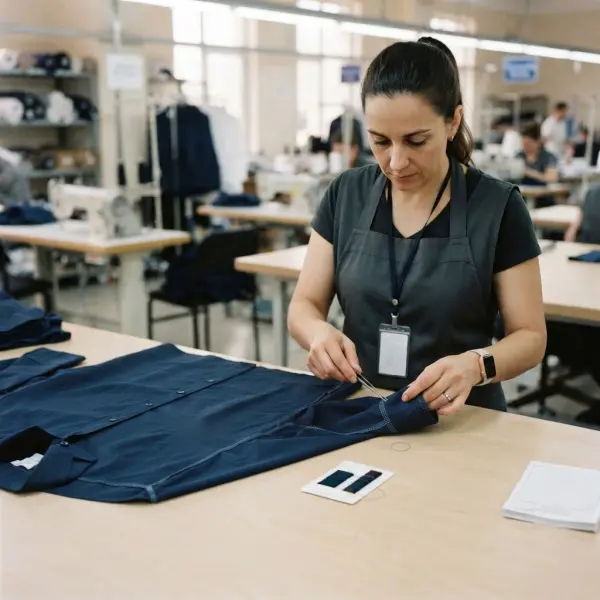
How Should Seam Performance Be Tested?
Testing should answer a defined product question.
A generic instruction to “test the seams” is not sufficiently precise. The brand needs to identify whether it is concerned about breaking force, seam slippage, extension, smoothness, laundering, abrasion, comfort, or appearance.
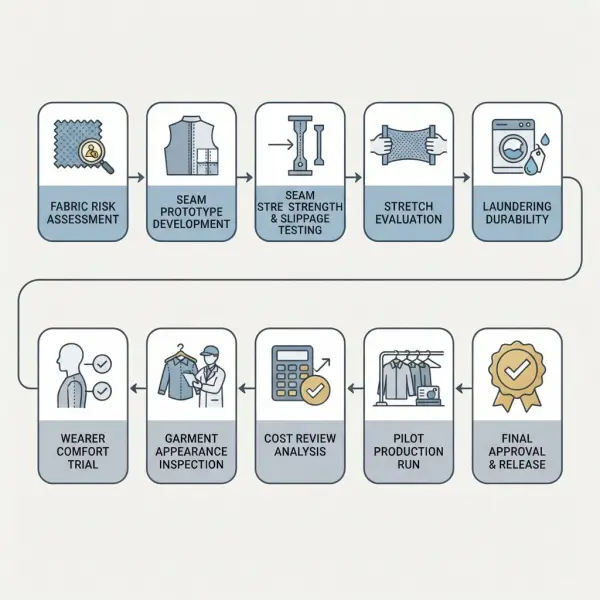
Begin with a Risk Assessment
The development team should consider:
- garment category;
- fabric structure;
- stretch and recovery;
- fit;
- seam location;
- expected load;
- frequency of laundering;
- care method;
- direct skin contact;
- expected product life;
- customer or regulatory requirements.
A loose occasion blouse and a compression legging require different evaluation priorities.
Use Relevant Laboratory Methods
For woven-fabric seam strength and integrity, ASTM D1683/D1683M-22 can support evaluation of specified seam assemblies. For yarn slippage at seams in suitable woven fabrics, the ISO 13936 series provides defined methods. For post-laundering appearance, AATCC TM88B and TM143 address seam smoothness and finished-product appearance under standardized conditions.
These methods should be applied by competent laboratories using the correct scope and current customer specification. A result from one method should not be described as universal proof that a garment is durable or comfortable.
Add Product-Specific Practical Tests
Laboratory testing may need to be combined with realistic product trials:
- repeated dressing through narrow openings;
- squatting, reaching, running, or bending;
- controlled wear trials;
- washing according to the care label;
- inspection after garment dyeing or finishing;
- rubbing at high-contact areas;
- checking under backpacks, belts, or protective equipment;
- evaluating seams against the skin;
- repeated fastening and pocket use.
Practical trials should be documented rather than treated as informal opinion. The team should define the number of cycles, conditions, sample size, defect criteria, and acceptance decision.
Inspect Both Inside and Outside
An inspector should review more than the raw-edge coverage.
The external garment should be checked for:
- seam puckering;
- twisting;
- panel distortion;
- visible ridges;
- seam grinning;
- uneven topstitching;
- show-through;
- asymmetry.
The interior should be checked for:
- exposed raw edges;
- loose loops;
- missed binding;
- rough thread chains;
- skipped stitches;
- excessive trimming;
- inconsistent allowances;
- bulky intersections;
- unsecured thread ends.
The strongest inspection system uses both measurable requirements and an approved visual sample.
How Fashion Businesses Can Apply These Insights
Define Quality by Product Category
A single seam standard cannot serve every garment.
Brands should create category-specific construction requirements for:
- lightweight woven apparel;
- stable woven basics;
- knitwear;
- activewear;
- tailoring;
- denim;
- childrenswear;
- next-to-skin products.
Each category should define the critical quality priorities. These may include seam extension, raw-edge coverage, wash appearance, interior presentation, or alteration allowance.
Build an Approved Seam Library
An approved seam library can include photographs, diagrams, stitch types, seam allowances, thread requirements, machine classes, acceptable tolerances, and tested fabric ranges.
This reduces repeated development and prevents factories from interpreting general terms such as “clean finish” differently.
The library should remain adaptable. A seam approved for one cotton poplin should not automatically be used on a looser, lighter, or more heavily finished fabric simply because the fiber content appears similar.





Comments 0
Leave a CommentSend Comment
Anda harus Login terlebih dahulu untuk dapat memberikan komentar.