

Seersucker vs Poplin: How Fabric Surface Structure Affects Clothing
Quick Answer: What Is the Difference Between Seersucker and Poplin?
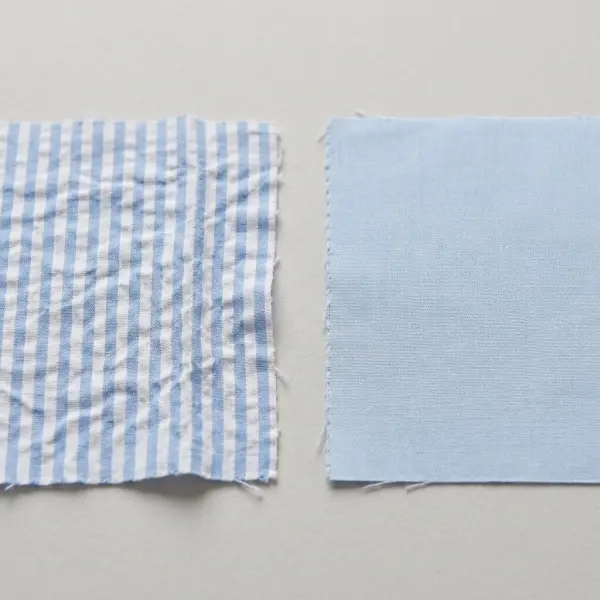
The main difference between seersucker and poplin is their surface structure. Seersucker has intentionally puckered areas that create a raised, three-dimensional texture, while poplin is a plain-weave fabric with a relatively smooth, flat surface and a subtle crosswise rib. Both can be made from cotton or other fibers, and both are used in shirts, dresses, and lightweight apparel.
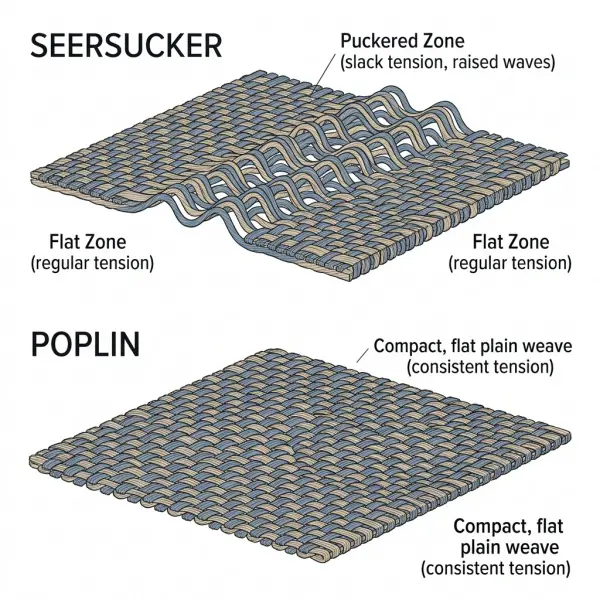
Traditional seersucker uses differential warp tension to create alternating flat and puckered sections. Poplin typically uses closely arranged warp and weft yarns to produce a compact, smooth-looking fabric with a clean appearance.
These structural differences influence how clothing looks, feels, drapes, and responds to pressing. Seersucker is often associated with relaxed casualwear, resort clothing, and textured summer tailoring. Poplin is frequently chosen for crisp shirts, structured dresses, uniforms, and garments requiring a neat surface.
Neither fabric is automatically more breathable, durable, or comfortable than the other. Actual performance depends on fiber composition, fabric weight, yarn density, finishing, and garment construction.
For fashion businesses, choosing between seersucker and poplin is ultimately a decision about design intent, desired surface appearance, manufacturing requirements, and customer expectations.
Understanding the Structural Differences Between Seersucker and Poplin
Seersucker and poplin are both woven textile categories, but their structures are designed to produce different surface effects. The distinction begins with how yarns are arranged, controlled, and interlaced during production.
Poplin is traditionally defined as a plain-weave fabric with a fine crosswise rib, often produced by combining a relatively high density of finer warp yarns with coarser or less densely arranged weft yarns. Seersucker, by contrast, is defined primarily by its puckered surface, which may be created through weaving or other specialized textile processes.
For designers and sourcing teams, this means the two fabric names communicate different types of information. Poplin emphasizes a recognizable weave construction and surface quality, while seersucker emphasizes a three-dimensional texture.
Seersucker: A Woven Fabric With Raised Puckered Areas
Traditional seersucker is manufactured using controlled differences between groups of warp yarns. Certain yarns are woven with additional length relative to the flatter ground sections, creating raised ripples when the fabric relaxes.
The result is a textured surface containing alternating smooth and puckered areas. These sections may appear as vertical stripes, subtle tonal variations, or other repeated patterns.
The puckering is a deliberate construction feature rather than an accidental wrinkle. It can affect fabric thickness, flexibility, and the degree of contact between the textile and the wearer's skin.
Cotton Incorporated's technical guidance on woven cotton seersucker production describes how warp control, fabric density, and finishing conditions influence the formation and stability of the puckered effect.
For a more detailed explanation of the material itself, see how seersucker fabric is constructed and used in fashion.
Poplin: A Compact Plain-Weave Fabric With a Fine Rib
Poplin generally uses a plain-weave structure in which each weft yarn alternates over and under successive warp yarns. Its characteristic subtle crosswise rib arises from the relationship between yarn thickness and thread density.
Unlike the pronounced raised areas of seersucker, the rib in poplin is usually fine enough that the fabric appears smooth under normal viewing conditions.
Poplin is often described as crisp, clean, and relatively stable. These characteristics make it useful for shirts, blouses, uniforms, and garments where surface regularity supports a polished appearance.
The poplin fabric guide published by Nooteboom Textiles identifies its smooth appearance, fine crosswise rib, and suitability for shirts, dresses, and lightweight uniforms.
However, poplin does not have one universal weight, fiber composition, or level of stiffness. Different yarn selections and finishing processes can produce substantially different fabric qualities.
Can Seersucker and Poplin Use Similar Weave Structures?
Yes. Traditional woven seersucker can include plain-weave areas, meaning that the basic over-under interlacing may resemble the weave used in poplin.
The major distinction is that seersucker introduces deliberately different yarn behavior or structural conditions across the fabric to form puckers. Poplin, meanwhile, is ordinarily manufactured to create a comparatively flat and consistent surface.
Therefore, the comparison is not simply between two unrelated weaving techniques. It concerns how the overall fabric structure is engineered and how that engineering affects the finished textile.
This is an important technical distinction when evaluating supplier samples. A close-up photograph of individual yarn intersections may not fully explain the appearance or performance of the entire fabric.
Seersucker vs Poplin: Key Differences at a Glance
The following comparison highlights the practical characteristics most relevant to fashion design, garment manufacturing, and textile sourcing.
|
Comparison factor |
Seersucker |
Poplin |
|
Defining characteristic |
Raised, puckered surface |
Smooth surface with subtle crosswise rib |
|
Typical construction |
Differential-tension woven structure or alternative puckering method |
Compact plain weave |
|
Surface appearance |
Textured and deliberately irregular |
Relatively flat and visually uniform |
|
Common fibers |
Cotton and various blends |
Cotton, polyester-cotton, and other compositions |
|
Typical handfeel |
Variable, often textured and flexible |
Often smooth, crisp, or firm |
|
Fabric thickness |
Raised areas increase effective surface thickness |
Generally more uniform thickness |
|
Draping behavior |
Influenced by pucker depth and fabric stiffness |
Influenced by yarns, density, weight, and finish |
|
Pressing requirements |
Texture should generally be preserved |
Smooth pressing may be desirable |
|
Wrinkle appearance |
Intentional puckers can visually disguise some incidental creases |
Unwanted creases may be more visible |
|
Common applications |
Casual shirts, resortwear, dresses, summer tailoring |
Dress shirts, blouses, uniforms, dresses |
|
Print presentation |
Texture may visually interrupt fine details |
Smooth surface often supports clear printed details |
|
Production considerations |
Texture consistency and tension control |
Surface uniformity and conventional woven quality control |
These distinctions provide a useful starting point, but they should not be treated as fixed performance rankings.
A lightweight cotton poplin may be softer and more flexible than a heavy seersucker. Conversely, a carefully engineered lightweight seersucker may have a more relaxed handle than a densely constructed poplin.
Comparisons become meaningful when fabric composition, weight, finishing, and intended use are considered together.

How Does Fabric Surface Structure Affect Clothing Appearance?
Fabric surface structure strongly influences the visual character of a garment. Even when two textiles share the same color, fiber composition, and general weight category, their surfaces can produce noticeably different styling effects.
Seersucker introduces visible texture that becomes part of the garment's design. Poplin provides a cleaner visual plane that allows silhouette, seam lines, and other construction details to stand out.
This difference matters because fabric selection communicates style before the consumer examines the garment's technical specifications.
Seersucker Creates a Relaxed, Textured Appearance
Seersucker's puckered surface introduces small highlights and shadows. Under directional lighting, the raised areas can become more visible, producing a sense of depth even when the fabric is a single color.
This quality makes seersucker useful for relatively simple garments. A basic short-sleeved shirt can appear more distinctive when made from textured seersucker rather than a flat woven material.
The irregular surface also creates a relaxed visual effect because the textile is not expected to appear perfectly smooth.
For contemporary brands, this can support casual collections, resortwear, and selected styles that emphasize tactile materials.
However, prominent texture can compete with complex garment details. Designers using oversized pockets, decorative pleats, or elaborate panel construction may need to reduce the intensity of the seersucker pattern to avoid an overly busy appearance.
Poplin Supports Clean Lines and Precise Styling
Poplin creates a different visual impression. Its relatively flat surface helps reveal garment construction, making it suitable for sharply defined collars, plackets, pleats, and tailored seam lines.
A white cotton poplin shirt, for example, may emphasize the relationship between collar shape, sleeve volume, and overall fit. The fabric provides a relatively quiet background for those structural details.
This makes poplin useful in both conventional shirting and contemporary fashion designs with exaggerated silhouettes.
In a structured poplin dress, the smooth surface can also support crisp folds and geometric volume. However, the outcome depends on fabric stiffness and finishing. Not every poplin has sufficient body for sculptural construction.
The key design advantage is surface regularity rather than a guaranteed level of rigidity.
How Texture Influences Color and Print Presentation
Surface geometry also affects how consumers perceive colors and patterns.
Seersucker's raised sections can create small variations in reflected light, making a solid color appear visually textured. Printed details may follow the puckered contours, which can alter their apparent sharpness or alignment.
Poplin usually provides a more uniform surface for printing. This can be useful for fine geometric motifs, detailed illustrations, and designs requiring consistent visual registration.
For fashion brands developing printed collections, the choice should follow the artwork.
A large floral print may work well on either material, while a highly detailed small-scale graphic may be easier to present clearly on a smooth poplin.
How Do Seersucker and Poplin Differ in Comfort and Wearability?
Comfort is one of the most commonly discussed differences between seersucker and poplin, particularly for warm-weather clothing.
Seersucker's raised texture can create small air spaces between the fabric and skin. Poplin generally presents a flatter contact surface, although the actual amount of contact depends on garment fit, movement, and fabric stiffness.
These differences can influence tactile sensation and thermal behavior, but neither structure guarantees superior comfort in every situation.
Skin Contact and Surface Sensation
Seersucker's raised areas may reduce continuous fabric-to-skin contact. For some wearers, this produces a less clingy sensation, particularly when the garment is loose-fitting.
The degree of benefit depends on the depth and distribution of the puckers. Shallow textures may behave differently from strongly raised constructions.
Poplin typically provides more consistent surface contact. A fine cotton poplin can feel smooth against the skin, although a stiff or densely woven version may not feel particularly soft.
There is therefore no universal answer to which material feels better. Some wearers may prefer the subtle texture of seersucker, while others may prefer the smooth handfeel of poplin.
Fit, seam placement, fiber composition, and fabric finishing can outweigh the difference between the two surface structures.
Air Permeability Is Not the Same as Surface Texture
Air permeability describes how readily air passes through a textile under specified testing conditions. It is influenced by yarn arrangement, fabric porosity, thickness, and finishing.
Seersucker's puckering creates spaces around the fabric surface, but those spaces do not necessarily indicate that air passes easily through the woven material itself.
Similarly, a smooth poplin may have relatively high or low air permeability depending on its construction.
This distinction is supported by research published in the International Journal of Clothing Science and Technology. The study Comfort-related properties of seersucker fabrics in dry and wet state examined how yarn selection and seersucker construction influence thermal properties and air permeability.
The researchers found that some structural modifications, including the use of elastomeric weft yarn, could tighten the fabric and reduce air permeability.
For product developers, the implication is clear: fabric texture should not substitute for performance testing when airflow is part of the product promise.
Thermal Resistance and the Role of Trapped Air
Another important consideration is thermal resistance, which describes how strongly a material or textile system resists heat transfer.
Puckered seersucker can have a greater effective thickness because of its raised surface. This geometry may increase thermal resistance compared with certain flat woven constructions.
Research published in the AUTEX Research Journal, Investigation of Heat Transfer in Seersucker Woven Fabrics Using Thermographic Method, examined how the raised sections and air spaces affect heat transfer through seersucker textiles.
This introduces an important qualification to the popular assumption that seersucker is always cooler than smooth fabrics.
The raised surface may reduce direct contact with the skin, but air trapped in the structure can also contribute to insulation. Whether the overall garment feels comfortable depends on the interaction between airflow, moisture, environmental conditions, fabric properties, and fit.
A definitive seersucker-versus-poplin thermal ranking cannot be established from surface appearance alone.
Moisture Behavior and Fabric Composition
Moisture handling is another area where fiber composition and finishing matter more than fabric names alone.
Cotton seersucker and cotton poplin may share some general moisture-related characteristics because they use the same fiber. However, their construction can still influence absorption behavior, drying, and the way moisture interacts with the skin.
Polyester-cotton blends may behave differently, and specialized finishes can further change moisture transport or drying performance.
In apparel development, comfort claims should therefore be based on the actual fabric specification.
A brand selling lightweight summer shirts should not assume that a seersucker label automatically establishes better moisture management than a comparable poplin.
How Fabric Structure Changes Drape and Garment Silhouette
The difference between seersucker and poplin becomes especially visible once the fabric is cut and assembled into clothing.
Fabric drape describes how a textile hangs or forms folds under its own weight. It is influenced by bending stiffness, shear behavior, mass, yarn construction, and finishing.
Seersucker's puckered surface introduces additional geometric complexity, while poplin's relatively flat construction often produces more predictable surface behavior during pattern development.
Seersucker and Natural Garment Volume
Seersucker can create a fuller-looking silhouette because its raised sections occupy space and reflect light unevenly.
In a loose shirt, this can support a relaxed appearance. In a dress with substantial gathering, however, prominent puckering may increase perceived volume beyond what the designer expected.
The fabric's bending behavior also matters. A soft, finely puckered quality may fall gently, while a heavily textured, dense seersucker can resist folding and create a more structured shape.
Designers should therefore evaluate drape using the actual selected fabric rather than assuming that all seersucker qualities behave alike.
This is particularly important for products with multiple gathers, tiered panels, or fitted waistlines.
Poplin and Defined Silhouette Construction
Poplin is frequently chosen when designers want a relatively clean relationship between fabric and pattern.
A crisp poplin can support a structured shirt collar, a defined sleeve shape, or controlled volume in a dress. Its flat surface can also make fold lines and seam transitions more visually precise.
However, poplin is not necessarily stiff. Lightweight qualities made from fine yarns may have a softer handle, while heavier or specially finished versions can provide greater structure.
For this reason, it is useful to evaluate fabric weight and bending behavior alongside appearance.
When creating designs with pleats, tucks, and gathers in garment construction, the difference between textured seersucker and smooth poplin can affect how clearly each detail is expressed.
Seersucker vs Poplin for Different Clothing Categories
Both fabrics can be used across similar apparel categories, but their surface structures influence the design outcome.
The more useful sourcing question is not which material is generally better. It is which fabric provides the intended appearance, comfort, construction behavior, and maintenance profile for a specific garment.
Shirts: Relaxed Texture or Crisp Presentation?
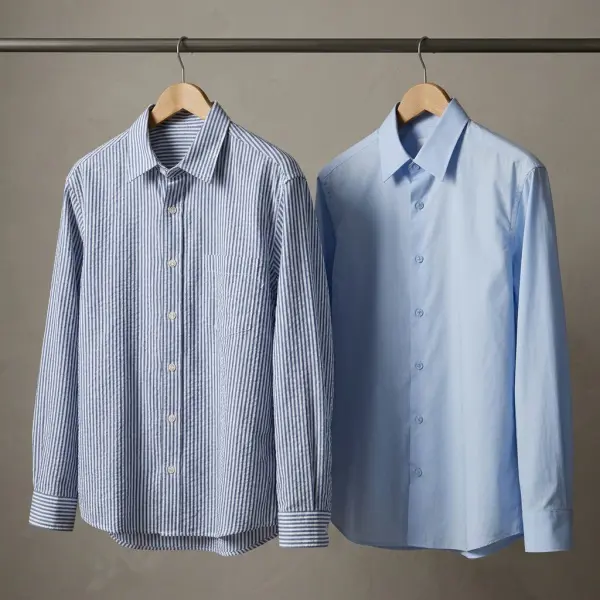
Seersucker is frequently associated with casual shirts, short-sleeved resort styles, and relaxed button-down designs. Its puckered surface creates visual interest and can reduce the emphasis on perfectly smooth pressing.
Poplin is widely used in dress shirts, business casual shirts, and uniform tops because its clean appearance supports sharp collars, plackets, and seam details.
Both can work in casual clothing. A contemporary oversized poplin shirt may look relaxed, while a carefully tailored seersucker shirt can appear refined.
The distinction is therefore one of material character rather than a rigid division between formal and informal clothing.
Dresses: Surface Interest or Structured Shape?
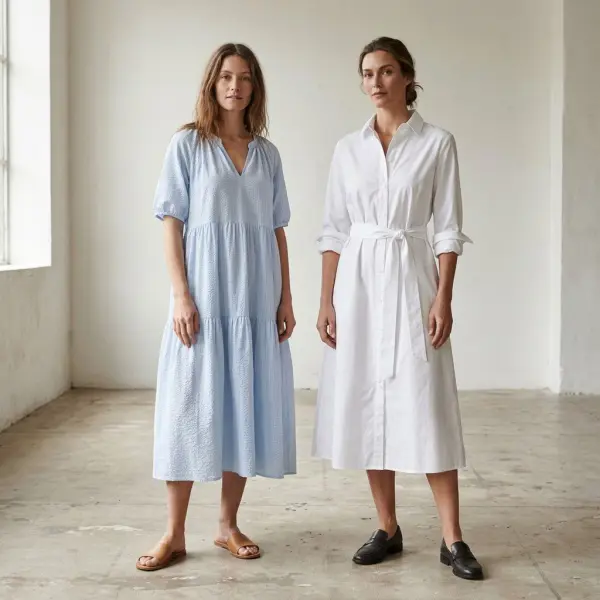
Seersucker dresses often use the fabric's texture as a primary design feature. Solid-color seersucker can add depth without prints, while lightly puckered qualities can complement loose summer silhouettes.
Poplin dresses may emphasize shape instead. A crisp poplin shirt dress, for example, can highlight the collar, waist shaping, and arrangement of buttons.
For highly detailed designs, the smoothness of poplin may make structural elements easier to see.
Yet both materials can support gathered or relaxed dresses when the chosen fabric weight and flexibility are appropriate.
Tailoring and Lightweight Jackets
Seersucker is used in certain summer jackets, trousers, and coordinated suits. Its textured surface creates a distinctive appearance often associated with less formal warm-weather tailoring.
Poplin can also be used in lightweight jackets, particularly casual overshirts, shirt jackets, and selected unlined outerwear.
The choice requires more than comparing the outer fabric.
Interfacing, linings, seam construction, shoulder shape, and garment weight can substantially change how either material performs.
A heavily constructed seersucker jacket may not feel especially lightweight, while an appropriately engineered poplin overshirt may provide a comfortable alternative for casual layering.
Uniforms and Commercial Apparel
Poplin is a familiar option for shirts used in hospitality, office uniforms, retail operations, and other commercial apparel categories. Its smooth surface can support a consistent visual presentation, including embroidery or printed branding.
Seersucker may be appropriate where a more relaxed appearance is desired, such as selected resort uniforms or casual hospitality clothing.
However, corporate apparel purchasing often prioritizes durability, color consistency, laundering performance, dimensional stability, and supplier continuity.
Those requirements should be tested rather than inferred from the fabric name.
For businesses managing large uniform programs, material availability and repeatability may be more important than small differences in surface appearance.
Manufacturing Differences: Cutting, Sewing, and Finishing
Seersucker and poplin can require different handling during garment production.
Both use conventional woven garment-making techniques, but the raised surface of seersucker creates additional considerations during spreading, cutting, sewing, and pressing.
Poplin generally provides a flatter working surface, although thin or slippery varieties can present their own handling challenges.
Fabric Spreading and Cutting Accuracy
Poplin usually lies relatively flat on a cutting table, making grain alignment and pattern placement straightforward when the fabric is properly prepared.
Seersucker may require greater attention to surface distortion. Excessive tension during spreading can temporarily flatten or stretch puckered areas, potentially affecting cut dimensions after the material relaxes.
For striped seersucker, operators must also consider both visual stripe alignment and the position of the structural puckers.
A consistent cutting procedure is important when multiple garment panels must match.
Sewing Behavior and Seam Appearance
Seersucker's raised texture can influence feeding behavior through industrial sewing machines. When fabric sections pass unevenly under the presser foot, additional unwanted distortion may occur if machine settings are unsuitable.
The challenge is distinguishing the intended puckering of the textile from sewing-related seam puckering.
Poplin has a comparatively uniform surface, making certain seam defects easier to detect visually. However, tightly woven poplin may still develop seam puckering because of thread tension, needle selection, feed imbalance, or fabric displacement.
The appropriate sewing settings depend on the specific fabric, not simply its category.
For both materials, sampling should establish suitable needle size, stitch length, thread selection, and machine tension.
Pressing and Surface Preservation
Pressing is one of the clearest operational differences between the two fabrics.
Poplin garments are often pressed to produce a clean, smooth appearance. Depending on fiber content and finishing, collars, facings, and seams may respond well to conventional controlled pressing techniques.
Seersucker generally requires an approach that respects its intentionally raised surface.
Excessive pressure may temporarily suppress puckering or make the texture appear inconsistent around garment seams.
This does not mean seersucker should never be pressed. It means the finishing procedure should preserve the intended fabric character.
The production team should confirm suitable temperature, steam, pressure, and handling requirements during sample approval.
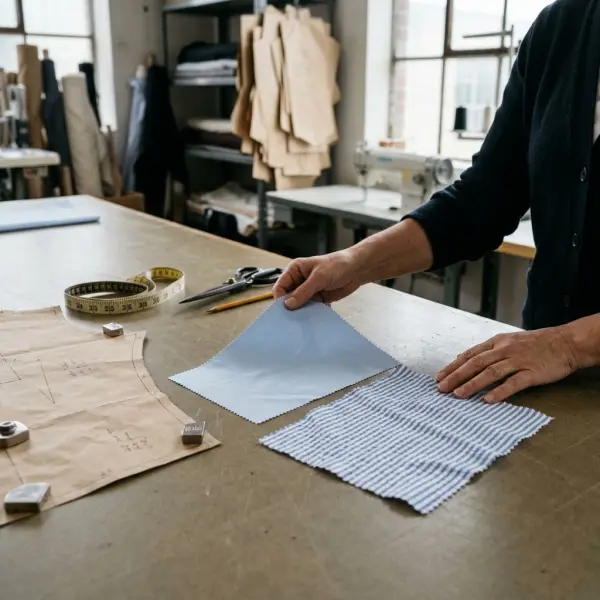
Which Fabric Is Easier to Maintain?
Maintenance requirements depend on composition, finishing, garment construction, and care instructions. Nevertheless, the surface structures of seersucker and poplin create different expectations about appearance after laundering.
Seersucker's intentionally textured surface often makes minor incidental creases less visually prominent. Poplin's smoother surface may reveal unwanted wrinkles more clearly, especially in untreated cotton qualities.
This difference helps explain why seersucker is frequently associated with casual, low-pressing styling.
Wrinkle Visibility and Ironing Expectations
Seersucker may require less effort to achieve its intended textured appearance because the garment does not need to be perfectly smooth.
However, its puckering should not be confused with universal wrinkle resistance. Areas such as plackets, collars, waistbands, or seams can still crease.
Poplin can show wrinkles clearly because the surrounding surface is relatively flat. This is particularly noticeable in certain crisp cotton constructions.
Yet wrinkle-resistant finishing or blended fibers can substantially change poplin's maintenance profile.
A polyester-cotton poplin designed for commercial uniforms, for example, may have different care requirements from an untreated lightweight cotton poplin.
Shrinkage and Dimensional Stability
Both seersucker and poplin can experience dimensional changes during washing.
For cotton qualities, shrinkage depends on yarn characteristics, fabric processing, residual manufacturing tension, and laundering conditions.
Seersucker introduces an additional consideration because relaxation may affect the appearance or geometry of puckered areas.
Poplin may be easier to evaluate visually as a flat fabric, but dimensional stability still requires measurement.
Manufacturers should establish acceptable length and width changes after the intended care cycle.
For finished garments, testing should also verify critical measurements such as chest width, garment length, sleeve length, and collar dimensions.
Cost, Availability, and Sourcing Implications
The commercial differences between seersucker and poplin extend beyond garment appearance.
Production complexity, supplier capability, minimum order quantities, material consumption, and finishing requirements can influence the sourcing decision.
Traditional woven seersucker may require specialized warp control and additional attention to the consistency of its puckered sections. Poplin generally uses a more conventional plain-weave manufacturing approach.
This does not establish a universal price difference, but it affects the questions buyers should ask.
Why Seersucker May Require More Specialized Production
Traditional woven seersucker relies on controlled differences between fabric sections. Achieving a stable and repeatable texture requires attention to warp tension, yarn density, finishing, and related production variables.
Research published in Materials in 2026, Assessment of Surface Geometry of Puckered Area of SeerSucker Woven Fabrics, describes challenges involving yarn consumption, production efficiency, and consistent pucker geometry in woven seersucker.
These requirements can influence supplier capacity and production planning.
However, commercial seersucker fabrics made through alternative processes may have different manufacturing economics. Buyers should confirm the actual production method rather than assuming every seersucker quotation reflects traditional weaving.
Poplin as a Versatile Sourcing Option
Poplin is available in multiple fiber compositions, finishes, and weight categories. Suppliers may offer qualities suitable for fashion shirting, dresses, uniforms, and other woven apparel.
This range can give sourcing teams flexibility when balancing appearance, cost, and performance requirements.
Nevertheless, a supplier's basic poplin offering may not match the quality needed for a premium garment. Yarn consistency, fabric density, finishing, and dimensional stability still influence commercial suitability.
A finely constructed poplin using expensive yarns and specialized finishing may cost more than an ordinary seersucker quality.
Comparisons should therefore use actual supplier quotations with equivalent technical and purchasing conditions.
Supplier Consistency and Repeat Orders
Consistency matters especially when a brand plans to repeat a successful product across seasons.
Poplin buyers should monitor shade, handfeel, width, and dimensional performance between production lots.
Seersucker buyers should assess those same factors while also documenting the appearance and regularity of the puckered areas.
For products with strong texture visibility, a small change in pucker depth may make new inventory look different from previously approved stock.
Physical reference swatches and agreed production tolerances can reduce this risk.
How Should Fashion Brands Choose Between Seersucker and Poplin?
A practical fabric decision begins with the intended garment rather than the material name.
Design teams should identify which characteristics are necessary for the product: visual texture, clean styling, drape, skin contact, maintenance expectations, print presentation, or manufacturing simplicity.
A useful selection framework connects these priorities with sourcing and production realities.
|
Product requirement |
Fabric to evaluate first |
Reason |
|
Distinctive puckered surface |
Seersucker |
Texture becomes an intentional design feature |
|
Smooth shirt fabric |
Poplin |
Supports clean surface presentation |
|
Relaxed resort shirt |
Seersucker |
Works naturally with casual textured styling |
|
Crisp shirt dress |
Poplin |
Can support defined folds and structured details |
|
Fine printed artwork |
Poplin |
Flat surface may support clearer print presentation |
|
Traditional textured summer suit |
Seersucker |
Provides recognizable warm-weather tailoring character |
|
Lightweight uniform shirt |
Poplin |
Common choice for clean commercial apparel |
|
Lowest thermal resistance |
Test both |
Surface type alone cannot determine the result |
|
Minimal visible creasing |
Depends on specification |
Texture and wrinkle-resistant finishing both matter |
|
Cost-sensitive bulk production |
Compare actual quotations |
Supplier, composition, and construction determine cost |
These recommendations indicate where to begin fabric evaluation, not which textile is guaranteed to win.
A relaxed shirt can be made from poplin, and a structured dress can be made from seersucker. What matters is whether the chosen fabric delivers the intended result after sampling and manufacturing.
Start With the Garment's Visual Identity
A brand developing a collection of minimal, crisp shirts may benefit from poplin because the fabric complements precise tailoring and a clean presentation.
A brand developing tactile casualwear may prefer seersucker because the raised surface adds visual character without additional embellishment.
In both cases, material selection should reinforce the product's positioning.
An attractive fabric is not necessarily the right fabric when it conflicts with the garment's intended silhouette.
Evaluate Actual Samples Under Comparable Conditions
Brands should compare fabrics using consistent criteria rather than relying entirely on supplier descriptions.
A reliable evaluation can include:
- Fiber composition: Confirm the materials and blends used in each sample.
- Fabric weight and thickness: Measure relevant properties rather than judging by hand alone.
- Surface structure: Compare puckering, smoothness, and consistency.
- Drape and handfeel: Assess the fabric on a garment form or in a sewn sample.
- Comfort performance: Test air permeability and other relevant properties when needed.
- Manufacturing behavior: Evaluate cutting, sewing, pressing, and finishing.
- Care performance: Verify dimensional stability and appearance after laundering.
The value of this process lies in separating subjective visual preference from measurable product requirements.
Consider Customer Expectations and Retail Communication
Consumers rarely evaluate fabric through weaving terminology alone. They respond to how a garment looks, feels, fits, and behaves during normal use.
For seersucker products, retail descriptions can emphasize deliberately puckered texture, garment styling, and verified care characteristics.
For poplin products, descriptions may emphasize the smooth surface, crisp appearance, and specific attributes supported by the garment's construction.
Claims such as "breathable," "easy care," or "comfortable in hot weather" should reflect actual product characteristics rather than being assigned automatically to the fabric category.
Clear material communication helps customers understand the product without overstating its performance.

Common Mistakes When Comparing Seersucker and Poplin
Several misconceptions can affect fabric selection when buyers focus too heavily on material names or visual appearance.
Mistake 1: Assuming Seersucker Is Always Cooler Than Poplin
Seersucker is frequently promoted as a summer fabric because its raised texture can reduce direct skin contact. However, this does not guarantee better cooling or higher air permeability.
Some seersucker constructions have relatively high thermal resistance because their puckered surfaces contain additional air spaces. A lightweight, relatively open poplin may perform differently from a dense seersucker.
Brands should evaluate the actual textile and garment conditions rather than treating the fabric's traditional seasonal association as technical proof.
Mistake 2: Assuming Poplin Is Always Stiff
Poplin is often associated with crisp shirts, but its handfeel varies considerably.
Fine yarns, lighter constructions, fiber blends, and finishing methods can produce softer poplin qualities. Conversely, some heavier constructions can feel quite firm.
Choosing poplin based on the assumption that it always creates strong structure may result in a garment that lacks the desired shape.
The appropriate approach is to assess drape, bending stiffness, and finished-garment behavior during sampling.
Mistake 3: Treating Seersucker's Puckering as a Manufacturing Defect
The raised areas of seersucker are intentional. Attempting to remove them completely through pressing can interfere with the material's defining appearance.
The challenge for quality control is distinguishing designed surface irregularity from accidental distortion.
A physical reference sample, approved texture specification, and appropriate finishing instructions can help teams maintain the intended appearance.
Mistake 4: Comparing Fabrics Without Controlling Other Variables
Comparing a lightweight cotton seersucker with a heavy polyester-cotton poplin cannot isolate the effect of surface structure.
Differences in fiber composition, density, weight, and finishing may dominate the result.
This becomes especially problematic when buyers use such comparisons to make claims about comfort, durability, or cost.
For technically meaningful evaluation, comparable samples should be selected wherever possible, and remaining differences should be documented.
Mistake 5: Ignoring the Relationship Between Fabric and Garment Design
A fabric may look attractive on a swatch but behave differently when assembled into clothing.
Prominent seersucker puckers can affect perceived volume and seam appearance, while crisp poplin may make unwanted folds more visible.
The consequence may be an unsatisfactory fit or design outcome rather than a fabric defect.
Garment sampling should therefore confirm whether the textile supports the intended construction before the brand commits to bulk purchasing.
Important Technical Caveats Before Making a Fabric Decision
Seersucker and poplin should not be evaluated as universally opposing





Comments 0
Leave a CommentSend Comment
Anda harus Login terlebih dahulu untuk dapat memberikan komentar.