
Interlining Fabric Explained for Garment Structure and Support
A crisp shirt collar, a jacket front that holds its line, or a waistband that stays stable through repeated wear rarely depends on the visible fabric alone. Inside many garments is a second material doing structural work that the customer may never see: the interlining.
Interlining is easy to overlook during early product development because it is normally hidden once the garment is finished. Yet selecting the wrong interlining can change how a garment feels, folds, stretches, presses, washes, and ultimately looks on the body. A lightweight shell can become unexpectedly rigid. A collar can collapse after laundering. A stretch garment can lose the mobility intended by the designer.
For fashion brands and manufacturers, interlining therefore sits at the intersection of design intent and production engineering. The decision is not simply whether a garment needs reinforcement. Teams need to determine where support is required, how much support is appropriate, and which interlining construction works with the outer fabric and intended care process.
Quick Answer
Interlining fabric is a textile layer incorporated inside selected parts of a garment to provide support, reinforcement, dimensional stability, shape, or controlled flexibility without becoming a prominent part of the finished appearance. It is commonly used in areas such as collars, cuffs, shirt plackets, waistbands, jacket fronts, lapels, pocket openings, and other components that need more stability than the shell fabric can provide on its own.
Interlinings can be made with woven, knitted, or nonwoven textile bases. They may be attached by sewing or supplied as fusible materials with a heat-activated adhesive coating. Commercial interlining ranges use these different constructions because a structured coat, stretch blazer, lightweight blouse, formal shirt, and casual trouser do not require the same mechanical behavior. Industry suppliers such as Freudenberg Performance Materials describe woven, weft-inserted, and nonwoven interlinings across multiple apparel categories.
The right choice should support the garment while preserving the intended drape, handfeel, stretch, appearance, care performance, and manufacturing consistency.
What Is Interlining Fabric?
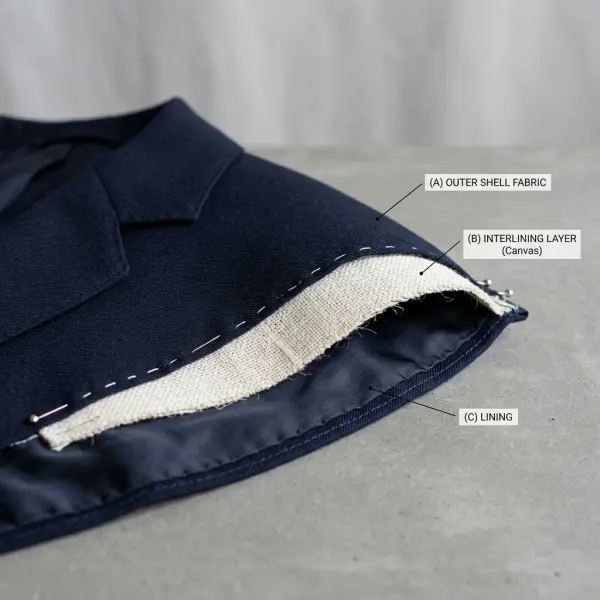
Interlining is a hidden textile component used inside a garment to modify or support the behavior of the outer fabric. Depending on the application, it may provide additional firmness, reinforcement, dimensional stability, resilience, shape retention, or controlled flexibility.
That definition matters because interlining should not automatically be understood as a stiff material. Modern interlining systems cover a broad range of constructions and weights. Some are designed to make a shirt collar noticeably firm; others are sufficiently light and elastic to support a soft blouse or stretch garment without destroying its drape.
Commercial suppliers manufacture interlinings as woven, knitted, and nonwoven structures, including both fusible and non-fusible alternatives. Freudenberg, for example, lists fusible and non-fusible interlinings made from cotton, polyester, and blends for shirt applications, while Chargeurs PCC categorizes its structural garment materials across fusible, sew-in, woven, knitted, and nonwoven solutions.
The terminology can become confusing because interlining and interfacing are sometimes used differently across companies, markets, sewing traditions, and supplier catalogs. In many apparel contexts, both terms refer to hidden structural materials applied to garment components. Production teams should therefore rely on a supplier's technical specification and intended application rather than assuming that terminology alone identifies the material's performance.
Why Does a Garment Need Interlining?
The visible fabric is selected partly for aesthetics: color, surface, drape, texture, weight, stretch, and handfeel. Those characteristics do not necessarily provide enough structural performance for every component of the garment.
Consider a lightweight cotton shirt. The body fabric may need to remain comfortable and relatively soft. The collar, however, is expected to maintain a defined edge and controlled shape. Making the entire shirt from a heavier fabric simply to stabilize the collar would solve one construction problem by creating another.
Interlining allows the product developer to reinforce specific zones rather than changing the entire garment fabric.
A similar principle applies to tailoring. A jacket front has to behave differently from a flowing dress panel, even when designers want both garments to feel relatively lightweight. Strategic internal support can help control areas such as the front body, lapel, pocket region, or hem without making every part of the garment equally rigid.
Typical applications include:
- shirt collars and collar stands;
- cuffs and plackets;
- jacket and coat fronts;
- lapels and undercollars;
- waistbands;
- pocket openings and pocket flaps;
- selected hems and edges;
- belt loops and other narrow components requiring stabilization.
Freudenberg identifies collars, cuffs, waistbands, and plackets among common structural applications in womenswear, while specialized tapes can also be used to stabilize garment edges and pocket openings.
This selective approach is what makes interlining commercially useful. The material is not there merely to make a garment "stronger." Its job is to create the specific mechanical behavior required by each garment component.
Interlining Is an Engineered Component, Not Just an Extra Layer
One of the most common misconceptions is treating interlining as if it were simply another piece of fabric placed behind the shell.
In practice, its behavior depends on several variables: the textile structure of the base, fiber composition, weight, thickness, resilience, stretch characteristics, surface treatment, and—when the product is fusible—the adhesive system and bonding conditions.
That is why two interlinings of approximately similar weight can behave very differently.
A product developer might need an interlining that prevents excessive deformation along a waistband. Another garment may need support that stretches and recovers with a knitted shell. A tailored jacket may require controlled body and resilience while still allowing the front to roll and move naturally.
The purpose is therefore not maximum stiffness.
Good interlining selection creates the required support with the least undesirable change to the character of the shell fabric.
This becomes particularly important with lightweight, elastic, delicate, coated, washed, or highly textured materials. The more sensitive the shell fabric, the less reliable it becomes to select an interlining based solely on a generic description such as "lightweight" or "medium weight."
The Three Main Interlining Base Constructions
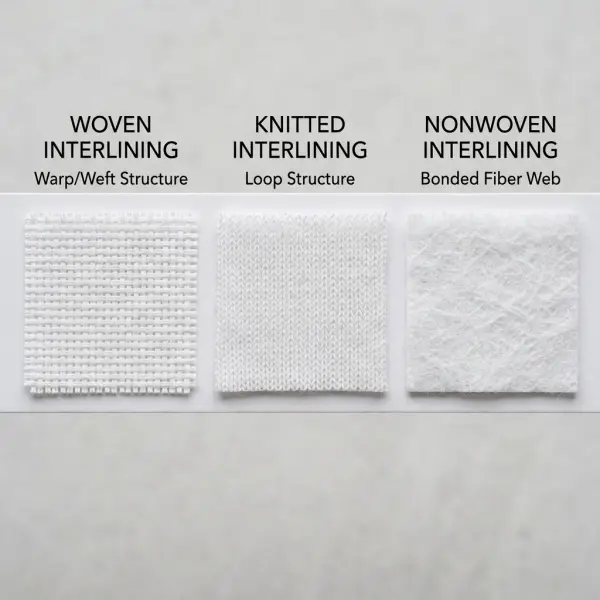
Most apparel teams will encounter three major textile bases: woven, knitted, and nonwoven interlinings. Each can be engineered in numerous ways, so these categories should be treated as starting points rather than rigid performance rankings.
A technical review of fusible interlining in garment manufacturing similarly identifies woven, nonwoven, and knitted structures among the principal constructions used for apparel applications.
|
Interlining base |
Basic construction |
Typical characteristic |
Common selection logic |
|
Woven |
Interlaced warp and weft yarns |
Directional stability and textile-like behavior |
Structured garments and components where controlled support is needed |
|
Knitted |
Interlooped yarn structure, sometimes with inserted weft yarns |
Greater potential for flexibility, stretch, and recovery |
Stretch, softer, or more movement-sensitive applications |
|
Nonwoven |
Fibers formed into a web and bonded rather than woven or knitted |
Wide range of engineered weights and economical processing options |
Broad ready-to-wear reinforcement applications depending on specification |
The table is deliberately general. A knitted interlining is not automatically soft enough for every stretch garment, and a nonwoven product is not automatically stiff. Supplier construction, weight, fiber system, finishing, adhesive technology, and application all influence actual performance.
Woven Interlining
Woven interlining is produced from warp and weft yarns, giving it a recognizable textile grain and directional structure. This can be valuable when a garment component requires controlled dimensional stability while retaining a fabric-like construction.
Woven interlinings are commonly associated with shirts, coats, tailored garments, trousers, and other products where the pattern maker or technical team needs predictable behavior along specific directions.
The outer fabric and interlining grain orientation can matter. Cutting or applying a directional interlining without considering the shell's movement can alter the component's flexibility or create unexpected tension.
Woven does not necessarily mean heavy or rigid. Fine woven constructions can be designed for lighter applications, while heavier variants may support more structured products.
Knitted Interlining
Knitted interlinings use interconnected loops rather than conventional warp-and-weft interlacing. Depending on construction, they can provide greater adaptability to fabrics that need movement or elasticity.
This makes them relevant to product categories where forcing a highly stable backing onto an elastic outer fabric would compromise the design.
Some commercial knitted interlinings use weft insertion to combine stability in one direction with controlled elasticity in another. Chargeurs PCC, for example, describes weft-inserted knitted interlinings as combining directional stability with elasticity and recovery characteristics.
For a stretch blazer or fitted apparel product, this relationship can be critical. Reinforcement still needs to move sufficiently with the shell instead of turning the supported area into an immobile patch.
Nonwoven Interlining
Nonwoven interlinings are produced by forming fibers into a web and bonding them rather than creating fabric through conventional weaving or knitting. Thermal and chemical bonding are among the manufacturing approaches used for nonwoven structures.
They are widely used because their structure can be engineered across different weights and performance levels and because they can be efficient for industrial garment manufacturing.
Yet purchasing a material simply because it is described as "nonwoven" gives the sourcing team very little useful information. Fiber composition, bonding method, density, weight, dimensional stability, handfeel, adhesive specification, and compatibility with the shell still need to be assessed.
Fusible and Sew-In Describe Attachment, Not the Base Structure
Another distinction is important: woven, knitted, and nonwoven describe how the textile base is constructed, while fusible and sew-in describe how the interlining is incorporated into the garment.
A fusible interlining contains a thermoplastic adhesive coating that is activated using controlled heat, pressure, and time so that the interlining bonds to the shell fabric. A sew-in interlining is incorporated mechanically through garment construction rather than being permanently bonded over its surface with fusible adhesive.
This distinction means that a woven interlining can be fusible, but another woven interlining can be sew-in. The same broad logic applies to other base constructions.
The practical implications are significant enough to deserve their own discussion. Fashion teams evaluating equipment requirements, adhesive compatibility, bonding quality, heat-sensitive fabrics, tailoring methods, and production efficiency can explore these considerations in Fusible vs Sew-In Interlining: What Fashion Teams Should Know.
For this introductory discussion, the key point is simpler: do not confuse textile construction with attachment method.
How Interlining Changes the Behavior of a Garment
Interlining affects a garment by changing the mechanical behavior of selected components.
That change may be intentionally visible—such as the sharply defined collar of a formal shirt—or deliberately subtle, as when a lightweight garment needs just enough reinforcement to keep a facing or opening from becoming unstable.
Depending on the specification, interlining can influence:
- bending stiffness and firmness;
- dimensional stability;
- resilience and recovery;
- edge definition;
- local stretch behavior;
- handling during sewing;
- resistance to distortion around high-stress areas;
- perceived body and handfeel.
The challenge is that these characteristics are interconnected.
Increasing support may improve shape but make the garment feel too rigid. A highly stable backing may control distortion but restrict stretch. An unsuitable fusible combination may look acceptable immediately after pressing but respond poorly to later washing or finishing.
The appropriate target is therefore controlled compatibility, not simply reinforcement.
A deeper examination of how these internal materials influence silhouette, stability, and visual quality belongs in How Interlining Improves Garment Shape, Stability, and Finish.
Where Interlining Decisions Enter the Product Development Process
Interlining selection should ideally begin during product development rather than being left entirely to bulk production.
A designer may specify a sharp collar, clean jacket front, or soft but stable waistband. Those descriptions need to be translated into measurable construction decisions by pattern makers, technical developers, fabric teams, and factories.
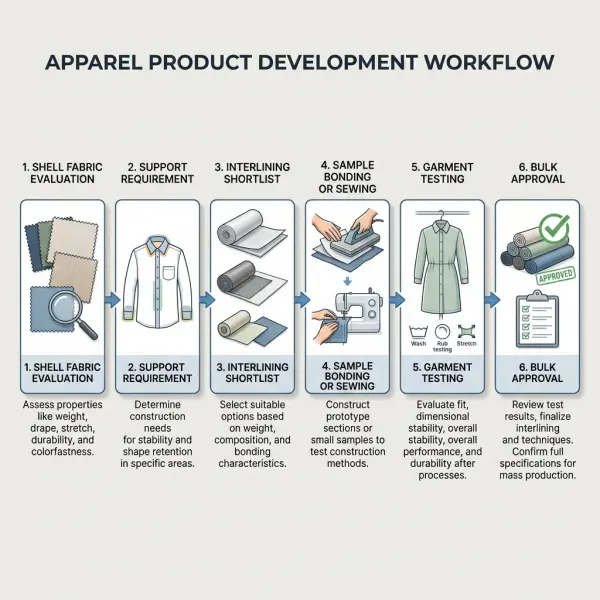
A typical development sequence may look like this:
- identify which garment components require support;
- assess the shell fabric's weight, structure, stretch, texture, and heat sensitivity;
- define the required degree of stability or flexibility;
- shortlist technically compatible interlinings;
- construct or fuse test specimens;
- assess appearance, handfeel, bond or attachment performance, and dimensional behavior;
- test the complete garment through the intended care or finishing process;
- approve the final specification before bulk production.
The sequence sounds straightforward, but interlining problems often appear because one of those steps is compressed. A supplier substitutes a similar product. The shell fabric changes slightly between development and bulk. Production uses different press conditions. Or the approval is based on appearance before laundering rather than full performance testing.
What Should Fashion Teams Evaluate When Selecting Interlining?
The best starting point is the final garment rather than the interlining catalog.
Ask what the supported component is expected to do when the customer wears, washes, presses, stretches, folds, and stores the garment.
Outer Fabric Compatibility
The interlining and shell become a material system. Evaluating them independently can therefore be misleading.
Relevant shell characteristics include fabric weight, thickness, construction, surface texture, elasticity, dimensional stability, fiber composition, finishing, and sensitivity to heat or pressure.
A lightweight outer fabric may reveal adhesive strike-through or surface changes more easily than a heavier material. A highly elastic shell needs reinforcement that does not unnecessarily suppress its intended extension. Certain coated or sensitive fabrics may require especially careful bonding trials.
Required Hand and Drape
Support should correspond to design intent.
A formal collar may require relatively clear structure. A soft women's jacket may need only enough reinforcement to maintain shape without producing a board-like front. Two garments using similar shell fabrics can therefore require different interlining specifications.
Sampling should be judged from both sides of the material: technicians need to inspect bonding and stability, while designers should evaluate whether the finished component still feels like the garment they intended to create.
Stretch and Recovery
Stretch outer fabrics create another compatibility problem.
If the interlining extends substantially less than the shell, the fused or reinforced region may restrict movement. If it stretches too freely, it may fail to provide the required stabilization.
This is one reason manufacturers offer elastic and super-elastic interlinings for modern apparel categories. Freudenberg, for example, lists elastic interlining applications extending from lightweight activewear components to denim and maternity apparel.
The relevant metric is not simply whether a material stretches. Teams need to consider direction, amount of extension, and recovery relative to the shell fabric.
End-Use and Care Conditions
A product expected to withstand industrial laundering presents a very different requirement from a fashion garment intended for gentle home care.
For workwear and uniforms, for example, interlining systems may need to tolerate repeated washing and finishing conditions that would not apply to many occasion garments. Freudenberg specifically describes interlining and adhesive systems developed for garments exposed to intensive washing and industrial laundry processes.
Testing should reflect the actual care label and finishing process, not an abstract laboratory condition that the garment will never encounter.
The Business Impact of a Material Customers Rarely See
Because interlining is hidden, brands sometimes treat it primarily as a cost item.
That can be misleading.
The material itself may represent only a small portion of the garment's bill of materials, but a poor specification can affect sampling time, sewing behavior, pressing, appearance, reject rates, garment consistency, and after-care performance.
Imagine a brand developing 10,000 shirts. Reducing the interlining cost slightly may look attractive in a sourcing spreadsheet. But if the replacement changes collar hand, creates inconsistent bonding, or produces higher rejection during final inspection, the saving needs to be evaluated against the cost of rework, delayed shipment, markdown risk, and customer dissatisfaction.
Conversely, using an expensive premium interlining everywhere is not automatically good product engineering either. Over-specification increases cost without necessarily creating a customer-visible benefit.
The commercially sensible question is:
What is the minimum technically reliable specification that consistently achieves the intended garment performance?
That question aligns sourcing discipline with product quality instead of treating them as competing goals.
Practical Application for Fashion Brands and Manufacturers
Fashion businesses do not need to become interlining manufacturers themselves. They do need enough technical control to prevent this hidden component from becoming an uncontrolled supplier decision.
For sourcing teams, the approved interlining should be incorporated into the bill of materials with enough identification to prevent arbitrary substitution. A generic entry such as "white fusible" is far less useful than a supplier reference, construction, weight or specification range, approved alternative, application area, and relevant processing requirement.
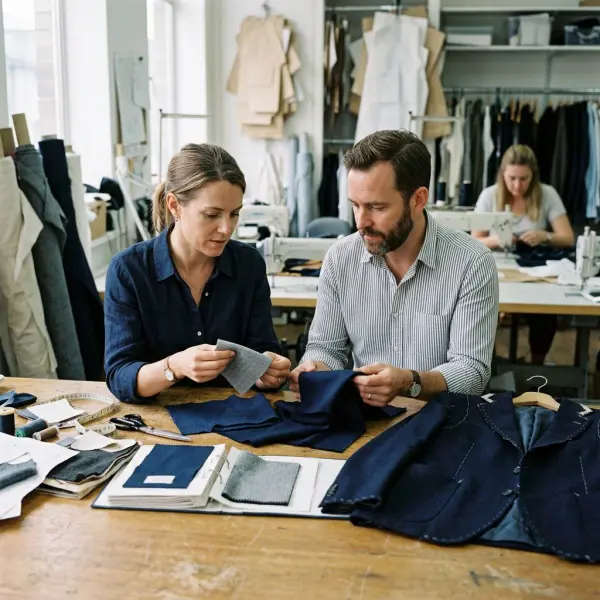
Product development teams should compare interlining candidates on actual shell fabrics rather than generic swatches. The same interlining can create very different results when paired with different outer materials.
Manufacturing teams need repeatable application parameters and quality checks, particularly for fusible systems. The exact process deserves detailed treatment in the companion article, but the principle is clear: adhesive systems perform properly only when material compatibility and production conditions work together.
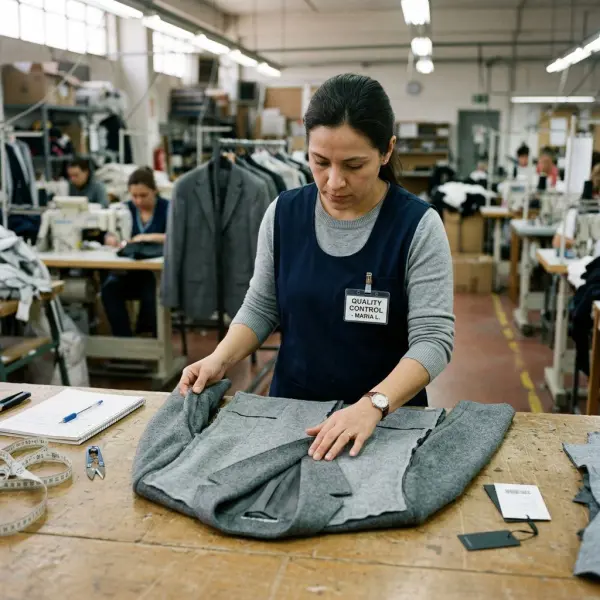
Quality teams should also evaluate the garment after representative care and finishing cycles rather than relying only on first appearance.
For a growing fashion company, a practical control system might include:
- an approved interlining library;
- supplier and article references;
- recommended shell-fabric combinations;
- component-specific applications;
- approved alternatives;
- fusing or sewing requirements;
- wash and care validation records;
- sample approval history.
The objective is not bureaucracy. It is repeatability. Once several factories or sourcing regions become involved, undocumented material decisions become much harder to control.
Common Interlining Mistakes That Create Production Problems
Choosing by Weight Alone
Two materials with similar grams per square meter can have different construction, resilience, stretch, thickness, and hand.
Weight is useful, but it does not describe the complete mechanical behavior of an interlining.
A better approach is to evaluate the complete shell-interlining combination through physical samples.
Assuming More Support Means Better Quality
A heavily reinforced garment can look controlled on a hanger yet feel unnatural when worn.
Excessive stiffness is particularly damaging when the designer intended softness, mobility, or fluidity. Premium quality is not synonymous with maximum structure.
The correct amount of reinforcement is the amount required by the product.
Ignoring Stretch Direction
An elastic outer fabric combined with an incompatible stabilizer can produce restricted movement, distortion, or an obvious change in behavior between reinforced and unreinforced areas.
Teams should evaluate stretch and recovery directionally rather than relying on a simple "stretch" label.
Approving the Material Before Care Testing
A freshly fused sample can appear successful before laundering.
Later exposure to water, heat, mechanical action, dry cleaning, or garment finishing may reveal changes that were invisible during initial approval.
Care testing should therefore match the expected product lifecycle.
Allowing Uncontrolled Bulk Substitution
Factories may occasionally need alternative materials because of availability, lead time, or minimum order constraints. A substitution is not necessarily problematic—but assuming two interlinings are equivalent because they look similar is risky.
An alternative should be tested against the approved shell and performance requirement before it becomes a bulk-production replacement.
What Brands Should Verify Before Acting
Interlining performance is highly context-dependent. Technical decisions should therefore be based on tests rather than broad category assumptions.
Fashion teams should verify at least four things before approving a specification.
First, confirm the material identity. Woven, knitted, and nonwoven describe broad construction families, not complete performance specifications.
Second, evaluate the combined garment system. Shell fabric, interlining, adhesive where applicable, pressing, sewing, finishing, and laundering can influence one another.
Third, test the intended end use. A blazer designed for dry cleaning and a uniform designed for repeated industrial washing require different validation conditions.
Fourth, avoid assuming that sustainability follows automatically from material labels. Recycled fiber content, mono-material construction, lower-temperature fusing, durability, and recyclability can each be relevant considerations, but none by itself demonstrates that the complete garment has a lower environmental impact. Any sustainability claim should be tied to specific evidence and the actual product system.
The hidden nature of interlining makes disciplined verification especially valuable: problems may not become visible until after the garment has entered bulk production—or after customers begin using it.
Interlining as Part of Garment Engineering
Interlining is one of those apparel components whose importance becomes clearest when something goes wrong.
A successful interlining often disappears into the garment. The customer notices the clean collar, controlled lapel, stable waistband, or well-supported jacket front rather than the material creating that behavior.
For product teams, that invisibility should not translate into indifference. Interlining belongs in the same development conversation as shell fabric, pattern engineering, seam construction, pressing, and care performance because all of those decisions influence the final product together.
As product categories become lighter, stretchier, softer, or technically more complex, matching reinforcement to the shell becomes even more important. The solution may be a stable woven construction, an adaptable knitted interlining, an engineered nonwoven, a fusible system, or a sew-in structure.
There is no universal winner.
There is only a material system that either supports the design correctly—or does not.
Frequently Asked Questions
Is interlining the same as lining?
No. Lining and interlining serve different primary purposes. A lining is generally the visible inner fabric that covers internal garment construction, improves comfort or dressing, and creates a finished interior. Interlining is usually positioned within the garment structure to reinforce or modify the behavior of selected components.
A jacket can therefore contain both. The interlining may support the front body or lapel while the lining covers the internal seams and construction. Because terminology varies between suppliers and production regions, technical specifications should identify the exact material and application rather than relying on the name alone.
What parts of clothing usually need interlining?
Collars, cuffs, plackets, waistbands, lapels, jacket fronts, pocket areas, and selected edges are common applications, although the exact requirement depends on garment design and shell-fabric behavior.
Not every component needs the same level of support. A formal shirt collar may intentionally feel crisp, while a casual collar may require considerably softer reinforcement. Product teams should specify interlining by component and desired performance, rather than assuming that one material should be used throughout an entire garment.
Is woven interlining better than nonwoven interlining?
Not universally. Woven and nonwoven interlinings have different structures and can be engineered for different performance requirements.
Woven constructions can provide textile-like directional stability, while nonwoven materials can offer efficient and versatile reinforcement across many apparel applications. Knitted products add another option where flexibility or stretch behavior is important.
The correct decision depends on the shell fabric, garment area, handfeel, required stability, care conditions, manufacturing method, and target cost. Comparing actual bonded or sewn samples is more reliable than ranking the three categories in isolation.
Can interlining make a garment too stiff?
Yes. Excessive reinforcement or an incompatible interlining can alter drape, handfeel, flexibility, and wearer comfort.
This often happens when material selection is driven by the assumption that greater stiffness means greater quality. In many fashion products, the technical objective is not rigidity but controlled support. Soft tailoring, women's jackets, stretch garments, and lightweight shirts can require stabilization while retaining substantial flexibility.
Sample approval should therefore consider both structural performance and the subjective hand of the completed garment.
Does stretch fabric require stretch interlining?
Often it requires an interlining with compatible movement, but that does not necessarily mean both materials must have identical stretch characteristics.
The supported garment component may intentionally need less extension than the shell. The relevant question is how much movement, recovery, and dimensional control the component requires.
Teams should compare stretch direction and recovery as well as overall extension. Testing the actual shell-interlining combination is particularly important because restricting an elastic fabric too aggressively can change fit and comfort.
Should interlining be specified in the garment tech pack?
For commercially produced apparel, documenting the approved interlining or interfacing specification is good practice.
The record may include supplier, product reference, construction, color, weight or relevant specification, application area, attachment method, approved substitute, and processing requirements where needed.
This becomes increasingly valuable when production is distributed across multiple factories. Without a controlled specification, hidden materials can be substituted without designers or buyers immediately noticing the change, even though the substitution may alter garment hand, manufacturing behavior, or care performance.
How should a brand test a new interlining?
Start by testing the interlining with the actual production shell fabric rather than evaluating it alone.
Assess the component after application for appearance, hand, flexibility, dimensional behavior, and attachment quality. The trial should then be exposed to the finishing and care conditions expected for the finished garment.
For fusible systems, processing compatibility is particularly important because the adhesive relationship depends on the material combination and fusing conditions. Brands producing at scale should retain an approved reference sample so that bulk output can be compared with the development standard.
Conclusion
Interlining may be hidden inside the finished garment, but its influence extends from design development to factory execution.
The material allows fashion teams to give particular components more stability, reinforcement, resilience, or controlled flexibility than the shell fabric could provide alone. Woven, knitted, and nonwoven bases give developers different structural tools, while fusible and sew-in systems provide different methods of integrating that support into the garment.
The useful question is therefore not simply, "Which interlining should we buy?"
It is: what should this part of the garment do, and which shell-interlining combination can deliver that behavior consistently through production, wear, and care?
Once that requirement is clear, interlining becomes less of a hidden trim decision and more of what it actually is: a deliberate part of garment engineering.




Comments 0
Leave a CommentSend Comment
Anda harus Login terlebih dahulu untuk dapat memberikan komentar.