

Common Sourcing Mistakes That Affect Cost, Quality, and Delivery
Quick Answer
The most damaging fashion sourcing mistakes usually begin before bulk production starts. They include sending incomplete product specifications, choosing suppliers mainly by unit price, comparing quotations with different cost inclusions, overlooking material minimums, approving unrealistic lead times, and scaling orders before production capability has been tested.
These errors are connected. An unclear technical pack creates inaccurate costing. Inaccurate costing leads to price changes after development. Late changes disrupt material purchasing and factory scheduling. Compressed production then increases the likelihood of defects, overtime, unauthorized subcontracting, delayed shipments, or expensive air freight.
Growing apparel brands can reduce these problems by controlling a small number of sourcing fundamentals:
- Define the product before requesting final prices.
- Compare total landed cost rather than factory price alone.
- Qualify supplier capability with samples and pilot production.
- Confirm material, trim, and process lead times separately.
- Record every approval and specification change.
- Inspect quality during production, not only at shipment.
- Clarify logistics, import, and defect responsibilities in writing.
- Measure supplier performance using consistent data.
No sourcing system removes every disruption. The purpose of sourcing control is to identify uncertainty early, assign responsibility clearly, and prevent small development issues from becoming expensive commercial failures.

Why Small Sourcing Errors Become Expensive
Fashion sourcing is a chain of dependent decisions. A fabric cannot be ordered accurately until composition, construction, weight, width, color, and quantity are sufficiently clear. Production cannot be scheduled reliably until materials, samples, prices, and approvals are confirmed. Delivery cannot be promised responsibly until the factory understands both its workload and the product requirements.
An error at one stage therefore changes the assumptions used by the next stage.
Consider a brand developing a lightweight woven dress. The original quotation is based on a standard fabric, simple seams, and basic packaging. During sampling, the brand changes to a custom color, adds lining, modifies the sleeve construction, introduces embroidery, and requests individual garment bags.
Each change may be reasonable on its own. Together, they affect:
- Fabric consumption
- Material minimum quantities
- Dyeing and embroidery lead times
- Sewing operations
- Labor cost
- Packaging cost
- Quality checkpoints
- Production capacity
- Final delivery date
The mistake is not necessarily changing the design. The mistake is continuing to use the original price and calendar after the product has materially changed.
This pattern is common because development decisions are often made by design, sourcing, merchandising, finance, and marketing teams using different documents. When those teams are not working from the same approved product information, the supplier receives conflicting instructions and the commercial plan becomes unstable.
The resulting cost is rarely recorded under one heading called “sourcing failure.” It appears as sample charges, revised quotations, rejected fabric, rework, partial shipment, air freight, delayed sales, customer returns, markdowns, and time spent resolving disputes.
The Three Areas Most Sourcing Mistakes Damage
Most sourcing failures eventually affect one or more of three commercial outcomes.
|
Impact area |
What typically goes wrong |
Commercial consequence |
|
Cost |
Missing quotation items, excess materials, rework, freight upgrades, duties, financing, or order changes |
Lower margin and higher working-capital requirements |
|
Quality |
Unclear standards, unsuitable supplier capability, material variation, rushed production, or weak inspection |
Defects, returns, inconsistent fit, and customer dissatisfaction |
|
Delivery |
Late approvals, unavailable materials, unrealistic schedules, capacity conflicts, logistics errors, or customs problems |
Missed selling windows, cancellations, and expedited shipping |
These outcomes are also connected. A quality problem can create a delivery delay. A delivery delay can create an air-freight cost. A price negotiation that removes necessary quality controls can increase both defects and rework.
For this reason, brands should avoid managing price, quality, and lead time as separate sourcing conversations. They are different expressions of the same production system.
Mistake 1: Requesting Final Prices from an Incomplete Product Brief
A supplier cannot produce a reliable final quotation when the product is still loosely defined.
Early indicative prices are useful for evaluating whether a concept is commercially plausible. Problems begin when the brand treats an indicative quotation as a committed production price while continuing to change materials, construction, sizing, finishing, or packaging.
A sufficiently developed sourcing brief normally includes:
- Product drawing or reference sample
- Technical construction details
- Bill of materials
- Target fabric specification
- Measurement chart and tolerances
- Size and color breakdown
- Required print, embroidery, wash, or finish
- Label and packaging instructions
- Estimated order quantity
- Intended sales market
- Quality and testing requirements
- Required delivery location and date
Not every detail must be final at the first discussion. The supplier should, however, know which details remain open and which assumptions support the quoted price.

Why This Mistake Happens
Founders and designers may need cost information before investing in full product development. Suppliers may also provide an attractive preliminary price to keep the opportunity moving.
The estimate becomes misleading when assumptions are not documented. One party thinks the price includes custom-dyed fabric and retail packaging; the other has priced available stock fabric and export cartons.
Operational Consequence
As specifications become clearer, the supplier revises the cost. The brand may interpret this as arbitrary price inflation, even though the original product is no longer being produced.
If the retail price has already been announced or wholesale orders have been accepted, the brand has limited room to absorb the increase.
Better Approach
Label early quotations clearly as indicative. Record the fabric, construction, order quantity, packaging, quality, delivery term, and currency assumptions behind them.
Request the final production quotation only after the bill of materials and approved product standard are sufficiently stable.
Mistake 2: Comparing Supplier Quotations That Cover Different Responsibilities
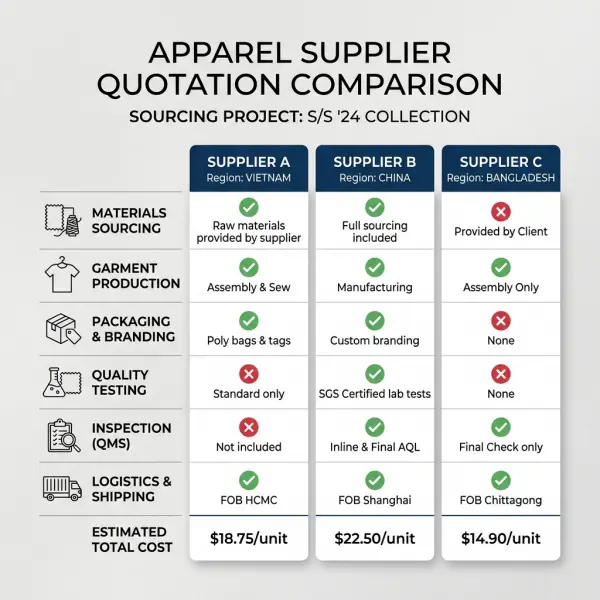
Two quotations can display the same garment description while pricing different scopes of work.
One factory may provide a full-package price covering fabric, trims, sewing, finishing, labels, packaging, and export preparation. Another may quote only cutting and sewing. A third may include materials but exclude testing, inspection, development, inland transport, or documentation.
Selecting the lowest number without normalizing these differences creates a false comparison.
What Brands Commonly Overlook
Quotation gaps frequently involve:
- Pattern and grading charges
- Sample development
- Fabric testing
- Custom color development
- Print screens or embroidery setup
- Labels and packaging
- Inspection fees
- Freight to the export point
- Customs documentation
- Buying-agent commissions
- Banking charges
- Duties and destination costs
The landed cost of an imported product generally includes the original product price plus freight, insurance, tariffs, taxes, and other fees required to reach the buyer. Exact customs treatment depends on the destination market and transaction. International Trade Administration guidance on landed cost
Operational Consequence
The selected supplier appears to meet the target cost until excluded charges emerge. The margin is then reduced after product development, when changing suppliers would mean repeating samples and losing time.
Better Approach
Create a standardized quotation sheet. Require every supplier to confirm:
- Product specification used
- Material and trim inclusions
- Sample and setup charges
- Packaging
- Testing and inspection
- Order minimums
- Price validity
- Currency
- Payment terms
- Delivery term and named place
- Explicit exclusions
The objective is not to force every supplier into the same manufacturing model. It is to make commercial differences visible before a decision is made.
Mistake 3: Choosing a Supplier Mainly Because of the Lowest Unit Price
Price matters. Fashion products must support the required margin, retail positioning, and customer expectations. The mistake is treating unit price as a complete measure of supplier value.
A low quotation may reflect genuine efficiency. It may also reflect:
- Lower material quality
- Missing construction operations
- Unrealistic labor assumptions
- Excluded packaging or testing
- Underestimated fabric consumption
- Production planned through subcontractors
- Weak quality control
- A price intended only to win the development order
- Capacity that has not actually been reserved
A higher-priced supplier is not automatically safer or better. The brand needs evidence that the price is consistent with the product and production model.
Why This Mistake Happens
Unit price is immediate and measurable. Reliability, technical competence, communication quality, and recovery from problems are harder to quantify before orders begin.
Small brands under margin pressure may also assume that every cost reduction directly improves profitability. That is only true when the product remains saleable, arrives on time, and does not create additional failure costs.
Business Impact
A supplier saving $1 per garment on a 2,000-unit order appears to save $2,000. That advantage disappears if several hundred units require rework, the shipment moves by air after a delay, or the product receives a high return rate.
The precise financial result depends on the order, but the business logic is consistent: purchasing price and effective sourced cost are not the same.
Better Approach
Score suppliers across several dimensions:
|
Dimension |
Evidence to review |
|
Product cost |
Normalized quotation and price assumptions |
|
Technical capability |
Comparable products, equipment, and sample accuracy |
|
Quality control |
Procedures, records, defect handling, and inspection |
|
Delivery capability |
Capacity, material plan, and production calendar |
|
Communication |
Accuracy, responsiveness, and escalation |
|
Commercial fit |
Minimums, payment terms, and development support |
|
Risk and compliance |
Site information, subcontracting, documentation, and corrective action |
Supplier selection should reflect which factors matter most for the product. A permanent basic may prioritize repeatability and capacity, while a limited capsule may prioritize flexible quantities and development speed.
Mistake 4: Treating a Good Sample as Proof of Bulk Production Capability
A high-quality sample proves that the supplier can produce at least one acceptable unit under sample-room conditions. It does not prove that the normal production line can reproduce the same result across hundreds or thousands of garments.
Sample rooms often use senior pattern makers, technicians, and machinists. Bulk production uses a larger workforce, production targets, line balancing, material batches, and routine quality controls.
The two environments are related but not identical.
What Can Change During Bulk Production?
- Fabric may come from a different roll or dye lot.
- Operators may use different machine settings.
- Seam allowances may gradually vary.
- Pressing and finishing may be rushed.
- Measurements may drift across sizes.
- Print or embroidery placement may become inconsistent.
- Approved trims may be substituted.
- Part of the order may be subcontracted.
- Packaging may not follow the approved sequence.
Operational Consequence
The brand discovers that the approved sample is not representative of production. Correction becomes expensive after the full quantity has been cut or assembled.
Better Approach
Use several approval stages where appropriate:
- Development or prototype sample
- Fit sample
- Size-set sample
- Pre-production sample using intended materials
- Production pilot or first output review
- Inline inspection
- Final inspection
The exact sequence depends on product risk and order scale. A simple T-shirt and a structured technical jacket do not require identical controls.
For strategically important new suppliers, begin with a controlled production order. Evaluate not only finished quality but also reporting, material control, schedule performance, and problem resolution before increasing volume.
Mistake 5: Ignoring Upstream Material and Trim Minimums
A factory’s minimum order quantity is only one of several minimums in an apparel supply chain.
The factory may accept 300 garments, but the fabric mill may require a larger order. A dye house may impose a minimum per color. A zipper supplier may require thousands of custom units. Packaging, labels, embroidery, printing, and washing processes can each introduce separate quantity conditions.
Why This Mistake Happens
Brands often ask the garment factory, “What is your MOQ?” and assume the answer applies to the complete product.
In reality, the factory may quote its sewing minimum before confirming the required material sources. Material minimums may emerge only after color, fabric, and trims are finalized.
Operational Consequence
The brand may need to:
- Buy excess fabric
- Reduce the number of colors
- Use stock materials
- Pay a surcharge
- Increase the garment quantity
- Accept a substitute trim
- Delay production while searching for another source
Excess material also ties up working capital and creates storage, identification, and reuse problems.
Better Approach
Request a minimum-order map covering:
- Garments per style
- Units per color
- Fabric per construction
- Dyeing per shade
- Printing or embroidery
- Custom trims
- Labels
- Packaging
Then determine whether minimums can be shared across styles or colorways. Two products using the same fabric, thread, and packaging may create better purchasing economics than several unrelated small orders.
This analysis should happen during line planning, not after the purchase order has been issued.
Mistake 6: Confirming Delivery Dates Before Validating the Critical Path
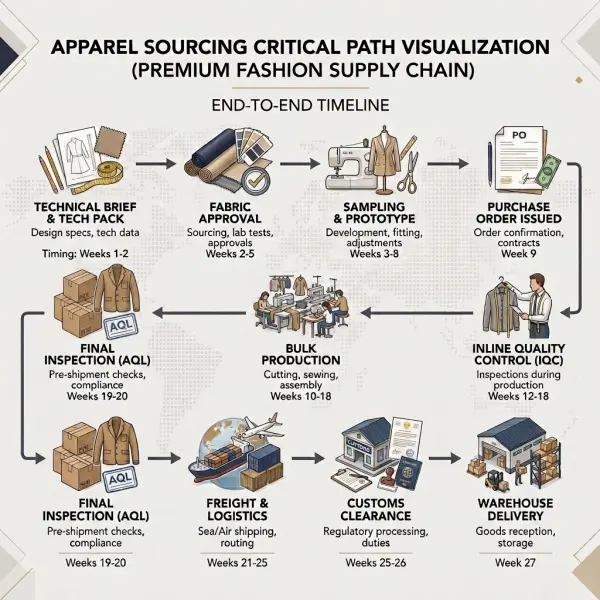
A delivery date is only credible when every dependent activity can be completed in the required sequence.
Brands often focus on the stated sewing lead time. The factory may say production takes 30 days, but that period may begin only after fabric, trims, labels, pre-production samples, payment, and final approvals are received.
The true sourcing calendar may also include:
- Fabric development or booking
- Lab dips and color approval
- Print or embroidery strike-offs
- Pattern correction
- Fit approval
- Testing
- Packaging procurement
- Production scheduling
- Inspection and rework
- Freight booking
- Customs clearance
Why This Mistake Happens
Marketing and wholesale calendars may be set before sourcing confirms feasibility. Commercial teams naturally want a clear launch date, while suppliers may be reluctant to challenge an aggressive schedule.
The result is often a date based on aspiration rather than capacity and material evidence.
Operational Consequence
When approvals run late, the delivery date remains unchanged. The factory is asked to recover time that has already been lost.
Possible responses include:
- Overtime
- Reduced inspection
- Parallel production before full approval
- Unauthorized subcontracting
- Split shipments
- Air freight
- Postponed delivery
ILO research on purchasing practices has identified planning, specifications, sampling, pricing, order placement, and lead times as buyer-supplier practices connected with production conditions. Its findings indicate that insufficient lead times may be associated with longer working hours and increased use of temporary workers or outsourced production.
ILO research on purchasing practices and working conditions
Better Approach
Build a critical-path calendar backward from the required warehouse date. Include the latest safe date for:
- Technical-pack release
- Material confirmation
- Sample submission
- Fit approval
- Color and trim approval
- Purchase-order placement
- Production start
- Inspection
- Freight handover
- Customs clearance
Each milestone should have an owner and a consequence if missed.
When an approval is late, recalculate the plan instead of pretending that the original delivery date is unaffected.
Mistake 7: Making Late Changes Without Recalculating Cost and Time
Product changes are part of apparel development. The failure occurs when a change is approved creatively but not processed commercially and operationally.
A small design alteration can affect more than appearance.
Changing a neckline may require a revised pattern, different binding length, new grading, updated consumption, and another fit sample. Replacing a zipper can affect the opening construction, garment length, trim minimum, and delivery schedule. Adding lining changes materials, labor, labeling, testing, and packaging weight.
Why This Mistake Happens
Changes may be spread across email, messaging applications, sample comments, and verbal conversations. The person approving the design may not be responsible for costing or production scheduling.
Suppliers sometimes begin implementing the change while commercial effects remain unresolved because waiting would create another delay.
Business Impact
The brand and supplier may later disagree about:
- Which version was approved
- Whether the price includes the change
- Who caused the delay
- Which sample represents the production standard
- Whether old materials can still be used
- Who should pay for rework
Better Approach
Use formal change control, even if the business operates with a simple spreadsheet.
Every material change should record:
- Change description
- Reason
- Date requested
- Product and order affected
- Cost impact
- MOQ impact
- Lead-time impact
- Quality or testing impact
- Approver
- New specification version
Do not rely on messages such as “Please use this version” without identifying the exact file and approval status.
Mistake 8: Failing to Verify Real Capacity and Subcontracting
A supplier may have the technical capability to make a product but lack available capacity during the required period.
Factories serve several buyers. Their workload changes, materials arrive late, machines break, workers may be unavailable, and previous orders can occupy production lines longer than expected.
Stated monthly capacity does not necessarily equal capacity available to one brand.
Warning Signs
Potential concerns include:
- Reluctance to show a production calendar
- Immediate acceptance of every quantity and delivery request
- Large promised volume despite a small visible facility
- Unclear answers about where printing, washing, or sewing occurs
- Production status that cannot be verified
- Different company names across quotations, invoices, and factory records
- Sudden quality differences between order sections
Subcontracting is not automatically improper. Specialist processes are routinely performed by external partners. Risk increases when subcontracting is unauthorized, undisclosed, or unmanaged.
Operational Consequence
The order may be moved to another production site that has not received the approved sample, training, material instructions, or quality expectations.
The brand may also lose visibility into labor, safety, environmental, origin, or compliance conditions.
Better Approach
Confirm:
- Physical production site
- Planned production line
- Available capacity for the order period
- Major existing workload
- Operations performed internally
- Authorized external processors
- Approval requirements for further subcontracting
- Responsibility for subcontractor quality
- Required production and transaction records
The OECD garment and footwear guidance recommends risk-based due diligence across business relationships and supply-chain activities rather than relying on a one-time declaration. OECD garment and footwear due diligence guidance
Mistake 9: Relying Only on Final Inspection
Final inspection is useful, but it happens after most production cost and time have already been committed.
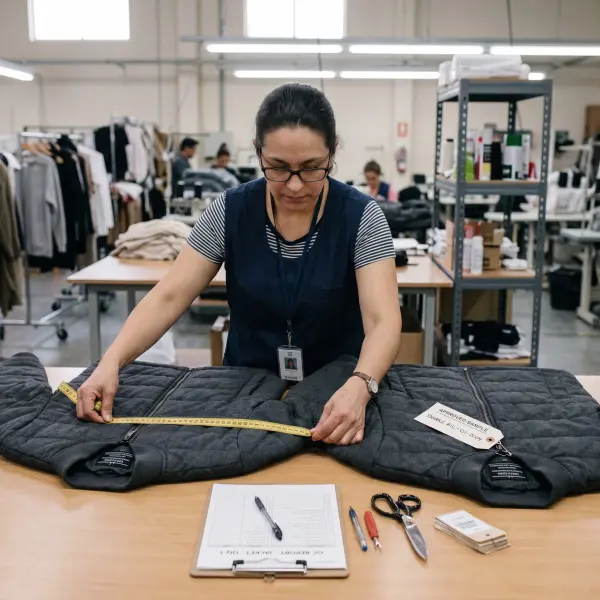
A final inspector can identify defects in sampled finished garments. The inspection cannot easily correct fabric that has already been cut, repeated seam problems across thousands of units, or a measurement error built into the production pattern.
Quality should be controlled at the point where a problem can still be prevented or corrected efficiently.
A More Effective Quality Sequence
Material stage
Inspect relevant fabric characteristics before cutting. Depending on the product, this may include shade, width, weight, surface defects, shrinkage, stretch, or performance properties.
Pre-production stage
Confirm the approved pattern, size specifications, construction, trims, labels, packaging, and sample.
Early production stage
Review first production output to identify misunderstood operations, machine settings, seam problems, placement errors, or measurement drift.
Inline stage
Check work while production is continuing. Repeated defects can be corrected before the entire order is completed.
Final stage
Assess finished and packed products against the agreed acceptance criteria.
Important Sampling Caveat
Acceptance sampling examines a defined sample from a production lot rather than every unit. ISO 2859-1:2026 provides sampling schemes indexed by acceptance quality limit for lot-by-lot inspection by attributes. A passed sampled inspection does not mean every garment is defect-free; it means the sampled lot met the selected plan’s acceptance conditions. ISO 2859-1:2026 sampling procedures
Inspection should support—not replace—stable materials, trained operators, clear specifications, and process control.
Mistake 10: Using Vague Quality Standards
Terms such as “premium quality,” “export quality,” “good stitching,” or “same as sample” are too imprecise to resolve a production dispute.
Quality needs measurable or observable criteria.
For apparel, these may include:
- Measurement tolerances
- Stitch and seam requirements
- Symmetry and placement
- Shade standards
- Fabric appearance
- Print or embroidery position
- Functional performance
- Care-label accuracy
- Packaging requirements
- Defect classifications
- Inspection method
Why This Mistake Happens
Product teams may recognize quality visually but struggle to translate their expectations into technical specifications. Suppliers may also assume that their usual standard is acceptable.
The two sides may not discover their different interpretations until final inspection.
Better Approach
Use approved physical or digital references together with written specifications. Define which sample controls production and retain it under agreed conditions.
Where subjective characteristics matter—such as wash appearance, handfeel, distressing, or handmade variation—define an acceptable range using several reference samples rather than one ideal unit.
For performance claims, use an appropriate test method and acceptance level. A fabric supplier’s general statement does not necessarily prove how the finished garment will perform after sewing, finishing, care, and use.
Mistake 11: Misunderstanding Incoterms and Import Responsibilities
Terms such as EXW, FCA, FOB, CIF, DAP, and DDP are frequently treated as informal shipping-price labels. They are formal trade rules that allocate specified delivery obligations, costs, and risks between seller and buyer.
Using the wrong term—or using one without a named place—can create uncertainty about:
- Where delivery occurs
- Who arranges carriage
- Who handles export clearance
- Which party bears particular transport costs
- When transit risk transfers
- Whether insurance is required under the selected rule
ICC states that Incoterms® 2020 contains 11 rules covering the allocation of buyer and seller obligations, costs, and risks in trade transactions. The rules do not replace the full sales contract or determine every issue involving ownership, payment, customs classification, product compliance, or dispute resolution. ICC Incoterms 2020 guidance
Common Operational Errors
- Comparing an EXW price with a DDP price
- Using FOB for any shipment without considering transport mode
- Omitting the named port or place
- Assuming CIF means the seller carries all risk to the destination
- Assuming DDP removes all importer obligations in every jurisdiction
- Failing to confirm destination handling charges
- Believing the Incoterms rule determines product ownership
Business Impact
Unexpected freight, clearance, storage, duty, or handling costs emerge after shipment. Goods may be delayed because neither party prepared the required documents or appointed the correct service provider.
Better Approach
For each order, state:
- Incoterms® rule and version
- Exact named place or port
- Exporter and importer responsibilities
- Freight-booking party
- Insurance arrangement
- Customs broker
- Required documents
- Expected destination charges
Import requirements vary by jurisdiction and product. Brands should verify classification, valuation, duty, origin, labeling, and importer obligations with qualified customs or legal professionals.
Mistake 12: Treating Compliance as a Supplier-Certificate Exercise
A certificate can provide useful evidence about a system, material, facility, or assessment. It does not transfer all responsibility to the supplier or prove every claim a brand wants to make.
Common errors include:
- Accepting expired certificates
- Failing to confirm the certified entity and site
- Assuming a facility certificate covers every subcontractor
- Applying a material certificate to an unsupported finished-product claim
- Treating one audit as proof of permanent conditions
- Ignoring the scope, standard version, or transaction documents
- Requesting documentation only after production has finished
Why This Mistake Happens
Certificates provide a simple yes-or-no field in a supplier database. Actual due diligence is less convenient because it requires identifying risks, reviewing evidence, following corrective actions, and updating information over time.
Better Approach
Begin with the product, market, supplier, process, and claim.
Ask:
- Which legal or customer requirement applies?
- What risk is the document intended to address?
- Who issued it?
- Which legal entity, site, product, and period does it cover?
- Is chain-of-custody or transaction evidence required?
- What additional verification is needed?
- What happens if evidence is missing or inconsistent?
The OECD framework treats due diligence as an ongoing process to identify, prevent, mitigate, track, and communicate actual or potential adverse impacts. It is not limited to collecting supplier documents.
Mistake 13: Depending on One Supplier Without Understanding Concentration Risk
Single sourcing can provide meaningful advantages. It may simplify development, strengthen relationships, improve consistency, and concentrate order volume.
The mistake is not using one supplier. It is having no practical response if that supplier cannot perform.
Disruption can result from:
- Capacity overload
- Machinery failure
- Financial difficulty
- Material unavailability
- Labor disruption
- Compliance concerns
- Natural hazards
- Logistics interruption
- Ownership or management change
Why Brands Delay Backup Development
Qualifying a second supplier requires samples, technical work, materials, audits, negotiation, and often minimum orders. For small businesses, maintaining two active sources may be unnecessarily expensive.
That does not mean continuity planning should be ignored.
Better Approach
Use risk-based contingency.
High-priority products may require:
- A qualified second factory
- An alternative fabric
- Approved substitute trims
- Transferable patterns and specifications
- Ownership of molds, screens, and artwork
- Buffer stock
- Reserved emergency capacity
- Alternative freight route
- Documented supplier-exit process
The strongest backup is not always a second supplier producing identical volume. It may be a tested recovery option appropriate to the commercial consequence of disruption.
Mistake 14: Managing Sourcing Through Scattered Messages and Memory
Informal communication works until the business has several styles, samples, suppliers, team members, and simultaneous delivery dates.
At that point, important decisions may exist only in:
- Personal email
- Messaging applications
- Verbal discussions
- Unnamed attachments
- Different spreadsheet versions
- Handwritten sample notes
Operational Consequence
Teams use different prices, measurements, materials, and delivery assumptions. The supplier may produce from an outdated file while the brand believes a newer revision was approved.
When a dispute occurs, neither side can reconstruct the decision path confidently.
Better Approach
Create one controlled source for each product and order. It should contain:
- Current technical pack
- Bill of materials
- Approved samples
- Final quotation
- Purchase order
- Change history
- Approval dates
- Production status
- Inspection results
- Shipping documents
- Corrective actions
A growing business does not necessarily need a complex platform immediately. A disciplined shared folder and controlled spreadsheet can be effective when ownership, naming, versioning, and access are clear.
Technology should support process discipline. It cannot repair inaccurate data or unclear decision rights.





Comments 0
Leave a CommentSend Comment
Anda harus Login terlebih dahulu untuk dapat memberikan komentar.