
How Workwear Style Is Changing in Modern Professional Life
Quick Answer
Workwear style is shifting from a fixed professional uniform toward a more adaptable wardrobe shaped by hybrid schedules, changing office cultures, practical commuting needs, personal identity, and the type of work being performed.
The traditional suit has not disappeared, but it is no longer the automatic standard across every office role. Many professionals now combine tailored trousers, relaxed blazers, knit tops, polished footwear, overshirts, dresses, and elevated casual pieces according to the situation. A presentation to senior clients may still require formal tailoring, while an internal collaboration day may call for softer, more relaxed clothing.
For fashion businesses, the commercial opportunity is not simply to make office clothing more casual. It is to design garments that preserve professional credibility while improving comfort, versatility, fit, care, and repeat wear. Successful modern workwear often relies on modular styling: pieces that can be layered, dressed up, dressed down, and worn across office, remote, travel, and social settings.
The main challenge is context. Expectations still differ by industry, geography, organizational culture, climate, seniority, safety requirements, and customer contact.

What Does Workwear Style Mean in a Modern Office?
Professional workwear is clothing designed or selected for office, administrative, managerial, creative, commercial, and client-facing activities, with the practical purpose of communicating competence while allowing the wearer to perform their job appropriately.
In this context, workwear does not refer to industrial protective clothing, high-visibility garments, medical uniforms, or personal protective equipment. Those categories are governed by operational, hygiene, and safety requirements that cannot be replaced by fashion-led interpretations of office style.
Modern professional workwear is better understood as a spectrum rather than a single dress code. It may include formal business clothing, business casual outfits, smart casual combinations, creative-industry dressing, branded uniforms, and role-specific apparel.
What connects these categories is not one garment. It is contextual appropriateness.
A structured suit may still be expected for a legal hearing, executive presentation, government meeting, luxury retail environment, or formal financial consultation. The same suit may feel unnecessarily rigid for a software development session, internal design review, or hybrid team meeting. Professionalism remains relevant, but its visual expression is becoming more situational.
Workwear Is Moving from a Uniform to a Flexible System
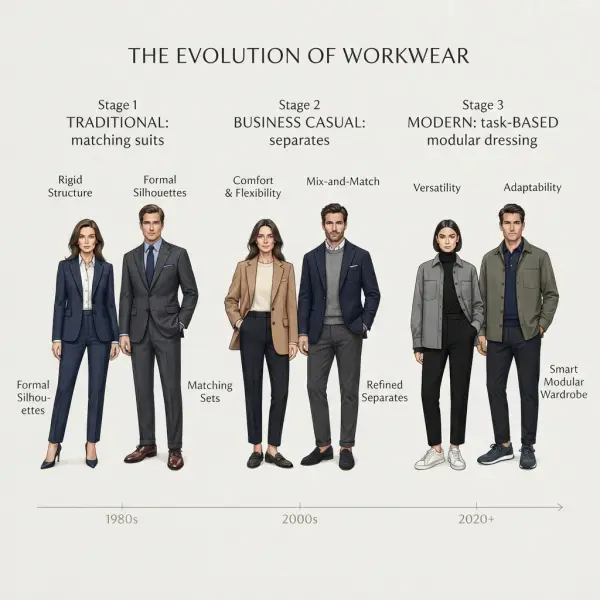
For much of the twentieth century, conventional office clothing was built around recognizable formulas. Men were often expected to wear suits, shirts, ties, and formal shoes. Women frequently navigated a more complicated combination of skirt suits, dresses, tailored trousers, blouses, hosiery, and prescribed footwear.
These standards were never universal. They varied according to occupation, class, gender, climate, culture, and geography. Even so, office clothing was generally expected to create visible separation between professional life and private life.
That separation has weakened.
A 2024 YouGov survey of employed U.S. adults found that 47% reported wearing business-casual clothing at work and the same percentage reported wearing casual street clothing. Business-professional clothing was reported by 22%, while 66% of employed respondents said they never wore a suit while working. The findings describe one national sample rather than a universal global standard, but they illustrate how varied professional wardrobes have become. YouGov survey on suits and work clothing
The emerging model is closer to a wardrobe system:
|
Earlier officewear logic |
Modern workwear logic |
|
One standard for most office days |
Clothing adjusted to the day’s activities |
|
Formality communicates professionalism |
Fit, condition, coordination, and context communicate professionalism |
|
Matching suits and prescribed combinations |
Modular separates and interchangeable layers |
|
Clear distinction between work and leisure |
Garments may move across work, travel, and social settings |
|
Dress codes organized by gender |
Policies increasingly focus on function and appropriateness |
|
Appearance managed through rigid rules |
Appearance managed through judgment and situational guidance |
This change does not eliminate standards. It relocates responsibility. Employees need to interpret the workplace, and employers need to explain expectations more clearly than a vague instruction such as “dress appropriately.”
Why Is Professional Workwear Changing?
The current shift is not driven by a single trend. It reflects changes in where people work, how offices are used, what employees expect from clothing, and how businesses define professional presence.
Hybrid Work Has Changed the Purpose of an Office Day
For many office-based employees, the workplace is no longer where every task happens. It may be where teams gather for collaboration, presentations, onboarding, client interaction, or important decision-making.
This alters clothing decisions. A person who works remotely for part of the week may not maintain five nearly identical formal office outfits. Instead, that person may invest in fewer garments that can handle a commute, a video call, an in-person meeting, and an evening engagement.
Hybrid work is not equally available across occupations, countries, or income groups. However, it remains significant in remote-compatible professional roles. The U.S. Bureau of Labor Statistics reported that 35.5 million people teleworked or worked from home for pay during the first quarter of 2024, representing 22.9% of people at work. It also found that more people were combining home and workplace hours rather than working remotely for all of their hours. U.S. Bureau of Labor Statistics telework analysis
The OECD has similarly described a post-pandemic movement from exclusively remote work toward hybrid arrangements, particularly in cities and remote-compatible occupations. OECD analysis of remote and hybrid work
For apparel brands, the implication is straightforward: a modern workwear item may need to serve more situations, even when consumers own fewer dedicated office garments.
Professionals Are Dressing for Activities, Not Only Locations
The old question was often, “What do people wear to the office?”
The more useful question now is, “What will they do while they are there?”
A modern professional may need different levels of polish across the same week:
- a structured jacket for a board presentation;
- a knitted polo or blouse for routine meetings;
- relaxed trousers for a workshop;
- a wrinkle-resistant layer for business travel;
- clean, comfortable footwear for commuting;
- a formal outfit for a ceremony, negotiation, or high-stakes client event.
This is task-based dressing. It explains why modern workwear collections increasingly mix structured pieces with softer alternatives instead of treating formalwear and casualwear as completely separate wardrobes.
It also creates uncertainty. A company may describe its policy as business casual while different teams interpret that term in very different ways. Client services, finance, design, technology, and warehouse administration may all operate under the same corporate brand but require distinct levels of formality.
Comfort Has Become a Product Requirement, Not an Excuse for Poor Presentation
Comfort-driven workwear does not have to resemble loungewear. It may come from better pattern engineering, lighter constructions, softer waistbands, increased ease, breathable materials, stretch recovery, reduced lining, or less restrictive footwear.
The difference matters. A poorly shaped garment made from elastic fabric is not automatically comfortable, just as a rigid-looking jacket is not automatically uncomfortable. Final performance depends on several factors:
- fiber and fabric construction;
- garment weight;
- pattern balance and ease;
- seam placement;
- lining and interlining;
- waistband structure;
- climate;
- movement requirements;
- individual body shape.
This deeper relationship between office dressing and wearability is explored in how office outfits are becoming more flexible, comfortable, and personal.
For brands, comfort should therefore be treated as a technical development objective. It requires wear testing, fit evaluation, laundering trials, and feedback from users performing real activities such as sitting, walking, commuting, reaching, presenting, and carrying devices.
Personal Identity Is Becoming More Visible at Work
As formal rules loosen, employees have more room to communicate identity through color, silhouette, accessories, modest dressing, cultural garments, gender expression, or styling choices.
This does not mean every workplace has become fully permissive. It means that professional credibility is less dependent on one narrow uniform in many environments.
The shift is commercially relevant because it expands what can qualify as workwear. A professional wardrobe may now include:
- relaxed or unstructured tailoring;
- coordinated separates rather than matching suits;
- modest dresses and longer layers;
- gender-neutral shirts, trousers, and jackets;
- regional textiles used in contemporary silhouettes;
- polished sneakers or comfort-focused shoes;
- bags designed for laptops and commuting;
- subtle jewelry and personal accessories.
Accessories are particularly useful because they allow an outfit to change its level of formality without replacing the central garment. A simple dress, shirt, or trouser can take on a different professional character through a structured bag, belt, scarf, watch, or piece of jewelry. This role is examined further in how accessories transform simple outfits into stronger looks.
Climate and Commuting Are Influencing Design Decisions
Workwear designed for a climate-controlled office can fail before the wearer reaches the building.
Employees may walk, cycle, use crowded public transport, move between outdoor heat and indoor air conditioning, or travel through rain and humidity. These conditions increase demand for garments that are breathable, layerable, washable, quick to refresh, and comfortable in motion.
The response should not be reduced to “use natural fibers.” Linen, wool, cotton, regenerated cellulosic fibers, synthetics, and blends can all be appropriate depending on fabric construction, weight, finishing, durability, care requirements, and price positioning.
For example, a lightweight wool or wool-blend trouser may offer drape, recovery, and temperature regulation, while a cotton-rich fabric may feel familiar and washable. A synthetic blend may improve crease resistance or drying speed, but could perform poorly in humid conditions if the construction traps heat.
Material selection must follow the use case.
How Is the Workwear Silhouette Evolving?
The central design movement is not simply from formal to casual. It is from rigid coordination toward controlled versatility.
Tailoring Is Becoming Softer and More Separable
Modern tailoring often reduces the visual and physical rigidity associated with traditional suits. Jackets may use lighter interlining, partial lining, softer shoulders, knitted constructions, patch pockets, or more relaxed proportions.
Trousers may include discreet elastic sections, drawcords hidden inside tailored waistbands, wider legs, cropped lengths, or fabrics with mechanical or added stretch.
The commercial strength of these pieces lies in separation. A blazer can be worn with matching trousers, denim, a dress, or a knitted skirt. Tailored trousers can work with a shirt, fine-gauge knit, polo, T-shirt, or overshirt.
That flexibility increases styling possibilities, but it creates product-development challenges. Separates must still coordinate across color, fabric weight, surface texture, and silhouette. A collection can look fragmented when every product is individually attractive but difficult to combine.
Knitwear Is Occupying the Space Once Reserved for Shirts and Jackets
Fine-gauge sweaters, knitted polos, structured cardigans, sweater jackets, and compact knitted dresses increasingly function as professional layers.
Their advantage is not only softness. Knit constructions can accommodate movement and body variation more easily than some rigid woven garments. They may also look presentable on video calls and layer effectively under outerwear.
However, knitwear requires careful control of:
- pilling;
- dimensional stability;
- neckline recovery;
- seam reinforcement;
- transparency;
- snagging;
- laundering behavior;
- shape retention after sitting and wearing.
A garment that looks polished when new but loses form after several wears will not meet the practical demands of a work wardrobe.
Footwear Is Becoming Less Ceremonial
Formal pumps and leather dress shoes remain relevant, but they now compete with loafers, flats, low boots, refined sandals where appropriate, and minimal sneakers.
The acceptable choice depends heavily on industry and setting. A clean leather sneaker may work in a design studio or technology company but remain unsuitable for a courtroom, formal diplomatic event, luxury hospitality role, or conservative client meeting.
Brands entering professional footwear should not treat comfort as a styling claim alone. Last shape, toe room, arch support, heel stability, lining, outsole grip, breathability, and weight all influence real wearability.
The Best Pieces Can Change Formality Quickly
A modern workwear garment often succeeds when it can move one level up or down in formality.
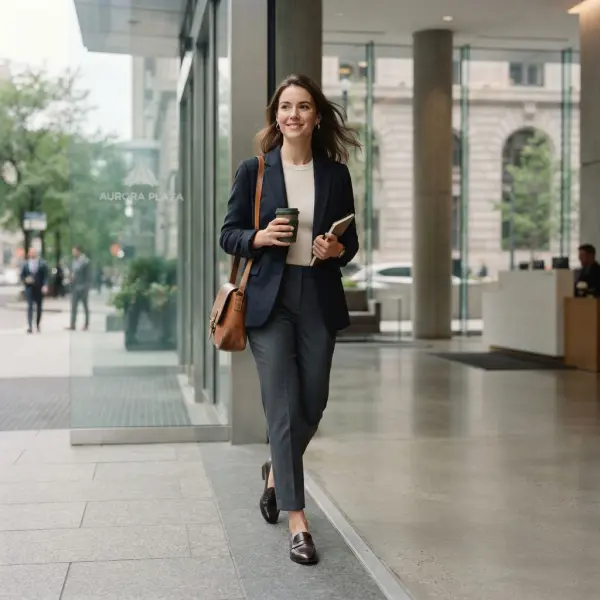
Consider a dark unstructured jacket. With matching trousers and a formal shirt, it may suit an important meeting. With a knitted top and loafers, it becomes routine officewear. With denim and minimal sneakers, it may work for a creative presentation or informal professional event.
This adaptability explains the continuing influence of smart casual dressing on everyday fashion, although smart casual should not be mistaken for the entire workwear market. Formal, uniformed, safety-regulated, ceremonial, and customer-facing environments still operate under different requirements.
What Does the Workwear Evolution Mean for Fashion Businesses?
The shift changes more than seasonal styling. It affects assortment architecture, fabric selection, fit, merchandising, content production, and inventory planning.
Product Categories Are Blending
A product may no longer sit neatly inside “officewear,” “casualwear,” or “occasionwear.” The same jacket might be marketed for work, travel, dinner, and weekend use.
This can improve commercial reach, but overly broad positioning creates weak products. A blazer promoted as suitable for every occasion may be too casual for formal work, too restrictive for travel, and too expensive for everyday use.
Brands need a clear primary use case. Versatility should extend the product’s value, not replace its identity.
A useful assortment might include:
|
Product role |
Primary function |
Development priority |
|
Presentation piece |
Higher-stakes meetings and formal events |
Structure, finish, visual authority |
|
Everyday office piece |
Routine professional activity |
Comfort, care, repeat wear |
|
Hybrid layer |
Home, commute, and office transitions |
Soft structure, temperature flexibility |
|
Travel workwear |
Business travel and mobile work |
Crease recovery, pockets, layering |
|
Creative professional piece |
Personality within a polished outfit |
Distinctive shape, color, or detail |
|
Modular foundation |
Coordinates with multiple outfits |
Fit consistency and neutral compatibility |
This structure helps design teams avoid producing a collection made entirely of interchangeable “smart” basics with no clear hierarchy.
Fit Systems Need to Reflect Real Movement
Workwear fit is often evaluated while the model stands upright. Actual wear includes sitting for hours, bending, carrying a laptop, reaching across a table, climbing stairs, and moving between transport systems.
Wear trials should examine:
- pressure at the waist while seated;
- jacket movement across the back and shoulders;
- shirt exposure when arms are raised;
- pocket accessibility;
- hem movement while walking;
- fabric transparency under different lighting;
- comfort with layered garments;
- appearance after several hours of sitting.
Inclusive sizing also requires more than grading one sample proportionally. Different body shapes may need adjusted rises, lengths, shoulder balances, sleeve widths, bust shaping, or waist-to-hip relationships.
Merchandising Should Show Multiple Levels of Formality
Consumers often struggle not because they cannot find clothing, but because they cannot judge whether it is appropriate for their workplace.
Product pages can reduce this uncertainty by showing:
- the same garment styled for different professional situations;
- front, back, seated, and movement views;
- fabric weight and stretch information;
- care requirements;
- pocket functionality;
- model measurements and garment measurements;
- guidance on relative formality;
- compatibility with other items in the collection.
The phrase “perfect for work” is rarely sufficient. Work in a bank, school, design agency, government office, retail store, technology company, and consulting firm can involve very different expectations.
Inventory Planning May Need to Become Less Seasonal
Many workwear staples are not driven by short trend cycles. Trousers, shirts, knit tops, blazers, simple dresses, and commuter bags may sell across several seasons with adjustments in fabrication, color, and weight.
For brands, this creates an opportunity to build replenishable core products. It also requires disciplined color continuity and supplier consistency. A customer who returns six months later for a replacement trouser may expect the fit, shade, and fabric handfeel to remain similar.
Poor continuity can undermine trust, particularly when the brand promotes the product as a wardrobe foundation.

How Can Fashion Brands Apply These Changes Strategically?
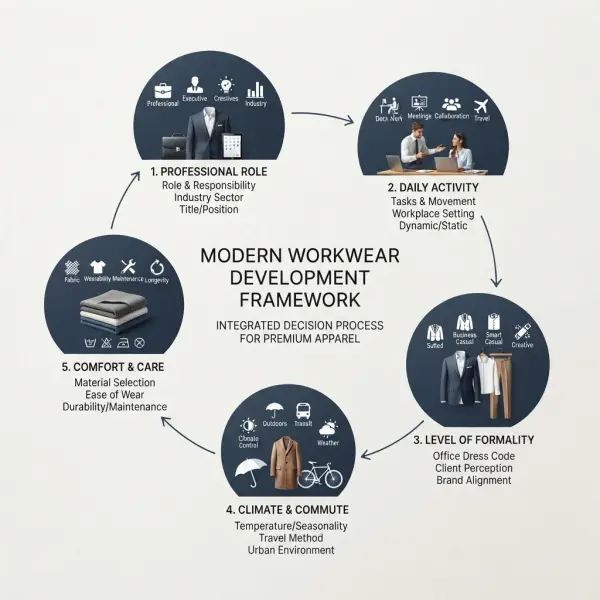
The safest approach is to begin with the customer’s working reality rather than with a generic officewear trend board.
1. Define the Professional Context
Identify where, when, and how the target customer works. Useful questions include:
- Is the customer office-based, hybrid, remote, mobile, or client-facing?
- How formal is the industry?
- Does the customer commute?
- What climate and indoor conditions are common?
- Are garments expected to be machine washable?
- Does the customer need modest, adaptive, maternity, or gender-neutral options?
- How often are formal meetings or events required?
- What price can the customer reasonably justify for repeated use?
A global brand may need different answers by city or region. Expectations in a tropical creative office cannot be assumed to match those in a conservative financial center or a cold-climate government workplace.
2. Build a Formality Ladder
Instead of labeling everything “workwear,” classify products according to their realistic level of formality.
A simple ladder may include:
1. Formal professional: matching tailoring, formal dresses, refined shirts, structured footwear.
2. Polished business: tailored separates, knit jackets, trousers, blouses, loafers.
3. Smart casual: overshirts, polos, dark denim where acceptable, clean sneakers.
4. Remote professional: camera-ready knitwear, comfortable trousers, soft layers.
5. Off-duty casual: products not positioned primarily for workplace use.
The boundaries will vary, but the framework helps customers make decisions and prevents the brand from presenting every casual item as office-appropriate.
3. Design Modular Outfits, Not Isolated Products
Each central garment should ideally coordinate with several others in the range. This requires decisions about proportion, color, length, fabric contrast, and layering before samples are finalized.
For example, a blazer should be tested over the intended shirts and knit tops. Trousers should work with both tucked and untucked silhouettes. Outerwear must fit over the collection’s heaviest office layer.
Modularity is operational, not just visual.
4. Validate Comfort Through Wear Testing
Internal fit sessions may identify obvious construction problems, but real users reveal different issues. Ask testers to wear garments through a realistic workday and record discomfort, creasing, temperature response, pocket use, and styling limitations.
A product intended for hybrid professionals should be tested in the environments it claims to serve: home, transport, workplace, and possibly evening use.
5. Communicate Versatility with Evidence
Show exactly how the garment changes between settings. Avoid vague claims such as “from desk to dinner” unless the product genuinely performs in both situations.
Effective evidence may include:
- three styling combinations;
- a short movement video;
- close-up fabric images;
- a transparent care explanation;
- garment measurements;
- a description of lining and structure;
- realistic use-case photography.
Good communication reduces mismatched expectations and may help customers select more appropriate products.
Common Workwear Strategy Mistakes
Treating “Casual” as the Entire Trend
The shift away from rigid formality does not mean that unstructured, oversized, or leisure-oriented clothing will work in every professional environment.
This mistake often happens when brands interpret relaxed dress codes only through runway styling or social-media aesthetics. The result may be visually interesting but commercially narrow.
A better strategy is to preserve signals of intention: controlled fit, quality finishing, fabric stability, thoughtful coordination, and clear use-case positioning.
Adding Stretch Without Improving the Pattern
Stretch fiber can improve mobility, but it cannot correct poor balance, insufficient ease, twisted seams, restrictive armholes, or badly positioned waistbands.
Excessive stretch can also reduce fabric recovery, create bagging at the knees or seat, alter breathability, or make a tailored garment look less refined.
Comfort should be engineered through the combined effect of fabric, pattern, construction, and finishing.
Designing Only for Standing Product Photography
A jacket may look excellent on a stationary model but pull across the back when the wearer types or reaches. Trousers may fit well while standing but become uncomfortable when seated.
Modern workwear should be assessed in motion and over time. Fit photographs remain useful, but they should not replace functional testing.
Using Ambiguous Professional Language
Terms such as “business casual,” “smart,” “polished,” and “office-ready” are interpreted differently across markets.
When brands rely on these terms without examples, customers must estimate whether a product fits their workplace. That uncertainty is especially difficult for graduates, career changers, employees returning to offices, and professionals entering unfamiliar corporate cultures.
Visual examples and contextual descriptions are more helpful than labels alone.
Ignoring the Cost of Maintaining the Garment
A relatively affordable jacket can become expensive to own if it requires frequent specialist cleaning, creases easily, or cannot withstand repeated use.
Care expectations should align with the role of the product. Everyday office trousers may need easier maintenance than a formal suit worn only for important events.
Brands should test shrinkage, colorfastness, pilling, surface abrasion, seam durability, and shape recovery according to the intended use.
Assuming One Global Office Culture
Professional expectations are affected by local customs, religion, climate, organizational hierarchy, client norms, and industry conventions.
A product or campaign that appears confidently individual in one market may appear overly casual, impractical, or culturally insensitive in another. Global styling should therefore be adapted rather than merely translated.
What This Evolution Does Not Mean
Modern workwear is more flexible, but several boundaries remain important.
First, the decline of daily suit-wearing in some offices does not make the suit obsolete. Formal tailoring continues to serve ceremonies, leadership settings, client negotiations, hospitality, finance, law, government, luxury retail, and other environments where visual convention remains influential.
Second, professional flexibility does not override safety. Production facilities, laboratories, healthcare settings, kitchens, construction sites, and warehouses may require uniforms, protective footwear, restrained silhouettes, hair covering, high-visibility clothing, or other controls.
Third, an inclusive dress code does not mean an organization cannot set standards. Employers may still establish expectations connected to safety, hygiene, identification, customer service, or legitimate operational needs. However, policies should be specific, consistently applied, and reviewed under the laws of the relevant jurisdiction.
For example, the UK Advisory, Conciliation and Arbitration Service advises employers to ensure dress codes are flexible enough to accommodate needs associated with protected characteristics. Acas guidance on inclusive workplace policies
In the United States, Equal Employment Opportunity Commission guidance explains that covered employers may need to make exceptions to usual dress or grooming rules for religious practices unless the accommodation would create undue hardship under the applicable legal standard. EEOC guidance on religious dress and grooming
These examples should not be treated as universal legal advice. Dress-code obligations differ across jurisdictions, and businesses should verify local employment, equality, religious accommodation, disability, gender identity, health, and safety requirements.
What Should Brands Verify Before Developing a Workwear Collection?
Before committing to materials, silhouettes, or marketing claims, brands should verify five areas.
Customer reality
Confirm actual working environments rather than relying only on aspirational mood boards. Interview customers across roles, seniority levels, ages, body types, climates, and commuting patterns.
Garment performance
Test fit, movement, thermal comfort, crease behavior, durability, laundering, pilling, colorfastness, and shape recovery.
Workplace appropriateness
Assess which sectors and situations the product genuinely suits. A garment can be professionally styled without being appropriate for every workplace.
Policy and cultural context
Avoid promoting clothing in ways that conflict with uniform rules, safety requirements, modesty expectations, or local employment regulations.
Commercial continuity
Decide whether each product is seasonal, trend-led, replenishable, or part of a long-term core range. This affects fabric commitments, color continuity, minimum order quantities, and markdown risk.
The main decision is not whether workwear should become formal or casual. It is how much structure, versatility, comfort, and identity the target customer needs—and under what conditions.
Frequently Asked Questions
Is traditional business attire becoming obsolete?
No. Traditional business attire is becoming less routine in some professional environments, but it remains important for formal meetings, ceremonies, interviews, leadership settings, legal work, finance, government, luxury services, and conservative client-facing roles.
Its function is changing. Instead of being the default uniform for every office day, formal clothing may be reserved for moments that require greater visual authority or adherence to convention. This can lead consumers to buy fewer suits while expecting each one to provide better fit, durability, and styling flexibility.
Brands should therefore avoid treating formalwear as either universally essential or completely outdated. Demand depends on occupation, location, company culture, age group, and occasion.
What is the difference between business casual and smart casual?
Business casual is generally connected to workplace expectations, while smart casual is a broader styling category that combines polished and relaxed elements for work or social settings.
Business casual often includes tailored trousers, collared shirts, blouses, modest dresses, knitwear, loafers, and relaxed blazers. Smart casual may permit more denim, fashion-led proportions, statement accessories, casual jackets, or clean sneakers.
The categories overlap, and neither has a universal definition. A smart casual outfit accepted in a creative agency may still be too informal for a client-facing financial office. Employees should check actual workplace examples rather than relying only on the label.
Which fabrics are most suitable for modern workwear?
There is no single best workwear fabric. Suitable choices depend on climate, garment type, formal appearance, care expectations, price, and frequency of wear.
Wool and wool blends can provide drape and recovery. Cotton constructions may offer familiarity and washability. Linen can support airflow but usually creases visibly. Regenerated cellulosic fibers may offer softness and fluidity, although their durability varies by construction. Synthetic fibers may improve crease resistance, stretch, or drying speed but can affect breathability and handfeel.
Brands should evaluate the complete fabric specification, including weight, weave or knit structure, finishing, recovery, opacity, shrinkage, abrasion resistance, and laundering performance.
Can sneakers be considered professional footwear?
Sneakers can be appropriate in workplaces that accept smart casual or casual dress, particularly when the design is clean, understated, well maintained, and coordinated with the outfit.
They are not automatically appropriate in every professional setting. Formal client meetings, ceremonies, conservative sectors, luxury service roles, and workplaces with safety footwear rules may require different options.
From a product perspective, brands should distinguish lifestyle sneakers from professional comfort footwear. Surface material, sole profile, color, branding, cleanliness, cushioning, and overall visual bulk affect how formal the shoe appears.
How should small fashion brands enter the workwear market?
A small brand should begin with a narrow customer problem rather than a complete officewear wardrobe.
It might focus on one dependable trouser fit, a washable professional dress, a lightweight tropical blazer, modest workwear, adaptive office clothing, plus-size tailoring, commuter-friendly shirts, or gender-neutral professional separates.
The brand should test the product with real users, establish reliable sizing, and show several realistic styling situations. It is usually safer to build around one repeatable hero product than to launch a broad collection with inconsistent fit and unclear positioning.
Expansion can follow once repeat purchase behavior and customer feedback are understood.
Does more relaxed workwear improve employee performance?
Clothing may affect comfort, confidence, identity, and perceived appropriateness, but it would be inaccurate to claim that relaxed clothing automatically improves performance.
Work outcomes are influenced by management, workload, role clarity, workplace culture, physical environment, tools, skills, and many other variables. Even hybrid work research should not be interpreted as evidence that a particular style of clothing increases productivity.
A Stanford field experiment found that employees working a hybrid schedule of roughly two office days per week reported benefits including work-life balance and job satisfaction, but the study evaluated working arrangements rather than clothing. Stanford hybrid work field experiment
Should employers replace detailed dress codes with “dress for your day”?
A situational policy can work when employees understand the organization’s expectations and managers apply them consistently.
The approach is weaker when “use good judgment” is the only guidance. Employees may receive conflicting feedback, while personal bias can influence who is considered polished or professional.
A stronger policy explains expected appearance by activity: routine office work, client meetings, formal events, remote calls, site visits, and safety-regulated areas. It should also include accommodation procedures and neutral examples rather than rigidly gendered rules.
Employers should review any policy under applicable local law before implementation.
Conclusion
Workwear is no longer defined by one dominant office uniform. It is becoming a layered system in which formality, comfort, personal expression, climate, commuting, and professional activity must be balanced.
The most commercially relevant change is not the disappearance of tailoring or the unrestricted rise of casual clothing. It is the growing demand for garments that can perform across several professional contexts without looking generic or losing their intended function.
For fashion brands, this requires more disciplined product thinking. Fabric must support real wear. Patterns must accommodate sitting and movement. collections must coordinate. Formality must be communicated clearly. Claims about comfort and versatility must be demonstrated rather than assumed.
The brands most likely to build durable workwear categories will not chase every office aesthetic. They will understand how their customers actually work and create reliable clothing for those specific conditions.




Comments 0
Leave a CommentSend Comment
Anda harus Login terlebih dahulu untuk dapat memberikan komentar.