
How Mini-Me Styling Influences Kidswear and Family Fashion
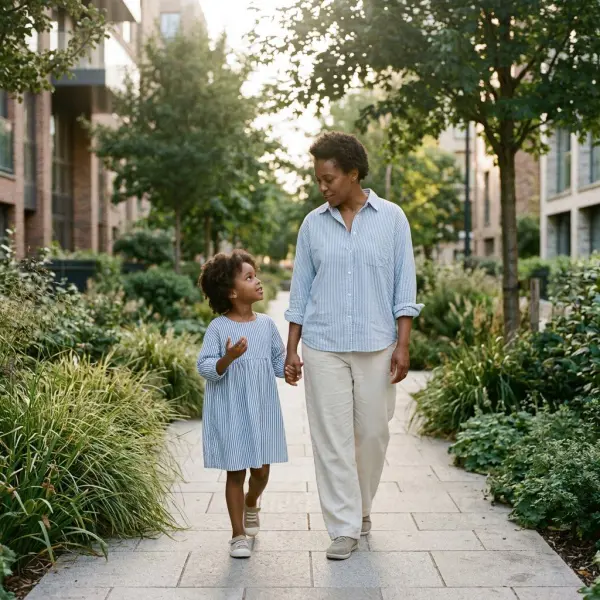
A parent wears a striped linen shirt to a weekend gathering. Their child arrives in a dress made from the same fabric, but with a looser silhouette and playful details. The outfits are not identical, yet the connection is immediately recognizable.
This is one expression of mini-me styling, a fashion approach that connects adult and children's wardrobes through shared colors, prints, fabrics, or design themes.
Matching family clothing is not a new concept. Coordinated outfits have appeared in family photographs, holiday traditions, occasionwear, and fashion collections for decades. What makes the contemporary interpretation interesting is the growing variety of ways brands translate adult fashion into children's clothing without necessarily reproducing entire outfits.
For fashion businesses, mini-me styling creates opportunities to connect product categories that are usually developed and merchandised separately. A womenswear print can become the foundation of a children's capsule. A familiar adult sweatshirt can inspire an age-appropriate kidswear version. A coordinated collection can also give customers a reason to browse across multiple departments.
However, successful mini-me fashion is not simply adult clothing produced in smaller sizes. It requires careful design adaptation, coordinated assortment planning, realistic inventory management, and an understanding of how families actually choose clothing.
Quick Answer: What Is Mini-Me Styling in Fashion?
Mini-me styling is a fashion approach in which children's clothing visually matches or coordinates with adult outfits through shared colors, prints, fabrics, silhouettes, or design details. It is commonly associated with parent-child matching outfits, but it can also include siblings, extended families, and coordinated dressing across different generations.
The approach ranges from identical graphic T-shirts to subtly connected outfits that share a color palette or pattern while using different garment constructions.
Mini-me fashion influences kidswear by introducing adult fashion references into children's collections. It also encourages brands to consider family-based merchandising, cross-category product development, and coordinated marketing campaigns.
For families, the appeal may involve celebrating an occasion, expressing a shared sense of style, or enjoying a playful dressing experience. For retailers, coordinated collections can create opportunities to sell related garments across multiple customer categories.
The central design principle is adaptation rather than exact replication. Children's versions should remain suitable for their intended age group, activities, climate, and relevant safety requirements.
Mini-me styling is also not a universal consumer preference. Its commercial relevance varies by culture, occasion, household budget, and individual attitudes toward coordinated clothing.
How Mini-Me Fashion Became Part of Family Dressing
Coordinated family clothing has existed long before social media made matching outfits easy to share publicly.
Families have traditionally used clothing to communicate belonging, celebrate important occasions, and create a recognizable visual connection between relatives. Matching holiday garments, similar colors in family photographs, and coordinated ceremonial clothing are familiar examples in different cultural settings.
The fashion industry's contemporary use of mini-me places greater emphasis on the relationship between adult collections and childrenswear design.
British Vogue was discussing mini-me fashion collections as early as 2015, featuring adult and children's versions of recognizable fashion products. This demonstrates that mini-me styling is not a trend that originated in the mid-2020s.
More recent coverage has explored its changing meaning. A June 2025 feature in The Guardian examined renewed interest in coordinated dressing, including its relationship with family identity, nostalgia, celebrity fashion, and social media.
These observations help explain why the aesthetic remains visible, although editorial coverage alone does not establish how frequently families purchase matching clothing.
The commercial development is also broader than simply dressing children like adults. Some childrenswear brands have introduced adult products using the same relaxed silhouettes, playful graphics, or fabric stories.
This creates a two-way relationship: adult fashion can influence kidswear, while children's design language can also inspire products intended for parents.
Mini-Me Styling Does Not Always Mean Identical Outfits
One of the most useful distinctions in family fashion is the difference between exact matching and visual coordination.
Matching clothing uses essentially the same design across different wearers, adjusted as necessary for size and suitability. Coordinated dressing creates a recognizable relationship between outfits without requiring identical garment shapes.
Both approaches can work, but they serve different aesthetic and practical needs.
Exact Matching Outfits
Exact matching is the most recognizable interpretation of mini-me fashion.
A parent and child might wear T-shirts with the same graphic, dresses featuring the same print, or shirts developed from identical fabric. The garments are intended to create an immediate visual connection.
This approach is relatively straightforward to communicate in product photography because customers can easily recognize the relationship between the items.
However, identical visual design does not eliminate the need for different garment specifications.
An adult shirt and a toddler shirt may share fabric and print placement, but their neck openings, lengths, closures, seam construction, and proportions require separate development.
Exact matching can work particularly well for simple garments, such as jersey tops or casual shirts, where a shared design can be adapted without introducing unnecessary complexity.
Complementary Family Styling
Complementary styling uses coordinated colors, related textures, or selected common details rather than replicating entire garments.
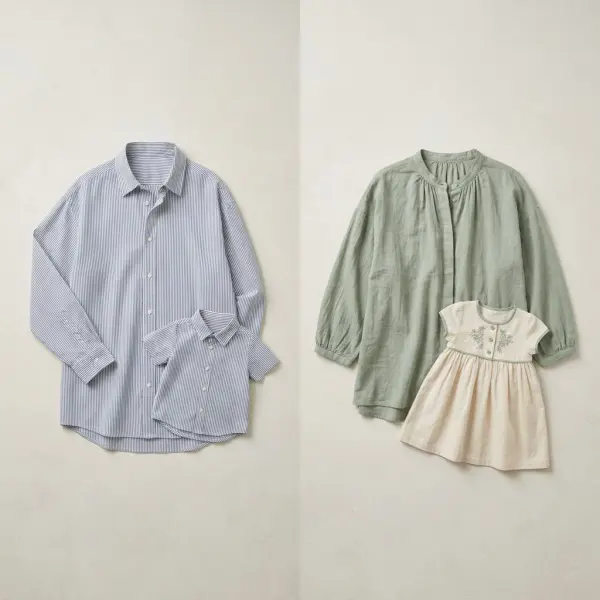
For example, a parent might wear a sage-green linen dress while a child wears cream trousers and a sage-green shirt. The family looks coordinated because the palette is consistent, even though the garments are completely different.
This approach offers flexibility for families whose members have different clothing preferences.
It also allows brands to introduce shared design elements into existing collections without developing an identical adult and children's product for every style.
A 2024 Vogue family-fashion shopping feature illustrated the range of coordinated options available, from related striped garments to occasionwear and complementary family ensembles.
Shared Prints With Different Silhouettes
Shared-print styling offers a middle ground between exact matching and looser color coordination.
The same floral, geometric, striped, or illustrated fabric design can appear on different products tailored to each wearer's needs.
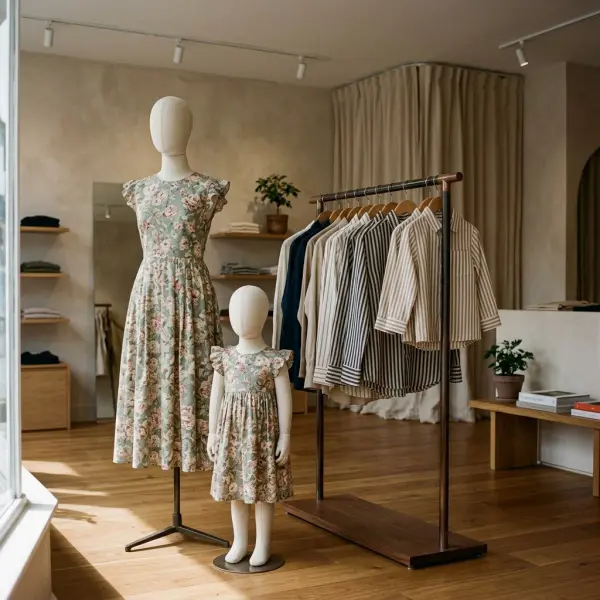
A brand might use one botanical print for an adult midi dress, a child's short-sleeved dress, and a casual shirt. Each garment has its own pattern construction, but the print creates a shared collection identity.
This can be commercially useful because a recognizable print may connect several products in one campaign.
Nevertheless, the print must be evaluated on different garment sizes. A large motif that works well on an adult dress may look disproportionate on a toddler's small bodice.
Print scaling and placement can therefore be as important as the garment silhouette itself.
|
Styling Approach |
Visual Connection |
Example |
Main Design Consideration |
|
Exact matching |
Same or nearly identical garment appearance |
Parent and child graphic T-shirts |
Age-appropriate proportions and construction |
|
Coordinated colors |
Shared palette across different garments |
Navy parent shirt with navy child dress |
Consistent color communication |
|
Shared prints |
Same print applied to different silhouettes |
Floral adult blouse and children's dress |
Print scaling and placement |
|
Complementary details |
Related trims, textures, or design accents |
Matching striped collars or contrast pockets |
Construction suitability |
|
Occasion-based coordination |
Unified dressing theme for a particular event |
Family holiday or celebration outfits |
Different garment needs across family members |
For brands, the choice should reflect the intended customer experience. A novelty capsule may benefit from obvious matching, while a premium everyday collection may work better with coordinated details that remain useful when worn separately.
Why Families Choose Coordinated Clothing
The appeal of mini-me fashion cannot be explained by aesthetics alone. Family routines, celebrations, personal preferences, and social contexts all influence the decision to coordinate outfits.
Different customers may purchase similar-looking garments for entirely different reasons.
Celebrating Family Identity
Coordinated clothing can communicate a sense of connection between family members.
For some families, wearing similar outfits is a playful activity. For others, it becomes part of a recurring tradition associated with holidays, birthdays, photographs, or travel.
A shared print can make a family photograph visually cohesive, while complementary colors may be enough to communicate unity without creating a uniform appearance.
This does not mean matching clothes inherently strengthen family relationships. That would be a psychological claim requiring stronger evidence than fashion trend reporting generally provides.
The more defensible observation is that some families use clothing as one visible expression of togetherness.
For retailers, this suggests that mini-me products may be more relevant when presented around specific moments rather than promoted only as abstract fashion statements.
Creating Shared Fashion Experiences
Mini-me dressing may also appeal to parents who enjoy fashion and want to explore styling with their children.
A parent who regularly wears striped knitwear, for instance, might enjoy finding a children's garment using a similar color combination. The appeal comes partly from recognizing a familiar personal style in another product category.
Children may respond differently. Some enjoy matching a parent, while others prefer clothes that express their own tastes.
Both preferences can exist within the same household.
For brands, family styling becomes more inclusive when matching is presented as an option rather than a requirement. Coordinated clothing should leave room for the child's preferences and the practical demands of daily activities.
Special Occasions and Family Traditions
Mini-me collections can be particularly relevant to occasions when families anticipate being together and may want coordinated clothing.
Examples include birthdays, weddings, family photographs, holidays, vacations, and cultural celebrations. The exact occasions differ by region and community.
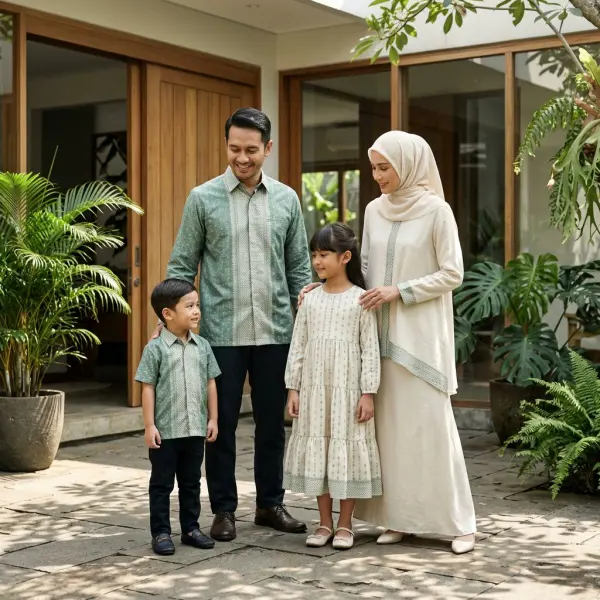
In Indonesia, family-coordinated sarimbit clothing provides a useful market example. These collections commonly feature related colors or motifs across garments intended for different family members.
A February 2026 ANTARA report on Klamby's family collections described coordinated family clothing as an important part of the brand's Ramadan and Eid assortment. This is a brand-specific commercial example, not evidence of universal demand across Indonesia.
Sarimbit and contemporary Western-style mini-me collections are not culturally identical, but they demonstrate how coordinated family dressing can take different forms according to local traditions.
For international fashion businesses, this distinction matters. A global matching-family campaign may need to be adapted substantially to align with local celebrations, dress conventions, and purchasing schedules.
How Social Media Influences Mini-Me Styling
Matching family outfits are well suited to visual media because the styling relationship is immediately understandable.
A photograph of coordinated parent-child clothing communicates the concept without requiring an extended explanation. The shared color, print, or silhouette becomes the central visual element.
This makes mini-me fashion relevant to lifestyle campaigns, creator collaborations, product photography, and user-generated content.
However, social media visibility should not be confused with proven commercial demand.
A matching outfit may attract considerable attention because it looks distinctive in photographs. That does not establish that viewers will purchase the products, wear them frequently, or consider the price acceptable.
Fashion brands need to evaluate the entire customer journey, from visual interest to actual purchasing behavior.
From Personal Styling to Brand Campaigns
Family-focused campaigns can present clothing in realistic situations that help customers imagine the products in use.
For example, a collection of striped T-shirts may be photographed during a family picnic, while coordinated linen garments might appear in a casual vacation setting.
These contexts can help communicate the relationship between adult and children's products.
The most useful images also reveal practical details. Children's garments should fit appropriately and allow natural movement, while adult pieces should appear wearable outside the coordinated outfit.
When the styling feels forced or overly formal, customers may struggle to imagine using the products beyond one photographic occasion.
Campaigns should therefore demonstrate both the coordinated appearance and the individual usefulness of each garment.
User-Generated Content and Customer Participation
Customer photographs can show how mini-me garments are styled outside a controlled studio environment.
A retailer might encourage customers to share coordinated outfits for a family gathering or holiday, subject to appropriate permissions and platform rules.
Such content can provide styling inspiration, but brands need to handle images featuring children with particular care.
UNICEF Indonesia's guidance on sharenting discusses privacy concerns associated with sharing children's images online and the importance of considering children's perspectives and consent.
For commercial campaigns, brands should establish appropriate image permissions, respect children's dignity, avoid unnecessary personal information, and comply with applicable privacy and advertising requirements.
The commercial value of a family photograph does not outweigh the responsibility to protect the people appearing in it.
How Mini-Me Styling Influences Kidswear Product Design
Mini-me styling creates a particular technical challenge: the brand wants a consistent visual language across garments intended for people with substantially different body proportions and clothing requirements.
The easiest approach may appear to be scaling down an adult pattern. In practice, this is often insufficient.
A successful collection must preserve recognizable design elements while developing each product for its intended wearer.
Translating Adult Silhouettes Into Children's Garments
Adult fashion frequently uses details that require modification before being incorporated into children's clothing.
Oversized tailoring, long hems, fitted waistlines, decorative ties, and heavy hardware may contribute to an adult garment's aesthetic. Their suitability for a child's garment depends on age, use, fit, and applicable safety requirements.
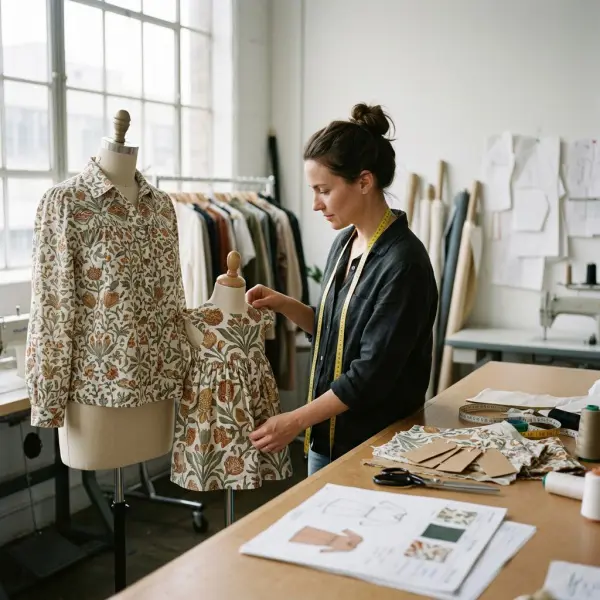
Consider a coordinated linen collection. An adult garment might feature a long, flowing silhouette, while the child's version could use the same fabric but a shorter length, simpler closures, and proportions that support movement.
The design connection remains visible without compromising the child's garment specifications.
For a deeper technical examination of garment suitability, seewhy comfort, safety, and easy care matter in children's clothing.
Adapting Prints, Embroidery, and Decorative Details
A shared textile motif is one of the most recognizable ways to connect adult and children's garments.
However, decorative scale matters.
A large floral repeat may appear balanced on an adult skirt but become visually fragmented on a small child's top. A centrally placed embroidery motif may require repositioning to fit a different neckline or bodice length.
Manufacturers may need separate print-placement specifications or adjusted motif scales.
These changes can increase sampling work and may affect textile consumption or printing costs.
Brands should decide whether exact motif consistency is commercially necessary. Sometimes maintaining the same color palette and print character is sufficient to create a coordinated look without requiring identical pattern placement.
Designing for Different Activities
An adult and a child may attend the same event but experience it very differently.
At a family gathering, an adult might remain seated for extended periods while a child moves between indoor and outdoor spaces. A shared outfit concept should therefore accommodate different levels of movement.
This affects garment length, fabric weight, closures, lining, and overall construction.
For example, a child's coordinated dress may require a less restrictive silhouette than its adult counterpart. Similarly, matching jackets should not automatically share decorative cords or heavy trims.
The U.S. Consumer Product Safety Commission's guidance on children's upper outerwear drawstrings identifies specific safety requirements for defined children's garment categories and sizes.
Product teams must evaluate the children's garments independently rather than assuming that adult design approval establishes suitability for the entire collection.
What Mini-Me Collections Mean for Apparel Sourcing and Manufacturing
A coordinated collection may share fabrics, prints, and design concepts, but it still consists of multiple distinct products.
Each garment has its own size range, pattern pieces, construction requirements, costing, and inventory position.
For manufacturers and sourcing teams, coordination can create efficiencies in some areas while increasing complexity elsewhere.
Shared Materials and Fabric Planning
Using one fabric across adult and children's products may offer purchasing and visual consistency advantages.
For example, a coordinated shirt collection could use the same striped woven cotton across several garment styles.
Consolidating demand for a fabric may help meet supplier minimum order quantities or simplify material selection, depending on the sourcing arrangement.
However, different garments can have different performance needs. A material that works well for a loose adult shirt may not be ideal for a baby's bodysuit or a child's activewear garment.
Shared sourcing should therefore be treated as an opportunity to evaluate, not a requirement that every product must use an identical material.
Even when the same fabric is suitable, different garment widths, print placements, cutting layouts, and consumption rates need to be considered.
Pattern Development and Size Grading
Adult and children's garments require separate sizing logic.
A womenswear size range cannot simply be converted into children's sizes through a fixed percentage reduction. Body proportions change during childhood, and different garment categories require different ease allowances.
Each product family needs an appropriate base pattern, measurement specification, and grading approach.
A coordinated collection containing men's shirts, women's dresses, children's shirts, and toddler dresses therefore involves several distinct pattern-development tasks.
For smaller brands, this can increase sampling costs and the number of fit approvals required before production.
The visual benefit of offering many matching options needs to be balanced against the operational work involved.
Managing Fabric Consumption and Cutting Efficiency
Using a common print does not guarantee that all garments can be manufactured with the same material efficiency.
An adult dress may consume significantly more fabric than a child's shirt, while directional prints can limit how pattern pieces are positioned during cutting.
Large motifs may also require placement matching, which can introduce additional cutting constraints.
Production planners should calculate fabric consumption by style and size rather than relying on a general assumption that shared fabrics will automatically reduce waste.
The goal is to identify actual manufacturing advantages while accounting for the complexity introduced by different garment patterns.
The Commercial Opportunity: Selling Coordinated Looks Across Categories
Mini-me styling can connect adult fashion, childrenswear, and family-oriented merchandising within one recognizable collection.
This creates a different commercial structure from a conventional childrenswear launch.
Instead of selling a single children's garment, a retailer may present several complementary products that can be purchased individually or together.
Cross-Category Merchandising
Cross-category merchandising is one of the clearest opportunities.
A brand could display an adult striped shirt alongside a child's striped dress, linking the two product pages so customers can discover the coordinated option.
This does not require customers to purchase both garments.
The adult shirt should still function as a desirable product for the adult customer, while the children's dress should remain appropriate and useful independently.
This matters because coordinated dressing may be occasional. If customers only find a garment appealing when purchased as part of a set, demand could be narrower than expected.
The strongest assortment design gives each item a credible individual use while making the coordinated relationship easy to recognize.
Matching Sets and Bundle Offers
Retailers may also introduce bundles combining adult and children's garments.
For example, a parent-child T-shirt set could be offered with a modest bundled price, while each item remains available separately.
This can simplify discovery for customers who already intend to buy matching outfits.
However, bundle pricing introduces operational questions. Families may need different size combinations, and a missing size in one product can affect the attractiveness or availability of the complete offer.
Bundles also require clear return and exchange policies.
A customer may wish to exchange only the child's garment while keeping the adult product. The retailer needs a system that handles such situations without confusing customers or distorting inventory records.
Occasion-Based Capsule Collections
Coordinated family clothing may be especially suitable for focused capsules developed around identifiable occasions.
A holiday capsule, for instance, could contain a small selection of adult and children's garments using one shared print story.
Compared with a broad permanent assortment, this structure can make campaign planning and product relationships easier to communicate.
Nevertheless, occasion-based merchandise can create concentrated inventory risk.
If the selling period is short and demand is lower than expected, remaining stock may be difficult to sell at full price after the occasion.
Brands should therefore use realistic forecasts, controlled initial production quantities, and designs that may remain wearable beyond the campaign period.
Brand Extension Into New Customer Categories
Mini-me styling can provide a pathway for an established adult fashion brand to explore children's products.
An adult label known for graphic sweatshirts, for example, might introduce a limited children's capsule that uses the same visual identity.
The reverse is also possible: a childrenswear brand may introduce selected adult garments so existing customers can coordinate with their children.
The commercial challenge is that entering a new category requires additional product development knowledge, fit expertise, compliance evaluation, and customer service capabilities.
Brand familiarity may support customer interest, but it does not replace these operational requirements.
Planning a Mini-Me Assortment Without Excessive Inventory Risk
The complexity of a family collection becomes clearer when sizing is considered.
A single design may be offered in several adult and children's sizes. If multiple colors or silhouettes are introduced, the number of individual stock-keeping units (SKUs) grows quickly.
For example, consider an illustrative capsule with one adult T-shirt in five sizes and one children's T-shirt in six sizes, both available in three colors.
The assortment would contain 33 size-color SKUs before introducing any additional product categories.
This is a planning illustration, not an industry benchmark. Actual inventory requirements depend on style count, size distribution, and assortment structure.
A brand that expands the capsule into dresses, trousers, and outerwear will face additional forecasting and inventory decisions.
A useful planning framework separates three considerations:
|
Planning Area |
Key Question |
Operational Implication |
|
Shared designs |
Which colors or prints should connect the products? |
Material coordination and design consistency |
|
Size distribution |
Which adult and children's sizes are likely to sell? |
Inventory allocation and replenishment |
|
Matching combinations |
Which products should customers see together? |
Product linking and coordinated merchandising |
|
Bundle availability |
What happens when one matching size sells out? |
Inventory rules and customer communication |
|
Selling period |
Is the collection seasonal, occasion-based, or evergreen? |
Production timing and markdown risk |
|
Individual demand |
Can each product sell without its matching counterpart? |
Assortment flexibility and residual stock management |
For a small fashion business, a limited capsule can be a practical way to test demand before expanding.
One shared print applied to a few carefully chosen silhouettes may provide sufficient visual impact without requiring an extensive family wardrobe.
Product-level performance should then guide further development.
How Retailers Can Present Mini-Me Fashion More Effectively
A coordinated collection can be difficult to shop when adult and children's products are stored in separate website departments with no obvious connection.
Good merchandising makes those relationships visible without forcing customers to navigate unfamiliar categories.
Connect Related Products on Product Pages
A children's dress page can show the corresponding adult garment under a section such as Complete the Family Look.
Similarly, an adult shirt page can feature the matching children's version.
These links should be based on actual product relationships, not generic recommendations.
If an adult blouse and children's skirt share a fabric print, the connection should be accurately described even if the garments are not identical.
Useful product information includes size availability, fabric differences, fit notes, and whether the garments are sold individually or as a bundle.
Show Both Coordinated and Individual Styling
Family campaign photography can demonstrate how products work together, while individual garment images show each item's fit, proportions, and details.
Both types of photography are important.
A beautiful family portrait may communicate the collection's theme but provide little information about sleeve length, neckline construction, fabric texture, or the child's garment fit.
Retailers should therefore supplement lifestyle imagery with individual product photographs and appropriate measurement guidance.
This approach allows customers to evaluate each garment on its own merits.
Build Campaigns Around Real Family Occasions
Mini-me styling is often easier to understand when associated with a recognizable occasion.
A retailer may use coordinated outfits in a weekend getaway campaign, family celebration collection, or seasonal holiday assortment.
However, the campaign should remain relevant to the intended market.
The same styling concept may need different products and imagery for tropical vacations, colder-weather celebrations, or local cultural events.
Strong merchandising connects the aesthetic with a believable use case instead of assuming that matching clothing appeals equally to every family.
The Importance of Children's Individuality in Family Fashion
Mini-me styling creates a visible relationship between adults and children, but that relationship should not eliminate children's preferences.
An outfit chosen for a family photograph may be enjoyable for a child who likes the design. The same outfit may be frustrating for another child who dislikes the fabric, silhouette, or idea of matching.
These differences become particularly relevant as children develop stronger personal preferences.
Mini-me collections can accommodate this by offering choices within a shared design story. One child might select a printed T-shirt, another a dress, while the adults wear complementary garments.
The family can still achieve visual coordination without requiring everyone to adopt the same silhouette.
This is also relevant to how brands represent children in campaigns.
Children should not be treated merely as miniature adult models or styling accessories. Clothing needs to be suitable for their age and activities, and photography should respect their comfort, dignity, and applicable consent requirements.
A child-centered approach does not undermine coordinated fashion. It can make the concept more practical and flexible.
Common Mistakes Brands Make With Mini-Me Collections
Despite the apparent simplicity of matching outfits, mini-me collections can encounter design and commercial problems when the coordinated appearance becomes the only priority.
Scaling Down Adult Garments Without Redesign
An adult garment may contain proportions, closures, decorative details, or fabric weights that do not translate appropriately into children's clothing.
Simply reducing pattern dimensions can lead to poor fit, uncomfortable construction, or unsuitable features.
Brands should retain the desired design language while creating a separate children's specification and evaluating the garment according to its intended age group.
The objective is visual consistency, not identical engineering.
Offering Too Many Matching Products at Once
It is tempting to develop matching dresses, shirts, trousers, pajamas, jackets, and accessories across a large size range.
However, every additional garment creates new inventory commitments, sampling work, and sourcing requirements.
If a collection has not yet demonstrated demand, a broad launch can result in fragmented stock and substantial leftover inventory.
A focused capsule using a limited set of recognizable design elements is often a more manageable starting point.
Prioritizing Social Media Appeal Over Wearability
Highly coordinated outfits may perform well visually but offer limited practicality beyond a photoshoot.
A restrictive garment, difficult closure, or delicate material may disappoint customers who expected an everyday product.
Brands should communicate whether garments are intended for occasional use or regular wear and ensure that their construction aligns with those claims.
Attractive campaign photography should support product suitability rather than distract from its limitations.
Ignoring Differences Between Adult and Children's Markets
Adult customers and children may have different preferences for silhouettes, fabrics, and decorative features.
A print that appeals to a parent does not necessarily appeal to an older child, and a premium adult material may be unsuitable for a young child's intended activities.
Brands need to evaluate each customer group rather than assuming that adult brand loyalty automatically translates into children's product demand.
Market testing can help determine which shared design elements are genuinely appealing across generations.
Treating Family Bundles as Simple Inventory Products
Bundles can complicate availability, returns, exchanges, and pricing.
If one children's size sells out while adult inventory remains available, customers may be unable to purchase the complete matching combination.
Retailers should establish clear product relationships, stock-handling rules, and exchange policies before launching bundles.
Offering individual products alongside coordinated recommendations can sometimes provide more flexibility than requiring customers to buy complete sets.
What Brands Should Verify Before Launching a Mini-Me Collection
Before investing in coordinated family fashion, brands should distinguish three questions: whether customers like the aesthetic, whether they want to purchase the garments, and whether the business can supply them profitably.
These are not the same thing.
An attractive campaign may generate engagement without producing enough orders to justify a broad collection. Similarly, strong demand for one matching design does not guarantee that additional products will perform equally well.
A practical launch review should consider:
- Target customers: Which families, age groups, price segments, and occasions are relevant?
- Product relationships: Which garments genuinely share a recognizable design story?
- Children's suitability: Are the children's versions appropriately developed and compliant with applicable requirements?
- Material planning: Can shared fabrics or prints be sourced without compromising product performance?
- Inventory exposure: How many sizes, colors, and garment combinations must be stocked?
- Commercial validation: Do actual purchasing signals support the proposed collection size?
- Campaign execution: Can the brand present coordinated styling while respecting children's privacy and individuality?
The answers should shape the assortment rather than being addressed after production commitments are made.
Market evidence also needs careful interpretation.
Fashion publications and retailer collections demonstrate that mini-me styling exists in the market. They do not, by themselves, establish a global sales growth rate, consumer adoption percentage, or guaranteed return on investment.
For example, Harrods' mini-me fashion editorial shows how luxury retailers organize matching adult and children's products, while Dolce & Gabbana's Mini Me collection provides a concrete example of coordinated products within a luxury brand assortment.
These examples support the existence of a commercial product category, not a universal forecast of its performance.
The broader overview of style developments appears in kidswear trends for modern families and fashion brands.




Comments 0
Leave a CommentSend Comment
Anda harus Login terlebih dahulu untuk dapat memberikan komentar.