

Industrial IoT Explained for Modern Garment Factories
Garment factories have traditionally relied on production supervisors, manual records, and end-of-shift reports to understand what happens on the sewing floor. These methods can provide useful information, but they often reveal problems after production has already been affected. When a sewing line falls behind schedule, managers may need to investigate several workstations before identifying whether the problem involves machine availability, material flow, operator allocation, or an unexpected production interruption.
Industrial Internet of Things (IIoT) technology offers a different way to observe factory operations. By connecting manufacturing equipment, sensors, and production information systems, garment manufacturers can collect operational data closer to the moment an activity occurs. Instead of depending entirely on periodic reports, production teams can use connected information to identify abnormalities, examine bottlenecks, and make more informed decisions during the working day.
The value of Industrial IoT in garment manufacturing is not simply the ability to connect sewing machines to a network. Its practical significance lies in translating machine and production data into information that supports line balancing, production planning, equipment management, and operational coordination.
For apparel businesses facing frequent style changes, fluctuating order volumes, and demanding delivery schedules, this visibility can be useful. However, the results depend on how well the technology reflects actual production conditions, how accurately data is interpreted, and whether factory teams can act on the information collected.
Quick Answer: What Is Industrial IoT in Garment Manufacturing?
Industrial Internet of Things (IIoT) in garment manufacturing is the use of connected machines, sensors, communication networks, and software platforms to collect and exchange operational data from apparel production processes, helping manufacturers monitor equipment, understand production performance, and support operational decisions.
In a garment factory, IIoT may connect industrial sewing machines, cutting equipment, pressing stations, environmental sensors, and production monitoring systems. These devices can provide information about machine activity, equipment status, operating conditions, and selected production events. Data is transmitted through local networks or other communication infrastructure to software that organizes it into reports, dashboards, or alerts.
Unlike ordinary office-based reporting systems, IIoT captures information directly from physical production equipment or associated sensing devices. This can reduce reliance on some manual data collection activities, although human input remains necessary for information such as defect reasons, production disruptions, and other conditions that machines cannot reliably interpret.
Industrial IoT does not automatically make a factory fully automated or eliminate production problems. It provides a technical foundation for better visibility and potentially faster operational responses. Its effectiveness depends on equipment compatibility, accurate data collection, reliable connectivity, appropriate cybersecurity controls, and disciplined production management.
Understanding Industrial IoT in the Garment Factory Environment
Industrial IoT applies connected-device technology to manufacturing operations. According to the National Institute of Standards and Technology's explanation of IoT systems, network interfaces and interactions with the physical world through sensors or actuators are central characteristics of IoT systems. In industrial environments, these capabilities are applied to equipment, production activities, and operational processes.
In a garment factory, this connection creates a relationship between physical operations and digital information. A sewing machine may generate an operating signal, a sensor may detect an equipment condition, or a production terminal may record a completed operation. The collected information becomes useful when it is associated with meaningful manufacturing context, such as a production line, garment style, workstation, operation, or work order.
This distinction matters because garment manufacturing is not a uniform mechanical process. Two sewing machines might run for similar periods while producing different quantities of acceptable garments. One may be performing a short seam operation on a basic T-shirt, while another handles a more complex operation requiring careful alignment, multiple handling steps, or additional quality checks.
Industrial IoT therefore needs to be understood as an operational information system rather than simply a machine-counting technology. Effective implementations combine device-level observations with the production knowledge required to explain those observations.
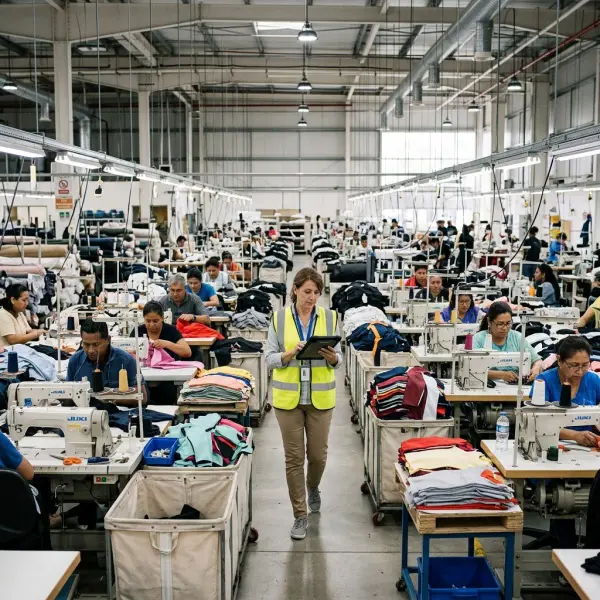
Industrial IoT, Smart Manufacturing, and Industry 4.0
Industrial IoT, smart manufacturing, and Industry 4.0 are related concepts, but they do not mean exactly the same thing.
Industrial IoT describes the connected devices and data exchange capabilities used in industrial operations. Smart manufacturing is a broader approach that uses digital information, coordinated processes, and technologies to improve how manufacturing activities are planned, managed, and executed. Industry 4.0 is an even broader industrial transformation concept involving connected production, cyber-physical systems, automation, and digital integration.
An apparel factory can adopt Industrial IoT without implementing a comprehensive Industry 4.0 strategy. For example, connecting a group of existing sewing machines to collect operating information is an IIoT application, even if cutting schedules, material inventory, and quality inspection records remain partially manual.
Conversely, a factory might introduce digital work instructions or computerized production planning without directly collecting machine data. Those improvements contribute to manufacturing digitalization but do not necessarily represent an IIoT deployment.
The distinction helps garment manufacturers invest according to actual operational needs instead of assuming that every digital initiative requires a complete smart-factory transformation.
How Does Industrial IoT Work in a Garment Factory?
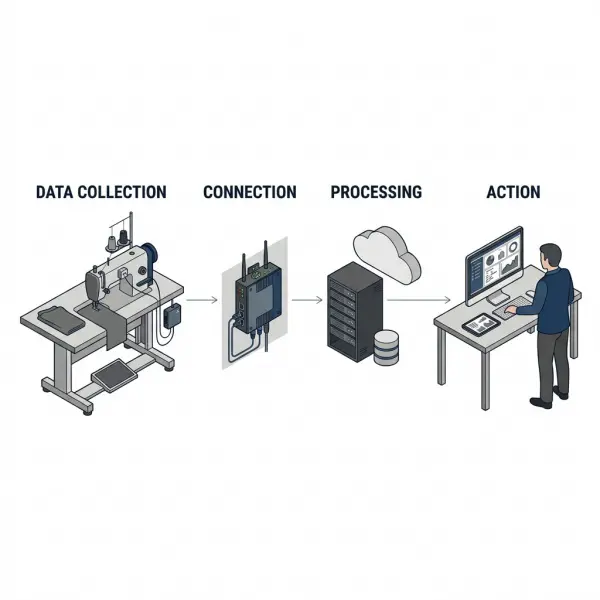
Industrial IoT works by collecting information from manufacturing equipment, transmitting it through a communication network, processing it into usable operational data, and presenting the results to people or systems that can respond. In garment manufacturing, the technical architecture may be relatively simple, involving connected sewing machines and a monitoring dashboard, or more extensive, connecting multiple production departments to an integrated factory management system.
The underlying process generally involves four stages: data collection, communication, data processing, and operational response. Each stage has a specific responsibility, and weaknesses in any one of them can reduce the usefulness of the entire system.
1. Collecting Information from Machines and Sensors
The process begins with physical equipment or sensing devices. Some modern industrial sewing machines contain electronic controllers capable of providing machine operating information. Older or less sophisticated equipment may require additional sensors or external monitoring modules.
Depending on the equipment and installation, manufacturers may collect machine running status, motor activity, operating time, selected machine settings, electrical consumption, or other equipment-specific measurements. Additional input devices may record production counts, downtime reasons, or work-order identification.
The important distinction is between a directly measured condition and a calculated production indicator. A motor sensor can help determine whether a sewing machine is operating, but that measurement alone cannot establish how many acceptable garments have been produced. Additional production context, counting methods, or quality records are required.

2. Transmitting Data Through Factory Networks
Once equipment information is available, it needs to reach a system where it can be processed. This may involve wired Ethernet, appropriately designed wireless networks, industrial communication protocols, or dedicated gateways that collect data from multiple devices.
A gateway acts as an intermediary between connected equipment and higher-level applications. It may translate machine-specific signals, organize incoming records, buffer information during connection interruptions, or transmit data to an on-premises server or cloud-hosted system.
Communication technologies such as MQTT can be used for message transmission, while OPC Unified Architecture (OPC UA) supports structured industrial information exchange where compatible implementations are available. The OPC Foundation's technical specifications describe applications extending from industrial sensors and control systems to manufacturing execution and enterprise resource planning systems.
Not every sewing machine supports these technologies directly. Manufacturers must verify actual interfaces, available data fields, and integration requirements rather than assuming that every digitally controlled machine offers standardized network connectivity.
3. Processing Operational Data into Useful Information
Raw signals have limited business value until they are interpreted. A monitoring application may receive repeated machine-status changes, but the factory needs to understand what those events mean in relation to orders, operations, operators, and planned production capacity.
For example, a sewing workstation might report 35 minutes of operating activity during a particular hour. Without further information, that number does not reveal whether the workstation achieved its output target, was processing difficult fabric, experienced material shortages, or spent time producing pieces that later required rework.
Software systems can combine equipment signals with relevant production data to calculate indicators, identify unusual patterns, or compare actual progress with planned output. Data accuracy depends on correct timestamps, device identification, consistent definitions, and appropriate handling of missing or duplicated records.
4. Presenting Information for Operational Decisions
The final stage is making the information available to the people responsible for production. Supervisors may receive line-level dashboards, production planners may review order progress, and maintenance teams may receive equipment-related notifications.
An effective dashboard should answer operational questions rather than simply display large quantities of data. Production teams need to know which operations are behind schedule, where intervention is required, and whether the available information supports a practical response.
For example, a supervisor who sees repeated inactivity at a particular workstation may investigate the cause. If the problem is missing cut panels, maintenance is unlikely to help. If the machine has stopped because of a technical fault, material replenishment will not resolve it. Data becomes valuable when it directs attention toward an actual production constraint.
Where Industrial IoT Can Be Used in Apparel Production
Sewing departments are a natural starting point for Industrial IoT because they contain numerous workstations whose combined performance determines much of the factory's assembly capacity. However, connected monitoring can also support other stages of garment manufacturing where equipment conditions, production events, or resource usage can be measured reliably.
The suitability of each application depends on the production process. A highly automated fabric cutting system may provide more detailed electronic operating data than a manually operated sewing workstation. Pressing equipment may be more suitable for monitoring temperature and machine status, while finishing departments may require a combination of digital records and manual event confirmation.
The following table illustrates how IIoT can support different production activities without assuming that the same technical solution works everywhere.
|
Production area |
Possible IIoT application |
Operational value |
|
Fabric cutting |
Monitor compatible cutting machine status, activity, and selected fault events |
Identify interruptions and understand equipment availability |
|
Sewing operations |
Collect machine activity and selected production events |
Improve visibility into workstation and line performance |
|
Embroidery |
Monitor compatible embroidery machine status and job progress |
Identify interruptions affecting production schedules |
|
Pressing and finishing |
Monitor appropriate equipment conditions, such as temperature or operating status |
Support process consistency and equipment supervision |
|
Equipment maintenance |
Collect condition measurements and operating history |
Support equipment inspection and maintenance planning |
|
Factory utilities |
Measure electricity consumption or suitable environmental conditions |
Improve visibility into resource consumption and facility conditions |
|
Material movement |
Combine identification technologies with digitally recorded movement events |
Improve work-in-progress tracking where checkpoints and processes are properly designed |
This range of applications illustrates an important principle: industrial connectivity should follow a clearly defined operational problem. A factory does not need to connect every machine to obtain useful insights, particularly when certain departments have more measurable constraints or more immediate improvement opportunities.
Sewing-Line Visibility
Sewing is particularly relevant because garment assembly often consists of multiple interdependent operations. A line producing shirts, for example, may include collar preparation, sleeve attachment, side-seam sewing, buttonhole creation, and final assembly, depending on the garment design and production method.
A production delay at one operation can affect workstations farther along the line even when those machines are functioning normally. IIoT can contribute activity and production-event data that helps industrial engineering teams identify where further investigation is needed.
Commercial systems demonstrate that these capabilities are available in the industrial sewing market. JUKI's JaNets JT Simple system describes machine-operation monitoring, production comparisons, and the use of additional sensors to collect information from selected older or third-party sewing machines. Brother also describes network connectivity and production visibility through its NEXIO industrial sewing machine solutions.
These examples show practical equipment connectivity rather than proving that every factory will experience the same performance improvement. The results still depend on installation, production processes, worker involvement, and how collected information is used.
For a more detailed discussion of workstation data and production-line visibility, see how connected sewing machines support real-time production monitoring.
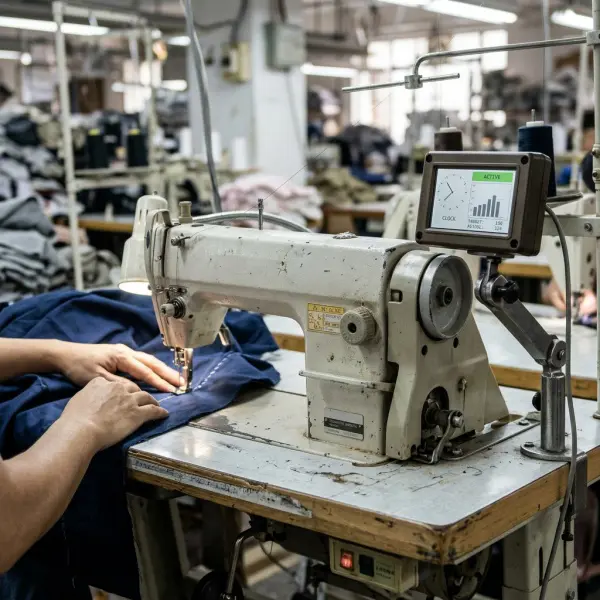
Equipment Condition and Maintenance Monitoring
Industrial equipment can generate signals that help maintenance teams understand how machines behave over time. Depending on the machine and available instrumentation, these may include vibration, temperature, electrical current, operating hours, fault codes, or other condition-related information.
Such data can support condition monitoring, where maintenance personnel examine equipment behavior and determine whether inspection or corrective action may be necessary. More advanced predictive maintenance applications attempt to estimate potential failures or developing faults using appropriate historical and current data.
However, continuous data collection is not equivalent to reliable failure prediction. Meaningful predictive maintenance requires suitable measurements, adequate failure history, machine-specific knowledge, and validation of the methods used. As NIST explains in its manufacturing maintenance research, maintenance information can come from equipment, external sensors, and human-generated records.
The deeper technical and commercial considerations are covered in predictive machine maintenance for apparel manufacturers.
Resource and Environmental Monitoring
Garment manufacturing involves more than sewing-machine performance. Electricity supply, compressed air where used, pressing equipment, air conditioning, and other supporting systems may affect production costs and operating conditions.
Connected meters and suitable environmental sensors can help manufacturers understand consumption patterns or monitor specified operating conditions. For example, electricity measurements collected by production area can reveal when equipment is drawing power and support comparisons between operating periods.
These observations should not be confused with verified environmental improvements. Monitoring electricity consumption does not automatically reduce energy use, and a lower consumption figure does not necessarily mean better productivity if output also declines. Reliable assessment requires an appropriate production baseline and normalization for factors such as operating hours and output volume.
Why Industrial IoT Matters for Garment Manufacturers
The main operational value of Industrial IoT is the ability to narrow the gap between what is happening on the production floor and what management knows about it. Traditional garment production reports may summarize completed output, but they do not always explain the sequence of interruptions, workstation conditions, or short-term changes that led to the final result.
When data becomes available more frequently, factories may be able to investigate problems before they affect an entire shift. This is particularly useful in apparel manufacturing, where delays can arise from equipment, materials, workforce allocation, quality issues, or frequent product changeovers.
Greater Production Visibility
Production visibility means understanding the current condition and progress of relevant manufacturing activities. Industrial IoT can contribute by providing more frequent equipment status records and selected production information.
Consider a factory assembling two garment styles on separate lines. One line performs close to its planned pace, while the other experiences repeated interruptions. A monitoring system may reveal which workstations have unusually high inactivity or where recorded output is falling below expectation.
The system does not necessarily identify the underlying cause. However, it gives supervisors a more focused starting point for investigating production constraints.
Better Coordination Between Departments
Production performance depends on coordination among planning, cutting, sewing, finishing, quality assurance, and maintenance teams. When departments use disconnected reports, they may interpret the same production situation differently or react to information that is already outdated.
Connected monitoring can help establish shared operational information. A planner may see that a production line is behind its scheduled quantity, while a maintenance technician can check whether equipment interruptions contributed to the delay. Industrial engineering personnel can examine whether actual work distribution is consistent with the planned operation sequence.
This coordination becomes valuable when there is a defined process for responding to deviations. Dashboards alone do not ensure that departments communicate or solve problems effectively.
Improved Evidence for Capacity Planning
Capacity planning requires more than counting installed sewing machines. Garment manufacturers must consider available labor, operator skills, standard operation times, machine suitability, quality requirements, and the mix of styles scheduled for production.
Industrial IoT can provide additional evidence about actual equipment availability and observed production conditions. When combined with work-order information and established industrial engineering methods, this data may help factories review whether planned capacity assumptions are realistic.
For example, a manufacturer regularly producing small batches may find that setup changes and material transitions occupy a meaningful part of available production time. Recognizing those conditions can improve planning discussions, although machine monitoring alone cannot quantify every type of setup or labor-related delay.
More Informed Quality and Process Investigations
IIoT can assist quality management by connecting selected machine conditions or production events with quality inspection records. If a defect pattern appears repeatedly around a particular operation, engineers may examine relevant equipment settings, production timing, and maintenance history.
Yet garment quality depends on fabric characteristics, operator technique, machine adjustment, construction specifications, and handling methods. A connected sewing machine cannot independently determine whether seam appearance, garment measurements, or assembly quality meet customer specifications unless suitable inspection technologies and validation processes are also implemented.
For this reason, IIoT should complement established quality assurance methods rather than replace fabric inspection, in-process checking, or finished-garment evaluation.
Industrial IoT Data: What Should Garment Factories Actually Measure?
A connected factory can generate substantial amounts of data, but collecting more information does not necessarily improve operations. Manufacturers should prioritize measurements that support identifiable decisions, have clear definitions, and can be collected with acceptable accuracy.
A factory concerned about production delays may benefit more from reliable machine-status and downtime information than from sophisticated dashboards containing dozens of poorly defined indicators. Similarly, a factory struggling with quality rework needs reliable defect records and production context, not just machine running hours.
|
Operational metric |
What it represents |
Important interpretation |
|
Machine operating time |
Time during which a machine is detected as operating |
Does not represent productive output by itself |
|
Machine availability |
Equipment availability according to defined operating and downtime rules |
Depends on how planned and unplanned interruptions are classified |
|
Production quantity |
Number of production units recorded by an appropriate counting method |
Counts must be associated with the correct operation or production stage |
|
Downtime events |
Periods when equipment or an operation is unavailable under defined conditions |
Causes may require operator or supervisor confirmation |
|
Cycle time |
Time associated with a defined production cycle or operation |
Must account for operation complexity and measurement boundaries |
|
Work-in-progress (WIP) |
Partially completed production units at defined tracking points |
Usually requires production identification and movement records beyond machine signals |
|
First-pass quality |
Proportion of units meeting defined requirements without rework |
Requires valid quality inspection records |
|
Equipment energy consumption |
Electrical energy used by monitored equipment or circuits |
Requires appropriate metering and context for meaningful comparison |
The ISO 22400 framework for manufacturing operations management KPIs provides industry-neutral concepts for defining and using manufacturing performance indicators. While such frameworks can support KPI consistency, garment manufacturers still need measurement rules suited to their labor-intensive, multi-operation production environments.
Why Machine Activity Is Not the Same as Production Efficiency
One of the most significant analytical risks in garment manufacturing is treating machine running time as a complete representation of worker productivity or line efficiency.
A sewing operator may spend time aligning fabric, matching garment panels, positioning components, checking seam placement, or preparing the next operation while the machine is not running. These activities can be necessary parts of producing an acceptable garment. A system that labels every non-running period as wasted time would produce a misleading assessment.
Similarly, a machine operating continuously may still produce defects or contribute to excess work-in-progress if production is not balanced across the line.
Factory managers should distinguish machine utilization, operator performance, production efficiency, and quality-adjusted output. These indicators overlap, but they measure different aspects of manufacturing performance.
Using Real-Time Information Without Misinterpreting It
Real-time monitoring is useful only when the timing and completeness of the information are understood. In practice, a factory dashboard may update within seconds or at longer intervals, depending on device capabilities, communication conditions, data processing, and system configuration.
A reported machine interruption may also require verification. The device may be disconnected, a sensor may have malfunctioned, or the machine may be inactive because the operator is performing another legitimate task.
For this reason, production teams should establish data-quality rules, event definitions, and manual verification procedures before relying on connected information for critical operational decisions.
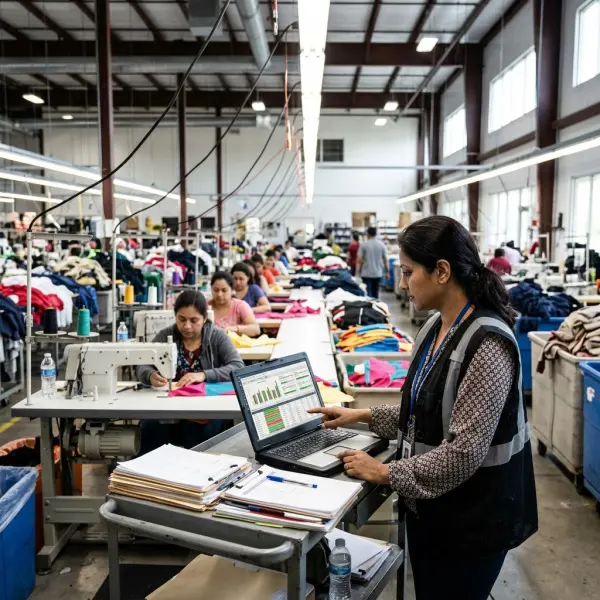
Industrial IoT vs MES and ERP: Understanding the Differences
Industrial IoT is often discussed alongside Manufacturing Execution Systems (MES) and Enterprise Resource Planning (ERP) software. These technologies can work together, but they serve different primary purposes.
IIoT provides a mechanism for collecting and communicating data from physical equipment and production processes. MES software helps manage and monitor manufacturing execution, while ERP software coordinates broader business processes such as purchasing, inventory, finance, and order management.
|
Technology |
Main function |
Garment manufacturing example |
|
Industrial IoT (IIoT) |
Collect and exchange data from connected production equipment and sensors |
Monitor sewing machine status and selected operating events |
|
Manufacturing Execution System (MES) |
Manage production execution, traceability, work orders, and shop-floor information |
Track production progress, operation assignments, and WIP |
|
Enterprise Resource Planning (ERP) |
Coordinate enterprise resources and business transactions |
Manage purchase orders, inventory, manufacturing orders, and financial records |
These systems are complementary rather than interchangeable. A factory may use IIoT data to improve the accuracy of an MES dashboard, while ERP information provides the production order and material context associated with that data.
Not every factory requires separate software platforms for each function. Some commercial products combine device monitoring, production reporting, and execution management. The relevant questions are whether essential capabilities are supported, whether data definitions are compatible, and whether information can move between systems without unnecessary manual reconciliation.
How Apparel Manufacturers Can Start Implementing Industrial IoT
For most garment manufacturers, the most manageable approach is to begin with a specific operational problem and expand connectivity only after demonstrating that collected information is reliable and useful.
A pilot should not be judged by the number of connected machines alone. Its value should be assessed according to whether factory personnel can identify issues more accurately, respond effectively, and produce measurable operational improvements against a credible baseline.
Start with a Factory Problem, Not a Technology Purchase
The first step is identifying an operational question worth answering. A production manager may want to understand why certain lines repeatedly miss hourly targets. A maintenance manager may need better equipment downtime records. A factory owner may want improved visibility into production progress across multiple lines.
Each objective requires different data. Monitoring line progress may involve work-order records and production events, while monitoring equipment availability may require machine-status signals and reliable downtime classification.
Factories should document the current reporting process, the decisions being made, and the limitations of existing information before selecting devices or software.
Evaluate Equipment Compatibility
An equipment inventory should identify machine types, manufacturers, model numbers, control systems, available communication interfaces, and any existing data collection capabilities.
A modern electronically controlled sewing machine may support certain digital functions, but those capabilities should be confirmed in the manufacturer's documentation. Older equipment may require retrofit sensors, while some machines may not justify the cost or complexity of direct monitoring.
The aim is to identify an appropriate technical method for the selected use case without compromising machine reliability, warranty conditions, electrical safety, or normal operation.
Run a Controlled Production Pilot
A practical pilot may connect a limited group of workstations within a selected sewing line. The pilot should involve production supervisors, industrial engineers, equipment technicians, IT personnel, and operators who understand the actual manufacturing workflow.
A structured approach may follow these stages:
- Establish the baseline. Document existing output reporting, equipment interruptions, production targets, and known data-quality problems.
- Define the measurements. Identify what each sensor or terminal will record, how events are classified, and what additional production information is required.
- Validate equipment and connectivity. Test machine compatibility, signal accuracy, network availability, and data handling during communication interruptions.
- Compare digital records with factory observations. Reconcile device information with actual workstation activity, production counts, and supervisor records.
- Introduce a response procedure. Define who reviews alerts, how problems are investigated, and which actions are recorded.
- Evaluate operational outcomes. Determine whether the pilot improved information reliability, decision-making, or a predefined production indicator.
The pilot should produce an evidence-based decision about further implementation. If a system accurately identifies machine activity but cannot provide usable information about the operational problem being investigated, the project may need to be redesigned rather than immediately expanded.
Connect Production Data with Existing Systems
Once the initial monitoring process is reliable, manufacturers can consider how the collected information should interact with production planning, execution management, and enterprise reporting systems.
This integration may require consistent identifiers for machines, lines, work orders, garment styles, and production operations. Without those identifiers, equipment records may be technically accurate but difficult to associate with commercial orders or production schedules.
Interoperability is particularly important when factories use machinery from multiple suppliers. Before selecting a platform, manufacturers should examine supported APIs, industrial communication protocols, data export capabilities, and whether critical information remains accessible if the software provider changes.
Train Teams to Use Data Responsibly
Connected monitoring introduces new responsibilities for supervisors and operators. Employees need to understand what is measured, how the information will be interpreted, and how they should report circumstances that sensors cannot detect.
Poor implementation can create unnecessary pressure if every moment of machine inactivity is treated as a productivity failure. A more reliable approach combines machine observations with normal production-management practices, reasonable performance standards, and opportunities for operators to explain exceptions.
The objective is to improve process understanding and operational coordination, not to replace informed management judgment with a single numerical indicator.
What Are the Costs and Business Trade-Offs of Industrial IoT?
Industrial IoT investment extends beyond purchasing sensors or subscribing to a monitoring dashboard. A complete deployment may require equipment interfaces, gateways, communication infrastructure, software licenses, system integration, installation, technical support, cybersecurity measures, and staff training.
Costs also depend on whether the factory already operates compatible machinery and suitable IT infrastructure. A new production facility with network-ready equipment may face different integration requirements from an established factory with several generations of sewing machines from multiple manufacturers.
The main commercial considerations include hardware acquisition and retrofit costs, recurring software and connectivity charges, maintenance and technical support, system integration effort, staff training, and potential interruptions during installation.
Factories should evaluate these costs against clearly defined operational outcomes. Possible benefits may include reduced manual reporting time, more accurate equipment records, faster identification of production disruptions, or improved planning information. These benefits should be measured rather than assumed.
How Should Manufacturers Evaluate Return on Investment?
Return on investment should compare the value of demonstrable improvements with the full cost of implementing and operating the system. A manufacturer should avoid assuming that every recorded reduction in machine inactivity represents additional profitable output.
For example, suppose a pilot improves visibility into downtime but the factory cannot increase shipments because fabric deliveries remain the main constraint. The information may still be valuable for management, but it would be inaccurate to convert all recovered machine minutes directly into additional revenue.
A credible business case should distinguish confirmed financial savings from estimated productivity opportunities. It should also consider whether benefits can be sustained after the pilot, particularly when deploying the system across different lines, styles, and facilities.
Can Small Garment Factories Benefit from IIoT?
Smaller factories can benefit when a low-cost implementation addresses a clearly identified problem. However, purchasing a complex platform may be difficult to justify if current production volumes are limited or existing manual records already provide adequate visibility.
A peer-reviewed study published in iScience examined a low-cost radio-frequency IoT architecture for garment sewing-line productivity monitoring. The research demonstrates the feasibility of the approach within its studied conditions, while also identifying limitations concerning broader equipment applicability. Its findings should not be interpreted as universal performance results for every garment factory.
For smaller manufacturers, a sensible starting point may be a simple monitoring pilot focused on one production constraint. The objective should be dependable information and an actionable improvement, not technological complexity for its own sake.
Common Industrial IoT Implementation Mistakes in Garment Factories
Industrial IoT projects can produce disappointing results when technology decisions are made without enough attention to production processes. Many problems originate not from the sensors themselves, but from inaccurate assumptions about what data represents or how factory personnel will use it.
Connecting Equipment Without Defining Operational Goals
A common mistake is installing connected devices across a factory before identifying which decisions the collected data should support. This can produce detailed dashboards that attract attention initially but have little relevance to daily production management. Manufacturers should begin with a measurable operational problem and select the minimum data required to investigate it.
Treating Machine Running Time as Operator Productivity
Machine activity is an incomplete measure of garment production performance. Operators may perform necessary fabric handling, component alignment, and inspection activities while equipment is stationary. Using machine running time as the primary measure of worker productivity may lead to misleading assessments and counterproductive management decisions. The better approach is to combine equipment information with appropriate operation standards, output records, and quality results.
Ignoring Data Quality and Equipment Differences
Garment factories frequently operate machinery from different manufacturers and generations. Assuming that all devices provide equivalent data can create inaccurate comparisons, especially when some machines use native electronic records while others depend on retrofit sensors. Before combining records in a single dashboard, manufacturers should validate measurement accuracy, timestamps, data definitions, and equipment compatibility.
Overlooking Workforce Training and Operational Procedures
Technology cannot improve production decisions when personnel do not understand how to interpret or respond to the information. A monitoring system may identify repeated interruptions, but the benefit depends on whether supervisors investigate the correct cause and coordinate an effective response. Training, clear responsibilities, and realistic operating procedures are essential to obtaining value from connected manufacturing data.
Important Technical Caveats and Risks
Industrial IoT introduces additional technical dependencies into manufacturing operations. Equipment connectivity, system availability, software maintenance, data integrity, and cybersecurity must be considered alongside ordinary production requirements.
Connecting operational technology to broader information networks creates potential security exposure. The NIST Guide to Operational Technology Security (SP 800-82 Revision 3) explains security considerations for systems interacting with physical environments, including their distinctive safety, reliability, and operational requirements. The ISA/IEC 62443 standards series also provides an established framework for industrial automation and control system cybersecurity.
Garment manufacturers should assess network segmentation, access permissions, device authentication, software updates, backup procedures, and vendor remote-access arrangements according to their environment. Production-critical equipment should not depend unnecessarily on continuous external connectivity, and monitoring failures should not compromise essential machine safety functions.
Data governance also requires attention. Information associated with individual operators, shift performance, or workplace activity may raise privacy and employment considerations depending on applicable laws and organizational policies. Manufacturers should establish appropriate access controls, retention policies, and transparent workforce communication.
Finally, IIoT does not inherently provide comp





Comments 0
Leave a CommentSend Comment
Anda harus Login terlebih dahulu untuk dapat memberikan komentar.