
Office Outfits Are Becoming More Flexible, Comfortable, and Personal
Quick Answer
Office outfits are becoming more flexible because professional clothing now has to work across different locations, activities, climates, and levels of formality. Many employees no longer need one rigid uniform for five identical office days. They may work remotely, commute to a collaborative meeting, visit a client, attend an event, and move into a social setting within the same week.
Comfort is also being evaluated more seriously. In modern officewear, comfort can come from improved fit, softer tailoring, breathable or lightweight fabrics, practical footwear, adjustable waistbands, useful pockets, and garments that remain presentable after sitting or travelling. It does not necessarily mean wearing leisurewear to work.
At the same time, employees increasingly use clothing to express personal identity through silhouette, color, accessories, cultural influences, modest dressing, and gender expression. This freedom remains context-dependent. A creative studio, financial institution, government office, school, and luxury retailer may maintain very different expectations.
For fashion businesses, the opportunity is to create modular office outfits that balance polish, comfort, individuality, care, and repeated use without assuming that every customer shares the same definition of professional dress.

What Does Flexible Office Dressing Mean?
Flexible office dressing is a wardrobe approach in which garments can be adjusted, combined, or restyled for different professional activities rather than being restricted to one fixed dress formula.
The idea is not simply to make office clothing more casual. A flexible work wardrobe still needs to communicate an appropriate degree of preparation, competence, and respect for the setting. The difference is that professionalism is created through coordination, fit, garment condition, and situational judgment rather than through one mandatory combination such as a matching suit, formal shirt, and dress shoes.
A flexible office wardrobe might include a structured jacket for presentations, an unlined blazer for everyday meetings, tailored trousers with a comfortable waistband, fine-gauge knitwear, a simple dress, polished flat shoes, and a practical bag. Each piece has a recognizable purpose, but it can also coordinate with several others.
The broader structural reasons behind this shift are examined in how workwear style is changing in modern professional life. This article focuses more closely on what flexibility, comfort, and personal expression mean at outfit and product level.
Officewear Is No Longer One Clearly Defined Category
The phrase “office outfit” once suggested a relatively narrow visual language. In many professional environments, that language has expanded.
A 2024 YouGov survey of employed U.S. adults found that 47% said they wore business-casual clothing at work, while the same percentage reported wearing casual street clothes. Business-professional clothing was reported by 22% and leisure or athletic wear by 26%. Respondents could select more than one category, which reflects the fact that people may dress differently on different workdays. YouGov research on work clothing in the United States
A separate YouGov survey of British workers conducted in 2023 found that smart casual was the most commonly selected workwear category at 34%, compared with 26% for casual attire and 7% for business attire. Among people who worked from home some of the time, 49% described what they wore when visiting the workplace as smart casual. These findings relate to one national market, but they demonstrate how less formal categories can dominate even when employees are describing clothing worn at a workplace rather than at home. YouGov data on workplace attire in Britain
These surveys do not prove that all offices are becoming casual. Uniforms, protective clothing, formal business dress, and sector-specific appearance standards remain important. What they show is that professional clothing can no longer be represented accurately by the suit alone.
The modern officewear market contains several overlapping categories:
|
Officewear category |
Typical purpose |
Common garment direction |
|
Formal business |
High-stakes meetings, ceremonies, conservative sectors |
Matching tailoring, formal shirts, structured dresses |
|
Business casual |
Routine office and client activity |
Tailored separates, blouses, polos, knitwear, loafers |
|
Smart casual |
Less formal professional or creative settings |
Relaxed jackets, refined casual trousers, clean sneakers |
|
Hybrid workwear |
Movement between home, commute, and office |
Soft tailoring, camera-ready tops, adaptable layers |
|
Creative professional |
Workplaces allowing stronger personal style |
Distinctive silhouettes, color, print, and accessories |
|
Branded office uniform |
Consistent employee or customer-facing identity |
Coordinated garments selected by the organization |
These categories do not have universal boundaries. A dark denim trouser may be considered polished in one company and prohibited in another. A collarless jacket may be accepted for a management presentation in one market but appear informal in a more traditional business culture.
That uncertainty is one reason office outfits are becoming more thoughtfully assembled. Employees often need to interpret the day rather than merely follow a garment list.
Why Are Office Outfits Becoming More Flexible?
Hybrid Schedules Create Different Clothing Needs Across the Week
Hybrid work has made the professional week less visually consistent for many office-based employees.
Data from the U.S. Bureau of Labor Statistics showed that 22.9% of people at work teleworked during the first quarter of 2024. Among those who teleworked, the proportion working remotely for all of their hours declined from 54% in the first quarter of 2023 to 47.9% one year later. This pattern indicates that many teleworkers were combining remote and non-remote hours rather than working exclusively from home. U.S. Bureau of Labor Statistics analysis of 2024 telework trends
For clothing, a mixed schedule creates several potential scenarios:
- a remote focus day with video calls;
- a collaborative office day;
- a client-facing presentation;
- a business trip;
- an industry event;
- an informal team gathering;
- a day divided between home and workplace.
A rigid office uniform is inefficient when the wearer encounters these situations irregularly. A modular wardrobe is more practical because the level of formality can be adjusted by changing one or two pieces.
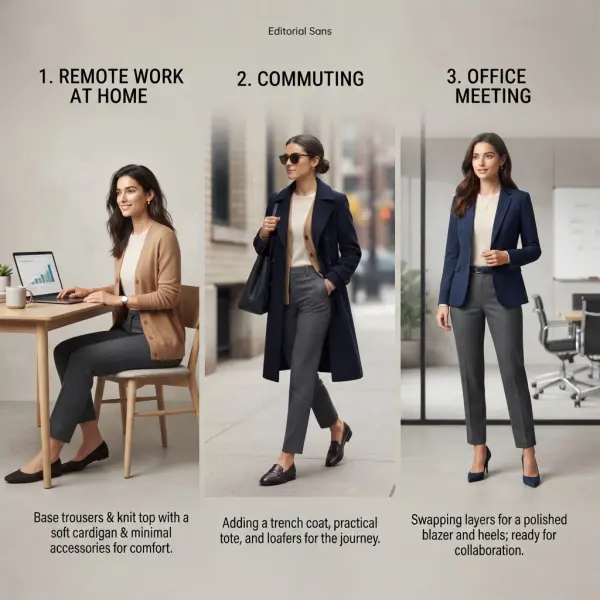
A knit top can be worn alone during remote work, under a relaxed blazer at the office, or with a more structured jacket for a presentation. Tailored trousers can support formal shoes, loafers, or clean sneakers depending on the context.
The garment remains the same. The professional signal changes.
Office Days Are Becoming More Purpose-Specific
When employees attend a workplace less frequently, some office days become more concentrated around meetings, mentoring, collaboration, or social interaction.
This can encourage employees to dress more intentionally on the days they attend. The outcome is not always greater casualness. Some people may wear sharper tailoring when they know they will meet colleagues or clients, while choosing softer clothing for individual work.
The commercial implication is that officewear demand may be divided between two needs:
- highly adaptable garments suitable for routine use; and
- more distinctive or polished outfits reserved for visible professional moments.
A collection made entirely of neutral casual basics may satisfy the first need but fail to address the second. Conversely, a range dominated by statement tailoring may look compelling in a campaign while offering little practical value for everyday work.
Employees Expect Garments to Serve More Than One Setting
A garment purchased only for the office may offer less perceived value when the customer attends the workplace two or three days per week.
Customers may therefore prefer items that can also be worn for travel, dinner, networking, presentations, religious or community events, and other semi-formal occasions. This does not necessarily mean consumers want every garment to be completely neutral. They may still want character, but the styling needs to move between contexts.
Versatility is strongest when the product has a clear central identity.
A blazer can be primarily professional but still work with denim. A dress can be designed for meetings but adapt to evening use through footwear and accessories. A knitted polo can function as a refined everyday top without pretending to replace formal tailoring.
When a product attempts to serve every possible occasion, it often loses the construction or visual authority required for any one of them.
What Makes an Office Outfit Comfortable?
A comfortable office outfit allows the wearer to sit, walk, commute, reach, layer, and regulate temperature without continuous physical distraction while still maintaining the intended appearance.
Comfort does not come from one fiber, one stretch percentage, or one loose silhouette. It results from the interaction between material, pattern, construction, climate, body shape, activity, and personal preference.
This distinction matters because comfort is frequently marketed too loosely.
A wide trouser can still pull at the waist when seated. A stretchy jacket may still restrict the shoulders if the armhole and back balance are poorly designed. A soft fabric may feel pleasant initially but become uncomfortable if it traps heat. A relaxed shirt may provide movement but appear untidy if the fabric collapses or creases excessively.
Fit Is the First Layer of Comfort
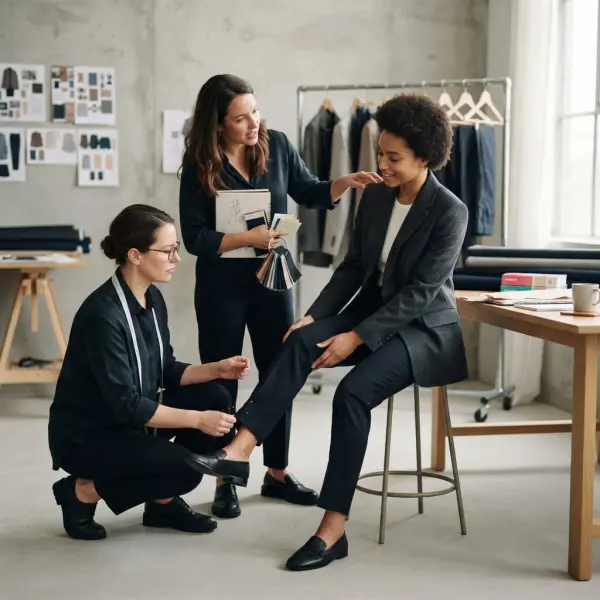
Officewear fit needs to be assessed in working positions, not only while the wearer stands in front of a mirror.
The body changes shape when seated. The waist and abdomen expand, the hip angle changes, the back lengthens, and trouser legs rise. Jackets and shirts are also placed under different tension when a person types, reaches forward, carries a bag, or crosses their arms.
A realistic workwear fitting process should examine:
- waistband pressure while sitting;
- pulling across the upper back;
- movement at the shoulder and armhole;
- shirt or blouse gaping;
- sleeve movement while typing;
- trouser rise in standing and seated positions;
- skirt movement when walking and climbing stairs;
- pocket access;
- hem position after prolonged sitting;
- comfort when garments are layered.
These tests often reveal problems that are invisible in static e-commerce photography.
Fabric Structure Matters as Much as Fiber Content
Consumers commonly describe fabrics by fiber—cotton, linen, wool, viscose, polyester, or elastane—but fiber content alone does not determine comfort.
Two fabrics made with the same fiber can behave very differently because of yarn size, twist, weave or knit construction, density, weight, finishing, and garment design.
For example:
- a loosely woven lightweight linen may allow airflow but crease visibly;
- a compact cotton twill may be durable but feel warmer;
- a fine wool fabric may provide drape and recovery but require specific care;
- a regenerated-cellulose fabric may feel smooth and fluid but perform differently when wet;
- a polyester blend may improve crease resistance but feel less comfortable in certain hot or humid conditions;
- a knitted construction may offer movement even without added elastane.
Brands should therefore explain fabric performance rather than relying on fiber names as shortcuts.
Stretch Should Support the Pattern, Not Replace It
Stretch can improve movement, but more stretch is not automatically better.
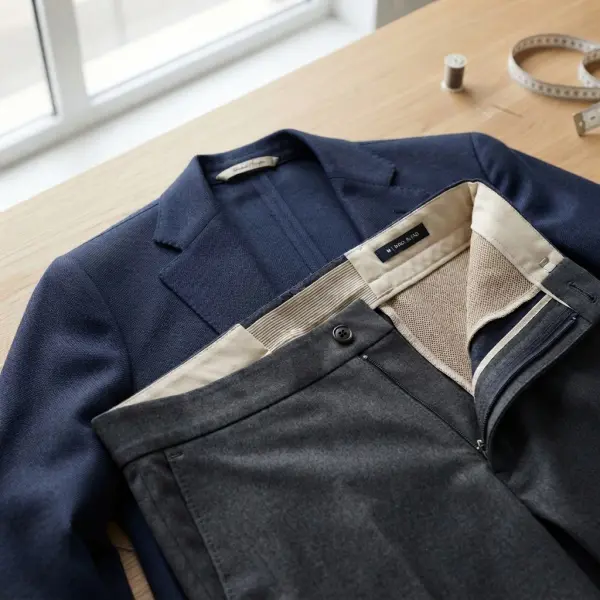
A small amount of elastane may help a woven trouser recover after sitting. Mechanical stretch created through yarn or fabric construction can also improve movement. However, stretch fabric cannot correct a waistband that is incorrectly shaped, a jacket that lacks back width, or a trouser rise that does not suit the wearer.
High-stretch fabrics may also create other trade-offs:
- knee or seat bagging;
- loss of recovery over time;
- reduced tailoring definition;
- heat retention;
- surface shine;
- greater sensitivity to high washing or drying temperatures;
- difficulty matching replacement fabric in a long-term core range.
The appropriate stretch level depends on garment type and intended appearance. A fitted trouser, softly tailored jacket, knitted dress, and formal suit should not be developed according to the same performance expectations.
Temperature Flexibility Is Increasingly Important
Office workers often move between very different thermal environments: outdoor heat, public transport, air-conditioned buildings, meeting rooms, and open-plan workspaces.
Layering is one practical response. Instead of relying on one heavy garment, an outfit can use a breathable base, a removable middle layer, and an outer layer with enough ease to fit comfortably over both.
For fashion businesses, temperature flexibility affects:
- fabric weight;
- lining coverage;
- sleeve construction;
- garment ease;
- collar height;
- layering proportions;
- packability;
- crease recovery.
A tropical-market blazer may benefit from partial lining and a lighter construction, while a cold-climate office wardrobe may need knit layers that remain polished beneath outerwear.
A global collection should not assume that one fabric weight can serve every region.
Footwear and Bags Are Part of Physical Comfort
An office outfit cannot be considered comfortable if the wearer struggles to walk from the station or carry a laptop.
Professional footwear is gradually expanding beyond high heels and rigid leather dress shoes to include loafers, flats, low boots, supportive sandals where culturally and professionally appropriate, and understated sneakers.
Whether these options are accepted depends on the workplace. The relevant product considerations include:
- toe shape and room;
- arch and heel support;
- outsole grip;
- shoe weight;
- lining and breathability;
- stability;
- resistance to repeated walking;
- ability to remain visually polished.
Bags also influence the outfit. A small decorative handbag may suit a styled campaign but fail to accommodate a laptop, charger, water bottle, identification card, and commuting essentials. A large functional bag can solve the capacity problem while undermining the intended look if its scale and construction are ignored.
Comfort is therefore an outfit system, not merely a fabric claim.
Why Is Personal Style Becoming More Visible at Work?
Personal style becomes more visible when dress codes define broader standards—such as neatness, safety, or level of formality—without prescribing identical garments for everyone.
This creates room for employees to communicate taste, cultural identity, gender expression, modesty preferences, profession, and personality.
A person may choose a colorful scarf with neutral tailoring, a contemporary batik shirt, a long modest dress, a gender-neutral overshirt, sculptural jewelry, wide-leg trousers, a sharply cut suit, or a minimalist monochrome outfit. Each choice can remain professional when it suits the role and setting.
Personalization is not the same as unrestricted dressing. It works within a visual and operational boundary.
Silhouette Is Becoming More Individual
Earlier officewear systems frequently relied on standardized shapes: fitted skirt suits, narrow trousers, formal shirts, sheath dresses, and structured jackets.
Modern assortments can include:
- straight, tapered, wide, cropped, and softly pleated trousers;
- fitted, boxy, longline, and unstructured jackets;
- tunics, overshirts, and extended layers;
- compact knitwear;
- fluid dresses;
- matching sets with relaxed proportions;
- modest and gender-neutral options.
This variety allows customers to choose shapes that better suit their bodies and identities.
However, brands should not confuse size expansion with silhouette inclusivity. Offering more sizes in one narrow cut does not necessarily accommodate different proportions or style preferences. A genuinely broader workwear offer may need alternative rises, lengths, shoulder balances, sleeve widths, and fit blocks.
Color Is No Longer Limited to Conventional Corporate Neutrals
Black, navy, grey, beige, and white remain commercially useful because they coordinate easily and often communicate formality.
Yet modern office outfits may also use muted greens, burgundy, brown, dusty blue, warm neutrals, soft pastels, or controlled brighter colors. The key is not whether a color is traditional. It is how the color is distributed across the outfit and whether the garment’s shape, fabrication, and condition remain appropriate.
A bright blouse beneath a neutral suit reads differently from a head-to-toe highly saturated outfit. A colored trouser may feel polished when combined with a refined knit but more casual with a graphic T-shirt.
Brands can help customers by demonstrating these distinctions rather than merely describing products as “office-ready.”
Cultural and Modest Dressing Can Be Part of Professional Style
Professional clothing does not need to erase cultural or religious identity.
Traditional textiles, head coverings, long layers, modest silhouettes, regional garments, and culturally meaningful accessories can be integrated into professional wardrobes in many settings. The appropriate implementation depends on the wearer, workplace, local culture, and any genuine operational or safety requirements.
From an employer perspective, dress policies also need to be considered within applicable equality and employment law. The UK Advisory, Conciliation and Arbitration Service advises employers to make dress codes flexible enough to accommodate needs connected with protected characteristics such as race, religion, sex, and gender reassignment. Acas guidance on preventing discrimination through workplace policies
In the United States, Equal Employment Opportunity Commission guidance states that covered employers generally need to make exceptions to usual dress and grooming rules for sincerely held religious practices unless the accommodation would impose undue hardship under the applicable legal standard. EEOC guidance on religious dress and grooming at work
These examples are jurisdiction-specific and should not be treated as universal legal advice. Employers and fashion businesses should verify requirements in each market where they operate.
Accessories Offer Controlled Personalization
Accessories provide one of the simplest ways to personalize office clothing without changing the entire wardrobe.
A neutral outfit can be adjusted through:
- a structured bag;
- a belt;
- jewelry;
- a watch;
- a scarf;
- eyewear;
- footwear;
- a tie;
- a brooch;
- culturally significant accessories.
These elements can strengthen personal identity while preserving a consistent wardrobe foundation.
Their influence is explored more deeply in how accessories transform simple outfits into stronger looks. For officewear brands, accessories can also create cross-selling opportunities, but they should be proportionally and functionally compatible with the central garments.
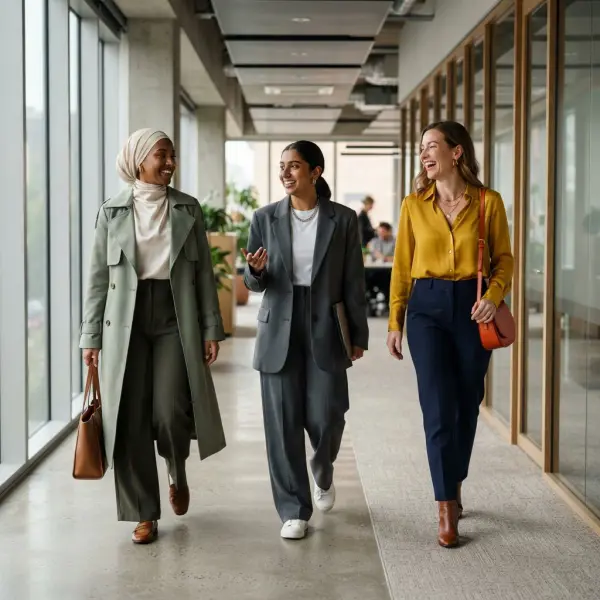
The New Office Wardrobe Is Built Around Outfit Modularity
A modular office wardrobe uses a limited number of compatible garments to create outfits at several levels of formality.
The system works when pieces share a coherent relationship across color, silhouette, fabric weight, and layering. It does not require every garment to match perfectly, but each item should have more than one useful combination.
Start with Stable Foundation Pieces
Foundation pieces are the garments worn repeatedly and combined with more expressive items. Depending on the customer, these may include:
- tailored trousers;
- a simple skirt;
- dark, refined denim where permitted;
- a versatile dress;
- a plain shirt or blouse;
- a knitted top;
- a relaxed blazer;
- a practical shoe;
- a work bag.
The exact foundation should reflect the customer’s profession and climate. A lawyer, lecturer, architect, retail manager, software engineer, and nonprofit field coordinator should not be expected to build identical wardrobes.
The strongest foundation pieces usually offer reliable fit, controlled color, manageable care, and enough visual neutrality to support different combinations.
Use Layers to Change Formality
A layer can quickly alter how an outfit is read.
Consider a base of tailored trousers and a fine knitted top:
- worn alone, it may suit remote work or a relaxed office;
- with an overshirt, it becomes informal professional dressing;
- with a soft blazer, it becomes business casual;
- with a structured jacket and formal footwear, it becomes more presentation-ready.
This ability to shift formality helps customers adapt without purchasing a separate outfit for every activity.
The concept overlaps with why smart casual dressing continues to influence everyday fashion, but modular officewear has a narrower professional objective. It must account for workplace credibility, not simply a balanced casual-polished aesthetic.
Introduce Personality Through Replaceable Components
A wardrobe becomes more personal when the wearer can change high-visibility components without replacing every foundation garment.
These components may include:
- patterned or colored tops;
- distinctive knitwear;
- statement footwear;
- scarves;
- jewelry;
- textured jackets;
- belts;
- bags;
- printed or culturally influenced garments.
This is commercially useful for fashion brands because it creates different purchasing rhythms. Foundation items may be replenished, while expressive pieces can respond more quickly to color, seasonal, and styling trends.
Maintain a Formality Reserve
Even employees in relaxed workplaces may occasionally need a more formal outfit.
A practical wardrobe can retain one presentation-ready combination: a suit, structured dress, polished jacket-and-trouser set, or other culturally appropriate formal option.
This prevents the flexible wardrobe from becoming so casual that it cannot support an interview, ceremony, major client meeting, conference appearance, or leadership event.
Flexibility works best when it includes the ability to become more formal—not only less formal.
How Should Fashion Brands Develop More Comfortable and Personal Officewear?
Build Around a Specific Workday
Product development should begin with a clear scenario.
For example:
A mid-level professional commutes by train, works in an air-conditioned office three days per week, attends internal and occasional client meetings, carries a laptop, and prefers machine-washable clothing.
This scenario immediately informs decisions about fabric weight, pockets, layering, crease recovery, footwear compatibility, care, and formality.
A different customer might drive to a conservative government office, work in a warm climate, require modest clothing, and attend formal public events. The product solution should change accordingly.
“Modern professional woman” or “urban office worker” is not specific enough to guide a credible collection.
Develop an Outfit Architecture Before Individual Styles
An officewear collection should be planned as combinations rather than as a row of unrelated garments.
A simple architecture might include:
|
Collection role |
Example product |
Main responsibility |
|
Foundation bottom |
Tailored trouser |
Fit consistency and repeated use |
|
Everyday top |
Knit polo or blouse |
Comfort and layering |
|
Formality layer |
Relaxed blazer |
Elevates multiple outfits |
|
Personal piece |
Colored or textured shirt |
Adds visual identity |
|
One-piece option |
Versatile dress or jumpsuit |
Simplifies outfit planning |
|
Commuter layer |
Lightweight coat or overshirt |
Transition between environments |
|
Functional accessory |
Laptop-compatible bag |
Supports daily equipment |
|
Footwear anchor |
Loafer, flat, or minimal shoe |
Balances polish and mobility |
The architecture helps design, merchandising, and marketing teams understand why each product exists.
Without it, collections often become overloaded with similar tops while lacking suitable trousers, layers, or footwear to complete the outfit.
Test Clothing Through a Full Working Day
A short fitting appointment cannot reproduce eight hours of wear.
Brands should conduct structured wear trials that include:
- sitting for an extended period;
- walking and using stairs;
- carrying a work bag;
- typing or reaching forward;
- moving between temperatures;
- layering and removing jackets;
- checking garment appearance after several hours;
- laundering according to the care label.
Testers should record physical discomfort and visual deterioration. A waistband may feel acceptable for 15 minutes but become painful by afternoon. A fabric may recover after standing or retain severe seat creases. A blouse may become transparent under strong office lighting.
These findings should influence pattern corrections, material selection, and product communication.
Offer Useful Fit Choices Rather Than Excessive Style Variation
Customers may gain more value from two well-developed trouser fits than from eight superficially different trousers based on the same block.
Useful fit options can include:
- straight and wide-leg silhouettes;
- regular and long lengths;
- different waist-to-hip proportions;
- petite and tall options;
- alternative bust or shoulder fits;
- adjustable or discreetly elasticated waistbands;
- maternity or adaptive configurations where appropriate.
Every additional fit increases sampling, inventory, and quality-control complexity. Brands should prioritize the differences that solve a demonstrated customer problem.
Treat Care as Part of Product Performance
Repeated officewear needs predictable maintenance.
Customers should be able to understand:
- whether the garment is washable;
- whether it needs pressing;
- how quickly it creases;
- whether color transfers;
- whether the fabric pills;
- whether the garment shrinks;
- how it should be stored;
- whether the lining or embellishment limits care options.
A garment marketed as an everyday work essential may disappoint customers when it requires frequent specialist cleaning or loses shape after ordinary washing.
Easy care does not mean every garment must be machine washable. Formal tailoring may reasonably require different maintenance. The important point is alignment between the product’s use frequency, price, and ownership requirements.
How Should Retailers Communicate Flexible Office Outfits?
Replace Generic Workwear Labels with Specific Scenarios
“Suitable for work” is too broad to guide a customer confidently.
A more useful description might explain that a garment is designed for business-casual offices, routine meetings, commuting, or professional travel. It can also state when the piece may not be formal enough.
Examples of clearer merchandising language include:
- “Designed for business-casual offices and internal meetings.”
- “Softly structured for commuting and everyday professional wear.”
- “Can be elevated with the coordinating blazer for client presentations.”
- “Unlined construction intended for warmer environments.”
- “Relaxed fit; not designed as formal suiting.”
- “Minimal sneaker styling may depend on workplace policy.”
Specificity helps customers avoid both overdressing and underdressing.
Show the Same Piece in Several Contexts
A versatile garment should be demonstrated, not merely described.
Product imagery can show:
- a relaxed version for remote or individual work;
- an everyday office combination;
- a more polished meeting outfit;
- an after-work or travel styling option.
The base product should remain visually clear in every image. Styling should not become so elaborate that the customer cannot see the garment’s actual shape and use.
Include Movement and Seated Views
Traditional fashion images prioritize standing poses because they create clean silhouettes. Officewear customers also need to understand how a garment looks when seated, walking, carrying a bag, or worn under another layer.
Useful digital content can include:
- front, side, and back views;
- seated photographs;
- short movement videos;
- close-ups of waistbands and closures;
- pocket demonstrations;
- jacket opening and layering;
- fabric drape in motion.
These formats help customers evaluate comfort claims more critically.
Explain Relative Formality
Retailers can use a simple formality scale to help customers compare products.
For example:
|
Level |
Suggested context |
|
1 — Relaxed professional |
Remote work and casual internal days |
|
2 — Smart casual |
Creative offices and informal meetings |
|
3 — Business casual |
Routine office and moderate client contact |
|
4 — Polished business |
Presentations and higher-stakes meetings |
|
5 — Formal professional |
Ceremonies and conservative business settings |
Such a scale should be presented as guidance, not a universal rule. Workplace standards remain local and organizational.
Common Mistakes in Designing Flexible Office Outfits
Mistake 1: Equating Comfort with Oversized Clothing
Generous ease can improve movement, but excessive volume may create other problems. Sleeves can interfere with typing, hems may drag, jackets can overwhelm smaller frames, and wide trousers may become inconvenient during commuting.
A better approach is to identify where ease is required: across the back, at the waist, through the hip, around the armhole, or within the sleeve. Volume added everywhere is rarely the most effective solution.
Mistake 2: Using One Stretch Fabric Across the Collection
A fabric that works for trousers may not have the drape, opacity, surface, or stability required for a jacket or dress.
Fabric platforms can be efficient when performance has been validated by product category. They should not become a substitute for selecting the appropriate construction for each garment.
Mistake 3: Making Every Piece Neutral
Neutral colors improve coordination, but an entirely neutral collection can lack emotional relevance and differentiation.
Personal office style often depends on controlled variation: one interesting color, texture, print, silhouette, or accessory. Brands should provide enough stable pieces for coordination while allowing customers to develop a recognizable identity.
The balance depends on brand positioning. Minimalist brands may rely on texture and construction, while creative workwear brands can emphasize expressive design.
Mistake 4: Designing Personality Only Through Decoration
Personal style is not limited to prints, embellishment, or unusual color.
It can also come from:
- trouser proportion;
- jacket length;
- collar shape;
- sleeve volume;
- textile texture;
- cultural construction;
- layering;
- modesty;
- gender-neutral styling;
- accessory selection.
A garment does not need decorative excess to feel individual.
Mistake 5: Ignoring Workplace Hierarchy and Client Context
A collection that addresses only internal office life may fail to support the customer’s most consequential professional moments.
Brands should map the wearer’s visibility, not only the physical workplace.
Mistake 6: Claiming Universal Inclusivity
A campaign may feature diverse models while the product range still offers limited sizing, inaccessible closures, restrictive fit blocks, or no options for modest dressing.
Brands should state clearly what they provide and avoid suggesting that one garment solves every body, identity, disability, religious, or cultural requirement.
Mistake 7: Treating Flexibility as the Absence of Standards
Poor maintenance, damaged footwear, excessive transparency, unsuitable coverage, or clothing that interferes with safety may remain inappropriate even in a relaxed workplace.
The stronger commercial message is not “anything can be officewear.” It is “professional outfits can be adapted more intelligently.”




Comments 0
Leave a CommentSend Comment
Anda harus Login terlebih dahulu untuk dapat memberikan komentar.