

How Connected Sewing Machines Support Real-Time Production Monitoring
A garment production line rarely moves at a perfectly consistent pace. Operators may wait for cut panels, machines can stop unexpectedly, and certain sewing operations take longer than planned. Even when production targets are carefully calculated, a line may fall behind because of interruptions that are not immediately visible to production managers.
Traditionally, many garment factories have tracked sewing output through manual counting, supervisor observations, production boards, or reports prepared at regular intervals. These methods remain useful, but they may provide an incomplete picture of what happens between reporting periods. By the time a supervisor discovers that an operation has fallen behind, the problem may already have affected downstream workstations.
Connected sewing machines offer another source of production information. Through built-in electronic controllers, additional sensors, and factory communication networks, manufacturers can collect selected machine activity and production-event data throughout the working day. That information can then be organized into dashboards, production reports, or alerts that support faster investigation of operational problems.
The technology is part of the broader Industrial IoT approach to modern garment manufacturing, but its practical application is particularly relevant to sewing departments. Unlike highly automated manufacturing processes, garment sewing often depends on complex interactions between machinery, operator skill, fabric handling, and the sequence of assembly operations.
For apparel manufacturers, the goal is not simply to measure how long a sewing machine runs. It is to understand how reliable machine information, combined with production records and factory observations, can improve visibility into sewing-line performance.
Quick Answer: How Do Connected Sewing Machines Monitor Production?
Connected sewing machines support real-time production monitoring by collecting machine operating signals and selected production events, transmitting the data to monitoring software, and presenting information that helps garment factories evaluate equipment activity, production progress, and potential sewing-line interruptions.
Depending on the machine and monitoring system, information may come from built-in electronic controllers, motor or power sensors, production-counting devices, or operator terminals. The collected data can help supervisors identify inactive equipment, compare actual output with planned quantities, and investigate operations that may be affecting production flow.
For example, a monitoring dashboard may reveal that several workstations are operating normally while one frequently becomes inactive. A supervisor can then investigate whether the interruptions involve machine faults, material shortages, handling difficulties, or other production conditions.
The technology has important limitations. Machine running time does not directly equal operator productivity, and motor activity alone cannot verify the number of acceptable garments produced. Reliable production monitoring requires accurate counting methods, appropriate work-order information, consistent data definitions, and human interpretation.
Connected machines are therefore most useful when they strengthen existing production management practices rather than replacing supervisors, industrial engineering analysis, or quality inspection.
What Makes an Industrial Sewing Machine Connected?
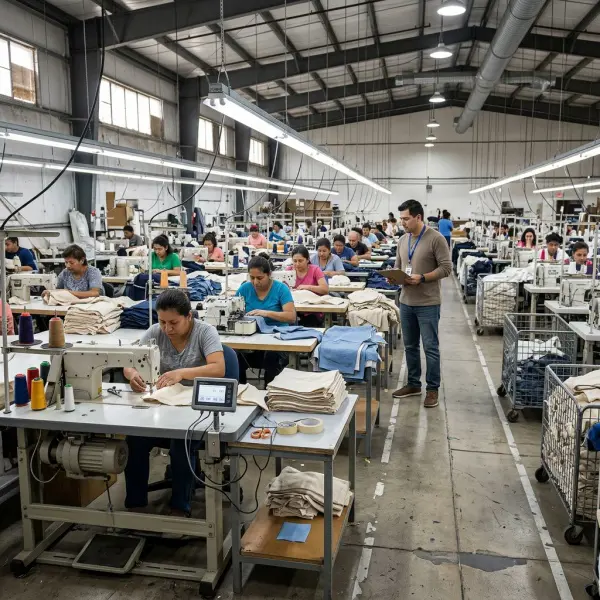
A connected industrial sewing machine is a sewing workstation equipped with a compatible mechanism for transmitting operational information to an external monitoring or management system. This capability may be built into the equipment or added through external devices, depending on machine design and monitoring requirements.
Modern industrial sewing machines frequently use electronic controllers to manage functions such as motor operation, thread trimming, programmable sewing patterns, or selected machine adjustments. However, electronic control and network connectivity are not identical. A machine can contain sophisticated digital components without providing a suitable interface for external production monitoring.
Connected monitoring generally requires three elements working together: an accessible equipment signal or production-event source, a communication method, and software capable of interpreting the information in its manufacturing context.
Built-In Connectivity in Modern Sewing Machines
Some industrial sewing machine platforms incorporate communication capabilities that allow compatible software to access selected operating information. Depending on the model and configuration, these systems may provide production-related records, machine settings, or equipment status information.
For example, Brother describes its NEXIO industrial sewing machine platform as a network-connected solution intended to support production visualization and analysis. JUKI similarly describes its JaNets JT Simple system as a way to visualize machine operations and compare production volumes across processes.
These commercial examples illustrate different approaches to sewing-machine connectivity. However, the availability of a manufacturer's digital platform does not mean that every model within its product range supports identical data fields or monitoring functions.
Factories need to verify specific machine models, controller versions, network interfaces, software compatibility, and licensing requirements before designing an installation.
Retrofitting Existing Sewing Machines
Many garment factories operate sewing equipment purchased over several years. Replacing every existing machine simply to obtain digital monitoring capability may be commercially impractical, particularly when the equipment remains suitable for its production tasks.
Retrofit monitoring can provide an alternative. Depending on the equipment, additional sensors may detect motor activity, electrical consumption, equipment movement, or other measurable signals. Some installations also use separate terminals for recording production counts, operation changes, or interruption reasons.
JUKI states that its JaNets JT Simple system can collect information from selected older JUKI machines and equipment manufactured by other companies through the addition of sensors. This demonstrates an established commercial retrofit approach, although the information available from a sensor-equipped machine may be more limited than that available from a directly integrated digital controller.
A retrofit system must also distinguish signal collection from actual production measurement. Detecting that a motor has started does not necessarily establish that a garment component has been completed. Factories may need additional events, operator confirmation, or validated counting logic to produce meaningful output records.
Connecting Different Sewing Machine Types
Garment production lines frequently combine lockstitch, overlock, coverstitch, buttonhole, bartack, and other specialized sewing equipment. These machines perform different operations and may have different mechanical characteristics, cycle patterns, and monitoring interfaces.
A monitoring method suitable for a continuously operated lockstitch machine may not provide an equivalent production count on a programmable bartacking machine. Likewise, a sensor detecting motor activity may be insufficient for determining the completion of a multi-step sewing operation.
This variation matters when selecting monitoring hardware and defining production indicators. A factory should classify its equipment by machine type, operation, and data availability before assuming that one collection method will provide consistent information across the entire sewing department.
How Real-Time Sewing Machine Monitoring Works
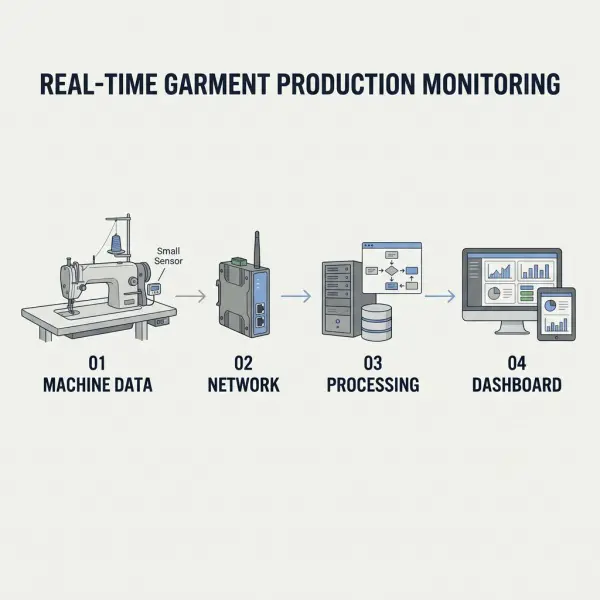
Real-time sewing machine monitoring follows a process in which equipment activity is detected, recorded, transmitted, and interpreted by production software. Although the architecture varies by supplier, a typical implementation involves equipment-level data collection, a communication network, a processing platform, and a monitoring interface.
The distinction between measurement and interpretation is especially important. A monitoring device may report that a machine is running, but determining whether the workstation is meeting its assigned production target requires additional information about the operation, order, expected processing time, and recorded output.

Step 1: Capture Machine Activity and Production Events
The first stage involves observing a physical machine condition or recording a production event. Built-in controllers may supply electronic operating information, while external devices can detect selected equipment signals.
For example, a motor-current sensor may help distinguish between periods of electrical activity and inactivity. A compatible controller might provide more detailed machine status information. Separately, a production terminal may record a completed bundle, a count of processed units, or a reason for an interruption.
Research published in the International Journal of Production Research has examined IoT-based electrical power monitoring for sewing-work measurement. The study demonstrates the technical relevance of power signals for estimating sewing activity, while its methods and performance remain dependent on the measurement system and research conditions. The published research on IoT-based sewing work measurement provides a technical example of this approach.
Factories should treat captured signals as measurements of specific conditions, not automatic representations of complete production performance.
Step 2: Transfer Data Through a Factory Network
After a machine event is detected, the information must be transmitted to a monitoring application. Communication may occur through wired networks, appropriate wireless infrastructure, or dedicated gateways that collect information from multiple workstations.
A gateway can help organize incoming events, associate records with equipment identifiers, and forward data to local or cloud-based software. Certain systems also buffer records temporarily when connectivity is interrupted, although this capability should be verified rather than assumed.
Network design matters because sewing floors may contain numerous machines, electrical equipment, dense workstation layouts, and physical obstructions. Wireless performance should therefore be tested under actual factory operating conditions rather than evaluated only in an office environment.
Step 3: Associate Machine Data with Production Information
A machine signal becomes more meaningful when it can be connected to the correct production context. This may include the workstation identifier, garment style, production order, operation name, operator assignment, and reporting period.
Consider a sewing machine identified only as workstation 18. Its operating time provides limited insight without knowing whether it is performing sleeve attachment, collar topstitching, or a short reinforcement operation.
When an operator changes tasks or a factory switches styles, the system must also update the relevant production association. Otherwise, monitoring software may continue attributing machine activity to an earlier operation, producing misleading production reports.
Step 4: Display Information and Trigger Operational Responses
The monitoring platform organizes collected records into information that supervisors, industrial engineers, production planners, or maintenance personnel can review.
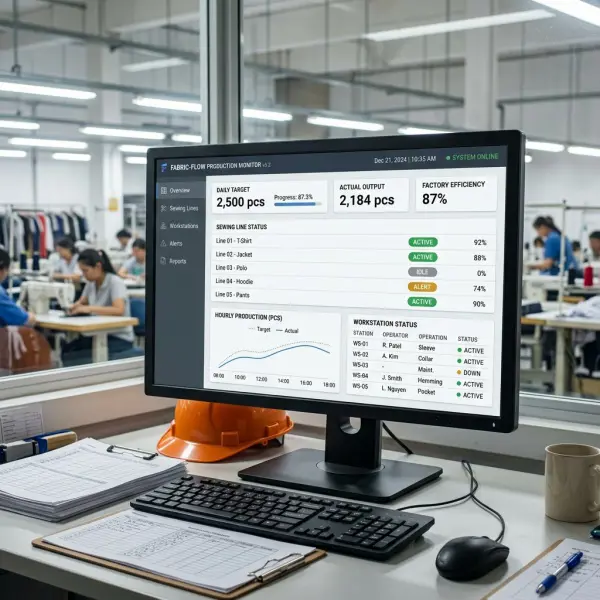
A dashboard may display workstation operating conditions, reported output, progress against targets, interruption patterns, or line-level summaries. Where the system supports alerts, selected conditions can prompt a supervisor to investigate.
The response should depend on the issue. If an equipment fault is confirmed, maintenance personnel may be required. If a workstation is inactive because cut panels have not arrived, the appropriate intervention involves material flow or production coordination.
What Production Data Can Connected Sewing Machines Collect?
Connected sewing machines can provide different categories of information depending on their hardware, controller capabilities, software configuration, and any additional recording devices. Understanding the source of each measurement is essential because not every useful production indicator comes directly from the sewing machine.
Some information is measured automatically, such as selected motor or controller states. Other information may be inferred using processing rules or obtained from production systems and operator input.
|
Production data |
Possible collection method |
What it helps manufacturers understand |
|
Machine running status |
Electronic controller or validated activity sensor |
Whether the machine is operating under the defined detection rule |
|
Operating duration |
Timestamped machine-status events |
How long recorded equipment activity continues |
|
Machine inactivity |
Comparison of running and non-running states |
When a workstation requires further investigation |
|
Stitch or cycle information |
Compatible controller, encoder, or specialized sensor |
Selected aspects of sewing-machine activity |
|
Completed operation count |
Controller event, validated counting device, or operator input |
Progress for a specific sewing operation |
|
Planned vs actual output |
Production counts combined with work-order targets |
Whether production is progressing as expected |
|
Equipment fault events |
Available controller diagnostics or technician input |
Technical interruptions requiring attention |
|
Downtime reasons |
Operator terminal, supervisor input, or linked maintenance system |
Why production activity was interrupted |
|
Quality-related events |
Inspection records or integrated quality terminals |
Whether production output meets defined requirements |
The practical value of these records depends on how they are combined. Machine operating duration and actual output can help investigate unusual production conditions, but neither is sufficient by itself to explain why an operation is performing below expectations.
Machine Running Time and Inactivity
Machine running time is one of the more accessible measurements because it can often be derived from equipment activity signals. The monitoring system records when a defined operating condition begins and ends, allowing it to estimate activity duration over a selected period.
This information may help identify workstations experiencing repeated interruptions or unusually low machine activity. However, an inactive machine is not automatically a malfunctioning machine. The operator may be preparing fabric, checking alignment, changing threads, examining a seam, or waiting for the next component.
For accurate interpretation, factories should establish what each machine state means and determine which supporting events are needed to explain inactivity.
Production Counts and Operation Completion
Production counts are particularly useful because they can be compared against work-order requirements and planned targets. However, garment manufacturing involves multiple operations, and a single garment may pass through several sewing machines before assembly is complete.
A counter recording completed collar components cannot automatically be treated as a count of finished shirts. Similarly, repeated sensor pulses or machine cycles may not correspond to individual production units.
The system therefore needs a validated counting method and clear identification of what is being counted. Production managers should distinguish completed operations, completed components, assembled garments, and accepted finished units.
Machine Cycle and Processing Time
Machine activity data can also help estimate the duration of selected sewing cycles. This is most straightforward when a machine performs a repeatable operation with identifiable start and completion events.
In manually controlled sewing, however, total operation time includes activities beyond stitching. Fabric positioning, handling, alignment, and checking may form a substantial part of the complete operation cycle.
A sensor-derived stitching duration should not be presented as the complete Standard Minute Value (SMV) of an operation. SMV is based on work measurement and an established standard-time methodology, which may include allowances according to the system used. Connected monitoring can support time studies, but does not automatically replace them.
Equipment Interruptions and Downtime Reasons
Connected monitoring may reveal when a machine stops, but it cannot necessarily explain why. This is an important distinction for production analysis because different interruptions require different interventions.
A machine may become inactive because of broken thread, needle replacement, fabric shortage, quality checking, operator absence, or a mechanical fault. Some technical conditions may be identified through available controller diagnostics, while others require operator or supervisor input.
Meaningful downtime reporting should use consistent categories and distinguish equipment-related failures from normal handling activities and production-flow interruptions. Otherwise, aggregated data may overstate mechanical problems or conceal broader workflow constraints.
How Production Dashboards Make Sewing-Line Performance More Visible
A real-time sewing production dashboard brings together selected machine and production records in a format that helps managers assess current operating conditions. Its main purpose is to make deviations easier to recognize and investigate while production is still underway.
Dashboard design should follow operational responsibilities. A line supervisor needs a different level of detail from a factory manager reviewing several departments. Similarly, an industrial engineer examining operation balance may need workstation-level history rather than only overall production totals.
Workstation-Level Monitoring
At workstation level, monitoring can display equipment activity, the assigned operation, recorded production events, and progress against a relevant target. This allows supervisors to identify particular stations that may require attention.
For example, a sewing machine with repeated short interruptions may warrant investigation even when the total number of interruptions appears modest. The pattern could indicate a recurring machine adjustment issue, difficult fabric handling, or an operation that has not been standardized effectively.
The dashboard provides evidence for investigation, but the cause must be established through additional records or direct observation.
Sewing-Line Production Overview
At line level, managers need to understand whether individual operations are supporting the planned output of the entire production sequence.
A useful display may compare actual production with the scheduled target, show recorded output at critical operations, and highlight workstations whose progress differs substantially from expectation.
For example, a production line may meet its target at several upstream operations while final assembly falls behind. The resulting imbalance may lead to accumulating work-in-progress even when some machines show high operating activity.
The main advantage is that managers can examine the developing pattern rather than discovering it only after a completed-shift report.
Historical Production Analysis
Real-time monitoring is also valuable when timestamped records are retained for later analysis. Historical data can help manufacturers review recurring interruptions, investigate the effects of style changes, or compare production conditions across comparable orders.
However, comparisons must account for changes in garment complexity, operation allocation, shift duration, machine capability, and workforce composition. A line producing basic knit tops should not be judged directly against a line producing complex woven jackets using raw production counts alone.
Reliable analysis requires relevant manufacturing context as well as consistent data definitions.
How Connected Sewing Machines Help Identify Production Bottlenecks
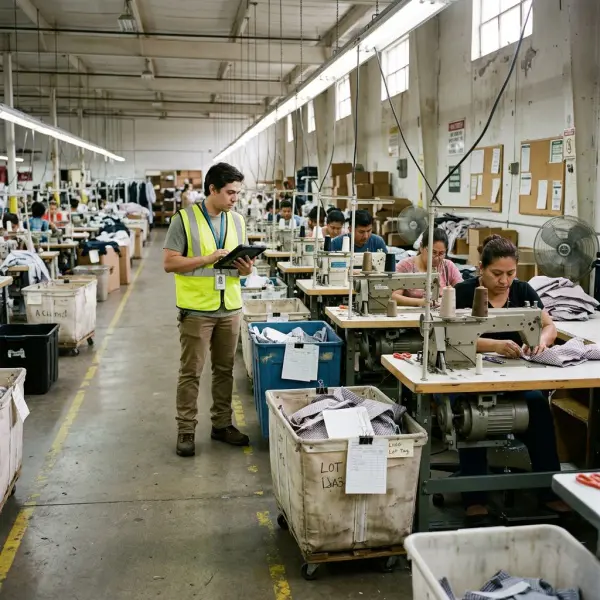
A sewing-line bottleneck is an operation or resource that limits the production flow under the current operating conditions. Because garment assembly involves a sequence of interdependent tasks, a slowdown at one workstation can create upstream accumulation and downstream waiting.
Connected monitoring can help identify potential bottlenecks by showing how production progress and machine activity differ across operations. However, low machine activity does not automatically identify a bottleneck. A true constraint must be evaluated in relation to operation capacity, workload, material availability, and the output requirements of the entire line.
Recognizing Uneven Production Flow
Consider a hypothetical factory producing woven shirts. The sewing line includes collar preparation, sleeve assembly, side-seam sewing, buttonhole formation, and final assembly.
Suppose the collar preparation operation regularly completes fewer units than the downstream operations are capable of processing. Finished collar components may become unavailable when needed, causing subsequent workstations to wait even though their machines have no technical problems.
A monitoring system that combines operation counts with production order information may reveal the imbalance early. The supervisor can then determine whether the difference is caused by a longer operation time, insufficient staffing, material issues, or another constraint.
This is different from simply identifying the machine with the lowest utilization. The bottleneck is the operation limiting overall throughput, which may not be the workstation with the lowest machine running percentage.
Supporting Line Balancing Decisions
Sewing-line balancing involves distributing operations and resources so that production can flow efficiently through the assembly sequence. Industrial engineers consider standard operation times, workforce skills, equipment requirements, task dependencies, and the target production rate.
Connected machine data can strengthen line-balancing analysis by providing observations about actual operating conditions. If an operation repeatedly falls behind schedule, engineers can investigate whether the workload allocation is appropriate or whether interruptions are affecting the expected capacity.
An adjustment may involve reallocating suitable tasks, assigning trained assistance, improving material delivery, or changing the workstation arrangement. The appropriate decision depends on verified causes rather than dashboard colors or machine activity percentages.
For example, adding another machine will not necessarily improve production if the underlying problem is a shortage of prepared components. Connected monitoring is most useful when it supports established industrial engineering methods instead of replacing them.
Preventing Excess Work-in-Progress
Work-in-progress, or WIP, refers to materials and components that have entered production but have not yet reached the defined finished stage. Garment sewing lines can accumulate WIP when operations produce at different rates or when materials move between workstations in large batches.
Connected production systems may help reveal where output is accumulating, particularly when machine records are combined with bundle identification, operation completion events, or material movement records.
Machine activity monitoring alone cannot accurately establish WIP quantities across an entire line. The factory must also know which units have entered and exited relevant operations.
When these records are properly integrated, supervisors can identify excessive accumulation, investigate the reasons, and assess whether changes to production release or workflow organization are necessary.
Which KPIs Matter Most in Real-Time Sewing Production Monitoring?
The usefulness of connected sewing-machine data depends on whether it supports reliable key performance indicators (KPIs). Manufacturers should define KPIs according to their production objectives and avoid combining measurements that represent different operational conditions.
For example, machine utilization measures equipment activity under a specified definition, while line efficiency relates production output or standard work content to available labor time. These indicators can inform one another, but they are not interchangeable.
The table below summarizes useful measurements and their interpretation.
|
KPI |
Practical purpose |
Measurement caution |
|
Machine running percentage |
Understand the proportion of a defined time period when equipment is detected as operating |
Normal fabric handling may occur while the machine is stationary |
|
Hourly production output |
Monitor recorded production progress |
Requires valid counts at a clearly defined operation or output point |
|
Target achievement |
Compare actual output with planned quantity |
Targets must reflect garment complexity and available capacity |
|
Sewing-line efficiency |
Evaluate standard production work content against available labor time |
Requires valid standard times, output records, and labor-time definitions |
|
Equipment downtime |
Review defined periods of equipment unavailability |
Inactivity and equipment failure must be distinguished |
|
Production bottleneck indicators |
Identify operations potentially restricting workflow |
Requires operation-level capacity and flow analysis |
|
First-pass quality |
Evaluate output accepted without rework under defined inspection rules |
Requires inspection data rather than machine signals alone |
Machine Utilization vs Sewing-Line Efficiency
Machine utilization and sewing-line efficiency answer different questions.
Machine utilization concerns how much a machine is used within a defined time period. Sewing-line efficiency, under a common standard-minute-based approach, evaluates the standard work content produced relative to the labor time available or used, depending on the factory's measurement convention.
A sewing line may have relatively low machine running percentages because operations involve substantial manual handling. That does not automatically indicate poor efficiency. Equally, high machine running activity does not guarantee efficient production if the machines are producing defective components or excess WIP.
Manufacturers should document KPI definitions and verify that comparisons use equivalent production conditions.
Overall Equipment Effectiveness in Sewing Operations
Overall Equipment Effectiveness (OEE) is commonly expressed through availability, performance, and quality components in manufacturing. It can be useful for evaluating suitable equipment, but applying conventional OEE directly to garment sewing requires careful interpretation.
Sewing operations differ from highly automated machinery because operator handling time, garment complexity, and frequent process changes influence production cycles. A calculation based solely on motor activity may therefore misrepresent actual performance.
For individual sewing machines or entire lines, manufacturers should clearly define productive time, expected output, performance standards, and quality-adjusted production before adopting an OEE framework. A poorly adapted OEE calculation may look precise while providing little operational value.
Why Real-Time Does Not Always Mean Instantaneous
Real-time monitoring is often used as a commercial description for systems that provide frequent or timely updates. It does not guarantee that every displayed figure reflects a machine event at the exact moment it occurs.
Actual latency depends on sensor sampling, communication intervals, network conditions, software processing, and dashboard refresh settings. Some systems may also aggregate records before displaying them.
Manufacturers should define the acceptable delay for each operational use case. A dashboard used for hourly production intervention may tolerate greater latency than a fault notification requiring an immediate technical response.
Practical Benefits for Apparel Production Management
Connected sewing-machine monitoring can support several production-management activities when the collected data is accurate and acted upon.
One benefit is reducing the time spent collecting certain equipment-status records. Manual production reporting may require supervisors to gather information from individual workstations, reconcile counts, and prepare summaries. Where automatic records are reliable, monitoring systems can reduce some of this administrative work, leaving more time for investigating production constraints.
A second benefit is earlier visibility into operating abnormalities. Instead of waiting until a shift ends, production teams may identify repeated interruptions or unusual output patterns while corrective action is still possible.
The systems can also support communication between production and technical personnel. For instance, a machine fault event linked to an identifiable workstation can help a maintenance team locate the affected equipment. However, detailed equipment diagnostics and failure prediction require additional capabilities beyond ordinary operating-status monitoring.
A Hypothetical Production Scenario
Consider a garment factory operating a sewing line for a repeat order of basic shirts. The line supervisor receives hourly output summaries, but certain operations frequently miss their expected quantities.
After introducing connected monitoring at selected workstations, the production team finds that a particular operation has repeated inactivity periods. The supervisor initially suspects machine reliability, but direct observation shows that the operator regularly waits for prepared components from an upstream workstation.
The factory then investigates the component preparation process and adjusts material replenishment and task allocation. A subsequent review may determine whether those changes improve production flow.
This example illustrates the logic of connected monitoring rather than a documented case study or guaranteed result. The technology makes an operating pattern easier to detect, while production-management decisions address the underlying problem.
Commercial Systems Already Used for Sewing Production Visibility
Commercial sewing-machine platforms demonstrate that connected production monitoring is an established technical application rather than a hypothetical concept.
JUKI's JaNets JT Simple includes machine-operation monitoring and production comparisons intended to help factories examine process-level performance. Brother's NEXIO platform describes network-connected industrial sewing equipment and production visualization capabilities. Meanwhile, Dürkopp Adler's QONDAC platform includes machine connectivity, production monitoring, and data exchange capabilities, with functions depending on the selected modules and compatible equipment.
These examples establish the availability of relevant technologies, but vendor descriptions should not be treated as independent evidence of universal productivity gains. Actual results depend on factory conditions, implementation quality, and the changes made in response to collected information.
How Garment Factories Can Implement Connected Sewing Machine Monitoring
A successful implementation begins with a production-management requirement, not the assumption that every machine needs to be connected. Manufacturers should choose an area where better information can support a specific operational decision.
A controlled pilot is generally more manageable than immediate factory-wide deployment, particularly when equipment varies in age, controller design, and available connectivity.
A Practical Implementation Framework
A garment manufacturer can structure its initial deployment around the following activities:
- Define the monitoring objective. Identify whether the priority is production visibility, downtime investigation, operation-level output tracking, or another measurable problem.
- Audit equipment and available signals. Document sewing machine types, controller models, communication capabilities, and retrofit requirements.
- Select meaningful production metrics. Define how machine status, output, interruptions, and targets will be measured and interpreted.
- Test a limited group of workstations. Validate sensor accuracy, connectivity, production identification, and compatibility with daily sewing activities.
- Introduce an operational dashboard. Present information that supervisors can understand and use to investigate deviations.
- Evaluate results before expansion. Compare monitoring accuracy, response procedures, and relevant operational outcomes against the pre-installation baseline.
Pilot success should be evaluated through data reliability and operational usefulness, not simply the percentage of machines connected.
Integrating Monitoring with Existing Production Systems
Connected sewing-machine records become more useful when associated with production orders, operation assignments, and quality information.
Manufacturers may connect monitoring platforms with a Manufacturing Execution System (MES), production planning software, or an Enterprise Resource Planning (ERP) system. Integration can help place equipment activity within a broader manufacturing context.
However, connecting systems requires consistent identifiers, reliable data mapping, appropriate access permissions, and clear ownership of production records. Factories should verify available APIs, export formats, and integration costs before selecting a monitoring platform.
Training Supervisors and Operators
Factory personnel should understand what connected monitoring measures and what it cannot determine. Operators may need simple procedures for recording interruption causes, while supervisors require training to interpret dashboard information and investigate unusual patterns.
Monitoring data should support process improvement rather than encourage decisions based on incomplete measurements of individual performance.
Common Mistakes in Sewing Machine Production Monitoring
Assuming Every Machine Stop Represents Lost Productivity
Machine inactivity may reflect normal fabric handling, inspection, preparation, or waiting conditions. Treating every stopped motor as wasted production time can distort performance analysis and encourage inappropriate management responses. Manufacturers should distinguish necessary operation activities from avoidable interruptions.
Relying on Unverified Production Counts
Some counting methods measure machine cycles rather than completed garment components. If the relationship between a cycle and a production unit is not validated, reported output may be inaccurate. Factories should test counting logic against actual completed operations and reconcile discrepancies.
Comparing Different Sewing Operations Without Context
A complex collar construction operation should not be evaluated using the same raw output expectations as a short straight-seam operation. Production comparisons require suitable standard times, equipment context, and quality requirements. Without these adjustments, dashboard rankings can be misleading.
Collecting Data Without Establishing Response Procedures
A monitoring system may identify recurring interruptions without improving production performance if nobody investigates them. Factory teams should establish clear responsibilities for reviewing alerts, determining causes, recording corrective action, and evaluating outcomes.
Important Technical and Operational Caveats
Connected sewing-machine monitoring has limitations that manufacturers should evaluate before purchasing equipment or software.
First, data availability depends on actual machine and sensor capabilities. A monitoring platform cannot automatically access every electronic controller, and retrofit devices may provide fewer measurements than purpose-built digital systems.
Second, production data requires contextual interpretation. Machine activity, sewing efficiency, operation throughput, and acceptable finished output represent different measurements.
Third, system reliability and cybersecurity require attention. Factory networks should use appropriate access controls, device management, and security practices. The NIST Guide to Operational Technology Security provides guidance for managing security risks while considering the reliability and safety requirements of industrial equipment.
Finally, collecting operating data does not automatically create a predictive maintenance system. Predicting equipment faults requires appropriate condition measurements, historical evidence, and validated analytical methods. These considerations are explored in what apparel manufacturers should know about predictive machine maintenance.
Frequently Asked Questions About Connected Sewing Machines
1. Can older industrial sewing machines be connected to production monitoring systems?
Yes, some older industrial sewing machines can be connected through compatible external sensors or monitoring terminals. These devices may detect machine activity, electrical consumption, or selected production events without replacing the entire machine. However, the available information depends on the equipment and installation method. A retrofit sensor cannot necessarily provide the detailed diagnostics available from a modern electronic controller. Factories should verify technical compatibility, electrical safety, installation requirements, and counting accuracy before deploying a retrofit system.
2. Can connected sewing machines automatically count completed garments?
Some connected systems can record production counts, but reliable garment counting requires an appropriate event or counting method. A motor cycle or stitching event does not necessarily correspond to one completed garment because sewing involves multiple operations and handling stages. Counts may refer to components, operation completions, or finished units depending on the system. Manufacturers should establish what each count represents, validate it against physical production, and connect it to the correct work order and operation.
3. Does real-time sewing monitoring eliminate manual production reporting?
Not entirely. Connected monitoring can automate selected equipment-status records and reduce some manual data collection, but garment factories still need information that machines cannot directly provide. Downtime explanations, defect classifications, operator assignments, material shortages, and quality outcomes may require additional recording systems or human input. The appropriate goal is to reduce unnecessary reporting effort while improving data reliability. Completely eliminating manual input without adequate sensing or validation may create gaps in production information.
4. How can connected sewing machines help with line balancing?
Connected sewing machines can provide activity and production-event records that help industrial engineers examine workstation performance and identify possible production constraints. When combined with standard operation times, staffing information, and work-in-progress records, these observations can support decisions about workload distribution. However, low machine utilization does not automatically identify a bottleneck. Engineers must examine operation dependencies, capacity, material availability, and quality conditions before adjusting a line. Connected monitoring supports line-balancing analysis rather than replacing established methods.
5. Is connected sewing machine monitoring suitable for small garment manufacturers?
It can be suitable when implementation costs are proportionate to a clearly defined operational need. Small factories may begin by monitoring a limited number of machines or one production line rather than purchasing a comprehensive factory management platform. The business case should consider hardware, installation, software subscriptions, connectivity, training, and ongoing support. A low-cost system is not necessarily economical if data is unreliable or nobody uses it. A controlled pilot provides a practical way to assess value before larger investments.
Conclusion: Better Sewing-Line Visibility Starts with Reliable Data
Connected sewing machines can help garment manufacturers understand production activity with greater frequency and detail than periodic manual reporting alone. When integrated with appropriate production records, these systems can support workstation monitoring, bottleneck investigation, line balancing, and more informed supervision.
Their value lies in making operational conditions easier to examine, not in automatically solving every production problem. Machine running time must be interpreted alongside manual handling, operation complexity, quality requirements, and material flow. Without that context, even sophisticated dashboards can produce misleading conclusions.
For apparel manufacturers, the most effective approach is to begin with a measurable production challenge, validate the information collected, and use the results to support established industrial engineering and production management practices.
The future of connected sewing production will depend not only on improved sensors and communication capabilities, but also on factories' ability to translate reliable equipment information into practical, sustainable operational improvements.





Comments 0
Leave a CommentSend Comment
Anda harus Login terlebih dahulu untuk dapat memberikan komentar.