
Why Statement Dressing Becomes Stronger in Event-Based Fashion Culture
Quick Answer
Statement dressing becomes stronger in festivals, concerts, and other fashion-conscious events because the social environment temporarily changes what feels normal, noticeable, and acceptable to wear. Clothing that might attract excessive attention in an everyday setting can feel proportionate inside an event where performers, crowds, stage design, photography, and other attendees already create a visually intensified environment.
Research on music festivals supports this idea of temporary behavioral and identity shifts. Studies of heavy-rock festivals have found that participants can use dress to move away from everyday identity and enter a temporary ritual community, while research into electronic dance music culture describes event spaces as places where participants experiment with and perform different identities. Research on dress, transformation, and conformity at rock festivals
For fashion businesses, the implication is not simply that event clothing should be louder. Successful statement products balance visual distinction with community relevance, physical comfort, usability, and enough personal flexibility for customers to make the look their own.
What Is Statement Dressing?
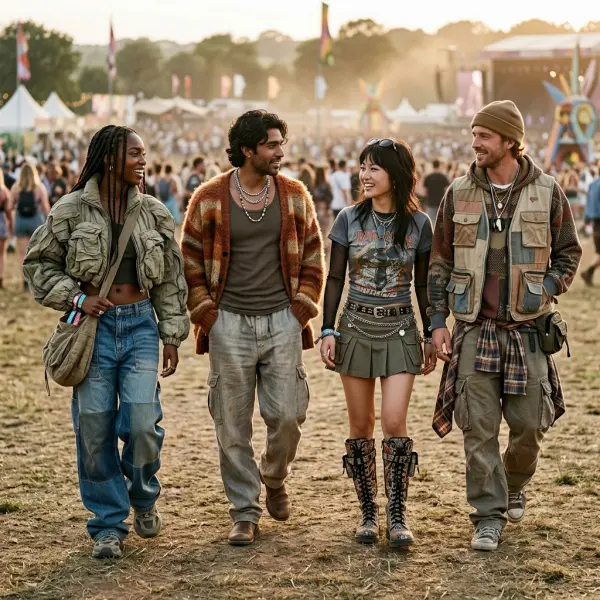
Statement dressing is an approach to personal style in which one or more elements of an outfit are deliberately more visually distinctive than the surrounding norm. The statement can come from silhouette, scale, color, surface treatment, material, accessories, graphics, styling contrast, customization, or the cultural meaning attached to a garment.
It does not necessarily mean maximalism.
A sharply oversized jacket worn with simple clothing can make a statement. So can one unusual hat, an archival band T-shirt, dramatic boots, a highly recognizable jewelry piece, a reconstructed garment, or an otherwise minimal outfit built around an unconventional proportion.
What makes the item a “statement” is therefore relational. It stands out relative to its environment.
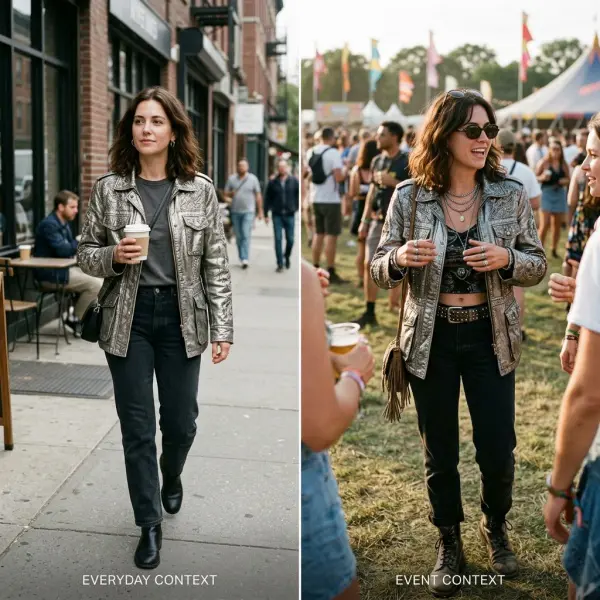
That distinction is particularly important in event fashion. The same metallic jacket may feel highly conspicuous on a routine morning commute but relatively restrained in a nighttime music festival. The garment has not changed; the visual baseline around it has.
Statement dressing in event culture is consequently shaped not only by clothing design but also by context.
Why Do Events Make Bolder Clothing Feel More Acceptable?
Events create temporary social environments with different expectations from everyday life.
A workplace, university, neighborhood supermarket, music festival, fashion week party, stadium concert, and nightclub each has its own informal boundaries around appearance. People read those boundaries partly by observing others.
Music festivals are particularly useful for studying this phenomenon because they combine temporary place, ritual, music, collective participation, and dress. Research into heavy-rock festivals found that attendees used dress as part of moving away from everyday identity and entering a temporary community with its own codes of appearance and behavior.
Festival research has also used the concept of liminality to describe temporary periods in which people move outside some structures and routines of ordinary life. This does not mean normal social rules disappear entirely. Rather, the event can establish another set of expectations for a limited period.
Fashion becomes part of that shift.
An attendee who might hesitate to wear dramatic face decoration, an unusual hat, platform footwear, exaggerated jewelry, unconventional layering, or a reconstructed garment in everyday life may perceive less social risk when similarly expressive choices are visible throughout the crowd.
The event changes the reference point.
Social Permission Matters as Much as Personal Confidence
Bold dressing is often discussed as though it depends entirely on individual confidence. Context matters too.
A person can feel comfortable wearing something unusual when the surrounding environment communicates that experimentation is expected or at least tolerated. Seeing other attendees participate reinforces that permission.
This creates an important distinction between personal willingness and social permission.
A consumer may already want to experiment with clothing but lack an appropriate context in ordinary life. Festivals and concerts can supply that context. The event effectively provides a temporary reason to dress differently.
For brands, this helps explain why an item that seems too dramatic for ordinary retail photography may become easier to understand when styled for an event.
Event Culture Changes the Visual Baseline
Whether something appears bold depends partly on what surrounds it.
At a visually restrained event, a vivid red coat can dominate the scene. At an event where attendees wear metallic fabrics, large jewelry, artist merchandise, bright makeup, vintage pieces, fringe, custom graphics, or theatrical accessories, the same coat may no longer seem unusual.
This produces what fashion teams can think of as a shifted visual baseline.
The baseline does not become infinitely expressive. Every event still develops informal boundaries. Research into heavy-rock festivals is useful here because it found an apparent paradox: attendees used dress to differentiate themselves from mainstream culture while simultaneously conforming to recognizable codes inside the festival community.
Statement dressing therefore does not necessarily mean complete visual independence.
A bold outfit can communicate individuality while still being legible to the group.
That tension helps explain why event fashion can contain enormous visual variety while still producing recognizable patterns. Hundreds of attendees may look different from one another yet repeatedly use similar categories—boots, band merchandise, Western references, metallic surfaces, sportswear, crochet, oversized proportions, reconstructed clothing, or statement accessories—depending on the event.
The exact visual language varies. The mechanism is broader: people interpret what feels appropriate by looking both at their own identity and at the temporary community around them.
Collective Participation Can Reduce the Risk of Standing Out
Statement dressing involves visibility, and visibility normally carries social risk.
A highly distinctive garment invites attention. That attention may be positive, neutral, or uncomfortable depending on the setting. Event culture can change the balance because visual participation is often distributed across many people rather than concentrated on one individual.
Someone wearing an unusual outfit in a conventional environment may become “the person wearing the unusual outfit.” Inside a festival crowd, that same person may simply become one participant among many expressive attendees.
This does not eliminate judgment. Festivals are not automatically egalitarian spaces, and subcultures can have their own expectations, exclusions, or hierarchies. Research on festival dress has documented both community belonging and conformity, while studies of some EDM festival environments have also raised concerns about how apparently open-ended dress practices can intersect with cultural appropriation and racial dynamics. Research examining cultural appropriation in EDM festival dress
The useful insight is therefore more precise: collective participation can make visual experimentation easier, but it does not remove cultural context or social boundaries.
Spectacle Raises Expectations for Visual Impact
Music events are not visually neutral spaces.
Lighting systems, stage architecture, large screens, performer costumes, pyrotechnics, branding, merchandise, installations, signage, and crowd movement all contribute to the sensory environment. The audience is surrounded by spectacle.
That affects fashion indirectly.
A subtle design detail that looks sophisticated in a quiet studio can disappear inside a large outdoor crowd. A stronger silhouette, reflective surface, high-contrast accessory, unusual texture, or recognizable graphic may retain greater visual presence.
This does not mean every attendee consciously dresses to compete with the stage. Rather, spectacle raises the environmental level of visual stimulation.
Performers can reinforce that effect. Stage clothing often needs to communicate from a distance, work under lighting, support a performance narrative, and remain visible on screens. Those conditions encourage stronger visual choices than many everyday situations.
Attendees then interpret rather than simply copy those signals.
The result is an environment where increased visual intensity can feel proportional rather than excessive.
Statement Dressing Is Not the Same as Wearing More
One of the most commercially important distinctions is that a stronger fashion statement does not require a more complicated outfit.
Visual impact can come from concentration.
An outfit containing ten expressive elements can actually become less memorable if no element dominates. By contrast, one strong jacket, oversized belt, sculptural necklace, dramatic boot, unusual trouser proportion, customized T-shirt, or highly distinctive textile can create a clearer visual focal point.
This matters for both product design and merchandising.
A statement product should answer a simple question: What is the eye supposed to notice first?
If the answer is unclear, adding more embellishment may not solve the problem.
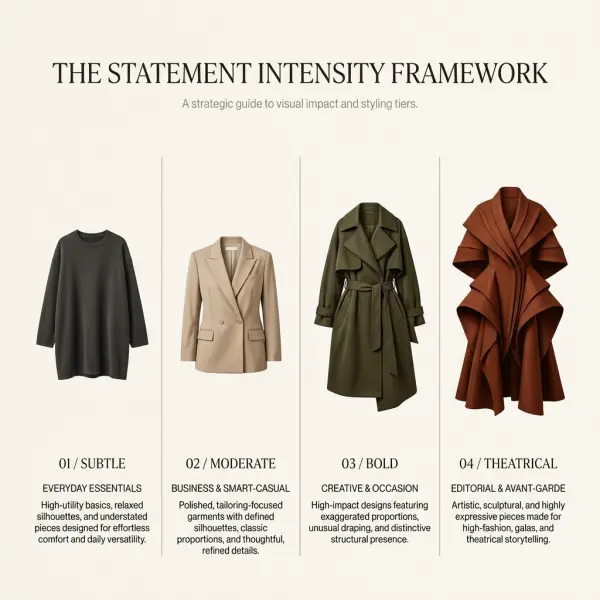
Fashion brands can therefore think about statement intensity as a spectrum:
|
Level |
Typical approach |
Commercial role |
|
Low |
Familiar item with subtle distinctive detail |
Easy entry into event styling |
|
Moderate |
One recognizable color, shape, texture, graphic, or accessory |
Strong styling piece with broader rewear potential |
|
High |
Dramatic proportion, surface treatment, embellishment, or highly distinctive construction |
Hero product or event-focused statement |
|
Theatrical |
Costume-like scale or performance-oriented construction |
Best suited to performance, editorial, stage, or highly specific customers |
The strongest commercial opportunity is not necessarily at the highest level. It depends on brand positioning and customer behavior.
Photography Changes the Value of Visual Distinction
Event dressing is increasingly experienced both physically and visually through images.
Research examining 200 location-tagged Instagram posts from attendees at the 2017 Coachella festival found strong emphasis on visual self-presentation. Full-body images appeared frequently, helping emphasize festival fashion, while attendees also used carefully composed imagery to establish their presence and experience at the event. Study of Coachella attendee self-presentation on Instagram
This does not prove that festival attendees dress primarily for social media. It does demonstrate that clothing can become part of the visual documentation of attendance.
That changes the lifecycle of an outfit.
Before the event, consumers may plan what to wear. During the event, the clothing functions physically and socially. Photographs then allow the outfit to circulate after the event has ended.
A visually distinctive garment can therefore operate across several environments:
body → event → photograph → social feed → wider audience
This helps explain the commercial attraction of statement pieces. One physical product can become disproportionately visible when photographed repeatedly.
Brands should still be careful with the concept of “Instagrammability.” Optimizing only for photographs can create products that perform poorly during hours of actual wear. The strongest event product works in both environments.
Social Media Can Amplify Exceptional Looks
Photography creates another challenge for fashion teams: the outfits most visible online are not necessarily the outfits most commonly worn.
Media and social platforms naturally favor novelty.
A spectacular outfit generates stronger imagery than an ordinary T-shirt and comfortable trousers, even if the latter represents far more attendees. Celebrity appearances, creator content, street-style photography, and brand activations can magnify this selection effect.
That means event coverage should not automatically be treated as market-share evidence.
A striking outfit can be culturally important without being commercially widespread.
Fashion teams therefore need to distinguish three different signals:
- Visibility: the look receives substantial attention.
- Adoption: many people actually wear similar products or styling.
- Commercial translation: consumers are willing to purchase and use related products beyond the specific event.
These signals can overlap, but they should not be assumed to be identical.
The distinction protects brands from building inventory around an outfit that was highly photographable but behaviorally rare.
Why Statement Dressing and Group Belonging Can Coexist
Individuality and belonging are sometimes presented as opposites in fashion, but event culture shows how easily they can operate together.
Research into Tomorrowland examined costumes, flags, accessories, and other possessions used by attendees and identified multiple functions connected to both private and collective identity. Research on identity expression through costumes and possessions at Tomorrowland
A person can therefore dress distinctively while still signaling membership in the same community.
Consider band merchandise. Thousands of people can wear shirts connected to the same performer, yet customize them differently through cutting, layering, jewelry, jackets, footwear, or styling. The shared reference creates belonging; the interpretation creates individuality.
The same mechanism can apply to Western boots, metallic accessories, dark rock styling, sports jerseys, vintage clothing, handmade pieces, or other event-associated categories.
Statement dressing becomes stronger when people do not have to choose between standing out and belonging.
They can often do both.
Events Can Function as Temporary Fashion Test Spaces
A festival or concert can provide a relatively contained opportunity to try a fashion idea.
Someone curious about a dramatic silhouette, unconventional material, brighter color, body-conscious piece, oversized accessory, or vintage reference may hesitate to incorporate it directly into everyday dressing. An event offers a defined occasion where experimentation has a reason.
Research in dance music culture has described event spaces as contexts where participants can experiment with and perform multiple identities through dress. Research on dress and identity in contemporary dance music culture
For fashion businesses, this makes event culture valuable beyond immediate sales.
Events can reveal which visually stronger products customers are willing to try before those ideas become part of ordinary wardrobe behavior.
Some experiments remain event-specific. Others migrate into everyday style.
A statement boot may become a weekly wardrobe piece. A dramatic costume probably will not. A bold accessory may become surprisingly versatile once the wearer has learned how to style it.
The event therefore provides a form of real-world fashion experimentation.
Contemporary Festival Style Shows That “Statement” Keeps Changing
What counts as a statement is not fixed.
Coachella offers a useful contemporary example because its fashion has been extensively documented. For 2026, Vogue's pre-event analysis described the festival's longstanding association with bohemian dressing but argued that newer styling could move away from stereotypical festival formulas toward vintage, do-it-yourself approaches, functional gear, Americana references, and more individual combinations. Vogue analysis of Coachella style in 2026
Post-event coverage still found strong bohemian references, demonstrating how a familiar festival code can persist while being repeatedly reinterpreted.
This illustrates an important principle for brands.
Statement dressing does not always require inventing something visually unprecedented. It can involve taking a familiar category and changing its proportion, styling, material, age, condition, juxtaposition, or context.
A vintage piece can become more distinctive than a newly produced “festival” garment precisely because it feels less standardized.
Likewise, restrained dressing can become a statement when everyone else is highly decorated.
Context keeps changing the equation.
Practicality Still Sets the Boundary
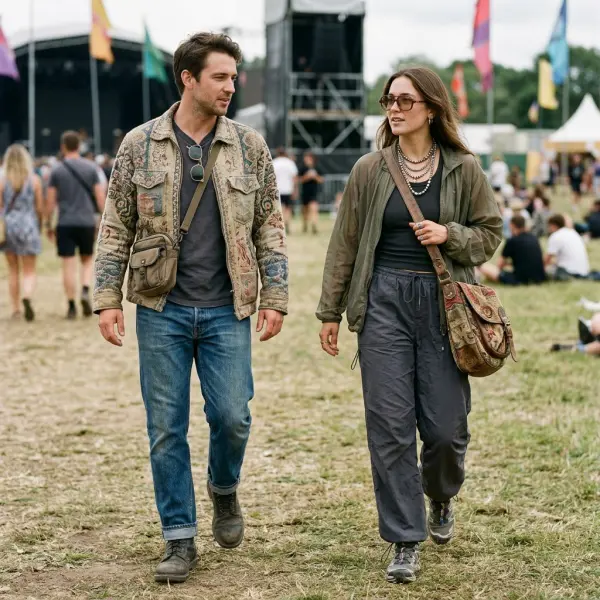
Event culture may allow greater visual experimentation, but the body still has to experience the event.
Heat, rain, dust, mud, crowds, walking distance, standing time, transportation, bag restrictions, security rules, toilets, seating, and temperature changes can all place limits on statement dressing.
That makes functional design especially important when visual intensity increases.
A very long fringe treatment may catch on objects. Heavy embellishment can become uncomfortable after several hours. Oversized sleeves can interfere with movement. Platform footwear may become exhausting. Delicate light-colored fabrics may perform poorly in a dusty field.
None of these categories is automatically unsuitable. Their usefulness depends on the environment and construction.
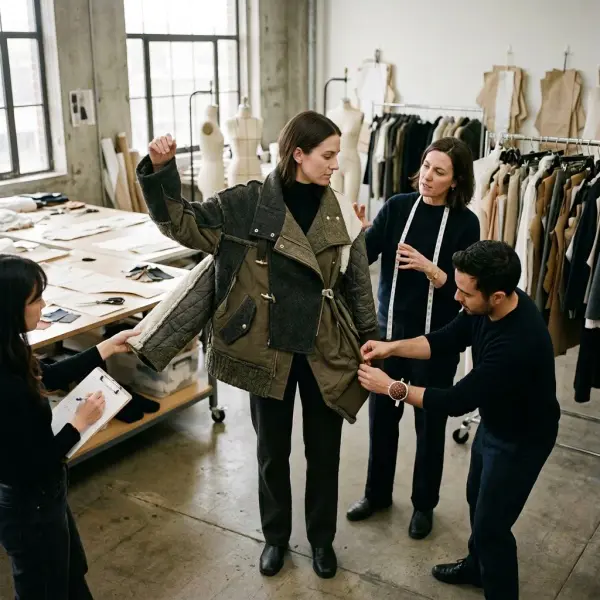
Product teams should therefore test statement garments under conditions closer to real use rather than evaluating them only on a mannequin or during a brief fitting.
For event apparel, relevant tests can include movement, sitting, extended wear, carrying a bag, layering, heat management, closure security, and interaction between embellishment and surrounding objects.
Visual drama is most valuable when customers can actually enjoy wearing it.
How Fashion Brands Can Design Better Statement Products
Fashion brands do not need to make every event product dramatic. A stronger assortment often combines a small number of visually distinctive pieces with quieter products that allow customers to control the intensity themselves.
The strategy can begin with the focal point.
If the product's distinctive feature is silhouette, other details may need restraint. If surface treatment is the hero, the basic shape may remain familiar. If an accessory provides the statement, apparel can stay relatively simple.
Several principles help translate event expression into commercially realistic products:
- Design around one clear visual idea. A product is easier to understand when its main distinctive feature is obvious.
- Protect movement and comfort. Statement value deteriorates quickly if customers want to remove the product after an hour.
- Offer styling flexibility. Pieces that work with denim, basic tops, familiar footwear, or existing outerwear are easier to personalize.
- Consider modular intensity. Detachable accessories, reversible elements, removable trims, adjustable layers, or separate statement pieces can let customers control how far they go.
- Think beyond the event. Unless deliberate one-time theatricality is the objective, rewear potential can strengthen the product proposition.
- Photograph the product both dynamically and realistically. Show the expressive effect while also demonstrating movement, storage, layering, and everyday combinations.
- Check cultural provenance. A visually powerful reference is not automatically free of cultural meaning simply because it appears repeatedly at festivals.
For most commercial brands, the objective is not maximum attention. It is controlled distinctiveness.
That gives the customer enough visual impact to feel special without making the garment unusable after the event.
Merchandising Can Create Statement Without New Product Development
Brands sometimes assume that responding to event culture requires a new capsule collection.
Often, styling can do much of the work.
A retailer might already carry a distinctive boot, oversized jacket, vintage-inspired belt, jewelry piece, graphic shirt, metallic bag, sheer layer, or colorful accessory. Combining one of those products with simpler wardrobe items can produce a convincing event look without creating additional inventory.
This is particularly useful for smaller fashion businesses.
Instead of accepting development costs, minimum order quantities, sample cycles, and inventory risk for a highly seasonal capsule, the brand can test demand through merchandising and content first.
Customer response then provides information for future product development.
This approach also gives consumers more control. A complete “festival costume” tells customers who to become. A curated collection of statement options lets them decide.
Statement Dressing Can Improve Visibility but Not Automatically Brand Value
Visually strong products are useful for content because they attract attention.
That does not guarantee they will strengthen the business.
A garment can generate substantial engagement yet sell poorly because the price is too high, styling is difficult, fit is restrictive, the occasion is too narrow, or customers admire it more than they want to own it.
This distinction is especially important in event marketing, where spectacle can make attention metrics appear more meaningful than they are.
Brands should evaluate statement products across different objectives:
|
Objective |
Useful measure |
|
Brand visibility |
Reach, press coverage, social shares, creator pickup |
|
Product interest |
Product-page visits, saves, wish lists, inquiries |
|
Commercial demand |
Conversion, sell-through, margin, repeat demand |
|
Styling relevance |
User-generated looks, combinations with existing products |
|
Longer-term value |
Rewear, repeat styling, resale demand, continued organic visibility |
A hero product can still be strategically valuable even when unit sales are modest. It may give an assortment visual identity or attract attention to more commercial products.
The business should simply know which role the product is expected to perform.
Common Mistakes in Event-Based Statement Dressing Strategy
Mistake 1: Assuming More Extreme Means More Effective
Adding larger graphics, brighter colors, heavier embellishment, additional cutouts, more hardware, or increasingly unusual shapes does not necessarily make a garment more memorable. Visual competition can weaken the focal point. The better approach is to decide which element deserves attention and let the rest of the product support it.
Mistake 2: Designing for Social Media Before Designing for the Body
Photography is relevant to event fashion, but an outfit exists physically before it becomes content. Products that photograph dramatically but restrict movement, cause overheating, lose trims, create friction, or become difficult to manage in crowds can generate poor customer experiences. Visual communication and wear testing should develop together.
Mistake 3: Confusing Attention With Adoption
The most spectacular event looks are often the most photographed, which can exaggerate their apparent prevalence. Brands should validate whether similar elements appear repeatedly among broader attendees, customer searches, actual purchases, resale activity, or ordinary styling before treating visibility as evidence of widespread demand.
Mistake 4: Making Every Item a Statement Item
An outfit needs visual hierarchy. When jackets, trousers, footwear, bags, jewelry, graphics, and accessories all compete simultaneously, customers may find the assortment difficult to style. Commercial ranges usually benefit from combining hero pieces with supportive products that make those heroes easier to wear.
Mistake 5: Treating Cultural References as Neutral Decoration
Event freedom does not remove cultural meaning. Research into festival dress has specifically documented debates around cultural appropriation in some festival environments. Brands should understand where symbols, garments, prints, ceremonial references, hairstyles, or accessories originate before using them as generic markers of “festival creativity.”
What Brands Should Verify Before Acting
The first thing to verify is whether the proposed statement actually fits the event community.
Visual strength alone is not enough. A product may attract attention because it belongs naturally in the environment—or because it looks disconnected from it.
Brands should also establish whether the design relies on a durable customer preference or a narrow visual moment. A distinctive silhouette appearing across several seasons and settings represents a different commercial opportunity from a novelty seen around one performer for a few weeks.
Function deserves equal attention. Event duration, climate, venue rules, footwear requirements, bag policies, mobility, and layering needs can determine whether a visually compelling product remains viable.
Finally, determine what the customer is buying: a collectible, costume, hero fashion item, versatile wardrobe product, fan signal, or temporary experience.
Each can be a legitimate proposition.
Problems arise when the brand develops one but markets it as another.
Statement Dressing Is Ultimately About Context, Not Excess
The strongest reason event culture amplifies statement fashion is not that people suddenly abandon ordinary taste.
The environment changes around them.
Temporary social norms become more permissive. Other attendees provide visual permission. Performers and stages raise the level of spectacle. Collective participation reduces some of the isolation of standing out. Photography extends the audience beyond the physical event. Familiar cultural codes give unusual clothing shared meaning.
Together, these forces change the threshold at which clothing begins to feel “too much.”
This is why the broader identity function of festival fashion as lifestyle and self-expression matters, and why the specific influence of music events on color, silhouette, and styling choices cannot be separated completely from statement dressing.
But the final mechanism is contextual.
Statement fashion is not inherently loud. It is fashion that creates meaningful visual distinction relative to the environment around it.
Events simply create environments where that distinction can become stronger.
Frequently Asked Questions
Why do people wear bolder outfits at festivals than in everyday life?
Festivals can temporarily change the social expectations surrounding dress. Research on music-event participation shows that attendees can move away from everyday identity and participate in temporary communities with their own appearance and behavior codes. When expressive styling is already common around them, an individual garment may feel less socially risky than it would in a conventional setting. Personal taste still matters, and not every attendee wants bold clothing.
Does statement dressing always mean bright colors or maximalism?
No. Statement dressing means creating noticeable visual distinction, which can come from silhouette, proportion, texture, historical reference, accessories, construction, customization, graphics, or contrast. An all-black outfit with an unusual shape can be more visually distinctive than a multicolored outfit made from familiar pieces. What counts as a statement depends partly on the surrounding visual environment.
Why are accessories so useful for event statement dressing?
Accessories allow consumers to change the visual intensity of an existing wardrobe without committing to a completely new outfit. Jewelry, belts, bags, footwear, eyewear, scarves, hats, or removable garment elements can create a strong focal point while familiar clothing provides the foundation. This can make accessories commercially useful for brands serving customers who want event expression but still prioritize budget or rewear.
Does social media cause people to dress more dramatically for festivals?
Social media can influence how festival style is planned and circulated, but a simple causal claim would be too strong. Research on Coachella Instagram posts found substantial emphasis on visual self-presentation and full-body imagery that highlighted festival fashion. However, expressive event dress existed before contemporary social media. Music culture, performers, subcultures, group identity, ritual, and event spectacle also shape how people dress.
How can a fashion brand tell whether a statement item is commercially viable?
The brand should evaluate more than visual engagement. Useful evidence includes product-page behavior, saves, preorders, conversion, sell-through, repeat styling, customer feedback, search demand, and whether similar visual signals persist across multiple events or seasons. Fit, price, comfort, manufacturing complexity, minimum order quantities, and rewear potential also affect viability. An item can be excellent for brand imagery without becoming a high-volume seller.
Should event-focused fashion always be designed for everyday rewear?
Not always. Performance pieces, collectibles, costumes, limited merchandise, and deliberately theatrical products can legitimately have narrow use cases. For mainstream apparel brands, however, broader rewear can strengthen value because consumers may be more willing to purchase an expressive piece that can also work after the event. The appropriate balance depends on product category, price, audience, and brand positioning.
Can understated clothing become statement dressing at an event?
Yes. Statement value depends on contrast with the surrounding environment. At an event dominated by highly decorated outfits, an exceptionally clean tailored or monochromatic look may stand out precisely because it rejects the dominant visual language. This is another reason brands should avoid defining statement fashion only through embellishment or maximalism. Distinction is contextual rather than tied to one aesthetic.
Conclusion
Statement dressing becomes stronger in event-based fashion culture because events temporarily reorganize the visual and social rules surrounding clothing.
Research into music festivals and dance culture shows how dress can participate in temporary identity shifts, collective belonging, and the performance of different selves. Research into Coachella's social-media representation demonstrates how fashion also becomes part of the documented experience, while contemporary festival coverage shows that the definition of a standout look keeps changing rather than settling into one permanent formula.
For fashion businesses, that means statement dressing should not be reduced to louder color, heavier decoration, or more extreme silhouettes.
The more useful opportunity lies in understanding controlled visual distinction: giving customers a product or styling tool that feels special in the event environment, remains physically workable, respects cultural context, and delivers the level of visibility the customer actually wants.
Some of those products will remain tied to one occasion. Others will migrate into ordinary wardrobes and help change what consumers consider wearable in everyday life.
That movement—from extraordinary context toward ordinary adoption—is one of the reasons event culture remains such a useful place to observe fashion.





Comments 0
Leave a CommentSend Comment
Anda harus Login terlebih dahulu untuk dapat memberikan komentar.