
How Accessories Transform Simple Outfits Into Stronger Looks
Quick Answer
Accessories transform simple outfits into stronger looks by changing where the eye focuses, how the body’s proportions are perceived, and what mood or level of formality the clothing communicates. A belt can define the waist or interrupt a long silhouette. A necklace can direct attention toward the face or neckline. A structured bag can add visual discipline to relaxed clothing, while a scarf can introduce color, movement, and texture.
The transformation does not depend on adding many items. In most cases, one clearly chosen accessory is more effective than several pieces competing for attention. Scale, placement, contrast, material, and relationship with the clothing matter more than decoration alone.
Simple garments are particularly responsive because they provide visual space around the accessory. A plain shirt, monochromatic dress, neutral suit, or basic knit-and-trouser combination can function as a stable foundation while the accessory establishes the focal point.
For fashion businesses, this makes accessories more than add-on products. They can help customers understand how to wear core apparel, extend merchandising stories, strengthen campaign images, and create several styling directions from a limited product assortment.
What Does It Mean for an Accessory to Transform an Outfit?
An accessory transforms an outfit when it changes the visual structure, interpretation, or practical use of the garments around it. The clothing may remain physically unchanged, but the accessory introduces a new focal point, proportion, color relationship, texture, rhythm, or social context.
A black dress paired with minimal earrings and a slim leather bag may appear restrained and professional. The same dress worn with a large metal cuff and sculptural clutch can feel more editorial. Add a soft printed scarf and woven shoulder bag, and the look may become more relaxed.
The garment provides the base. The accessories determine how that base is read.
Transformation should not be confused with decoration. Decoration adds detail, while styling transformation changes the relationship between the elements. A necklace that merely fills an empty neckline is decorative. A necklace that changes the vertical emphasis, balances the neckline, and draws the eye toward the face has a more structural role.
A Stronger Look Is Not Necessarily a Louder Look
A stronger outfit is one with clearer visual intention. It does not need to contain brighter colors, larger jewelry, visible logos, or more objects.
Strength can come from precision. A narrow black belt placed correctly over a monochromatic dress may create a more coherent silhouette than a heavily embellished belt. A small architectural bag can provide enough structure to balance an oversized coat. A single brooch can establish an asymmetrical focal point without making the outfit visually busy.
The objective is not maximum attention. It is controlled emphasis.
Why Do Simple Outfits Respond So Well to Accessories?
Simple outfits usually contain fewer competing visual elements. Their relatively stable colors, shapes, and surfaces provide space for an accessory to become legible.
A plain shirt and trousers do not tell the viewer exactly where to look. The addition of a necklace, scarf, bag, belt, or pair of glasses establishes a hierarchy. It suggests which part of the outfit matters first and how the other elements relate to it.
This is one reason accessories are often used to refresh wardrobe staples. A familiar garment does not need to be redesigned or replaced to support a different aesthetic direction. Its interpretation changes through styling.
Recent editorial coverage continues to show this mechanism. In July 2026, Vogue highlighted scarves worn at the waist over trousers, dresses, skirts, and tailoring. The styling method uses placement, color, and texture to make familiar clothing appear more considered without changing the garments themselves. Vogue’s scarf-as-belt styling guide provides current examples from runway, street-style, and editorial contexts.
The principle is not new. The Victoria and Albert Museum notes that accessories such as brightly colored tights, boots, hats, jewelry, and bags were central to creating the distinctive modern appearance associated with 1960s fashion. The V&A overview of 1960s accessories illustrates how accessories have long helped define the visual character of an era.
What changes from period to period is the preferred object, proportion, material, and method of placement—not the underlying ability of accessories to redirect a look.
Visual Hierarchy: How Accessories Control Where the Eye Goes
Visual hierarchy is the arrangement of elements so that some attract attention before others. In general visual design, hierarchy can be created through scale, color, contrast, spacing, alignment, and placement. Applied to fashion styling, these same principles help explain why an accessory may become the dominant focal point of an outfit. This application is an editorial styling framework rather than a formal rule of dress. The Interaction Design Foundation’s visual hierarchy overview explains the wider design principles behind scale, contrast, spacing, and alignment.
An outfit with no clear hierarchy may feel unresolved because several elements compete equally or nothing provides a point of emphasis. A strong accessory can solve either problem.
It can:
- establish the first place the viewer looks;
- create a path from one element to another;
- connect separated colors or materials;
- introduce contrast against a quiet background;
- balance a visually heavy garment;
- interrupt an overly continuous silhouette.
These functions often happen simultaneously. A red handbag worn with a cream suit introduces color contrast, becomes the focal point, and creates a visual stop near the lower torso. Its effect is not just “adding red.”
Placement Determines the Area of Emphasis
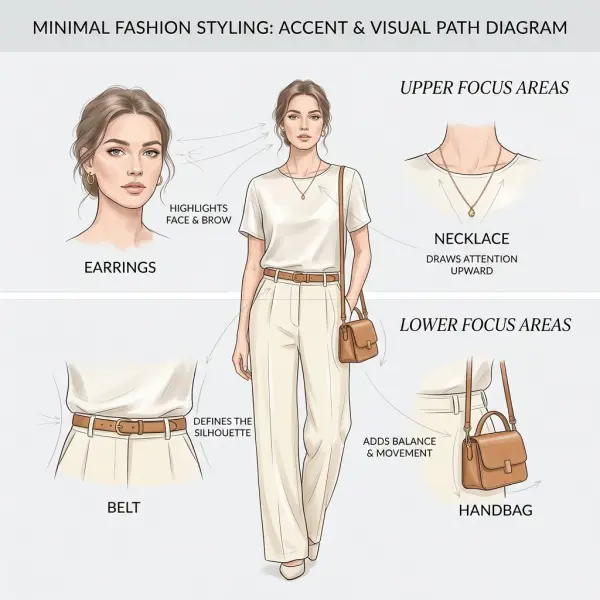
An accessory attracts attention not only because of what it looks like, but because of where it appears on the body.
Jewelry and eyewear position emphasis near the face. Necklaces influence how the neckline is read. Belts affect the torso and waist. Bags create weight near the hand, hip, shoulder, or torso depending on how they are carried. Shoes establish the visual endpoint of the silhouette.
The same accessory can produce a different effect when repositioned. A scarf around the neck frames the face and upper body. Tied at the waist, it emphasizes the torso and changes the rhythm of the outfit. Attached to a bag, it becomes a smaller area of color and movement.
For brands and stylists, placement should therefore be treated as part of the product story. Showing only a flat-lay image explains the object but not its influence on the body.
Isolation Increases Visual Importance
An accessory often becomes more powerful when there is space around it. A large pendant may disappear against a dense print but become highly visible over a plain knit. A geometric bag may appear more intentional beside a clean trouser line than within an outfit containing several unrelated patterns.
This does not mean simple garments are inherently better. Complex clothing can support sophisticated accessory styling, but the relationship needs greater control.
The more detailed the clothing, the more selective the accessory usually needs to be.
Contrast Makes an Accessory Visible
Contrast is created when an accessory differs noticeably from the garments around it. The difference may involve color, value, shape, scale, finish, texture, softness, rigidity, or cultural association.
The most obvious contrast is color: a green bag against a brown outfit or silver jewelry against black clothing. Yet some of the most effective combinations use quieter contrasts.
Examples include:
- polished metal against soft wool;
- a rigid leather bag beside fluid jersey;
- rounded jewelry with sharp tailoring;
- a narrow belt over a voluminous garment;
- aged or irregular craft surfaces with clean contemporary clothing;
- a formal brooch on a casual denim jacket;
- delicate jewelry with heavy outerwear.
Contrast gives the accessory a reason to be noticed. It also gives the clothing greater definition because the two elements clarify each other.
Contrast Needs One Dominant Logic
Problems begin when an outfit contains several unrelated forms of contrast without hierarchy. A bright bag, patterned scarf, oversized necklace, decorative shoes, and contrasting belt may each be attractive separately but compete when worn together.
The better question is not “Do these items match?” It is “Which contrast should lead?”
A look might prioritize:
- one strong color contrast;
- one difference in scale;
- one material tension;
- one historical or cultural reference;
- one structural change in proportion.
Secondary accessories can support the main contrast through quieter repetition or neutral coordination.
Scale Changes the Perceived Strength of an Outfit
Scale refers to the relative size of an accessory compared with the body and garments around it. It affects both visual impact and proportion.
A large necklace can make the upper body appear more visually dominant. A wide belt divides the torso more decisively than a narrow one. An oversized bag introduces substantial weight near the hip or hand. Small earrings may create subtle light near the face without interrupting the broader silhouette.
Scale is relative. A medium-sized bag may appear large against a fitted dress but small beside an oversized coat. The same necklace may dominate a petite neckline and appear restrained over a broad jacket lapel.
This is why accessory dimensions should be evaluated on the body, not only as isolated product measurements.
Oversized Clothing Does Not Always Need Oversized Accessories
One common styling assumption is that voluminous garments require equally large accessories. That approach can work, but it is not the only option.
A substantial bag may reinforce the scale of an oversized coat, creating a deliberate high-volume look. A small, rigid bag can instead introduce tension by contrasting with the coat’s volume. Both approaches are valid, but they communicate different ideas.
The decision depends on whether the stylist wants:
- reinforcement;
- interruption;
- balance;
- exaggeration;
- visual relief.
This distinction is more useful than applying a universal rule based on body shape or size.
Accessories Can Redefine Proportion and Silhouette
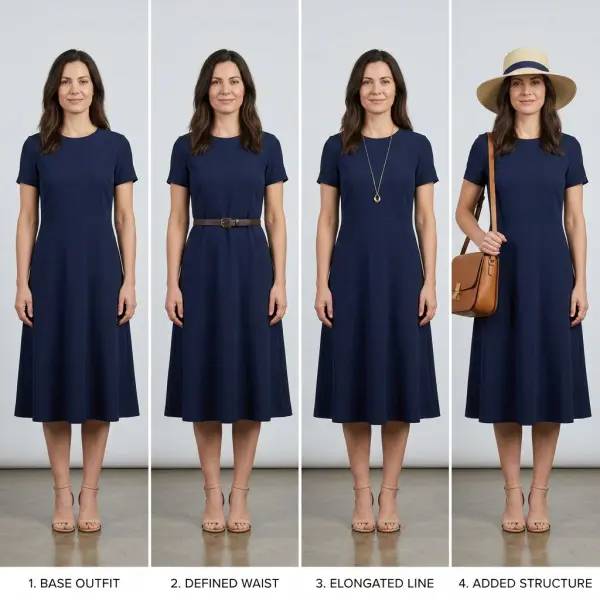
Accessories may be smaller than garments, but they can change how the overall silhouette is perceived. Belts, crossbody straps, long necklaces, scarves, bags, hats, and footwear all introduce lines that divide, lengthen, widen, or interrupt the body.
A belt creates a horizontal division. Its position can make the torso appear shorter or longer relative to the lower body. A long necklace introduces a vertical path. A crossbody strap adds a diagonal line. A wide-brimmed hat expands the upper silhouette. A large shoulder bag adds width and volume to one side.
These effects should be understood as visual relationships, not rigid instructions about which bodies should wear particular products.
Prescriptive body-shape rules often oversimplify personal styling. Comfort, identity, movement, culture, clothing construction, and the desired creative effect all matter. Fashion businesses should provide proportion guidance as an option rather than presenting one silhouette as universally corrective or flattering.
Belts Create Structure and Interruption
Belts are particularly influential because they can alter both the appearance and behavior of a garment. A belt can gather volume, hold layers together, secure clothing, define a waistline, or create a contrasting horizontal band.
Its effect depends on:
- width;
- position;
- buckle scale;
- stiffness;
- color contrast;
- how tightly it is worn;
- whether the garment is fitted, fluid, or oversized.
A wide rigid belt over a soft dress creates stronger architectural structure. A narrow tonal belt introduces definition without significantly interrupting the surface. A loosely tied textile belt can suggest movement rather than precision.
The product category will be explored further in bags, belts, and jewelry as details that shape personal image. Here, the central lesson is that belts are structural styling tools, not simply waist decorations.
Bags Add Visual Weight to a Specific Area
A bag affects an outfit through size, shape, carrying position, and movement. A handheld top-handle bag concentrates visual weight near the lower arm. A shoulder bag sits closer to the torso. A crossbody bag adds a diagonal line and positions the object against the body. A large tote expands the silhouette and may make the outfit feel more practical or relaxed.
The contents also matter. A bag that changes shape when filled may look different from the empty sample used in campaign photography. Styling and product-development teams should evaluate the bag both empty and under realistic load.
Jewelry Can Lengthen, Frame, or Interrupt
Jewelry introduces small but highly visible lines near the skin, neckline, hands, and face. A pendant may extend the vertical line of a garment. A collar necklace can create a firm boundary around the neckline. Earrings may frame the face or add movement beside it. A cuff can interrupt a long sleeve or draw attention toward the hands.
These effects depend on scale and placement more than price or material prestige.
Color Can Connect an Outfit or Deliberately Disrupt It
Accessories can introduce color without requiring a garment-level commitment. This makes them useful for testing new palettes, adding seasonal direction, or creating variation around neutral apparel.
There are several ways an accessory can function within a color system.
Repetition occurs when the accessory repeats a color already present in the outfit. A green earring may echo a small green detail in a print, making the combination feel more connected.
Analogy uses neighboring colors, such as blue with blue-green or red with red-orange. The effect is generally cohesive without becoming monochromatic.
Contrast places visibly different colors together. A blue bag with an orange-brown outfit creates a stronger separation.
Neutral interruption uses black, white, metallic, brown, or another restrained tone to break up a colorful outfit.
Controlled accent places one small area of strong color within an otherwise quiet look.
No method is universally superior. The correct choice depends on the desired mood, customer, occasion, material finish, and lighting.
Exact Color Matching Is Often Unnecessary
Accessories do not need to reproduce a garment color precisely to look intentional. Perfect matching can sometimes make the outfit appear overly coordinated or commercially packaged.
A more natural result may come from using related but not identical tones. Dark burgundy shoes can work with a brighter red bag because both belong to a connected color family while maintaining enough difference to remain interesting.
Material changes color perception as well. The same hue looks different in polished leather, matte suede, satin, transparent resin, glass, and brushed metal. Digital imagery may further alter those differences through lighting, screens, and editing.
Brands selling coordinated products should avoid promising an exact match unless the materials have been evaluated together under appropriate lighting.
Texture Gives Simple Clothing More Depth
A simple outfit may have strong shape and fit but limited surface variation. Accessories can add texture without disturbing the entire garment structure.
A woven bag brings irregularity to smooth cotton. A metal necklace introduces reflection against matte knitwear. A suede belt softens polished tailoring. A silk scarf adds fluidity and sheen beside denim or wool.
Texture affects how light moves across the outfit. Polished surfaces create sharper highlights, while matte and porous materials absorb or diffuse light. Soft items fold and move; rigid objects maintain their form.
This makes texture particularly important in monochromatic styling. When several garments share a similar color, differences in surface can prevent the outfit from appearing visually flat.
A black look might combine:
- matte wool trousers;
- a fine ribbed knit;
- polished leather shoes;
- brushed-metal jewelry;
- a soft suede bag.
The palette remains restrained, but the surfaces create depth.
Accessories Can Shift Formality and Context
An outfit’s formality is not determined by one item alone. It emerges from the combination of garment construction, fabric, fit, condition, color, footwear, accessories, grooming, and social setting.
Accessories can nevertheless change the balance significantly.
A white shirt and dark trousers may appear more business-oriented with a structured bag, leather belt, watch, and polished shoes. With a canvas tote, fabric belt, colorful earrings, and casual footwear, the same clothing can become more relaxed.
The transformation is partly visual and partly cultural. Structured leather goods, fine jewelry, silk scarves, sports caps, backpacks, workwear belts, and beaded accessories carry associations that differ between markets and communities.
These associations are not fixed. A tie can move from conventional office wear into gender-fluid or subcultural styling. A brooch can shift from traditional formal jewelry to an unexpected detail on denim, knitwear, or a bag. Current runway styling frequently depends on this kind of recontextualization. Vogue’s Fall 2025 accessory coverage documented scarves used as belts and headpieces, brooches integrated into layering, and ties used beyond conventional uniforms.
Context Determines Whether the Transformation Works
A dramatic necklace may strengthen a gallery-opening look while feeling impractical in an environment involving machinery, food preparation, childcare, or intensive movement. A long scarf may provide elegance but create a safety concern near equipment.
Styling advice should therefore account for:
- movement;
- workplace requirements;
- climate;
- safety;
- storage;
- travel;
- social expectations;
- cultural and religious context.
Visual success should not be separated from real use.
Repetition Makes Accessories Feel Connected Rather Than Random
Repetition is the deliberate recurrence of a color, shape, material, line, motif, or finish. It helps several elements feel as though they belong within the same outfit.
A round buckle may connect visually with circular earrings. Silver bag hardware can relate to silver jewelry. A curved bag handle may echo the rounded neckline of a top. A scarf can repeat one of the smaller colors in a patterned skirt.
The repetition does not need to be exact. In fact, literal matching may feel overly controlled. The objective is recognition, not duplication.
An outfit may use:
- related geometric shapes;
- the same metal family;
- repeated vertical lines;
- two appearances of an accent color;
- similar levels of visual formality;
- one recurring craft or material reference.
This creates coherence while allowing the individual pieces to remain distinct.
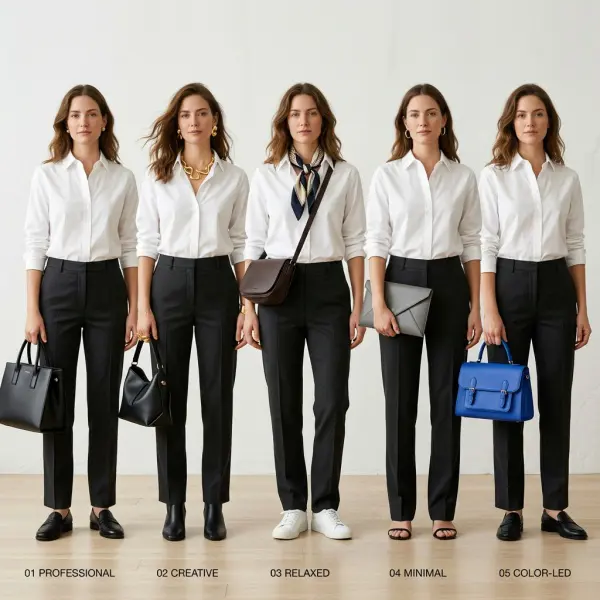
How One Simple Outfit Can Produce Several Strong Looks
The same garment combination can communicate very different messages depending on how accessories are selected and placed.
Consider a white shirt with straight dark trousers.
|
Styling Direction |
Accessory Choices |
Visual Result |
Appropriate Context |
|
Precise and professional |
Structured top-handle bag, narrow belt, watch, small metal earrings |
Clean hierarchy and controlled proportion |
Office, presentation, client meeting |
|
Creative and editorial |
Sculptural necklace, asymmetric brooch, geometric clutch |
Strong focal points and greater visual tension |
Fashion event, gallery, creative industry setting |
|
Relaxed and practical |
Soft crossbody bag, printed scarf, flat shoes, simple rings |
Movement, texture, and accessible personality |
Travel, casual meeting, weekend use |
|
Minimal and refined |
Tonal bag, discreet cuff, fine leather belt |
Quiet structure with limited contrast |
Dinner, professional-social event, everyday polished styling |
|
Color-led |
Bright bag, coordinated earrings, neutral shoes |
Controlled accent against a stable base |
Retail event, social content, seasonal campaign |
The garments do not need to carry every message. Their simplicity allows the accessories to establish direction.
How Fashion Businesses Can Apply Accessory-Led Styling
Accessory-led styling can improve how fashion brands design, merchandise, photograph, and sell relatively simple apparel. The value is strongest when the strategy begins during collection planning rather than after production has been completed.
Build Styling Roles Into the Assortment
Every accessory should have a defined relationship with the apparel collection.
Some may serve as:
- focal products;
- color connectors;
- proportion tools;
- functional products;
- entry-price items;
- signature brand elements;
- seasonal updates;
- cross-selling products.
Not every accessory needs to be a hero. A collection with several competing hero products can be difficult to style and expensive to merchandise.
A useful assortment might include one highly recognizable statement piece, several adaptable supporting products, and a small group of practical core accessories.
Develop Accessories Beside the Clothing
When accessory and apparel teams work separately, differences in scale, color, hardware, material, and delivery timing can weaken the final collection.
Accessories should be reviewed against real garment samples. Teams need to see whether:
- a necklace works with the actual neckline;
- a belt fits through garment loops;
- a bag overwhelms or disappears beside the silhouette;
- hardware conflicts with buttons or zippers;
- a scarf catches on trims;
- accessory colors change under campaign lighting;
- straps damage delicate fabrics;
- the combined weight remains comfortable.
A technically successful product can still fail as a styling product when it has not been tested with the collection.
Photograph the Transformation, Not Only the Product
Customers often need to see the difference an accessory makes. A strong content sequence can show:
- the simple outfit without the accessory;
- the outfit with one focal accessory;
- a close-up of placement and construction;
- one alternative way to wear it;
- the product in realistic movement or use.
This approach explains value more clearly than presenting several accessories together without hierarchy.
Before-and-after content should avoid implying that the unaccessorized person is incomplete, unattractive, or incorrectly dressed. The message is that accessories create different styling possibilities—not that they correct the wearer.
Provide Scale and Placement Information
Online product pages frequently show accessories as isolated objects. This creates uncertainty about size and proportion.
Useful information includes:
- product dimensions;
- model height where relevant;
- strap drop;
- necklace length;
- belt measurement method;
- earring dimensions and weight;
- bag capacity;
- adjustable positions;
- on-body images from more than one angle.
Where practical, brands should show accessories on people with different body proportions or provide sufficiently detailed measurements for customers to make their own assessment.
Train Retail and Customer-Service Teams in Styling Logic
Sales teams need more than product names and materials. They should understand what each accessory does within a look.
A useful product explanation might be:
“This belt creates a clearer waistline over loose layers, but it can also be worn lower on the hip for a less structured effect.”
That is more informative than:
“This is our must-have statement belt.”
Specific styling guidance improves customer understanding without making unsupported claims.
Use Accessories to Reconnect New and Existing Products
A new scarf, belt, or bag can be photographed with garments from earlier collections. This demonstrates continuity and gives customers additional reasons to revisit products they already own.
The strategy may also reduce the pressure to present every campaign as a completely separate visual universe. It supports a more coherent brand wardrobe.
This is closely connected to the broader shift described in why statement accessories are becoming central to modern styling.
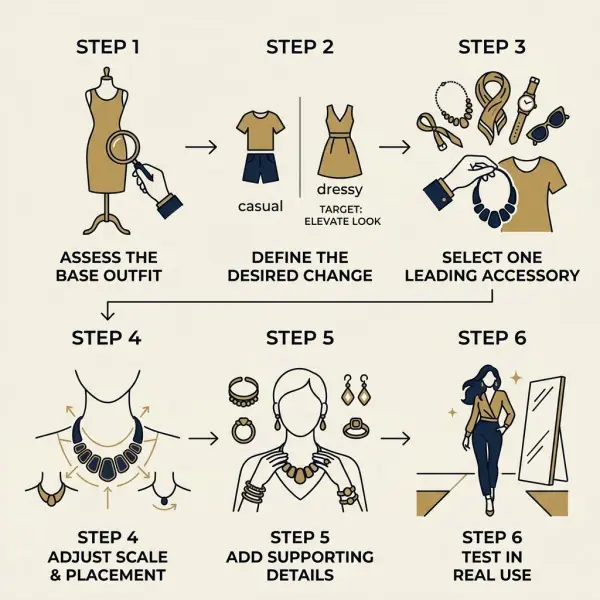
A Six-Step Framework for Styling a Simple Outfit
1. Identify What the Garments Already Communicate
Begin with the clothing rather than immediately adding accessories.
Assess:
- silhouette;
- dominant lines;
- color;
- surface;
- level of formality;
- fit;
- visual weight;
- practical context.
A structured suit needs a different intervention from a fluid jersey dress, even when both are neutral.
2. Decide What Needs to Change
The outfit may need:
- a focal point;
- stronger proportion;
- more texture;
- a color accent;
- greater formality;
- greater relaxation;
- clearer brand identity;
- functional support.
Do not add an accessory without understanding its intended contribution.
3. Choose One Leading Accessory
Select the item that carries the main visual responsibility. It may be a bag, belt, necklace, scarf, eyewear frame, hat, or shoe.
The leading accessory should be visible enough to establish the direction without requiring several other dominant pieces.
4. Control Scale and Placement
Evaluate the accessory on the body and against the garment volume. Move it if necessary.
A necklace may need a shorter chain. A bag may work better carried by hand than across the body. A scarf might be more effective at the waist than around the neck.
Placement is an active styling decision.
5. Add Supporting Details Selectively
Secondary accessories can repeat one color, metal, shape, or material from the leading piece. They should strengthen the visual logic rather than compete with it.
The number of accessories matters less than the clarity of their roles.
6. Test the Look in Real Conditions
Check the outfit while standing, sitting, walking, carrying daily items, and wearing outerwear where relevant.
A successful still image is not enough. The styling needs to survive movement, climate, comfort, and practical use.
Common Styling and Merchandising Mistakes
Adding Accessories Without a Clear Purpose
An accessory may be attractive on its own but unnecessary within a particular outfit. Adding products simply because the look feels “too basic” can produce clutter rather than strength.
The better approach is to identify the missing function first. Does the outfit need contrast, structure, movement, color, or context? The answer should guide the choice.
Making Every Item a Focal Point
A statement necklace, large earrings, patterned scarf, bright belt, decorative bag, and bold shoes may create several independent stories.
This happens frequently when merchandising teams are expected to show too many products in one image. The commercial objective is understandable, but the styling result can make every item less visible.
Campaign and product imagery should distinguish between a complete styling story and a catalogue of available products.
Selecting Accessories Only by Color
Color coordination is useful, but it is only one part of the relationship. Two items may match in color while conflicting in scale, texture, formality, or construction.
A delicate satin dress and a heavy utility belt can share the same color but communicate very different ideas. The contrast may be intentional, but it should be recognized rather than assumed to be harmonious because the colors match.
Ignoring the Garment’s Existing Lines
A necklace may interfere with a complex neckline. A crossbody strap can cut across a carefully constructed jacket. A belt may compress pockets, pleats, or closures in ways the garment was not designed to accommodate.
Stylists and product teams need to understand garment construction. Accessories should interact with the design, not accidentally obscure it.
Using Scale Without Considering Comfort
A large accessory may improve visual balance while creating physical discomfort. Heavy earrings, rigid cuffs, oversized bags, or wide belts need realistic wear testing.
Image and comfort are not separate quality criteria. An accessory that customers stop wearing cannot continue strengthening their outfits.
Treating All Customers as Having the Same Proportions
Accessory effects change with height, shoulder width, torso length, mobility, body volume, clothing size, and personal preference.
Brands should provide options and measurements rather than presenting rigid body-correction rules. Customers may deliberately choose exaggeration, imbalance, or contrast as part of their personal style.
Overstating Versatility
A product may work with several outfits without working with everything. Calling an accessory universally versatile can create unrealistic expectations.
More credible communication shows specific contexts: three neckline types, two carrying positions, or several wardrobe combinations. Demonstrated versatility is stronger than vague claims.
What a “Stronger Look” Does Not Mean
A stronger outfit is not necessarily more expensive. Price does not determine visual hierarchy, fit with the garments, or personal relevance.
It is not necessarily more trend-driven. An heirloom brooch, familiar leather belt, or well-used bag can provide more character than a new seasonal product.
It is not necessarily more formal. A cap, fabric tote, bandana, or technical crossbody bag can make casual clothing feel more intentional.
It is not necessarily more coordinated. Deliberate tension can be more compelling than exact matching.
It does not require hiding or correcting the body. Accessories can frame, divide, lengthen, or add volume, but those effects should serve the wearer’s desired expression rather than a universal ideal.
It is not automatically more sustainable. Restyling existing garments may support continued use, but buying large quantities of short-lived accessories can create additional consumption and waste.
The stronger look is the one whose elements have a clear relationship to one another and to the person wearing them.
What Brands Should Verify Before Applying This Strategy
Accessory-led styling can support apparel sales and customer engagement, but brands should verify several practical issues before building campaigns around it.
First, confirm that the products genuinely work together. Do not rely only on digital mood boards or color references. Evaluate physical samples under realistic lighting and movement.
Second, confirm that the accessory is comfortable, safe, and functional in its intended context. Decorative effect should not override secure construction, suitable weight, and reliable closures.
Third, verify product information. Dimensions, materials, adjustability, color, weight, and care details should align with the actual item customers receive.
Fourth, test whether the styling remains clear at different image sizes. A detail visible in a close-up may disappear in a marketplace thumbnail or full-body campaign image.
Finally, separate editorial styling from customer promises. A campaign can show an imaginative use, but product pages should explain whether that method is recommended, tested, and compatible with the construction.
Frequently Asked Questions
What is the easiest accessory for transforming a simple outfit?
The easiest choice depends on which area of the outfit needs emphasis. A necklace or scarf is useful when the upper body lacks a focal point. A belt can change the structure of a loose dress, shirt, or jacket. A bag can introduce color, shape, and practical context without altering the garment. Eyewear and earrings place attention near the face. Rather than searching for one universally effective accessory, identify what the outfit currently lacks: contrast, proportion, texture, color, structure, or formality. One item chosen for a specific purpose usually creates a clearer result than several unrelated additions.
How many accessories should be worn with a simple outfit?
There is no technically correct number. The more useful principle is to establish hierarchy. One accessory may lead while one or two quieter pieces support it. A sculptural necklace might serve as the focal point, accompanied by small earrings and a simple bag. Alternatively, several small pieces can work together when they repeat the same metal, shape, or visual theme. Problems arise when every item demands equal attention. Comfort, practical context, garment detail, and personal preference should also influence the decision. A simple outfit does not automatically need a large collection of accessories.
Do accessories need to match each other?
Accessories do not need to match exactly, but they should usually have a readable relationship. That relationship may come from shared color, shape, metal, texture, formality, craft reference, or visual weight. A bag and shoes can differ in color while sharing a similarly structured shape. Mixed-metal jewelry can feel intentional when the combination is repeated rather than appearing accidental. Exact matching may suit uniforms, formal events, or highly controlled brand imagery, but it is not required for everyday styling. Coherence is broader than duplication.
How can accessories make an outfit look more polished?
Accessories can create polish by clarifying proportion, introducing a deliberate focal point, and reinforcing the level of formality. A structured bag, correctly fitted belt, clean footwear, and restrained jewelry may make simple clothing appear more considered. Product condition also matters. Scratched hardware, damaged edges, twisted straps, or tarnished surfaces can undermine the effect regardless of price. Polish does not always mean formal or minimal; a colorful scarf can produce a polished result when it is positioned intentionally and relates clearly to the clothing.
Can accessories make oversized clothing look more balanced?
They can change how oversized clothing is perceived, although balance does not require reducing or correcting the volume. A belt can gather part of the garment, while a structured bag may provide a contrasting shape. A long necklace or crossbody strap can introduce vertical or diagonal direction. Large accessories can reinforce the oversized scale; small accessories can create tension and visual relief. The best approach depends on whether the wearer wants to emphasize, interrupt, organize, or contrast with the volume. Comfort and garment construction should remain part of the decision.
What accessories work best with monochromatic outfits?
Accessories with distinctive texture, finish, shape, or controlled color contrast work well because monochromatic outfits provide a stable visual field. A tonal leather bag can add structure without changing the palette. Metal jewelry introduces reflection, while suede, woven fibers, resin, or polished surfaces create textural variation. A contrasting accessory can establish a focal point, but it is not required. When several items share one color, variations in material and value help prevent the look from appearing visually flat.
Can accessories help fashion brands sell basic garments?
Yes, when accessories demonstrate additional ways to style the garments rather than merely increasing the number of products shown. A brand can photograph one core dress with several accessory directions, create bundled styling suggestions, reconnect new accessories with earlier collections, and train retail teams to explain proportion and placement. The strategy works best when the accessories are genuinely compatible with the garments. It becomes less effective when campaign images are overcrowded, product combinations are impractical, or customers cannot understand the scale and function of the individual items.
Is accessorizing an outfit more sustainable than buying new clothes?
It may help customers continue wearing familiar garments, but it is not automatically a more sustainable choice. The result depends on whether the accessory is durable, frequently used, responsibly produced, repairable, and relevant across several outfits. Buying many short-lived novelty accessories can add consumption rather than reduce it. Brands should describe the specific benefit—such as providing additional styling options for existing garments—without treating versatility alone as proof of lower environmental impact.




Comments 0
Leave a CommentSend Comment
Anda harus Login terlebih dahulu untuk dapat memberikan komentar.