
Why Smart Casual Dressing Continues to Influence Everyday Fashion
Quick Answer
Smart casual dressing continues to influence everyday fashion because it provides a practical middle ground between formal clothing and unrestricted casualwear. Instead of prescribing one fixed outfit, it combines polished elements—such as tailored trousers, structured knitwear, blazers, refined shirts, dresses, loafers, and clean footwear—with more relaxed garments.
Its appeal extends beyond offices. The same styling logic can work for restaurants, travel, networking events, informal celebrations, creative meetings, and other situations where people want to look considered without appearing excessively formal.
Smart casual has also become commercially important because it supports wardrobe versatility. A relaxed blazer can be worn with tailored trousers, denim, or a dress. A knitted polo can move between professional and social settings. A simple outfit can become more polished through footwear, accessories, fabric quality, and proportion.
However, smart casual is not a universal dress code. Its meaning varies by workplace, country, climate, generation, industry, occasion, and social setting. For fashion brands, the opportunity is not to label almost any garment “smart casual,” but to create products that balance ease and polish in a clearly defined context.
What Is Smart Casual Dressing?
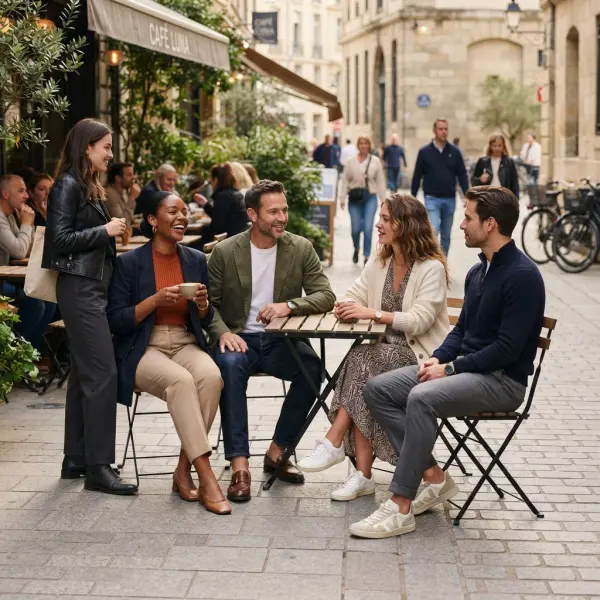
Smart casual is a style of dress that combines the visual order and polish of more formal clothing with the comfort and flexibility of casual garments.
It is more refined than ordinary casualwear but less formal than traditional business attire, ceremonial clothing, or a complete matching suit. The exact balance depends on the occasion.
The Massachusetts Institute of Technology’s Career Advising and Professional Development office describes smart casual as more kempt than casual and less formal than traditional professional dress. It also notes that many people may already own individual garments that can be combined into a smart casual outfit. MIT guidance on the smart casual dress code
In fashion terms, smart casual is best understood as a styling relationship rather than a product category.
A blazer is not automatically smart casual. It may look formal when worn with matching trousers, a crisp shirt, and dress shoes. The same blazer can become smart casual when combined with a fine knitted top, dark denim, and loafers.
Similarly, sneakers are not automatically casual enough to undermine the outfit. A clean, low-profile pair may work with tailored trousers in some settings, while heavily branded running shoes may create a much more relaxed impression.
Smart casual therefore depends on the complete outfit:
- garment structure;
- fabric quality and condition;
- fit and proportion;
- color coordination;
- footwear;
- accessories;
- grooming;
- the social or professional context.
No single item determines the result.
Why Has Smart Casual Become So Influential?
Smart casual has gained influence because contemporary life frequently requires clothing that can move between different levels of formality.
People may attend an office meeting, work from a shared space, travel across a city, meet friends, visit a restaurant, or attend an informal event without changing their entire outfit. Strict formalwear may be unnecessary for these activities, while basic casualwear may feel insufficiently considered.
Smart casual fills that gap.
Its rise is also connected to broader changes in professional dressing. A 2023 YouGov survey found that smart casual was the most commonly selected workplace attire category among British workers, at 34%. Among respondents who worked from home some of the time, 49% said they wore smart casual clothing when visiting the workplace. These figures describe one national survey rather than a universal global pattern, but they show how strongly the category can feature in hybrid professional life. YouGov research on workplace attire in Britain
A separate 2024 YouGov survey of employed U.S. adults found that 47% reported wearing business-casual clothing at work and the same proportion reported wearing casual street clothes. Respondents could select several categories, suggesting that many working wardrobes include multiple levels of formality rather than one fixed uniform. YouGov survey on suits and work clothing
Smart casual is commercially useful because it helps consumers navigate that overlap. It allows fashion products originally associated with offices, leisure, travel, or social dressing to coexist within one wardrobe.
Smart Casual Is a Balance, Not a Checklist
The most common misunderstanding is that smart casual can be defined through a universal list of permitted garments.
It cannot.
A list may provide a starting point, but the visual meaning of each garment changes according to material, cut, condition, color, and styling.
Dark denim without distressing may appear polished with a structured jacket and loafers. The same jeans may look fully casual with an oversized graphic T-shirt and athletic shoes.
A knitted polo made from a stable, fine-gauge construction can appear professional. A loose polo with a faded collar and visible surface wear communicates something different.
Even a suit can be styled smart casually when the components are separated, softened, or combined with less formal garments.
The better question is not, “Is this item smart casual?”
It is, “What does this item contribute to the overall level of polish?”
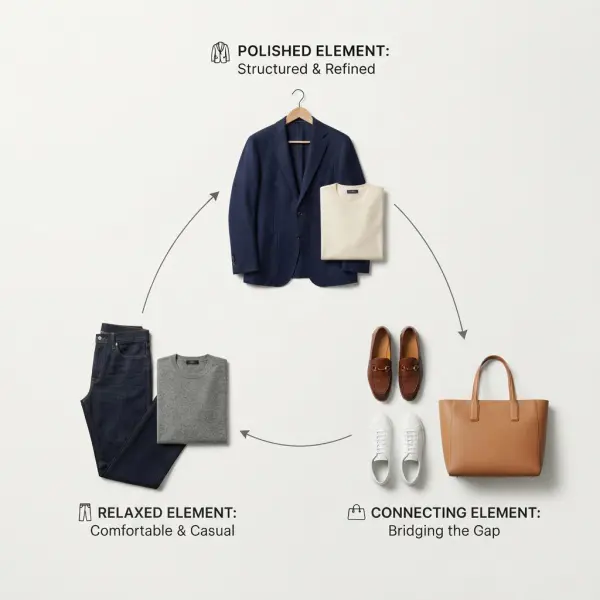
The Polished Element
Most smart casual outfits contain at least one element that introduces visual structure or refinement.
Examples include:
- tailored trousers;
- a blazer or jacket;
- a collared shirt;
- a refined blouse;
- a fine-gauge knit;
- a structured dress;
- leather loafers;
- a polished bag;
- controlled monochromatic styling.
This element does not need to be highly formal. Its role is to prevent the outfit from reading as entirely recreational or unplanned.
The Relaxed Element
The casual component softens the outfit and makes it more suitable for everyday movement.
It may include:
- dark denim;
- a plain T-shirt;
- relaxed trousers;
- an overshirt;
- a knitted polo;
- clean sneakers;
- a cardigan;
- softer tailoring;
- an unstructured bag;
- rolled or pushed-up sleeves where appropriate.
The relaxed element should still appear intentional. Excessive wrinkling, damage, fading, poor fit, or visible wear can weaken the smart component rather than merely adding casualness.
The Connecting Element
A strong smart casual outfit usually includes something that visually connects the polished and relaxed pieces.
This may be:
- a shared color;
- similar garment proportions;
- repeated texture;
- coordinated footwear;
- a structured accessory;
- consistent hardware;
- balanced layering.
For example, a navy blazer and dark jeans may feel disconnected when combined with a highly technical running shoe. A cleaner leather or suede shoe can connect the formality levels more convincingly.
This connecting logic is one reason smart casual styling influences everyday fashion so strongly. It teaches consumers to create coherence across garments that were not originally designed as a matching set.
How Does Smart Casual Differ from Business Casual?
Smart casual and business casual overlap, but they are not identical.
Business casual is primarily a workplace dress category. It usually starts from professional clothing and removes some of the formality associated with traditional business attire.
Smart casual is broader. It can apply to offices, restaurants, events, travel, social meetings, and everyday dressing. It may also allow more fashion-led silhouettes, color, denim, accessories, and footwear.
|
Comparison point |
Business casual |
Smart casual |
|
Primary context |
Workplace |
Workplace and social settings |
|
Starting point |
Relaxed business clothing |
Polished everyday clothing |
|
Typical priority |
Professional appropriateness |
Balance between ease and refinement |
|
Tailoring |
Common and often expected |
Optional but influential |
|
Denim |
Sometimes restricted |
Often accepted when clean and controlled |
|
Sneakers |
Workplace-dependent |
More commonly included |
|
Personal expression |
Usually moderate |
Can be more visible |
|
Formality range |
Narrower |
Broader and more fluid |
The distinction becomes clearer through examples.
Tailored trousers, a blouse, and loafers are likely to fit both categories.
Dark denim, a fine knit, an unstructured blazer, and clean sneakers may be smart casual but not accepted under every business-casual policy.
A matching suit with formal shoes is business professional rather than smart casual, although separating the jacket and trousers may allow both pieces to enter a smart casual wardrobe.
Neither category has a globally standardized definition. Employers, event organizers, brands, and consumers often use the terms inconsistently. Context should therefore take priority over the label.
How Is Smart Casual Influencing Everyday Wardrobes?
Smart casual has moved beyond being an occasional dress instruction. Its basic logic now shapes how many people build daily wardrobes.
The influence is visible in four areas: garment versatility, softer tailoring, elevated basics, and mixed-category styling.
Formal Garments Are Being Separated and Reused
Traditional tailoring was often sold as a complete set. Smart casual encourages consumers to use each component separately.
A suit jacket may be worn with:
- dark denim;
- chinos;
- a midi skirt;
- a simple dress;
- knitted trousers;
- a plain T-shirt;
- a fine sweater.
Suit trousers may be combined with:
- a knitted polo;
- a sweatshirt with a controlled shape;
- a relaxed shirt;
- a cropped jacket;
- loafers;
- minimal sneakers.
This separation increases the number of potential outfits and may improve the perceived value of tailoring.
For brands, however, separates require greater coordination. Jacket and trouser colors need to work with the rest of the collection. Proportions must remain balanced when the matching partner is removed. Fabrics need enough character to stand alone without looking incomplete.
Casual Basics Are Becoming More Refined
The influence also moves in the opposite direction. Casual staples are being developed with more controlled construction and styling.
Examples include:
- T-shirts made from heavier or smoother jersey;
- polos with stable collars and cleaner plackets;
- sweatshirts with minimal branding and refined proportions;
- knitted jackets that resemble soft tailoring;
- elasticated trousers cut with a tailored line;
- sneakers with reduced visual bulk;
- overshirts made from suiting-inspired fabrics.
These products retain casual ease but provide enough shape and surface quality to work within more polished outfits.
This development is not simply a matter of using more expensive material. A refined basic needs appropriate neckline recovery, seam stability, opacity, fit, finishing, and durability.
A premium-looking T-shirt that twists after washing or loses its collar shape cannot perform reliably as a smart casual foundation.
People Are Combining Categories More Freely
Smart casual encourages combinations that would once have belonged to separate wardrobes.
A structured jacket can appear with denim. A silk-like blouse may be worn with relaxed trousers. A formal skirt can be paired with knitwear. A work bag may accompany sneakers. A casual jumpsuit can be elevated through jewelry and footwear.
The fashion value comes from contrast.
Too much uniformity can make the outfit feel overly formal or excessively casual. Controlled contrast gives it visual interest while retaining coherence.
This approach also influences retail merchandising. Stores and e-commerce platforms can no longer assume that consumers will shop only within one traditional department or occasion category.
A customer looking for a dinner outfit may purchase office-style trousers. Someone building a travel wardrobe may select a blazer. A shopper seeking casual clothing may buy loafers or a structured bag to make existing outfits feel more intentional.
Everyday Dressing Is Becoming More Occasion-Fluid
A smart casual outfit can often move through several parts of the day without a complete change.
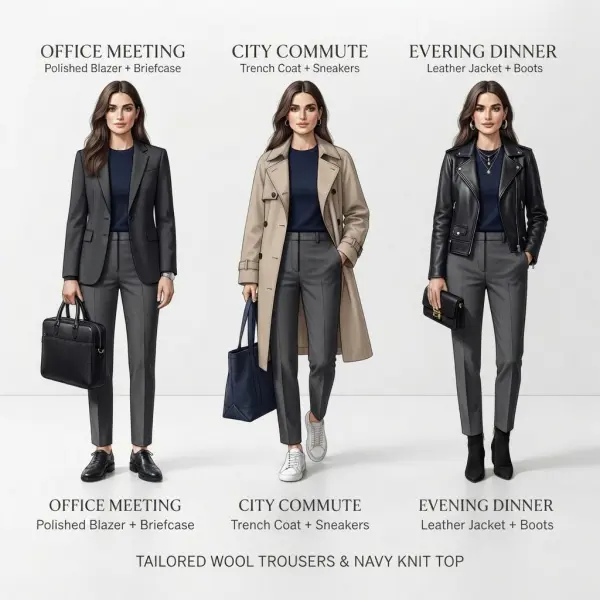
A person might wear tailored trousers, a knitted top, and a relaxed jacket for an office meeting, remove the jacket while travelling, and add jewelry for dinner.
This makes smart casual especially relevant to customers who value wardrobe efficiency. The garment does not need to serve every possible occasion, but it should be compatible with several.
A 2025 International Workplace Group survey of more than 1,000 U.S. hybrid workers reported that 92% considered it important for clothing purchases to be flexible across work and leisure. Because the research was commissioned by a flexible-workspace company and focused specifically on hybrid workers, it should not be generalized to all consumers. It nevertheless illustrates the commercial importance of versatility within that segment. IWG Workwear Reimagined survey
Which Garments Define Contemporary Smart Casual Style?
No garment is mandatory, but some categories are especially useful because they can move between formal and casual contexts.
Relaxed Blazers
The relaxed blazer is one of the clearest smart casual garments because it introduces tailoring without requiring a full suit.
Common features include:
- softer shoulder construction;
- reduced or partial lining;
- patch pockets;
- lighter interlining;
- knitted or stretch-woven fabrics;
- slightly relaxed proportions;
- versatile neutral or muted colors.
The jacket still needs shape. If it collapses completely, pulls across the shoulders, or lacks sufficient fabric recovery, it may resemble a cardigan rather than tailoring.
Neither outcome is automatically wrong. The product simply needs to communicate its intended role clearly.
Tailored Trousers with Practical Comfort
Modern smart casual trousers frequently combine a clean front and controlled silhouette with practical comfort features.
These may include:
- partial elastic at the back waistband;
- internal drawcords;
- stretch or mechanical stretch;
- pleats that provide movement;
- softer interlining;
- wider legs;
- crease-resistant fabrics;
- deeper functional pockets.
The design challenge is to prevent comfort features from making the garment appear like sportswear unless that is the intended aesthetic.
A waistband can be flexible without becoming visibly gathered. A drawcord can be hidden internally. Stretch can support movement without producing a shiny or overly fitted appearance.
Refined Knitwear
Fine sweaters, knitted polos, cardigans, knitted jackets, and compact knit dresses provide softness while retaining enough structure for polished styling.
Important quality considerations include:
- pilling resistance;
- neckline recovery;
- dimensional stability;
- transparency;
- seam reinforcement;
- snagging;
- shape retention;
- laundering behavior.
Knitwear can appear elegant when new but become unsuitable for repeated smart casual use if it stretches, pills, or loses definition quickly.
Dark or Controlled Denim
Denim is one of the clearest examples of a garment moving from casualwear into smart casual contexts.
The most adaptable versions often feature:
- dark or even washing;
- limited fading;
- no major distressing;
- controlled fit;
- minimal decorative stitching;
- clean hems;
- stable fabric;
- restrained hardware.
This does not mean dark denim is appropriate everywhere. Many formal offices, ceremonies, hospitality settings, or conservative professional events may still exclude it.
Its smart casual status is conditional.
Shirts, Blouses, and Elevated T-Shirts
A collared shirt remains useful because it can quickly increase the outfit’s polish. Softer blouses and collarless tops provide alternatives where conventional shirting feels too formal.
Plain T-shirts can also work when their construction supports the outfit. Relevant details include:
- stable neckline;
- suitable opacity;
- controlled length;
- clean seams;
- appropriate fit;
- minimal visible wear;
- fabric weight compatible with layering.
The difference between an elevated basic and an ordinary basic is often visible after repeated use rather than at the first fitting.
Dresses, Skirts, and One-Piece Options
Simple dresses and skirts can enter smart casual wardrobes when they balance ease with visual control.
Useful characteristics may include:
- movement without excessive volume;
- appropriate coverage for the context;
- stable necklines;
- functional pockets;
- layering compatibility;
- manageable care;
- footwear flexibility.
A YouGov survey of British adults illustrates how garment interpretations can differ. For example, 89% of respondents considered a sheath dress compatible with smart casual dressing, while opinions varied more widely for many other garments. Such findings reflect public perception within one market and should not be treated as a universal styling standard. YouGov research on what Britons consider smart casual
Loafers, Flats, Boots, and Minimal Sneakers
Footwear often determines whether the final outfit appears polished enough.
Loafers and simple leather shoes create an obvious bridge between formality and ease. Flats and low boots may provide similar flexibility. Minimal sneakers are increasingly incorporated into smart casual outfits, but their acceptability remains context-dependent.
Important visual factors include:
- sole thickness;
- amount of branding;
- surface material;
- color;
- technical detailing;
- cleanliness;
- condition;
- relationship to the trouser or skirt silhouette.
A highly technical running shoe can be comfortable but may not support the same visual message as a low-profile leather sneaker.
Why Proportion Matters More Than Individual Garments
Smart casual outfits often succeed or fail because of proportion.
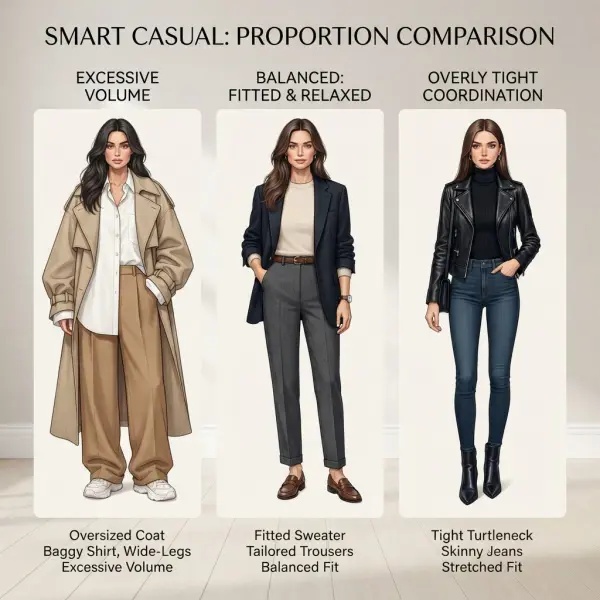
A relaxed blazer, wide trousers, oversized shirt, large bag, and chunky sneaker may each be acceptable individually. Combined without control, they can overwhelm the body and appear more trend-driven than polished.
The same principle applies to fitted garments. Narrow trousers, a fitted shirt, cropped jacket, and pointed shoe may create excessive visual tension, even when every item is formally appropriate.
A balanced outfit usually manages three relationships:
- volume between the upper and lower body;
- length between layers;
- visual weight between clothing, footwear, and accessories.
For example, wide-leg trousers may work well with a shorter or more fitted top, although a long relaxed jacket can also succeed when the fabric drapes cleanly and the footwear provides enough visual balance.
There is no universal formula. Body proportions, garment construction, cultural preferences, and the desired silhouette all matter.
Fashion brands should therefore merchandise complete outfits, not merely display isolated products. Consumers often understand proportion more easily through visual examples than through written styling rules.
How Accessories Shape Smart Casual Dressing
Accessories are especially influential in smart casual styling because they can change the perceived formality of simple clothing.
A plain shirt and trousers can look more polished with a structured bag, belt, watch, scarf, or refined jewelry. The same outfit becomes more relaxed with a canvas tote, sports watch, cap, or highly casual footwear.
Accessories can perform several functions:
- introduce color;
- connect unrelated garments;
- strengthen personal identity;
- adjust formality;
- provide texture;
- improve practical utility;
- create a focal point.
They are not merely decorative.
A work bag may need to carry a laptop and commuting essentials. A belt can influence the proportion of an oversized shirt or dress. Footwear affects walking comfort as well as appearance. Eyewear and jewelry can become recognizable parts of personal presentation.
The wider role of these details is explored in how accessories transform simple outfits into stronger looks.
Brands should avoid over-accessorizing smart casual campaigns. When every outfit contains multiple statement elements, the styling becomes difficult for ordinary customers to reproduce and may obscure the central garments.
One deliberate accessory is often more commercially useful than several competing focal points.
Why Smart Casual Works Across Different Consumer Segments
Smart casual does not belong to one age group, gender, or profession. Its flexibility allows different consumers to interpret the same principle through their own wardrobes.
Early-Career Professionals
People entering professional life may use smart casual clothing to avoid the cost and rigidity of maintaining a large formal wardrobe.
A small capsule can include:
- one blazer;
- two trousers;
- several tops;
- a simple dress or additional bottom;
- one polished shoe;
- one clean casual shoe;
- a practical bag.
The main challenge is uncertainty. Early-career employees may not know whether denim, sneakers, sleeveless tops, prints, or relaxed silhouettes are accepted.
Retail communication should therefore include situational guidance rather than presenting smart casual as a self-explanatory term.
Hybrid and Mobile Workers
Hybrid workers often need clothing that performs across home, transport, shared offices, and meetings.
Priorities may include:
- camera-ready upper garments;
- seated comfort;
- layering;
- crease recovery;
- practical pockets;
- walkable footwear;
- easy maintenance;
- business-travel compatibility.
These customers may value fewer, more versatile garments, but price sensitivity remains important. A product cannot rely on versatility as justification for a premium price unless the construction and performance support the claim.
Creative and Client-Facing Professionals
Creative workers may use smart casual as a platform for stronger personal expression. Color, unusual proportions, statement accessories, or design-led footwear may be acceptable or even beneficial in industries where visual identity contributes to professional credibility.
Client-facing professionals often need more control. They may want personality, but the outfit must also reassure customers, investors, partners, or stakeholders.
The appropriate balance depends on what the wearer needs to communicate: authority, accessibility, creativity, technical competence, luxury, trust, or cultural awareness.
Consumers Outside Traditional Offices
Smart casual influences people who do not work in conventional offices.
Teachers, consultants, entrepreneurs, sales representatives, speakers, community leaders, creators, hospitality managers, and event professionals may all need clothing that appears polished without resembling formal corporate uniform.
This broader use explains why smart casual continues to influence general retail. Its relevance is not limited to return-to-office dressing.
How Climate Changes Smart Casual Styling
Smart casual is often presented through layered outfits developed for temperate climates. That approach does not transfer directly to hot, humid, cold, rainy, or highly variable environments.
Warm and Humid Climates
In warmer conditions, polish may need to come from fabric quality, silhouette, color coordination, and finishing rather than from multiple layers.
Useful product directions can include:
- lightweight unlined jackets;
- breathable shirts;
- structured short-sleeve tops;
- fluid trousers;
- modest dresses in lighter constructions;
- open but professionally appropriate footwear;
- washable fabrics;
- perspiration-conscious colors and prints.
Linen and linen blends may support airflow, although visible creasing is part of their natural behavior. Cotton can be comfortable but varies considerably by construction. Regenerated cellulosic fabrics may offer smooth drape but require appropriate testing for strength, shrinkage, and care.
Brands should avoid describing any fiber as universally breathable or climate-perfect without considering fabric density, garment fit, lining, and finishing.
Cold Climates
Cold-weather smart casual dressing relies more heavily on layering.
Fine knitwear, wool trousers, knitted jackets, boots, coats, scarves, and thermal base layers may create comfort without requiring highly formal suiting.
The operational challenge is compatibility. A blazer needs enough room beneath outerwear. A coat must fit over the heaviest intended layer. Trouser hems need to work with boots. Static, pilling, and friction between fabrics can affect the final appearance.
Variable Indoor and Outdoor Temperatures
Many consumers move between hot transport systems, cold outdoor environments, and climate-controlled interiors.
Removable layers are more useful than one heavy garment. Lightweight knitwear, overshirts, cardigans, soft jackets, and scarves can help the wearer adjust throughout the day.
For retailers, this is a stronger merchandising story than simply grouping products by season. It connects clothing to a realistic daily journey.
What Does Smart Casual Mean for Fashion Product Development?
Smart casual creates opportunity, but it also introduces product ambiguity.
A formal suit has a relatively clear purpose. A sports garment has measurable movement requirements. A smart casual product may be expected to deliver comfort, versatility, visual polish, durability, and broad occasion use at the same time.
Brands need to define which responsibility matters most.
Begin with a Primary Use Case
A product should have one clear central job.
Examples include:
- a blazer for everyday business-casual use;
- trousers for commuting and office meetings;
- a dress for professional and social events;
- a knitted jacket for home-to-office transitions;
- a polo for warm-climate professional dressing;
- a shoe for walking and informal client meetings.
Secondary uses can extend the value of the item, but they should not weaken the primary function.
A blazer promoted equally for formal presentations, flights, exercise, dinners, and weekend Define the Intended Formality
Product teams should agree on the outfit context before approving materials and silhouettes.
A simple internal scale might include:
|
Formality level |
Product direction |
|
Relaxed casual |
Soft, recreational, highly informal |
|
Elevated casual |
Refined basics with controlled fit |
|
Smart casual |
Casual and polished elements in balance |
|
Business casual |
Workplace-oriented professional separates |
|
Business formal |
Matching or highly coordinated formal clothing |
This framework helps prevent inconsistent development.
A design team may consider a knitted jacket business casual, while marketing sees it as weekend casual and merchandising places it beside formal blazers. Without agreement, the customer receives mixed signals.
Test Styling Compatibility
Each garment should be tested with several products from the same range.
A blazer may need to work with:
- a shirt;
- a T-shirt;
- knitwear;
- tailored trousers;
- denim;
- a skirt or dress where relevant.
The team should check sleeve width, layering ease, jacket length, fabric contrast, and color coordination.
This is particularly important for online brands because customers cannot easily test combinations before purchasing.
Validate Repeated Wear
Smart casual garments are often marketed as wardrobe foundations. They should therefore be evaluated for:
- pilling;
- abrasion;
- colorfastness;
- seam durability;
- collar recovery;
- knee and seat bagging;
- shrinkage;
- twisting;
- creasing;
- surface shine;
- shape retention.
A garment that works for one styled photograph but deteriorates after routine use cannot support a credible versatility claim.
Develop Consistent Core Fits
Smart casual categories can support repeat purchase when customers trust the fit.
A brand may maintain a reliable trouser block, shirt fit, blazer proportion, or knitted top shape across seasons while changing color, texture, and detail.
This approach supports more flexible and personal office outfits and can reduce the customer’s uncertainty when replacing wardrobe essentials.
Consistency does not mean refusing to improve. Fit changes should be tested, documented, and communicated when they materially affect the product.
How Can Retailers Merchandise Smart Casual Clothing More Clearly?
The phrase “smart casual” is widely used but poorly standardized. Retailers need to make the meaning visible.
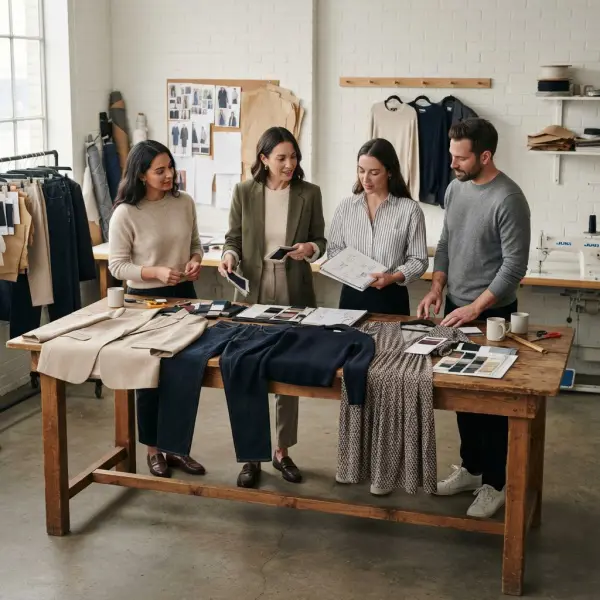
Show Complete Outfits
Customers need to see how polished and relaxed pieces interact.
A product page for tailored trousers might show:
- an elevated casual outfit with a T-shirt and sneakers;
- a smart casual outfit with knitwear and loafers;
- a business-casual outfit with a blazer and refined shoe.
The product remains the same, but its context changes.
This approach helps customers understand value without claiming that the item is suitable for every environment.
Describe the Intended Situation
Specific descriptions are more useful than generic labels.
Instead of saying:
Perfect for any smart casual occasion.
A retailer could explain:
Designed for relaxed offices, informal meetings, restaurant dressing, and professional travel. For conservative workplaces or formal events, style it with the coordinating jacket and closed footwear.
The second version gives the customer a decision framework.
Explain Fabric and Construction
Consumers may associate softness with comfort and structure with formality, but these relationships are more complex.
Retailers should explain:
- whether the jacket is lined;
- whether the waistband stretches;
- whether the fabric has recovery;
- whether the garment creases;
- whether the knit is lightweight or compact;
- whether the shoe is designed for extended walking;
- whether the product is washable;
- whether the fit is relaxed or oversized.
Clear technical information helps the customer judge whether the product supports their intended use.
Use a Relative Formality Scale
A retailer can classify products along a simple internal or customer-facing scale:
- everyday casual;
- elevated casual;
- smart casual;
- business casual;
- formal professional.&l




Comments 0
Leave a CommentSend Comment
Anda harus Login terlebih dahulu untuk dapat memberikan komentar.