

What Apparel Manufacturers Should Know About Predictive Machine Maintenance
A sewing machine rarely becomes unreliable without creating some form of operational consequence. It may develop unusual vibration, experience recurring thread-related interruptions, operate at an abnormal temperature, or require increasingly frequent adjustments. These symptoms do not always indicate an approaching mechanical failure, but they can provide useful information when maintenance teams know how to evaluate them.
For garment factories operating under demanding delivery schedules, unexpected equipment failures create challenges beyond the immediate cost of repair. A machine breakdown can interrupt a critical sewing operation, leave downstream workstations waiting, require production to be reassigned, or complicate an already tight shipment schedule. The impact depends on the equipment involved, the availability of replacement capacity, and how quickly technicians can restore normal operation.
Predictive maintenance offers an approach to equipment management that uses condition measurements, operating history, and analytical methods to estimate potential faults or deterioration before they cause an unacceptable interruption. Instead of relying exclusively on fixed servicing intervals or waiting until equipment fails, manufacturers can use evidence about machine condition to support maintenance decisions.
The concept has become closely associated with Industrial Internet of Things (IIoT) technology, machine learning, and smart manufacturing. However, reliable predictive maintenance requires considerably more than attaching a sensor to a sewing machine and displaying its measurements. Equipment characteristics, failure mechanisms, data quality, maintenance records, and the economic consequences of incorrect predictions all influence whether the approach is practical.
For apparel manufacturers, the central question is not whether predictive maintenance technology is available. It is whether the equipment problems experienced by a particular factory can be monitored, anticipated, and addressed more effectively than through existing maintenance practices.
Quick Answer: What Is Predictive Machine Maintenance in Apparel Manufacturing?
Predictive machine maintenance in apparel manufacturing is a data-driven maintenance approach that evaluates equipment condition, operating patterns, and relevant historical information to identify developing faults or estimate future maintenance needs before serious equipment failure occurs.
In a garment factory, predictive maintenance may involve monitoring vibration, motor temperature, electrical current, operating hours, or equipment fault records from suitable sewing, cutting, embroidery, or finishing machines. Analytical methods examine these measurements to identify meaningful deterioration patterns and support decisions about inspection, repair, or component replacement.
Unlike time-based preventive maintenance, which schedules servicing according to predetermined intervals, predictive maintenance attempts to use actual equipment condition and evidence of degradation to determine when intervention is appropriate. It can support more targeted maintenance, although it cannot reliably predict every failure.
Its effectiveness depends on selecting measurable failure modes, collecting trustworthy data, validating detection or prediction methods, and ensuring that maintenance teams can act on the results. For many apparel factories, a combination of routine preventive maintenance, basic condition monitoring, and selective predictive analytics may be more practical than applying sophisticated prediction systems to every machine.
Why Machine Maintenance Matters in Garment Production
Garment manufacturing depends on a wide range of equipment, from conventional industrial sewing machines to automated pattern-sewing systems, fabric cutting equipment, embroidery machines, and specialized finishing machinery. The reliability requirements differ across these assets, but equipment problems can affect production continuity, operational cost, and garment quality.
A single sewing machine failure may be manageable when another suitable workstation is available. The same failure can be more disruptive if the machine performs a specialized operation, requires particular attachments, or occupies a critical position in the assembly sequence.
Consider a factory producing tailored jackets. A conventional lockstitch machine may be easier to substitute than a specialized equipment configuration used for a particular construction operation. If the specialized machine becomes unavailable, the production team may need technical intervention, alternative process arrangements, or rescheduling before work can continue.
This explains why maintenance priorities should consider equipment criticality rather than merely the number of machines installed. The most important asset is not necessarily the most expensive machine. It may be the one whose failure has the greatest effect on production flow, product quality, or delivery commitments.
How Unexpected Machine Failures Affect Production
Unexpected failures can generate several overlapping costs. The repair itself may require components, technician labor, and equipment testing, while the associated interruption affects production capacity.
A factory may experience delayed operations, temporary changes in operator assignments, additional work-in-progress, or overtime to recover lost production. If a malfunction affects stitch formation or machine control, the manufacturer may also need to inspect material processed before the problem was discovered.
These consequences are not identical across all factories. Equipment redundancy, spare-part availability, order complexity, and maintenance response time determine the actual business impact.
The National Institute of Standards and Technology's manufacturing maintenance research addresses monitoring, diagnostics, and prognostics as capabilities that can support manufacturing reliability and reduce unplanned interruptions. NIST also emphasizes the importance of equipment-generated information and human-maintained service records in developing effective maintenance strategies.
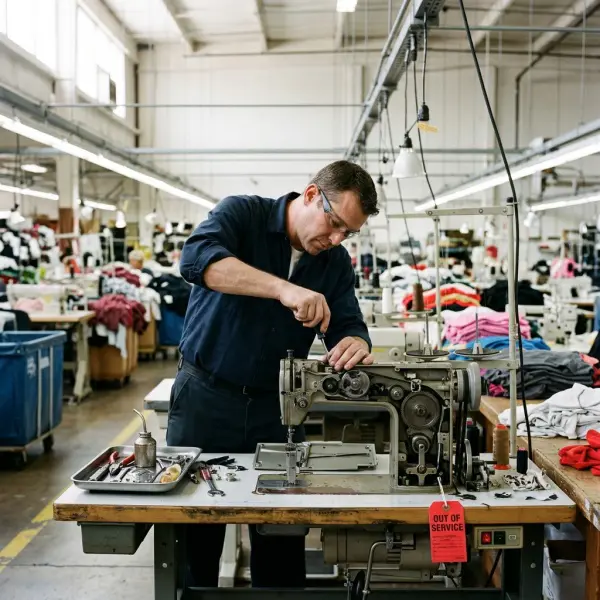
Preventive vs Predictive vs Reactive Maintenance: What Is the Difference?
Reactive, preventive, condition-based, and predictive maintenance are related equipment-management approaches, but they use different triggers for maintenance intervention.
Reactive maintenance responds to an existing failure. Preventive maintenance follows predetermined intervals or usage schedules. Condition-based maintenance responds to observed equipment condition, while predictive maintenance goes further by using condition information and analytical methods to estimate developing faults or future maintenance requirements.
These approaches are not mutually exclusive. A garment factory may use scheduled lubrication for some equipment, condition-based inspections for others, and predictive monitoring for machinery where failure consequences justify the additional investment.
|
Maintenance approach |
Main trigger |
Garment factory example |
Primary limitation |
|
Reactive maintenance |
Equipment has failed or is no longer functioning acceptably |
Repairing a sewing machine after a component fails |
Unexpected downtime and potentially disruptive repair |
|
Preventive maintenance |
Scheduled time, operating hours, or prescribed servicing interval |
Cleaning and inspecting a machine according to its manufacturer-approved schedule |
Work may occur before it is technically necessary |
|
Condition-based maintenance |
A measured or observed condition reaches a defined intervention criterion |
Inspecting a motor after repeated abnormal temperature measurements |
An alarm does not necessarily predict the timing of failure |
|
Predictive maintenance |
An assessed deterioration pattern or model indicates elevated future failure risk |
Scheduling inspection based on a validated combination of operating and condition trends |
Requires appropriate data, model validation, and reliable interpretation |

Reactive Maintenance: Repairing Equipment After Failure
Reactive maintenance is often the simplest approach to organize because intervention occurs when equipment stops functioning or develops a clearly unacceptable problem. It may be economically reasonable for noncritical assets that are inexpensive to repair and can be replaced without disrupting production.
However, relying on reactive maintenance for critical production equipment creates uncertainty. A failure may occur during a major order, require parts that are not immediately available, or result in additional damage if a developing problem remains undetected.
Factories should therefore evaluate the consequence of each failure before deciding that waiting for breakdown is an acceptable strategy.
Preventive Maintenance: Servicing Equipment on a Schedule
Preventive maintenance involves inspections and servicing activities performed according to an established schedule or usage interval. These may include cleaning, lubrication, checking machine adjustments, and replacing specified consumable or wear-related components.
Manufacturer instructions are especially important because lubrication systems, service procedures, and inspection requirements vary among machine models.
Preventive maintenance remains valuable even when connected monitoring technology is available. A predictive system cannot justify ignoring required safety inspections, manufacturer-prescribed servicing, or routine cleaning simply because its sensors have not issued an alert.
Condition-Based Maintenance: Acting on Measured Equipment Conditions
Condition-based maintenance uses information about machine condition to guide servicing decisions. For example, a technician may inspect a machine after detecting an unusual vibration pattern or repeated abnormal temperature measurements under comparable operating conditions.
This approach can reduce reliance on arbitrary servicing intervals for suitable components, but it does not necessarily predict when a failure will occur. A threshold alarm may indicate that a condition requires attention without estimating remaining useful life.
The ISO 17359:2018 condition monitoring guidelines establish a general framework for developing machine condition-monitoring programs. The standard remains current according to ISO's published catalogue information.
General guidelines
Predictive Maintenance: Estimating Future Maintenance Needs
Predictive maintenance builds on equipment observations by assessing whether the recorded information indicates developing degradation or an increased likelihood of failure within a relevant planning period.
A predictive system might detect an unusual combination of temperature trends, vibration characteristics, operating load, and previous fault history. If the analytical method has been validated for that equipment and failure type, the result may help technicians determine when inspection or repair should be scheduled.
Not every predictive system needs artificial intelligence. Statistical models, degradation analysis, engineering rules, and appropriately validated machine-learning methods can all contribute, depending on the problem.
The critical requirement is that the prediction provides actionable information about future equipment condition, rather than merely reporting that a sensor value has crossed a predefined threshold.
How Does Predictive Maintenance Work in a Garment Factory?
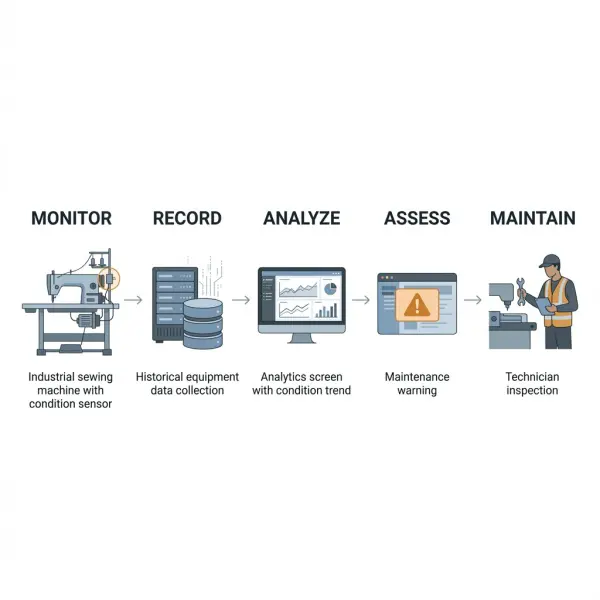
Predictive maintenance works by collecting relevant equipment-condition data, analyzing it against established behavior or degradation patterns, estimating the significance of detected changes, and using the results to guide maintenance intervention.
In garment manufacturing, the process may begin with a motor temperature sensor, a vibration sensor attached to an appropriate machine component, or fault information available from an electronic controller. The data is recorded over time and associated with operating conditions, equipment history, and maintenance events.
The objective is not simply to discover that a machine is running differently. It is to determine whether the difference represents a meaningful equipment problem and whether an intervention can prevent a costly interruption.
1. Monitoring Relevant Equipment Conditions
The first requirement is selecting measurements related to the failure mechanisms being investigated.
A factory concerned about electrical motor overheating may consider temperature and electrical measurements. Equipment with suitable rotating components may benefit from vibration analysis. Machines equipped with electronic controllers may provide diagnostic codes or operational records useful for specific maintenance investigations.
However, the existence of a measurable signal does not guarantee that it can predict a particular fault. Engineers must understand the relationship between the measurement, normal machine operation, and the deterioration mechanism.
For example, motor temperature may change because of operating load, ambient conditions, cooling performance, or machine usage. A higher reading is not automatically evidence of imminent failure.
2. Establishing Normal Operating Behavior
A predictive system needs a reliable understanding of normal equipment behavior. This baseline may involve measurements collected during healthy operation under representative conditions.
For garment sewing machines, operating conditions can vary substantially. Sewing thick denim may impose different mechanical loads from sewing lightweight woven fabric. Machine speed, thread selection, material thickness, operation type, and working duration can also influence sensor readings.
A system trained on one set of conditions may incorrectly classify normal behavior as abnormal when those conditions change.
Consequently, equipment-condition data should be associated with relevant operating variables. Where practical, monitoring systems should account for machine speed, load, material category, operating mode, and comparable production conditions.
3. Detecting Anomalies and Deterioration Patterns
Once a baseline is established, analytical methods can examine incoming information for significant deviations.
An anomaly is an observation that differs from an expected pattern. It may indicate deterioration, a changed operating condition, incorrect machine adjustment, sensor malfunction, or another event requiring investigation.
Some systems use engineering thresholds and trend analysis. More advanced applications may use statistical models or machine-learning algorithms to identify relationships among multiple measurements.
Anomaly detection is not the same as failure prediction. Detecting an abnormal vibration pattern may justify an inspection, but predicting the remaining operating life of a component requires further evidence.
4. Estimating Fault Risk or Remaining Useful Life
Where sufficient degradation information exists, predictive models may estimate the likelihood of a specified failure within a future period or calculate an estimated Remaining Useful Life (RUL).
RUL describes the estimated time or usage remaining before a component reaches a defined end-of-useful-life condition. Such estimates are inherently uncertain and should be interpreted alongside their assumptions and validation results.
The current ISO 13381-1:2025 standard on machine prognostics provides guidance and requirements for developing and applying prognostic processes, including the data and characteristics necessary for meaningful prognostic assessment. It supersedes the 2015 edition.
In a garment factory, an estimate becomes commercially useful when it provides enough lead time to plan a safe intervention, arrange suitable parts, and coordinate work with the production schedule.
5. Turning Predictions into Maintenance Actions
The final stage connects analytical findings with actual maintenance management.
A useful system should communicate what requires attention, the evidence behind the alert, the estimated urgency, and any limitations in the assessment. Qualified technicians then determine the appropriate inspection or corrective action.
For example, a validated deterioration trend might prompt a technician to inspect an affected component during the next suitable production break. The technician's findings should be recorded so the factory can evaluate whether the alert represented a genuine developing fault.
This feedback is essential. Without documented inspection and repair outcomes, predictive models may continue generating alerts without demonstrating that they prevent equipment failures.
What Machine Data Is Useful for Predictive Maintenance?
Predictive maintenance depends on collecting measurements relevant to specific equipment failure mechanisms. For apparel manufacturers, the most appropriate data varies with machine construction, operating conditions, and available instrumentation.
Not every sewing machine requires vibration sensors, and not every motor temperature measurement provides valuable diagnostic information. The selection process should begin with the equipment component and potential failure mode rather than the availability of a particular sensor.
|
Data type |
What it measures |
Potential maintenance application |
Important limitation |
|
Vibration |
Mechanical movement at the sensor location |
Investigating abnormal rotating-component or mechanical behavior |
Strongly affected by speed, operating conditions, and sensor placement |
|
Motor temperature |
Temperature at a specified measurement point |
Monitoring unusual heating patterns |
Ambient temperature and operating load influence readings |
|
Electrical current |
Current drawn by monitored equipment |
Investigating abnormal load or electrical behavior |
Current changes do not uniquely identify a mechanical fault |
|
Operating hours |
Accumulated recorded equipment usage |
Supporting usage-based servicing and degradation analysis |
Usage history alone does not establish component condition |
|
Controller fault codes |
Diagnostic events available from compatible electronic controllers |
Identifying specific reported machine or control problems |
Coverage and meaning differ by manufacturer and model |
|
Lubrication-related measurements |
Selected oil condition, flow, level, or temperature where suitable sensors exist |
Supporting investigation of lubrication-related problems |
Many sewing machines lack the necessary instrumentation |
|
Maintenance work orders |
Recorded failures, repairs, components, and corrective actions |
Linking condition patterns to verified equipment problems |
Inconsistent records can undermine analytical reliability |
Vibration Monitoring
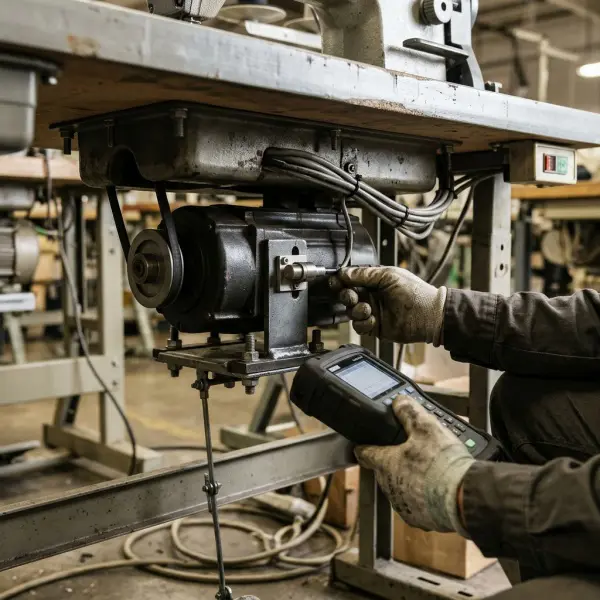
Vibration analysis can help investigate some mechanical deterioration mechanisms, particularly in suitable rotating equipment. Measurements may reveal changes associated with imbalance, looseness, bearings, or other mechanical conditions, depending on the equipment and analytical method.
For industrial sewing machines, interpreting vibration is more complicated than simply comparing one reading with another. Machine speed, reciprocating needle mechanisms, material thickness, and operating mode can influence vibration characteristics.
A sensor installed in an unsuitable location may measure activity unrelated to the component being assessed. Manufacturers therefore need appropriate installation, baseline measurements, and technical validation before associating a vibration change with a specific maintenance requirement.
Temperature and Electrical Monitoring
Temperature and electrical measurements may provide useful information about motors, drives, or other suitable equipment components.
A developing cooling problem or abnormal electrical condition may produce measurements that differ from established operating patterns. However, these measurements must be interpreted according to equipment load, speed, ambient temperature, and sensor placement.
Temperature trends alone cannot reliably distinguish all failure causes. Similarly, a change in motor current can reflect legitimate differences in the material or sewing operation rather than equipment deterioration.
Combining complementary measurements may support better analysis, but the added complexity is justified only when it improves diagnostic reliability.
Fault History and Maintenance Records
Historical records are essential when manufacturers want to progress from monitoring abnormal conditions to predicting specific equipment failures.
A maintenance work order should identify the affected machine, observed symptoms, verified problem, corrective action, replacement components, and relevant dates. Records should also distinguish actual hardware faults from adjustments, routine servicing, and interruptions caused by external production conditions.
An unlabeled vibration anomaly provides less reliable training information than an anomaly associated with a technician-confirmed component problem.
NIST's research on manufacturing maintenance explicitly recognizes maintenance work orders as important human-generated data for recording equipment health, faults, failures, and repairs.
For factories beginning digital maintenance programs, improving the quality of existing service records may be more valuable initially than introducing complex machine-learning algorithms.
Which Garment Manufacturing Machines Are Suitable for Predictive Maintenance?
Predictive maintenance is not equally useful for every asset in a garment factory. The strongest candidates are generally machines with significant failure consequences, observable deterioration mechanisms, sufficient operating history, and practical opportunities for intervention.
A factory should assess equipment criticality, repair cost, availability of replacement capacity, and the feasibility of measuring relevant conditions.
Industrial Sewing Machines
Industrial sewing machines are central to apparel assembly, but they vary widely in complexity and maintenance requirements.
Basic lockstitch and overlock machines may benefit from consistent cleaning, lubrication, adjustment, and routine inspection. Additional condition monitoring can be useful when there is a recurring, identifiable failure problem and suitable measurements are available.
Specialized electronically controlled sewing machines may justify more advanced monitoring when their failure would interrupt a critical operation or require substantial repair time.
However, many common sewing problems, such as thread breakage or skipped stitches, can result from needle condition, thread selection, material characteristics, tension settings, or operator handling. These events are not automatically evidence of mechanical deterioration, and a predictive model should not classify them as such without adequate diagnostic evidence.
Automated Fabric Cutting Equipment
Automated fabric cutting machinery can be a relevant candidate because it performs equipment-intensive operations that may affect the supply of cut components to multiple sewing lines.
Depending on its design, monitoring may focus on drive systems, cutting mechanisms, electrical components, or other machine-specific conditions.
A breakdown during cutting can have consequences beyond the cutting department if subsequent sewing operations cannot receive materials on schedule. This makes the relationship between machine reliability and production continuity particularly important.
Predictive monitoring should nevertheless be selected according to the cutting equipment manufacturer's technical requirements and the actual failure mechanisms experienced by the factory.
Embroidery and Specialized Production Machines
Embroidery machines, programmable pattern-sewing equipment, and other specialized systems may present opportunities for condition monitoring where compatible controller data or suitable external measurements are available.
Their potential value depends on how difficult the operation is to transfer to another machine and how much downtime affects production.
A manufacturer producing embroidered garments, for instance, may prioritize the reliability of specialized embroidery equipment because the required operation cannot necessarily be performed on conventional sewing machines.
Pressing, Finishing, and Factory Support Equipment
Some factories may find more compelling predictive maintenance applications in selected utility systems, motors, compressors, or finishing equipment than in individual sewing machines.
These assets can have defined failure mechanisms and may support established condition-monitoring techniques. A failure in shared support equipment can also affect numerous production workstations simultaneously.
However, safety-related inspections and statutory requirements must remain separate from predictive estimates. Condition-monitoring systems should never be used to bypass required maintenance or examination procedures.

How Predictive Maintenance Can Support Garment Factory Operations
The most practical benefit of predictive maintenance is the opportunity to investigate equipment problems before they create major production interruptions. This can help factories plan technical interventions more deliberately, although the benefits depend on prediction accuracy and the ability to act before a failure occurs.
Reducing Unplanned Equipment Downtime
An appropriately designed predictive system may identify developing equipment conditions before they cause a breakdown. Maintenance teams can use that information to determine whether inspection, adjustment, or repair should be scheduled.
This is particularly useful when an affected machine supports an operation with limited alternative capacity. Early identification may give production managers time to rearrange workloads or coordinate maintenance with planned production breaks.
However, an accurate prediction does not automatically prevent downtime. Technicians must still confirm the problem, obtain necessary components, and complete the required work.
Supporting Maintenance and Spare-Part Planning
Unexpected equipment failures can be difficult to manage when appropriate replacement components are unavailable. Predictive information may help maintenance personnel identify which parts deserve closer attention and plan procurement before a breakdown.
The potential benefit is strongest when component deterioration is measurable and the estimated intervention window is sufficiently reliable.
Manufacturers should avoid using uncertain predictions as the sole basis for eliminating safety stock or postponing essential servicing. Spare-part planning still needs to consider supplier lead times, component interchangeability, and equipment criticality.
Reducing Equipment-Related Quality Risks
Some equipment conditions can affect garment construction quality. Mechanical misalignment, inappropriate machine adjustments, or other equipment problems may contribute to inconsistent stitch formation or production defects.
Condition monitoring may help engineers investigate relationships between machine behavior and observed quality problems. However, textile defects are influenced by many factors, including fabric properties, needles, thread, stitch settings, and operator technique.
A predictive system should therefore be integrated with appropriate quality inspection records rather than treated as a substitute for garment quality control.
Improving Maintenance Decisions Through Historical Evidence
Over time, reliable equipment records can help manufacturers understand recurring technical problems and evaluate whether maintenance interventions are effective.
A factory may discover that certain machines require repeated repairs under particular operating conditions. Maintenance teams can then investigate whether the pattern involves equipment age, usage, servicing practices, or another identifiable cause.
This analysis can also support equipment replacement decisions. However, replacement should be justified through repair history, future operating requirements, and total ownership costs rather than a single predictive alert.
How Apparel Manufacturers Should Evaluate Predictive Maintenance Technology
Predictive maintenance platforms often emphasize artificial intelligence, automated alerts, and equipment health scores. These features may be useful, but manufacturers need to understand the underlying data and evidence before relying on them.
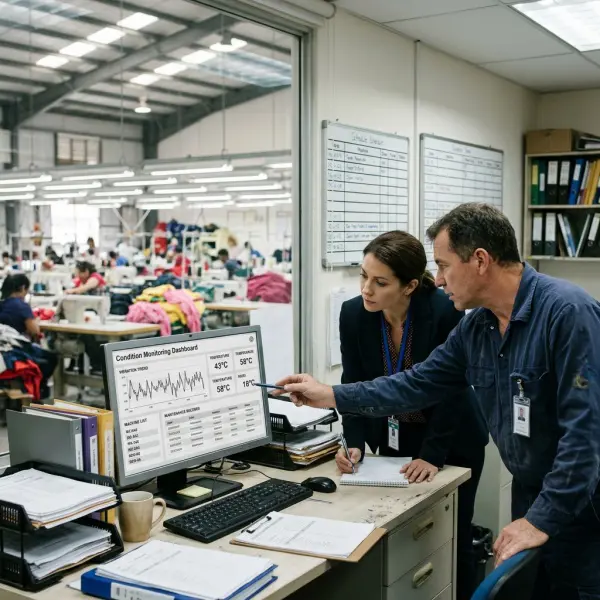
A visually sophisticated dashboard does not establish that a system can accurately predict equipment failure.
Separate Fault Detection from Failure Prediction
Fault detection identifies a condition that may indicate an existing problem. Diagnosis attempts to determine the nature or cause of that problem. Prognostics estimates how equipment condition may develop in the future.
These capabilities require different levels of evidence.
A vibration monitoring system may detect an abnormal signal without identifying its cause. A diagnostic system may associate that pattern with a specific mechanical problem. A prognostic system may then estimate the probability of future failure or the remaining useful life of a component.
Vendors should explain which capabilities are actually supported and how they have been validated.
Verify Performance Under Real Factory Conditions
Predictive models should be evaluated using data representative of the machines and operating conditions where they will be deployed.
A model developed using one machine type or a limited experimental dataset may perform differently when applied to equipment from another manufacturer. Changes in production materials, machine settings, operating schedules, and sensor installation can also affect performance.
The distinction between laboratory validation and operational results is especially important.
For example, a 2026 study of a Lean–TPM 4.0 framework for textile-related small and medium-sized enterprises explored predictive maintenance using historical equipment data and an LSTM model. Its reported operational improvements were evaluated through simulation rather than established as outcomes from a broad live factory deployment. This makes the research relevant as a technical feasibility example, not proof of universally achievable improvements.
Evaluate False Alarms and Missed Failures
A predictive maintenance system can produce two particularly important errors.
A false alarm occurs when the system identifies a potential problem that does not correspond to a relevant failure condition. A missed failure occurs when an actual developing fault is not identified in time.
False alarms may lead to unnecessary inspections, component replacement, and production interruptions. Missed failures can create misplaced confidence and leave factories exposed to unexpected breakdowns.
Manufacturers should assess prediction precision, recall, warning lead time, and the operational cost of both error types. Overall classification accuracy alone can be misleading when actual equipment failures are rare.
Demand Evidence of Economic Value
A 2025 systematic review published in the Journal of Manufacturing Systems examined evaluations of condition-monitoring technologies. The researchers found considerable variation in evaluation methods and limited directly comparable evidence across industrial applications, highlighting the need for stronger engineering and economic assessments.
The NIST-hosted review of condition-monitoring evaluation methods reinforces why manufacturers should assess benefits in their own operating environments rather than assume that published or vendor-reported results are transferable.
For garment manufacturers, a sound evaluation should consider maintenance costs, production interruption consequences, equipment importance, and the reliability of the proposed detection or prediction method.
Practical Implementation: Starting a Predictive Maintenance Program
A garment factory does not need to introduce machine learning immediately to develop a more evidence-based maintenance program. The first priority is establishing reliable equipment records and identifying maintenance problems that can realistically be addressed through condition monitoring.
Step 1: Identify Critical Machines and Failure Patterns
Begin by reviewing which equipment creates the greatest operational disruption when unavailable.
Machine criticality should reflect production consequences, repair requirements, replacement capacity, and safety considerations. Maintenance teams should then examine recurring problems and determine whether they have identifiable deterioration patterns.
A factory may discover that most machine interruptions are minor adjustments rather than failures suitable for prediction. In that case, improving preventive maintenance and technician response procedures may be a better initial investment.
Step 2: Establish a Reliable Maintenance Baseline
Record machine identification, equipment type, operating history, observed failures, repair duration, and corrective actions.
Useful baseline indicators may include unplanned downtime, breakdown frequency, Mean Time Between Failures (MTBF), and Mean Time To Repair (MTTR), using consistently defined measurement boundaries.
Factories should also distinguish equipment faults from production interruptions caused by materials, operator absence, or planned changeovers.
Without this distinction, maintenance performance indicators can misrepresent the actual reliability of machinery.
Step 3: Select Appropriate Monitoring Methods
Choose sensors or controller-based information according to the failure mechanism being investigated.
For a suitable motor-related problem, temperature or electrical measurements may provide relevant information. For certain mechanical faults, vibration analysis may be appropriate. Other conditions may be better addressed through scheduled inspection and technician observations.
The monitoring method should be tested for measurement consistency, safe installation, and suitability under representative machine operating conditions.
Step 4: Pilot Condition Monitoring Before Advanced Prediction
A controlled pilot can begin with monitoring selected measurements and establishing normal operating ranges.
Technicians should investigate abnormalities and record whether they correspond to actual equipment problems. This creates evidence about the relationship between monitored signals and verified maintenance outcomes.
More advanced prediction methods become appropriate only when the collected data supports a clearly defined analytical task.
Step 5: Connect Insights to Maintenance Workflows
Monitoring information becomes useful when it reaches the people responsible for maintenance decisions.
Where practical, alerts can be linked with a Computerized Maintenance Management System (CMMS) or another established work-order process. Such integration can help record inspections, repairs, component replacements, and outcomes.
However, automatic work-order generation should not be confused with automatic technical diagnosis. Qualified personnel must still evaluate the condition and determine suitable maintenance actions.
Step 6: Measure Results and Refine the Program
After implementation, compare maintenance performance with the established baseline.
Relevant questions include whether verified equipment failures are detected earlier, whether unplanned downtime has changed, how many alerts required intervention, and whether maintenance costs have improved after accounting for the monitoring system's operating expenses.
If meaningful benefits cannot be demonstrated, manufacturers should reconsider the monitored failure mode, analytical approach, or scope of deployment.
Predictive Maintenance Costs and Return on Investment
Predictive maintenance costs vary significantly according to equipment characteristics, monitoring infrastructure, analytical requirements, and the number of machines involved.
A basic condition-monitoring installation may require relatively simple sensors and recording software. A more advanced predictive program may involve specialized instrumentation, historical data preparation, software integration, model development, validation, and ongoing technical support.
Manufacturers should account for both initial and recurring expenses, including sensor installation, networking, monitoring software, staff training, inspection labor, system maintenance, and the time required to investigate alerts.
The financial case should be evaluated against identifiable operational benefits. These may include avoided repair expenses, reduced unplanned downtime, improved maintenance scheduling, or fewer production disruptions.
A useful decision framework is to compare the risk-adjusted annual value of avoided failures and maintenance improvements against the annualized cost of the monitoring program. Estimated benefits should reflect actual production constraints, rather than assuming every avoided machine-stop minute becomes additional saleable output.
When Predictive Maintenance May Not Be Worth the Investment
Predictive maintenance is not always the most economical maintenance approach.
A conventional sewing machine that is inexpensive to repair, has readily available replacement capacity, and rarely experiences costly failures may not justify continuous specialized monitoring. Regular servicing and accurate repair records may provide sufficient protection.
By contrast, equipment whose failure disrupts multiple production processes may present a stronger case, particularly when relevant deterioration can be measured reliably.
The economic decision should be based on failure consequences and monitoring feasibility, not on machine age or technology sophistication alone.
Common Predictive Maintenance Mistakes in Garment Manufacturing
Assuming Every Sensor Alert Predicts a Breakdown
A measurement anomaly may indicate a changed operating condition, sensor problem, or developing equipment fault. Without validation, the factory cannot reliably determine which explanation is correct. Treating every warning as an impending breakdown can lead to unnecessary maintenance and production interruptions. Manufacturers should verify alert logic and maintain procedures for technical investigation.
Using Incomplete Maintenance Records to Train Models
Machine-learning models depend on the quality and relevance of their training data. When maintenance records fail to distinguish actual equipment failures from ordinary servicing or operator adjustments, analytical results may be misleading. Factories should improve maintenance documentation and establish consistent fault categories before attempting advanced prediction.
Ignoring Differences Between Machine Operating Conditions
Garment machinery operates under varying speeds, material loads, production schedules, and equipment configurations. A normal vibration or electrical pattern for one operation may appear unusual during another. Predictive systems should incorporate relevant operating context and be tested across the conditions they are expected to encounter.
Replacing Routine Maintenance with Predictive Alerts
Predictive maintenance does not eliminate the need for manufacturer-required cleaning, lubrication, inspections, or safety procedures. A machine may require regular servicing even when monitored measurements appear normal. Factories should combine predictive methods with established maintenance practices and ensure that safety-critical work remains subject to appropriate requirements.
Expanding Technology Before Proving Operational Value
Factories may be tempted to connect large numbers of machines before validating their initial monitoring system. This increases equipment, software, and integration costs without necessarily improving maintenance outcomes. A better approach is to demonstrate reliable detection, meaningful intervention, and measurable benefits in a limited pilot before expanding the program.
Important Technical Caveats and Safety Considerations
Predictive maintenance should be viewed as a decision-support capability rather than an automatic guarantee against mechanical failure.
Some failures occur without a sufficiently detectable warning period. Others develop through mechanisms that are not captured by the installed sensors. Even when a degradation trend is measurable, predictions may become unreliable if operating conditions change significantly.
Connected equipment also introduces cybersecurity and information-management requirements. Maintenance platforms may collect machine data through factory networks, remote access systems, or cloud services. Appropriate protections should address network access, device authentication, software updates, and continuity of critical operations.





Comments 0
Leave a CommentSend Comment
Anda harus Login terlebih dahulu untuk dapat memberikan komentar.