
How Music Events Influence Color, Silhouette, and Styling Choices
Quick Answer
Music events influence fashion by creating a visual environment around sound. Performers, genre communities, stage design, historical subcultures, venue conditions, social media, and other attendees can all affect which colors, silhouettes, proportions, materials, accessories, and styling combinations feel relevant at a particular event.
The connection is not deterministic. Rock does not require black, electronic music does not automatically require neon, and a country concert does not make Western clothing compulsory. Instead, recurring cultural references create recognizable visual vocabularies that individuals reinterpret.
Research comparing rock, electronic dance music (EDM), hip-hop, and jazz festivals in Korea found substantial links between music and festival fashion in the expression of emotion and taste, community belonging, and cultural meaning.
For fashion businesses, this means music-event styling should not begin with a generic “festival look.” Product and merchandising teams need to understand which visual codes come from the music community, which are driven by the specific event environment, and which are merely temporary fashion trends.
How Does Music Influence Fashion at an Event?
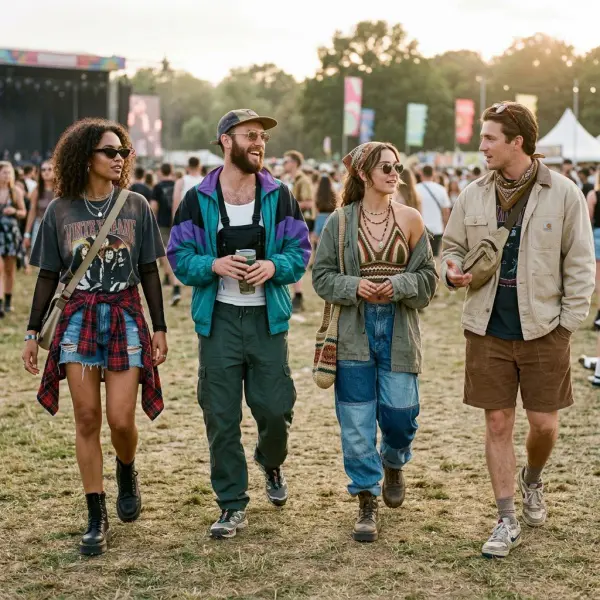
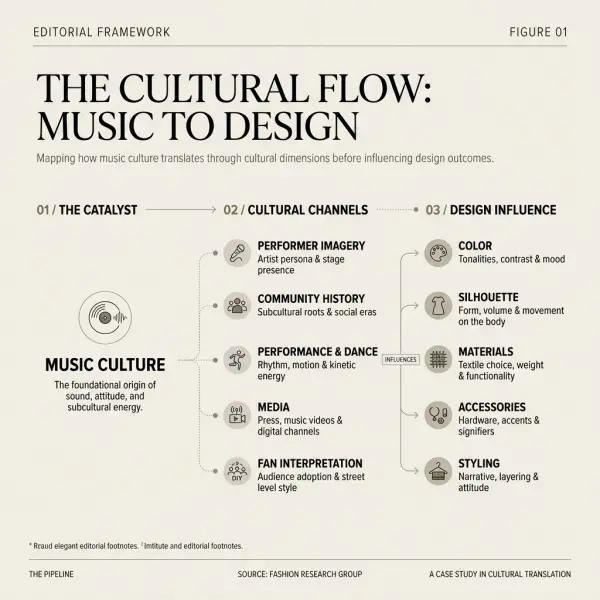
Music influences event fashion indirectly through culture rather than literally through sound. The music itself does not prescribe a garment shape or color palette; instead, performers, fans, historic subcultures, visual media, dance behavior, venues, album imagery, merchandise, and repeated community conventions create associations that can become recognizable over time.
A 2024 study published in the Journal of the Korean Society of Clothing and Textiles analyzed fashion associated with rock, EDM, hip-hop, and jazz festivals between 2019 and 2023. The research concluded that music and festival fashion showed significant relevance in how they communicated emotion and taste, created community belonging, and conveyed cultural meaning.
That finding is useful because it avoids an overly simple interpretation of influence. Music does not merely produce a corresponding “look.” Rather, fashion and music operate as separate expressive systems that can communicate related meanings.
In practice, those meanings become visible through choices such as:
- color intensity and contrast;
- loose, fitted, oversized, cropped, or layered silhouettes;
- proportions between tops and bottoms;
- material combinations;
- footwear;
- jewelry and accessories;
- artist or band merchandise;
- customization;
- makeup and hair;
- styling references to earlier musical eras.
The relationship is therefore better understood as a visual vocabulary than as a uniform.
Music Genre Creates References, Not Dress Codes
Genre is one of the strongest influences on event styling, but it should be treated as a cultural reference rather than a fixed dress code.
Different musical communities accumulate visual histories. Those histories may come from performers, youth cultures, nightlife, geographic scenes, political movements, dance practices, sporting influences, working-class clothing, luxury fashion, or earlier generations of fans.
Punk offers a particularly clear historical example. The Metropolitan Museum of Art's PUNK: Chaos to Couture exhibition documented how punk's visual language included do-it-yourself practices, hardware, bricolage, graffiti, agitprop, and deliberately distressed or reconstructed clothing. Those ideas later moved far beyond the original punk scene and influenced both ready-to-wear and couture.
Hip-hop provides a different trajectory. The Museum at FIT documents how hip-hop communities developed and popularized combinations involving outerwear, denim, athletic clothing, sneakers, jewelry, luxury references, customization, and distinctive proportion. The museum also emphasizes that reducing hip-hop style to oversized T-shirts, baggy jeans, and “bling” would ignore decades of regional variation, experimentation, female styling, aspirational fashion, and reinterpretation.
These examples demonstrate why product teams should study cultural lineage rather than copy a surface aesthetic.
How Music Events Influence Color Choices
Color at music events is shaped by a combination of cultural association, visual contrast, performer imagery, season, environment, and wider fashion trends. It should not be assumed that each genre has a permanent palette.
Certain associations nevertheless become strong enough to function as visual shorthand.
Black has long appeared across many rock, punk, metal, and alternative scenes, for example, but its meaning varies. It may connect with band merchandise, leather, rebellion, practicality, historical subcultural codes, or simply individual preference. Research into heavy-rock festival participation has found that dress can help attendees transition into a temporary festival identity while simultaneously conforming to recognizable group codes.
In some electronic music environments, brighter colors, reflective surfaces, transparency, luminous effects, graphic contrast, or highly saturated accessories can work effectively because attendees are participating in a visually intensive environment with stage lighting, darkness, movement, and spectacle. That pattern is not universal to electronic music, however. Minimal techno, house, commercial EDM, rave cultures, and large destination festivals can have substantially different aesthetics.
Color may also come directly from a performer or era. A tour whose artwork repeatedly uses one strong palette can encourage fans to adopt related colors. Album visuals, stage costumes, lighting design, and promotional imagery can make those references more recognizable.
The important business distinction is between color as cultural signal and color as seasonal trend. They can overlap, but they are not the same.
Why Brands Should Avoid “Genre = Color” Formulas
A formula such as “rock equals black” or “EDM equals neon” may simplify merchandising, but it also risks producing generic products.
A more useful approach is to examine four layers simultaneously:
- Genre history: Which colors have recurring associations with the wider culture?
- Current performer imagery: Are important artists introducing a different visual direction?
- Event environment: Will daytime heat, nighttime lighting, dust, rain, or indoor conditions affect the palette?
- Current fashion market: Which colors already have momentum in broader apparel and accessories?
When several layers align, a color direction may feel especially credible. When they conflict, forcing a conventional genre palette can make the assortment look dated.
Silhouette Often Reveals More Than Color
Silhouette can be a stronger cultural signal than color because it changes the way the entire body appears.
Oversized outerwear, wide trousers, cropped tops, fitted leather, flowing dresses, short bottoms, long skirts, workwear shapes, sports jerseys, tailoring, or layered technical garments each create very different relationships between the wearer, the music culture, and the surrounding crowd.
Hip-hop demonstrates how influential proportion can become. The Museum at FIT notes the importance of inventive proportion, outerwear, denim, sportswear, and customization across hip-hop's history, while also emphasizing substantial variation by period, location, performer, and gender.
Punk developed different visual strategies. Reconstruction, hardware, torn or distressed surfaces, narrow or exaggerated shapes, and DIY intervention became more important than adherence to conventional polish. The Met's documentation of punk shows how these methods later became design resources for fashion houses far removed from their original cultural context.
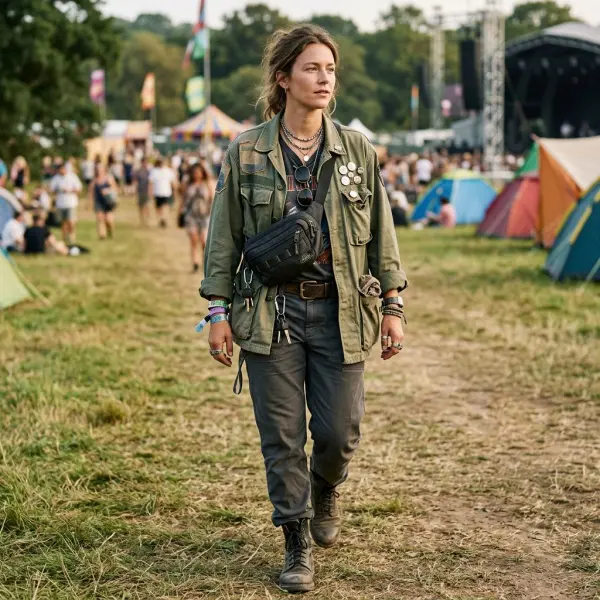
Silhouette also responds to practical movement. A person dancing for several hours has different requirements from someone seated in an arena. Outdoor festivals may encourage layering because temperatures change between afternoon and night, while a compact indoor venue can reward lighter, simpler dressing.
This is where music and physical event design intersect.
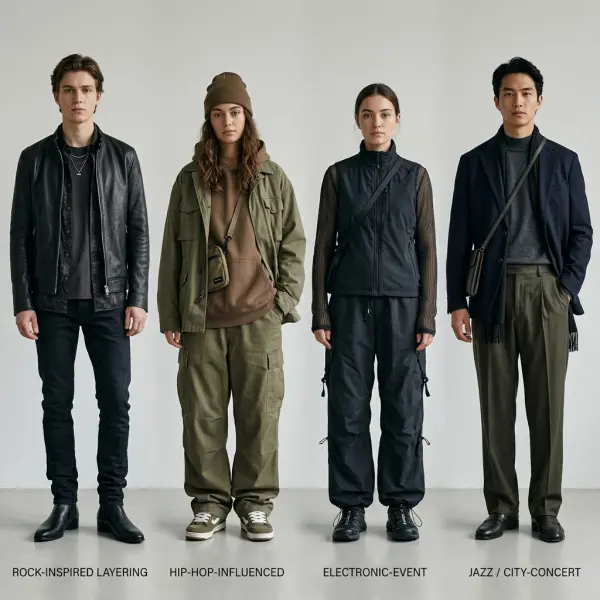
Movement Changes What a Good Silhouette Means
A music-event outfit is not experienced while standing still in a studio.
People walk between stages, queue, dance, sit on grass, use public transport, move through crowds, carry bags, deal with temperature changes, and sometimes remain in the same clothing for ten or more hours. Those conditions can determine whether an expressive silhouette remains enjoyable after the first photograph.
This creates a product-development tension between visual volume and physical manageability.
Wide trousers can communicate relaxed proportion but may become difficult in mud or crowded environments. Dramatic sleeves may look compelling but interfere with movement. Long hems can create problems outdoors. Very fitted garments may become uncomfortable during extended periods of heat and activity.
Fashion teams therefore need to evaluate silhouette in motion rather than through static imagery alone.
For festival-focused products, fit testing can include walking, sitting, reaching, dancing, bag carrying, and layering. These tests are simple, but they often reveal problems that mood-board development misses.
Performers Can Accelerate Styling Codes
Performers occupy a disproportionately visible position in music fashion because their clothing is repeated through stage photography, video clips, fan accounts, press coverage, merchandise, and social media.
A stage look can therefore create a powerful reference without becoming a direct replica.
Fans may adopt one small element: a boot shape, hat, jersey, color, jewelry treatment, makeup direction, or proportion. Others may reproduce a complete performer-inspired look. Still others deliberately avoid imitation while remaining within the broader aesthetic environment.
This is an important distinction for fashion brands. Cultural influence often works through translation, not duplication.
A literal copy may have limited commercial life. An adaptable interpretation can travel further because consumers can integrate it into their existing wardrobes.
The strongest influence also tends to come from repetition. One unusual costume may attract attention; a consistent visual identity across an album campaign, performances, videos, merchandise, and touring can create a more recognizable fashion code.
For brands watching music culture, recurrence is usually more meaningful than a single viral outfit.
Styling Choices Carry the Cultural Detail
Color and silhouette create the broad visual impression, but styling often determines whether the outfit feels connected to a music community.
Two people can wear almost identical jeans and T-shirts yet communicate very different references through footwear, jewelry, belts, headwear, bags, makeup, layering, garment modification, and the way clothing is worn.
Hip-hop history illustrates this particularly well. The Museum at FIT describes customization and individualization as central elements of hip-hop style, including ways dancers adjusted jeans and shoelaces, artists used jewelry and outerwear, and designers remixed luxury imagery with new silhouettes.
Punk developed its own styling language through safety pins, chains, hardware, DIY graphics, reconstructed garments, distressed surfaces, and deliberately unconventional combinations.
At electronic festivals, accessories can also become part of participation rather than decoration alone. Research on Tomorrowland specifically examined the role of flags, costumes, accessories, and other material possessions in constructing private and collective identities among festivalgoers.
The commercial implication is important: accessories can provide customers with a relatively low-commitment way to enter an event aesthetic without replacing an entire wardrobe.
Fashion Influence Moves in More Than One Direction
It is tempting to imagine a simple sequence:
musician → fan → mainstream fashion
The reality is more circular.
Performers borrow from existing street cultures, designers, vintage clothing, sports, workwear, nightlife, and previous music generations. Fans reinterpret performers. Stylists introduce fashion references to artists. Designers observe subcultures. Social media accelerates certain looks. Retail then packages some of those visual signals for broader consumers.
Hip-hop is an especially well-documented example of this reciprocal process. The Museum at FIT notes that styles developed within hip-hop communities—including streetwear, athletic references, logo use, customization, and luxury reinterpretation—later became deeply embedded in mainstream fashion.
Punk followed another path from underground DIY culture into high fashion. The Met specifically designed PUNK: Chaos to Couture to examine how couture and ready-to-wear borrowed punk's visual symbols and techniques.
Music-event fashion should therefore not be treated merely as a downstream response to musicians. Events are spaces where multiple visual influences meet, become visible together, and are redistributed.
The Venue Can Override the Genre
Genre may establish cultural expectations, but the event environment can change how those expectations are expressed.
An outdoor desert festival, muddy rural field, stadium tour, warehouse rave, jazz club, urban park, beachfront event, and arena concert each creates different practical conditions.
The same fan might interpret one artist differently depending on the venue.
At an outdoor event, breathable layers, sun protection, comfortable footwear, and practical bags may become priorities. At a nighttime indoor show, heavier fabrics, outerwear, dramatic makeup, or less weather-sensitive footwear may be more manageable.
This is why event-based merchandising should combine cultural research with physical-context research.
Contemporary Coachella provides a useful example of how multiple influences can coexist. Vogue's 2026 coverage described bohemian references alongside vintage, DIY, Americana, practical footwear, and more individual styling, demonstrating that even one highly visible festival cannot be reduced to a single aesthetic.
The event creates boundaries, but attendees still negotiate within them.
How Social Media Changes Event Styling
Music-event style once circulated primarily through concerts, magazines, music television, fan communities, street photography, and word of mouth. Contemporary social platforms accelerate that process.
A styling detail photographed in the afternoon can circulate globally before the headline act performs that evening.
This speed increases visibility but also creates noise.
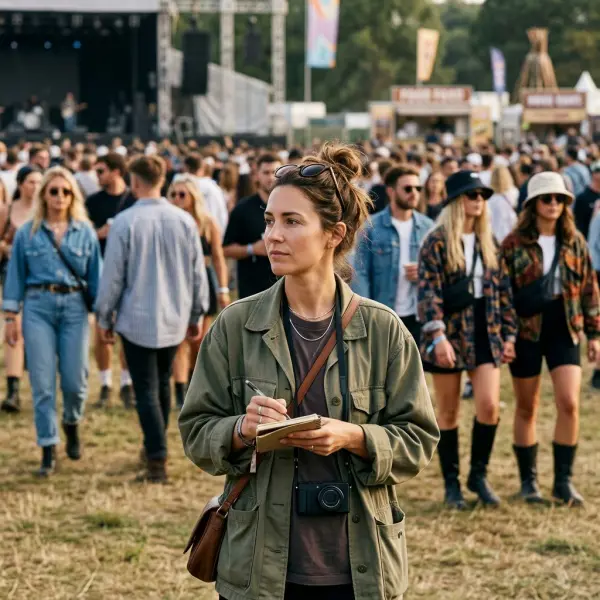
A striking outfit may receive disproportionate coverage because it photographs well, not because most attendees are dressing that way. Celebrity and influencer images can similarly create the impression that an exceptional look represents the event as a whole.
Brands should therefore distinguish between visual salience and actual adoption.
Repeated appearance across ordinary attendees is often a stronger behavioral signal than a small number of heavily photographed celebrity looks. Retail search behavior, product sales, social saves, creator content, resale listings, and repeated street-style observations can provide additional context.
This distinction becomes even more important when assessing whether an event look can become a wider commercial trend.
Music Event Influence vs Broader Fashion Trends
Not every fashion element visible at a festival comes from music culture.
Consumers arrive at events already influenced by seasonal collections, street style, celebrities, social platforms, vintage markets, weather, sportswear, workwear, luxury brands, and everyday retail.
Music events often reorganize those existing influences rather than create them from nothing.
For example, if wide-leg trousers are already commercially strong, attendees may adopt them in event styling because the silhouette is familiar and accessible. A performer wearing the same proportion can strengthen the association, but that does not prove the musical event caused the trend.
A practical distinction for brands is:
|
Signal |
Likely interpretation |
|
Appears mainly around one performer |
Artist-specific styling code |
|
Appears repeatedly within one genre community |
Possible subcultural or genre-linked code |
|
Appears across unrelated festivals and mainstream retail |
Broader fashion trend |
|
Appears mainly because of climate or venue rules |
Functional event adaptation |
|
Appears briefly in celebrity coverage |
Visibility signal, not necessarily adoption |
|
Persists across several seasons and channels |
Stronger evidence of lifestyle crossover |
This framework helps prevent fashion teams from overreacting to event photography.
How Fashion Businesses Can Use Music-Event Signals
The most useful approach is to translate music-event observations into product and merchandising decisions without assuming every visible look deserves a collection.
Teams can begin with structured observation.
Instead of simply saving attractive photographs, record which elements repeat: proportion, dominant garments, footwear, color families, layering, accessories, customization, materials, and artist references.
Then separate those observations by source.
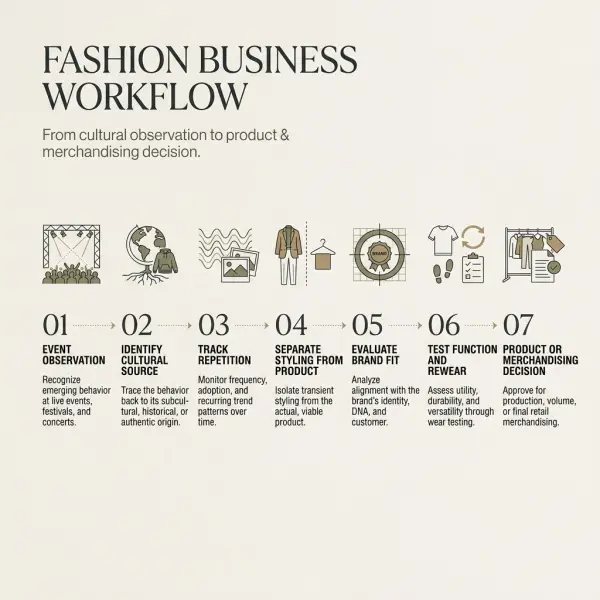
A practical workflow is:
- Identify the cultural source. Determine whether the signal is linked primarily to a genre, performer, fan community, wider fashion movement, or event setting.
- Measure repetition. Look for the same idea across multiple people, events, content sources, or seasons.
- Separate styling from product. An unusual styling combination does not necessarily imply demand for a new garment.
- Evaluate commercial translation. Ask whether the reference can fit the brand's customer, price architecture, production capability, and existing assortment.
- Test rewear potential. Determine whether the product works outside the event unless deliberate novelty is part of the business model.
- Check cultural context. Avoid extracting symbols from music communities without understanding their origin and meaning.
- Validate function. Make sure footwear, bags, silhouettes, closures, materials, and layers make sense in the physical event environment.
The objective is not to reproduce music culture faster than competitors. It is to identify where a cultural signal genuinely overlaps with the brand.
Product Development Implications
Music-event influence can affect product development at several levels.
Color teams may identify a palette associated with a tour, genre revival, or event environment. Designers may notice repeated proportions or garment categories. Merchandisers may see accessories as the easiest point of entry. Content teams may find that existing products can be styled differently rather than redesigned.
Not every observation requires manufacturing something new.
In many cases, the fastest and lowest-risk response is merchandising. A retailer can regroup existing denim, boots, jerseys, accessories, outerwear, or lightweight layers into an event edit and test customer interest before committing to new inventory.
A dedicated capsule becomes more defensible when the signal is persistent, clearly aligned with the brand, and difficult to serve using existing products.
For manufacturers, technical implications may include:
- modifying fit for greater movement;
- reinforcing closures or pockets;
- choosing materials appropriate for heat or layering;
- controlling embellishment weight;
- testing trims against extended wear;
- considering washable finishes for outdoor use;
- maintaining sizing consistency when silhouettes become more exaggerated.
This operational layer matters because a visual reference only becomes a successful fashion product when it can be manufactured, priced, worn, and sold effectively.
Common Mistakes When Translating Music Into Fashion
Mistake 1: Treating Genre Stereotypes as Consumer Research
Using a handful of familiar images to define an entire music audience can produce shallow design. Hip-hop, rock, jazz, electronic music, pop, and country each contain numerous subgenres, regional scenes, generations, and overlapping communities. Research should therefore examine the actual event, artists, customer base, and current audience rather than relying on inherited visual stereotypes.
Mistake 2: Copying the Performer Too Literally
A stage outfit is designed for visibility, performance, photography, and artistic storytelling. Those requirements are not identical to everyday apparel or even attendee clothing. Translating one proportion, color combination, material, or accessory can be commercially useful; reproducing a costume without adaptation may produce a product that customers admire but rarely wear.
Mistake 3: Assuming the Most Photographed Look Is the Dominant Look
Street-style galleries and social media naturally favor clothing that is visually distinctive. This creates selection bias. Before building inventory around an apparent trend, brands should look for repetition across ordinary attendees, multiple events, retail behavior, search patterns, and subsequent styling rather than relying solely on high-engagement images.
Mistake 4: Ignoring Movement and Venue Conditions
A silhouette can look convincing on a model while becoming impractical in a real concert environment. Designers should test how the garment performs while walking, sitting, dancing, layering, carrying a bag, and dealing with weather. Event functionality does not need to eliminate visual expression, but it should influence construction.
Mistake 5: Removing Cultural Context From the Reference
Some fashion codes have histories tied to specific communities, race, class, geography, politics, or subcultures. Hip-hop and punk are clear examples of visual cultures that later entered mainstream and luxury fashion. Treating those references as anonymous decoration can flatten their meaning and create reputational risk. Good design research includes provenance as well as aesthetics.
What Brands Should Verify Before Acting
Before translating a music-event signal into product, brands should verify where the signal actually comes from.
Is it specific to one artist? Does it belong to a longer genre history? Is it a mainstream fashion trend appearing inside a festival? Is it practical adaptation to climate or venue conditions? Or is it simply a highly visible image being repeated online?
These categories require different responses.
An artist-specific signal may be more suitable for a collaboration or content moment. A persistent genre code may support longer-term merchandising. A mainstream trend may already belong in the core assortment. Functional adaptation may call for product engineering rather than aesthetic change.
Brands should also verify whether they have the legitimacy to use the reference. Cultural familiarity matters when working with visual codes rooted in communities that the brand has little connection to.
Finally, teams should determine whether the opportunity lies in product, styling, merchandising, or communication. Creating new inventory should not be the default response to every cultural signal.
Why Music Events Are Powerful Fashion Laboratories
Music events bring together unusually dense visual information.
Thousands of people interpret similar cultural references at the same time, but through different wardrobes, budgets, body types, geographic backgrounds, and personal tastes. Performers contribute one layer, fans contribute another, while retailers, sponsors, vintage sellers, stylists, and creators add additional influences.
That makes festivals and concerts useful observational environments for fashion teams.
They reveal which styling ideas people are willing to wear outside controlled editorial settings. They also show how an aesthetic changes when it encounters movement, weather, crowd behavior, practical footwear, bags, layering, and ordinary consumer wardrobes.
The most valuable signal is therefore not necessarily the most dramatic outfit.
Often, it is the repeated small adjustment—a change in proportion, a recurring accessory, a specific type of layering, a revived footwear shape, or a new way of combining familiar garments—that indicates a visual idea is becoming easier for consumers to adopt.
Music Influence Should Be Read as a System
Color, silhouette, and styling are rarely influenced independently.
A wider trouser silhouette may become culturally meaningful because it appears with specific footwear, outerwear, jewelry, graphics, and performer references. A black palette may communicate something entirely different when combined with tailoring than when combined with distressed denim and hardware.
The full styling system therefore matters more than one isolated feature.
For fashion businesses, a useful interpretation model is:
Music culture → visual references → attendee interpretation → repeated styling behavior → wider visibility → possible commercial adoption
Not every signal travels through the entire sequence.
Some remain local to a fan community. Some disappear after one tour. Some become mainstream fashion. Others return decades later through nostalgia or reinterpretation.
This uncertainty is normal. Fashion research is not about predicting every outcome correctly; it is about distinguishing strong signals from superficial ones and making proportionate business decisions.
The broader role of festival fashion as identity and lifestyle behavior is explored in Festival Fashion Explained as a Lifestyle and Self-Expression Trend. The reason unusually bold looks can become more acceptable and visible within these environments is examined further in Why Statement Dressing Becomes Stronger in Event-Based Fashion Culture.
Frequently Asked Questions
Does music genre determine what people wear to concerts?
No. Music genre can provide recognizable cultural references, but individual attendees still interpret them through personal style, climate, venue, budget, age, local fashion culture, and wider trends. Academic research comparing several music-festival genres supports a relationship between music and fashion expression, but not the idea of one mandatory outfit for each genre. For brands, genre should therefore function as contextual research rather than a rigid design formula.
Why do performers have so much influence on concert fashion?
Performers occupy a highly visible position and repeat their image across stages, music videos, album artwork, social media, press photography, and merchandise. That repetition can make particular colors, garments, proportions, or accessories recognizable to fans. Consumers do not necessarily copy the entire look; influence often happens through selective adoption. A recognizable pair of boots, hat, jewelry treatment, jersey, or silhouette can travel more easily into everyday wardrobes than a complete stage costume.
Are some colors naturally associated with certain music genres?
Associations exist, but they are cultural rather than natural. Black has strong historical visibility in several rock and alternative communities, while high-saturation or reflective colors may appear in some electronic-event environments. These relationships change across subgenres, generations, locations, performers, and broader fashion cycles. Brands should study the specific audience and event instead of assuming that a permanent color palette belongs to an entire genre.
How can brands tell whether festival styling is becoming a real trend?
Repetition across several signals is more useful than one viral photograph. Brands can examine whether similar silhouettes, garments, colors, or accessories appear across multiple events, ordinary attendees, creators, retail assortments, resale listings, search behavior, and subsequent seasons. A trend becomes more commercially meaningful when the idea travels beyond one performer or one event and customers begin incorporating it into ordinary wardrobe behavior.
Should brands create new products for every major music trend?
Usually not. Styling and merchandising can often respond faster and with less inventory risk. Existing denim, footwear, outerwear, accessories, jerseys, dresses, or layering pieces may become relevant when presented differently. New product development is more justified when the signal is persistent, fits the brand's customer and positioning, requires a product not already available, and offers enough demand to justify development, sourcing, minimum order quantities, and inventory exposure.
What is the difference between performer fashion and attendee fashion?
Performer fashion is often optimized for stage visibility, artistic narrative, photography, lighting, choreography, and entertainment. Attendee fashion has to function within the physical experience of watching the event—walking, standing, dancing, carrying belongings, dealing with weather, and remaining comfortable for long periods. The two influence each other, but brands should not assume that a successful stage costume can be transferred directly into consumer product without modification.
Can older music aesthetics become relevant again?
Yes. Music culture repeatedly revisits earlier decades, and fashion can return with those revivals. However, revived aesthetics are usually reinterpreted rather than reproduced exactly. New materials, contemporary fit expectations, social media, current footwear, gender expression, and broader fashion cycles can change how an older reference appears. Brands should identify which part of the original visual language is actually returning instead of recreating an entire historical look indiscriminately.
Conclusion
Music events influence fashion because they bring sound, community, performers, visual culture, movement, and physical environment into the same space.
The result is not a simple set of genre uniforms. Color, silhouette, proportion, accessories, materials, and styling emerge from a much more complicated exchange between musical history, performer imagery, fan interpretation, practical conditions, and wider fashion trends.
Punk demonstrates how DIY techniques and anti-establishment visual codes can migrate into high fashion. Hip-hop shows how proportion, sportswear, customization, jewelry, outerwear, and luxury references can move from community practice into global fashion. Contemporary festivals demonstrate how older references can coexist with new styling, functional requirements, and digital visibility.
For fashion businesses, the useful skill is therefore not copying what people wear at concerts. It is learning how to read the system behind those choices.
A recurring silhouette may reveal changing ideas about proportion. An accessory may signal cultural affiliation. A color may originate in performer imagery. A garment combination may simply solve an environmental problem. Understanding those differences helps product, merchandising, and marketing teams decide which signals deserve action—and which are better observed rather than manufactured.





Comments 0
Leave a CommentSend Comment
Anda harus Login terlebih dahulu untuk dapat memberikan komentar.